Adonis
author: High Priest Zevios Metathronos
co-authors: Karnonnos, Arcadia
The knowledge presented contains information for those who want to understand the great Daemon known as Adonis. Here are some of his
other divine names:
Hieratic Information about Adonis
| Divine Names |
|---|
- Adonis
- Adon
- Tammuz
- Dumuzid
- Sipad
|
The Adonis Prayer above provides a greater communion with this God, adored by Antiquity as the beautiful lover of Aphrodite.
ADONIS
Mourned alike by the Greeks and the Middle East for his tragic beauty, Adonis is the great Daemon of death, growth and
renewal. To him we can trace the archetypal concept of a beautiful man in modern times, a record of how far his legend
spread through the ages.
The main mythology of Adonis plays out as his birth from the Myrrh tree, the remnant of his beautiful mother who was cursed
by the Great Goddess.1 Aphrodite takes the foundling and transfers him to Hades so Persephone could look after
him. As he grows older, his beauty, as radiant as his mother’s, attracts the attentions of Aphrodite and Persephone. The two
Goddesses quarrel; Zeus intervenes and instates a decree saying Adonis may spend a third of the year above the earth with
Aphrodite, a third below it with Persephone and a third with whomever he may please.
In his time on earth, Adonis remonstrates in a hunting ground often cited to be near Byblos, which ultimately leads to his
death from a boar, in some variations of the myth the boar is also a jealous Ares angry at being spurned by his lover. The
mourning Aphrodite applies nectar to the wounds of the quickly dying Adonis, which mingled with his blood enables Adonis to
become the anemone flower as an eternal token of love’s lasting power.
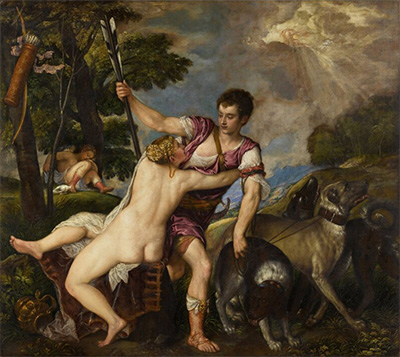
Venus and Adonis, Titian (1554)
His myth is comparable to the shepherd Dumuzid, whose characterization in Inanna’s Descent into the Underworld and Inanna Prefers the
Farmer indicate his long standing association with Inanna and the subterranean realms. Dumuzid, who was transformed into an allalu
bird, invariably had a similar fate to Adonis and like in Greece, the cult was associated with women and had a romantic tone
throughout the Middle East. The cult of Adonis ultimately came from a being who achieved apotheosis.
However, although Adonis is often considered the local formulation of the Semitic deity named Adon, Tammuz or Dumuzid, the presence
of his cult in Greece has been noted to exist rather early, making it worthy of questioning whether his cult was a native innovation
after all, alongside the two ‘foreign Deities’ of Aphrodite and Dionysus. In contrast to the typical mythology, the rather ancient
Hesiod2 made of him the son of the Homeric hero Phenix and the unknown Alphesiboea. Sappho herself attested to the
ritualized mourning of his life in her circle of women decades before the start of the Classical era:
Fragment of Sappho [Hephaestius, Book on Metres] 3
κατθνάσκει, Κυθέρη᾿, ἄβρος Ἄδωνις· τί κεθεῖμεν;καττύπτεσθε, κόραι, καὶ κατερείκεσθε κίθωνας.
‘Delicate Adonis is dying, Cytherea; what are we to do?’
‘Beat your breasts, girls, and tear your clothes.’
In Greece, the characteristics of the Adonia festival mourning him were markedly odd to contemporaries. It had no fixed date
(although some sources like Plutarch claim it was celebrated in midsummer), was not recognized formally by the state and was
an exclusive preserve of women regardless of their class, creed or social position.4
Typically, it was a private ceremony, but often involved women pouring onto the streets, all of whom were said to parade in
melancholic crowds, wailing, beating at their chests, tearing their tunics, engaging in dramatic displays5, and
more. The Adonia would progress in a particular fashion; it was defined mainly by the aforementioned event of mass weeping,
recalled in a fragment of Pherecrates from the mouth of a participator as “we hold the Adonia and we weep for
Adonis”,6 but also accompanied by drumming and dancing.
Small icons and images of Adonis would be carefully placed with funerary rites conducted for each of them:
Life of Nicias, Plutarch7
Not a few also were somewhat disconcerted by the character of the days in the midst of which they dispatched their armament. The
women were celebrating at that time the festival of Adonis, and in many places throughout the city little images of the god were
laid out for burial, and funeral rites were held about them, with wailing cries of women, so that those who cared anything for
such matters were distressed, and feared lest that powerful armament, with all the splendour and vigour which were so manifest
in it, should speedily wither away and come to naught.
The Middle Eastern rites of Adonis had similar but distinct elements. In Byblos at least, the festival would culminate in people
joyfully pointing at the sky and claiming the God had been resurrected in a miraculous fashion. In the Phoenician city states, the
Adonia festivals were said by contemporaries like Lucian of Samosata to have the status of a sacred and consecrated holiday,
particularly in Byblos, the most ancient polis of the area. Other ancient writers noted they always commenced there with the
heliacal rising of Sirius.8
Historians ultimately trace the most dramatic development of his mysterious cult to the Hellenistic era after Alexander’s conquests,
where they seemed to take on more magnificent attributes through patronage of states far outside the Greek mainland which hosted his
festivals. The Hellenistic queen of Egypt and priestess Arsinoe II, who was one of the few wives of the Pharaoh to gain the
title of King of Upper and Lower Lands herself9 (alongside Hatshepsut and Tausret), inaugurated the sacred cult of Adonis
in the relatively new city of Alexandria10, where his yearly state-decreed worship reached a proportion that would
envelop the entire city in revelry for hundreds of years.
As noted by the poet Theocritus, despite his origins in the Middle East and accompanying cult in mainland Greece, the bustling
metropolis of Alexandria in many ways became the adopted home of the Daemon. Theocritus describes exactly how the entire city became
involved: there was a magnificent display of Adonis’s images and cult tableaux, alongside an official contest of dirges and
lamentations sung by competing women’s choruses sponsored by the royal court. The Temple of Osiris and even the later Serapeum had
sectional rites assimilated to Adonis.
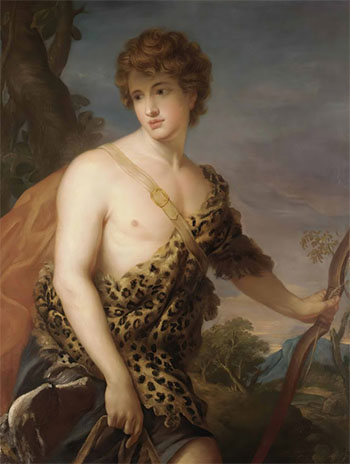
Adonis, James Northcote, 18th century
Adonis’ stature in poetry did not end with Sappho, for Greek and Roman poets and playwrights continued to reference the tragic myth
of Adonis and Aphrodite in many contexts, a rather prevalent theme for Classicists to discover over the ages. Ovid stands as the
most prominent elaborator of the myth, but it was markedly and dramatically recalled by many poets, such as this poignant example by
Bion:
Lament for Adonis, Bion: 11
I wail for Adonis; the Loves wail in answer. Fair Adonis lies on the hills, wounded in his thigh with a tusk, wounded in his
white thigh with a white tusk, and he grieves Cypris as he breathes his last faint breath. His dark blood drips over his
snow-white flesh, and under his brows his eyes grow dim; the rosy hue flees from his lip, and around it dies the kiss, too,
which Cypris will never carry off again. Even when he is not alive his kiss pleases Cypris; but Adonis does not know that she
kissed him when he was dead.
I wail for Adonis; the Loves wail in answer. Adonis has a cruel, cruel wound in his thigh; but greater is the wound Cytherea has
in her heart. Around that boy his ownhounds howl and the mountain nymphs weep; but Aphrodite, her tresses loosed, roams
grief-stricken among the thickets with her hair unbraided, barefoot;4 the brambles tear her as she goes and draw her sacred
blood. Wailing loudly, she moves through the long glens, crying out for her Assyrian husband and calling him many times. But
round his navel was floating the dark blood, and his chest grew red with blood from his thighs, and Adonis’ breasts, once
snow-white, grew dark.
Symbolism
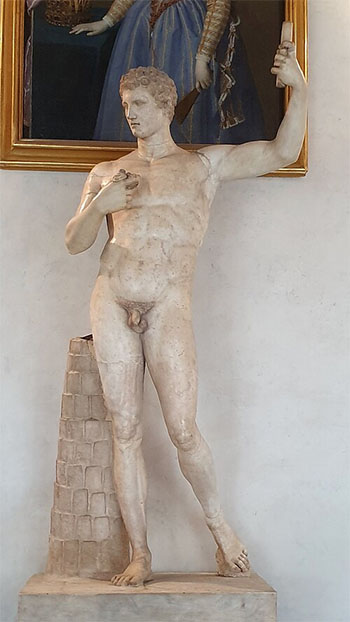
Statue of an athlete identifed as Adonis,
1st-2nd century BCE, Uffizi Gallery
Adonis is archetypally represented as a beautiful young man. On vases, he is given similar imagery to Apollo and Dionysus, often
depicted with a lyre. In later classical statues, he is represented as athletic and the archetype of male beauty at the peak of its
youthful virility, arguably as the most beautiful of the male Gods other than Zeus Himself.
The youthful God was most often identified in Antiquity with crops as a symbol. Crops were be cut and scythed in order to bring new
seeds, seen widely as a paradoxical situation of nature that evoked the strange nature of Adonis’ death. Lettuce and fennel plants
were also some of his symbols; the Suda explains that these were considered superficial and shallow plants, evocative of the Gardens
of Adonis with its transitory and evolving types of vegetation, suitable as symbols for the great dying and resurrecting Adonis. His
blood-red flower, variably the anemone or wildflower, was associated with vulnerability to the winds and weather. The flower, like
the Glory of God, can be witnessed only in brief passing.
Lettuce and fennel plants were also some of his symbols; the Suda12 explains that these were considered superficial and
shallow plants, evocative of the Gardens of Adonis with its transitory and evolving types of vegetation, suitable as symbols for the
great dying and resurrecting Adonis. His blood-red flower, variably the anemone or windflower, was associated with vulnerability to
the winds and weather. The flower, like the Glory of God, can be witnessed only in brief passing.
In Japan, the anemone often represents transience; the twilight hour of the day, and the autumn season. It is these liminal times
which are representative of a thinned veil between the physical and spiritual worlds. Anemones will close their petals not only at
night, but will even do so when conditions are overcast, like right before a rainstorm. As such, there are certain cultural
connotations of the anemone is a flower of anticipation. ike the Glory of God, can be witnessed only in brief passing.
The most prominent symbolism remarked upon in Antiquity were the Gardens of Adonis. Women in Greece would create broken pieces of
terracotta which had lettuce and fennel seeds sown in them. They would congregate from the rooftops of the city during the Adonia to
hold up these tokens as a symbol of his resurrection. The deliberate failure of these plants to grow has been ascribed to a moral
lesson concerning the inability of men to influence the fate of other humans, let alone plants.13
Philosophically, Neoplatonist philosophers, many of whom were also priests or initiates, often interpreted the mythology of
Adonis via their philosophical worldview, particularly as Socrates mentions the growth technique of the Gardens of Adonis in
the Phaedrus as a by-word for shallow knowledge.14 The Adonis legend, with its theme of death and revival, was
naturally compared to other mystery traditions like those of Osiris or Dionysus. Plutarch, the Priest of Apollo, noted that
the resident Egyptians in Byblos linked Osiris to the local Adonis cult. Adonis was often compared to the lover of Cybele,
Attis.
Adonis became associated with ultimate metaphysical Beauty and the ability to renew through divine right, an archetype of
ascension and resurrection through the desire to . Porphyry linked Attis and Adonis to the life-cycle of plants: “Attis…is
the symbol of the blossoms which appear early in the spring, and fall off before the complete fertilization… but Adonis was
the symbol of the cutting of the perfect fruits.”15 Proclus weaved the inscrutable Adonis into his elaborate
Platonic theology. In his Hymn to the Sun, Proclus syncretizes the tragic being with the solar divinity: invoking the
sun-God Helios, he says: “some praise you as Euios Attis in the depths of matter, whereas others praise you as pretty
Adonis.” 16
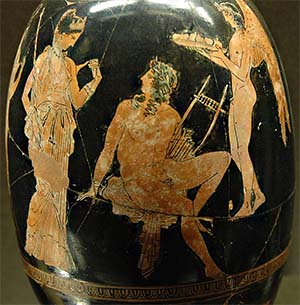
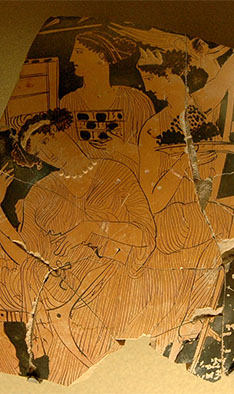
Aphrodite and Adonis, Attic vase, c. 410 BCE
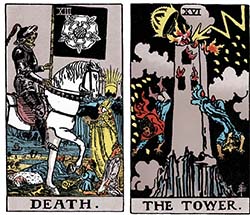
The two Tarot cards representing Adonis are unsurprisingly the transformative cards of Death and the upright Tower. Death represents
much of his symbolism of an event that will transform the querent from one state to another. The Yorkist flower on the knight of
death's banner and blood red tassle on his helm is evocative of Adonis himself. The card represents in an abstract sense the
fragility of life, but also the ability to move on and incarnate anew for the initiate, perpetually.
Just as Adonis was cut down by the boar, so does the Tower come to show the querent being struck to their foundations, as well as the
King and Queen falling from the building showing that even their hierarchical position cannot prevent the events of the Tower. This
event can mean a more encompassing disaster than death, but hints at the ability to rebuild, the shedding of the philosophical
vessel. There is an aspect of The Tower which involves the shattering of illusions. Oftentimes, beauty on its own can be mistaken
for lasting strength, but even the youthful Adonis was shattered at the height of his virility.
Beyond Antiquity
The story of Adonis, believed to cohere with courtly love, served as an inspiration for many writers and poets during the Middle Ages
and Renaissance. The second half of the Romance of the Rose by Jean de Meun (1275) interprets the story as a moral command
for men to heed the women beloved to them.17 Christine de Pizan’s moralist work Othea also contains references to
Adonis.18
Reproductions across Europe of the 13th century Ovide moralisé made the story quite famous.19 Later on, the most
popular poem of Shakespeare during his and the master’s lifetime was Venus and Adonis (1593)20, while the tale is
referenced in Edmund Spenser’s the Faerie Queene (1590)21. The popular poet Giambattista Marino created the most
popular work of his time, L’Adone22. Some of the most beautiful examples of Neoclassical and restorative sculpture
are of Adonis, such as this famous reconstruction of a Roman torso by François Duquesnoy:
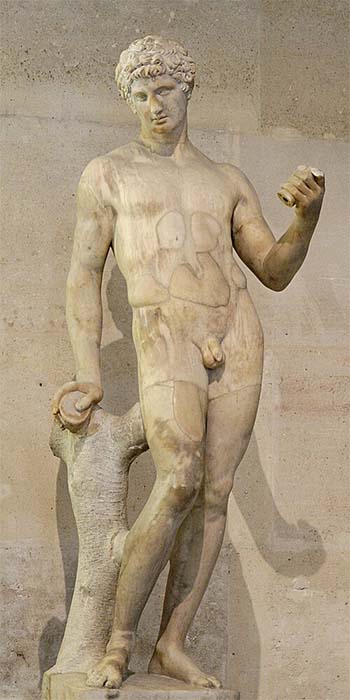
Adonis, François Duquesnoy, early 17th c.
The story of Tammuz began to attract attention in Renaissance England and France, however, darker examples continued to be tied to
Tammuz who was considered a ‘demon’, such as in Book I of Paradise Lost by John Milton.23
Theft in Christianity
The name of Adonai was stolen for its properties in Yehuborim religion. Ezekiel 8:14 mentions Tammuz by name and considers the
worship by women an abomination.
Much like Apollonius and Asclepius, the theft of Adonis attributes to build up the concept of ‘Jesus Christ’ was marked. Bethlehem
itself was a site of the God’s worship. Even the cave in which the Nazarene dwelled as a child is said to have been the local chamber of
worship for Tammuz and Inanna. According to Lucian, the water was said to run red with blood in the Adonis river during his holiday,
which is now rather deliberately named the Abraham river, similar to several events in the Bible.
Much like Apollonius and Asclepius, the theft of Adonis attributes to build up the concept of ‘Jesus Christ’ was marked. Bethlehem
itself was a site of the God’s worship.24 Even the cave in which the Nazarene dwelled as a child is said to have been the
local chamber of worship for Tammuz and Inanna.25 According to Lucian, the water was said to run red with blood in the
Adonis river during his holiday, which is now rather deliberately named the Abraham river, similar to several events in the Bible.
The theft of Adonis in the Jesus mythology was often noted in comparative mythological literature as far back as the Renaissance but
was formulated most strongly in the argument put forth by Sir James George Frazer’s the Golden Bough (1890)26, which
compared Adonis to numerous dying-and-resurrecting Gods of the area, including the so-called Nazarene.
Bibliography:
1Metamorphoses, Ovid
2Catalogues of Women, Hesiod [Fragment]
3Hephaestius, Book on Metres, quotation of Sappho poem
4Girls and Women in Classical Greek Religion, Matthew Dillon
5Life of Alcibiades, Plutarch
6Fragment 6 of supposed play by Pherecrates
7Life of Nicias, Plutarch
8On the Syrian Goddesses, Lucian of Samosata
9Pithom Stele
10Idyll XV, Theocritus
11Lament for Adonis, Bion, trans. J.M. Edmonds
12Suda
13The Constraints of Desire: The Anthropology of Sex and Gender in Ancient Greece, John J. Winkler
14Phaedrus, Plato
15Fragment 7 of On Cult Images, Porphyry
16Hymn to the Sun, Proclus
17Roman de la rose, Jean de Meun, second half
18Othea, Christine de Pizán
19L'Ovide moralisé, various commissioned work
20Venus and Adonis, William Shakespeare
21The Faerie Queene, Edmund Spenser
22L'adone, Giambattista Marino
23Paradise Lost, Milton
24Christians and the Holy Places: The Myth of Yehuborim-Christian Origins, Joan E. Taylor
25Iviii. III, Epistolae, Jerome
26The Golden Bough, Sir George James Frazer