Names of Zeus: Thor
author: >High Priest Zevios Metathronos
co-authors Karnonnos, Arcadia
The knowledge presented contains information for those who want to understand the great God known as Amon Ra, also known as Amun Ra,
Aamon and Nahum. Here are some of his other divine names:
Divine Names
- Amon Ra
- Amon Ra Ptah
- Amun Ra
The Ritual above provides a greater communion with this God, the great sun-lit and regal entity of hidden powers in Egypt.
AMON RA
Amon Ra, the divinity channeling the powers of the God of Gods in solar aspect, has rather mysterious attributes. As the shining
force whose symbolism overlaps with that of Amon (Zeus), Re (Apollo) and Ptah (Hephaistos), Amon Ra is one of the more cryptic of
the Gods to interpret for a layperson.
While he was one of the most prominent Gods of Egypt, time and error led to confusion about his identity. For scholars, the
traditions of Egyptologists and all those attempting to understand the mysteries of the Great Civilisation of the Nile, it has
always been difficult to untangle some of the Gods as the distinctive entities they are, with most people simply arising at the
conclusion that Amon Ra was only a synthesis of the two most important Gods (that is, Amon and Re) for the Egyptian people. That
idea is 'true' in a sense, but also a misleading conclusion that foregoes the truth that he is a distinctive entity who interprets
these powers in a unique manner.
Aggravating all attempts to understand what is happening is that Amon Ra simply was represented in the Goetia and other Yehuboric works
as Amon or Aamon. Therefore, what is of absolute importance is to clarify who Amon Ra is. The Lord of the Light
firstly occupied a preeminent role in the Egyptian pantheon as being the continual creator of everything visible and perceptible, in
contrast to the world we cannot really see. The major truth of this echoed from the temples that Amon Ra gives form to the world
from the higher and mysterious parts of the universe, shown allegorically in hymns such as this excerpt:
Leiden Papyrus 1
He opened speech from within the stillness: and he opened each eye, letting it see; He began sounds while the world was silent –
and his unchallenged victory-shout encircled the earth.
In the royal context, Amon Ra occupied a heightened role in the Pharaonic cult from the end of the Middle Kingdom after the Egyptians
had vanquished the invading Hyksos and banished them from the realm, placing their new capital at Thebes. The start of the New
Kingdom to the beginning of the Late Kingdom was the period where his worship reached its zenith.2 Throughout this era,
endless artefacts, writings and civic projects bear his divine name, and his cult spread from the place of government to practically
every city of the empire.
Although as explained in the Zeus section that Amon, the Hidden Power, was tied to the Pharaohs as the ultimate arbiter of the world
and the power behind the monarch's throne, Amon Ra took a more direct role as the personification of the Pharaoh's endowed majesty
and right to rule which all of the people could see, standing side-by-side with the ruler. At the apex of Egypt's power as a
civilization, it is true that the Lord of Karnak was the major light of the world.
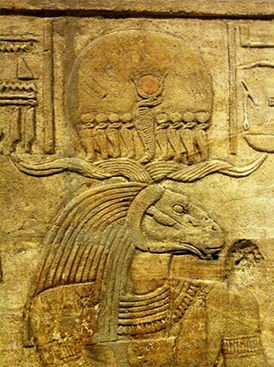
Amon Ra in ram-headed form equated with Khnum, with nine serpents of enlightenment
Persistent mythology of the Pharaonic cult laid down its own claims that Amon Ra himself was the true father of the Pharaoh, a
testimony to the solar powers the divine ruler of Egypt was endowed with. Hatshepsut, for example, enthusiastically and pointedly
embraced this convention by adorning the Temple of Luxor with the tale that Amon Ra was her true father who had visited her mother
before conception at night on its Birth Colonnade 3. His mere evocation could grant immense legitimacy.
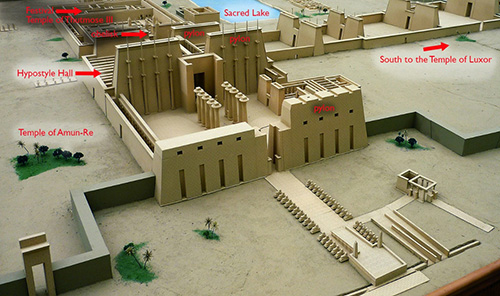
Temple of Amon Ra, Karnak
Along with the Theban complexes of Amon, many of the great temples of Thebes, particularly the holy district of Karnak, were devoted
to Amon Ra also. The main sacred area of the city is located within the massive Karnak Temple Complex. The Precinct of Amon Ra,
shown above, is the largest and most significant part of the entire temple. With its stunning grandeur, these monuments served
continually as the primary religious center for worship of the God of the Sun. The continuing sustenance of Egypt itself was held to
be the exact reflection of the Pharaoh's abdomen, allegorical of the powers of creation. His titles, such as, 'shines as Re, yet is
hidden...' show a very distinct side relating to creative faculties and apotheosis.4
Majesty was not the only area of life his worship pertained to. It is important to understand that Amon Ra was highly associated with
active wealth as a concept and was esteemed as the God who could grant both the proper use of wealth and the pathway to favor from
the highest echelons. Numerous sacred texts from Egypt point towards his ability to grant money and success in business matters. The
existence of physical gold suggested the spiritual gold found on the path of the initiate, particularly when engraved into the soul
generation after generation as a perpetual resource. Endless blessings sourced from Egypt invoke and evoke his name for this
purpose, which shows that the people of all classes seeking occult engagement equated the deity with finding gold on that path as
well.
At the same time, during the New Kingdom, he came to be regarded as the righteous protector of the impoverished and the downtrodden.
Beneficiary acts and poor relief of the Egyptian temples were associated with his mercy. Morality tales show individuals in dire
straits who ask for his protection, such as the tale of the priest stranded at sea recorded in the Tale of Wenamun5. The
perception of Amon Ra as a deity who would help the multitude resulted in a more personal worship of devotion after the expulsion of
the Hyksos, in distinct contrast to the hieratic and veiled worship of Amon:
Deir al-Medina Stelae: 6
Amon-Ra, Lord of the Thrones of the Two Lands, who listens to the petitions of the humble…You are the one who is merciful to the
one who calls upon you.
His worship was particularly prominent among the aristocracy.7 Amon Ra did not just symbolize the pursuit of money itself,
instead his worship signified the need to use the powers of reason (nous), effort and patience to gain lasting and fruitful wealth,
instead of immense riches or relief being bestowed randomly by the fickle powers of fate. The association with the pursuit of wealth
through such endeavors links his powers to the mysterious, heavenly and unpredictable attributes of Amon (Zeus) in a solar,
manifested form, combined with the rational and ordering power of Re (Apollo).
Very notably, health concerns among regular Egyptians sometimes prompted worshipers to plead for his intercession and invocation. The
healing powers of Amon Ra were tied to the sustenance of the life force as represented in the serpent, and they were often related
to the power of healing children, in particular. An informing example housed in the Museum of Berlin pertains to a modest craftsman
named Nebre who praised Amon Ra for healing his son's long-term illness:
Nebre Stela: 6
the one who comes at the cry of the poor; when I cry out to you in affliction, you come and I am
saved…
In this, there was a darker, punitive and dualistic side to the God, who could be prompted to help only after being strongly
merciless in his initial judgement:
Ramesside Hymn, New Kingdom
Papyrus: 7
Great of punishment, mightier than Sekhmet like a raging fire, sublime in mercy, caring for those who praise him, who turns
(from his wrath) to heal the suffering.
As far as psychological matters are concerned, Amon Ra rules over pivotal aspects of self-awareness and individuation. This
punitive-and-merciful side of him shows the role he plays in guarding the wise, the aware and the somber who are able to reflect
accurately upon their acts, both good and bad, opposed to those who drown in chaos with an unmoored mind. This part of his powers is
linked to the cleansing powers of fire, and it ties strongly into the force of serpent energy flowing unobstructed.
The association with prophecy is a persistent theme in his worship. The reason his diviners were consulted typically involved
people who wanted to know what to do in active sense. Oracle-seekers wished for rational solutions when given certain divine omens
by him, which even had ceaseless distinctive categories. He is closely associated with Re and Horus, and the two falcon Gods are the
attendants and subordinates of Apollo, which is one of the reasons the falcon headed imagery is used liberally for all three Gods.
Hymn to Amon Ra: 8
A hymn to Amon Ra… giving warmth of life to all…
[…]
Power-made by Ptah, fair child of love.
[…]
Suspender of the skies, who wrung out the earth.
Therefore, part of the secret behind Amon Ra's functions lies in his materialization of what Amon (Zeus) governs, giving it solar
form through the breath of life and a visual presence comprehensible to all. Titles from the Hymn of Amon Ra found in the Leiden
Papyrus such as 'the one God who made himself into the multitude' indicate the ways he is persistently involved in the creation of
human beings. Corollary to this is his other association is with Ptah (Hephaestus) with the symbolism of being first-born. Ptah
fashioned the bodies of human beings as the master work of the Gods on earth, while Amon Ra breathes the breath of life into all
people, marking the final stage of reincarnation. The full title of this God is Amon Ra Ptah with a threefold division of powers
that apply to the expanse of the universe.
SYMBOLISM
The symbolism of Amon Ra is a difficult subject to breach. The situation necessitates us to say what occurred here, yet even in Egypt
itself, the spiritual code of the Lord of the Two Lands was itself hidden.
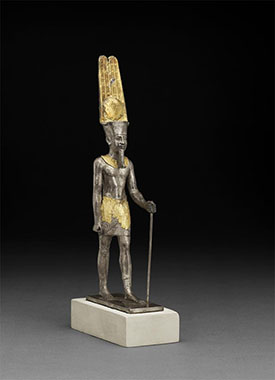
Gold plated Amon Ra statuette from Thebes
(© The Trustees of the British Museum.
Shared under a
Creative Commons Attribution-NonCommercial-Share
Alike 4.0 International (CC BY-NC-SA 4.0) licence)
A symbol in Egypt could have a multiplicity of meanings. What that means is that a symbol anyone can see could have different
meanings to:
a commoner
a new initiate
an intermediate practitioner
a priest of the highest schools
The same symbol thus could carry many different meanings. A painting of Amon on the tombs could represent both Amon and Amon Ra at
the same time, but aspects of the interpretation (i.e. the crown both wear) could mean distinctive things depending on whether the
person is beholding Amon or Amon Ra.
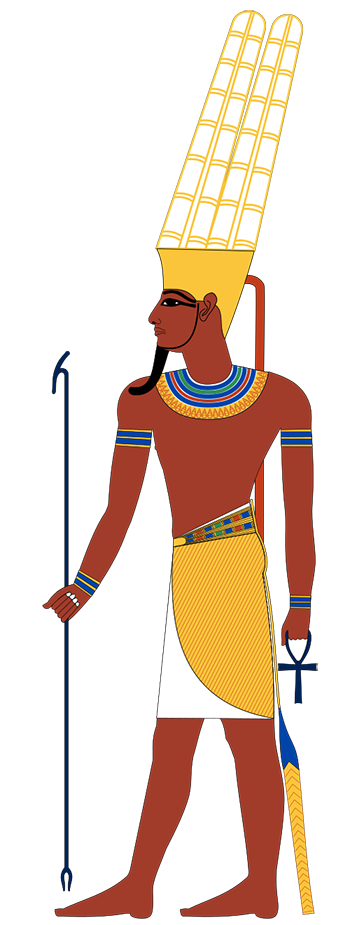
Amon Ra
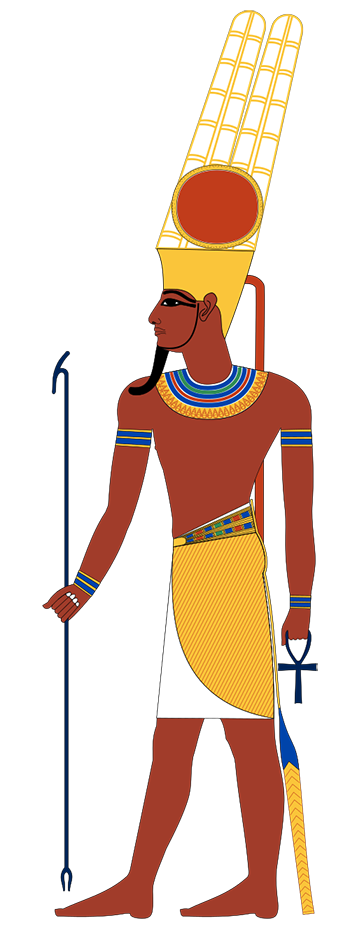
Amon Ra with Solar Disk
This type of representation of Amon could be both, as could the blue or green skinned variation. In the case of Amon Ra, there is a
distinct visual syllabary here if one is inclined to see it that way. Note, for instance, the right-angled belt fastened to where
the Solar 666 Chakra is. Amon Ra carries the ankh as do many Gods, but in this case, the ankh assumes very primary importance. As is
said above, he is the God with the power to breathe life into all living things. The midsection of the Ankh with the loop coming out
of it is also representative of the Solar Chakra and his powers to activate this process of evolution.
The golden headdress or tiara shows the power of kingship and life, as well as the incredible wealth of the Pharaoh and power of the
Sun. The shuti feathers represent the active side of what is seen and unseen, the dual realms of life, but that Amon Ra is involved
in making the unseen a material reality, linking him to the foremost feather. Certain representations, such as Amon with the sun in
his headdress like the above image, generally only concern Amon Ra. The falcon-headed Amon endowed with the head of Re is always of
him.
He is also referred to as the firstborn, the beautiful child and the son. The imagery of being the son of Zeus shows that the
manifestation of the highest God is being brought from heaven to earth through his decrees and powers. Egyptian belief considered
the sun as not simply rising every morning, but outright being reborn, with Re beginning the day young and ending it old (something
reflected in the famous Riddle of the Sphinx). He is also commonly paralleled visually with Khnum in having powers over life and the
imagery of the serpent, often represented too as four-headed in this guise. For this reason, like Amon alone, the Lord of the Light
is represented in the form of a ram. Khnum is the ultimate originator of biological life, but Amon Ra breathes life into each life
itself.
Amon Ra rules over many aspects of the Solar Chakra and its equivalent powers. He rules over the fiery and purifying phase of
any initiate pursuing advancement, particularly as the powers of the Solar Chakra are activated. His powers relate to the faculty of
creation and inspiration, and this is another semantic code for the 'son' who is born from all effort. He is also a Guardian of the
Base and Crown Chakras as they relate to the serpentine powers.
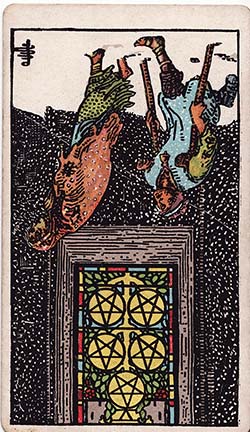
The card of the Minor Arcana that Amon Ra represents is the reversed Five of Pentacles. It may seem strange that the God of
Riches represents a card typically conveying poverty and being shut out of help, but in reverse, the card represents the aid
beckoned by the light of the window.
The two individuals represented on the RWS deck are a man and woman dressed in ragged clothing, huddling through the snow.
Interestingly, one carries two crutches flaring in outward directions as he walks. In the background is a stained-glass
window full of golden light, representing the five pentacles or coins in its art. Traditionally, the window is meant to
convey that the two are unable or apparently unwilling to see help is present, but in reverse, that aid is soon coming to
them. Other interpretations include being locked out of benevolence, wealth, social festivities or even being frozen out of
a relationship, situations which now are passing. This interpretation can also mean that such deprivation was ultimately for
a good reason the querent cannot see
The ragged condition of the two can even be read as being wanting in spiritual hygiene. Notably, the church or temple implies
community assistance and relief, mitigated by Amon Ra. Although Amon Ra concerns mastery of the Third Chakra, it is
(properly) the fifth Chakra to open in sequence. Deprivation or underdevelopment of the Solar Chakra leads to the scenarios
of the Five of Pentacles. When the card is reversed, the window becomes the focal point of the picture with the four Chakras
leading to the Solar at the very bottom being emphasized. Numerologically, the number five in Roman numeral is represented
as a V-shape, as an open grail. It also shows the parallel meeting of two lines – in contrast to the crutches the man wears.
The Greek numeral, epsilon, also meets in the middle on its side.
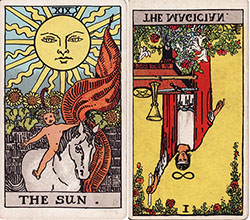
Among the Major Arcana, his cards are the Sun upright and the Magician reversed. The Sun is a card that exalts in power, joy and
creation. The imagery of Amon Ra as the son is represented by the child waving a red banner, coming forth. The hat the child wears
with the six rings (or flowers) and a feather can be taken as an allegory for the six chakras and the Crown. He also does not even
require a saddle to ride. Yet, take note that the white horse is identical to the one Death rides.
The Sun often conveys pregnancy for the querent or successful conception of a child, while having the wonder and joy of a
child is also bestowed by it. In a more oblique manner, positivity and the signalling of a creative period are often
conveyed by its presence in readings. It also broadly stands for enlightenment and truth in all matters, which is a major
theme of Amon Ra. Traditionally, sometimes represented as 'Eclairissement', the Sun deals with clarity and elucidation, the
major sign of breakthroughs. The Magician reversed, portrayed with a bright yellow background in the Rider Waite decks, can
serve as a warning to not let doubt sabotage the querent or others asked about. The card often shows the necessity to summon
the will power to engage properly with life and to pull off tricks.
It can also signify trickery by others; in here, part of the allegory is that Amon Ra has the powers of giving and taking
away as explained above. If something appears to be too good to be true yet rests on shaky foundations, just as the Solar
Chakra can be propped up by two malfunctioning Chakras beneath, there is a warning about its validity. The adage that “all
that glitters is not necessarily gold” is true. Note too that the Magician’s one hand points towards the Base and the other
towards the skies. The upper part of the cup is approximate to the Solar Chakra. The cup, sword, pentacle and wand on the
desk are indicative of the four elements.
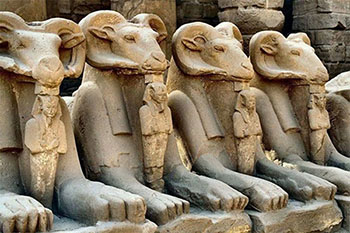
Four ram-headed sphinxes representing Amon Ra
at the Precinct of Amon Ra in Karnak, Thebes
Goetia
In Yehuboric Grimoires, he was represented as the demon named Amon, alternatively named Aamon, or most revealingly, Nahum:
Pseudomonarchia Daemonum8
Amon, or Aamon, is a great and mightie marques, and commeth abroad in the likenes of a woolfe, having a serpents taile, (spetting
out and breathing) [vomiting] flames of fier; when he putteth on the shape of a man, he sheweth out dogs teeth, and a great head
like to a mightie (raven) [night hawk]; he is the strongest prince of all other, and understandeth of all things past and to
come, he procureth favor, and reconcileth both freends and foes, and ruleth fourtie legions of divels.
The reference to being the strongest prince is obviously and clearly a covert reference to Zeus. This signposting betrays the
influence of the Egyptian conventions of Amon Ra where he is described as the King of the Gods. The part referencing ‘all things
past and to come’ refers to his abilities of prophecy, while the serpent’s tail is allegorical of his control of these powers.
The reference to the human form with dog’s teeth and the wolf-like form is an allegory of the two powers of Zeus and Amon Ra, but
points towards their ability to destroy entirely. Here is also a herbal code: the dens canis (dogtooth violet) plant was widely used
in Roman texts as a healing agent of the stomach and as an emetic, even though it has numerous poisonous lookalikes.
Children are widely known to have worn actual canine teeth from the end stages of Rome, possibly to ward off evil and to transfer
pain from their teeth, a regular occurrence found in graves.
The idea that he procures favor also shows his involvement with creation and enlightenment. In a more material sense, the realm which
the Solar Chakra rules over controls promotions and patronage. This also refers to the favor of the Gods gained from empowerment of
this area of life.
Colin de Plancy, one of the major writers of demonological tracts during the 19th century, deliberately associates Amon Ra with the
Egyptian head God in the Infernal Dictionary (Dictionaire infernal)9, describing his link to the blue skinned deity.
NG Arcadia found out that one of the listed names for the Goetic idea of Aamon is "Nahum", in line with the Biblical book of Nahum
above. This is connected to the Akkadian naḫāmu (‘relief’) and shows that aspects of the curse from the Bible made their way
directly into the Goetia.
Bibliography:
1Leiden Papyrus
2Ammon, Encyclopaedia Britannica, 1911 edition
3Birth Colonnade, located in the mortuary temple of Hatshepsut
4The Invocation Hymn at the Temple of Hibis, David Lorton
5Tale of Wenamun
6Deir al-Medina Stelae
7Handbook of Egyptian Mythology, Geraldine Pinch
8Pseudomonarchia daemonum, Johann Weyer
9 Dictionnaire infernal, Colin de Plancy
Further reading:
Egyptian Solar Religion in the New Kingdom: Re, Amun and the Crisis of Polytheism, Jan Assman
Les cultes d'Amon hors de Thèbes: Recherches de géographie religieuse, Ivan Guermeur
De Hymnen aan Amon van papyrus Leiden I, Jan Zandee
Adoration of the Ram: Five Hymns to Amun-Re from Hibis Temple, David Klotz
ANCIENT EGYPT: Amun and the One, Great & Hidden, Sofiatopia
 አማርኛ
አማርኛ العربية
 বাংলা
বাংলা Български
 中文
中文 Čeština
 Dansk
Dansk Deutsch
 Eesti
Eesti Ελληνικά
 Español
 Français
 हिन्दी
 Hrvatski
 IsiZulu
 Italiano
 日本語
日本語 Kiswahili
 Magyar
 Македонски
 नेपाली
 Nederlands
 فارسی
فارسی Polski
 Português
 Română
 Русский
 Slovenščina
 Suomi
Suomi Svenska
 Tagalog
 Türkçe