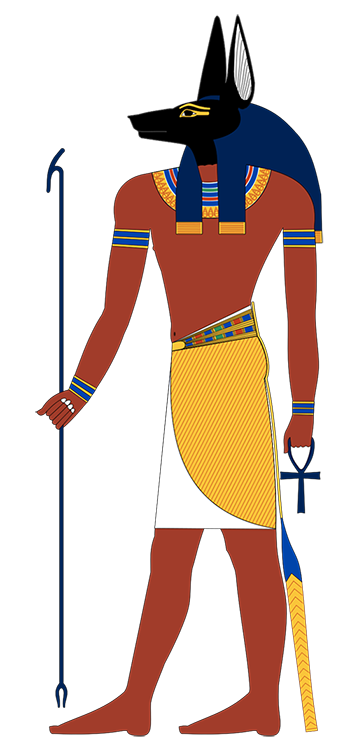
Anubis
author: High Priest Zevios Metathronos
I. The Name of Anubis
Anubis is probably first referenced in the Palermo Stone referencing his role during the First Dynasty as a copy of annals,
albeit the object is made in the Fifth Dynasty of the 25th century BCE.1 Dog iconography is very primeval in
Ancient Egypt and is attested even as far back as any coherent imagery can even be found, though the white wolf god Wepwawet
is thought to be older.1,2
The earliest mention may be as far back as the Pharaoh Hor-Aha's reign directly as an ebony label of Hor-Aha (from 3000 BCE)
could perhaps refer to him, while the most secure attestations in a funerary context that identifies any of the jackal gods as
gods, not possibly only an imiut formula, comes from the tomb complex of Qa-a in the Early Dynastic period, from the seal
impression Oxford E 1282. The phrase used relates to Khentamentiu, however, not Anubis. The Old Kingdom offerings
formulae of Sneferu (2613–2589 BCE) identify Anubis as a god requiring offerings unambiguously.2,3
The name is maybe derived from 'royal child' or 'prince' in the Egyptian language reflecting his heritage as a son of Ra or
Osiris,4 yet the Egyptian name Inpu (jnpw), Ienepu, Yenepaw or Anapa is also clearly related to the verb jnp,
meaning to decay or putrefy.5 This dualism and almost antonymic quality between youthfulness and aged putrefaction
may be deliberate.
The oldest Greek forms predate the exposition about Anubis mythological role by Plutarch. Greek forms of Anubis come from the
Hellenistic era; the dative form Ἀνούβι ('to Anubis') is attested first in an inscription from Smyrna either from 305–281 BCE
or 197–159 BCE6 due to the reference possibly relating to two different queens named Stratonike:
Ἀνούβι· | ὑπὲρ βασιλίσσης | Στρατονίκης | καὶ ὑπὲρ ἑαυτῶν || Ἡράκλειτος Ἀρχιγένους | καὶ οἱ συνανουβιασταί ...
“To Anubis, on behalf of Queen Stratonike and on behalf of themselves, Herakleitos son of Archigenes and the fellow
Anubiasts ...”
Smyrna dedication, I.Smyrna 765
The Coptic form ⲁⲛⲟⲩⲡ (Anoup) or ⲁⲛⲟⲩⲃ (Anoub), derived from Demotic 'inp or Anapa, is attested later, surviving as a personal
name up to the 9th century.7,8
Sources: Hsu, The Palermo Stone: The Earliest Royal Inscription from Ancient Egypt (2010); Wegner, Wepwawet in Context: A
Reconsideration of the Jackal Deity and Its Role in the Spatial Organization of the North Abydos Landscape (2007);
Harland, Dedication to the God Anubis by Fellow-Anubiasts for Queen Stratonike (305–281 / 197–159 BCE), Smyrna
(2020); Thesaurus Linguae Aegyptiae, Jnp.w; TLA Lemma No. C145: ⲁⲛⲟⲩⲡ. Coptic Dictionary
Online1,2,6,7,9
II. Anubis
The canine-headed god of the underworld who, arguably even in modern times, is one of the most well-known gods, Anubis may be
one of the most enduring symbols of Egypt too. He was known as the god of the underworld and was strongly associated with
mummification and funerary rites. Many scenes of Anubis in Ancient Egyptian art depict him guiding the dead as a psychopomp,
embalming the deceased, and weighing the heart on the scale of Maat. The symbolism of Anubis in Egypt is prolific and
extremely widespread in both scale and frequency, even though he is only tied to a few myths. Throughout the history of Egypt,
he was considered to be the primordial god of the dead, alongside Osiris.10,11
Anubis is first referenced in the Palermo Stone, otherwise called the Royal Annals, referencing the First Dynasty as a copy
but fashioned during the Fifth.1 Another object from the time of the Pharaoh Hor-Aha may feature his
name.3 The symbolism of Wepwawet, Anubis and another jackal-headed god, Khentamentiu, is extremely old and probably
Protodynastic, predating detailed description. His role begins in formal Egyptian texts early.12
Again and again in the arcane Pyramid Texts the Pharaoh is said to don a "jackal-like" face as Anubis, to stand up and sit
down as Anubis, while it is also said he is cleansed in the purifying jackal-lake and instructs the Pharaoh to cleanse himself
using the eight jars of water. The mummification role is not explicitly outlined as references to it involve the heart of the
deceased being remade in Anubis' house more obliquely and symbolically, but as the Pharaoh's father it is clear Anubis stands
next to the great monarch in death.12,13,14,15
The Coffin Texts of the Middle Kingdom expand his array of contexts. Anubis is squarely and strongly associated with the
mummification process, being referenced around eighty-three times. He is associated with the gates that the dead must pass
through. The jackal god gives formulae to prevent putrefaction and rotting away, to retain integrity and youth in death. He
enables the dead to live, travel anywhere on earth and to see the sun and in the most revealing manner indicative of what the
god does, Anubis is said to "knit together" the deceased coherently so they live anew. In one instance, it is Anubis credited
with stitching the parts of Osiris together. Again and again he is called Lord of the God's Booth, Lord of the Coffin, Lord of
the Underworld in rhythmic fashion.16,17,18,19
In later myth, Anubis was considered to be the son of Osiris and Nephthys, as elaborated most notably by Plutarch. When Osiris
is dismembered by Set, it is Anubis who keeps his father's organs safe and at hand. In another myth, such as the one in the
Jumilhac Papyrus, the canine God flays Set, then brands and wears the skin when the latter transforms into a leopard to attack
the corpse of Osiris lying in peace. Such associations led to Anubis being represented as the foremost protector of the
deceased, the primary deity concerned with mummification but they also show more symbolically that Anubis keeps the dead
integral, whole, complete. During this episode, Anubis outlines why the hide is worn by the setem priest.20,21
This preoccupation with death reflects the role of Anubis as the god who fashions the souls of individuals postmortem to be
able to accommodate another body or existence. Among the gods, he is also the most proactive guardian of the deceased, the
foremost to be consulted by people on all matters of funerals and the passage from one life to another, a role tying him very
directly to both Maat and Nephthys, Osiris and Horus, a steward of Isis. While Set reigns over the realm of the ignorant ones
and Osiris reigns over the righteous in heaven, Anubis occupies a median zone between the two; he is transitional, a hermetic
force.
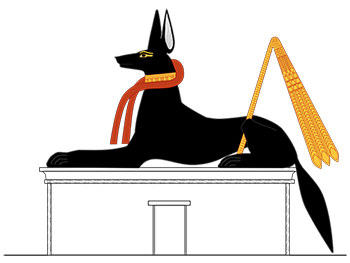
Anubis in animal form as guardian of tombs
As insatiable as possible in guarding the departed in the Egyptian mind as the guardian of tombs, Anubis was thought to punish
those who disturbed the dead or upset cosmic order. Popular belief imbued him with an almost judicial authority on behalf of
the dead. As recorded in later Egyptian lore: "Anubis and his army of messengers were charged with punishing those who
violated tombs or offended the Gods. If someone robbed a grave or committed evil, the common folk expected Anubis to avenge
the wronged spirit. For most people, this aspect of Anubis had practical implications, as he could be called upon for
vengeance or protection. Amulets, tomb paintings, and inscribed curses show that Egyptians regularly invoked Anubis for
protection and vengeance. A villager would call on Anubis to curse a grave robber or to safeguard their household from
malevolent magic. This dual image, being both a benevolent guide for the just and a fierce punisher of thieves, made Anubis a
profoundly prominent figure in the eyes of ordinary Egyptians, one who reinforced the moral order (Ma'at) in daily
belief.22,23
III. Names and Titles
Sources: Global Egyptian Museum, “Stela of Hetepneb”; Penn Museum, Stela, 29-66-594 | Collections; Penn Museum,
Stela, 29-66-627 | Collections; Newell The Significance of Anubis as seen in the Coffin Texts (2014);
DuQuesne Anubis Master of Secrets (ḥry-sštꜣ / Hry-sStA) and the Egyptian Conception of Mysteries (1996); Hays,
The Death of the Democratisation of the Afterlife (2011)16,24,25,26,27,28
IV. Saqqara and the Anubaeons
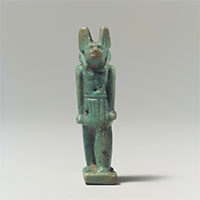
Anubis amulet
Temples dedicated to Anubis were named Anubaeons. As a testimony to the popularity of the canine God, there were multiple
temples like these across the breadth of Egypt, with the site at Saqqara assuming the highest importance. Complexes associated
with Anubis typically contain millions of mummified canids, such as the ones discovered at Saqqara. Two cities dedicated to
Anubis existed. One was named Usakai or Hardai, or in Greek, Cynopolis ("dog city"). The other, also dedicated to Wepwawet,
was named Zahwaty, or in Greek, Lycopolis ("wolf city"), which is now modern Asyut. Various temple complexes existed at both
of these locations.29,30,31
The principal Nome cult center of Anubis was located at Cynopolis (Hardai), in the 17th nome of Upper Egypt,32
known to the Greeks as the “City of Dogs” due to its association. Cynopolis was associated with a dog cemetery in its
environs, reportedly on the opposite bank of the Nile near Hamatha. Sacred dogs and jackals were kept, ritually treated,
mummified, and buried as votive animals.33 Despite this, Cynopolis did not have large temples that have been found.
Although Plutarch considers it the god's city, the relevance appears to have been cultural or to do with the dead.
The cult was furthermore expressed through some structures and ritual practices that dotted the necropolis and dealt with the
treatment of the human dead like the wabet.34
Within the worship system of Anubis was situated the animal necropoleis of Saqqara, in particular the Anubeion and the
Bubasteion, located in the eastern area of the plain of Ankhtauy, dedicated to the cults of sacred animals. Each complex is
associated with specialized catacombs: canids for the Anubeion and felines for the Bubasteion. The Anubeion, constructed on an
elevation, represents the symbolic point of mediation between the desert and the cultivated valley, positioning itself as a
liminal space. In this context, the dog, an animal associated with Anubis, assumes the value of an intermediary between two
worlds, reinforcing the function of the god as guardian of the necropolis and protector of the passage to the afterlife,
leading to the copious amount of animal offerings.20,34,35
The religious complex consists of above-ground temple structures associated with an extensive hypogeal system excavated into
the limestone bedrock. Saqqara was therefore not a single temple, but a set of sanctuaries, courtyards, and underground
galleries. The underground galleries were organized according to a longitudinal development with lateral branches, and it is
in this place, part of an organized system, that votive mummies of animals, especially canids, offered by the faithful to the
god, were deposited.36
The site develops along a sandy scarp articulated on multiple terraces. Of the lower terrace, insufficient traces remain to
reconstruct its original organization and building typologies. The central terrace constituted the main nucleus and housed
three separate temple buildings: South Temple, Central Temple, North Temple. The South Temple presents the so-called Chambers
of Bes, spaces excavated into the living rock that housed votive statues of the god. A processional route connected this area
to the Central Temple, the fulcrum of the complex, dedicated to the cult of Anubis, as suggested by the iconographic
documentation referable to the reign of Ptolemy V Epiphanes. Of the North Temple, only the foundations survive today, but its
presence is confirmed by the layout of the wall structures.37,38
On the upper terrace, a settlement area was closely connected to the temple complex. Developed significantly in the Ptolemaic
period and frequented until the 1st century CE, it consisted of mudbrick buildings and functioned as a residential sector,
organized along street axes, and intended for administrative or storage functions. Among the archaeological finds that suggest
this are tools, hearths, and containers, indicative of occupation, which archaeologists have hypothesized to have been that of
priests devoted to Anubis and to rites connected to this deity.39,40,41
Anubis had a more limited presence in the city of Wepwawet in its western necropolis, which nonetheless was devoted to canine
deities. The Asyut Project demonstrates that both Wepwawet and Anubis were worshipped at ancient Asyut, with the Wepwawet
temple lying west of modern Asyut and the Anubis temple probably near the foot of Gebel Asyut al-Gharbi, the mountain to the
west.42
V. Funerary Rite and Representation
Anubis was typically represented as dog or jackal related to the imiut, or as a man wearing the mask of a dog or a
jackal.11 The illuminated, human-like gilded eye and brow were usually shown on the mask, pointing to his various
parentage of Ra or Osiris.43 Most often, he was clad in gold and white, signifying his mastery over the dimensions
of the dead.
The most significant rituals involving Anubis' symbolism for an ordinary Egyptian occurred during funerals. Death was
considered to be in the domain of the family and connected to the theme of perseverance on earth. While professional embalmers
(who were often priests of Anubis) handled the technical mummification, the relatives of the deceased participated in
ceremonies where Anubis was symbolically present. By custom, the chief embalmer priest wore a painted Anubis mask when
performing key rites of a funeral. By the New Kingdom, it became customary for an official to take the role of Anubis in
public funerary pageants, which continued into later periods. One late Ptolemaic papyrus from Oxyrhynchus is known with
payments to various participants in a festival, including the "dog-headed one" (kunophis), an actor playing Anubis, with an
evidence suggesting that even at non-royal funerals or local festivals of the dead, having an Anubis impersonator was
standard.44,45
The community could see Anubis walk among them and ritually lead the deceased to the tomb. Common mourners addressed this
figure with petitions, essentially treating him as the deity's presence.
One major festival of Osiris was the Wag Festival (Festival of the Dead), a yearly rite focused on the dead. Small funerary
boats were floated and offerings made. Anubis would receive some of these devotions attested as far back as the Coffin Texts,
though Osiris was the major focus of this festival. "Letters to the Dead" (messages inscribed on bowls or papyri by living kin
to deceased relatives) often included threats to appeal to Anubis or Osiris if the deceased's spirit did not cease troubling
them about wrongdoers, invoking the divine tribunal. Such letters show that commoners believed Anubis among other gods was
actively involved in the fate of souls and could mediate between the living and the dead on their behalf.46
His functions did not simply relate to the world of death. Many of them were deeply tied to the world of the living and the
breathing, such as control of social matters, truth, and vows, indicated strongly in his relation to the Opening of the Mouth
Ritual. The enemy has tried to obliterate all knowledge of this. Socrates, for instance, invokes Anubis several times, vowing
"by the dog of Egypt" in order to convey the absolute truth of what he was saying, but also to invoke the witticisms of
Anubis.
The Egyptians knew Anubis could provide them with advice in dealing with relationships and the courage to face those
different from themselves. Bravery was a large element of his cult, and this was supposed to represent the triumph of eternal
life over death, alongside the desire to keep incarnating and existing. Anubis ruled over aspects of family matters: matters
of blood and ties, and his dog-like symbolism is very much related to this.47,48
VI. Canine Guard
The dog was his symbol for many reasons, not just the loyalty of dogs to humans, but in regard to their zest for life,
fierceness, vocal nature, and tendency to even put themselves at grave risk of death for their masters. Families owning dogs
relate to the symbolism of Anubis as a protector of families and the race. The dog also represents the social principle of
routine and keeping one's integral promises to others. Such loyalty and vivaciousness displayed by dogs was interpreted as a
symbolism for loyalty to life itself.
In likeness and contrast to the dog, the jackal is another dualistic symbol of Anubis that relates strongly to the themes of
death. A jackal is a scavenger animal that feeds on corpses. The power of putrefaction, evoking obliteration and decay, was
represented in the jackal. Yet essentially, so was the idea that every element of the dead could be put toward a greater and
renewed purpose in time. Generally speaking, a jackal is also not a group oriented animal, other than its mating partner for
life, which it will often hunt with. Represented in his wife Anput, loyalty and fidelity were strong elements of the cult of
Anubis. Therefore, his cult was popular with strictly monogamous couples, along with widows and widowers.49,50
Both the dog and jackal are wide-mouthed with archetypally long muzzles, a code for the Mouth powers associated with Anubis.
The god of death was heavily involved in the Opening of the Mouth ceremony,51 which marked a sort of graduation to
higher powers of communication and also unlocked certain abilities after death for the soul involved. The Mouth, referenced in
Anubis nicknames such as "barker," also bestows the individual with much stronger levels of command. His black color
represents the transformation of life into death and the soil of the Nile, but also the absorption of life into the flow of
all things and the knowledge of the hidden. The Black Land itself was evoked in the ebony fur of Anubis. He contrasts with the
reddish symbolism of Set and the other wolf-headed god named Wepwawet, who is clad in white.
The most dog-like form of Anubis is represented abundantly in tombs and mortuary monuments, showing his role as the protector
of the dead from any form of hubris, which he would avenge. This is also part of why a flail is held by his hind legs, which
was associated with fertility, but also with Osirian royalty.52 The flail was a code representing that the land of
the dead is more "fertile" than what the living can see and to take warning. As can be expected, many of his titles relate to
the process of embalming and mummification.
Another important matter to note is that, the distinctive black headed color is not associated with the jackal itself, rather
being a piece of symbolism. Prior to mummification, a body would be covered in natron,53 which would dry the body
out and protect it from moisture (and thus bacteria), after which the body's color would take on a darker, blacker look.
Further, the color black represented fertility for the Egyptians, as it was the color of the Nile's fertile silt, being
something of a duality. Black may be a color of death, but death and decomposition may lead to life and rebirth in turn. Of
course, it also represented putrefaction too as the dualist symbolism of Anubis is important.
VII. Endurance and Passion
A domain of Anubis was also related to love, where the passions, romance and the carnal matters inevitably featured. Demotic
Egyptian love spells were often used to "ignite the heart" of a desired person using substances or figurines. Although these
come from a later period, they continue the concept of the heart as the locus of desire that can be magically manipulated. The
heart's occult property included being an object of sympathetic magic: to control someone's heart was to control their will
and love. This aspect of Anubis in domination, and the imagery of the canine hunter, is referenced in certain spells, though
we do not endorse the mindset of the operator here:
“Anubis, god of the earth, underworld and heavens, dog, dog, dog, use all your strength and all your power on Tier (the
woman in question), who was born by Sophia. Strip from her her pride, prudence and modesty, and bring her to me here, at
my feet, languid with passion, at every hour of the day or night, dreaming of me ceaselessly, when she eats and when she
drinks, when she works and even when she makes love, when she rests, when she dreams and when she is dreaming; when,
tormented by you, she hastens, languishing for me, wholeheartedly, her soul filled with generosity, offering herself to
me, and fulfills the duty of women toward men, serving to satisfy my lust and her own, never bored, without shame,
rubbing her thigh against mine, her black down against my black down [pubis] in the sweetest way! Yes, my master, bring
me Tier, to whom Sophia gave birth.”
Ptolemaic-era spell, translated in Christian Jacq, Magic and Mystery in Ancient Egypt54
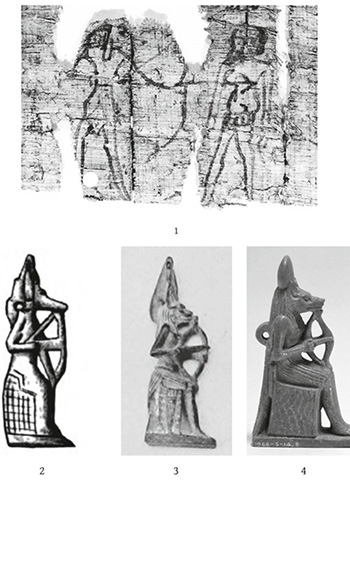
1. Anubis with bow and arrow, love spell fragment, Roman era
2. to 4. Symbolism of bow-wielding Anubis statuettes, Ptolemaic to Roman era
VIII. Spirituality
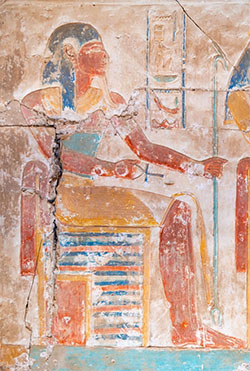
Rare depiction of Anubis in human form,
Museum of Egypt
Anubis, like Maat, was intricately associated with the ib (heart) of the individual,55 tying him to the Weighing of
the Heart ceremony. During this ceremony, Anubis would act as the intercessor or attorney of the deceased, attempting to
elaborate their good aspects. He was known as the Guardian of the Scales. Plutarch also interpreted Anubis as the horizon
(boundary) between the upper and lower hemispheres of the cosmos.56 The heliacal rising of Sirius, commonly was
aligned with the hot days of summer in July, which are commonly called "the dog days of summer", from κυνάδες ἡμέραι.
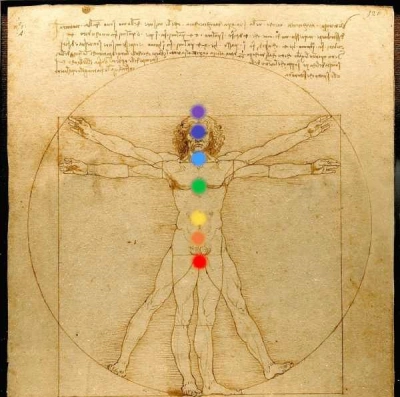
The relation to the heart is symbolic because the Middle Chakra represents the ability to commune with the astral, and it is
the place from which one emerges upon death. Along with embalming, this is part of what conveys the magickal phrase THAT
WHICH IS INSIDE.
Internal matters of the soul also had a spiritual meaning relating to meditation, even one's level of advancement. The quality
or characteristic of the realm accessed by the dead will depend on the development of their body, mind and soul in approaching
true union, also something symbolized by Cerberus in his parallel canine depictions.
Likewise, his title of Foremost of the Westerners is another code. This does not only relate to the west bank of the Nile,
where the dead were buried, but also to the western direction in general, which represents the setting point of the Sun and
the Water element. The Water element is tied to the Upper Chakras, which govern all that is past, present and future.
In Ptolemaic Egypt and Rome, Anubis was often featured by the side of Isis, similarly to Cerberus at Serapis'
side.57 His symbolism continued to be popular in Rome, although not without some commentary from the more ignorant
of Romans.58
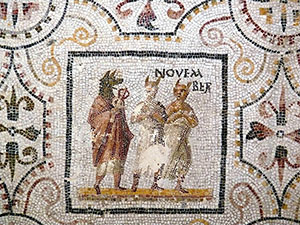
Mosaic panel of Anubis holding the Caduceus of Hermes to represent November,
floor from Carthage
Along with the July symbolism, Anubis was strongly associated with the month of November,59 which was designated as
the month of mourning in the Roman period. Sandalwood, his representative plant, was used in the embalming process, in
incense, and other ritual matters. The element of water is also apparent, given its associations regarding dissolution,
transformation, death, rebirth, and the submerging of the ego.
IX. The Priesthood of Anubis
The priesthood of Anubis occupied a well-defined position within the Egyptian religious system, as its functions were
predominantly confined to the spheres of funerals and expertise. In the Book of the Dead, Anubis is referred to as “he who is
in the embalming tent” (imy-ut), indicating his central role in the treatment of the body. One of the primary functions of the
priests of Anubis, as representatives of Anubis on earth, was to ensure the transformation of the deceased and his preparation
to face the journey in the Afterlife, so that the passage might be serene. Diodorus Siculus states in the Bibliotheca
historica that embalmers operated “according to sacred laws,” confirming the religious organization of the
process.60,61,62,63,64
During embalming, the priests performed precise ritual actions. Herodotus, in the Histories, details the physical process of
embalming carried out by the emissaries of Anubis, but Egyptian sources show that the entire process did not consist solely of
technical operations but was accompanied by sacred formulas pronounced by the embalming priests and addressed to the god.
Evidence shows that ancient Egyptian priests possessed a broad knowledge of human anatomy, knowing how to operate anatomically
and how to manage decomposition and infections but perhaps no one had a better idea of this than Anubis' sacred
personnel.63,65,66
The practices of embalming and funerary procedures were supervised by the “Master of Secrets” (ḥery-seshta), a priestly figure
associated with ritual knowledge who acted as guardian of the necropolis. Anubis is depicted in Egyptian iconography as the
supervisor of the weighing of the heart in the “Hall of the Two Truths,” the culminating moment for the deceased in the
afterlife, and the priest had to embody this role, acting as an intermediary between the world of the living and the dead. He
often wore a mask of Anubis to symbolically assume the role of the god during the preparation of the body, in addition to the
funerary contexts discussed in the above sections.15,43
Under him operated different levels of embalming priests, including the wab (purification priests), responsible for ritual
cleansing, and the embalming priests associated with the “House of Beauty” (Per Nefer), where mummification took
place.63
The entire process of preparing the deceased was seen as an extension of the divine work of Anubis. A surviving wood-and-glass Anubis
mask in the Egyptian Museum, Cairo, is catalogued as having been worn by the embalming priest during mummification.43 The
tomb of Nebenmaat is TT 219 at Deir el-Medina and belongs to the family complex published together with TT 218 and TT
220.67,68 In funerary ritual, the Opening of the Mouth restored full sensory capacity to the deceased in the afterlife.
Sources and Bibliography
-
Hsu, Shih-Wei. “The Palermo Stone: The Earliest Royal Inscription from Ancient Egypt.” Altorientalische Forschungen 37, no. 1 (2010): 68–89.
-
Wegner, Mary-Ann Pouls. “Wepwawet in Context: A Reconsideration of the Jackal Deity and Its Role in the Spatial Organization of the North Abydos Landscape.” Journal of the American Research Center in Egypt 43 (2007): 139–50.
-
Sperveslage, Gunnar. “Inschrift auf Oxford E 1282.” Text ID H2OW6Z5RW5DCZBSGRBXLAXX2DI. Thesaurus Linguae Aegyptiae, Corpus Issue 20, Web App version 2.5.0. Edited by Tonio Sebastian Richter, Daniel A. Werning, Hans-Werner Fischer-Elfert, and Peter Dils.
-
Redford, Donald B. “The Literary Motif of the Exposed Child (Cf. Ex. ii 1–10).” Numen 14, no. 3 (1967): 209–28.
-
Faulkner, Raymond O. A Concise Dictionary of Middle Egyptian. Oxford: Griffith Institute, 1962. S.v. “inp.”
-
Harland, Philip A. “Dedication to the God Anubis by Fellow-Anubiasts for Queen Stratonike (305–281 / 197–159 BCE), Smyrna.” Associations in the Greco-Roman World. AGRW 185; I.Smyrna 765; RICIS 304/0201; SIRIS 305.
-
Koptische/Coptic Electronic Language and Literature International Alliance. “TLA Lemma No. C145: ⲁⲛⲟⲩⲡ.” Coptic Dictionary Online.
-
Wilfong, Terry G. Death Dogs: The Jackal Gods of Ancient Egypt. Ann Arbor: Kelsey Museum of Archaeology, University of Michigan, 2015.
-
Thesaurus Linguae Aegyptiae. “Jnp.w.” Lemma ID 27360. Corpus Issue 20, Web App version 2.5.0.
-
Doxey, Denise M. “Anubis.” In The Oxford Encyclopedia of Ancient Egypt, edited by Donald B. Redford, 1:98–99. Oxford: Oxford University Press, 2001.
-
Encyclopaedia Britannica. “Anubis.”
-
Allen, James P., trans. The Ancient Egyptian Pyramid Texts. Edited by Peter Der Manuelian. Writings from the Ancient World 23. Atlanta: Society of Biblical Literature, 2005. Pepi Spell 312.
-
Allen, James P., trans. The Ancient Egyptian Pyramid Texts. Edited by Peter Der Manuelian. Writings from the Ancient World 23. Atlanta: Society of Biblical Literature, 2005. Pepi Spell 523.
-
Allen, James P., trans. The Ancient Egyptian Pyramid Texts. Edited by Peter Der Manuelian. Writings from the Ancient World 23. Atlanta: Society of Biblical Literature, 2005. Unis Spell 206 and Pepi II Spell 593.
-
Taylor, John H. Death and the Afterlife in Ancient Egypt. Chicago: University of Chicago Press, 2001.
-
Newell, Charlotte. “The Significance of Anubis as Seen in the Coffin Texts.” MRes thesis, Macquarie University, 2015.
-
Faulkner, Raymond O., trans. The Ancient Egyptian Coffin Texts. Vol. 3, Spells 788–1185 and Indexes. Warminster: Aris & Phillips, 1978. Coffin Texts 825 and 908.
-
Faulkner, Raymond O., trans. The Ancient Egyptian Coffin Texts. Vol. 2, Spells 355–787. Warminster: Aris & Phillips, 1977. Coffin Texts 531 and 755–56.
-
Faulkner, Raymond O., trans. The Ancient Egyptian Coffin Texts. Vol. 1, Spells 1–354. Warminster: Aris & Phillips, 1973. Coffin Text 55.
-
Plutarch. “Isis and Osiris.” In Moralia. Vol. 5, Isis and Osiris; The E at Delphi; The Oracles at Delphi No Longer Given in Verse; The Obsolescence of Oracles. Translated by Frank Cole Babbitt. Loeb Classical Library 306. Cambridge, MA: Harvard University Press, 1936.
-
Castel, Elisa. “Panthers, Leopards and Cheetahs: Notes on Identification.” Trabajos de Egiptología: Papers on Ancient Egypt 1 (2002).
-
Hart, George. The Routledge Dictionary of Egyptian Gods and Goddesses. 2nd ed. London: Routledge, 2005, 22–24.
-
Pinch, Geraldine. Egyptian Mythology: A Guide to the Gods, Goddesses, and Traditions of Ancient Egypt. Oxford: Oxford University Press, 2002, 104.
-
Global Egyptian Museum. “Stela of Hetepneb.”
-
Penn Museum. “Stela, 29-66-594.” Collections.
-
Penn Museum. “Stela, 29-66-627.” Collections.
-
DuQuesne, Terence. “Anubis Master of Secrets (ḥry-sštꜣ / Hry-sStA) and the Egyptian Conception of Mysteries.” Discussions in Egyptology 36 (1996): 25–38.
-
Hays, Harold M. “The Death of the Democratisation of the Afterlife.” In Old Kingdom, New Perspectives: Egyptian Art and Archaeology, 2750–2150 BC, edited by Nigel Strudwick and Helen Strudwick, 115–30. Oxford: Oxbow Books, 2011.
-
Ikram, Salima, and Paul Nicholson. “Sacred Animal Cults in Egypt: Excavating the Catacombs of Anubis at Saqqara.” Expedition 60, no. 3 (2018).
-
Köhler, E. Christiana, Thomas J. C. Astor, and Jochem Kahl. “Preliminary Report on the Investigation of a Late Period Tomb with Aramaic Inscription at El-Sheikh Fadl/Egypt.” Ägypten und Levante / Egypt and the Levant 28 (2018).
-
Getty Research Institute. “Asyut.” Getty Thesaurus of Geographic Names Online.
-
Helck, Wolfgang. Die altägyptischen Gaue. Beihefte zum Tübinger Atlas des Vorderen Orients, Reihe B, Geisteswissenschaften 5. Wiesbaden: Ludwig Reichert, 1974.
-
Ptolemy. Geography 4.5.60. See also William Smith, ed., “Cynopolis,” in A Dictionary of Greek and Roman Geography, vol. 1 (London: John Murray, 1873).
-
Rageot, Maxime, Ramadan B. Hussein, Susanne Beck, Johannes M. Bähr, Mahmoud M. Bahgat, Ahmed M. Megahed, and Philipp W. Stockhammer. “Biomolecular Analyses Enable New Insights into Ancient Egyptian Embalming.” Nature 614, no. 7947 (2023): 287–93.
-
Nicholson, Paul T., Salima Ikram, and Steve Mills. “The Catacombs of Anubis at North Saqqara.” Antiquity 89, no. 345 (2015): 645–61.
-
Nicholson, Paul T. The Catacombs of Anubis at North Saqqara: An Archaeological Perspective. With Salima Ikram and Steve Mills; contributions by John P. Harrison and Ying Qin. British Museum Publications on Egypt and Sudan 12. Leuven: Peeters, 2023.
-
Cannata, Maria. “Social Identity at the Anubieion: A Reanalysis.” American Journal of Archaeology 111, no. 2 (2007): 223–40.
-
Jeffreys, David G., and H. S. Smith. The Anubieion at Saqqâra I: The Settlement and the Temple Precinct. With a chapter by M. Jessop Price. Egypt Exploration Society Excavation Memoir 54. London: Egypt Exploration Society, 1988.
-
Giddy, Lisa L. The Anubieion at Saqqâra II: The Cemeteries. With contributions by H. S. Smith and P. G. French. Egypt Exploration Society Excavation Memoir 56. London: Egypt Exploration Society, 1992.
-
French, Peter. The Anubieion at Saqqâra III: Pottery from the Archaic to the Third Intermediate Period. Egypt Exploration Society Excavation Memoir 103. London: Egypt Exploration Society, 2013.
-
French, Peter, and Janine Bourriau. The Anubieion at Saqqâra IV: Pottery of the Late Dynastic Period with Comparative Material from the Sacred Animal Necropolis. Egypt Exploration Society Excavation Memoir 110. London: Egypt Exploration Society, 2018.
-
The Asyut Project. “Gebel Asyut al-Gharbi: Overview and Sites.” Freie Universität Berlin.
-
Global Egyptian Museum. “Mask of Anubis.” Egyptian Museum, Cairo, inventory no. JE 55620.
-
Abdelwahed, Youssri Ezzat Hussein. “More Than Pets: Dogs in Graeco-Roman Egypt.” Journal of Faculty of Tourism and Hotels, University of Sadat City 1, no. 1 (2017).
-
Gasparini, Valentino. “Les acteurs sur scène: Théâtre et théâtralisation dans les cultes isiaques.” In Individuals and Materials in the Greco-Roman Cults of Isis: Agents, Images, and Practices, edited by Valentino Gasparini and Richard Veymiers, 714–46. Religions in the Graeco-Roman World 187. Leiden: Brill, 2018.
-
Troche, Julia. “Letters to the Dead.” In UCLA Encyclopedia of Egyptology, edited by Jacco Dieleman and Willeke Wendrich, 1–12. Los Angeles: UCLA Department of Near Eastern Languages and Cultures, 2018.
-
Plato. Republic. Edited and translated by Chris Emlyn-Jones and William Preddy. 2 vols. Loeb Classical Library 237 and 276. Cambridge, MA: Harvard University Press, 2013.
-
Hoerber, Robert G. “The Socratic Oath ‘By the Dog’.” Classical Journal 58, no. 6 (1963): 268–69.
-
Melville, Hannah, Craig J. Tambling, Arjun Amar, and Morgan J. Trimble. “Black-Backed Jackals Are Left to Crave Carrion in Absence of Larger Vertebrate Scavengers.” Food Webs 37 (2023).
-
Animal Diversity Web. “Canis aureus: Golden Jackal.” University of Michigan Museum of Zoology.
-
Petrie Museum of Egyptian Archaeology, University College London. “The ‘Opening of the Mouth’ Ritual.” Digital Egypt for Universities.
-
American Research Center in Egypt. “The Story of Anubis.” Google Arts & Culture.
-
Abdel-Maksoud, Gomaa, and Abdel-Rahman El-Amin. “A Review on the Materials Used during the Mummification Processes in Ancient Egypt.” Mediterranean Archaeology and Archaeometry 11, no. 2 (2011): 129–50.
-
Jacq, Christian. Magic and Mystery in Ancient Egypt. London: Souvenir Press, 1998.
-
British Museum. “Papyrus of Ani: Ani’s Judgment.” Collection object EA10470,3.
-
DuQuesne, Terence. The Jackal Divinities of Egypt I: From the Archaic Period to Dynasty X. Oxfordshire Communications in Egyptology 6. London: Darengo, 2005.
-
Kelsey Museum of Archaeology, University of Michigan. “Anubis in the Greek and Roman World.” In Death Dogs: The Jackal Gods of Ancient Egypt. Ann Arbor: University of Michigan, 2015.
-
Raschle, Christian R. “The Expulsion of Isis Worshippers and Astrologers from Rome in the Late Republic and Early Empire.” In Religious Violence in the Ancient World: From Classical Athens to Late Antiquity, edited by Jitse H. F. Dijkstra and Christian R. Raschle, 87–105. Cambridge: Cambridge University Press, 2020.
-
Egypt Museum. “Mosaic of Anubis in Tunisia.”
-
Assmann, Jan. Death and Salvation in Ancient Egypt. Translated by David Lorton. Abridged and updated by the author. Ithaca, NY: Cornell University Press, 2005.
-
Faulkner, Raymond O., trans. The Ancient Egyptian Book of the Dead. Edited by Carol A. R. Andrews. Rev. ed. London: British Museum Publications for the Trustees of the British Museum, 1985.
-
Faulkner, Raymond O., trans. The Egyptian Book of the Dead: The Book of Going Forth by Day: Being the Papyrus of Ani (Royal Scribe of the Divine Offerings). With additional translations and commentary by Ogden Goelet Jr. Edited by Eva von Dassow. Edition conceived by James Wasserman. San Francisco: Chronicle Books, 1994.
-
Ikram, Salima. Death and Burial in Ancient Egypt. Harlow: Longman, 2003.
-
Diodorus Siculus. Library of History. Vol. 1, Books 1–2.34. Translated by C. H. Oldfather. Loeb Classical Library 279. Cambridge, MA: Harvard University Press, 1933. See 1.91.
-
Herodotus. Histories. Vol. 1, Books 1–2. Translated by A. D. Godley. Loeb Classical Library 117. Cambridge, MA: Harvard University Press, 1920. See 2.85–88.
-
David, A. Rosalie, ed. Egyptian Mummies and Modern Science. Cambridge: Cambridge University Press, 2008.
-
Institut français d’archéologie orientale. “TT 219: Nebenmaât.” Archives de l’IFAO.
-
Gaber, Hanane. Les tombes d’Amennakht et de ses fils Nebenmaât et Khâemter à Deir el-Médina (TT 218, TT 219, TT 220). 2 vols. Mémoires publiés par les membres de l’Institut français d’archéologie orientale 153. Cairo: Institut français d’archéologie orientale, 2024.