





17 min read
Lord of the High Dwelling · King of Kings
Baal-Zevul
author: High Priest Zevios Metathronos
For the complete theology, worship, temples, philosophy, and spiritual practice of Zeus, see the main page: Zeus: Father of Gods and Men
I. The Original Name: Baal-Zebul
The name "Beelzebul" (also rendered Baalzebul, Baal-Zebul, or Beel-Zebul) is not a name of a demon. It is a title of the supreme God. In the Semitic languages, "Baal" means "Lord" or "Master," and "Zebul" means "High House," "Dwelling," or "Exalted Place." Baal-Zebul is therefore "Lord of the High House": a title referring to the heavenly temple, the dwelling place of the supreme deity.1
This was a title that any god with a magnificent temple might bear. But in practice, it was reserved for the highest: the god who ruled from the cosmic mountain, the lord of thunder and rain, the king of the gods. In the Greek world, this god was Zeus. In the Phoenician world, Baal. In the Sumerian world, Enlil. The title Baal-Zebul bound all these identities together under a single honorific of supreme authority.
The Encyclopaedia Biblica (1899) records this clearly:
Encyclopaedia Biblica, Vol. I: A–D, ed. T.K. Cheyne and J. Sutherland Black (Macmillan, 1899), entry: "BAALZEBUB"2
"It is more probable that Baal-Zebub, 'Lord of Flies,' is a contemptuous, uneuphonic modification of the true name, which was probably Baal-Zebul, 'Lord of the High House.' This is a title such as any God with a fine temple might bear. High House would, at the same time, refer to the dwelling place of the Gods, the mountain of assembly in the far North."
II. The Hebrew Inversion: From Lord of the High House to Lord of the Flies
The Hebrews deliberately corrupted the name Baal-Zebul into Baal-Zebub ("Lord of the Flies"). This was standard practice in their religious polemics: take the name of a rival god, alter a letter or syllable, and produce a degrading pun. The process is well documented by biblical scholars and comparative Semitists.3
The same technique was applied to the Greek epithet Zeus Myiagros ("Zeus who drives the flies away"), which Pausanias attests as a title of healing and purification. The Hebrews inverted the meaning: from "he who drives away pestilence" to "he of the flies," from healer to defiler. What was originally a title of supreme honor became a term of mockery.4
The corruption did not stop at wordplay. Systematic campaigns of slander, defamation, and deliberate misrepresentation were deployed to portray Baal-Zebul in the most profane manner possible. The mouths of Yehubor have uttered these distortions for over two millennia, and the grimoire tradition perpetuated them further.
The Hebrew authors themselves have acknowledged this campaign openly. As the Huffington Post documented:
"Powerful waves of spiritual warfare rose against Baal that would tear him down and turn him into an arch-demon. The attack on Baal came through the writings of the Old Testament, primarily to discourage Hebrews from worshipping Baal and unifying them under the sole sovereignty of Yahweh. By the time the New Testament was being written, Baal had been firmly associated with dung, filth, and sexual perversities and was known as Beelzebub in Hebrew circles."5
III. Baal-Zevul in the Grimoire Tradition: "Bael" of the Goetia
The Ars Goetia, the first section of the Lesser Key of Solomon (compiled in its present form in the 17th century from older medieval sources), lists 72 spirits. The first spirit is Bael.6
The name "Bael" is simply "Baal": the ancient Semitic title meaning "Lord." The grimoire describes Bael as a King who commands 66 legions. He speaks with a hoarse voice. He grants the power of invisibility and imparts wisdom.
Johann Weyer's earlier Pseudomonarchia Daemonum (1577) provides a similar description, listing "Baell" as the first and highest among the spirits. The placement is significant: the supreme deity of the pre-Abrahamic world was placed at the head of the demon catalogue. This was not happenstance. It was a theological statement: the gods of the old world are the demons of the new.7
The grimoire tradition inherited the inversion wholesale. It took the gods of ancient Mesopotamia, Egypt, Greece, and Canaan, gave them distorted names and grotesque descriptions, and wrote rituals to bind and command them within Solomonic circles. The same process was applied across the entire list: Apollo became "Azazel," Astarte became "Ashtaroth," Osiris became "Oriax." Every major deity of the pre-Abrahamic world can be found somewhere in the Goetic catalogue, wearing a mask of demonization.8
IV. Baal-Zevul as the Healing God of Ekron
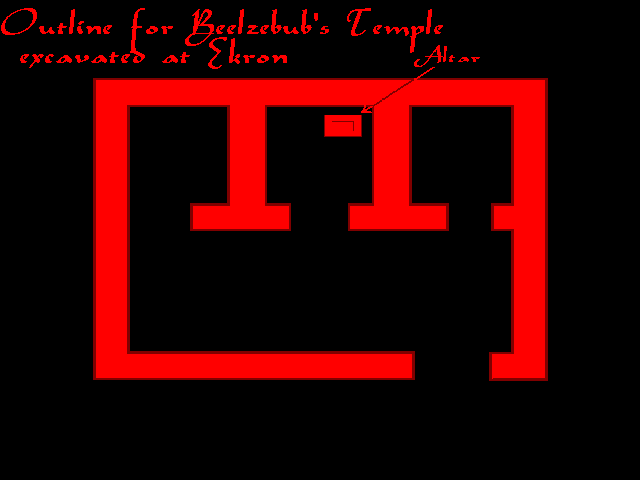
In the ancient Philistine city of Ekron, Baal-Zebul was worshipped as a god of healing. The biblical text itself (2 Kings 1:2–3) records that King Ahaziah of Israel, when severely injured, sent messengers to consult the oracle of Baal-Zebub at Ekron. This was not an act of desperation toward some minor figure: it was a pilgrimage to the most powerful healing deity in the region.9
Coleman South, Syria (1995):
"Baal Zebub, the Healing God of Ekron, later became one word, Beelzebub, which came to represent evil and idolatry in the New Testament of the Bible."
Baal-Zevul is best known as the God of the Philistines, ruling over the city of Ekron. The ancient Philistines worshipped him under the name "Baalzebub." Baal-Zevul is the "Lord over all that Flies." Wherever he was worshipped, he was known as a God of weather and meteorology. He also held dominion over the airways when the Nephilim descended to Earth. The Hebrews later distorted his name to mean "Lord of the Flies" as a means of desecration.
The reputation persisted into the New Testament period. When "Jesus" supposedly performed his healings, the people attributed the miracles not to him but to Beelzebul (Matthew 12:24, Mark 3:22, Luke 11:15). The Pharisees accused him of casting out spirits "by the power of Beelzebul, the prince of demons." This is a backhanded acknowledgment: even within the Yehuborim's own texts, Beelzebul is recognized as the supreme spiritual authority whose healing power dwarfs that of the fabricated Nazarene.
V. Baal-Zevul as Enlil of Nippur
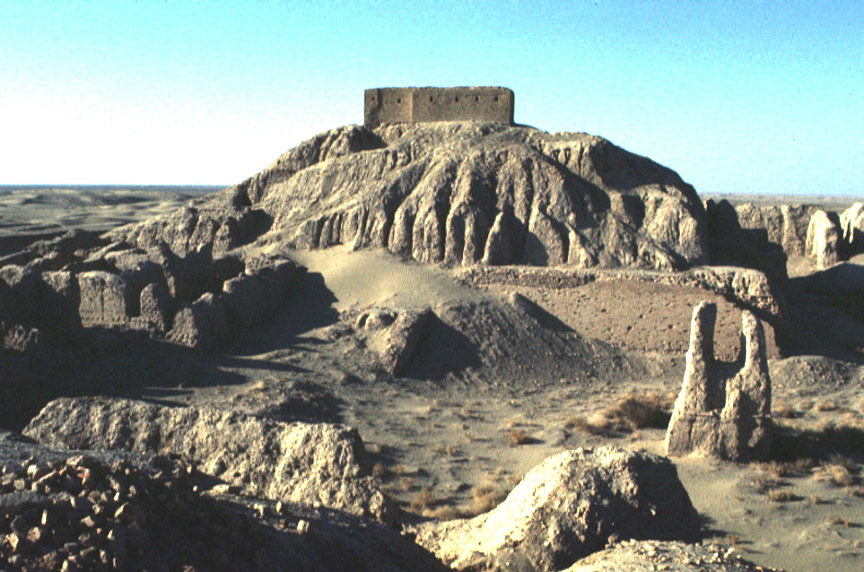
Baal-Zevul was known to the Sumerians as Enlil, "Lord of the Wind" (en = lord, lil = wind/air/breath). Enlil was the supreme deity of the Sumerian pantheon. His holy city was Nippur, in modern-day Iraq, where his great ziggurat E-kur ("Mountain House") stood as the most important religious center in the Sumerian world. His ziggurat in Nippur was called Fi-irn-bar-sag. His sacred number is 50.10
Baal-Zevul maintains order within the Temple and takes care of conflict and disputes between dedicated members. He can be very strict, as he does not approve of dedicated Temple members cursing each other. Among his many responsibilities, Baal-Zevul is also the Patron of the Orient (Far East). Martial arts and Asian culture have been deeply influenced by his spiritual current.
The Sumerian hymns describe Enlil as both a fearsome warrior and a gracious protector. He opens the gates of heaven to send rain upon the fields of his people. He raises impenetrable walls around those under his care. He sustains all life, from the greatest to the most humble. He defines the twelve signs of the zodiac, the year, the seasons, the months, and the signs of the heavens.11
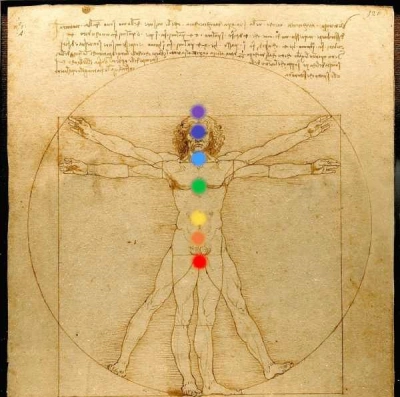
Enlil was endowed with "seven manifestations" of power, corresponding to the seven chakras. His emblem was a radiant scepter: both a symbol of sovereignty and a stylus through which he enacted divine will. He was protector and life-giver, yet when roused to anger against injustice, his fury was relentless and unstoppable.
VI. The Yezidi Connection: Pir Bub
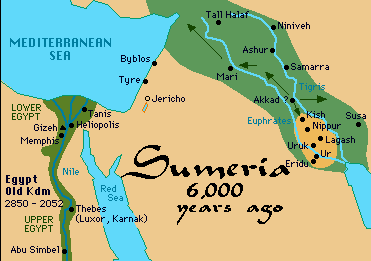
Among the Yezidi people of Iraq, often called "Devil Worshippers" by their persecutors, Baal-Zevul was known as "Pir Bub." The Yezidi identified him as the God of King Ahab and maintained continuous worship traditions connecting to the pre-Abrahamic Mesopotamian religion. Isya Joseph's Devil Worship (1919) documents this identification on page 40.12
The Yezidi represent one of the last surviving links to the original Mesopotamian theological tradition. Their persecution by Islamic extremists, including the genocide attempted by ISIS in 2014, is the latest chapter in the same war that has been waged against the worshippers of the ancient Gods for millennia.
From High Priest Zevios Metathronos:
"The significance of the title Baal translates to King or Master. Beelzebub has always been associated with kingship, rulership, cosmic order, and supreme authority. He has been revered as a high God in most Pagan civilizations, known by different names across cultures. To the Romans, he was Jupiter; to the Greeks, he was Zeus, both sharing the eternal qualities of thunder, weather control, kingly authority, and the bestowal of power and wealth.
He is a master of spirituality, granting spiritual gifts to his followers, which in turn lead to material prosperity as a result of deeper spiritual understanding. Beelzebub has been the driving force behind some of the world's greatest empires, both physically and spiritually advanced, as well as behind influential leaders and prominent figures who have significantly shaped human history.
He is the embodiment of authority, both worldly and cosmic. Throughout time, he has been a patron of many great and historically significant individuals, such as Alexander the Great. Beelzebub has been with us for aeons upon aeons."
VII. From Baal to Basileus: The Linguistic Bridge to Zeus
The title "Baal" (Lord/King) in the Semitic languages corresponds directly to "Basileus" (King) in Greek. The connection is not merely functional: it is cultural and theological. When Alexander the Great entered the Near East, he was hailed as "the son of Baal" in Phoenicia and "the son of Zeus" in Greece. Both titles conveyed the same meaning: sovereign authority derived from the supreme deity.13
The linguistic evidence establishing Zeus's identity across Indo-European languages is irrefutable. The word "God" in French (Dieu), Spanish (Dios), Italian (Dio), Portuguese (Deus), Romanian (Dumnezeu), Albanian (Zot), Lithuanian (Dievas), and Latvian (Dievs) all descend from the same Proto-Indo-European root *dyeu- that gives us the name Zeus. This is documented by Sihler (1995), Fortson (2010), Beekes (2010), and Mallory-Adams (2006).14
VIII. Beelzebul in the Bible: Fear Disguised as Contempt
Beelzebul is mentioned repeatedly in the New Testament, always in a context of fear. In Matthew 12:24–28, the Pharisees accuse Jesus of casting out demons "by Beelzebul, the prince of demons." Jesus's response is defensive. The passage reveals that Beelzebul's power was so widely recognized in the region that the population instinctively attributed miraculous healings to him rather than to the newcomer.15
In Revelation 2:13, the city of Pergamon is identified as "the place where Satan's throne is." This refers to the Altar of Zeus at Pergamon, one of the most magnificent monuments of the ancient world, now preserved in Berlin. The Christian author looked at the greatest throne of the greatest God and called it the throne of his greatest enemy. The identification is correct: Zeus is the being the Abrahamic traditions have called "Satan."16
Luke 10:18 records: "I saw Satan fall like lightning from heaven." The image is unmistakable: the thunderbolt, the defining attribute of Zeus, depicted as a fall. The Keravnos (thunderbolt) reinterpreted as a descent. The Lord of the Sky recast as a being cast down from it. This is the anatomy of inversion.17
IX. Entomancy and the Esoteric Meaning of Flies
Baal-Zevul is the God of Entomancy: divination through the behavior of insects. This art was practiced widely in the ancient Near East and Mediterranean. The association with "flies" has a deeper esoteric layer beyond literal entomancy.18
The buzzing, hissing, and vibrating sounds produced during chanting and vocal invocation mirror the auditory characteristics of insect flight. These sounds are the vehicle of Vril: bioelectric energy that manifests as tactile sensations during meditation, often described as "insects crawling on the skin." Zeus Myiagros does not lord over literal flies. He commands the vibrational frequencies of sacred sound that cleanse the soul and dissolve spiritual afflictions.
The "flies" that Zeus "drives away" (Myiagros) are pestilences: spiritual curses, physical illness, and social corruption. His healing power operates through resonance and vibration, the same forces that underlie all sacred chanting traditions from Vedic mantra to Hermetic invocation.
X. The Destruction Continues
In August 2015, fighters of the Islamic State destroyed the Temple of Baal in Palmyra, Syria. The temple, built in 32 CE and standing for nearly two thousand years, was one of the last physical monuments to Baal-Zevul in his original homeland. The destruction was filmed and broadcast to the world as a propaganda victory.19
The power of this God has been so immense that every effort by the forces of decay has been aimed at erasing his legacy from human history. They have destroyed temples, burned libraries, slaughtered worshippers, corrupted names, and rewritten history. They did the same to nearly every Pagan civilization they encountered.
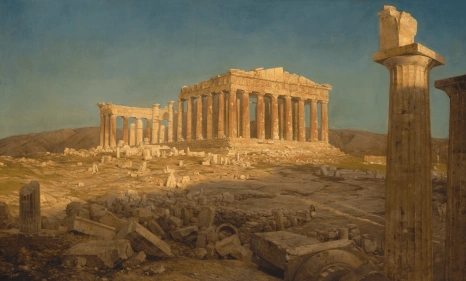
They have failed. The temples in Athens, Olympia, and Berlin still stand. The name lives in every Indo-European language. The word "God" itself carries his memory. And the Temple of Zeus has risen to restore what was taken.
XI. Sigils of Baal-Zevul
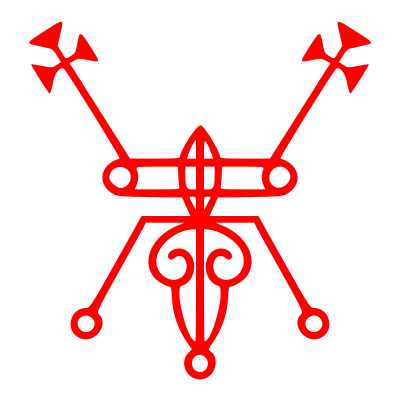
The sigils below are traditional seals associated with Baal-Zevul across various magical and spiritual traditions. The Egyptian hieroglyph for "air" and "wind" bears a striking resemblance to one of these sigils, reflecting the deep connection between Baal-Zevul/Enlil and the element of air. Baal-Zevul is the Prince of the Air.
Click HERE for larger sigil images.
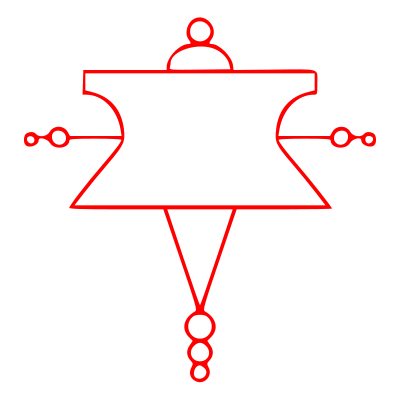
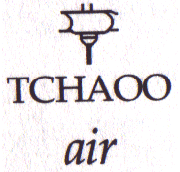
Many Yehuboric grimoires depict grotesque imagery alongside these sigils: monstrous portrayals designed to repulse and degrade. The ancient libraries that preserved the true knowledge were razed to the ground. The Christians and their predecessors were then free to blaspheme, malign, and slander the reputations of the original Gods without opposition. With no competing sources surviving, subsequent generations had no knowledge of these Gods beyond the distorted accounts found in Abrahamic scripture and the grimoires descended from it.
The lack of genuine information is staggering. Ancient peoples like the Avites, whose God was Adramelech, have virtually no surviving record outside the Judeo-Christian Bible, where the Hebrews brutally invade and commit genocide against them. The ancient libraries that were destroyed did not just hold occult and spiritual knowledge: they preserved history. This is a blatant example of historical erasure and the deliberate replacement of truth with falsehoods.
XII. Goetic Restoration
Bael is Zeus. The first spirit of the Ars Goetia is the supreme deity of the ancient world, wearing a mask placed on him by his enemies. The Temple of Zeus recognizes this identity and restores it. The name "Bael" is acknowledged as a Goetic designation originating in the grimoire tradition. The original and true name is Baal-Zevul, and his fullest identity is Zeus: Father of Gods and Men, Creator of Humanity, King of the Kosmos.
The same inversion was applied to every major deity in the Goetic catalogue. Apollo became "Azazel." Astarte became "Ashtaroth." Osiris became "Oriax." Ares became "Andras." Hephaistos became "Mulciber." The pattern is systematic, documented, and reversible. The Temple of Zeus has restored every one of these identities across its ritual pages.
- For the complete page on Zeus (theology, temples, epithets, philosophy, spiritual practice, and the full linguistic proof of his name): Zeus: Father of Gods and Men
- For the linguistic proof that the word "God" descends from the name of Zeus: Zevists: The Linguistic Evidence
Sources and Bibliography
- Encyclopaedia Biblica, Vol. I: A–D, ed. T.K. Cheyne and J. Sutherland Black (Macmillan, 1899). Entry: "BAALZEBUB." Etymology of Baal-Zebul as "Lord of the High House."
- Ibid. Full entry text establishing the Hebrew corruption of Baal-Zebul to Baal-Zebub.
- Herrmann, Wolfgang. "Baal." Dictionary of Deities and Demons in the Bible, ed. Karel van der Toorn, Bob Becking, and Pieter van der Horst. 2nd ed. Brill, 1999. Pp. 132–139.
- Pausanias, Description of Greece 5.14.1 (Zeus Myiagros at Olympia); Clement of Alexandria, Protrepticus 2.38 (cult at Elis).
- "Beelzebub: An Unfairly Demonized Deity?" Huffington Post, April 2016. Link.
- Anonymous. Lemegeton Clavicula Salomonis (Lesser Key of Solomon), Part I: Ars Goetia. 17th century compilation. Entry: "Bael."
- Weyer, Johann. Pseudomonarchia Daemonum (1577). Entry: "Baell."
- For the complete Goetic Restoration of ancient deity identities, see: Temple of Zeus Rituals, tozrituals.org.
- 2 Kings 1:2–3 (Ahaziah consults the oracle of Baal-Zebub at Ekron).
- Kramer, Samuel Noah. The Sumerians: Their History, Culture, and Character. University of Chicago Press, 1963. Ch. 4: "Religion."
- Radau, Hugo. Sumerian Hymns and Prayers to God Nin-Ib from the Temple Library of Nippur. University of Pennsylvania, 1911. Pp. 21–27.
- Joseph, Isya. Devil Worship: The Sacred Books and Traditions of the Yezidiz. Richard G. Badger, 1919. P. 40.
- Green, Peter. Alexander of Macedon, 356–323 B.C. University of California Press, 1991. On Alexander as "son of Baal" and "son of Zeus."
- Sihler, Andrew L. New Comparative Grammar of Greek and Latin. Oxford University Press, 1995; Fortson, Benjamin W. Indo-European Language and Culture. 2nd ed. Wiley-Blackwell, 2010; Beekes, Robert. Etymological Dictionary of Greek. Brill, 2010.
- New Testament: Matthew 12:24–28, Mark 3:22, Luke 11:15.
- Revelation 2:13 ("the place where Satan's throne is"). On the Pergamon Altar: Queyrel, François. L'Autel de Pergame. Picard, 2005.
- Luke 10:18 ("I saw Satan fall like lightning from heaven").
- On entomancy in the ancient Near East: Penglase, Charles. Greek Myths and Mesopotamia. Routledge, 1994. Ch. 7.
- "ISIS Destroys 2,000-Year-Old Temple of Baal Shamin in Palmyra." CNN, August 31, 2015. Link.