Dioskouroi
author: High Priest Zevios Metathronos
co-authors:
Karnonnos
The knowledge presented contains information for those who wish to consult the powers of the great mystical twins of the Greeks, the
Dioskouroi named Kastor and Polydeukes. The twins quickly became well-beloved Gods of the Roman
Empire as Castor and Pollux, commonly called the Gemini, the Castores or the
Tyndarids . Far to the east, they were also known as the ancient Ashvins of Vedic India, the powerful healing,
horse-riding deities Dasra and Nasatya . Deep into the Baltic forests, the duo were also known as the
Ashvieniai in Lithuanian folklore. During medieval times, they were rendered by the Yehubor into demons named Marbas and Orobas, as well
as the mystical pillars of Solomon, Boaz and Jachin.
Hieratic Information about the Dioskouroi
| Names |
|---|
- 2500BCE
- Dasra
- 800BCE
- Kastor
- 450BCE
- Castor
- Medieval era
- Orobas
|
| Divine Names |
|---|
|
The Kastor and Polydeukes Rituals above allow the Zevist initiate to engage with the twin powers of the ancient horse riders.
the diskouroi
The starry Diskouroi , the Divine Twins, are two of the most popular Gods of Antiquity. They were known as heavenly personifications of equestrianism, traveling, seafaring and the eternal saviors of those at sea. In particular, the duo were held from Homeric times 1 to be embodiments of two instances of St. Elmo's Fire or Helene, the recondite electrical phenomena created by a corona discharge on a rod-like or convex object, commonly witnessed by sailors at sea. 2 The two brothers emerged from a particular cycle of epics focusing around the divine birth of Polydeukes and the mortal birth of Kastor, as well as their tie to their sisters and female counterparts Helen and Clymenestra . On that account, Helen explicitly points out her brothers as two of the greatest commanders of the Greeks even in the ancient Iliad 3 which shows the great arcane heritage of the myth of the Twins, though in this case all of the siblings are of the same mortal father.
The twins were not just embodiments of a constellation but figures who regularly walked the hallowed ground of Olympus. Their worship involves
mysterious elements related to apotheosis beyond the mere surface of the story. 4 The Diskouroi were known as particularly helpful
deities to all classes of men who rescued the most imperiled of workers and travelers from all kinds of intractable issues. 5 That
was a major reason why both of them became popular deities among the people, often receiving by Roman times a major part of the public's
fixation on religion as a whole. Because of their perpetual link to horse-riding, they also served as examplar Gods for the traditionally
prestiguous horse riding aristocracies of ancient times, which in Greece were the orders of hippeis , often known as knights in
English conventions. 6
MYTHOLOGICAL TWINS
Legend has it that the two twins often do not have the same father, but they shared the same mother, Leda. Zeus, in the form of a swan, was rapt by the
Spartan queen Leda's beauty, and in the form of a swan rendered her with child as her husband, King Tyndareus (Taygetus in the Homeric Hymn), was off at
war. When she shared a bed with her husband, Leda consequently gave birth to two miraculous and large eggs. It was clear she had conceived quadtuplets;
she had produced two male twins, Kastor and Polydeukes in separate eggs, and two female, Helen and Klymnestra,. Uniquely, Hesiod's antique account in
the Theogony treats the quadruplets as all being children of Zeus. In subsequent accounts, it became obvious that Kastor from the
'mortal egg', regal as he was, shared the nature of Tyndareus, and the same as true of the beautiful Klymnestra who also cracked it open. 8
Polydeukes and Helen, marked by their surreal nature and emerging from the 'divine egg', were emphatically the divine offspring of the all-encompassing
Zeus. It is with Pindar's account in the Nemean Ode that this standard modality of the myth emerges, influencing all accounts later told. The two
brothers are in any case inseparable and beloved companions in childhood, with Kastor in Pindar's account being the more athletic, outgoing and
impulsive, a formula that Pindar contrasts ironically with his mortal vulnerability, yet the magnificent horseman is the more moderate of the two
according to the subsequent corpus of mythological exposition. Polydeukes gains fame as a youth as a boxer with divine fists, likewise an inheritance
from Homeric allusion in the Iliad.
The athletic contrast of the one twin who trains the external world by taming the horse with the other focusing on internal discipline of the body
through martial arts is there in all texts. Theocritus makes this distinction the most obvious and palpable in his characterization. Pindar associates
Castor with the horse race ( πποδρομαις 𝜋𝜋𝜊𝛿𝜌𝜊𝜇𝛼𝜄𝜍), linking him to the prestige of equestrian excellence, while he gives Polydeukes the share of the
the dog race ( κυνοδρομαις 𝜅𝜐𝜈𝜊𝛿𝜌𝜊𝜇𝛼𝜄𝜍) in the Ishthmian Ode. The ancient poet also hints at their Olympian symbolism elsewhere:
Tenth Nemean Ode, Pindar
Κάστορος δ' ἐλθόντος ἐ π ὶ ξενίαν πὰρ Παμφάη
καὶ κασιγνήτου Πολυδεύκεος, οὐ θαῦμα σφίσιν
ἐγγενὲς ἔμμεν ἀεθληταῖς ἀγαθοῖσιν· ἐ π εί
εὐρυχόρου ταμίαι Σ π άρτας ἀγώνων
μοῖραν Ἑρμᾷ καὶ σὺν Ἡρακλεῖ διέ π οντι θάλειαν,
μάλα μὲν ἀνδρῶν δικαίων π ερικαδόμενοι. καὶ
μὰν θεῶν πιστὸν γένος.
But given that Castor and his brother Polydeuces came for hospitality to the home of Pamphaës, it is no wonder that they have inborn ability to be good athletes, because those stewards of spacious Sparta, along with Hermes and Heracles, administer their flourishing allotment of the games and are very solicitous for men who are just. Yes, truly the race of the gods is faithful.
A distinct mythology of theirs, the most ancient of their adult myths, deals with the episode of the Calydonian boar prior to the outset of the
Trojan wars, which was sent by Artemis to ravage the region of Calydon after its king Oeneus had failed to give unto her the proper rites. In
this episode, the two are introduced as adjacent warriors to an ancient coterie of heroes; Apollodorus lists them along the catalog of hunters.
Ovid introduces Castor and Pollux as being knights on snow-white steeds. However, much like in the Iliad, they play no major role, and this
sequence sets up the subsequent adventure of the twins to the island of Amycus on the ship of Argos.
In most stories of the Argonauts, the two became enlisted among the sailors of the great epic. Apollonius marked the twins as elite figures tied
to Leda and Sparta at the outset of the story. When confronted by the bestial and brutal giant Amycus, Polydeukes accepts the boxing challenge
and defeats Amycus in a long and detailed bout. Kastor assists by helping arm him before the match, and then kills one of the attacking
Bebrycians in the melee afterward, but this does not occur in other renditions, and of the two, Polydeukes becomes marked as a distinct
character in Apollonius' narrative. Outside of his story, the relevance of both of the twins in the narrative fades from view because of the
generally episodic nature of each challenge, with some exceptions. The highly symbolic Orphic Argonautica develops Kastor's character as a
winner of a horse race for the funeral games of the island, of Amycus an account not found elsewhere, and joins his brother in a ritual with
Medea and Jason. Valerius Flaccus represents him watching the bout with the giant in icy fear of his divine brother's death and leading the
celebrations and prayers at the meal commemorating the victory of his twin; he also works as a messenger to the soldiers when negotiating with
King Aeetes and distracts the Colchians with his light, nimble horse.
The main narrative involving the Twins is the one that leads to the end of Kastor's life. A quarrel starts with the Apharetidai, their cousins named Ida
and Lynkaios, the two powerful twins of Sparta's traditional enemy, Messenia. The sons of Apharaios were also the other set of twins present on the
Argos. Pindar nominates their quarrel as being driven by pure hatred and a quarrel about cattle originating from Idas' mind, with Kastor ultimately
being impaled by Idas' spear in the melée. The other accounts note the reason for the quarrel being a dispute over the wives or fiancées of the
Apharetidae, Phoebe and Hilaeira, The Dioskouroi either boldly carry the two wives off or rob the fiancés of the two women of the right to marry them,
leaving them in ordinate outrage. In the account of Theocritus, the death occurs due to a duel between each set of twins. In the fragmentary retelling
of Stanisius of Cyprus, the two are actually caught stealing the cattle of their cousins. Dualistic symbolism is heavily laden into this mythological
account. In the end, every retelling of the story emphasizes Polydeukes' rage at seeing his brother lay dying, a matter that provokes him to kill
Lynkaios violently. The dangerous circumstances prompts Zeus, fearing for the wellbeing of his great son, to send a thunderbolt to destroy Idas.
Ultimately, Polydeukes is raised to the heavens to be in the presence of the great Olympians.
THE APOTHEOSIS
Tenth Nemean Ode, Pindar
θερμὰ δὴ τέγγων δάκρυα στοναχαῖς ὄρθιον φώνασε· “Πάτερ Κρονίων, τίς δὴ λύσις ἔσσεται πενθέων; καὶ ἐμοὶ θάνατον σὺν τῷδ᾿ ἐπίτειλον, ἄναξ. οἴχεται τιμὰ φίλων τατωμένῳ φωτί· παῦροι δ᾿ ἐν πόνῳ πιστοὶ βροτῶν καμάτου μεταλαμβάνειν.”
Bathing his face in hot tears, he cried aloud in a piercing voice:
Father, son of Cronus, what release shall there be from sorrows? Lay death upon me also together with him, lord. The honour of a man laid low
departs with him from his friends; and few among mortals are faithful in hardship, to take upon themselves a share of another’s toil.
ὣς ἤνεπε· Ζεὺς δ᾿ ἀντίος ἤλυθέ οἱ, καὶ τόδ᾿ ἐξαύδασ᾿ ἔπος· “Ἐσσί μοι υἱός· τόνδε δ᾿ ἔπειτα πόσις σ πέρμα θνατὸν ματρὶ τεᾷ πελάσαις στάξεν ἥρως. ἀλλ᾿ ἄγε τῶνδέ τοι ἔμπαν αἵρεσιν παρδίδωμ᾿· εἰ μὲν θάνατόν τε φυγὼν καὶ γῆρας ἀπεχθόμενον αὐτὸς Οὔλυμ πον θέλεις <ναίειν ἐμοὶ> σύν τ᾿ Ἀθαναίᾳ κελαινεγχεῖ τ᾿ Ἄρει,
ἔστι σοι τούτων λάχος· εἰ δὲ κασιγνήτου πέρι μάρνασαι, πάντων δὲ νοεῖς ἀποδάσσασθαι ἴσον, ἥμισυ μέν κε πνέοις γαίας ὑπένερθεν ἐών, ἥμισυ δ᾿ οὐρανοῦ ἐν χρυσέοις δόμοισιν.” ὣς ἄρ᾿ αὐδάσαντος οὐ γνώμᾳ διπλόαν θέτο βουλάν, ἀνὰ δ᾿ ἔλυσεν μὲν ὀφθαλμόν, ἔπειτα δὲ φωνὰν χαλκομίτρα Κάστορος.
Thus he spoke; and Zeus came before him and uttered this word:
“You are my son; but thereafter a mortal man, approaching your mother, shed his seed, a hero. Yet come now: of these things I wholly grant
the choice to you. If, escaping death and loathsome old age, you yourself wish to dwell upon Olympus with me, and with Athena and
dark-speared Ares, this lot is yours. But if you contend on behalf of your brother, and intend that all things be divided equally between
you, then half your time you shall breathe beneath the earth, and half in the golden halls of heaven.”
So he spoke. But Polydeuces did not set his heart upon a double counsel: he released from death the eye, and thereafter the voice, of
bronze-armored Castor.
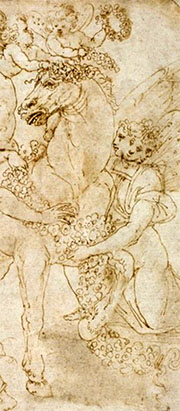
When Polydeukes enters the halls of the heavens, the twins are, for varying reasons, generally given the opportunity to dwell in Olympus for one day, and
in Hades for the other. Pindar's most ancient Ode of Nemea attributes this squarely to brotherly love on the part of
Polydeukes, as above, an instance of one of the most beautiful, poignant pleas in Antiquity, recognized as such by the denizens of that world
themselves. Hyginus' poetic account in his anthology of mythological stories says that Polydeukes received a star from Zeus, which he begged to have
shared with his beloved brother Castor, a plea that Zeus granted his assent to.
Following PIndar's account, one of the major conventions is that both would dwell in the heavens one day and the grave the next. Other traditions,
contrastingly, claimed one brother would spend time in Olympus and one in Hades, never appearing as twins yet linked by a mysterious
mechanism always. The mystery of the divine knights as being heavenly and chthonic-alike was another cryptic element of their cult which excited the
imagination of the people.
Alexandra, Lycophron
καὶ τοὺς μὲν Ἅιδης, τοὺς δ᾽ Ὀλύμπιοι πλάκες
παρ᾽ ἦμαρ αἰεὶ δεξιώσονται ξένους,
φιλαυθομαίμους, ἀφθίτους τε καὶ φθιτούς.
The one Hades shall take; the other the Olympian meadows shall forever receive as guest, day after day, brothers bound in loving blood, both deathless
and yet mortal.
There were, however, notably diverging accounts of just how the twins achieved their dwelling amongst the heavenly cohort. One of the major ones is of
Diodorus Siculus, because he ties the nature of their shared rising to the Godhead to the feat of riding on the Argos and participating in the
adventures of the Argonauts instead, tying two narratives together, despite the surviving Argonautic corpus showing them having rather limited roles.
Another fragment of his says they were elevated to godhead because of their "exceptional valor" that far surpassed all other mortals. Alcman, a Spartan
poet, states they built a house beneath the earth where they dwelled forever.
It was also recalled in the annals that Zeus elevated the two to the stars, making them the constellations of Castor and Polydeuces, together being the
sign of Gemini.
THE WORSHIP OF THE TWINS
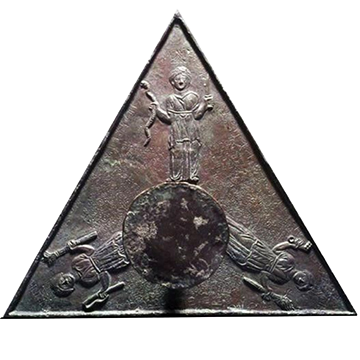
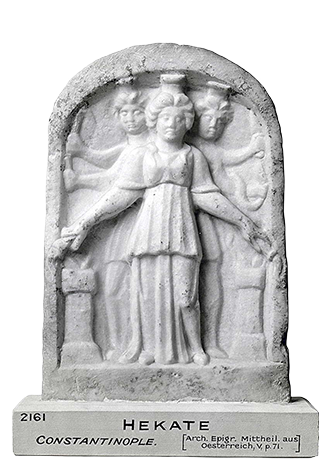
It was said the tradition of portraying Hecate in the form of a triple goddess originated with the great sculptor of divine forms, Alcamenes, as
Pausanias attests. 28 The general motif of a triple Hecate converging from a pole, known as a hekataion, was used at the shrines of
crossroads as well as at the entrances to temples and even homes. This convention also spread into pottery and wall paintings. One thing this is
evocative of is the trimester of pregnancy in women and the three major components of the uterus. Prior to modern imaging techniques, the conception of
a baby was mysterious and scarcely understood. For those women seeking to conceive, Hecate was inquired of and strongly associated with the goddess of
childbirth, Eileithyia, whose temple was placed adjacent to that of Hecate. 28 The trimesters of fetal development also relate to a larger
allegory of human evolution. One of the symbols she is strongly equated with is the spiral triskelion and, by extension, the equilateral triangle.
29 30 For the triskelion (also a symbol of Thoth in its more active sense), this was equated with her ability to destroy,
create, and maintain. She was also associated with 666, relating to the acquaintance of the higher self, and with the 60-degree angle.
Like Abraxas, Hecate was known to hold keys, which is reflected in one of her titles, Kleidophoros (roughly "Key-Holderess"). Such keys held the
designated recipe for practicing successful magic, but also the key to developing as a stronger being and to the boundary zone of the underworld
itself.
She was associated with numerous poisonous and noxious plants like garlic 31 , aconite 32 , possibly belladonna 33
, mandrake (otherwise associated with Venus) 34 and kinds of herbs often used in cosmetics, medicines and for subversive purposes, and
Didorus Siculus' highly questionable account even claimed Hecate discovered these poisons while being a queen of the Tauric Chersonese; other authors
show Medea crediting Hecate with picking the deadly herbs of the Colchian fields. 35 Garlic as a noxious allium is surprisingly associated
with cleansing properties, and can even be used to ward off severe infections like MRSA: the dualistic nature of garlic is much like the 'rotting'
Hecate's oppositional symbolism as a primordial deity of soul cleansing. Wolfsbane or aconite was often used to manufacture poison arrows to kill wolves
and crazed dogs; aconite was also used for assassination purposes. Belladonna leads to dilation of the eyes, a common trick to make oneself beautiful
throughout the centuries, as if an act of immediate magic.
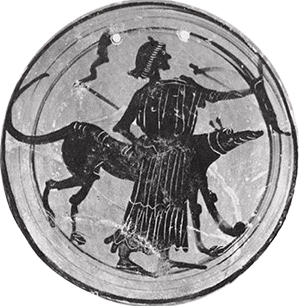
Hecate with dog, Museum der Universität Tübingen
Loyal dogs to their owners, particularly female dogs, are a symbol of Hecate, which Euripides describes as a sacred animal of hers. 36 Dogs
were used to dig up the mandrake plant, 37 which was also used for both cosmetic and darker purposes. Female dogs can be erratic,
emotionally sensitive, and independently minded, with a territorial edge toward other canines. Yet there is a sweeter and more contemplative side to
them compared to their generally boisterous male counterparts, related to the psychic sensitivity of dogs. Their cycle of being in heat consists of
proestrus, estrus, and diestrus. As an extension of the above concepts of motherhood, female dogs also fastidiously care for their young, who are
extremely dependent on their mother and require a quiet environment to thrive. The faithfulness of dogs is also echoed in the canine myth. Lycophron
claims that the dog following Hecate was Queen Hecuba of Troy, who had thrown herself into the sea in despair after seeing the bodies of her children
and was transformed into a familiar due to Hecate's estimation of her loyalty. Much like with Anubis and Cerberus, the symbolism of the dog was
suggestive of a faithfulness to life itself. Hecate is often depicted next to Cerberus, and one meaning of the keys she holds is to signal safe passage
without being savaged by him.
The other major animals who were constantly by her side were European polecats 38 , ancestors of modern ferrets. When Hera attempted to
prevent the birth of Hercules by having the goddesses of childbirth (Eileithyia and the Fates) sit with crossed legs and fingers, Galanthis tricked them
by shouting that the baby was born. The startled goddesses jumped up, breaking the spell, and Hercules was delivered. As punishment for her trickery,
the goddesses turned Galanthis into a polecat. According to Antoninus, Hecate felt pity for her comrade and appointed the polecat as her sacred
attendant or "sacred servant." Polecats pierce the skulls of other animals and leave them, still living, in their burrows for consumption. They are also
silent and habitual occupiers of the dens of other animals, being known as one of the worst pests to farmers imaginable for their sneakiness. These
animals also secrete a foul-smelling liquid to delineate their territory. Polecats are also far-seeing animals with exceptional vision and scent
capabilities. Due to these behaviors, they were considered to be thoughtful yet malicious animals with an appropriate understanding of the past and
future, suitable attendants for the Goddess of Time, who could put their powers to better use.
Another major animal is the lion, 20 who serves as a companion for Hecate in deeply occult contexts, and the serpent, which is often
represented growing out of her forearm or even her head. On vases and in statuary, Hecate was commonly represented carrying two torches and sometimes
possessing dualistic symbolism. These torches represent the ida and pingala, but also carry a nuanced meaning of patiently finding one's way through the
labyrinth of civilization, illusions, and distractions to arrive at the authentic higher self. Gripping the two torches requires balance: distraction
and carelessness lead to the torches being snuffed out, and losing oneself in darkness.
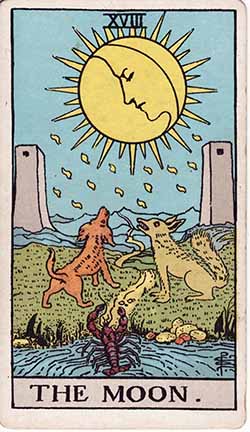
In Tarot, Hecate is associated with the Moon card, alongside Hera and Aphrodite [Artemis]. For a very long time, the Moon card has been represented as a
dog and the wolf barking at the Moon between two towers and a road, with a crab emerging from the water in the foreground. This card is representative
of things not being what they seem; it can deal with emotional and psychic liminality and the unexpected manifesting into the concrete. It can also
represent being trapped in delusions, or needing to work on psychic powers to gain full control of prophecy. Earlier representations showed two men with
compasses gesturing at the Moon, or Artemis alone.
Biblical context
In the Bible, Hecate is represented as the Witch of Endor. In Hebrew, she is elaborated as the 'ob (Light) of En Dor. This terminology of the 'ob has
connections in Kabbalah to insect symbolism, hinting at the synergy of powers she shares with Khepri (note the connection to the Egyptian 'ib, or heart
amulet, associated with Khepri). The Hebrew king named Saul had
long since passed a decree to murder all soothsayers in the Israelite kingdom. However, during a time of desperation following the death of Samuel, he
decided to consult a witch known for her powers of communing with spirits, who remained in Endor, as the entity YHVH had not answered any of his pleas.
The witch summons the spirit of Samuel, who admonishes Saul (Samuel also admonishes the Israelites for practicing divination in life) and claims he and
his sons will soon die for disobeying the command of the so-called Jewish deity to destroy the Amalekites or Gentile peoples (1 Samuel 28:18). The
predicted death comes to pass, as Saul is defeated by the Philistines in battle. This part of the Bible relates to commands given to Yehuboric
rabbinical circles never to consult diviners or show sympathy to outside peoples. Doing so guarantees the destruction of Israel. Metaphorically, it also
conveys the meaning of the crossroads of the right choice, which Saul falls victim to. Some modern Jewish scholars cited in academic texts note the
overtones of the text as having necromantic meanings relating to the ancient symbolism of the trivium. 40 The Greek translation also makes
this explicit: in the Septuagint, the witch is called ἐγγαστρίμυθος (belly-talker), a title for mediums in the Classical world. 41
Hecate in the medieval context
Hecate features in a wide variety of Christian writings that denounce her worship, and the worship of the trivium, as extremely dangerous and evil. Audoin
42 in the 7th century warns against placing votive objects, while Byzantine sources indicate efforts to stamp out her worship as late as
the 11th century at crossroads in Greece. She was also maligned due to her close association with Aphrodite in the form of Artemis. Consequently, she
remained one of the most famous pagan Gods altogether during medieval times.
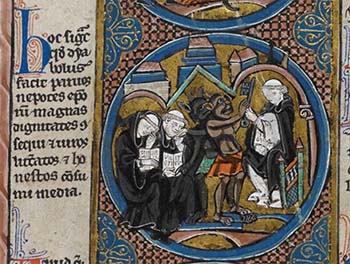
‘Daemons’ with keys, Harley MS 1526 f.4v
As Hera was more exclusively denounced by the Yehuboric in their circles, and the public worship of Aphrodite was torn down, while other Goddesses became
associated with symbols such as cats, Hecate functioned as a visible, human-bodied shorthand for Goddesses in general, partially due to her ambiguous
portrayal in surviving Greek and Roman works. The Christian imagination portrayed her as the patroness of all witches and the black mass. One of the
most famous portrayals of her is in Macbeth, which both the playwright William Shakespeare and the master Bacon contributed to. The two writers were
influenced by a recent religious tractate (Daemonologie) by King James. He wrote a Puritanical treatise on the Witch of Endor, 43 stating
his fear of demonic forces and witches, asserting that magick was absolutely real and that the interpretation of many contemporary Protestants claiming
it was not, was incorrect. The Weyward Sisters (commonly known as the Three Witches) function as Hecate’s servants, bringing visions to the evil-minded
Macbeth and the ill-fated Banquo. They speak pointedly, in analogy to the Goddess’s contradictory attributes:
Macbeth, William Shakespeare 44
Fair is foul, and foul is fair…
Although the play portrays Hecate as a force, it correctly shows her admonishing the Sisters for playing with Macbeth for their own amusement. Furious,
she pledges to push Macbeth toward his destiny by her weapons and designs. In the end, he sees a vision of the children and wife of Macduff murdered at
his command before he himself is cut down. The writers carefully portrayed Hecate as not merely deploying magic for the purpose of chaos, but for the
purpose of drawing out evil, subtly contradicting the Jacobean perspective:
Hecate's speech in Macbeth, William Shakespeare 44
He shall spurn fate, scorn death, and bear
His hopes ‘bove wisdom, grace, and fear.
And you all know, security
Is mortals’ chiefest enemy.
Hecate is also mentioned in A Midsummer Night’s Dream and King Lear. She is considered to be important to witches and modern practitioners of magic. A
peculiar kind of modern testament to Hecate’s influence appears in many horror films or survival genre media, often in the personification of the ‘final
girl,’ perhaps beginning with Britomart in The Faerie Queene (an allegory for Elizabeth I) and Mina Harker in Bram Stoker’s novel Dracula. Such girls
and women in media must use their minds and observational skills and sometimes the powers of magic to outwit a murderous one stalking them or to survive
in a dangerous environment that threatens to collapse on them. Many of these themes also overlap with the mythological trials of Psyche, a related
goddess.
Bibliography:
1 The Library, Apollodorus
2 Pergamon Altar
3 Homeric Hymn to Demeter
4 Terracotta bell-crater (bowl for mixing wine and water) , The
Met
5 The Goddess Hekate: Studies in Ancient Pagan and Christian Religion & Philosophy, Volume 1, eds Stephen Ronan
6 The Odyssey, Homer
7 Hesiod, Theogony
8 Suppliant Women Aeschylus
9 Fragment 216 of Aeschylan play (Semele)
10 Medea, Euripides
11 Trojan Women, Euripides
12 Fragment 23, presumed to be by either Sappho or Alcaeus
13 Root-Cutters, Sophocles
14 Hekate Soteira: A Study of Hekate's Roles in the Chaldean Oracles and Related Literature, Sarah Iles Johnston
15 Helen, Euripides
16 Elegies, Propertius
17 Magical Hekate, J.E. Lowe
18 Selinunte , Italy, NYU: The Institute of Fine Arts
19 Divine Heiress: The Virgin Mary And The Creation of Christian Constantinople, Vasiliki Limberis
20 Hecate: An Anatolian Sun-Goddess of the Underworld, Charles W. Steitler
21 Stratonikeian decree, Sanctuary of Hecate at Lagina
22 Geography, Strabo
23 Lagina frieze with Hecate and Zeus Panamaros
24 Anaplus of the Bosporus, Dionysius of Byzantium
25 Orphic Hymn to Hecate
26 Suda
27 Thesmophoriazusae, Aristophanes
28 vc
29 Greek Magical Papyri
30 The Face on the Moon, Plutarch
31 Characters, Theophrastus
32 Library of History, Diodorus Siculus
33 Enquiry into Plants, Theophrastus
34 Argonautica, Apollonius Rhodius
35 Argonautica, Valerius Flaccus
36 The Peliades, Euripides
37 The Jewish War, Flavius Josephus
38 Metamorphoses, Antoninus Liberalis
40 The Necromancer of Endor (1 Samuel, 28): Body, Power, and Transgression in the Visual Construction of Witchcraft, Cristina Expósito
de Vicente
41
ἐγγαστρίμυθος , Logeion, University of Chicago
42 Vita Eligii, Eloi
43 Daemonologie, King James I of England
44 Macbeth, William Shakespeare