 አማርኛ
አማርኛ العربية
 বাংলা
বাংলা Български
 中文
中文 Čeština
 Dansk
Dansk Deutsch
 Eesti
Eesti Ελληνικά
 Español
 Français
 हिन्दी
 Hrvatski
 IsiZulu
 Italiano
 日本語
日本語 Kiswahili
 Magyar
 Македонски
 नेपाली
 Nederlands
 فارسی
فارسی Polski
 Português
 Română
 Русский
 Slovenščina
 Suomi
Suomi Svenska
 Tagalog
 Türkçe
The Layers Of The Soul
by High Priest Zevios Metathronos
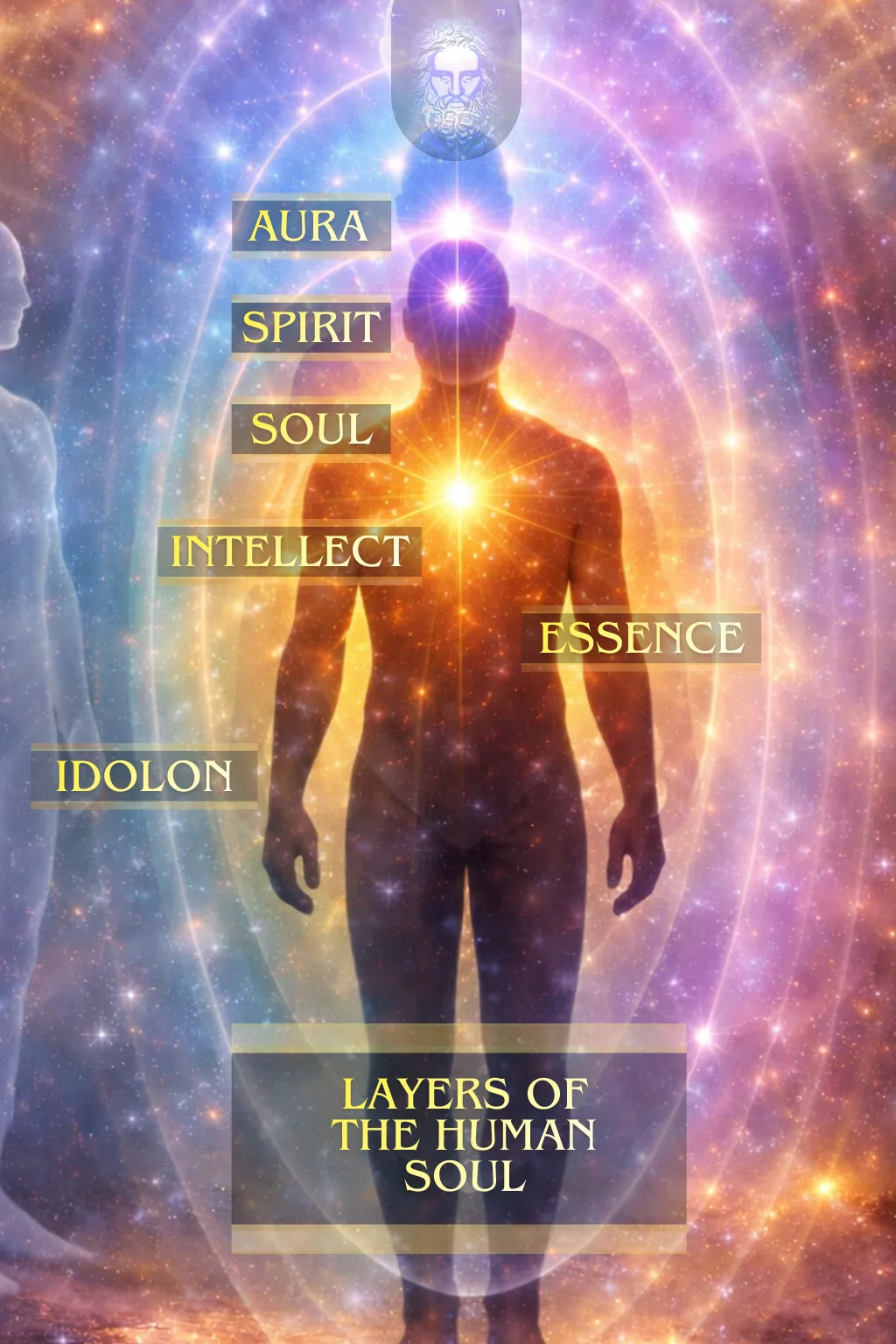
BODY - Soma (σῶμα): The physical vessel. This is known in English as the “Body,” the material, flesh body. The foundation is the Soma (σῶμα), the physical body. This is the vessel of flesh, bone, and blood, the tangible anchor to the material world. For the Greeks, the Soma was not inherently evil, but it was the most base and perishable component of the self. It is the vehicle through which we experience the physical world, the instrument for action, and the source of our appetites and sensations. Its purpose is to serve the higher principles, to be disciplined and maintained so that it does not become a prison, but a well-tuned instrument for the soul's journey. Without the Soma, the higher principles have no means of expression in the physical realm.
SOUL - Psyche (ψυχή): The animating principle of life and emotion, containing within it the fiery Thumos (emotions), spiritedness. This is essentially the seat of all your emotional powers and your “heart,” but also the basic chakra and nadi system above the material body. Animating the Soma is the Psyche (ψυχή), the Soul. The Psyche is the principle of life itself, the animating force that distinguishes a living being from a corpse. It is the seat of the emotions, desires, appetites, and courage. It is the "lower soul" that is intrinsically linked to the body and its survival. The Psyche is what feels anger, fear, passion, and hunger. It is the engine of personal will and the source of our character in a worldly sense. While powerful, it is often depicted as being in a state of conflict, pulled between the demands of the Soma and the guidance of the higher Nous.
MIND/INTELLIGENCE - Nous (νοῦς): The faculty of divine reason and logic, which, when perfected in the world, becomes Phronesis (φρόνησις), Practical Wisdom. This is the “Mind,” or what we refer to as the Mind. Rising above the tumult of the Psyche is the Nous (νοῦς), the Intellect or Divine Mind. The Nous is the faculty of true reason, wisdom, and higher understanding. It is not simply the ability to calculate or perform logical tricks; it is the capacity to perceive the eternal Forms, to grasp universal truths, and to apprehend the divine order of the cosmos. The Nous is the "eye of the soul" that looks upward toward the heavens. It is the immortal spark of reason within us that can align itself with the cosmic mind. The goal of the philosopher and the initiate is to allow the Nous to govern the Psyche and master the Soma, bringing the entire being into a state of rational harmony.
The above three interplay in their activity. When the interplay is advanced and improved, the following can be given rise to:
SPIRIT - Pneuma (πνεῦμα): Advanced levels of fully evolved soul and mind are combined. The divine, immortal spark. At the apex of this hierarchy is the Pneuma (πνεῦμα), the Spirit. While Pneuma literally means "breath" or "wind," in a philosophical and mystical context, it signifies the divine essence, the immortal spark of the cosmos that resides within the individual human. It is the fragment of the divine fire, the breath of the Gods that was inhaled at birth and is exhaled at death, returning to its source. The Pneuma is the ultimate source of life and consciousness, the very principle that allows the Nous to function and the Psyche to animate the Soma. It is our deepest connection to the Gods, the immortal core of our being that transcends earthly life and seeks to reunite with the divine All. To awaken the Pneuma is to realize one's own divinity.
AURA – ΑΥΓΗ, meaning “The Radiant Glow” (αὐγή): The sum of parts of the whole soul, an energy, egg-shaped field that surrounds the whole being. The word “Αυγή” in Ancient Greek has two meanings, one hidden and one obvious. In one, it means “Dawn,” which is the form of radiance or the association of light. In the other, a shape meaning form, it means “egg-shaped form,” that is, what we call in the West the Auric Field. The Aura is a term that is used by Western occultism for the energy field of a person; this field is supposed to be the sum that emanates from the person and surrounds all their bodies. The Aura, therefore, reflects everything that is going on in the individual entity that it surrounds. The mystical traditions were profoundly concerned with the subtle, radiant energy field that surrounds a living being.
Miscellaneous Parts of the Soul:
ESSENCE (Ουσία): The essence of being is one of the most important and difficult terms in all of Western philosophy. It translates to "substance," "essence," or "being." It is the fundamental reality of a thing, that which makes it what it is, independent of its accidental qualities. It is the answer to the question, "What is this thing, truly?" For example, the Ousia of a bronze statue is not its particular shape or color, which can change, but the underlying bronze and the form of "statue-ness" that gives it its identity. In the context of the self, each level has its Ousia. The Ousia of the Soma is its physical matter. The Ousia of the Psyche is its capacity to animate. The Ousia of the Nous is its power of rational thought. The ultimate goal for many philosophical and mystical traditions was to align one's personal Ousia with the Ousia of the divine consciousness, the divine, eternal substance of the universe itself.
ETHERIC DOUBLE (εἴδωλον): The shade-like image that remains after death, a shadow of the embodied self. The concept of the Eidolon explains the deep Greek tragedy of death. To die was not necessarily to be annihilated, but to be diminished to a mere Eidolon, a whisper of one's former self, deprived of the warmth of the Soma and the fire of the Psyche. It is the ghost in the machine, the personality's lingering after-image once the animating and divine principles have departed.
The “Chariot” Of The Soul: 3 Layers of Consciousness
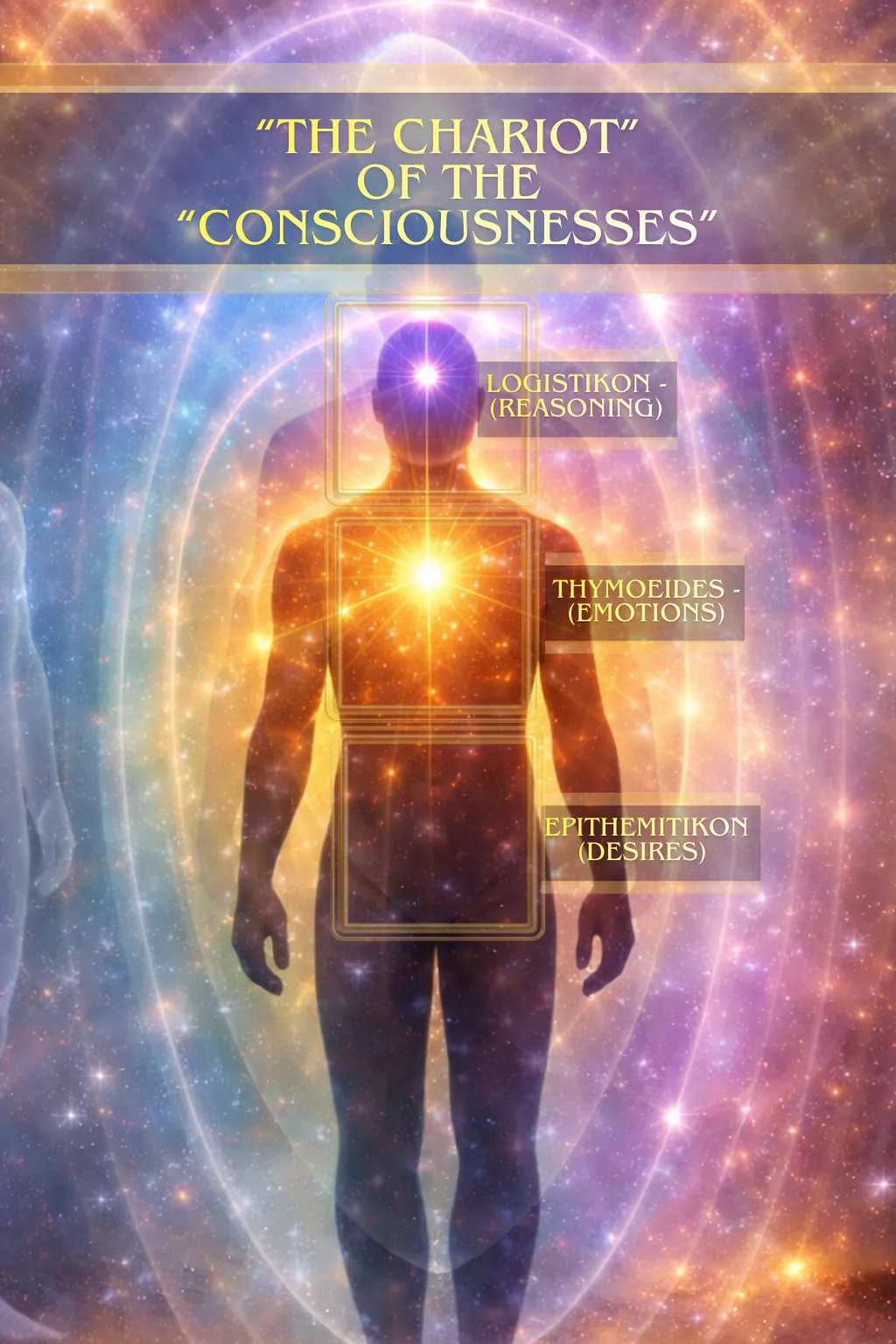
Plato's Allegory of the Chariot portrays the human soul as a charioteer struggling to control two opposing horses. The charioteer, the black horse, and the white horse must ascend into the heavens together. The Charioteer represents the rational soul (Logistikon), whose goal is to guide the chariot toward the divine heavens. One horse is the noble and spirited steed (Thymoeides), which provides courage and honor and aids the ascent when properly guided. The other horse is the ignoble and appetitive steed (Epithymetikon), a brutish creature that embodies earthly desires and constantly seeks to drag the chariot down into indulgence and chaos. The soul's journey is a constant, violent struggle for the Charioteer to master the ignoble horse with the help of the noble one, for only through this difficult discipline can the chariot ascend to behold the ultimate truth, while failure results in the soul being dragged back down, never to ascend.
- The Logistikon (λογιστικόν): The Rational Part | DIVINE REASONING
Location: Top of the head, 3rd eye/6th Chakra, Throat Chakra
This is the Logistikon, the "rational" or "calculating" part of the soul. It is the faculty that loves truth, seeks knowledge, and strives for wisdom through reason. This is the part of the soul that can perceive the eternal Forms, understand mathematics, and grasp the nature of reality. It is inherently aligned with what is good and just, not through emotion or convention, but through pure logic and insight. This logic does NOT mean left-brain logic, but rather “truthful” logic. The Logistikon is the divine charioteer in Plato's famous chariot allegory, whose role is to guide the entire being toward the heavens of truth.
- The Thymoeides (θυμοειδές): The Spirited Part | HIGHER OR LOWER EMOTIONAL REASONING
[DEPENDING ON TRAINING OF THE MIND]
Location: Heart and Solar Plexus Chakra
This is the Thymoeides, the "spirited" or "courageous" part of the soul. It is the seat of Thumos (θυμός), the seat of the emotions. This is the source of our anger, indignation, honor, courage, and ambition. The Thymoeides is not inherently good or evil; it is an ally of the Logistikon when properly trained. It provides the drive and the nerve to enforce the decrees of reason. When you feel a surge of righteous anger at an injustice or the courage to stand up for a principle you know to be true, that is your Thymoeides acting in concert with your Logistikon. If untamed, it becomes the source of aggression, rashness, and a desperate need for validation.
- The Epithymetikon (ἐπιθυμητικόν): The Appetitive Part, Source of Desire | [LOWER REASONING,
SURVIVAL INSTINCTS AND NEEDS]
Location: Loins, lower abdomen, belly
The Epithymetikon is the "appetitive" or "desiring" part of the soul. It is not “good” or “bad” by definition; it is the lowest form of the mind responsible for procreation, survival, and living power. At the same time, if not controlled or left to act on its own, it can sink one's spiritual potential. It is the source of all our physical and base desires: hunger, thirst, lust, and the craving for material wealth and comfort. It is the part of the soul concerned with the satisfaction of bodily needs and pleasures. In Plato's chariot allegory, the Epithymetikon is the unruly, dark horse that constantly tries to pull the chariot down toward the earth, toward instant gratification and sensual indulgence. The purpose of this aspect is to be guided by the higher aspects, so that all these drives can help someone ascend higher and not fall into the mud of the earth.
PLATO’S PARABLE: THE CHARIOT OF CONSCIOUSNESS
The Rational Soul (Logistikon)
At the heart of the allegory is the Charioteer, who represents the Logistikon (λογιστικόν), the rational part of the soul. The Charioteer’s task is to guide the chariot upward, toward the heavens, to behold the true reality of the Forms, especially the Form of Beauty. He is the master of reason, the seeker of wisdom, and the only part of the soul that has glimpsed the divine realm and remembers it. His goal is to maintain control and steer the chariot toward its ultimate destination, but he is constantly challenged by the two vastly different horses he must drive.
The Noble Steed: The Spirited Soul (Thymoeides)
One of the horses is a magnificent, noble creature. This horse represents the Thymoeides (θυμοειδές), the spirited part of the soul, the seat of Thumos. This steed is strong, beautiful, and well-bred. It is driven by a love of honor and a sense of shame. It instinctively understands the Charioteer’s goals and, with proper guidance, will strive upward toward the divine. It provides the courage, the drive, and the righteous indignation needed to overcome obstacles. When aligned with reason, this horse is the Charioteer’s greatest ally, providing the power to ascend.
The Ignoble Steed: The Appetitive Soul (Epithymetikon)
The other horse is a crooked, ugly, and unruly brute. This horse represents the Epithymetikon (ἐπιθυμητικόν), the appetitive part of the soul. This steed is obsessed with earthly desires: lust, gluttony, greed, and instant gratification. It is stubborn, lazy, and violently resists the Charioteer’s attempts to pull the chariot upward. It constantly tries to drag the chariot down toward the earth, toward indulgence and base pleasures. This horse is the source of all inner conflict, the voice of temptation and base instinct.
The Journey and the Struggle
The allegory depicts the soul’s life as a journey. The Charioteer struggles to control the two horses. The noble horse tries to help, while the ignoble horse fights him at every turn. Most souls, Plato argues, are unable to keep their chariot on the divine path. The ignoble horse overwhelms the Charioteer, the chariot crashes back to earth, and the soul is forced into a mortal body, forgetting the vision of truth it once had. Only the soul of a true philosopher, the one who has mastered the ignoble horse and aligned the noble one with reason, can successfully make the journey to the heavens and behold the Forms.