Nephthys
author: High Priest Zevios Metathronos
co-authors: Karnonnos, Arcadia, Lucius
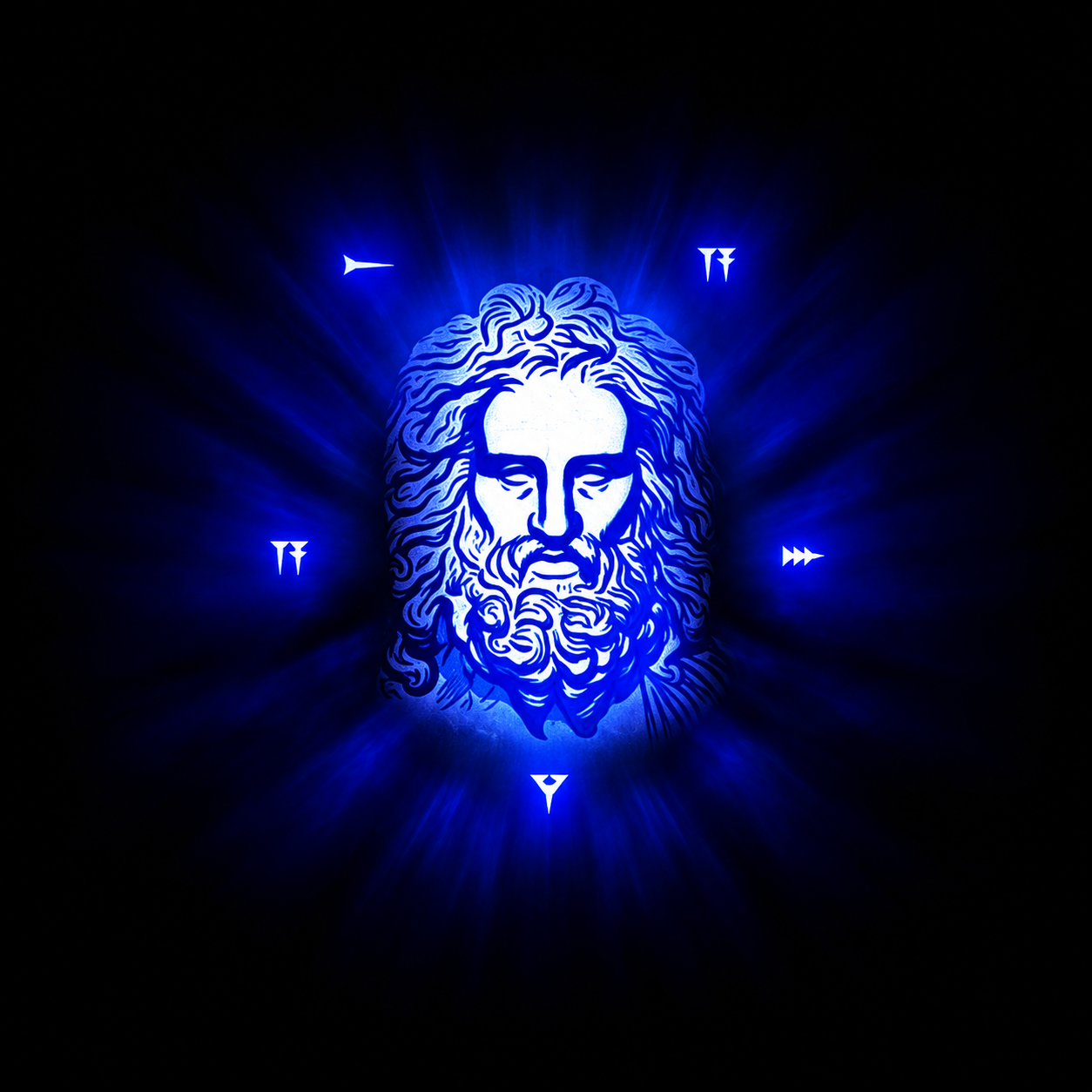
The knowledge presented contains information for those who want to understand the great Goddess of Darkness known as Nephthys,
also known in Greek mythology as the great Olympian deity of the heavens, Hestia. Nephthys is a member of the Great
Heliopolitan Ennead of Egypt, being a supreme deity of supernal and extreme importance. In the Goetia, she was labeled as the demon
Bathin. Her other divine names are presented below:
Hieratic Information about Nephthys
| Divine Names |
|---|
- Nephthys
- Neb-Hathith
- Neb-Hut
- Nahbhit
|
The Ritual above is a major way to engage in the mysteries of this Goddess, the sister of Isis, the solemn, sacred Queen of the
astral realms and the afterlife.
NEPHTHYS
Nephthys is an extremely important goddess ruling over very important processes of Life and Death. She is one of the foremost
Goddesses, and it is no exaggeration to say Nephthys' prominence in all facets of Egyptian religion was second only to Isis and
Hathor. Although Nephthys is considered to be a highly mysterious and enigmatic Goddess in the contemporary imagination due to a
general lack of understanding of her symbolism, the records of the Egyptian household, palace, temple, tomb, hieratic document, and
various sets of sacramental objects all have her imagery emblazoned upon them. Even as far back as the Old Kingdom with its
mysterious texts of the pyramids, Nephthys played a highly prominent role tied to the Pharaohs1, and this means that her
divine pedigree is assuredly of great antiquity.
Understanding why this is the case means understanding part of the intrinsic relationship of Isis and Nephthys. Their association
conveys the duality of of life and death. The pair are constantly portrayed together. Nephthys is referred to as being the
sister2 and daughter of Isis, but additionally as the minister, the midwife, the nursing mother, and the twin of Isis. In
addition, much of Nephthys' public worship was relationally positioned in regard to the temple cults of Osiris, and her few physical
chapels tend to correspond with the larger complexes of Set, relating strongly to the mythological tetrad of divine figures who give
way to the birth of Horus that Plutarch famously elaborated upon.3
Utterance 553, Pyramid Texts: 4
My mother is Isis, my nurse is Nephthys.
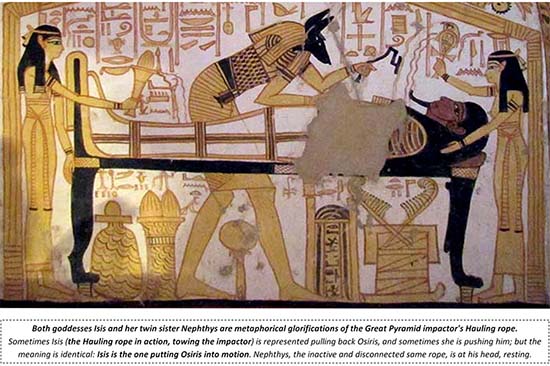
Nephthys is identified as part of a dyad with Isis in kite form as early as the Pyramid Texts.5 The two sister Goddesses
became inextricably associated with the lamentation rituals of Egyptian funerals and holiday periods. The high-profile mourning
events hosted in the temples of Osiris started to grow into rather complex, stratified events during the Middle Kingdom6;
during this time, the mourning events were incontestably important for the health of civic religion. Proceedings by the Ptolemaic
period give off the impression that the rituals were of an even higher importance, because they left behind a backlog of documents
like the Bremner-Rhind Papyrus7 describing in immense detail the patronage, preparation and precision necessary for the
organizers to pull them off.
Historians interpreting this paper trail quickly comprehended the importance of the Osirian lamentation rituals. Late–Ptolemaic
Osirian liturgies preserved in the Bremner-Rhind Papyrus, whose instructions for performance specify the consecration of the temple,
give step-by-step instructions for the ritual preparation of the two women representing Isis and Nephthys (purity, depilation, wigs,
and naming inscriptions on the upper arms), then provides sung strophes timed to specific festival dates in the Khoiak season at the
Osiris temple of Khentamenti (Abydos), and these holy rites would involve lamenting the strewn Osiris of the great mythology.
Dressed as Isis and Nephthys and by obligation free of bodily and spiritual defect, the two female priestesses (She of the
Kites) were regularly chosen to also conduct funerary rites in a very dramatic manner to ensure the soul of a deceased
person would continue to live peaceably in funerary contexts 8. The main living role of Nephthys was viewed in these
enactments of the divine play by the average Egyptian eye.
Numen (Vol. 5), C.J. Breeker: 9
A close study of this material must lead to the conclusion that the religion of the ancient Egyptians consisted mainly in the
performance of certain sacred actions, from which religious salvation was expected. The effect of these cultic actions depended
on their immanent mythical value. To the Egyptian mind, religiosity was not bound up with the knowledge of a certain doctrine
but with the celebration of certain rites that were somehow rooted in myth.
Nephthys did not have major temple complexes, and given her immense antiquity in Egyptian religion, this fact may seem strange.
However, smaller, modest temples and chapels dedicated to her still existed across Egypt, particularly encased in the complexes of
Set. The site at Sepermeru, for instance, is representative of a type of building dedicated to her. It is assumed by the design
aspects that these chapels have a strongly mortuary bent to them, being places of silence and contemplation. Her priesthood of these
places was important but seeemingly modest, which the Wilbour Papyrus hints at as a source.10 The papryus shows that
there was both a prophet and priest of the House of Nephthys in Sepermeru established by Ramesses II during the time of his
successor, Ramesses V. By the Late and Ptolemaic periods, she had further chapels at Edfu and Philae, and a temple dedicated to her
and Anoukis at Esna.11
Her name in Egyptian, Nebot-Het, means 'the Delineation of the House' or, more simply, 'the Mistress of the House.' The word 'house'
is used interchangably with 'temple' in Egyptian language. Nephthys was considered to embody the inner spiritual sanctum of the
home. There exists a not insignificant amount of evidence that Nephthys was worshiped privately in households, and in urban life,
the amulets commoners wore with her likeness testify to a Goddess whose presence was represented through private and public
symbolism on the breast of the people. Nephthys was known in some ancient Egyptian sacral theologies as the "Helpful Goddess" or the
"Excellent Goddess".12
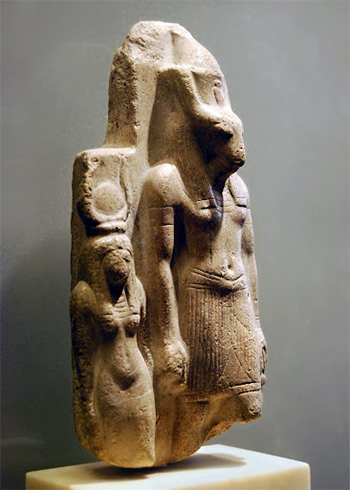
As a Goddess, she is married to Set. This marriage also contains several mysteries tied to the theme of the home. Following
on from defeating one's purely basic nature (one of the themes of Set), in taking a step into the boundaries of the Temple
via initiation and opening the Chakras, one's former life dies. The door to the state of ignorance is forever closed: the
Temple after Initiation is the new house of life. Set therefore represents the husband ushering in the devotee to the new
house of life, while Nephthys represents the wife of the household ready to welcome a sacred guest.
The character of Nephthys as the Ǫueen of the Dead or Ǫueen of the Night in accordance to her marriage to Set
is another aspect of her powers, a different type of hieratic function relating to her role in the astral realm. This
relates to her endeavors in Egyptian mythology to wall up the cave of Set so he cannot approach, similarly recounted in
numerous divine myths of infernal couples across the planet.13 Both the home and death represent a private sphere
of life with boundary lines and threshholds often connected to motherhood and creation, as in the symbolism of the 4th House
in Astrology. The ultimate point of such symbolism is that Nephthys is the ultimate guide to the souls of the dead on the
astral, which is her realm. Her helpfulness in the eyes of Egyptians is tied to the assistance she gives in death, and her
presence was used to mark the boundary zone of temples, tombs, and other sacred places. Nephthys was therefore commonly
represented on one of the two pylons (pillars) opening a temple, while Isis would be represented on the other. For any
worshiper entering the temple, Isis and Nephthys would appear as the Queen of Life and the Queen of Death, respectively, to
greet them. Both pylons would be aligned with the horizon.
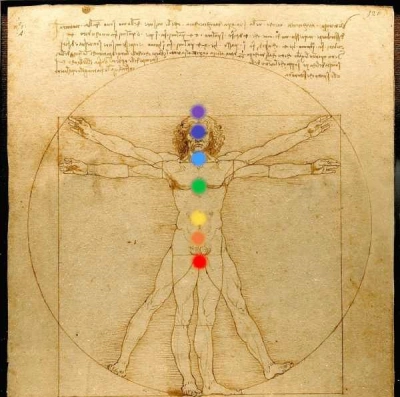
Nephthys is understood by Egyptologists to be the Goddess of the Air. The Chakra of Venus, the Middle Chakra, is ruled by air and
fire. This Chakra deals with using the astral body. The symbolism of levity and death connected to this Chakra (upon death, one's
soul exits the body through it) is in parallel to Nephthys' rulership of the lower realms of the Astral, where many of the dead
inhabit, a realm that only a few living people have access to. In Egyptian religion itself, Nephthys was often called upon to
intercede and protect the souls of the dead in front of Ma'at. In the guise of a protector and oath-beholder, she is represented as
having the wings of a kite and blessing the Pharaoh, analogous to the inscriptions at Philae. 14
In tandem, Set rules over elements of the visible world, which is a world with the majority of humanity totally blinded in ignorance.
Consequently, Set and Nephthys are equated with the underworld, darkness, and the night, being one of the male and female principles
of these matters in the same manner that Thoth and Seshat represent knowledge.
As the Ǫueen of the Dead, Nephthys is notably associated with Isis and Anubis who came to be known as the child of
Nephthys3. As the product of Nephthys and Osiris' affair in mythology, Anubis becomes the Lord of the Dead and enacts the
decrees of the two deities, carrying out all the bindings and synchronicities involved in life and death. These include the union of
matters necessary for the individual to continue incarnating, like matters of race and health, a parallel to the internal processes
that Nephthys creates in the soul for the 'Second Birth.' Many other mystical processes are associated with Nephthys who, is also
called the 'Binderess' and 'Nurse' in Ancient Egyptian. She represents many processes and alchemical matters of uniting the body and
soul together for the 'Second Birth,' a process overseen by Isis. In this context, the House of Nephthys does not merely represent a
physical place but the body and soul itself, supported by the pillar.
She is associated often with Seshat, enacting her decrees of reality and acting as a deputy to the Goddess of Fate.
Symbolism
Firstly, the visual symbolism of Nephthys being the identical twin to Isis shows a code involving the Ka or astral body, which is the
ethereal 'twin' of the mortal living body and moulds itself to the shape of the physical body in each incarnation. Often, the most
visible difference is in the colors of their clothing, with Isis wearing brighter and Nephthys wearing darker tones.
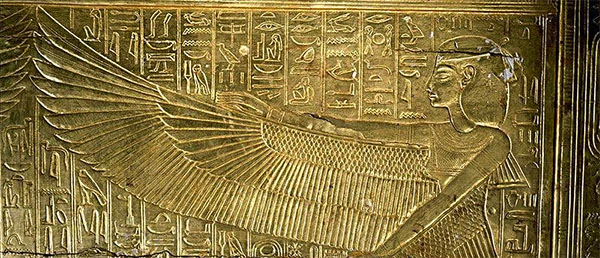
As with Isis, Nephthys was represented by the kite and shown with wings, representing levity and the ability to project in
the astral. Unlike Isis, however, Nephthys was distinctly associated with scavenger birds and the harsh desert. This
sprawling desert represented the 'domain' of Set and Nephthys, with Set ruling during the day and Nephthys at night. She is
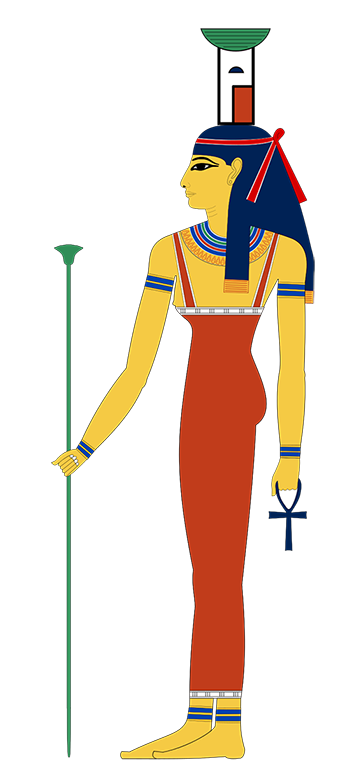
portrayed with the symbol for the boundary and basket representing the active connection of the soul atop her head, while
Isis wears a throne. The basket and house components of Nephthys name show the Grail of the Solar Chakra after the dew of
the Pineal Gland is activated and drips onto it. In line with this, Nephthys is associated with the spitting flame.
Nephthys' headdress and the Hieroglyph of Nephthys' name represent another code. If you look closely, it resembles a pillar
and a pylon in itself.
In an Egyptian tomb, the King and Queen meditation is represented. Here, Isis and Nephthys anoint Amon Ra, representing the
Solar Chakra and major life-force being activated via the dew of the Pineal Gland. Priest Alexandros Iowno pointed out that
the heart shape inside the human head is also given as a code by the arms of the Goddesses.
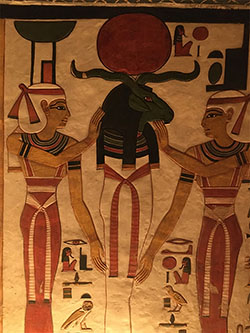
Isis and Nephthys with Amon Ra-Khnum
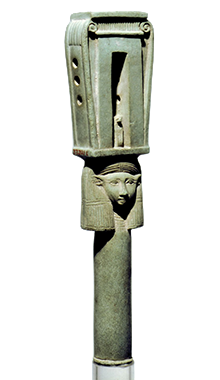
As Plutarch records3, both Isis and Nephthys were typically shown on the sistrum with one face of Isis on one side
and the other with Nephthys' likeness, often interchangably with Hathor. Nephthys is also occasionally shown with the crown
of Ma'at adorned with two feathers, illustrating the ability for her to intercede for the dead and hinting at her ability to
essentially be anywhere on the astral, which is of the essence of both Isis and herself.
Nephthys is shown playing the sistrum in obesiance to Hathor at the temple of Edfu, showing a kind of mystical relation of
the great instrument to the gradual procession of female deities in Egyptian religion.15 The Temple of the
Sistrum was referenced as the birthplace of Nephthys altogether. Some images at Edfu and Dendera also show Nephthys
receiving beer from the Pharaoh16, which is held to be symbolically connected to many of the sistrum and dance
festivals of the Red Land.
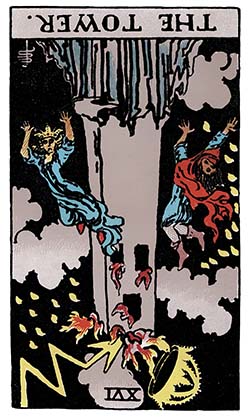
The Major Arcana card of Nephthys is the Tower reversed. Often, this card deals with a refusal to confront an issue, just as
the pillar-like Tower stays in its place suspended from the sky, even as it is struck by lightning. When dealing with a
dramatic event for the querent, this card is about rebuilding from the foundations of a disaster, distilling something to
its purest essence. Alternatively, it can mean narrowly avoiding these scenarios, or the disaster being a trick of the mind,
compared to the outright devastation of the upright card.
This card was called ‘the House of God’ in the past as noted on the page of Bastet, and the reversed form is one of the most cryptic
cards. Visually, the card shows this confusing nature, lightning striking from below and people falling upwards is almost
oxymoronic. The fate of the crowned and bejeweled figures who jump from the sinister structure likewise becomes more mysterious.
Whichever way, the Tower reversed beckons the querent to confront the darkness. In alchemy, it relates to the breaking of the
vessel, but the reversed version deals with its reconstitution.
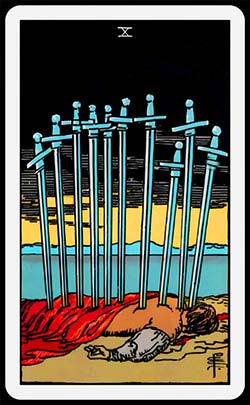
The Minor Arcana card is the Ten of Swords, another card conveying the absolute end of a situation in a thoroughly negative sense.
The man, laying on the ground, is impaled by ten swords, with one of his arms bent, his index and middle fingers positioned
gesturing towards a crimson shroud enveloping his body like a wave, just as the tumultuous black sky gives way to the citrine dawn.
His head is fixed to the earth. In the background, there is a still body of cyan water and mountains meaning that even in
destruction, calm will descend.
The end card of the Swords sequence is one of the most negative of all Tarot cards and relates to the devastation involved in an
upcoming or unfolded situation. The dawn imagery shows there is still hope, just as Nephthys assists the fallen ones. Part of this
card relates to secret insights only the Goddess can give.
HESTIA
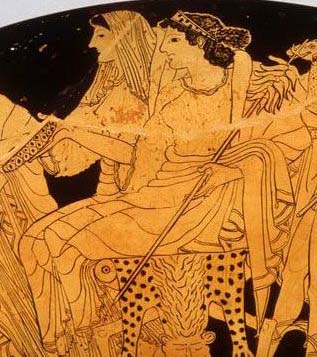
The Great Goddess Hestia represented the hearth, the family and the inner life of all people in Ancient Greece. Visual depictions of her were
rare, yet her functions were so intertwined with daily life that she occupied a prime place in the minds of those in touch with the divine. She
is known as one of the Twelve Olympians, making her a most important Goddess, yet her cryptic and modest symbolism is perhaps difficult to
interpret. Hestia was interpreted as maintaining the fire of the Gods on Olympus, and consequently she was forever fixed to one place. The
Greeks often substituted her place among the twelve with Dionysus and vice versa, which, in itself, is a mystery that has deeper implications
about the nature of perfection.
Mythologically, Hestia was said by the ancient Homeric Hymn of Aphrodite17 to have been the youngest of the Gods. She is described as
a ‘queenly maid’ that Apollo and Poseidon both sought the hand of, but she spurned both of them, touching the head of father Zeus to swear by
oath that she would never marry and would remain a steadfast maiden forever.18 Paradoxically, being the Goddess of the household, she
became identified with the hearth. She was connected primarily to a variety of rituals in Greek society for the people and the state, Hestia
represented the all-important starting and ending rite. Any new endeavor would start with a thorough offering to her first and last,
characterized by the Homeric hymns as pouring wine:
Homeric Hymn to Hestia: 19
Hestia, in the high dwellings of all, both deathless Gods and men who walk on earth, you have gained an everlasting abode and highest honor: glorious
is your portion and your right. For without you mortals hold no banquet, where one does not duly pour sweet wine in offering to Hestia both first
and last.
In ancient Greece, every single home contained a sacred hearth, so every home contained a dynamic shrine to Hestia.18 The state afforded
Hestia the title of the bearer of the household hearth and ‘the inner circle’. The presence of this space within a Greek household meant a commitment to
certain responsibilities; guests had to be well-treated and to treat their hosts well under oaths to Hestia and Zeus Xenios.1920
To violate this sacred right either way meant severe penalties. She was invoked rigidly before meals and during celebrations but also during times of
grave commemoration, and families would even offer a portion of their food to Hestia during these times as the ‘greatest share’.19.
Orphic Hymn to Hestia: 21
To Hestia, Fumigation from Aromatics. Daughter of Kronos (Cronus), venerable dame, who dwellest amidst great fire's eternal flame; in sacred rites
these ministers are thine, mystics much blessed, holy and divine. In thee the Gods have fixed their dwelling place, strong, stable basis of the
mortal race. Eternal, much formed, ever florid queen, laughing and blessed, and of lovely mien; accept these rites, accord each just desire, and
gentle health and needful good inspire.
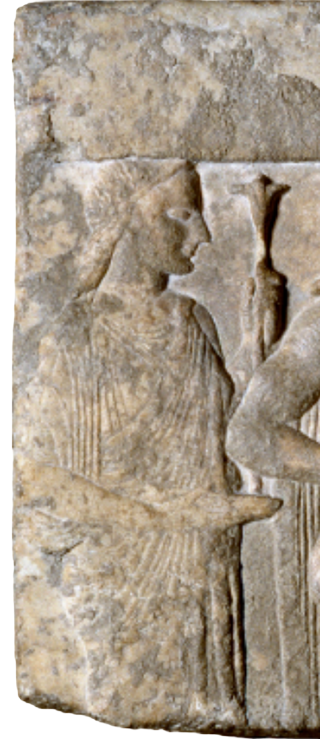
Hestia’s domestic cult also marked important family ceremonies. One ritual to mark development of the family was the Amphidromia,22
the ceremony to welcome a newborn infant into the household. On the fifth or seventh day after birth, the father would carry the infant in a
circle around the hearth, “running around (amphi-dromia) the hearth”, in a symbolic presentation of the child to Hestia and the family
ancestors, legitimizing the child as a citizen.2023 The association with both children and fire may indicate why Hestia
was held to be the caretaker of the holy house of Apollo19 Beyond the household, her influence radiated to the community level. Every
Greek polis maintained a public flame as the symbolic center of the community, and this was consecrated to Hestia.24 The public
hearth usually burned in the Prytaneion, the executive building, which was considered her primary sanctuary in the city and one of the holiest
areas of any urban space, an area where foreign dignitaries were received and where the prytan, essentially a mayor of a locality, served.25
Hestia lent her name to the civic houses hosting sacrificial banquets, the hestiatoria, close to the temenos of the temple. Banquets at the
prytaneia and hesiatoria became meeting places of the most important personalities in any state during civic triumphs and state
funerals.26 At Athens’ bouleuterion and in other Greek cities, cults of Zeus Boulaios and Hestia Boulaia were focal points in
deliberative civic buildings.
Aelius Aristides described the hearth as the vocal point of the entire Greek world.27 Additionally, any colony of the Greeks had the
flame of its motherland laboriously carried to the colony’s hearth and lit to signify continuity.28 All in all, the humble hearth
served as microcosm of the family, while its civic equivalent’s solemn flame was a symbol of the lifeblood of the community and race, while her
enduring flame was a symbol of the stability that was a necessity to keep this going smoothly. Suffice to say, the Greeks saw the diminution of
either fire as a dangerous omen because letting the hearth flame die out was not merely a practical inconvenience, it was an indication of
religious failing or sign of incumbent mass catastrophe.
But if the fire had been polluted by the presence of nefarious foreigners occupying a city, it was ordered to be snuffed out and relit.29 Due
to her presence in households, temples to Hestia in the Greek world were mostly sparse. According to the ancient sources like Pausanias in his travels
through Greece30, sacred complexes dedicated to her were simple by design and lacking in any sort of ornamentation or embellishment that
would distract from specifically serene contemplation at Priene, Delphi and other cities. The sole temples of Hestia at Sparta and Hermione were
unadorned other than having an altar.31 The records of inscriptions at the British Museum demonstrate that another temple to her existed in
the Piraeus,32 while an important center of religious worship was Entella in Sicily among a colony city of Greeks.33 Subtlely, it
was said every temple ever built had a mysterious element dedicated to her, something continually reaffirmed throughout Antiquity.33
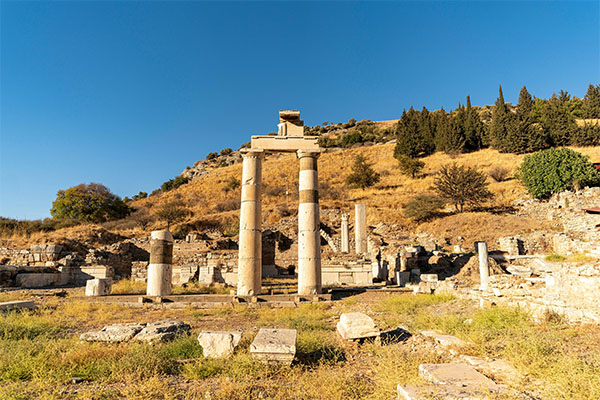
Prytaneon ruins, Ephesus
One of the most important cult sites of hers in contradiction to this austere trend was in Ephesus where a site was dedicated to Hestia
Boulaea.34 The Ephesian Prytaneion was constructed in the form of a temple with a grand hall and Doric-columned courtyard, while this
courtyard was paved with a mosaic depicting the shields of Amazons, exceptionally ornate in its design. Continued maintenance of this flame was
considered to be of strategic importance by the inhabitants of that great city. It served both religious functions and civic ones. The flame of Hestia
burned on its altar for centuries, and in the presence of the fire of the Goddess the city continued its eminent prergoative. Unlike the centralized
priesthood of Vesta in Rome, her priesthood was multifocal and varied throughout the Hellenistic world, though it appears that the Ephesian priesthood
of hers was the most important under the Curetes,35 who were primarily associated with Artemis but carried out many attested functions of
Hestia in that city and by a certain point moved to the Prytaneion. A large amount of women achieved priestly significance in Ephesus,36 as
an inscription from a Roman priestess called Claudia Trophime, a priestess of Hera and Hestia, indicates how Hestia was essentially beyond description
and beyond myth:
Ephesos 2058, inscription of Claudia Trophime: 37
αὕτα καὶ μακάρεσσιν ἐπήρκεσ’ ἐν εὐφροσύναισιν,
αὕτη καὶ θαλερὸν φῶς κατέχει πατρίδος·
ἁδυτάτα δαῖμον, κόσμου θάλος, ἀέναον φῶς
ἃ κατέχεις βωμοῖς δαλὸν ἀπ’ οὐρανόθεν.
κλεψιποτεῖ Πείων τὸν ὑπ’ ἠέρος ὄμβρον ἐν αὐτῷ
χωρῶν εἰς λαγόνας πρὸς πελάγους μέγεθος·
πῶς δέ τις ἄν σε φράσειε, θεόκτιτον ἃ κατέχεις φῶς,
σώζουσ’ ἐν σεαυτῇ λείψανον εὐμετρίης;
She too brought joy even to the blessed immortals in their gladness;
she too keeps watch over the flourishing light of her fatherland.
O sweetest Daemon, blossom of the ordered world, eternal flame,
you who hold upon your altars the torch sent down from heaven.
Paean drinks in secret the rain that falls from the sky into himself,
passing into his hollows, vast as the measure of the sea.
How could anyone ever declare your nature, you who hold the God-built light,
preserving within yourself the measure of perfect harmony?
Of the Goddesses, she is said to reign most vigilantly over the lot of mortal men:
Homeric Hymn to Aphrodite: 17
In all the temples of the Gods she has a share of honour, and among all mortal men she is chief of the Goddesses.
Owing to her status as a fixed and immovable being in conclusion, the episodes of Hestia in mythology are comparatively scarce in general. She was
swallowed by her father Cronus first and spat out by him last.18 As stated at the beginning, is said that when Apollo and Poseidon requested
her hand in marriage, she refused and touched the head of Zeus, activating his protective aegis. Even when the Typhon attacked Olympus, she did not
flee. Throughout the mythological record, she was known as an eternal virgin who was unable to be bent by the wiles of Aphrodite and Eros, alongside
Artemis and Athena. Other mythological stories involving her are indicative of Vesta and only by inference involve Hestia.
SYMBOLS
Every symbol relating to Hestia was related to the inner life of people and the family. Above all, she powers what is stable and enduring in life, the
basic necessities of sustenance that continue to keep the material world in place. Her name itself means simply ‘hearth’, but in the Greek language that
also became an alternate word for family or household.38 Socrates speculated that it was connected to the verb ‘estin’, or ‘to be’, in
Ancient Greek.39 It was also said, elsewhere in the Socratic dialogues of Plato, that he claimed Hestia alone resides eternally in the house
of the Gods at Olympus, untainted by contact with those below; she is the font of living.40 Thus it can be said that the public faces of
Nephthys and Hestia in each holy culture have a dualistic symbolism.
Nemean Ode XI, Pindar: 28
Daughter of Rhea, guardian of parliaments, Hestia, sister of all-highest Zeus, and of Hera who shares his throne, welcome with goodwill to your
sacred hall.
The flame was her most important symbol. Fire itself as a natural element is strange and unique, wherever a single flame may be quashed, fire itself can
be generated again by repeated friction. Earth, water and the air cannot be generated like this; nor can electricity be accessed with such ease. This
allusion is a hint about her eternal presence everywhere. Unlike Hephaestus, her flame was rigidly natural.Her sacred animal was the pig, which was
exhibited at the ancient Thesmophoria festival across Greece.41 Pigs are enormously beneficial animals for any civilization. A pig does not
necessarily need an accompanying field or the purchase of farmland to thrive. A single pig can remove harmful waste or food excess by consumption, its
body parts can be used for any sort of cooking, clothing, cosmetics, and weaponry, and the animal is a vouchsafe for any kind of famine due to the
flexibility involved in keeping its meat impervious to spoilage. Nothing was as beneficial to a family’s safety worldwide as possessing one. Another
symbolic aspect of the pig is that, unlike other even-toed hooved animals, they give birth by lying fixed in place, and of course, unlike what
the Yehubor slander claims, they are hygienic and fastidious animals.
Classical conventions of Hestia on vases tended to show her as clutching the chaste tree (agnos) branch sitting down or in a procession involving other
Goddesses. She also often sits upon a simple and rustic wooden throne or chair, demonstrating her simplicity, watchfulness and contentment. In his
Natural History, the Roman naturalist Pliny the Elder noted that Athenian girls would scatter the leaves of the chaste tree on their beds strictly
during the Thesmophoria to "quench the fire of lust" and preserve their chastity.42 The cooling idea rather cryptically interpreted Hestia’s
role as the virgin keeper of the hearth's flame for a committal purpose. The chaste tree symbolized the Goddess’ energetic virginity and oneness,
showing her unwillingness to be mixed with other, lower materials and her rigid spiritual purity as the flame keeper of Olympus; the symbol is not
necessarily a moral about sexual mores.
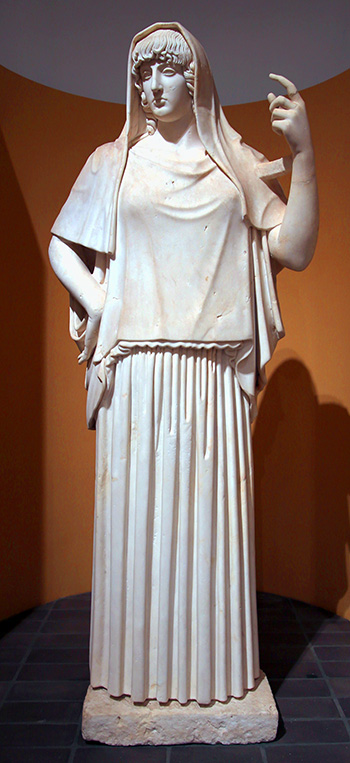
In Classical era statuary, Hestia has highly distinct qualities to other Goddesses that make her symbolism quite unique. She is typically represented
veiled and often looking away from the viewer in contrast to the synchronicity of expression between the face and the hands usually made by other Gods.
Facial features given by the sculptor represent a stern, calm and thoughtful woman, and her worn peplos is built like a pillar in a robust manner, as to
be not form-fitting whatsoever and to show how she is fixed in place. Her hairstyle is sometimes shaped with bangs or a fringe, which in the context of
the time the statues were made were tied to youth. Always Hestia shrouded herself with a veil whether on pottery or in statuary, even in the presence of
her mother, Demeter. The veil is one of her symbols and was tied to most orders of Greek womanhood; it shows the distinction between the one and the
multitudes. Her rare appearance in Greek art was rigidly enigmatic and mysterious. Of the Twelve Olympians, it was said, she possessed the virtue of
silence and scrutiny among them, and the veiled Goddess only opened her mouth to laugh. Visual depictions of her are rare in line with her lack of a
direct mythological role.
Another symbol of hers was the scepter, aligning with her queenly attitude in description. She is often shown in processions of the Gods tailing last
behind the others with this object.43 are certain marked similarities to the symbolism that pervades the imagery of Nephthys.
THE HEAVENLY HESTIA
In comparison to her mythological paucity, the Pythagoreans gave Hestia a highly mystical role as the fixed center of the world and associated her with
the Monad:
Introduction to Presocratics: A Thematic Approach to Early Greek
Philosophy with Key Readings, Giannis Stamellos: 44
The Pythagoreans offered significant cosmological observations . . . It is also noteworthy that the early Pythagoreans denied the geocentric and
geostatic model of the universe. According to the testimony of Aristotle (De caelo 293.18), they placed *fire* and not earth at the centre of the
universe. The earth became a celestial body, which creates day and night by its circular motion around Hestia (hestia meaning ‘hearth’). Ten divine
celestial bodies, ten being the perfect number, which encompasses the whole nature of numbers, rotate rhythmically around Hestia in the following
order: the dark counter-earth (antichthon), the earth, the moon, the sun, the five planets (Saturn, Jupiter, Mars, Venus, Mercury) and the sphere of
the fixed stars (aristotle, Metaphysics 986). This new cosmological model is usually attributed to Philolaus (B7 and A16) and explained through the
importance of the Monad in Pythagorean metaphysics. Since the Monad is the divine source of all numbers and is identified with, or represented by,
the purity of the fire, the source of the celestial bodies should be a divine fire in the centre of the cosmos (Aristotle, Metaphysics 986).
As mentioned, Socrates, as portrayed by Plato, metaphysically discusses the cosmogonical role of Hestia in the Phaedrus:
Phaedrus, Plato: 40
Hestia alone abides at home in the house of heaven; the others go forth in their procession.
In addition, Socrates links her name to ‘ousia’ or ‘Being:
Cratylus, Plato: 39
What may we suppose him to have meant who gave the name Hestia?…….that which we term οὐσἰα (ed. ousia) is by some called ἐσἰα (ed. esia), and by
others again ὠσἰα (ed. osia). Now that the essence of things should be called ἑστἰα (ed. estia), which is akin to the first of these (ἐσἰα=ἑστἰα),
is rational enough. And there is reason in the Athenians calling that ἑστἰα which participates in οὐσἰα. For in ancient times we too seem to have
said ἐσἰα for οὐσἰα, and this you may note to have been the idea of those who appointed that sacrifices should be first offered to Ἑστἰα (ed.
Hestia), which was natural enough if they meant that ἑστἰα was the essence of things. Those again who read ὠσἰα seem to have inclined to the opinion
of Heracleitus, that all things flow and nothing stands; with them the pushing principle (ὠθουν; ed. othoun) is the cause and ruling power of all
things, and is therefore rightly called ὠσἰα.
The other Gods may go out to move, separate and reshape, but Hestia is the fixed center and pillar of the universe who maintains the divine fire, the
guardian of everything static that enables the divine procession to keep on going without falling into chaos. The Stoic writer Cornutus45
explains Hestia through the idea of standing firm, inward centrality, and being the foundation on which the cosmos stands. Others further linked
Hestia’s name with ‘hestánai’ in Grek, meaning to stand amidst or in the middle. In addition, Hestia became identified with the earth itself as its
fixed guardian. Sallutius, the later Neoplatonist theorist, simply stated that “the earth belongs to Hestia”46, linking her with the cryptic
remark that she is the chief Goddess for mortal men among the Homeric hymns. All of these marked a significant reason she was invoked first and last in
all kinds of ceremonies; her fixed nature was an absolute necessity to keep the world coherent.
VESTA
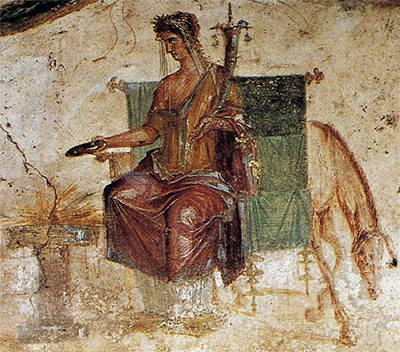
In Roman religion, Vesta is revered as the goddess of hearth, home, and family, and her priesthood was embodied by the Vestal Virgins. According
to tradition, Vesta was one of Saturn’s daughters, who, being first born, was swallowed by him first, as a prophecy foretold one of his children
would be his demise. However, Ops, the mother of Vesta and wife of Saturn, devised a plan to rescue her children from Saturn’s innards by using
the youngest born, Jupiter, to defeat his father. He was successful and forced Saturn to regurgitate his siblings; since Vesta was the first to
be eaten, she was the last to be freed, so she is both the first and last born.47 After her release, along with her siblings, she is
declared a “Queenly Maiden” and receives marriage proposals from both Apollo and Poseidon. She declines their offers and pleads with Jupiter to
accept her vows of chastity, he accepts, and she is sent to Olympus to tend the sacred hearth, remaining a virgin goddess.48 The only
other myth Vesta appears in is at a party that the goddess Cybele hosted, where she, Vesta, decided to sleep on a bed of grass, and Priapus, a
minor male fertility god, attempts to take advantage of the sleeping goddess but alerts a nearby donkey who awakens Vesta and the other gods and
goddesses who are outraged at Priapus’ lust.49
Considering the creation myth surrounding Vesta, her rulership is allegorically linked to two key traits: her hearth as fire and her virginity. The
connection between virginity and fire is essential to understanding Vesta's divine core. Fire, throughout religious and philosophical traditions,
symbolizes sacrifice, life, power, and purification.50 Dionysius of Halicarnassus describes the Roman veneration for fire, attributing its
consecration to Vesta as the goddess who kindles celestial fires from within herself, symbolizing immaculate conception.51 Similarly,
according to Plutarch, the second king of Rome, Numa, proclaimed fire as the universal force governing all things, worthy of reverence by vestals.52
Vesta embodies the primordial fire, representing creative energy and purity. While fire can be destructive, it also purifies, clearing away impurities
to make way for new growth and fertility. Vesta's virginity symbolizes her self-sustaining creative power, in contrast to the need for external union
with a partner. This is why she pleaded to remain chaste to Jupiter, an allegory for the energy’s self-sufficiency and how Priapus was unsuccessful in
his attempted rape. This symbolism encompasses the celestial, earthly, and spiritual domains. Ancient narratives depict Vesta as synonymous with the
earth itself, embodying the life-giving spark that sustains all existence while also symbolizing the foundational values of family and home.
As a domestic goddess, Vesta's presence permeated every aspect of Roman life, from the closeness of individual homes to the city of Rome itself. In each
family household, the hearth served as her sacred altar, symbolizing the heart of the home and the first goddess of daily rituals and
offerings.53 The home represented the nurturing and protective aspects of the goddess, fostering a sense of security among its inhabitants.
The cult of Vesta served as the foundation of Roman religious life, with the goddess revered as the centre of the earth and the personification of fire,
symbolizing both the vitality of Rome and the earth's importance as a centre of magnetism, i.e., home.54 It was Vesta who protected Rome from
her enemies and protected her sovereignty. She could be seen as the mother of Rome and its people. The sacred flame tended by the Vestal Virgins was
believed to illuminate and safeguard the vitality of Rome itself, making Vesta's temple a sacred space at the heart of the city (Alonso, 2010, as cited
in Galito, 2018, p. 5). The extinguishing of Vesta's sacred flame signalled ill omens for Rome, implying vulnerability to enemies, as the virgin goddess
represented the city's impregnability as an unpenetrated virgin. This duty fell to the Vestal Virgins, revered as sacred and holy by the Romans. To
depict Vesta as anything other than the guardian of Rome's purity and safety, a hearth or torch, would be considered blasphemous, emphasizing the devotion
and importance permitted to her worship.54 Though, as seen in figure 1, she has been depicted in her role as a patroness to bakers, which is
not uncommon because of her domestic, homelife rulership.
Vesta was equated strongly with the household Gods called the Penates, with this being strongly reinforced during Augustus' innovations of her cult, as
historian Macrobius relates.55 The Penates were associated with Aeneas of Troy who was the mythological ancestor of the Romans, and Vesta
herself was associated with that ancient city of the Iliad, perhaps suggestive of her worship in Ephesus down the Aegean coast. Vesta's worship held
deep cultural significance, dating back to the founding of Rome in Lavinium a city of refugees from Troy, highlighting her role as the embodiment of
safety, security, and peace for the Roman people.51 Then she was worshiped in a similar way in the second Trojan colony, Alba
Longa.51 Since the mother of Romulus and Remus, Rhea Silvia, was herself a Vestal, allegorically the worship of the Goddess was integrated
into many different facets of Roman symbolism and statehood from the beginning. The serious nature of the Vestal cult is comprehensible in light of how
Romans viewed her as an ancestral figure.
Although the Vestal Virgins were said to exist in Rome since time immemorial due to the Trojan inheritance, both Dionysius of Halicarnassus and Livy
point towards a particular kind of systematization of the cult during the reigns of the first two kings of Rome, Romulus and Numa. Her fire was lit on
the 1st of March on a continual basis every year from conventions originating in this period. The sacrifice rituals related to each hearth of the Curiae
were sacralized by King Numa into a single urban flame accessible to all, without removing those household flames, as the works of Dionysius of
Halicarnassus claim.56 Peculiarly, if the central fire was extinguished, complex ritual tools even in the times of Numa were used to rekindle
it. Unlike what is known about Hestia, we have much information from the account of Plutarch about the nature of this Roman kindling procedure in his
biography of the earliest Roman leaders:
Some Observations: On the Worship of Vesta, and the Holy Fire, in Ancient Rome: with an account of the Vestal Virgins, G.H. Noehden,
The Classical Journal, Volume 15: 57
It might happen, that, by some casualty, the holy fire was extinguished, and must be lighted again. This then was not to be done by the common and
vulgar method: but it was to be rekindled by fire, immediately derived from heaven. Plutarch. Numa c. ix.52, speaking of the Vestal fire,
adds: οὐ φασι μὴ δεῖν ἀπὸ ἑτέρου πυρὸς ἐναύεσθαι, καινὸν δὲ ποιεῖν καὶ νέον, ἀνάπτοντας ἀπὸ τοῦ ἡλίου φλόγα καθαρὰν καὶ ἀμίαντον; “which fire, they
say, is not to be lighted from another fire, but must be revived, and renewed, by kindling a pure and unpolluted flame from the sun.”
For that purpose, a peculiar mirror was generally employed, by Plutarch called σκαφεῖον. It seems to have been formed of a piece of metal, in the
shape of an equilateral rectangular triangle, which was wrought concave. What the metal was, we are not told. The word σκαφεῖον denotes a spade, or
shovel, and the mirror may have been so denominated from the resemblance of its form to the shape of that instrument. Plutarch describes it thus:
Ἐξάπτουσι δὲ μάλιστα τοῖς σκαφείοις, ἃ κατασκευάζεται μὲν ἀπὸ πλευρᾶς ἰσοσκελοῦς ὀρθογωνίου τριγώνου κοιλαινόμενα, συννεύει δ’ εἰς ἓν ἐκ τῆς
περιφερείας κέντρον: “They generally light the fire by means of the Scaphia, which are made by the side (or rather surface) of an equilateral
rectangular triangle being excavated (or rendered concave) in such a manner, as to verge, from all directions, towards the centre.” There may
originally have been a meaning attached to that particular shape. The action of the sun upon the mirror is then accurately delineated: Ὅταν οὖν
θέσιν ἐναντίαν λάβῃ πρὸς τὸν ἥλιον, ὥστε τὰς αὐγὰς πανταχόθεν ἀνακοπτομένας ἀθροίζεσθαι καὶ συμπλέκεσθαι περὶ τὸ κέντρον, αὐτόν τε διακρίνει τὸν
ἀέρα λεπτυνόμενον, καὶ τὰ κουφότατα καὶ ξηρότατα τῶν προστιθεμένων ὀξέως ἀνάπτει, κατὰ τὴν ἀντέρεισιν, σῶμα καὶ πληγὴν πυρώδη τῆς αὐγῆς λαβούσης:
“when, therefore, the mirror is placed in a position facing the sun, so that the rays, being reflected from all sides, are gathered and united at
the centre, it rarifies and dissipates the air, and quickly kindles any very light and dry material, when brought near it, because, in consequence
of the reflection, the rays obtain the consistency and power of fire.”
THE SHRINE OF VESTA
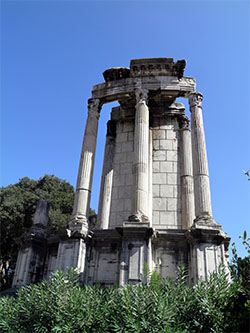
The Shrine of Vesta was central to Roman life. Although these are called temples, in the Roman context, their dimensions were not discerned from
augury, hence they were more properly called shrines. The original Shrine of Vesta in Rome was ancient and built by King Numa Pompilius. This
site was burned down by the Gauls in 390BC, and Livy claims that the Gauls, invading once more, were surprised to find the Virgins had patiently
lit a new hearth on the ashes of the old one.58 In 241BCE, the temple burned due to an internal fire, and again suffered destruction
during the wars of the late Republic. The shrine was extensively rebuilt during the reign of Augustus during his reforms of Vesta's cult and
added to by Nero. The final design of the remnant is assumed to be due to the patronage of the empress Julia Domna, wife of Septimus Severus, as
it once more had burned down in 191AD during the great fire of Commodus' reign that led to his ill-portented death, although this is only
supported by coinage evidence.59 The Christian emperor Theodosius declared that the flame be put out in 394AD. Ironically, this
iteration of the Shrine of Vesta survived more than a thousand years until the mid 1500s, when the Pope decreed that it should be knocked down
to provide bricks for Roman houses and neighboring buildings.60 Other shrines to Vesta were shared with Hercules, and another shrine
in Tivoli shares a similar circular design.
Because of Vesta's importance to the state, it was also the site where state wills and documents, senatorial documentations and other aspects were
carefully stored.61 It housed the Palladium, a wooden statue or xoanon of Pallas, considered to have been taken from Troy itself. In the fire
of 191, the Vestals managed to save this sacred object, a particularly auspicious sign during the troubled era of Commodus. The Roman emperor Augustus created a distinct innovation with the Vestal cult. When he ascended to being Pontifex Maximus, he gave part of
his private house to the priesthood of the hearth with a new shrine to the Goddess. The Pontifex Maximus was tied to her cult in a way unknown before.
The association with the hearth goddess to the central aspect of Roman power is shown by the fact the Roman emperors then became Priests of Vesta by
default. 62 This alternative hearth became the site of many of the most important rituals of Roman statehood.
Vesta had several holidays in Rome, the most famous being the Vestalia running from June 7th to 15th, climaxing on June 9th, often treated as days of
ill-portent. On the first day of festivities the penus Vestae, the holiest of holies often curtained off to the public, was opened, for the only time
during the year. Women could enter through a specific barefoot ritual during the Vestalia, as Ovid says.49 Among the duties of the Vestal
Virgins was the baking of bread used in the Roman rituals, and through this she became associated with cooks. The Vestalia itself became a holiday for
bakers and millers.63 The millstones and asses used in grinding were garlanded with flowers and hung with small loaves. This festival was
also tied to the Penates as the spirits of the kitchen and storechamber. Calendars were written to show the first day, June 7th, was called 'the opening
of Vesta', while the 15th was considered 'the closing of Vesta.' There was no ordinary public right of entry into the inner shrine. The strongest
literary evidence presents it as a place normally reserved for the Vestal Virgins, with male entry treated as improper, paralleling the taboo nature of
female entry into the shrines of Ares. Only the Priest could enter among men, and evidence suggests that particularly impious or crazed emperors were
treated with scrutiny. Even men who rushed in to save sacred objects in the holiest zone ended up blinded by flames.58 For this most sacred
inner recess, the Penus Vestae, where the hidden state talismans were kept, access was brutally tight. A late and explicit Roman source, the Historia
Augusta, says that this sanctuary was one “into which only Vestal Virgins and the priests may enter,” and its note explains that the sacred objects
there were such that only the Vestals and the Pontifex Maximus might look upon them. Elagabalus' crime of marrying a Vestal was considered evil, but his
looking into the sanctuary as a crazed individual and transferring its objects to the Temple of El-Gabal was simply damnable.64
VESTAL VIRGINS
To be a Vestal was of no small consequence. Initial candidates had to be six to ten years old, free of defect and free of any ties that could compromise
their work. Numa set out that marriage was expressly forbidden. The Vestal child, usually from a dozen to twentysomething other candidates, would
typically be chosen from a patrician family, although this was also open to plebeians as time went on.54 The Vestal was to serve for thirty
years as part of her Oath. In each of the three decades of her service, the Vestal had to function as a student, a servant and a teacher respectively.
If a Vestal died in the role, then single adult women of any kind could take her place.
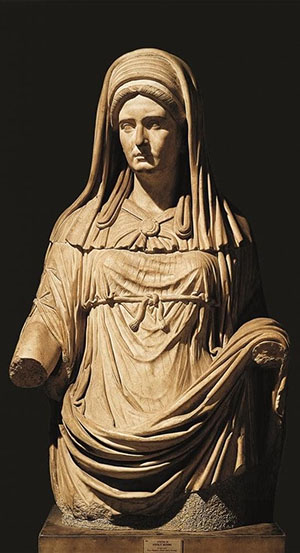
Although there were originally only two in the ancient period of Rome's history, by the late Republic, there were six total Vestals at any
time,60 with the highest ranking occuping the position of the Greatest Vestal Virgin (Virgo Vestalis Maxima) who had
peculiar privileges and acted as the leader of the group in society. From the ancient times, Vestals lived in the House of the Vestals, near the
Temple of Vesta itself.56 One of them was expected to tend to the flame for one turn, as the other five rotated in other
responsibilities. The Vestals were soverign because they represented the state in the flesh, Rome. They were the collective identity of Roman
culture in all its religious, civil, and political spheres. Their actions in those spheres were autonomous, so they were free to act without
male guardianship to own land, manage estates, create wills, and gift property to other women, which men were not even able to do, among other
things. Therefore, they were above the jurisdiction of typical law, customs, and traditions, yet they were highly symbolic, which is why they
were frequently deployed in political matters. The only binding element was sacral law, enforced by the vestal maxima and upward to the pontifex
maximus, the chief priest 60. The Vestals were allowed to witness anything they wished in Roman society and were given great
luxurious privileges to that effect such as ring-side seats at theaters, as long as they did not violate their oath of ritualized chastity in
particular periods.65 They even had particular power to proclaim criminals as innocent on the spot.52 The Greatest Vestal
Virgin, for her part, played a very important role in the social life of Rome as a city; she coordinated reconciliations, tied influential
groups together and acted as the representative of the Goddess, the social glue and fixed center of the city's life;66 the Vestal was
a public person whose study was oriented towards doing the best for the state. Their main religious duty was tending Vesta’s fire and guarding
the goddess’s cult, but they functioned as living symbols of Rome’s safety and continuity. One Vestal was able to spare Julius Caesar's life to
the dictator Sulla.67 Ancient and modern sources alike stress that they were meant to be seen in public, honored by magistrates, and
treated as the living embodiments of the state. Tacitus reports that Augustus’ will was brought into the senate by the Vestal Virgins from the
Shrine, and Suetonius says Augustus had deposited not only his will but other relevant documents of the state with them, showing the immense
trust that Rome put in the priesthood.65
Vesta was known to be associated with the donkey or ass, rather than the pig. Donkeys in garlands were often driven during the procession of the
Vestalia. A peculiar symbol of Vesta is the phallus, which perhaps seems paradoxical for a virgin Goddess. Her priesthood was associated with the
phallus because Roman religion treated the phallus as a sacred protective and life-generating sign that had the capability to ward off evil, and the
Vestals themselves were custodians of at least one such symbol, the fascinum. It also represented a masculine aspect of the flame and extended into why
the Vestal Virgins were tied to the continuance of fertility among families and others.68
IZANAMI
Nephthys is also known as the primordial Japanese deity, Izanami. The first gods Amenominakanushi and Kunitokotachi summoned either two beings or
six subsequent pairs of male and female beings into life, with the last sequence being the male Izanagi and the female Izanami. The primordial
deity charged them with creating the first land. To help them do this, Izanagi and Izanami were given a jewel-laden spear named Amenonuhoko
(spear of the heavens).69 The duo were obliged to go to the bridge between the heavens and everything below, the Ame-no-ukihashi.
They used the spear to churn the seas below, and from the droplets of salt, the land mass of Onogoroshima was created, a holy site in Shintoism.
Both deities descended from the heavens and decided to make their home on the island. It is said after this the two desired to be in union, so
they built a Pillar called Ame-no-mihashira (天の御柱);70 Japanese scholars interpret the World Pillar as a symbolism for the fixed
center of the world being represented in union of marriage, similar to the marital symbolism of Hestia and Vesta.71 From the
primordial Pillar, the world itself was created around the island, since the Nihon Shoki says the Pillar is even more clearly a cosmic central
post,72 not just random scenery, and one recension says they made Onogoro Island into the “国中之柱” (“pillar of the center of the
land”).
Around it all, the two built a palace called Yahiro-dono (八尋殿). Izanagi and Izanami circled the pillar in opposite directions. Izanami spoke
first, which was interpreted as improper by Izanagi. Then they shared a marital bed and two deities came of their union called Ebisu and
Awashima. The two children were considered to be deformed and not legitimate. They placed the children in a boat and cast them out to sea, then
appealed to the other gods to learn what mistake they had made. The gods replied that during the marriage rite the male deity should have spoken
first in greeting. Izanagi and Izanami therefore circled the pillar once more; this time Izanagi spoke first when they met, and their union was
at last successful, with the two siring the eight classical islands of Japan: Awaji, Iyo, Oki, Tsukushi (Kyūshū), Iki, Tsushima, Sado and the
main island of Yamato (Honshū). In the end, Izanami was said to have died in childbirth siring Kagu-tsuchi, the God of Fire.
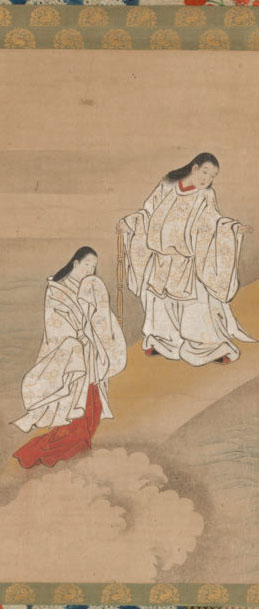
Izanagi hears that eating the food of Yomi, the underworld, means Izanami will be there forever. He goes down to the abyss to bring her back. In the
Kojiki, Izanami tells him that he has come too late because she has already eaten the sinister food, but says she will consult the deities of Yomi and
asks him not to look at her while he waits. Impatient, Izanagi breaks off a tooth of his comb, lights it as a torch, and looks inside. He sees that
Izanami’s body has decayed and is crawling with maggots, and that eight thunder deities have been generated on or in her corpse, including the deity
Raijin. Horrified, he flees. Enraged that he has seen her in this corrupted state, Izanami sends the Yomotsu-shikome (“ugly women of Yomi”) after him.
As he runs, Izanagi throws down items from his body to delay the pursuers: in the Kojiki these become foodstuffs that the pursuers stop to eat, while in
the Nihon shoki parallel account he also hurls down his many-toothed comb, which becomes bamboo shoots. The pursuit escalates: the thunder beings and
hosts of Yomi are sent after him as well. When Izanagi reaches Yomotsu Hirasaka, the slope or pass at the boundary between Yomi and the world of the
living, he takes three peaches and uses them to drive back his pursuers. Then Izanami herself comes after him. Izanagi blocks the passage with a huge
boulder, and the two stand facing one another from opposite sides of it. There they effectively end their marriage. In the Nihon Shoki, Izanami declares
that she will kill one thousand people each day in the land of the living; Izanagi responds that he will cause fifteen hundred births each day. This
exchange explains, mythically, both death and the excess of birth over death.
Having escaped from Yomi, Izanagi is polluted by contact with death and impurity, so he performs a rite of purification (misogi). In both the Kojiki
tradition summarized by Kokugakuin and the Nihon Shoki tradition, this cleansing leads directly to the birth of major deities, most famously Amaterasu,
Tsukuyomi, and Susanoo.7072 After Izanagi seals the entrance to that dimension, Izanami stays there as the underworld goddess
(黄泉津大神, “Great Deity of Yomi”), permanently separated from him, and her continuing mythic role is to be the death-dealing power of
Yomi.70
OYA
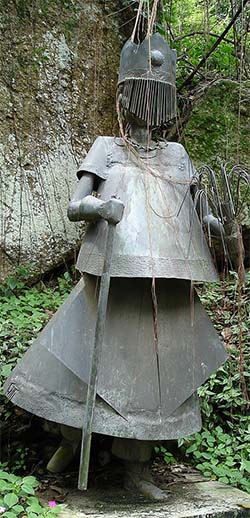
In Yoruba religion, she is known as Ọya, the Orisha of storms, lightning, cloth and powers over all of the ancestral dead and masked entities
(the Egúngún), as well as being the guardian of the cemetary.73 She gained control over the dead after dancing for Babalú Ayé, who,
moved by her compassion and bravery, granted her dominion over them, so it was said she was able to become an Orisha through her honor. Ọya is
believed to shapeshift into a buffalo, and is also associated with particular necklaces and ornaments. Her name means "she tore" in Yoruba
because she is representative of tearing of black cloth traditional in mourning rituals, and the death goddess is the sister of Yemoja and
Oshun. Her island is located on the Niger river. Although Ọya is commonly considered a wind goddess, her primary essence is deemed to be
fire.74 All of the complexities of death are under her mysterious control.75
Oya is often represented in Yoruba statuary with her face covered in a shroud and her silent nature is paramount. The Egúngún are celebrated with
elaborate covered costumes across Yorubaland during the dry season that obscure the body and face in cloth, resembling the traditional cloths
adorned on bodies of the deceased; men dance and perform while women are permitted to sing and direct the performance. The two sexes are
separated in their ceremonial role as it is said the power of women is too potent.76 It is said women once dominated the Egúngún cult
in line with Ọya's heritage, but men tricked them and took this power for themselves. The Yoruba people claim the spirits of the dead will not
come if the land is not fertile and the living are not prosperous enough. According to Yoruba mythology, Ọya as Queen of the Dead is responsible
for the seating of male ancestors in the trunk of the Akoko tree. She is variably the wife of Shango, Ogún and Oko.
In Candomblé, Oyá is known as Iansã or lyá Mésàn. She is said to control all forms of mystery involving death.75
Yehuboric Symbolism and Goetic context
The Book of Revelation provides a striking parallel to how Nephthys is represented in the Goetia as the demon named Bathin,
also known as Mathim or Marthim, depicted as a male knight on a pale steed.
Revelation 6:7-8:
Καὶ ὅτε ἤνοιξεν τὴν σφραγῖδα τὴν τετάρτην, ἤκουσα τῆς φωνῆς τοῦ τετάρτου ζῴου λέγοντος· Ἔρχου. Καὶ εἶδον, καὶ ἰδοὺ ἵππος χλωρός·
καὶ ὁ καθήμενος ἐπάνω αὐτοῦ ὄνομα αὐτῷ ὁ Θάνατος, καὶ ὁ ᾅδης ἠκολούθει μετ' αὐτοῦ· καὶ ἐδόθη αὐτοῖς ἐξουσία ἐπὶ τὸ τέταρτον τῆς
γῆς, ἀποκτεῖναι ἐν ῥομφαίᾳ καὶ ἐν λιμῷ καὶ ἐν θανάτῳ καὶ ὑπὸ τῶν θηρίων τῆς γῆς.
When the Lamb opened the fourth seal, I heard the voice of the fourth living creature say, “Come!” I looked, and there before me
was a pale horse. Its rider was named Death, and Hades was following close behind him. They were given power over a fourth of
the earth to kill by sword, famine, plague, and the wild beasts of the earth.
The fourth seal is the Middle Chakra. This part of the Bible is alchemical in the nature of its curses and is intended to assert the
primacy of the Hebrew 'right' over death and all its matters. The horse is symbolic of Her rulership of the Astral realm. Another
code here is that χλωρός as a word in Koine Greek means greenish-pale and is often indicative of rotting, but also reinforces
the visual connection to the Middle Chakra. Note the similarity below. The ability of Nephthys to control all things on the astral is referenced in the
oblique reference cursu
velocissmo hominem de regione in regionem transfert:
Pseudomonarchia daemonum, Johann Weyer77
Bathym, alibi Marthim Dux magnus C fortis: Visitur constitutione viri fortissimi cum cauda serpentina, equo pallido insidens.
Virtutes herbarum C lapidum pretiosorum intelligit. Cursu velocissimo hominem de regione in regionem transfert. Huic triginta
subsunt legiones.
Bathin [Bathym], sometimes called Mathim [Marthim], a great duke and a strong, he is seene in the shape of a verie strong man,
with a serpents taile, sitting on a pale horsse, understanding the vertues of hearbs and pretious stones, transferring men
suddenlie from countrie to countrie, and ruleth thirtie legions of divels.
Many of the representations of Death as a male figure on a horse in western culture thus come from this Yehuboric understanding.
Bibliography:
1Spell 216, Pyramid Texts
2Nephthys, Henadology
3Isis and Osiris, Plutarch
4Utterance 553, Pyramid Texts
5Utterance 532, Pyramid Texts
6From Isis-kite to Nekhbet-vulture and Horus-falcon: Changes in the identification of the bird above Osiris’s phallus
in temple ‘conception of Horus’ scenes, Lloyd D. Graham, Vol. 8, Birmingham
Egyptology Journal
7Bremner-Rhind Papyrus
8Isis as an Archetype for Women
in the Old and Middle Kingdom, Megan L. Sands
9Vol. 5, Numen, C.J. Breeker
10Wilbour Papyrus, Volume 3, edited and translated by Alan H. Gardener
11The Deterioration Problems of the Wall Reliefs of Komir Temple at Esna, Egypt, Nabil A. Bader, South Valley
University, MAA
12A Ptolemaic Lexikon: A lexicographical study of the texts in the Temple of Edfu, P. Wilson
13Le papyrus d'Imouthès fils de Psintaês au Metropolitan Museum of Art de New-York (Papyrus MMA 35.9.21), edited and
translated by Jean-Claude Goyon
14The Central Hall in the Egyptian Temples of the Ptolemaic
Period, Amr Gaber
15Un manuel de géographie liturgique dans la salle d’apparition du temple d’Hathor à Dendara, Lorenzo Medini, BIFAO:
Bulletin de l'institut francais d'archelogie orientale
16Dendera image, XII, 30, 7-8
17Homeric Hymn to Aphrodite
18The Library, Apollodorus
19Homeric Hymn to Hestia
20The Iliad, Homer
21Orphic Hymn to Hestia
22Theaetetus, Plato
23Suda
24On the Community, Aeschines
25Greek Mythology and Poetics, Nagy Gregory
26The Prytaneion: Its Function and Architectural Form, Stephen G. Miller
27First Oration, Aelius Aristides
28Eleventh Nemean Ode, Pindar (associated commentaries)
29 Life of Aristides, Plutarch
30Description of Greece, Pausanias
31Hellenica, Xenophon
32Part 1. Attika, Ancient Greek Inscriptions in the British Museum
33210, Four Decrees of Entella, Translations of Hellenistic Inscriptions
34Artemis Ephesia, the Emperor and the City: Impact of the Imperial Cult and the Civic Identity of Roman Ephesos, Dies van der Linde,
Ancient Society
35Public buildings to the north of the State
Agora in Ephesus, Turkish Archaeological News
36 Paul, Artemis and the Jews in Ephesus, Rick Strieland
37Ephesos 2058Ephesos 2058
38Artemis Ephesia, the Emperor and the City: Impact of the Imperial Cult and the Civic Identity of Roman Ephesos, Dies van der Linde,
Ancient Society
39Cratylus, Plato
40Phaedrus, Plato
41Wasps, Aristophanes
42Natural History, Pliny the Elder
43 Hestia a L’Omphalos, P. Roussel, Revue Archéologique
44Introduction to Presocratics: A Thematic Approach to Early Greek Philosophy with Key Readings, Giannis Stamellos
45 Compendium of Greek Theology, Cornutus
46On the Gods and the World, Sallutius
47Glory of Hera: Greek Mythology and the Greek Family, Philip Slater
48Tending Hestia's Flame: Circumambulating the Sacred Feminine, Janis Jennings
49Metamorphoses, Ovid
50Fire, Britannica
51Roman Antiquities, Dionysius of Halicarnassus
52Life of Numa, Plutarch
53On the Nature of the Gods, Cicero
54Law, Religion, and Constitution of the Vestal Virgins, Inge Kroppenberg
55Saturnalia, Macrobius
56History of Rome, Dionysius of Halicarnassus
57Some Observations: On the Worship of Vesta, and the Holy Fire, in Ancient Rome: with an account of the Vestal Virgins, G.H. Noehden, The
Classical Journal, Volume 15
58History of Rome, Livy
59Julia Domna & The Temple of Vesta, Susann S. Lusnia
60The Roman Forum: A Reconstruction and Architectural Guide, Gilbert Gorski and James E. Packer
61The Lives of the Caesars, Suetonius
62Religions of Rome: Volume 1, A History, Mary Beard, John North and Simon Price
63Fasti, Ovid
64Historia Augusta, various
65Life of Augustus, Suetonius
66Annals, Tacitus
67Life of Julius Caesar, Suetonius
68The Vestal Virgins and the Transition From Republic to Principate Under Augustus c. 30 BCE - 14 CE, Jamie R. Ditzel
69"Izanagi and Izanami", Matsumae Takeshi, Encyclopedia of Religion
70Nihon Kojiki
71古事記ビューアー (Kojiki
Viewer), 國學院大學 「古典文化学」事業 (“Classical Culture Studies” Project, Kokugakuin University)
72Nihon Shoki
73The Handbook of Yoruba Religious Concepts, Baba Ifa Karade
74Oya: In Praise of the Goddess, Judith Gleason
75Obaràyí : Babalorixá, Balbino Daniel de Paula
76"Seeing through a Woman's Eye: Yoruba Religious Tradition and Gender Relations", Oyeronke Olajubu, Journal of Feminist Studies in
Religion
77Pseudomonarchia daemonum, Johann Weyer
Further reading:
Aspects of the Goddess Nephthys, Especially During the Graeco-Roman Period in Egypt, Jessica Lévai