Sekhmet
author: High Priest Zevios Metathronos
The knowledge presented contains information for those who want to understand the great Royal Goddess known as Sekhmet, also known as Sekhet. Here are
some of her other divine names:
Hieratic Information about Sekhmet
| Divine Names |
|---|
- Sekhmet
- Sahmat
- Sahmatu
- Sakhmis [Hellenic]
|
The Ritual above provides a greater communion with this Goddess, the powerful and awe insipiring force of vengeance in Ancient Egypt.
SEKHMET
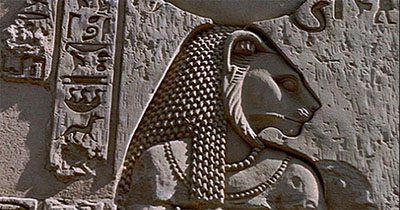
Sekhmet is known as the personification of Power as a Goddess. Represented in Egypt as a fierce lioness, Sekhmet rules over war, destruction, extreme
rage, discord, medicine, plagues, and
motherhood.
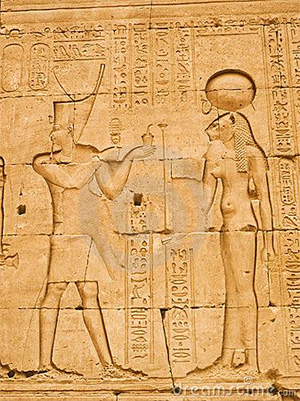
Sekhmet with Pharaoh
She is often represented with the Pharaoh as a protective deity during times of war and invoked to protect the Pharaoh during times of strife1.
Sekhmet is used as an aegis on objects
signifying protection, and many of the facets of Sekhmet relate to the willingness to destroy in creation. Along with Her son Maahes and the Goddess
Neith, Sekhmet is the most prolific war
Deity in Egypt. To this day, door knockers are often adorned with lion or lioness figures as a vestige of her influence.
Her cult was centered in Leontopolis, or 'the City of Lions,' called Taremu (Place of the Fish) by the Egyptians, the latter name involving one of
Apollo's mysteries. Bastet's cult also was a
major focus of this city, which hosted a gigantic festival. Sekhmet, as the consort of Ptah, was also the patron Goddess of Memphis, the most sprawling
city in the world at that point, meaning
Her importance to the Egyptian state was supreme.
Sekhmet in day-to-day life is represented as the destroyer of lies and seemingly paradoxically the creator of strife, including rivalry and competition
for further development. She was invoked
by rulers to uphold their oaths correctly and to be held accountable to the Gods. If the Pharaoh did not rule Egypt with wisdom, she would use
terrifying power to ruin him. Likewise, plagues were associated with her judgement of the land.
For surgeons, they would pray to Sekhmet prior to conducting surgery, as destruction was seen as a necessary act to get rid of disease. She was also
associated with relieving epidemics and
plagues2, particularly those on a national level, but in day-to-day life, any disease afflicting children. Mothers would often pray to
Sekhmet to relieve diseases such as smallpox.
The karmic nature of disease was tied to Sekhmet's attributes as Punitrix.
This is not the only signification, as many of her functions relate to the deepest aspects of the occult. Sekhmet represents the powers of the Kundalini
in its latent and feminine form as a
dispositor of the Great Serpent, Zeus. Her name, derived from 'sakhemu' or serpent power in Ancient Egyptian, represents this mysterious power. The
sakhemu form of a person was meant to
represent their idealized, perfected, and truly human state, in other words, the potential for what they can become.
In Egyptian sources, Sekhmet is known for her fiery breath, boiling like white-hot coals, and dwelling in the depths. She was also associated with struck
white flint, inflamed boils, flashing
visions and other visual codes relating to crisis.
Being the Destructrix of Lies and an incarnation of the Eye of Re, Sekhmet is a deputy of Apollo and enforces his decrees relating to Truth, Wisdom, and
Understanding as listed in the Zevist
Virtues, along with enforcing decrees on all matters related to him. In the primary story involving Sekhmet, the Eye of Re sent Hathor down to Egypt to
punish the impure humans who followed
Set into the desert and disobeyed the Gods. Sated with blood from destroying the impure, Hathor transformed into Sekhmet. Several other Goddesses also
interchangeably transform into
Sekhmet.
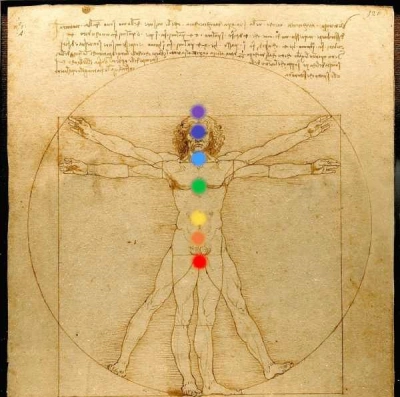
This primary mythology involving Sekhmet indicates the necessity of purifying the bad karma and dross (represented in the iniquitous humans) of the
Chakras (Gods), aura, mind, and soul before
the Kundalini can ascend properly in the Initiate and to have enough energy to be able to attempt this process. If achieved, the Serpent passes through
each of the cleansed Chakras (Gods)
before reaching its apex point in the Crown Chakra.Her bloodlust is only abated when Thoth, with words of power, directs her back to the pool of beer
stained with red ochre (the Base Chakra)
in preparation for the true rising, where She is reunified with Re and perfected, an always-occurring process with Kundalini in its final stages.
Symbolism
Sekhmet is a fierce Goddess ruling over flashingly powerful cycles of soul development, as well as many of the darker sides of nature. The point
of the visual codes in the story of Sekhmet's
rage is to point out that if a purified soul and mind are not achieved, chaos and peril will result with any attempted rising of this
imperceptibly powerful force, a force that can drive
unprepared individuals insane or even kill them. Sekhmet's violent symbolism in slaughtering humans serves as a vivid symbol. If the powers of
ignorance are not crushed in accordance with the
Laws of Ma'at, the soul will succumb to the negative manifestations of the domain of Set and fall under the forces of the material realm.
Sekhmet also represents the importance of harmony and balance in this process, as decreed by Apollo and Aphrodite. Physically, it is for this
reason that yoga and breathwork are pursued by the
Initiate to direct the serpent properly. Thoth using the words of power shows how vibration can affect the soul and alter a precarious path.
If the serpent is able to ascend with little trouble and is in synchronicity with Set's 144 Laws (the 144,000 Nadis of the soul), the powers of
both Gods become an unstoppable force for
ascension in full cooperation. Set erects the active serpent of His Father, pushing it towards Eden.
All of these allegories also convey the importance of using proper pace in advancement and not forcing development, rushing can result in burnout
or destruction, inviting the wrath of Sekhmet,
the magnetic force of the serpent.
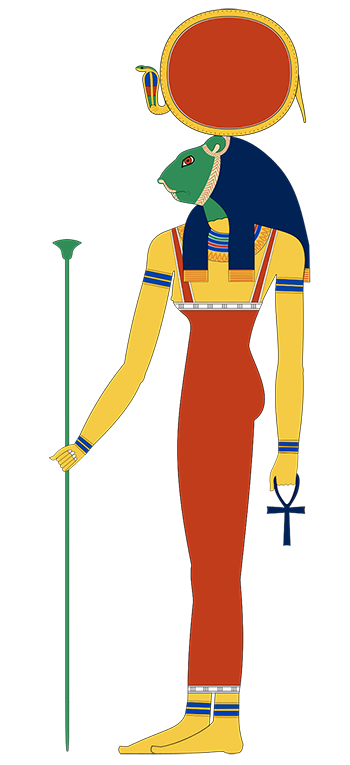
In Egypt, Sekhmet has the powers of the Black Land3, evocative of Her pulling on and materializing the realm of expanded infinite
consciousness (ruled by Bastet). The two Goddesses
were sometimes fused into one entity by the Egyptians for this reason. In line with accessing the powers of the Kundalini, Sekhmet also represents the
pulling together (magnetism) of all the bodies to attain Godhood and the invincible, activated aspect of the
serpentine power of the soul that fuels the ability to continue incarnating. In this regard, she stands in contrast to Nephthys, who binds together the
preliminary methods for ascension.
That is another reason Sekhmet is portrayed so commonly with the Pharaohs or God-Men of Egypt: as the symbolic wife of the Pharaoh, she stands as a
symbol of their divine ascension when they
are righteous. Her marriage to Ptah likewise shows the connection of the Pineal Gland and its role as the center of occult power in the brain in
relation to the serpent, among other codes that
relate to an ability to channel the forger’s fire into extreme power.
Sekhmet was also associated with prominent individuals associated with ascension cults such as Imhotep who came to be recognised as her son. In this
role, she stands as the fierce Guardian of
the philosopher and the initiate. The redoubtable Goddess is represented with the head of a lioness because the visage of the lioness demonstrates Her
fierce commitment to protecting the divine order of Ma'at2. Another element commonly
used in Sekhmet's imagery is the sun disk adorned with the serpent or uraeus. This is not just a symbol of the serpent enlightenment but a reminder of
Her being a dispenser of Re's powers and
for rulers to exercise their power wisely.
The symbol of the lioness also reveals several things about the nature of the feminine in tandem with the lion. Sekhmet represents the principle that
these forces require a rigid counterpart.
If a lion is a weakling or a corrupted leader, it is inevitable the lionesses will leave for a new pride. This is one of the inevitable dark sides of
nature and the magnetic principle. Yet Sekhmet also serves as a warning for both men and women alike to use wisdom and virtue in exercising their
relations with one another, lest they be subjected to Set's Laws of Nature and be
destroyed. Too much imbalance in one direction will lead to the entropic destruction of a civilized state of affairs, as men and women are ideally meant
to cooperate in a balance that is
always difficult to maintain when one sex cannot understand the other. Likewise, any citizen will abandon rulers who do not exhibit strength.
She was also depicted with the Sekhem and Lotus scepter, the latter a long, thin staff associated with the narrow sushumna channel of the soul,
often adorned with a lotus representing the Crown
and the union with the Mother Goddess. The right fist grasping this staff, however, also signifies the ruling power of Zeus and His dominion over the
visible universe. Sekhmet is an important deity for Africa through her everlasting royal connection to Egypt, presiding over every race and
ecological structure in it.
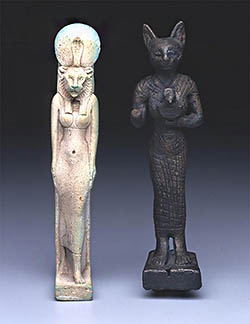
As Isis and Nephthys are portrayed together constantly, so are Sekhmet and Bastet equated. One major reason why Sekhmet is typically represented
as a lioness while Bastet is represented as a
domestic cat involves a certain delineation of their powers. Bastet, the Ǫueen of All Powers, represents the latent powers as they exist in
every advanced being, while Sekhmet represents their
powerful and ferocious activation. Bastet is also equated with the night and the Moon, while Sekhmet is equated with the day and the Sun. Both
cats and lions are crepuscular animals. The lioness and tigress are the most fearsome of all female animals and represent the apex of feline
evolution and wildness, while cats represent sophistication and contemplation among animals kept by humans.
Occasionally, however, Bastet is represented as a lioness and Sekhmet as a cat, confusing Egyptologists. Sekhmet is sometimes additionally
represented by scorpions, indicating the association
with tenacity and vengeance.
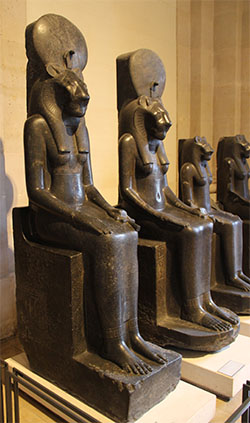
Her statues were copiously produced as protective items during times of disease or crisis.5 In just the past few years, Egyptologists have
discovered hundreds of statues of
Sekhmet6, crafted with such striking skill and synchronicity that conventional historians cannot explain how they were made. They were made
from red diorite (associated with
protection) and commonly had a black slate-like color with a reflective finish.
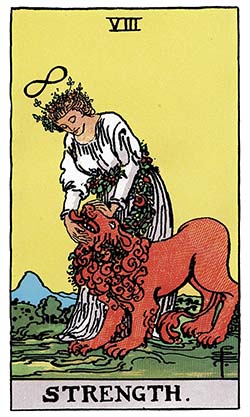
The Major Arcana card of Sekhmet is Strength, also named Fortitude or Force, which has been portrayed since the early modern era as a patient woman
holding a lion by its head. It represents an
inner quality to her powerful nature, because Strength beseeches the querent to overcome internal difficulties through courage and careful
observation.
Occasionally, the woman on the card is represented beside a pillar, which much like the card of Bastet ties in Sekhmet’s functions with those of
Nephthys. Both of these representations were
taken to be allegorical of the Biblical story of Samson, stolen from the myths of Hercules, but very quickly the figure on the Strength card universally
became a woman.
In the Opus, the woman subduing the lion represents the gentle mastery of the fiery forces. She does not kill the ferocious beast, as the lion cannot be
controlled by brute force, only by
patient measure, composure of a ritual character and inner equilibrium, which aids her in prizing apart his dangerous jaws. This is allegorical of the
story of Sekhmet’s transformation into
the Eye of Re as Hathor and subsequent pacification when drinking from the lake of ochre. Mastery of the ferocious solar fire is essential for the work
to be completed.
BIBLIOGRAPHY
1Sekhmet and Bastet, The Feline Powers of Egypt, Lesley Jackson
2Egyptian Goddess: The Divine Legacy of Isis, Nut, Hathor, Bast, Sekhmet and Other Goddess in Egyptian Mythology, Chronicle Press
3The Complete Gods and Goddesses of Ancient Egypt, Richard H. Wilkinson
4The Goddess Sekhmet, Robert Masters
5Seeking Sekhmet: The veneration of Sekhmet Statues in contemporary museums, Olivia Ciaccia, Pomegranate
6Black granite statues of Sekhmet, British Museum