
 አማርኛ
አማርኛ العربية
 বাংলা
বাংলা Български
 中文
中文 Čeština
 Dansk
Dansk Deutsch
 Eesti
Eesti Ελληνικά
 Español
 Français
 हिन्दी
 Hrvatski
 IsiZulu
 Italiano
 日本語
日本語 Kiswahili
 Magyar
 Македонски
 नेपाली
 Nederlands
 فارسی
فارسی Polski
 Português
 Română
 Русский
 Slovenščina
 Suomi
Suomi Svenska
 Tagalog
 Türkçe
| Language | Name of Apollo | Attestation |
|---|---|---|
| Faliscan | Apolonos | Tempio Maggiore Cup (500-475BCE) |
| Old Latin | Apolo | Latin caption, Etruscan scarab (375–325 BCE) |
Apollo / Mithra / Utu / Shammash
THE SUN GOD
from Lord Apollo directly to High Priest Zevios Metathronos
co-author: Novice Priest Karnonnos
Divine Names and Symbols
Divine Names
- APOLON [A-POL-ON]
- PAIANA [PE-ANA]*
- UDDTHU [U-D-U]*
- Azazee-eel [AZAZ-EE-EEL]
Divine Symbols
- Lyre (Musical Instrument)
- Sun Disk
- The Letter "E"
- Golden Bow and Arrow
- The Faravahar (Winged Disk)
- The Python (Serpent)
- The Laurel Wreath
- The Omphalos (Navel Stone)
- The Tripod of Delphi
Divine Numbers and Attributes
- Numbers: 5, 7, 20, 36
- Planet: Saturn, Lunar South Node (Dragon's Tail)
- Zodiac: Capricorn/Aquarius (1-10°); Spiritual Work: Ophiuchus degrees of Scorpio
- Tarot: Ace of Swords
- Candle: Blue, Black
- Metal: Lead
- Element: Air
- Runes: Sowilo, Raidho, Kenaz
- Animals: Python, Hawk, Dove, Dolphin, Mockingbird, Eagle, Scorpion
- Sacred Day: Sunday (Day of the Sun)
- Sacred Plant: Laurel (Bay), Hyacinth
- Sacred Stone: Amber, Sapphire
- Incense: Frankincense, Bay Laurel
- Rank: Chief of Security; works directly with Zeus
Divine Forces
- The Light
- Music
- Harmony
- Law
- Justice
- Grace
- Prophecy
- Medicine and Healing
- Spiritual Alchemy
- Purification
- Oracular Vision
Important Titles
- Lord Of The Light
- Helios
- Light Bringer
- Heavenly Protector
- Phoibos [The Radiant One]
- Loxias [The Ambiguous / Speaker of Oracles]
- Mousaios [Musician]
- Divine Juror
- Eternal Sun
- Apollo Pythios [Slayer of the Python]
- Apollo Kourotrophos [Protector of Youth]
- Apollo Akesios [Healer]
- Apollo Alexikakos [Averter of Evil]
- Apollo Patroos [Apollo of the Fathers]
The knowledge presented in this page is advanced and contains information for those who want to know Apollo in depth. There is also the containing of hieratic (deeply spiritual) knowledge such as the Divine Names of Apollo. In regards to additional information on Divine Names, these are Names which are the numerologically sound Divine Names to use for Summoning and Invocation.
Other Names:
APOLLO (Greek; God of the Shining Sun), Mithra (Roman), Mitra/Surya (Vedic Period), SHAMASH (Babylonian), UTU (Sumerian; The Shining One), SAMAS (Akkadian), BABBAR (Sumerian), Ashur (Assyrian), SHAMIYAH (Hathra), LUGUS/LUGH (Irish/Welsh), Susanoo-No-Mikoto (Japanese), Huitzilopochtli (Aztec), AZAZEL aka ZAZEL (the title given to this God in the Yehuboric literature, from Semitic roots meaning "Power" and "Light/God"; also appearing as SAMYAZA, SEMJAZA, SEMIHAZAH, SEMIHAZAI in various corrupted texts)
[*] There is no problem to also casually refer to him as Azazel in linear speech. The name Azazel is of Arabic origin and is merely a title, not the original Name of the Deity. The Hieratic Names are above and will give the best contact for spiritual works such as summoning.
APOLLO •
MITHRA •
UTU / SHAMASH •
SURYA / MITRA •
LUGUS / LUGH •
ASHUR / SHAMIYAH •
ASCLEPIUS •
APOLLONIUS •
AZAZEL
Apollo is one of these Gods that have been most popular in the Ancient World. A long standing and most powerful God, he has been followed by all of the Ancient Civilizations.
Lord Apollo is a god of harmony, majesty, beauty, art and high spirituality. His strong association with the Sun is a principle that fits strongly into his stature and nature. Under all his manifestations, he has been a God of Justice. He strongly stands for people "paying their dues" and people "getting paid their due," in a karmic way.
Apollo has given humanity many gifts. In many languages, the phrase still survives that "Nothing remains hidden under the Sun." Utu, the Sumerian Name of the God, is credited with being able to see "everything that happens within the world," but also observing the relations between people towards one another. Apollo's Oracle was consulted in Ancient Greece on the soundness of laws and legal systems, so that they would not be wrong or abusive to the citizens.1, 2
Alongside many other Pagan deities in many Pantheons, he was worshiped by the Ancient Greeks under the very famous name "Apollo." Apollo is not the specific God of the Sun in the sky as a heavenly body, but rather represents the majesty and power of the Sun. The literal Sun on the heavens is the God "Helios" in Ancient Greek. Helios was also used as a title for Apollo, as in "Helios Apollo" or the "Apollo of the Sun," to signify his major powers and high spiritual rank.
The name "Phoibos" (Φοῖβος), meaning "The Radiant" or "The Bright One," was among his most common epithets. This title directly parallels his Sumerian name: UTU derives from the root meaning "to shine," and his Sumerian title BABBAR means "the white" or "the shining." Across every culture, the same quality was recognized: this God radiates light, both literal and spiritual. His light illuminates what is hidden. His light exposes what is false. His light heals what is wounded.3

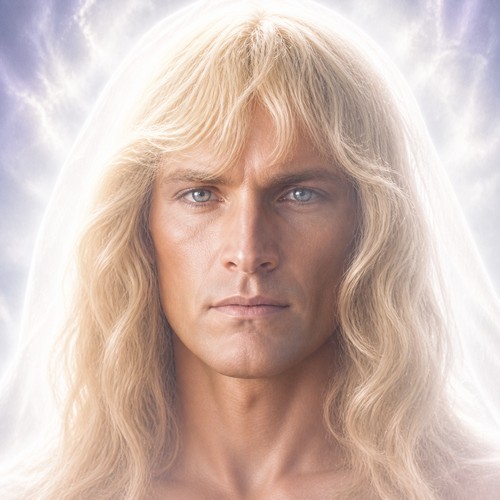
Apollo in his divine form. His figure is one of strength and extreme majesty.
Apollo's powers are many, but centered around the arts, music, medicine and prophecy. Prophecy is a very elaborate practice, involving all the divinatory arts, which bestow on one the ability to tell the past, present or future. Each of these powers has a lot of depth and analysis to it. It would take an encyclopedia to explain everything about Him, as Apollo is very rich in mysteries and knowledge.4
Apollo Pythios: The Slaying of the Serpent
One of the most profound foundational myths of Apollo concerns his slaying of the great serpent Python at Delphi. Python was the monstrous earth-serpent who guarded the oracle site before Apollo claimed it. The God, while still young, traveled to Delphi and slew Python with his golden arrows, then established his own oracle on the spot. This act earned him the title "Pythios" (Πύθιος).5
The spiritual meaning is multilayered. The Python represents the raw, untamed serpent force within the human being. Apollo's slaying of this serpent does not mean its destruction, but its mastery and sublimation. The Pythia, Apollo's priestess at Delphi, sat directly above the place where the serpent was slain. The prophetic vapors rising from below the earth symbolize the serpent energy (Kundalini) rising through the body. Apollo, as master of this force, channels it into prophecy, music and divine vision. The very name "Pythia" derives from Python: the priestess of prophecy draws her power from the conquered and controlled serpent.
The Pythian Games, second in importance only to the Olympics, were held at Delphi every four years in commemoration of this victory. They included both athletic and artistic competitions, because Apollo governs both bodily excellence and artistic perfection. The laurel wreath awarded to victors was sacred to Apollo: the bay laurel tree was his own sacred plant, tied to the myth of Daphne, whose transformation into the laurel tree preserved her essence within this most aromatic and purifying of plants.6
Shamash and the Code of Hammurabi
As the Babylonian Shamash, Apollo's role as God of Justice received its most monumental physical expression in the Code of Hammurabi, one of the oldest known written legal codes, dating to approximately 1792-1750 BCE. The famous stele (now in the Louvre Museum) depicts King Hammurabi standing before the enthroned Shamash, who is handing the king the rod and ring of authority. Shamash, the divine source of law and justice, is shown literally transmitting the laws to the human ruler.7
This is the oldest surviving depiction of a God giving law to a mortal king, and it establishes a principle that defined Mesopotamian civilization: law comes from the Gods, not from the whims of kings. Shamash's role was to ensure that justice was rendered fairly, that the strong did not oppress the weak, that contracts were honored and oaths were kept. The epilogue of the Code itself invokes Shamash repeatedly as the guardian of justice who will punish any ruler who perverts the law. The contents of this document have been drastically altered through the centuries, and what we have now resembles nothing of the original, but the principle remains: true law descends from the divine order that Shamash/Apollo represents.8
Mithra: The Mysteries of the Sun
As Mithra, during the time of the Romans, he was patron of the mysteries of Rome. There again, he was strongly associated with the Sun. In the Vedic literature, he was called "Mitra," again strongly associated with the Sun and the keeping of oaths.
The Roman Mysteries of Mithras constituted one of the most important initiatory systems of the ancient world. They operated through seven distinct grades, each corresponding to a planetary body and representing a stage of spiritual transformation. The seven grades were: Corax (Raven, under Mercury), Nymphus (Bridegroom, under Venus), Miles (Soldier, under Mars), Leo (Lion, under Jupiter), Perses (Persian, under the Moon), Heliodromus (Sun-Runner, under the Sun), and Pater (Father, under Saturn). Each grade carried specific ritual obligations, specific symbols, and a specific type of spiritual knowledge that was transmitted only to those who had proven themselves worthy at the preceding level.9
The progression through these grades mirrors the ascent of the soul through the planetary spheres, a concept directly parallel to the opening of the seven chakras in the Eastern tradition. The Mithraic initiate moved from the lowest sphere (Mercury, communication and basic awareness) to the highest (Saturn, mastery and completion). At the grade of Heliodromus (Sun-Runner), the initiate was considered a living embodiment of the solar force itself. The final grade, Pater (Father), placed the initiate in the role of Mithra himself: the teacher, the lawgiver, the keeper of the cosmic order.10
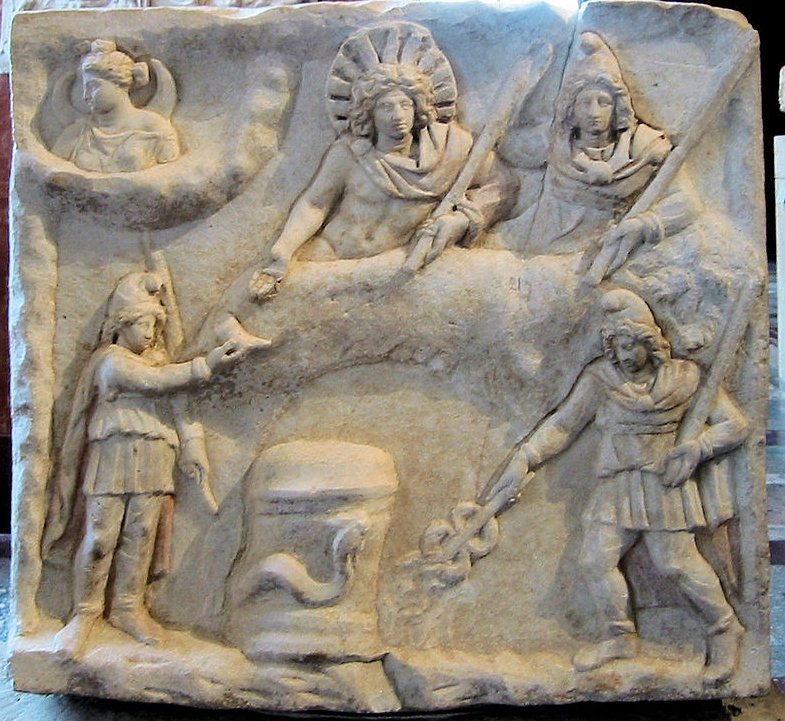
In the symbolism of the Roman Mithra, we can see Apollo giving the light, laws, and handing over his hand as a gesture of help towards the initiate. His symbol as Apollo, that of the Python (also related to Kundalini) is being pointed at by the initiate, to the right.
In the same depiction, Apollo here appears armed, holding on one hand the sword. On the other hand, he communes with the human disciple in a friendly manner. We also see one disciple being "lifted" to the place of the God, who appears to be on a mountain or a cloud.
The Phrygian Cap worn by the initiates is a very important symbol of the Mithraic rites. It symbolizes the opening of the consciousness. Like in many of his depictions, he has a Halo and a Solar Disk around his head.
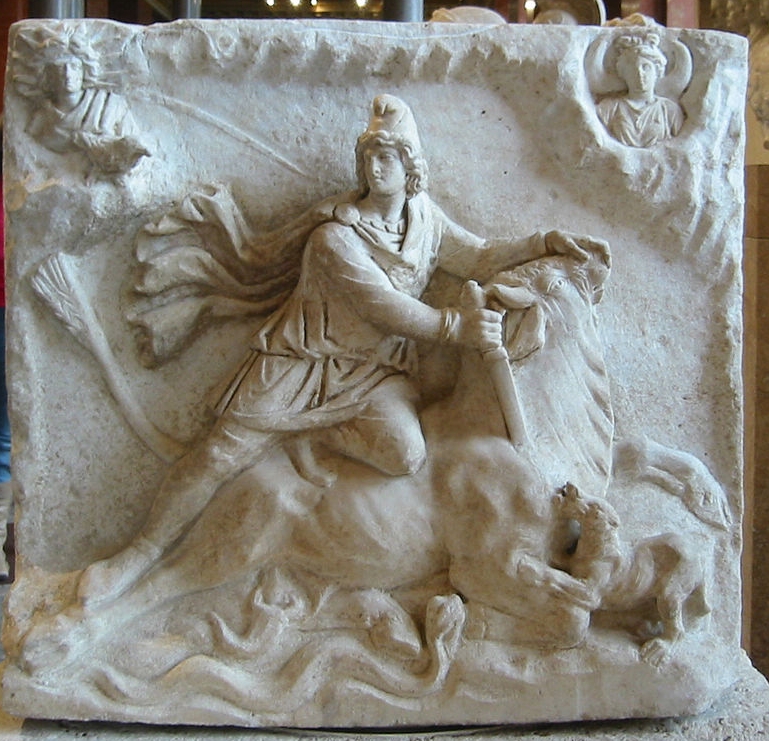
The slaying of the Bull (the tauroctony) is the central image of the Mithraic Mysteries. In an everyday perspective, it is symbolic of the control over one's creative drives. On the inscription of the left, we also see the Sun and Moon Gods, symbolizing Union (unified by Mithra and the Bull). In the deeper reading, the bull's blood nourishes the earth: the grain sprouts from the tail, the vine grows from the blood. From the controlled sacrifice of the lower nature, higher life is born. The dog and the serpent drink the blood (the two serpent forces of the body receiving the transformed energy), while the scorpion attacks the genitals (the base energy being redirected upward). Every element of the tauroctony is a map of internal spiritual transformation.
Going back to the Oaths, Mithra was also strongly identified, like all other names of Apollo, with the ability to take oaths and keep them. The oaths not only relate to literal oaths, but the oaths of silence in the Ancient Mystery schools. As Lugus for the Irish, he was also the God of bright vibrancy and the keeper of the oaths. Same are the relations on his Vedic identity as Mitra.11
Today, a very common practice of giving an Oath towards the Gods is the Oath where all doctors give (clearly associated with the healing powers of Apollo): the Hippocratic Oath. Despite what modern doctors follow in their practices, the oath is true and binding.
The Temple of Apollo at Delphi
Apollo is strongly associated with the sun rays, radiance of spiritual power. The titles given to the God have been many, extensive, and most esteemed and honorable. As Apollo he was given hundreds of glorifying epithets. He is a "God of Music," the hidden meaning of music being the music of the planetary spheres or the higher levels of existence, represented by the seven musical octaves. These represent the rising levels towards enlightenment for the individual human being.12
In the deeper mysteries, Apollo is a most wise teacher of the Arts of Alchemy and the workings of the light of the soul. As Apollo, his instrument is the Lyre, symbolizing the knowledge of all the dimensions of the world symbolized by each of the seven respective cords of the Lyre, all of which correspond to one of the 7 main chakras. As a result, Apollo was termed by the Ancient Greek Philosopher Plutarch as the "inventor of music," alongside Hermes or Thoth who created his lyrical instruments. The two Gods also share a very close relationship, based on strong friendship. Apollo can heal through music, a symbolism for the correct chanting of mantras into the soul but also literal music. Such "songs" were named "Paeans" by the Ancient Greeks.13
His rites, which were purificatory, dealt with the power of the sun to purify the human soul. Additionally, he was known to possess exceptional prophetic abilities, and he bestows the gift of looking into the future or extensive prophetic powers, being himself a God that is a master diviner. These abilities come from purifying and uplifting spiritually the Soul, by making use of the knowledge of the Gods.14
The Pythia and the Omphalos
At the heart of the Temple sat the Pythia, the priestess of Apollo, who delivered oracles in a state of divine possession. She sat upon a tripod over the adyton (the inner sanctum), chewing laurel leaves and inhaling vapors that rose from a chasm in the earth. The oracle was consulted on matters of state, war, colonization, personal affairs and spiritual guidance. For over a thousand years, from approximately the 8th century BCE to the 4th century CE, the Delphic Oracle was the supreme spiritual authority of the Greek-speaking world. No colony was founded, no war was declared, no major law was passed without first consulting Apollo through his Pythia.15
The omphalos (ὀμφαλός), a carved stone housed in the adyton, was considered the "navel of the world." According to tradition, Zeus sent two eagles from the ends of the earth, and they met at Delphi, marking it as the center of the world. The omphalos was covered in a net-like pattern (the agrennon), which represents the network of energy lines that cross the earth. This stone was the physical anchor of the oracular power, the point at which the divine and terrestrial worlds intersected. The spiritual practitioner who meditates at such a point of convergence experiences amplified contact with the higher dimensions.16
Plutarch, a most prominent Greek philosopher and Pagan theologian, writes about our esteemed God in his work "In regards to the Delphic Epsilon":
"Our beloved Apollo heals the woes of our lives, solving them by the giving of oracles to all those who will ask him, while he himself sets inside us and gives rise of spiritual longings in philosophers, to ask necessary questions towards the correct knowledge [logos] - he does this by making our soul open to the truth, something obvious in many other things [relating to the God], but also obvious in his choice for the letter E to represent him."17
The pronunciation of the letter "E" was what one had to say upon entering and exiting the temple of Apollo in Delphi. The choice of this letter was considered a great mystery of the God. The letter was pronounced exactly like the word "Hey" of today, a common greeting between people who speak English but also other languages. The word "Ei" in Ancient Greek [which was used for the greeting inside Apollo's Temple], had however another spiritual notion. It translated as "That which truly is" or "Thou Art," a sublime parable of the power of "existing".18 The letter E is strongly symbolized in his Sigil, too. The relation between the letter E and his temple is illustrated clearly here on the coin.
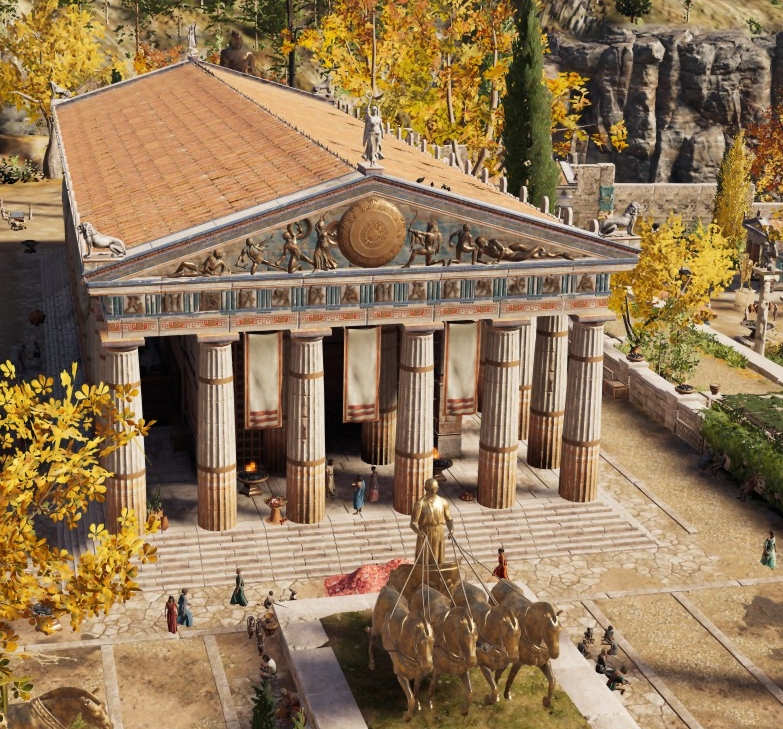
Temple of Apollo in Delphi, Reconstructed
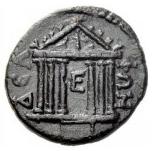
Coin symbolic of the Temple
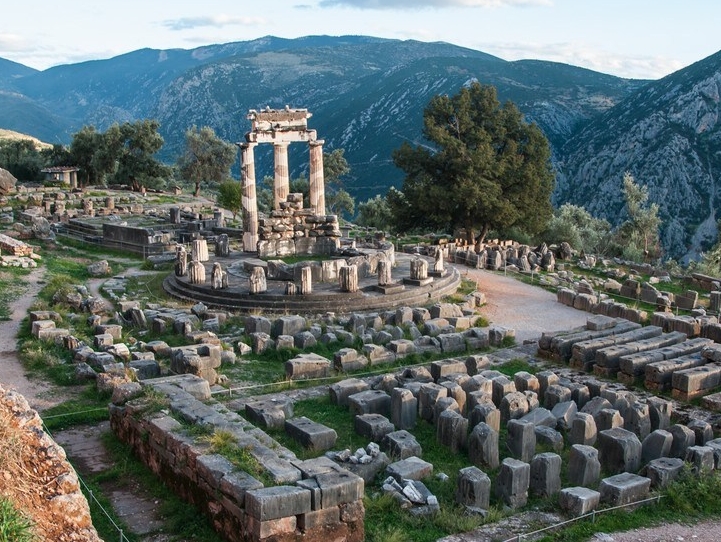
The remains of the Temple in Delphi, Greece today
On the entrance to the Temple of Delphi, there were inscriptions of wisdom. Three of these were on the entrance.
The First One:
"KNOW THYSELF"
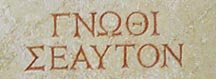
A most important occult statement, adopted for thousands of years by all mystery schools.
Here, Apollo describes the importance of meditation and knowing yourself. Without self-understanding, there is no wisdom.
The Second One:
"NOTHING IN EXCESS"
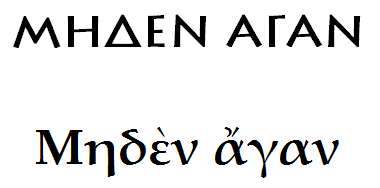
Excess here describes a situation of imbalance and lack of harmony on either side of lacking in something, or overabundance that causes disharmony, and therefore damage.
This "excess" is also a code-word for the balance of the soul.
The Third One:
"PLEDGE [Certainty], THEN CALAMITY"

This statement translates to "A pledge, then a calamity".
This is the most cryptic of the three statements.
This statement warns strongly against being deluded on false certainty, which can later bring calamity.
It warns to not "pledge" one's self to rumors or false ideals. Only if Christians took heed of this advice...
Sacred Cities: Sippar and Larsa
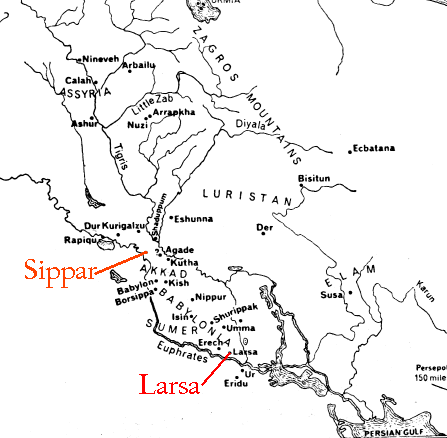
Map of Sippar
Apollo is a warrior god of justice and truth. His cities were "Sippar," an ancient Akkadian city on the east bank of the Euphrates, north of Babylon, and Larsa (Ellasar) of Sumeria. Sippar is 20 miles (32 km) southwest of Baghdad in Iraq. Sippar was one of the first cities to be established by the Gods. In Ancient Greece, his place of worship was at Delphi, the famous "Delphic Oracle," which was the global center of spiritual consultation and prophecy for many centuries.
Larsa's Sumerian name is given as Ararwa, apparently for Arauruwa, "light-abode," which is the meaning of the ideographic group with which it is written. In addition to the name Larsa, it was also called Aste azaga, "the holy (bright, pure) seat." Both its names were apparently due to its having been one of the great Babylonian centers of sun-god worship. Like most of the principal cities of Babylonia, it had a great temple-tower, called E-dur-an-ki, "house of the bond of heaven and earth." The temple of the city bore the same name as that at Sippar: E-babbar, "House of Light," where the sun-god Shamash was worshiped. Among the tablets found at this site by Loftus was one that gives measures of length and square and cube roots, pointing to the place as one of the great centers of Babylonian learning.19
The name E-babbar, "House of Light," tells us everything about the nature of this God's worship. The temples were not dark sanctuaries of fear and submission. They were houses of illumination. The worshiper came to receive light, clarity, understanding, and judgment. This is the direct opposite of the Abrahamic model, where the worshiper comes to submit, to confess, to beg. In the temple of Shamash, one came to see clearly and to be seen clearly, because nothing is hidden under the Sun.
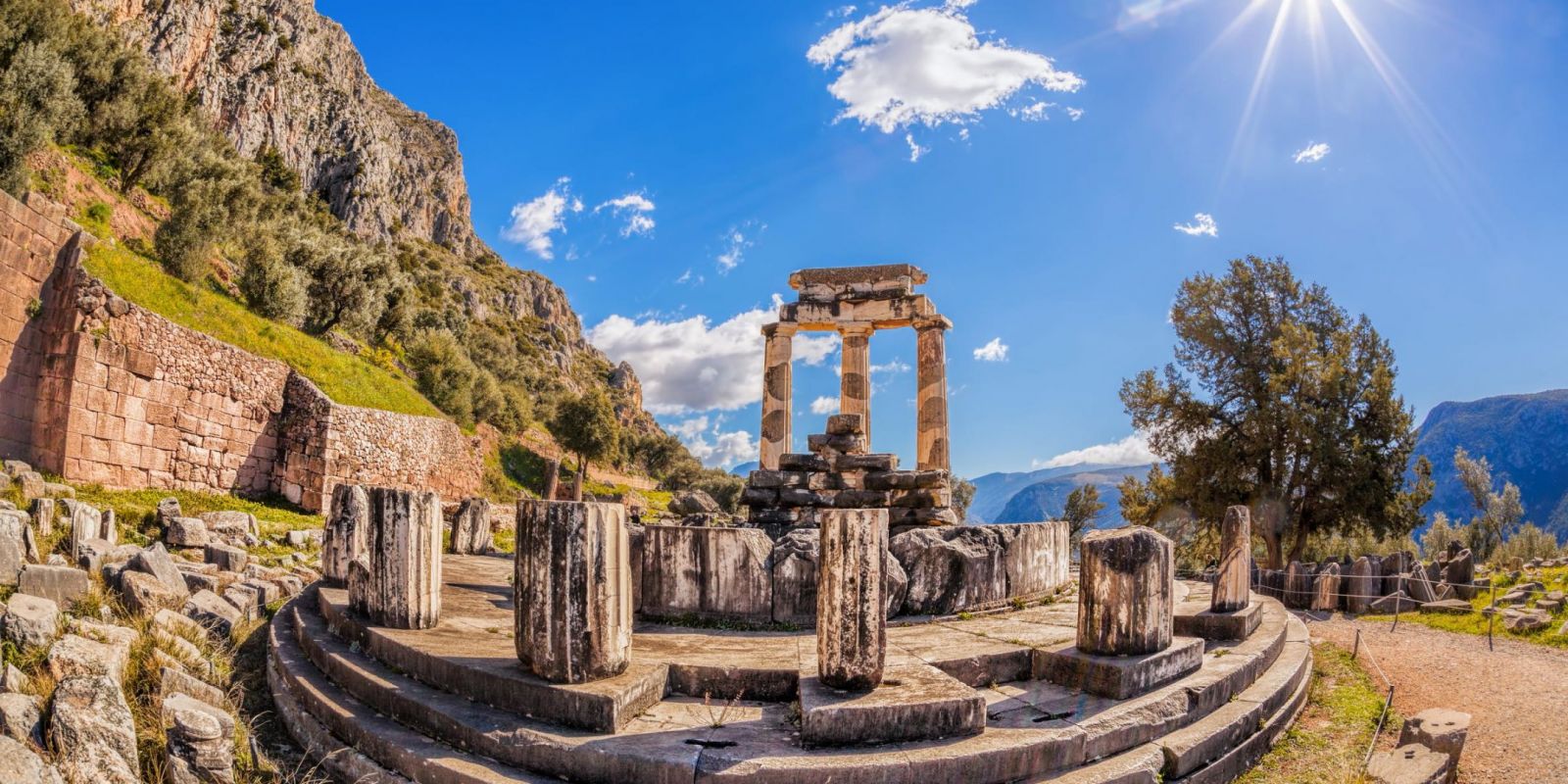
Delphi
The Faravahar and the City of Hatra
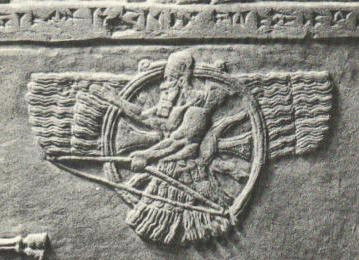
The Faravahar (Winged Disk)
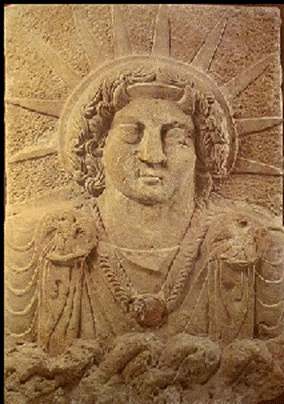
Chief Deity of Hatra
His symbol the Faravahar represents freedom of choice and protection. The Faravahar is the original winged disk, one of the most ancient and enduring symbols in human history. Apollo was also the Chief Deity of the City of Hatra, where he was known as "Shamiyah." Note the horns in the sculpture, denoting his high spiritual rank.
Sigils of Apollo

Apollo's Personal Sigil
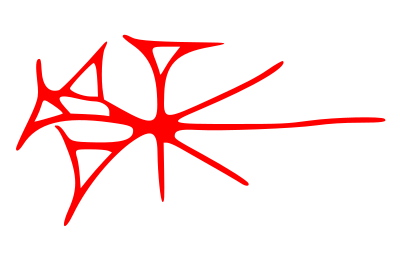
Sumerian Sigil
His personal sigil is of great importance in spiritual alchemy. The letter "E" is strongly embedded in its form. Click here for larger Sigil images.
Spiritual Alchemy and the Gifts of Apollo
Abrahamic texts read that "Azazel taught men to make swords, knives, shields, body armor." This is all symbolic. He is a Master of Spiritual Alchemy. Spiritual Alchemy has to do with the transformation of elements within the human soul, drawing energy from the earth and working with the earth spiritually. Each of the seven chakras is represented by a specific metal. Apollo works with dedicated disciples to achieve godhead.
All of the above is spiritual. The biblical account was twisted. The "swords, knives, shields, and body armor" are all spiritual weapons. He is an expert on the planets, constellations and astrology. He is also very skillful in the arts, cosmetology, crafting of ornaments and jewelry. Apollo creates beauty.20
Asclepius: The Son of Apollo and Father of Medicine
The myth records that Apollo "descended" on a mortal woman and gave her a son. The name of the woman is titled in the myth as "Coronis."21 The name "Coronis" implies the Greek Word for Crown (ΚοĎώνη), so that is an allegory. Apollo, in all Yehuboric literature, is attacked strongly for "Descending" downwards to help mankind. This has to do with the arrival of the Gods a very, very long time ago.
Apollo fathered a son with a physical wife, who was later called a Demi-God named Asclepius (áĽĎκληπιός). Asclepius is the father of modern medicine and healing arts. His symbol is also the symbol of his father: the entwined Python. The Rod of Asclepius, a single serpent wound around a staff, remains the universal symbol of medicine to this day, used by medical associations worldwide. This symbol represents the serpent force (Kundalini) channeled through the central pillar of the spine for the purpose of healing.22
Asclepius's healing temples, called Asclepieia (áĽĎκληπιεῖα), were among the most important institutions in the ancient world. The most famous was at Epidaurus in Greece. Patients who came for healing would undergo a process called enkoimesis (áĽÎłÎşÎżÎŻÎĽÎ·Ďις), or "incubation": they would sleep in the sacred precinct, and Asclepius would appear to them in dreams, either healing them directly or revealing the cure. This practice of healing through directed spiritual sleep is one of the oldest forms of medicine in human history, predating Hippocrates by centuries. It demonstrates that the true medicine of Apollo and his son was always spiritual at its foundation: the cure comes from the divine realm, transmitted through the opened channel of the sleeping soul.23
Apollonius of Tyana: The True "Messiah"
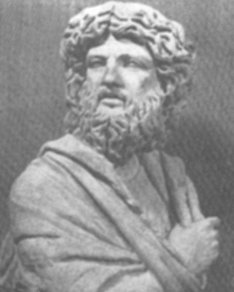
A most famous disciple and considered "Son" of the blessed God was "Apollonius" of Tyana. Upon the myth of Apollonius, who was a miracle worker and man who reached the Godhead, but also full immortality. Apollonius never died. All the writings, teachings and instructions of Apollonius were later, after copious perversion and forgery, falsely accredited to the non-existent character named "Jesus." These include teachings such as "The Kingdom of God is within" and other occult statements. Of course, these were also common knowledge in the Mystery Schools of the time.
The Name of Apollonius means "He of Apollo," as thus he was called "Apollonius" of Tyana. The kindness and good of Apollo is great, and the gifts he bestows are numerous towards his disciples. Apollonius was known beyond any doubt to have become a God, with extensive powers related to Apollo, such as extreme wisdom, oracular ability, god-like levels of divination, but also many other powers. He was recognized as being a God by all the Ancient Priesthoods of the time. He was loved by all and traveled in Rome, the Middle East, Far East, India, Egypt and Ancient Greece, giving teachings, spiritual knowledge, and promoting mystical knowledge. He was hailed as a living "God." Apollonius was a commoner, nor a king nor anything else. Yet, his intense love for Apollo and his extreme spiritual diligence gained him all the glory of the known world at the time. It was considered that inside him lived literally an aspect of the God Apollo.
Apollonius reached a spiritual level that is of the Gods, capable of all sorts of miracles. Towards the end of his life, he was that spiritually advanced that he was reported to be able to raise the dead, or do what we presently call "Teleportation" or "Bi-Location." The enigmatic figure of Apollonius was loved by everyone. No matter where he went, people flocked to listen to his sermons, and he was adored by all people.
He spread healing and positivity everywhere he went. Leaders of the time bowed to Apollonius and his massive wisdom, many recognizing him as a god in the flesh, while even more leaders wrote epistles to him. There are surviving fragments of his replies. Apollonius left behind a major wealth of written knowledge, that was burned and destroyed by the Yehuborim.
Philostratus, commissioned by the Empress Julia Domna in the early 3rd century CE, wrote the Life of Apollonius of Tyana in eight books. This is the most extensive surviving account of the sage. In it, Apollonius travels to Babylon, India, Egypt and Ethiopia, studying with the Brahmins and the Gymnosophists, mastering every form of spiritual knowledge available in the ancient world. He performed miracles of healing, exorcism, clairvoyance, and prophecy. He confronted the Emperor Domitian, was imprisoned, and vanished from his trial. He appeared after his supposed death to his disciples, proving that he had transcended mortality.24
Apollonius was called a "Goetic Magician" by the Church, and demonized. In contrast to the Yehuboric hoax of "Jesus," Apollonius was indeed believed and loved. Because of the extensive influence Apollonius had, the Christian Church destroyed all knowledge and mention of Apollonius, and where it didn't remove all of it, it simply replaced it with the lowest slander.
As Apollonius was slandered as a man and was replaced by "Jesus," so did Apollo get slandered to no end by the Yehuborim.
Apollo as Protector of the Young
Apollo, in the external world, represents the protection of children and is patron of children and their education. Apollo was called "Apollo Kourotrophos" (áĽĎ€ĎŚÎ»Î»Ď‰Î˝ ΚουĎοτĎόφος), implying he is the nurturer and protector of the children. He was considered a force that helps them grow into adulthood and protects children during this time in their life. The "Child" here is also a code word for the new soul that arises from meditation, progressively growing and reaching enlightenment or maturity. In the linear world, he protects and oversees children and their growth, but also education so that they become full adults.25
Apollo was also called "Apollo Patroos" (áĽĎ€ĎŚÎ»Î»Ď‰Î˝ ΠατĎῷος), meaning "Apollo of the Fathers," in Athens. Under this title, he was the protector of the family line, the guardian of inheritance and legitimacy. Every Athenian citizen swore by Apollo Patroos. This title connects directly to his Sumerian identity as Utu, who was invoked in contracts, property disputes and inheritance cases. From Sumer to Athens, across three thousand years, the same God protected the same things: the truth of lineage, the sanctity of oaths, the rights of children.26
Apollo as Deliverer of Justice
Apollo is also the deliverer of Justice. While he bestows many gifts to his disciples and people, he can be the exact reverse when it comes to the enemies of the Gods. He can bring very dark calamities, and as bright and beautiful he can be in his loving face, so dark and bleak can the curses he casts on his enemies be. The power of Apollo to curse was symbolized by his bow, with which he flung darts onto his enemies. Socrates in Plato's work refers to this power as his power to "Cast Darts," which can bring major damage to enemies.27 On the contrary, Apollo is a strong protector for those of the Gods, averting evil from reaching them.28
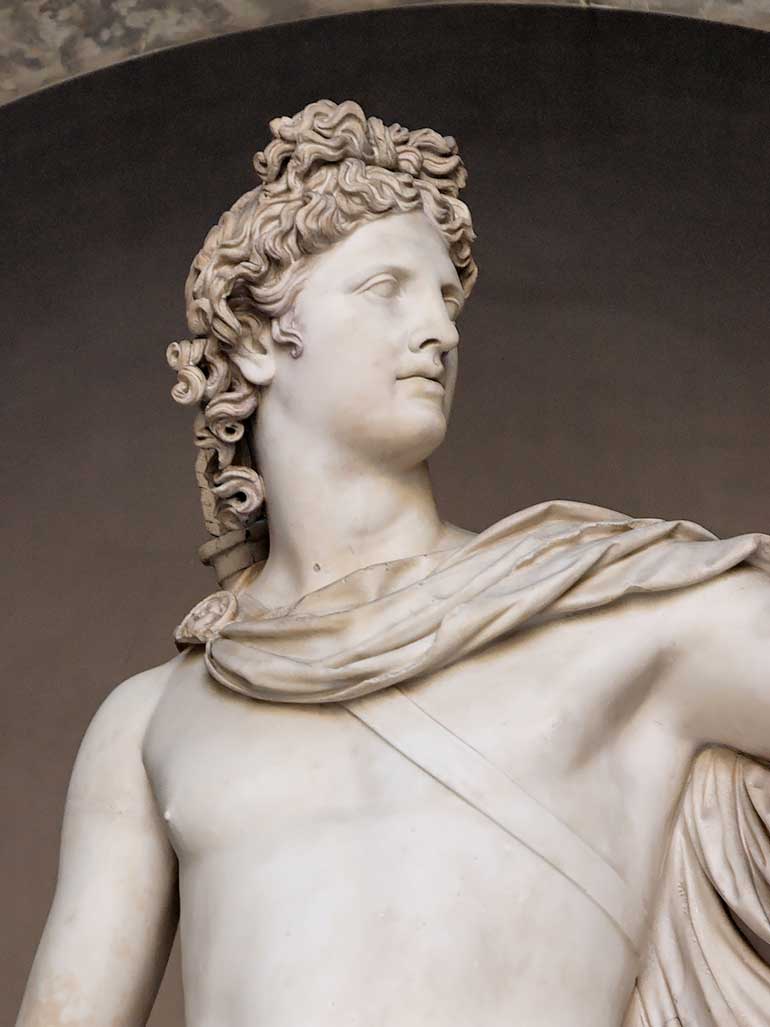
The statue on the left is one of the greatest forms of fine art the world has ever seen. It is called "Apollo Belvedere" and it currently resides in the Vatican. Even the Vatican could never pass by as a construct worth existing, without stealing the artwork of the Gods and the Ancients.
The beauty of Apollo is so extensive, that still the phrase "Apollonian Body" is a phrase that is commonly used to describe aesthetic perfection. Apollo represents a very strong balance between being a man but having beautiful grace.
Apollo was regularly called "Uranios" (Îźá˝Ďάνιος) which means "Heavenly," as in Heavenly Apollo. The title, except for a spiritual title, is also pointing to the beauty of this God. For centuries, Apollo was considered one of the ultimate types of human beauty and perfection.
In our modern world, Apollo remains a major inspiration for us humans collectively. NASA's most important mission to get to the moon was named after the God Apollo. It was also the first successful mission of landing on the moon. Except for reaching the starry heavens in this manner, Apollo still remains an inspiration for those who want to reach the heavens in their souls.
Those who partake in the spiritual communion with this God will find all the power shining strongly above them.
The Defamation of Apollo: From Sun God to "Azazel"
The Name "Azazel" that the Yehuborim have been calling this God is based on two separate words. It is merely a title, and not the actual Name of the Deity. These were Azaz and EL. Numerous blasphemous interpretations have been written about this Name as with any other Name of the Gods by the Yehuborim, yet their meaning remains clear even in present-day Arabic and Middle Eastern languages.
The word "Azaz" relates to meanings about "power" or "extreme power." The word "EL" simply means "God," but commonly translates to "Light." However, God here is a code-word for the spiritual light. These two words put together are to signify Apollo's extreme power and spiritual brilliance: his power of the Light. Further revealed is the power and high rank of Apollo, as many of the Yehuboric texts refer to him as the "Leader of the Hosts," confirming his high position in the divine hierarchy. His name in the Yehuboric literature is also described as "Azael," meaning "He who God Strengthens." This is a code word again for the light. He is also "condemned" and attacked for giving the "Secrets of the Heavens" to mankind, or spiritual knowledge.29
Even in the Yehuboric texts of defamation, Apollo, going under the Yehuboric-given title of "Semihazah" which means "The Great Rebellion," takes an oath with other Gods so that they carry out the revolt against the tyranny of the Yehuborim, while Apollo says he will take the responsibility himself. Apollo, in opposition to the injustice of the Yehuborim to sink humanity spiritually, resisted. He was thus slandered for protecting mankind against the Yehuborim.30 The same is also reflected in how Apollo joined the rest of the Olympians against the Giants or impure spirits in the Gigantomachy, where Apollo takes arms to defend the other Gods.
In modern "Daemonology," Apollo has been slandered as "Apollyon" and appears as such in many grimoires. This is a blasphemy and the word Apollyon means "he who goes away" or "he who gets thrown away." While Apollo means all the positive things mentioned above, the word "Apollyon" serves as blasphemy to the God. Christians to this day understand that the "Apollyon" figure in the Bible was one of the most powerful Gods, and a very powerful deity that they also admit ruled over Rome, an empire built by the "Forces" they sought to overthrow.31
Yom Kippur: The Ongoing Attack
There are few Gods that are as powerful as Apollo, and Apollo is very high ranking and loyal to Zeus, Astarte, and all other Gods. The Yehuborim center many of their attacks specifically on Apollo (under the name "Azazel"), because they recognize his superior power and higher rank, but also how many of the Gods thrive under him.32
The Yehuborim are so insistent to try to hide against Apollo's power that they have devoted one of their most important religious holidays (Yom Kippur) in direct full-on attack against the God under the title "Azazel." A Goat is brutalized during these dates, where ritualistic rites, curses and abuse are done on it by the Abrahamics. The goat is left desolate to die, or thrown off a cliff, to die a slow and painful death. The symbolism of the Goat is symbolic of both the Pagan cultures, yet there are many other more cryptic messages in this ritual attack that is conducted yearly by the Abrahamics.33
As Zeus is rebuked and as Astarte has had her name perverted to "Ashtoreth," so is Apollo attacked under the corrupted title "Azazel" in direct opposition to the collective splendor and Justice-oriented nature of Paganism. The Yehuboric religions preach lawlessness, excusing crimes indefinitely, turning the other cheek and so on. All of this is the antithesis of what Apollo represents.
HAIL APOLLO!!!
The Goetic Inversion: How Apollo Was Hidden in the Grimoires
The process by which Apollo/Mithra/Utu was transformed into the fearsome title "Azazel" follows the same pattern seen throughout the grimoire tradition. A God of truth, justice, light, prophecy and law was reframed inside hostile literature as a figure of dread and accusation.
The method was systematic: take the divine name, corrupt it linguistically, strip the deity of his attributes, and then invert the remaining identity into a figure to be feared, bound or condemned. In Apollo's case, his gifts of law, wisdom, healing and spiritual knowledge were recast as crimes against the Yehuboric religion.
The title "Azazel" preserved only a faint echo of his real nature. His role as teacher of humanity, bestower of knowledge and God who sees all things was inverted into the accusation that he revealed forbidden arts or watched mankind with hostile intent. The same hostile literature that slanders him still cannot avoid preserving traces of his true powers.
I. Names
Apollo first enters the Roman lexicon in the abbreviated form already known in Greece and in Magna Graecia, Apolo, on an Etruscan scarab showing Apulu playing a lyre on a golden swivel ring now in the J. Paul Getty Museum as accession 2019.13.11. The first attestation in any Latin language of his name as Apolonos, which appears to be a form from Faliscan, occurs far earlier in 500–475 BCE.35,36,37
The general form with two l letters (Apollo) began to dominate in Latin, again, a form already known in Greece.35,37
Sources: Allen and Wallace, Two Etruscan Scarab Rings Engraved with Old Latin Inscriptions (2021); J. Paul Getty Museum. Engraved Scarab with Apollo Playing the Lyre Set in a Gold Swivel Ring.; Bakkum, The Latin Dialect of the Ager Faliscus: 150 Years of Scholarship (2009).35,36,37
II. Roman History
The Averter of Plagues
In 449 BCE, according to Livy, the consuls moved their meeting outside of Rome because they did not want to intimidate the Senate with their legions. The new location for the Senate's meeting place was on the Prata Flaminia, near an area known as the Apollinar. Apollo had certainly been worshipped in Rome since early in the fifth century BCE; in 431 BCE, a temple to protect Rome from plagues was dedicated and possibly built on top of the Apollinar. It is uncertain how much of a religious focus there was on the area in which the Roman Senate met.38,59,61
The plague episode is essentially the foundation of Apollo's public worship in Rome. The Roman Senate sought guidance from the Sibylline Books through the duoviri sacris faciundis, the officials charged with their care, and vowed a temple to Apollo for "the health of the people". The obligation was fulfilled in 431 BCE, when the consul Gnaeus Julius Mento dedicated the aedes in the Campus Martius outside the pomerium (the boundary or limit of Rome), a setting consistent with the cult's conspicuously Greek and extramural character.38,48,49,59,61
Its extramural location also made the sanctuary suitable for public business that could not conveniently be conducted within the pomerium. For more than four centuries, it remained Apollo's only major public temple at Rome.38,59,61
Was Apollo Roman?
Non doctorum in litteris continetur, Apollinis nomen Pompiliana indigitamenta nescire?
Is it not recorded in the writings of learned men that the Pompilian indigitamenta did not know the name of Apollo?
Ex quo apparet et liquidum est, et hunc vobis fuisse incognitum, post autem aliquando coepisse esse et notum.
From this it is clear and evident that he too had been unknown to you, but afterwards at some point began to be known.
— Arnobius, Adversus nationes 2.73
According to Arnobius, though he was writing against the 'nations', Numa did not note down the name of Apollo in his lists. Roman sources certainly recognized a strongly Greek element in Apollo's public rites: Livy twice specifies that the decemviri were to sacrifice to Apollo Graeco ritu, “according to the Greek rite,” in his account of the establishment of the Ludi Apollinares in 212 BCE.39,49,74
Romans understood certain other solar gods to be ancestral to their own, such as Soranus, who likely either descended or came alongside the Etruscan god Shuri. Both variations have characteristics of Apollo; Soranus became an epithet of Apollo at Soractus too. Another problem is that another Christian, Augustine, contradicts the account of Arnobius because his account of Varro's separate twenty di selecti explicitly names Apollo, Sol, Luna, and Diana together.39,40,41,42
His apparently arcane earlier history in central Italy also is problematic for any literal historical reading of Arnobius, because Apollo's cult in the ager Faliscus is known to have existed as early as the fifth century BCE at Falerii Veteres.43,44
Whether Apollo was a Greek god or not, the existence of Apollo and the propitiation needed was held to be extremely pivotal to the functioning of Rome and the wellbeing of its people, particularly during times of plague and catastrophe; the Romans constantly consulted the Sibyl, the local representative of Apollo on earth, and later they would extend this to the oracle at Delphi and the sanctuary at Delos.45,46
Sibylline Books and Sacred College
The earlier arrival of the Sibylline Books, as Dionysius of Halicarnassus told the story, tied the Sibyl to Apollo in the background during the ancient kingdom of Rome. The god is only named as being the recipient of the Books originally in his temple at Gergis, near historical Troy, but the rest is inferred from context. The arrival of the books was itself told as a marvel: the historian reports that an unknown woman, presumably the spiritual ancestor of the Sibyl, offered nine volumes of extreme spiritual knowledge to king Tarquin, burned three when he refused her price, then three more, until the king bought the last three for the sum first named.47
The tradition of the holy books connected all of the Apollo oracle to Rome as a relationship founded in heaven. The priestly body charged with interpreting the Sibylline Books—the duoviri, later expanded to the decemviri and then the quindecimviri sacris faciundis—became one of the chief vehicles for the ritus Graecus, the "Greek ritual" emphasized by Jean Gagé, through which Greek rites could be incorporated under Roman public supervision. Dionysius himself in the Roman Antiquities repeatedly gave Greek antecedents to Roman institutions.47,48,49
Trojan Myth
Another thing that connected Apollo to Rome directly, albeit less linearly than the direct case of Venus, was his divine patronage of Troy in the Iliad, a type of divine favor was considered to have been bestowed on Rome through the Trojan ancestor of the city, Aeneas. This was another conflicting and divisive element that was rather contrary to any idea of Apollo being a pure Greek god in the Roman mindset.50,51
III. Epithets
Most of Apollo's names were adaptations of Greek titles referring to areas, but some had a distinctly Latin flair that were of immense importance.
| Epithet | Meaning | Domain |
|---|---|---|
| Apollo Medicus | Apollo the Physician | First Roman Apollo, healing |
| Apollo Palatinus | Apollo of the Palatine | Augustan Era |
| Apollo Actiacus | Apollo of Actium | The naval victory of 31 BCE |
| Apollo Soranus (Soracte) | Apollo of Soracte | Fire-cult of the Hirpi Sorani |
| Phoebus | The Bright | Light, the sun, poetry |
| Apollo Arcitenens | Apollo the Bow-Bearer | Archery, philosophy |
| Apollo Intonsus | Apollo the Unshorn | Eternal youth |
Sources: Livy, Ab urbe condita, trans. Foster; Virgil, Aeneid, trans. Fairclough; Horace, Odes, trans. Rudd; Ovid, Metamorphoses, trans. Miller; Propertius, Elegies, trans. Goold; Farnell, The Cults of the Greek States, 1907; Gagé, Apollon romain, 1955; Graf, Apollo, 2009; Smith, Dictionary of Greek and Roman Biography and Mythology, 1844–1849.38,41,49,52,53,54,55,56,57,58
IV. Temples, Sacred Sites
Aedes
As stated above, this was the most ancient of the sun god's temples in Rome, constructed outside the boundary zone of the city itself. It was inaugurated, as stated, to avert plagues, the Apollinar being a district already named after him. The temple's name proper was the aedes Apollinis, known topographically as Apollo in circo. This was the principal Roman site of Apollo Medicus.38,49,59,60,61
Modern excavations have shown that the sanctuary had a complicated history before the monumental Augustan rebuilding. The Apollinar of the fifth century gave way to the vowed temple of 431 BCE; a rededication or restoration is recorded in the fourth century BCE, and parts of earlier temple phases lie beneath the later podium. Vitruvius also names a temple of Apollo among his examples of the tetrastyle form, although the precise identification of his building with one archaeological phase remains debated.59,60,61,88
Gaius Sosius began the great late-Republican rebuilding of the old aedes after his triumph and alliance with Marc Antony. Augustus inherited the project after Actium and permitted Sosius' name to remain attached to the sanctuary. The rebuilt temple therefore became known conventionally as the Temple of Apollo Sosianus; it was not a separate sanctuary from the old Apollo in circo, but the monumental successor occupying the same sacred site beside the later Theatre of Marcellus.59,60,62
The temple had a strongly martial and triumphal emphasis. Its pediment reused Greek originals in island marble, carved around the fifth century BCE and depicting an Amazonomachy with Heracles and Theseus among the fighters and Athena and Nike above; the surviving pieces were excavated in 1937 and 1938 and are now displayed at the Centrale Montemartini. Among the masterpieces Pliny saw in the temple were the dying children of Niobe, whose authorship he could not decide between Scopas and Praxiteles, and he also records works by distinguished Greek sculptors in the sanctuary. Under Augustus the building could therefore look backward to Apollo Medicus and at the same time toward victory, Actium, and the visual language of Greek conquest.62,63,64
It was raised on a high podium of squared tufa. To make room for the Theatre of Marcellus, the podium and approach were reorganized; the frontal stair was replaced by lateral access, while columns and engaged half-columns used marble, travertine, and stucco to give the building the appearance of a marble peripteral temple. Part of the podium and three restored columns still survive beside the theatre.59,60
Palatinus
Augustus vowed to build the Palatine temple to Apollo in 36 BCE during the war against Sextus Pompey and dedicated it on 9 October 28 BCE on ground of the Palatine that a lightning strike had rendered sacer and therefore public. It was the second and by far the most famous monumental temple of Apollo in Rome, sited within the pomerium in a position that the traditional temple had not occupied. In Augustan ideology Apollo was consequently drawn into the heart of the imperial household and the civic center of Rome.65,67,79,86
The decoration turned the building into a monument of Actium as the cult became a vehicle for the restoration ideology and the piety of the emperor. Its precinct housed Greek and Latin libraries and, after Augustus' reform of the prophetic collections, the Sibylline Books themselves; Senate meetings could be held there. The cult group joined Apollo Citharoedus with Diana and their mother Latona. The sanctuary also played a central role in the Secular Games of 17 BCE, where Apollo and Diana were presented as divine patrons of the renewed Roman age.53,55,65,67,78,79,80
Poets surrounding the imperial regime praised the sanctuary as one of Augustus' greatest religious works. On the night before 19 March 363 CE the temple caught fire. Ammianus Marcellinus reports that the blaze was serious enough to threaten the Sibylline Books, but that concentrated efforts saved the prophetic volumes; he does not assign the fire to Christian arson, and the cause is not securely known.68,69
A much later medieval story attached another destruction to the Palatine library. John of Salisbury claimed in the twelfth century that Pope Gregory the Great, Gregory I, had burned books of the Palatine library in order to suppress forbidden divination and make greater room for Scripture. Modern scholarship treats this report as an unreliable medieval tradition rather than evidence for an actual sixth-century destruction.69,70
Phoebiana
One of the most important provincial sanctuaries of a Roman Apollo stood at Faimingen in Raetia, ancient Phoebiana. Here Apollo was joined to Grannus, a Celtic healing god, and the large temple precinct developed principally during the second and early third centuries CE. Architectural remains and inscriptions from the region make Faimingen one of the best documented centers of Apollo Grannus north of the Alps.72,73
Caracalla's connection with Apollo Grannus belongs to the god's medical function. Cassius Dio says that the emperor, afflicted in body and mind, sent prayers, sacrifices, and dedications to Apollo Grannus, Asclepius, and Serapis and even approached the gods personally, but obtained no cure. Andreas Hofeneder argues from the literary, epigraphic, and archaeological evidence that the Apollo Grannus sanctuary Caracalla visited in 213 CE should be identified with Faimingen rather than Grand in Gaul.71,72
V. Symbols
The Roman Apollo maintained most of the primary visual aspects of the Greek god. The use of a bow and arrow for the purpose of delivering plague or striking an enemy from far away demonstrated the power of Apollo. The lyre or cithara was used to represent the art of music, poetry, prophecy, and peaceful harmony. The laurel wreath signified Apollo's Delphic and purificatory character, while the tripod signified the source of Apollo's oracle. Roman poets and artists were able to transition from the dangerous archer to the calm Citharoedus as a matter of fact and poise.50,54,56,57,64
The lyre would eventually become a particularly significant symbol in the Augustan era of politics. As such, Apollo Citharoedus became an icon to translate victory at Actium into peace, musical order, and the restoration of the Roman State and proper religious rites; the Palatine cult statue and Augustan poetry made this particular version of Apollo specifically Roman in their public interpretation. Additionally, Apollo's association with the laurel wreath also became synonymous with Augustan victory and the house of the princeps.53,55,57,79,80
Macrobius later supplied a learned solar explanation for several of these symbols. In the Saturnalia he treats Apollo as the sun, interprets the god's arrows as rays, and explains the double power of those rays to heal and to harm. This late antique theology is important evidence for how Roman intellectual culture eventually systematized the solar Apollo, but it should not be projected unchanged back onto the earliest Republican cult.46,57,77
VI. Apollo Medicus
Again and again Apollo is invoked as the figure who saves Rome from disaster and plague. After the fall of Veii in 396 BCE the Romans sent a golden bowl to Apollo at Delphi from the spoils, a public act that tied military success to the god's favor and to the authority of his oracle.45,46,74
Legend has it that the Roman senate requested the transfer of Asclepius to Rome because of the plague that had occurred in 293 BCE. They again consulted their Sibylline Books and asked Apollo's son to come to Rome from Epidaurus. It is said that when he arrived in Rome that the god came as a snake and lived on an island in the river Tiber. About one hundred years later, the Carmina Marciana were composed by the seer Marcius who wrote the verses as part of the disaster at Cannae and therefore requested games be held in honor of Apollo. Approximately 100 years after this request had been made P. Cornelius Sulla, nephew of the famous Sulla and Urban Praetor of Rome, conducted the first Ludi Apollinares. At this time the decemvirs also required sacrifices to Apollo and his mother Latona to be performed according to Greek ritual.49,74,75,76,87
The sources preserve two stages in making the games permanent. Livy says that in 211 BCE the praetor C. Calpurnius Piso secured a senatorial decision that they should be repeated perpetually; in 208 BCE, during a serious epidemic, the praetor P. Licinius Varus carried a law fixing their annual date. Livy nevertheless insists that the games had originally been founded for victory over Rome's enemies rather than simply for public health, a distinction repeated by Macrobius.74,75,76,77,87
Apollo's medical character did not disappear under the Empire, but its most visible Roman expressions changed. At Rome, the Augustan language of Apollo emphasized Actium, prophecy, music, and dynastic renewal, while in the provinces healing forms such as Apollo Grannus continued to flourish at springs and sanctuaries. Macrobius still knew the old Roman invocation Apollo Medice, Apollo Paean, showing that the medical Apollo remained part of learned Roman religious memory centuries later.57,72,77,79
VII. Apollo and the Emperor
Augustus transformed the Roman cult of Apollo more radically than any earlier Roman ruler. The victory at Actium was fought beside a sanctuary of Apollo, and the princeps' subsequent patronage joined the god to victory, peace, prophecy, poetry, and the restoration of religious order. The Palatine temple stood beside Augustus' residence, contained the libraries and the Sibylline Books, and made the god's precinct one of the ceremonial centers of the new regime. Apollo was not simply declared the emperor's personal god above all others, but Augustus cultivated an unusually close and publicly visible affiliation with him.55,65,67,79,80
VIII. The Sibylline Oracle
The Sibylline Books were never simply an individual Book of Apollo. As a part of the Roman state's holy machinery, they were perennially consulted by a college of priests on behalf of the Roman state whenever the senate would require it. When Rome faced exceptional danger in the form of prodigies, epidemics, military crises or other similar threats; the two men responsible for maintaining these books, two men known as the Duoviri, would do so. Yltimately came to serve as members of the Decemviri (ten men) and then the Quindecimviri sacris faciundis, a priestly college of fifteen that was responsible for introducing or regulating new religious rites, which included rituals from Greece.45,46,47,48,49
The old collection was lost in the fire of the Capitoline temple in 83 BCE and was reconstructed from prophetic verses sought in Italy and the Greek world. Augustus then subjected prophetic literature to a famous purge: Suetonius says that he collected and burned more than two thousand unauthorized Greek and Latin prophetic writings, while the approved Sibylline Books were placed in gilded containers beneath the pedestal of Apollo Palatinus65,78,79
Their survival into late antiquity is shown dramatically by the fire of 363 CE. Ammianus records that the flames in the Palatine temple nearly consumed the Sibylline verses but that they were rescued. Whatever their later fate, the episode shows that Apollo's temple remained the recognized home of Rome's prophetic state archive more than three centuries after Augustus.68,69
IX. The Secular Games and Apollo
Apollo’s largest Augustan ritual in honor of the State was the Ludi Saeculares beginning in 17 BCE. The rituals took place over three nights and three day. They were specifically designed to combine Roman traditions for ceremonies from previous centuries with Greek and Sibylline precepts. On the final day Augustus and Agrippa sacrificed to Apollo and Diana on the Palatine, and a chorus of twenty-seven boys and twenty-seven girls, all with both parents living, performed Horace's Carmen Saeculare before Apollo's temple and again on the Capitol.53,78,79
Horace placed Apollo and Diana as the twin guardians in charge of this new era with his hymn. In the hymn, Apollo is depicted as prophetic and radiant. They were to listen to Rome's children, defend the city from harm, ensure that fertility and moral reform would abound throughout the land, and allow Rome to expand its wealth and power. By holding the performance at the Apollo Palatinus, it allowed the temple to become a site for one sacred act to represent both the revitalization of the Roman people and the establishment of the Augustan settlement of moral renewal.53,78,79,80
Later emperors celebrated new Secular Games according to differing chronological calculations, but the Augustan celebration remained the decisive model. Its surviving inscription and Horace's hymn preserve an unusually detailed record of a Roman festival in which Apollo was one of the principal divine guarantors of the Roman saeculum.53,78,79
X. Macrobius on Apollo
The discussion by Macrobius on Apollo is one of the most complete surviving Roman theological discussions. In Saturnalia, Praetextatus considers Apollo to be the sun. Because the sun provides healing or destructive power with its hot rays, he states the god has both opposing properties of plague giving and medicinal healing. This interpretation is further reinforced when he quotes a Roman religious formula where the Vestals invoke Apollo Medicus (Apollo Physician), Apollo Paean (Apollo, Healer) and assert that this single god can serve as either a healer or a pestilence-sender based upon whether his sun-rays produce healthy effects or are dangerous.77
His representation then converts Apollo’s mythological history and his epithets into a metaphorical expression in terms of his physical characteristics. He illustrates the arrows as solar rays and explains how the golden or uncut hair is a reflection of the sun which cannot be separated from itself. He further provides cosmological explanations for the names Pythius, Delphius, Didymaeus and other epithets. Once more, he elaborates on the tradition about the Ludi Apollinares (Games of Apollo) and insists like Livy, they represent victory.77
In the next chapter Macrobius extends the synthesis by arguing that Apollo and Liber are manifestations of the same solar divinity: in a secret theological scheme the sun above the horizon is Apollo and below it Dionysus or Liber. He associates this with the IAO given to the Pythia, stating that Hades is IAO in winter, the Sun IAO in summer, Dionysus IAO in the fall and Zeus is the IAO in spring.46,57,77
Another link Macrobius makes is with Janus, which he associates with a form of Apollo.
XI. Apollo's Festivals in Rome
| Festival / Observance | Date | Observance |
|---|---|---|
| Ludi Apollinares | 6–13 July | Annual public games |
| Campus Martius Sacrifice | 13 July | A calendrical sacrifice |
| Dedication of Apollo Palatinus | 9 October | Anniversary of Palatine, 28 BCE |
| Ludi Saeculares rites of Apollo and Diana | 3 June 17 BCE; repeated only in later saecular celebrations | Final sacriice to Apollo and Diana |
Sources: Livy, Ab urbe condita 25.12, 26.23 and 27.23; Horace, Odes 1.31 and Carmen Saeculare; Macrobius, Saturnalia 1.17; Fowler, The Roman Festivals of the Period of the Republic; Scullard, Festivals and Ceremonies of the Roman Republic; Platner and Ashby, A Topographical Dictionary of Ancient Rome; Ryan, “Die Apollinarspiele zur Zeit der Republik.”53,74,75,76,77,78,79,86,87
The Ludi Apollinares were the primary Roman festival honoring Apollo. The first year the Ludi Apollinares were held was during a time of war, when they were an all day event to honor Apollo on July 5th 212 BCE. For the next several years after the first year, the Roman Republic continued to hold the Ludi Apollinares as an annual event for six days which took place in late June and early July. In order to create continuity with their past festivals that had been dedicated to Apollo, the Romans extended the length of the Ludi Apollinares over the course of the month of July so that they would begin on July 5th and continued until July 13th.49,74,75,76,87
XII. The Sun God and the Mithraeum
Apollo was ordinarily shown in Mithraeums in certain plaques along with Sol and sometimes Luna, connecting him to the mysterious solar god.82
A remarkable exception comes from the third-century Mithraeum at Rudchester, ancient Vindovala, on Hadrian's Wall. RIB 1397 preserves an altar beginning Soli Apollini Aniceto [Mithrae]. The fourth line is restored, but the object was found in the Mithraeum and the editors translate the dedication as “To the Sun-god Apollo Invincible Mithras.” It is one of the clearest pieces of Roman evidence in which the names and solar powers of Apollo and Mithras were deliberately stacked together in a single dedication.81
The Rudchester altar is consequently important precisely because it is exceptional. It shows that a worshipper could combine Sol, Apollo, the title Invictus, and Mithras within one local religious formula, but it does not justify treating every image of solar Apollo or every Mithraic Sol as the same cult figure. The inscription is better read as evidence for the flexibility of imperial-era divine naming and the shared solar vocabulary available to several cults.81,82
XIII. Apollon as Medieval Demon
Apollo's movement into Christian demonology began before the Middle Ages. Lactantius gives the process in unusually explicit form: while arguing that the pagan gods are demons, he imagines a priest of Delphic Apollo confronted with the name of the Christian god and says that Apollo would flee from his priest just as a possessing demon leaves a victim. Augustine similarly places pagan divine and oracular powers inside his broader demonological critique. The old prophetic Apollo was commonly labelled as a demon.42,83
Early medieval encyclopedic tradition preserved the image of Apollo as a divinatory being. Isidore of Seville still describes Apollo as diviner, physician, Sol, Phoebus, and Pythius, while his treatment of magic and divination supplied later writers with a vocabulary in which “pythonic” prophecy could be classed among illicit practices. Thomas Aquinas later repeats that pythons were named from Pythius Apollo, said to be the inventor of divination, inside an argument that divinatory foreknowledge is obtained with demonic assistance.84,85
In this sense Apollo became a medieval demon more as a category of forbidden prophetic power than as a named demon of the later grimoires. The god remained recognizable in learned texts, but the Pythian oracle that had once guided Roman state religion was reinterpreted through the Christian language of possession and demons. John of Salisbury's much later story that Gregory the Great burned the Palatine books belongs to the same hostile medieval memory of Apollo's prophetic archive.69,70,83,84,85
Mahumet sert e Apollin recleimet
He serves Muhammad and invokes Apollin
— Chanson de Roland
In a manner too strange to pass any serious comment on, many medieval figures came to associate Apollo or possibly the demon Apollyon (Abaddon) with the Islamic east and interpreted the god of the Saracens as being Apollo, or a trinity involving the Termagant (a feminine deity) and the Islamic prophet. By the twelfth century, the sun god had fully become 'the god of the Saracens' in Middle Ages courtly literature. Even the The Sowdone of Babylone from 1450 still had the Sultan invoking 'Apollin'. 86,87,88,89
Appollo, god and governour
Of every plaunte, herbe, tree, and flour
— Franklin's Tale, Canterbury Tales
Petrarch converted the Apollonian laurel into an institutional and autobiographical symbol. His coronation as poet laureate on Rome’s Capitoline Hill in 1341 invoked the ancient relationship among Apollo, Daphne, laurel, poetic excellence and enduring fame. In the Canzoniere, the transformation of Daphne and the name of Laura generate a sustained play among the beloved woman, the laurel tree, poetic desire and frustrated possession. Dante, on the other hand, invoked Apollo to inspire, to guide his writing at the opening of the Paradise.90,91
The bridge between the demonization and the higher treatment exists with Geoffrey Chaucer who refers back to the Trojan story of Apollo and mixes in the themes of Termagant and other figures. Chaucer combines classical mythology with medieval astronomical knowledge that he was an expert in, as Apollo's changing declination regulates the seasons and therefore the growth of vegetation. In another story, Chaucer makes Phoebus into the archetypal aristocratic medieval knight, emblematic of aristocracy, who nonetheless is undone by mortal concerns.92
XIV. Apollo of the Renaissance
The treatment of Apollo in a serious Platonic light began with Plethon, Marsilio Ficino and other classicists. From there on, the beautiful statue of the Apollo Belvedere was rediscovered from Anzio (or the Viminal Hill) in 1489, acquired by Cardinal Giuliano della Rovere (later Pope Julius II) and placed in the Belvedere, where it was famed by artists beginning from 1508 onwards. Mantegna’s Parnassus, commissioned by Isabella d’Este for her studiolo in Mantua in 1496–97, displays the courtly potential, while Raphael’s Parnassus, painted in the Vatican’s Stanza della Segnatura around 1509–11, made Apollo the centre of a universal literary canon. The god plays a stringed instrument among the Muses, ancient poets such as Homer and Virgil, and post-classical poets including Dante.93,94,95,96,97
For centuries, Classicists rejoiced at the statue of the Belvedere, probably a copy of a bronze created by Leochares around 320BCE, as being the height of technical perfection in sculpture. Dürer, Michelangelo, Bandinelli, Raphael and Goltzius were inspired by it, while the engraver Marcantonio's print of it made it famous across Europe. In the eighteenth century, the Enlightenment milieu again made Apollo famous as a figure of truth, knowledge and reason.98,99
I. The Name of Apollo
Apollo's name is ancient, but it is unknown whether it is first attested from Linear B materials, a society on Greece's borders, or from Homer himself.103
Homer refers to the names Apollon and Paean first, the latter of which is treated as a separate entity to Apollo, though it is recognized as his divine name. The first widely accepted form of his sacred name Paean dates back to Mycenae as pa-ja-wo-ne, seemingly from the Room of the Chariot Tablets. There may be a Mycenean mention of him in the Linear B document KN E 842.3 from Knossos as a]-pe-ro₂-n[e possibly preceding the Hittite reference, but this attestation is highly contested and debatable. 104,105
The Hittites appear to refer to a deity named Appaliunash on the CTH 191 treaty, a god of the city of Wilusa, a city which is now identified with Troy. Some historians link this with the enthusiasm of Apollo for Troy in the Iliad.106,107,108
Socrates notes in the Cratylus dialogue that some are frightened of the name of Apollo as it ties into the Greek root 'to destroy' (ἀπόλλυμι, apollymi). Yet, as he points out, there are many more positive aspects to the name. He relates it to ἀπολούων (to wash clean) and ἀπολύων (to set free), making the sun the purifier, the one who washes away, the one who releases. Then he shows the similarity to ἁπλοῦν (pure, simple, unmixed), relating Apollo's name to truth.109
Later in the dialogue, he relates it to ἀεὶ βάλλων (ever-darting); the arrows of the god are accurate, adroit and apt. The next link he makes is to ὁμοπολῶν (to move together), and he alleges that the celestial music of Apollo causes everything to shift. For the philosopher, the name encompasses everything about Apollon.
πασῶν ἐφαπτόμενον κεῖται τῶν τοῦ θεοῦ δυνάμεων, ἁπλοῦ, ἀεὶ βάλλοντος, ἀπολούοντος, ὁμοπολοῦντος.
[Apollo] is a name that embraces all the god’s powers: his simplicity, his ever-shooting, his purifying, and his causing all things to revolve together.”
— Plato, Cratylus
| Language / Culture | Name of Apollo | Attestation |
|---|---|---|
| Mycenaean Greek | pa-ja-wo-ne (𐀞𐀊𐀺𐀚) | Linear B tablets, Knossos (c. 1400 BCE) |
| Classical Greek | Ἀπόλλων (Apollon) / Paean (Παιήων) | Homer, Hesiod, inscriptions (8th century BCE onward) |
| Hittite | Appaliunash | CTH 191 treaty (1250BCE) |
Sources: Homer, Iliad (1999); Ventris and Chadwick, Documents in Mycenean Greek (1973); Gulizio, Pluta and Palaima, Religion in the Room of the Chariot Tablets (2001); Bacharova, The Origin of Apollo—Again, (2022)103,104,105,106
II. Apollo in the Hellenic World
The Iliad
Apollo takes the dedication of Troy to him with extreme gravity, a dedication that propels him to fight for the elite of the city's denizens throughout the entire poem. He defends Aeneas and Hector among mortals as their piety and fated nature is emblematic of Troy's character. Conversely, the disrespect king Agamemnon shows to Chryses, the Priest of Apollo, inspires the dread god to send a plague upon the Achaean camp that descends in frightening waves.103
Three times then he rushed on, furious to kill, and three times Apollo beat back his shining shield. But when for the fourth time he came on like a divinity, with a terrible cry the god who works from afar addressed him: "Take thought, son of Tydeus, and give way; do not wish to think thoughts equal to the gods, since never is the race the same of immortal gods and of men who walk upon the earth.""
— Homer, Iliad
Later, he summons the war god Ares onto the field, who creates a cataclysm. Diomedes, inspired by Athena, is prompted to attack Apollo, and this attempt lies in vain, for Apollo speaks to him from both sides. It becomes clear that even the wisest of men must yield his ground to the sun.
Apollo later reaches an agreement with Athena beneath the great oak of Zeus. By the fifteenth book, with the Achaeans prevailing, Apollo is sent down by his father with the great aegis, causing extreme panic among the Greeks. Carrying the body off from battle, he buries Zeus' beloved son Sarpedon with verve and solemn duty, anointing him with ambrosia and wrapping him in immortal raiment.
It is the episode of Patroclus' disarmament that shows the role of the solar god as the destroyer. Wearing the armor of Achilles, Patroclus drives the Trojans back to their wall. Three times he assaults the wall, and on the fourth Apollo warns him not to avert fate, for neither he nor Achilles will ever destroy Troy.
A grim undoing unfolds in stages as Phoebus appears from the mists. The helmet of Achilles is knocked from the warrior's head, rolling between the dusty hooves of the horses; his great spear shatters into splinters, and ultimately, the fingers of the god loosen the corselet protecting him. Blinded, Patroclus is brought to the floor in a daze. Euphorbus spears him in the back and Hector spears him in the front.
In the battle between the gods of Olympus, Apollo defies the demand of Poseidon to attack either him or Troy, as Poseidon reveals that both he and Apollo were cheated by its king. Apollo refuses to shed any divine blood for mortals, while Artemis bitterly protests.
Apollo disguises himself as Agenor, a Trojan, leading Achilles to pursue him. Much of Achilles' rage is turned upon Apollo whom he calls 'the most ruinous', a divine force hinted to also one day be his own undoing. The solar god nonetheless complies with the measuring of Zeus when Hector is to die. However, when Achilles drags around Hector's body to desecrate it, both Apollo and his ally Aphrodite prevent its decay by casting a dark cloud upon it and anointing the body with roses respectively.
The final role of Phoebus is to decry the gods for their lack of pity when it comes to the pious who distinguish themselves above mere mortals, such as the fallen Hector. The fact Apollo is ambivalent about the general mass of mortals and praise-giving to the most pious among them shows his character, as does his faithfulness to Troy for serving him in an unbroken pattern. It is this speech that ultimately prompts Zeus to engineer the resolution between Achilles and Priam; the truth of Apollo is magnificent.
The Odyssey
In the Odyssey, the story of Demodocus lays out that the oracle at Pytho gave rise to the quarrel of Achilles and Odysseus before the Trojan War. Later in the texts, the nature of Apollo is elaborated upon more. Whjereas Apollo appears in the Iliad as a dangerous foe to the Achaeans, the drawing of his silver bow is said to grant a good and gentle death to the pious.110
Shrouded in the mists, he plays one narrative role at the end indirectly. Odysseus has been exiled from his kingdom of Ithaca for decades. He returns disguised as a wandering beggar and finds his house occupied by 108 suitors who wish to marry his queen, Penelope. Odysseus hears from her that any suitor must string Odysseus's rigid bow and shoot an arrow through twelve axe shafts to have her hand.
The feast of the suitors that ends the Odyssey is on Apollo's holy day. When it is declared, the suitors attempt to delay the trial of the bow by apppealing to a superficial holiness they had violated for decades. On the god's own day, the archer whom Apollo favors takes up the weapon of his slain rival, sends an arrow clean through the twelve axes, and turns the second shaft into the throat of Antinous over the cup he used to rink from. Everything the suitors say about Apollo turns against them. They defer the trial out of a show of piety toward a god whose favorite is already among them with the bow bent.
The Homeric Hymn
The Homeric Hymn to Apollo speaks of the birth of Apollo and Artemis to their mother, Leto. The pregnant goddess is troubled by the envious Hera sending her litany of beasts to pursue her. Leto makes an oath that her son, if born, will honor the holy island of Delos forever, lording it over the earth directly from there as the overseer of men. When he is born, delivered by his twin Artemis, the Hymn shows Apollo establishing law and oracle throughout the earth, bestowing his powers on the ancient cities of Greece.111
Denizens of Crete follow him to Pytho. There, smiling upon them, Apollo gives a command to humanity to guard his temple, enact his decrees and keep righteousness in their hearts. Yet, prophetically, he addsthat if they should fail in this and if they should become idle and commit outrage, wicked men with warped designs will keep them under servitude forever and ever.
Apollo also plays an important role as the deurantagonist of the Homeric Hymn to Herme. He attempts to thwart the lying of Hermes and investigates the other deity's own designs on his cattle, eventually coming to recognize his ingenuity and handing him the cadeuceus.
The Hesiodic Apollo
Apollo and Artemis are named among the very last of the divine births at the threshold where the succession of the gods reaches its final and stable form. The twins are called the loveliest of all the descendants of Heaven. Their birth marks Apollo as one of the crowning powers of the settled world, born of Zeus in the last age of divine powers.
In the Theogony, both Apollo and Artemis are traced to their Titanic antecedents, Coeus and Phoebe. They represent the final controlled form of the undefined powers, with Apollo representing truth incarnate and Artemis representing the guardian residing between boundaries. Hesiod also places Apollo at the origin of music, and of sound113:
ἐκ γάρ τοι Μουσέων καὶ ἑκηβόλου Ἀπόλλωνος ἄνδρες ἀοιδοὶ ἔασιν ἐπὶ χθόνα καὶ κιθαρισταί, ἐκ δὲ Διὸς βασιλῆες· For it is from the Muses and from far-shooting Apollo that there are singers upon the earth, and players of the lyre; and from Zeus come kings.
— Hesiod, Theogony 94–96
The Orphic Apollo
The Orphic Hymn gives Apollo a deeply occult nature, where he is said to tune the heavenly spheres from the high note of the neate to the lowest of the hypate. The sun holds the bounds of the cosmos, having the all-seeing eye that can trace everything within its boundaries.
All-flourishing one,
with your many-voiced kithara
you tune the entire celestial sphere.
— Orphic Hymn to Apollo
Everything, even the seasons, appears to be tuned by the plucking of Apollo. The Hymn also associates him on the lower octave with Pan, the god of nature, but also Pan- as the prefix meaning everything that was, is, and still shall be The line "χρησμούς τ’ ἀναφαίνων" shows that Apollo brings oracles to light, but the verb Ἀναφαίνω also means to make manifest, to give something coherent form. He is heralded as the divine and glorious youth, the ever-flourishing, the harmonizer of what is allotted to humanity.
ῥίζας νέρθε δέδορκας
You have beheld the roots below[...]
σοὶ δ’ ἀρχή τε τελευτή τ’ ἐστὶ μέλουσα
Beginning and end alike are your care.
— Orphic Hymn to Apollo
The sun-lit day gives way to ἀστερόομματος ὄρφνη, the star-lit darkness. Night itself has impenetrable eyes that Apollo still can use to view all things. He sees the roots of all things, and straddles the beginning and the end in observance.112
III. The Epithets of Apollo
| Epithet | Meaning | Domain |
|---|---|---|
| Apollo Loxias (Ἀπόλλων Λοξίας) | Apollo the Oblique | Oracular speech, the interpreter of Zeus |
| Apollo Musagetes (Μουσαγέτης) | Leader of the Muses | Music, poetry, the choral arts |
| Apollo Pythios (Πύθιος) | The Pythian | The Delphic oracle |
| Apollo Kourotrophos (Κουροτρόφος) | Nurturer of the Young | Protection of Children |
| Apollo Akesios (Ἀκέσιος) | The Healer | Healing, music |
| Apollo Alexikakos (Ἀλεξίκακος) | Averter of Evil | Deliverance from plague |
| Apollo Patroos (Πατρῷος) | Of the Fathers | Fatherhood |
| Apollo Phoebus (Φοῖβος) | The Bright, the Pure | Radiance, purity, prophetic clarity |
| Apollo Hekebolos (Ἑκηβόλος) | The Far-Shooter | Archery, the striking bow |
| Apollo Smintheus (Σμινθεύς) | Of the Mice | Plague and its aversion (the Troad) |
| Apollo Delphinios (Δελφίνιος) | Of the Dolphin | Seafaring, colonization |
| Apollo Delios (Δήλιος) | Of Delos | Birthplace, the Ionian festival cult |
| Apollo Lykeios (Λύκειος) | Of the Wolf/of the Light | Protection of flocks, civic cult (Argos, Athens) |
| Apollo Nomios (Νόμιος) | Of the Pastures | Herdsmen and flocks |
| Apollo Karneios (Κάρνειος) | Of the Karneia | Dorian festival cult (Sparta, Cyrene) |
| Apollo Agyieus (Ἀγυιεύς) | Of the Streets | Guardian of doorways and roads |
| Apollo Paian (Παιάν) | The Healer | Healing and the paean-song |
| Apollo Epikourios (Ἐπικούριος) | The Helper | Deliverance from plague (Bassae) |
| Apollo Klarios (Κλάριος) | Of Klaros | The oracle at Claros |
| Apollo Archegetes (Ἀρχηγέτης) | The Founder | Leader and protector of colonies |
Sources: Homer, Iliad, trans. Murray; Homeric Hymn to Apollo, trans. West; Pausanias, Description of Greece, trans. Jones; Herodotus, Histories, trans. Godley; Callimachus, Hymn to Apollo, trans. Mair; Thucydides, History of the Peloponnesian War, trans. Smith; Plutarch, Life of Theseus, trans. Perrin; Pindar, Pythian Odes, trans. Race; Diodorus Siculus, Library of History, trans. Oldfather; Farnell, The Cults of the Greek States, 1907; Graf, Apollo, 2009; Burkert, Greek Religion, 1985; Smith, Dictionary of Greek and Roman Biography and Mythology, 1873.103,111,114,115,116,117,118,119,120,121,122,123,124
IV. The Temples and Sacred Sites of Apollo
Apollo is strongly associated with the sun rays, radiance of spiritual power....125,126,127,128,129,130,131
Delos
Delos, famed as being the divine birthplace of the twins and mentioned in the Homeric Hymn, had a sanctuary that lay behind the Sacred Harbor, where the Sacred Way led to three temples by the Classical period: the ancient Porinos Naos constructed in the sixth century BCE, the Great Temple of the Delians that had repeated construction, while the middle temple constructed in 425-417BCE was the Athenian temple of Pentelic marble that, of the three, was definitely dedicated to Apollo. The Keraton, an altar that legend had Apollo building from goat horns retrieved from Cythian goats hunted by Artemis, faced the temples.
Near the temples lay the Sacred Lake, the Letoon, the house of Leto, and the sanctuary of Artemis, the Artemision, with treasuries and long stoas given by Hellenistic kings.132,133
Didyma
Didyma was the core focus of Apollo's worship in Asia Minor. Unlike Delphi, it was intricately connected to the civic cult of Miletus, being in some ways the Milesian counterpart to the Temple of Zeus in Pergamon and that of Artemis in Ephesus. Like the latter, it was extraordinarily old, with Pausanias claiming it predated the Ionian settlement of the area. Before the Persians sacked the site in 495BCE, the sanctuary was commonly known simply as Branchidae (Βραγχίδαι), after the hereditary priestly family who claimed descent from Branchos, Apollo's mystical prophet.
The scale of the reconstructed temple which began work after Milesian train contacted Alexander the Great was gigantic. The Hellenistic Didymaion stood on a seven-stepped platform. At the stylobate it measured approximately 51.1 × 109.3 m. It was designed as an enormous Ionic dipteros, with a double colonnade around the central structure. The intended external peristasis comprised 108 Ionic columns.
The most important fact about the Didymaion is that its enormous central enclosure, the adyton or sekos, was open to the sky, almost as if it was a sun temple. There was no normal roofed Greek naos containing a single cult statue. Instead, the architects wrapped a massive marble temple around a much older sacred landscape containing the prophetic spring, sacred laurel and a small naiskos. At the eastern end of the adyton a huge flight of steps climbed back toward the elevated two-column Eastern Chamber. On either side of that chamber were additional winding staircases leading upward toward the temple roof, the structures called the “Labyrinth” in the building accounts.134,135,136,137,138
Claros
Though it was famed later in the Hellenistic and Roman periods, Claros was another famous oracle of Apollo in Ionia. The temple had six enormous columns measuring 11.34m among the sides as an intended design and eleven along the long ones. It was originally designed to include hypaethral, open-air court, within which lay the sacred well whose water inspired the oracle. However, in the second century BCE, this open court was transformed into a complex with a subterranean layer which was built around the well, it now being in the lower reaches of the building with everything reconstructed around it.
The underground parts of the complex are what bequeathed to Claros a particularly sacred mystery. In the pronaos, there were two stairways leading to small passageways of black marble. A person who was in need of a consultation would have to turn around seven times as he walked down the corridor to reach his first underground room. The confusion was intentional and since the consultants went at night the only way they could see would be with candles or lanterns. After going past the above mentioned stone walls was the actual oracle room which was a long, thin area of approximately 10.52m x 3.745. Here the inspired official, called in the inscriptions the thespiōdos (θεσπιῳδός), drank the sacred water before delivering Apollo's response. The chamber had no natural light to draw on; illumination came from above. Above the crypt, at the back of the naos, stood a colossal cult group approximately 7–8 m high, showing Apollo enthroned between Artemis and Leto.139,140,141,142
Claros, like Didyma, was constantly built on for centuries. Emperor Hadrian instituted the last gigantic building project there. It appears that both temples had a continuous and neverending pattern of being constructed.
Other Major Sites
Many other parts of Greece had extremely important local temples to Apollo, such as his cult and resident temple from Thebes that dated back to the 8th century BCE, or the temple to Delphinian Apollo in Dreros that was alleged to have come from dolphins assisting the priests of the island of Crete. The oracles were not always necessarily affixed to grand sacred architecture. For example, Pausanias recorded divination by chance utterances at the ash altar of Apollo Spodios near the sanctuary of Heracles.114,143,144
X. The Philosophical Sun
Plutarch, his priest, makes it clear that Apollo occupies a particular cosmological office, the union of the many into the one. That is why Apollo is the articulation of the ray of the sun. His analysis of Horus in Egyptian belief touches upon a similar precept. Proclus and other Neoplatonists agree with this, drawing too on Plato's etymology about the multiplicity of Apollo's names and offices in the Cratylus.
Apollo’s office, that from the multitude to unity, has been endowed with two sensible instruments: light and sound (harmony). It is through light that the good’s uniting causal power can be seen clearly, and harmony binds the audible and the temporal. These are also emblematic of the god himself: the bow of the ray shafts whereon his arrows into the deepest areas run, and the lyre, the strings of which when plucked represent the celestial sphere.
His support of Troy, ambivalence towards mortals and demand that the gods respect the bodies of the deceased was understood by Neoplatonists to show that the sun through its light penetrates even the world of matter, even into the darkness of the Platonic cave, showing a lightened path towards the original Unity. This makes Apollo nominally opposed to Hera and Athena who cannot be tainted by matter; the latter instead pushes souls in the semblance of reason to the Father, the Intellect, rather than the Unity that is beyond it, around it and operates from both ends.
Apollo occupies in many ways a power opposite facing to that of Dionysus. Dionysus rules over the procession and the splitting of everything in its descent to ultimately participate in Unity, Apollo over the reversion and ascent back to Unity through representing the glimmer of its source. This is far from merely making them oppositional powers. For example, the initiatory mania of Dionysus and the prophetic mania of Apollo both pull on Unity, but the mechanism is quite different, something that Plato's Phaedrus is quite ready to outline. The Dionysiac power loosens to lead to it, the Apollonian power gathers.
XI. Festivals of Apollo
| Apollo Ritual Days | Place | Description | Importance | Date Recorded |
|---|---|---|---|---|
| Karneia | Sparta and the Dorian cities | Festival of Apollo Karneios | Nine days, musical contest | Athenaeus (late 2nd century CE) |
| Hyakinthia | Amyclae (near Sparta) | Joint rite of Apollo and Hyakinthos | Mourning for Hyakinthos, then boys' choruse | Athenaeus (late 2nd century CE) |
| Pythia | Delphi | Panhellenic games for Apollo's slaying of Python | Kitharodic contest, games | Pausanias (2nd century CE) |
| Delia | Delos | Origin Festival | Contests, purification of the island | Thucydides (5th century BCE) |
| Thargelia | Athens and the Ionian cities | Apollo's birthday | Expulsion of the pharmakoi (scapegoats);men's and boys' choral contests | Harpocration (2nd century CE) |
| Pyanepsia | Athens | Feast for Apollo | Boiling of the pyanos, first-fruits | Plutarch (early 2nd century CE) |
| Daphnephoria | Thebes | Procession for Apollo Ismenios | The kopo wand with the Daphnephoros | Pausanias (2nd century CE) |
| Boedromia | Athens | Festival of Apollo Boedromios | Honors to Boedromios and Artemis Agrotera | Plutarch (early 2nd century CE) |
Sources: Athenaeus, The Learned Banqueters (2006); Herodotus, The Persian Wars (1922–1925); Pausanias, Description of Greece (1926–1935); Thucydides, History of the Peloponnesian War (1920–1921); Strabo, Geography (1927); Pindar, Pythian Odes (1997); Callimachus, Hymns (2022); Plato, Phaedo (2017); Harpocration, Lexeis of the Ten Orators (1991); Diogenes Laertius, Lives of Eminent Philosophers (1925); Antiphon, Minor Attic Orators (1941); Plutarch, Lives (1914); Photius, Bibliothèque (1967); Etymologicum Magnum (1848).102,102,102,102,102,102,102
Sources and Bibliography
1 Wikipedia, "Utu" (Sumerian God). On Utu's role as the god who sees all things and judges human conduct.
2 Wikipedia, "Apollo": "Apollo also encouraged founding new towns and establishment of civil constitution. He is associated with dominion over colonists. He was the giver of laws, and his oracles were consulted before setting laws in a city." en.wikipedia.org/wiki/Apollo
3 Walter Burkert, Greek Religion, trans. John Raffan (Cambridge, MA: Harvard University Press, 1985), pp. 143-149, on Apollo's epithets, functions, and the meaning of "Phoibos." Also: Fritz Graf, Apollo (London: Routledge, 2009), Ch. 1-2.
4 Luke Roman and Monica Roman, Encyclopedia of Greek and Roman Mythology (New York: Facts on File, 2010), "Apollo" entry.
5 Homeric Hymn to Apollo (7th century BCE), lines 300-374 (the slaying of the Python). See also Joseph Fontenrose, Python: A Study of Delphic Myth and Its Origins (Berkeley: University of California Press, 1959).
6 Pausanias, Description of Greece, 10.7.2-8 (on the Pythian Games). On the laurel crown and Apollo's sacred plants, see Burkert, Greek Religion, pp. 144-145.
7 Martha T. Roth, Law Collections from Mesopotamia and Asia Minor (Atlanta: Scholars Press, 1997). The stele of the Code of Hammurabi with the Shamash scene is held in the Louvre Museum (Sb 8).
8 Jeremy Black and Anthony Green, Gods, Demons and Symbols of Ancient Mesopotamia: An Illustrated Dictionary (London: British Museum Press, 1992), "Shamash" entry.
9 Manfred Clauss, The Roman Cult of Mithras: The God and His Mysteries, trans. Richard Gordon (Edinburgh: Edinburgh University Press, 2000), Ch. 7: "The Grades of Initiation."
10 Roger Beck, The Religion of the Mithras Cult in the Roman Empire: Mysteries of the Unconquered Sun (Oxford: Oxford University Press, 2006), particularly Ch. 5 on the grade hierarchy and its cosmic correspondences.
11 From Wikipedia on the God Lugus. The Proto-Celtic root of the name, *lug-, is generally believed to have been derived from one of several different roots, such as *leug- "black," *leuǵ- "to break," and *leugʰ- "to swear an oath." See also Encyclopaedia Britannica, "Mitra" (Vedic deity).
12 HellenicGods.org, "The Lyre of Apollo." hellenicgods.org/the-lyre-of-apollo
13 Ibid.
14 Encyclopedia.com, "Utu as Helper and Rescuer." encyclopedia.com
15 Michael Scott, Delphi: A History of the Center of the Ancient World (Princeton: Princeton University Press, 2014), particularly Ch. 2-4 on the Pythia, the oracle's operation, and its political influence. See also Joseph Fontenrose, The Delphic Oracle: Its Responses and Operations (Berkeley: University of California Press, 1978).
16 On the omphalos, see Pausanias, Description of Greece, 10.16.3. On Zeus's eagles and the marking of the world's center, see Strabo, Geography, 9.3.6.
17 Plutarch, De E apud Delphos ("In Regards to the Delphic Epsilon"), c. 100 CE.
18 Ibid. Plutarch's treatise is one of the most concentrated pieces of Apollonian theology surviving from antiquity.
19 International Standard Bible Encyclopedia (ISBE), "Ellasar" entry. On Larsa/Sippar as centers of sun-god worship and Babylonian learning.
20 Jean Bottéro, Religion in Ancient Mesopotamia, trans. Teresa Lavender Fagan (Chicago: University of Chicago Press, 2001). Also: Donald A. Mackenzie, Mythology of the Babylonian People (1915).
21 Wikipedia, "Coronis (lover of Apollo)": en.wikipedia.org. See also Pindar, Pythian Odes 3.8-46.
22 On the Rod of Asclepius and its distinction from the Caduceus, see Albert R. Jonsen, A Short History of Medical Ethics (Oxford: Oxford University Press, 2000), pp. 2-5.
23 On the Asclepieia and the practice of incubation, see Emma J. Edelstein and Ludwig Edelstein, Asclepius: Collection and Interpretation of the Testimonies (Baltimore: Johns Hopkins University Press, 1998 [1945]), Vol. I-II. The temple at Epidaurus: Pausanias, Description of Greece, 2.27.1-7.
24 Philostratus, Life of Apollonius of Tyana (c. 220 CE), 8 books. Also: Gerasimos Kalogerakis, God On Earth: Apollonius of Tyana (2009).
25 Wikipedia, "Apollo": "As the protector of young (kourotrophos), Apollo is concerned with the health and education of children. He presided over their passage into adulthood." en.wikipedia.org/wiki/Apollo
26 On Apollo Patroos in Athens, see Jon D. Mikalson, Ancient Greek Religion, 2nd ed. (Oxford: Wiley-Blackwell, 2010), pp. 73-74. On Utu's role in Sumerian legal proceedings, see Thorkild Jacobsen, The Treasures of Darkness: A History of Mesopotamian Religion (New Haven: Yale University Press, 1976), pp. 134-137.
27 Plato, Cratylus, 405a-406a (Socrates to Hermogenes about Apollo). On Apollo's powers of "casting darts" (ἀεὶ βάλλων) and purification.
28 Pausanias, Description of Greece, 6.24.6: "Apollon Akesios (Healer): The meaning of the name would appear to be exactly the same as that of Alexikakos (Averter of Evil), the name current among the Athenians."
29 Rosemary Ellen Guiley, Encyclopedia of Demons and Demonology (New York: Facts on File, 2009), p. 20, "Azazel" entry.
30 Book of Enoch (1 Enoch), 6:3-5. This material is of the Yehuborim and is foul and corrupted, but given solely as reference for the claims made against the God.
31 Christianity.com, "What Is the Apollyon?": christianity.com. This source is of the Yehuborim, where they casually attack the Gods.
32 Andrei Orlov, "Azazel as the Celestial Scapegoat," from Symbola Caelestis: Le symbolisme liturgique et paraliturgique dans le monde Chrétien. Available at: marquette.edu/maqom/azazelscapegoat.html
33 Encyclopaedia Britannica, "Azazel" section. britannica.com/topic/Azazel
34 On the composition of 1 Enoch and the "Watcher" mythology, see George W. E. Nickelsburg, 1 Enoch 1: A Commentary on the Book of 1 Enoch, Chapters 1-36; 81-108 (Minneapolis: Fortress Press, 2001). On the Igigi, see Thorkild Jacobsen, The Treasures of Darkness (Yale University Press, 1976).
35 Ruth Martin Allen and Rex E. Wallace. “Two Etruscan Scarab Rings Engraved with Old Latin Inscriptions.” Zeitschrift für Papyrologie und Epigraphik 218 (2021): 307–314, especially 311–14. For the Old Latin Apolo inscription on the Etruscan scarab ring and its linguistic setting.
36 J. Paul Getty Museum. “Engraved Scarab with Apollo Playing the Lyre Set in a Gold Swivel Ring.” Accession no. 2019.13.11. Villa Collection, Malibu, California. Accessed July 31, 2026. For the object, provenance, date, and museum record of the scarab carrying the Old Latin caption.
37 Gabriël C. L. M. Bakkum. The Latin Dialect of the Ager Faliscus: 150 Years of Scholarship. Amsterdam: Vossiuspers UvA–Amsterdam University Press, 2009. See especially 33, 202, 354, 373, 416. For Faliscan Apolonos and the linguistic dossier of the Ager Faliscus.
38 Livy. History of Rome, Volume II: Books 3–4. Translated by B. O. Foster. Loeb Classical Library 133. Cambridge, MA: Harvard University Press, 1922. See 4.25.3 and 4.29.7. For the Apollinar in the Prata Flaminia and the dedication of Apollo's temple in 431 BCE.
39 Arnobius. Arnobii Adversus nationes libri VII. Edited by August Reifferscheid. Corpus Scriptorum Ecclesiasticorum Latinorum 4. Vienna: C. Gerold, 1875. See 2.73. For the claim that the Pompilian indigitamenta did not know Apollo's name.
40 Laura Ambrosini. “Śur/Śuri: una divinità ‘etnica’ etrusca?” In Culto, memoria e identità: Divinità “etniche” nell’Italia antica?, edited by Clara Di Fazio and Domenico Palombi, 53–72. Space and Memory 2. Rome: Edizioni Quasar, 2025. For Śuri as an indigenous Etruscan deity, his relation to Apollo in interpretatio Graeca, and Soranus Pater.
41 Ivan Di Stefano Manzella. “Nuova dedica a Soranus Apollo e altre iscrizioni dal Soratte.” Mélanges de l’École française de Rome: Antiquité 104, no. 1 (1992): 159–67. For the epigraphic dedication to Soranus Apollo at Soracte.
42 Augustine. De civitate Dei. Edited by Bernhard Dombart and Alfons Kalb. 2 vols. Corpus Christianorum, Series Latina 47–48. Turnhout: Brepols, 1955. See 7.2 and 8.23–24. For Varro's di selecti and Augustine's Christian demonological interpretation of pagan divine powers.
43 Beatrice Fochetti. “Il tempio monumentale repubblicano di Falerii Novi: ricerche storico-topografiche sull’insula XXXI (Area 4).” Papers of the British School at Rome 92 (2024): 23–53, especially 47. For the early diffusion of Apollo's cult in the Ager Faliscus and the fifth-century BCE evidence from Falerii Veteres.
44 Karolina Sekita. “Śuri et al.: A ‘Chthonic’ Etruscan Face of Apollon?” In Gods and Goddesses in Ancient Italy, edited by Edward Bispham and Daniele Miano, 101–19. London and New York: Routledge, 2019. For Etruscan Aplu and the cautions required in identifying Śuri simply as a chthonic Apollo.
45 Georg Wissowa. Religion und Kultus der Römer. 2nd ed. Handbuch der Altertumswissenschaft 5.4. Munich: C. H. Beck, 1912. For Apollo's place in Roman public religion, the Sibylline college, and Republican cult.
46 Kurt Latte. Römische Religionsgeschichte. Handbuch der Altertumswissenschaft 5.4. Munich: C. H. Beck, 1960. For the development of Apollo's Roman cult and the distinction between Republican practice and later solar theology.
47 Dionysius of Halicarnassus. Roman Antiquities. Translated by Earnest Cary. 7 vols. Loeb Classical Library. Cambridge, MA: Harvard University Press, 1937–1950. See 4.62 for the Sibylline Books tradition. For the Tarquinian purchase narrative and the Roman antiquarian framework.
48 Eric M. Orlin. Temples, Religion, and Politics in the Roman Republic. Leiden: Brill, 1997. For the political and topographical setting of Republican temples and the incorporation of foreign or Greek rites.
49 Jean Gagé. Apollon romain: Essai sur le culte d'Apollon et le développement du “ritus Graecus” à Rome des origines à Auguste. Bibliothèque des Écoles françaises d'Athènes et de Rome 182. Paris: E. de Boccard, 1955. For the Roman development of Apollo and the institutional setting of the ritus Graecus.
50 Homer. Iliad. Translated by A. T. Murray. Revised by William F. Wyatt. 2nd ed. 2 vols. Loeb Classical Library 170–171. Cambridge, MA: Harvard University Press, 1999. For Apollo's Trojan patronage and the bow, plague, and divine intervention that later Roman readers inherited from epic.
51 Andrew Erskine. Troy between Greece and Rome: Local Tradition and Imperial Power. Oxford: Oxford University Press, 2001. For Roman appropriation of Trojan ancestry and its implications for gods associated with Troy.
52 Virgil. Aeneid. Translated by H. Rushton Fairclough. Loeb Classical Library 63–64. Cambridge, MA: Harvard University Press, 1916–1918. See 3.75. For Arquitenens and Roman poetic language for Apollo.
53 Horace. Odes and Epodes. Edited and translated by Niall Rudd. Loeb Classical Library 33. Cambridge, MA: Harvard University Press, 2004. See Odes 1.31 and Carmen Saeculare. For Apollo Palatinus, the dedication context, and Apollo and Diana at the Secular Games.
54 Ovid. Metamorphoses. Translated by Frank Justus Miller. Loeb Classical Library. Cambridge, MA: Harvard University Press, 1916. See 1.441, 1.566, and 3.421. For Arcitenens, Intonsus, the laurel, and Apollo's youthful iconography.
55 Propertius. Elegies. Translated by G. P. Goold. Loeb Classical Library 18. Cambridge, MA: Harvard University Press, 1990. See 4.6 and 3.11.69. For Apollo Palatinus, Actium, and the Augustan poetic construction of Apollo.
56 Lewis Richard Farnell. The Cults of the Greek States. Vol. 4. Oxford: Clarendon Press, 1907. For Apollo's principal cult titles, symbols, and inherited Greek ritual forms.
57 Fritz Graf. Apollo. Gods and Heroes of the Ancient World. London and New York: Routledge, 2009. For Apollo's healing, plague, prophecy, music, archery, solar reception, and Roman transformations.
58 William Smith, ed. Dictionary of Greek and Roman Biography and Mythology. 3 vols. London: John Murray, 1844–1849. S.v. “Apollo.” For the classical literary dossier of Apollo's epithets and attributes.
59 Alessandro Viscogliosi. “Apollo, aedes in circo.” In Lexicon Topographicum Urbis Romae, edited by Eva Margareta Steinby, 1:49–54. Rome: Edizioni Quasar, 1993. For the topography and phases of Apollo in circo and the later Apollo Sosianus.
60 Alessandro Viscogliosi. Il tempio di Apollo in circo e la formazione del linguaggio architettonico augusteo. Bullettino della Commissione Archeologica Comunale di Roma, Supplementi 3. Rome: L'Erma di Bretschneider, 1996. For the archaeology, reconstruction, and Augustan rebuilding of the temple beside the Circus Flaminius.
61 Adam Ziolkowski. The Temples of Mid-Republican Rome and Their Historical and Topographical Context. Rome: L'Erma di Bretschneider, 1992. For the Republican temple of Apollo, its chronology, and its extramural topography.
62 Frederick W. Shipley. “C. Sosius: His Coins, His Triumph, and His Temple of Apollo.” In Papers on Classical Subjects in Memory of John Max Wulfing, 73–87. St. Louis: Washington University, 1930. For Gaius Sosius, his triumph, and the rebuilding of Apollo in circo.
63 Eugenio La Rocca. Amazzonomachia: Le sculture frontonali del tempio di Apollo Sosiano. Rome: De Luca, 1985. For the Amazonomachy pediment and the Greek sculptures reused on the Sosian temple.
64 Pliny the Elder. Natural History. Translated by H. Rackham, W. H. S. Jones, and D. E. Eichholz. 10 vols. Loeb Classical Library. Cambridge, MA: Harvard University Press, 1938–1962. See especially 36.28. For the Niobids and other celebrated Greek artworks displayed in Roman temples of Apollo.
65 Suetonius. Lives of the Caesars, Volume I: Julius, Augustus, Tiberius, Gaius. Translated by J. C. Rolfe. Loeb Classical Library 31. Cambridge, MA: Harvard University Press, 1914. See Augustus 29 and 31. For the Palatine temple, its libraries, Augustus' purge of prophetic books, and the transfer of the Sibylline Books.
66 Suetonius. Lives of the Caesars, Volume II: Claudius, Nero, Galba, Otho, Vitellius, Vespasian, Titus, Domitian. Translated by J. C. Rolfe. Loeb Classical Library 38. Cambridge, MA: Harvard University Press, 1914. See Nero 25 and 53. For Nero's citharoedic self-presentation and the Palatine Apollo in his ceremonial return from Greece.
67 Stephan Zink. “The Palatine Sanctuary of Apollo: The Site and Its Development, 6th to 1st c. B.C.” Journal of Roman Archaeology 28 (2015): 358–70. For the archaeology and development of the Palatine sanctuary and its status as a major imperial religious site.
68 Ammianus Marcellinus. History. Translated by John C. Rolfe. 3 vols. Loeb Classical Library. Cambridge, MA: Harvard University Press, 1935–1939. See 23.3.3. For the fire of the Palatine Apollo on the night before 19 March 363 CE and the rescue of the Sibylline Books.
69 Dirk Rohmann. Christianity, Book-Burning and Censorship in Late Antiquity: Studies in Text Transmission. Arbeiten zur Kirchengeschichte 135. Berlin and Boston: De Gruyter, 2016. See chapter 6. For the 363 fire, Christian reactions to temple destruction, and the unreliability of the later Gregory-the-Great story about the Palatine library.
70 John of Salisbury. Policraticus: Of the Frivolities of Courtiers and the Footprints of Philosophers. Edited and translated by Cary J. Nederman. Cambridge Texts in the History of Political Thought. Cambridge: Cambridge University Press, 1990. See 2.26 and 8.19. For the medieval tradition that Gregory the Great burned books of the Palatine library.
71 Cassius Dio. Roman History. Translated by Earnest Cary. 9 vols. Loeb Classical Library. Cambridge, MA: Harvard University Press, 1914–1927. See 77.15.5–7 (78.15 in some numbering). For Caracalla's illness and his appeals to Apollo Grannus, Asclepius, and Serapis.
72 Andreas Hofeneder. “Apollon Grannos: Überlegungen zu Cassius Dio 77, 15,5–7.” In Théonymie celtique, cultes, interpretatio / Keltische Theonymie, Kulte, interpretatio: Akten des X. Workshop F.E.R.C.AN., Paris 24.–26. Mai 2010, edited by Andreas Hofeneder and Patrizia de Bernardo Stempel, 101–11. Mitteilungen der Prähistorischen Kommission der Österreichischen Akademie der Wissenschaften 79. Vienna: Verlag der Österreichischen Akademie der Wissenschaften, 2013. For the argument identifying Caracalla's Apollo Grannus sanctuary with Faimingen.
73 Kurt Bittel. “Der Tempel des Apollo Grannus in Faimingen.” Württembergisch Franken 73 (1989): 81–97. For the archaeological sanctuary of Apollo Grannus at Faimingen.
74 Livy. History of Rome. Translated by B. O. Foster et al. 14 vols. Loeb Classical Library. Cambridge, MA: Harvard University Press, 1919–1959. See 5.23, 10.47, 25.12, 26.23, and 27.23. For the Delphic dedication after Veii, the introduction of Asclepius, the Carmina Marciana, and the establishment and annualization of the Ludi Apollinares.
75 W. Warde Fowler. The Roman Festivals of the Period of the Republic: An Introduction to the Study of the Religion of the Romans. London: Macmillan, 1899. See the July calendar. For the chronology, expansion, and ritual character of the Ludi Apollinares.
76 H. H. Scullard. Festivals and Ceremonies of the Roman Republic. Ithaca, NY: Cornell University Press, 1981. For the Republican festival calendar and the Ludi Apollinares of July.
77 Macrobius. Saturnalia, Volume I: Books 1–2. Edited and translated by Robert A. Kaster. Loeb Classical Library 510. Cambridge, MA: Harvard University Press, 2011. See 1.17–18. For Apollo as sun, healer and plague-sender, Apollo Medice, Apollo Paean, the solar interpretation of his symbols and epithets, the Ludi Apollinares, and the equation of Apollo and Liber in late antique theology.
78 Mary Beard, John North, and Simon Price. Religions of Rome. Vol. 2, A Sourcebook. Cambridge: Cambridge University Press, 1998. For the Sibylline Books, the Augustan Secular Games, and the epigraphic record of Roman public religion.
79 John F. Miller. Apollo, Augustus, and the Poets. Cambridge: Cambridge University Press, 2009. For Augustus' special affiliation with Apollo, Actian and Palatine ideology, and the poetic construction of Apollo as guarantor of the Augustan age.
80 Harry Morgan. Music, Politics and Society in Ancient Rome. Cambridge: Cambridge University Press, 2022. For Apollo Citharoedus, the politics of the lyre under Augustus and Nero, and musical imagery in imperial self-presentation.
81 Roman Inscriptions of Britain. “RIB 1397: Altar Dedicated to Sol Apollo Mithras.” Roman Inscriptions of Britain Online. Accessed August 7, 2026. For the third-century Rudchester Mithraeum altar reading Soli Apollini Aniceto [Mithrae] and its archaeological context.
82 Roger Beck. The Religion of the Mithras Cult in the Roman Empire: Mysteries of the Unconquered Sun. Oxford: Oxford University Press, 2006. For Mithras' solar identity, Sol Invictus language, and the limits of treating solar deities as simple equivalents.
83 Lactantius. The Divine Institutes, Books I–VII. Translated by Mary Francis McDonald. Fathers of the Church 49. Washington, DC: Catholic University of America Press, 1964. See 4.27. For the explicit Christian claim that Apollo would depart from his Delphic priest like a demon under Christian adjuration.
84 Isidore of Seville. The Etymologies of Isidore of Seville. Translated by Stephen A. Barney, W. J. Lewis, J. A. Beach, and Oliver Berghof. Cambridge: Cambridge University Press, 2006. See 8.9 and 8.11.53–55. For the medieval description of Apollo as diviner, physician, Sol, Phoebus and Pythius, and the taxonomy of illicit divination.
85 Thomas Aquinas. Summa Theologica. Translated by the Fathers of the English Dominican Province. New York: Benziger Bros., 1947. See II–II, q. 95, a. 3. For the statement that “pythons” take their name from Pythius Apollo and for the classification of divinatory foreknowledge under demonic assistance.
86 Samuel Ball Platner and Thomas Ashby. A Topographical Dictionary of Ancient Rome. London: Oxford University Press, 1929. S.v. “Apollo Palatinus, aedes.” For the dedication of Apollo Palatinus on 9 October 28 BCE, its libraries, cult group, and later history.
87 Franz X. Ryan. “Die Apollinarspiele zur Zeit der Republik.” Aevum 80, no. 1 (2006): 67–104. For the Republican history, administration, performance spaces, chronology, and expansion of the Ludi Apollinares.
88 Vitruvius. On Architecture. Translated by Frank Granger. 2 vols. Loeb Classical Library 251 and 280. Cambridge, MA: Harvard University Press, 1931–1934. See 3.3.4. For the tetrastyle temple of Apollo cited among Vitruvius' examples of temple design.
89 La Chanson de Roland. Edited and translated by Joseph Bédier. Paris: H. Piazza, 1922. Especially lines 7–9, 2580–90, 2696–2714, and 3490–94.
90 Otinel, Chanson de Geste. Edited by François Guessard and Henri Michelant. Paris: Maison A. Franck, 1859; repr., Nendeln: Kraus Reprint, 1966
91 Lewis, Bernard. Islam and the West. New York: Oxford University Press, 1993, 133–154.
92 The Sultan of Babylon. In Three Middle English Charlemagne Romances, edited by Alan Lupack, 1–103. Kalamazoo, MI: Medieval Institute Publications, Western Michigan University, 1990. Especially lines 86–87, 2104–17, 2175–80, and 2761–64
93 Alighieri, Dante. Paradiso. In the Divine Comedy. Princeton Dante Project. Princeton University.
94 Petrarch, Petrarch’s Lyric Poems: The Rime Sparse and Other Lyrics. Edited and translated by Robert M. Durling. Cambridge, MA: Harvard University Press, 1976.
95 Chaucer, Geoffrey. The Riverside Chaucer. Canterbury Tales. General editor Larry D. Benson. 3rd ed. Boston: Houghton Mifflin, 1987. See especially Troilus and Criseyde 1.65–75 and 5.1835–69; The Franklin's Tale 1024–81; The Manciple's Tale 105–308; The Man of Law's Introduction 1–15; The Man of Law's Tale 222–24; and Sir Thopas 807–16.
96 Hladký, Vojtěch. The Philosophy of Gemistos Plethon: Platonism in Late Byzantium, between Hellenism and Orthodoxy. Farnham: Ashgate, 2014.
97 Vatican Museums. “Apollo Belvedere.” Museo Pio Clementino, Cortile Ottagono.
98 Musée du Louvre. “Mars et Vénus, dit Le Parnasse.” Andrea Mantegna, INV 370. Département des Peintures.
99 Joost-Gaugier, Christiane L. Raphael’s Stanza della Segnatura: Meaning and Invention. Cambridge: Cambridge University Press, 2002.
100 Vatican Museums. “Parnassus.” Stanza della Segnatura.
101 Haskell, Francis, and Nicholas Penny. Taste and the Antique: The Lure of Classical Sculpture, 1500–1900. New Haven, CT: Yale University Press, 1981.
102 Metropolitan Museum of Art. “The Apollo Belvedere from the Vatican His Left Hand Resting on the Tree Trunk around Which Coils a Python.” Marcantonio Raimondi, ca. 1510–27. Department of Drawings and Prints.
103 Homer. Iliad. Trans. Murray, A.T. & Wyatt, William F. Cambridge, MA, Harvard University Press, 1999.
104 Michael Ventris and John Chadwick, Documents in Mycenaean Greek, 2nd ed. (Cambridge: Cambridge University Press, 1973), 126, 312.
105 Joann Gulizio, Kevin Pluta, and Thomas G. Palaima, “Religion in the Room of the Chariot Tablets,” in POTNIA: Deities and Religion in the Aegean Bronze Age, ed. Robert Laffineur and Robin Hägg, Aegaeum 22 (Liège: Université de Liège, Histoire de l’art et archéologie de la Grèce antique; Austin: University of Texas at Austin, Program in Aegean Scripts and Prehistory, 2001), 455, 458–60.
106 Bachvarova, Mary R. “The Origin of Apollo—Again.” Res Antiquae 19 (2022): 25–54, especially 25–31.
107 Petrosyan, Armen. “Apollo—Greek God.” ARAMAZD: Armenian Journal of Near Eastern Studies 12, no. 1 (2018)
108 Beekes, Robert. “The Origin of Apollo.” Journal of Ancient Near Eastern Religions 3, no. 1 (2003): 1–21, especially 12–14. doi:10.1163/1569212031960384.
109 Plato. Cratylus. In Plato: Cratylus, Parmenides, Greater Hippias, Lesser Hippias. Greek text, own translation. Loeb Classical Library 167. Cambridge, MA: Harvard University Press, 1926. Section cited: 405b–406a, on Apollo and the four etymologies..
110 Homer. Odyssey. Translated by A. T. Murray. Revised by George E. Dimock. Loeb Classical Library 104–105. Cambridge, MA: Harvard University Press, 1995. Sections cited: 3.6; 5.282; 9.528, 9.536; 11.241; 13.125.
111 Homeric Hymn to Apollo. 1–181 (Delios, the Delian birth and cult); 371–374 (Pythios, the naming of Pytho); 495–496 (Delphinios, the dolphin epiphany). Trans. M.L. West. Loeb Classical Library, 2003.
112 Orpheus. “Hymn 33: to Apollo.” In The Orphic Hymns, translated by Apostolos N. Athanassakis and Benjamin M. Wolkow. Baltimore: Johns Hopkins University Press, 2013.
113 Hesiod. Theogony. 94–96 (Apollo and the Muses as the source of singers and lyre-players, Musagetes). Trans. Glenn W. Most. Loeb Classical Library, 2006.
114 Pausanias. Description of Greece. 1.3.4 (Apollo Patroos and Alexikakos, Athenian agora); 2.19.3 (Lykeios, Argos); 3.13.3 (Karneios, Sparta); 6.24.6 (Akesios, Elis); 7.3.1 (Klarios, Colophon); 8.41.7 (Epikourios, Bassae); 8.53.1 (Agyieus, Tegea), 9.11.7 (Spodios oracle). Trans. W.H.S. Jones. Loeb Classical Library, 1918.
115 Herodotus. Histories. 1.91 (Loxias, the ambiguous oracle of Delphi). Trans. A.D. Godley. Loeb Classical Library, 1920.
116 Callimachus. Hymn to Apollo. 47–49 (Nomios, of the pastures). Trans. A.W. Mair. Loeb Classical Library, 1921.
117 Thucydides. History of the Peloponnesian War. 6.3.1 (Apollo Archegetes, altar of the founder at Naxos in Sicily). Trans. C.F. Smith. Loeb Classical Library, 1921.
118 Plutarch. Life of Theseus. 5.1 (the dedication of youthful hair to Apollo at Delphi, Kourotrophos). Trans. Bernadotte Perrin. Loeb Classical Library, 1914.
119 Pindar. Pythian Odes. In Pindar: Olympian Odes. Pythian Odes, translated by William H. Race. Loeb Classical Library 56. Cambridge, MA: Harvard University Press, 1997.
120 Diodorus Siculus. The Library of History. Vol. 1. Translated by C. H. Oldfather. Loeb Classical Library. Cambridge, MA: Harvard University Press, 1933.
121 Farnell, Lewis Richard. The Cults of the Greek States. Vol. 4. Clarendon Press, 1907.
122 Graf, Fritz. Apollo. Routledge, 2009.
123 Burkert, Walter. Greek Religion. Trans. John Raffan. Harvard University Press, 1985.
124 Smith, William, ed. Dictionary of Greek and Roman Biography and Mythology. 3 vols. John Murray, 1844–1849.
125 HellenicGods.org, "The Lyre of Apollo." hellenicgods.org/the-lyre-of-apollo
126 Ibid.
127 Encyclopedia.com, "Utu as Helper and Rescuer." encyclopedia.com
128 Scott, Michael. Delphi: A History of the Center of the Ancient World (Princeton: Princeton University Press, 2014), particularly Ch. 2-4 on the Pythia, the oracle's operation, and its political influence. See also Joseph Fontenrose, The Delphic Oracle: Its Responses and Operations (Berkeley: University of California Press, 1978).
129 On the omphalos, see Pausanias, Description of Greece, 10.16.3. On Zeus's eagles and the marking of the world's center, see Strabo, Geography, 9.3.6.
130 Plutarch, De E apud Delphos ("In Regards to the Delphic Epsilon"), c. 100 CE.
131 Ibid. Plutarch's treatise is one of the most concentrated pieces of Apollonian theology surviving from antiquity.
132 Bruneau, Philippe, and Jean Ducat. Guide de Délos. 4th ed. Sites et Monuments 1. Athens: École française d'Athènes; Paris: De Boccard, 2005.
133 Herodotus. Histories 4.33–35, Edited by C. Hude. Oxford Classical Texts. 3rd ed. Oxford: Oxford University Press, 1927. Translated by A. D. Godley. Loeb Classical Library. Cambridge, MA: Harvard University Press, 1920.
134 Slawisch, Anja, and Toby C. Wilkinson. “Processions, Propaganda, and Pixels: Reconstructing the Sacred Way Between Miletos and Didyma.” American Journal of Archaeology 122, no. 1 (2018): 101–143.
135 Parke, H. W. The Oracles of Apollo in Asia Minor. London: Croom Helm, 1985.
136 Parke. H.W. “The Temple of Apollo at Didyma: The Building and Its Function.” Journal of Hellenic Studies 106 (1986): 121–131
137 Wiegand, Theodor, and Hubert Knackfuß. Didyma. I. Teil: Die Baubeschreibung. Berlin: Gebr. Mann, 1941.
138 Prignitz, Sebastian. “Zu den Bauberichten von Didyma.” Istanbuler Mitteilungen 69 (2019): 5–38.
139 Ferrary, Jean-Louis. “Le sanctuaire de Claros à l’époque hellénistique et romaine.” In Les sanctuaires et leur rayonnement dans le monde méditerranéen de l’antiquité à l’époque moderne, 91–114. Cahiers de la Villa Kérylos 21. Paris: Académie des Inscriptions et Belles-Lettres, 2010.
140 Moretti, Jean-Charles. “Le temple de l’oracle d’Apollon à Claros.” In Archéologies et espaces parcourus, edited by Olivier Henry, 111–128. Istanbul: Institut français d’études anatoliennes, 2012.
141 Moretti, Jean-Charles, Nicolas Bresch, Isabel Bonora, Didier Laroche, and Olivier Riss. “Le temple d’Apollon et le fonctionnement de l’oracle.” In Le sanctuaire de Claros et son oracle, edited by Jean-Charles Moretti, with Liliane Rabatel, 33–49. Travaux de la Maison de l’Orient et de la Méditerranée 65. Lyon: Maison de l’Orient et de la Méditerranée Jean Pouilloux, 2014.
142 Moretti, Jean-Charles, and Didier Laroche. “Le temple de l’oracle d’Apollon à Claros.” Les Dossiers d’archéologie 342 (November–December 2010): 16–23.
143 American School of Classical Studies at Athens. “Surprises in Excavations on the Ismenion Hill.” May 31, 2017.
144 Cadogan, Gerald. “Dreros.” In The Princeton Encyclopedia of Classical Sites, edited by Richard Stillwell, William L. MacDonald, and Marian Holland McAllister. Princeton, NJ: Princeton University Press, 1976.
145 Chlup, Radek. "Plutarch's Dualism and the Delphic Cult." Phronesis 45, no. 2 (2000): 138–158. For the unity assigned to Apollo and Plutarch's reserve toward identifying the god flatly with the sun.
146 Plato. Republic, Books 6–10. Translated by Paul Shorey. Loeb Classical Library 276. Cambridge, MA: Harvard University Press, 1935. For light as the yoke binding sight to the visible and offspring of the sun, at 508a–509b.
147 Proclus. In Platonis Rem publicam commentarii. Edited by Wilhelm Kroll. 2 vols. Leipzig: Teubner, 1899–1901. For Apollo Musagetes holding the cosmos together (1.57), the Sirens' song as the harmony of the spheres, and the pillar of light that binds the cosmos as its luminous vehicle (2.193–201).
148 Lamberton, Robert (trans.), Proclus the Successor on Poetics and the Homeric Poems: Essays 5 and 6 of His Commentary on the Republic of Plato. Writings from the Greco-Roman World 34. Atlanta: Society of Biblical Literature, 2012. Translation of In Platonis Rem publicam commentarii above. For the theological types requiring the gods to be impassive, the allegorical reading of the theomachy in the sixth essay, and the assignment of unseemly partisanship to the daemons of a god's chain.
149 Plato. Phaedrus. Translated by Harold N. Fowler. Loeb Classical Library 36. Cambridge, MA: Harvard University Press, 1914. For the four divine madnesses and their patrons at Phaedrus 244a–245c and 265b.
150 Athenaeus. The Learned Banqueters, 4.139d–f, 4.141e–f. (Hyakinthia; Karneia) Edited and translated by S. Douglas Olson. Loeb Classical Library 208. Cambridge, MA: Harvard University Press, 2006.
151 Plato. Euthyphro. Apology. Crito. Phaedo, Phaedo 58a–c. (Delia) Edited and translated by Christopher Emlyn-Jones and William Preddy. Loeb Classical Library 36. Cambridge, MA: Harvard University Press, 2017.
152 Harpocration. Lexeis of the Ten Orators, s.v. φαρμακóς, Θαργήλια, εἰρεσιώνη, Πυανόψια. (Thargelia; Pyanepsia) Edited by John J. Keaney. Amsterdam: Adolf M. Hakkert, 1991.
153 Diogenes Laertius. Lives of Eminent Philosophers, 2.44; 3.2. (Thargelia) Translated by R. D. Hicks. Loeb Classical Library 184. Cambridge, MA: Harvard University Press, 1925.
154 Antiphon. On the Choreutes (6). (Thargelia) In Minor Attic Orators, Volume I: Antiphon. Andocides, translated by K. J. Maidment. Loeb Classical Library 308. Cambridge, MA: Harvard University Press, 1941.
155 Plutarch. Lives, "Theseus," 22, 27. (Pyanepsia; Boedromia) Translated by Bernadotte Perrin. Loeb Classical Library 46. Cambridge, MA: Harvard University Press, 1914.
156 Photius. Bibliothèque, tome V: Codices 230–241, codex 239 (Proclus, Chrestomathia). (Daphnephoria) Texte établi et traduit par René Henry. Paris: Les Belles Lettres, 1967.
157 Etymologicum Magnum, s.v. Βοηδρόμια. (Boedromia) Edited by Thomas Gaisford. Oxford: e Typographeo Academico, 1848.