
 አማርኛ
አማርኛ العربية
 বাংলা
বাংলা Български
 中文
中文 Čeština
 Dansk
Dansk Deutsch
 Eesti
Eesti Ελληνικά
 Español
 Français
 हिन्दी
 Hrvatski
 IsiZulu
 Italiano
 日本語
日本語 Kiswahili
 Magyar
 Македонски
 नेपाली
 Nederlands
 فارسی
فارسی Polski
 Português
 Română
 Русский
 Slovenščina
 Suomi
Suomi Svenska
 Tagalog
 Türkçe
| Muse | Domain | Symbol | Function |
|---|---|---|---|
| Calliope (Καλλιόπη) | Epic Poetry | Writing tablet, stylus | The "beautiful-voiced," chief of the Muses, mother of Orpheus |
| Clio (Κλειώ) | History | Scroll, books | The "proclaimer," who preserves the memory of great deeds |
| Euterpe (Εὐτέρπη) | Lyric Poetry / Flute Music | Aulos (double flute) | The "giver of delight," who presides over instrumental melody |
| Thalia (Θάλεια) | Comedy / Pastoral Poetry | Comic mask, ivy wreath | The "flourishing," who governs laughter and festive song |
| Melpomene (Μελπομένη) | Tragedy | Tragic mask, sword | The "songstress," who presides over the art of serious drama |
| Terpsichore (Τερψιχόρη) | Dance / Choral Song | Lyre, plectrum | The "delight of dancing," who governs rhythmic movement |
| Erato (Ἐρατώ) | Love Poetry | Cithara, small lyre | The "lovely," who inspires the poetry of desire and devotion |
| Polymnia (Πολύμνια) | Sacred Hymns / Eloquence | Veil, pensive posture | The "many-hymned," who governs divine praise and oratory |
| Ourania (Οὐρανία) | Astronomy | Celestial globe, compass | The "heavenly," who presides over the study of the stars |
Music: The Divine Harmony of Apollo Musagetes
author: High Priest Zevios Metathronos
Why the Pythagoreans Taught That Everything Is Music, How Apollo and the Muses Govern the Arts of Civilisation, and Why Zevism Embraces Every Form of Music as Sacred
A comprehensive study, grounded in the Pythagorean, Platonic, Aristotelian, and Neoplatonic traditions, of the ancient teaching that music is the foundational structure of the cosmos itself. The present work establishes the Pythagorean doctrine of universal harmony, examines the role of Apollo Musagetes as divine patron of music and leader of the Muses, surveys the nine Muses and their respective domains, demonstrates from ancient sources that music forms and articulates the human character, presents the Zevist teaching that all forms of music are sacred, examines the documented psychological effects of music on the human soul and body, and culminates in the figure of Orpheus, the divine musician whose song moved stones, trees, rivers, and the very gates of Death.
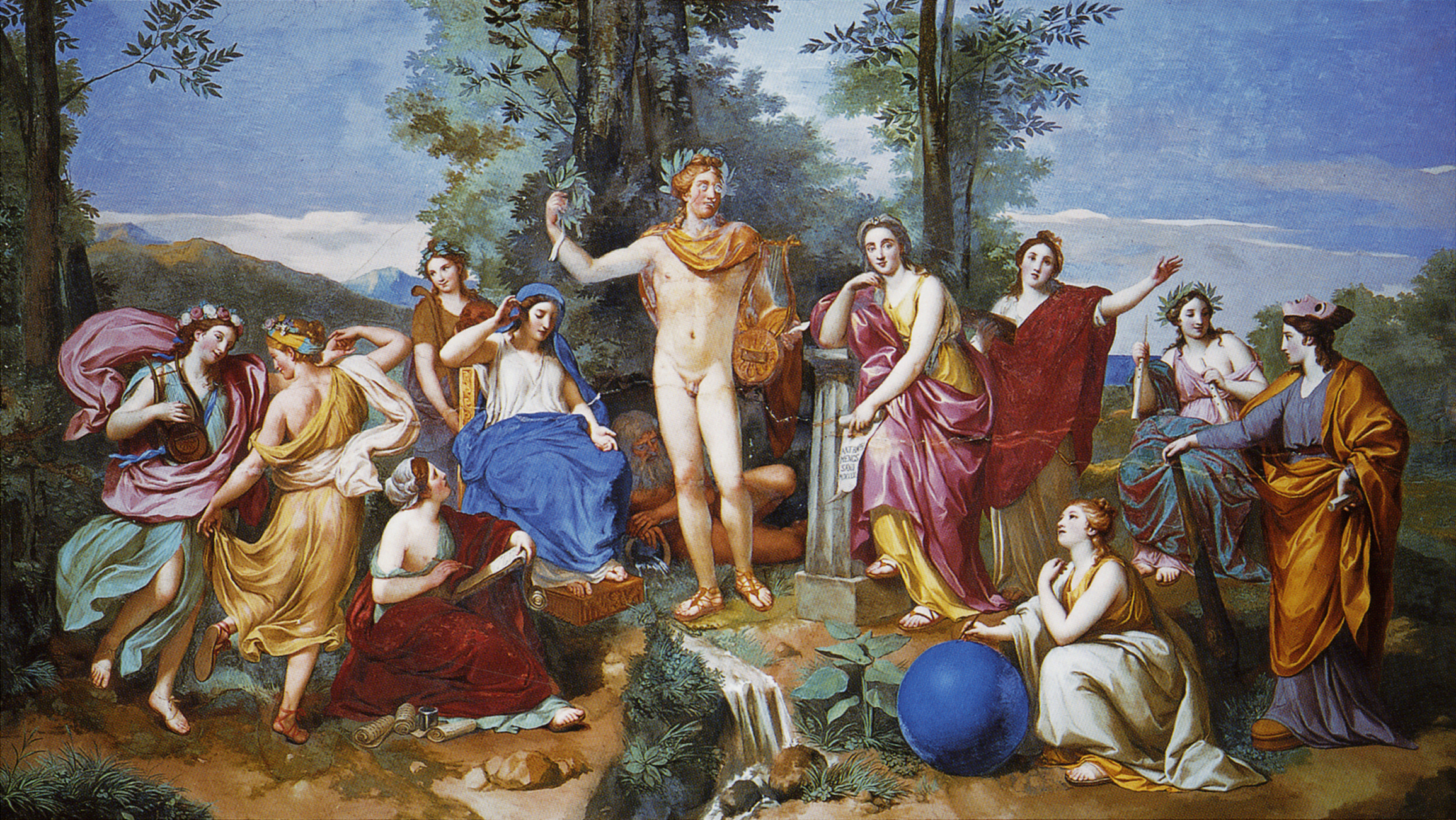
The Divine Harmony
Apollo Musagetes, leader of the Muses, plays the golden lyre on Mount Parnassus. The ancients taught that his music was the audible expression of the same mathematical harmony that governs the orbits of the planets, the structure of the human soul, and the proportions of all created things. Music, in the ancient understanding, was the voice of the cosmos itself.
Apollo Musagetes, leader of the Muses, plays the golden lyre on Mount Parnassus. The ancients taught that his music was the audible expression of the same mathematical harmony that governs the orbits of the planets, the structure of the human soul, and the proportions of all created things. Music, in the ancient understanding, was the voice of the cosmos itself.
Prologue: The Blacksmith's Forge
According to a tradition preserved by Nicomachus of Gerasa (Manual of Harmonics, ca. 100 CE) and repeated by Boethius (De Institutione Musica, ca. 510 CE), Pythagoras was walking past a blacksmith's forge when he noticed that the hammers striking the anvils produced different pitches depending on their weight. He stopped. He listened. He went inside and examined the hammers. And he discovered that the hammers whose weights stood in simple numerical ratios (2:1, 3:2, 4:3) produced the most harmonious intervals: the octave, the fifth, the fourth.1
Whether or not this story happened exactly as told, what Pythagoras did with the observation changed the history of human thought. He took a single perceptual fact (certain sounds are pleasant together, others are not) and traced it to a mathematical foundation (simple ratios of whole numbers). And then he made the leap that defined the Pythagorean school for the next 2,500 years: if the beauty of music rests on mathematical proportion, and if mathematical proportion is the structure of reality itself, then everything is music.
The planets sing. The seasons harmonize. The elements combine in chords. The human body is an instrument. The soul is a tuning. The entire cosmos, from the largest orbital arc to the smallest vibrating string, is a single composition, played continuously, heard by those whose souls are tuned to receive it.
This is the Pythagorean teaching on music. It is also the Zevist teaching. And the present study unfolds it in full.
Part One: The Pythagorean Doctrine of Universal Harmony
Everything Is Music
The Pythagorean school, founded in Croton in southern Italy around 530 BCE, held as its central doctrine that number is the principle of all things. Aristotle summarized the Pythagorean position in the Metaphysics:
Aristotle, Metaphysics 985b-986a:
"The so-called Pythagoreans, who were the first to take up mathematics, not only advanced this study, but also having been brought up in it they thought its principles were the principles of all things. Since of these principles numbers are by nature first, and in numbers they seemed to see many resemblances to the things that exist and come into being, more than in fire and earth and water."2
The Pythagorean insight was specific. They didn't merely say "numbers are important." They said: the same ratios that produce beautiful intervals in music also produce beautiful forms in geometry, beautiful proportions in architecture, and beautiful orbits in the heavens. The ratio 2:1 produces the octave in music and the double-circle in geometry. The ratio 3:2 produces the fifth in music and the sesquialtera proportion in architecture. The ratio 4:3 produces the fourth in music and the epitritic proportion in visual harmony. The same mathematics underlies all beauty, in every domain. The cosmos is a single harmonious composition.
The most famous expression of this teaching is the doctrine of the Harmony of the Spheres (ἁρμονία τῶν σφαιρῶν, harmonia tōn sphairōn). The Pythagoreans taught that the celestial bodies, as they move through space, produce sounds. These sounds are determined by the ratios of their orbital distances, just as the pitch of a string is determined by the ratio of its length. The result is a continuous cosmic chord, inaudible to ordinary perception (because it has sounded without interruption since birth and the ear has no silence against which to contrast it), but perceivable to the philosopher whose soul has been purified and tuned.3
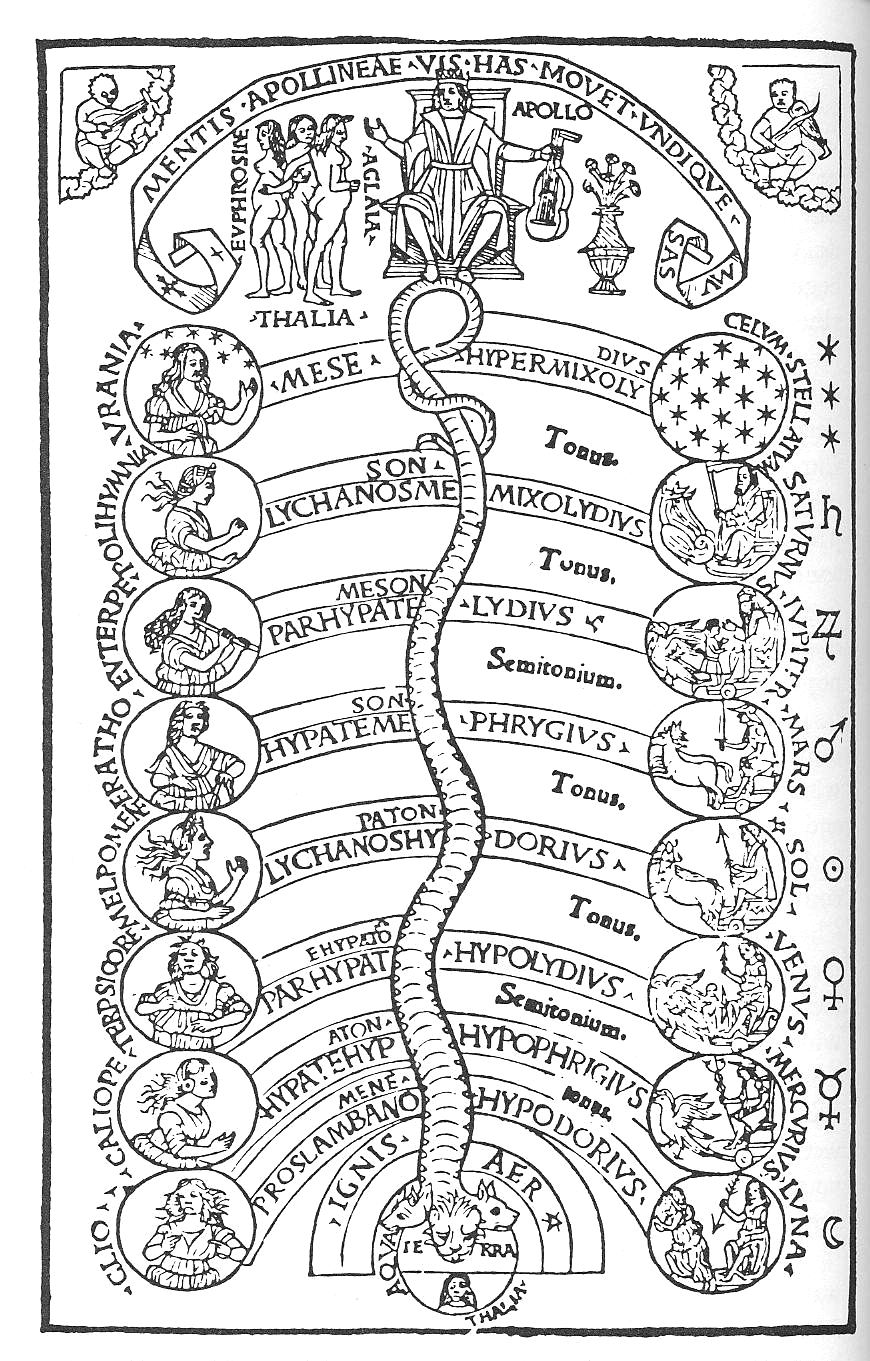
The Cosmic Instrument
The Pythagorean model of the cosmos as a musical instrument. Each planetary sphere produces a tone determined by the ratio of its orbital distance, just as each string produces a pitch determined by the ratio of its length. The entire cosmos is a single chord, played without interruption since the first moment of creation. Pythagoras taught that the philosopher, through purification of the soul, could learn to hear it.
The Pythagorean model of the cosmos as a musical instrument. Each planetary sphere produces a tone determined by the ratio of its orbital distance, just as each string produces a pitch determined by the ratio of its length. The entire cosmos is a single chord, played without interruption since the first moment of creation. Pythagoras taught that the philosopher, through purification of the soul, could learn to hear it.
Boethius and the Three Musics
The most systematic ancient classification of the Pythagorean teaching was produced by Boethius in his De Institutione Musica (ca. 510 CE), which remained the standard textbook on music theory at Oxford and Cambridge until 1856. Boethius distinguished three levels of music that together comprise the total harmonic structure of reality:4
Musica Mundana (cosmic music): the harmony of the celestial spheres, the proportioned interplay of the elements (fire, air, water, earth), and the rhythm of the seasons. This is the music of the cosmos itself, the fundamental harmony that holds all things in their proper relationships.
Musica Humana (human music): the harmony of the human being, the proportioned interplay of body, soul, and spirit. When these three are in right relationship, the person is "in tune." When they are in wrong relationship, the person is "out of tune," and the result is psychological and physical disharmony: illness, agitation, confusion, despair.
Musica Instrumentalis (instrumental music): the audible music produced by human voices and instruments. This is the most accessible form of music but, in the Pythagorean understanding, the least fundamental. It is the audible echo of the inaudible harmonies above it.
Boethius, De Institutione Musica:
"Music is related not only to speculation but to morality as well, for nothing is more consistent with human nature than to be soothed by sweet modes or disturbed by their opposites. Thus we can begin to understand the apt doctrine of Plato, which holds that the whole universe is united by musical concord."5
The Zevist understanding follows Boethius faithfully. Music is not entertainment. Music is not mere art. Music is the structural principle of existence. When you hear a beautiful song, you're hearing a fragment of the same harmony that holds the planets in orbit and the soul in coherence. The pleasure you feel is the pleasure of recognition: your own internal harmony resonating with the harmony of the cosmos.
Plato's Timaeus: The Cosmos as Musical Composition
Plato, in the Timaeus (ca. 360 BCE), presented the creation of the cosmos as an act of musical composition. The Demiurge (the divine craftsman) constructs the World Soul by blending existence, sameness, and difference in mathematical proportions that correspond exactly to the intervals of the musical scale. The cosmos is literally tuned like an instrument, and its ongoing motion is a continuous performance of the composition the Demiurge scored at the beginning of time.6
Plato, Timaeus 35b-36b:
"And he began the division in this way: first he took one portion from the whole, and next a portion double of this, and then a third portion half as much again as the second, and the fourth double of the second, and the fifth three times the third, and the sixth eight times the first, and the seventh twenty-seven times the first."7
These are the ratios 1, 2, 3, 4, 9, 8, 27: the series of doubles (1, 2, 4, 8) and triples (1, 3, 9, 27) that generate, through their subdivisions, the entire system of musical intervals. The cosmos is built on the octave, the fifth, and the fourth. The World Soul is a lyre. The orbits of the planets are its strings. And the music never stops.
Part Two: Apollo Musagetes, Leader of the Muses
The God of Harmony
Among all the Gods of the ancient world, one stands at the summit of the musical order: Apollo, who bears the title Μουσηγέτης (Mousēgetēs), "Leader of the Muses." Pausanias records the title directly:
Pausanias, Description of Greece 1.2.5:
"They call Apollo Mousegetes, Leader of the Muses."8
Strabo, the great geographer, confirms and expands the title:
Strabo, Geography 10.3.10:
"The Muses are goddesses, and Apollo is leader of the Muses. As for the Muses and Apollo: the Muses preside over the choruses, whereas Apollo presides both over these and the rites of divination."9
Apollo's connection to music is not incidental. It is constitutive of his divine nature. He is the God of light, of prophecy, of healing, of order: and music is the medium through which all of these functions operate. Light is wave and frequency. Prophecy is the perception of hidden harmonies. Healing is the restoration of right proportion in the body. Order is the imposition of mathematical structure on chaos. All of these are musical operations. Apollo doesn't merely patronize music the way a wealthy citizen might patronize a theatre. Apollo is the principle of cosmic harmony manifested in divine form.
The Homeric Hymn to Apollo describes his arrival on Olympus and its immediate effect:
Homeric Hymn to Apollo 182-206:
"Then Phoebus Apollo played upon the lyre and stepped forth gracefully. His brightness shone around him, and the gleam of his feet and close-woven vestment glittered. And golden-haired Leto and wise Zeus rejoiced in their great hearts as they watched their dear son playing among the immortal Gods."10
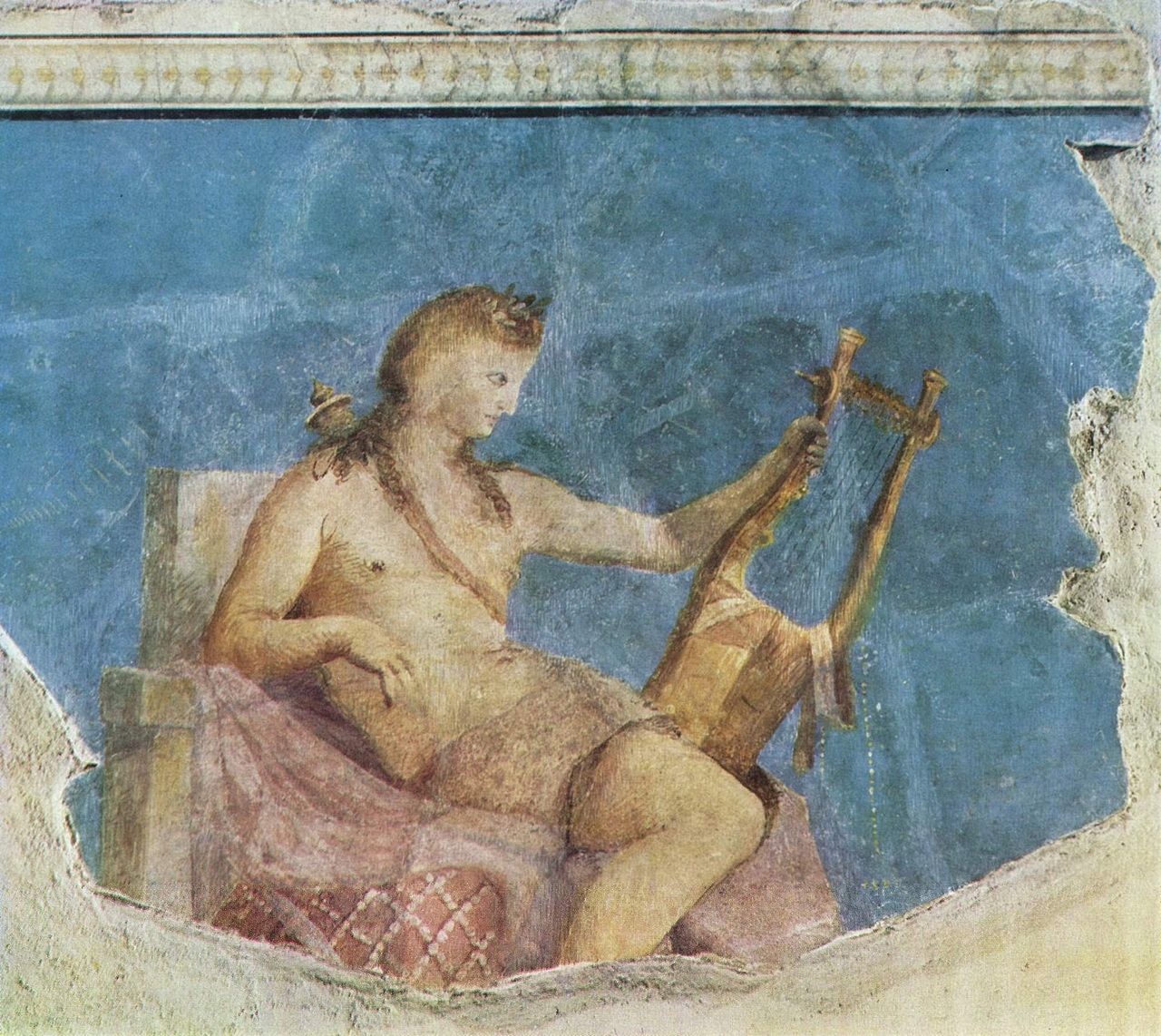
Apollo Citharoedus
Apollo playing the golden lyre. In the Homeric Hymn, his arrival on Olympus causes the Gods themselves to stop and listen. His music is the audible form of cosmic order: the same mathematical harmony that holds the planets in orbit, expressed through the seven strings of the divine cithara.
Apollo playing the golden lyre. In the Homeric Hymn, his arrival on Olympus causes the Gods themselves to stop and listen. His music is the audible form of cosmic order: the same mathematical harmony that holds the planets in orbit, expressed through the seven strings of the divine cithara.
The Lyre and Its Seven Strings
Apollo's lyre had seven strings, and this number was not arbitrary. The seven strings correspond to the seven visible celestial bodies (Moon, Mercury, Venus, Sun, Mars, Jupiter, Saturn), to the seven vowels of the Greek alphabet (Α, Ε, Η, Ι, Ο, Υ, Ω), and to the seven planetary tones of the Pythagorean cosmic scale. Nicomachus of Gerasa (Manual of Harmonics) and the Magical Papyri (PGM XIII) both preserve the tradition that the seven vowels, when intoned in sequence, produce the sound of the cosmic harmony: each vowel corresponds to a planet, and the full series constitutes a miniature performance of the Music of the Spheres.11
When Apollo plays, he plays the cosmos. His seven strings are the seven orbits. His melody is the ordered motion of the celestial bodies. His rhythm is the cycle of the seasons. Every human musician who picks up an instrument and plays is, in the Pythagorean understanding, imitating Apollo: producing an audible echo of the inaudible divine harmony.
Part Three: The Nine Muses and Their Domains
The Daughters of Zeus and Mnemosyne
The Muses (Μοῦσαι, Mousai) are the nine daughters of Zeus and Mnemosyne (Memory). Their parentage is significant: they are born from the union of supreme divine power (Zeus) and the faculty of remembrance (Mnemosyne). What the Muses govern, then, is the intersection of power and memory: the arts by which human beings remember what is true, preserve what is beautiful, and transmit what is sacred across the generations.
Hesiod, in the Theogony (ca. 700 BCE), provides the foundational account:
Hesiod, Theogony 75-79:
"The Muses sang who dwell on Olympus, nine daughters born of great Zeus: Clio and Euterpe, Thalia, Melpomene, Terpsichore, Erato, Polymnia, Ourania, and Calliope, who is the foremost of them all."12
The classical assignment of the nine Muses to their respective domains was standardized in the Hellenistic period and confirmed by the Latin tradition. Each Muse presides over a specific art, but the word mousikē (μουσική) in the ancient sense was far broader than the modern English word "music." It encompassed all the arts of the Muses: poetry, history, dance, astronomy, comedy, tragedy, sacred hymn, and lyric song. To say that someone was mousikos (μουσικός) in ancient Greece was to say that they were cultivated in the full range of arts and sciences. The word "music" in its ancient meaning covered nearly the entire field of what we would today call the humanities.
The nine Muses and their domains:
That astronomy (Ourania) sits among the arts of the Muses is telling. The ancient world did not separate the arts from the sciences. Astronomy was mousikē because the movements of the stars are governed by the same harmonic ratios that govern the intervals of the lyre. To study the stars was to study music in its cosmic dimension. To play the lyre was to perform astronomy in its audible form.
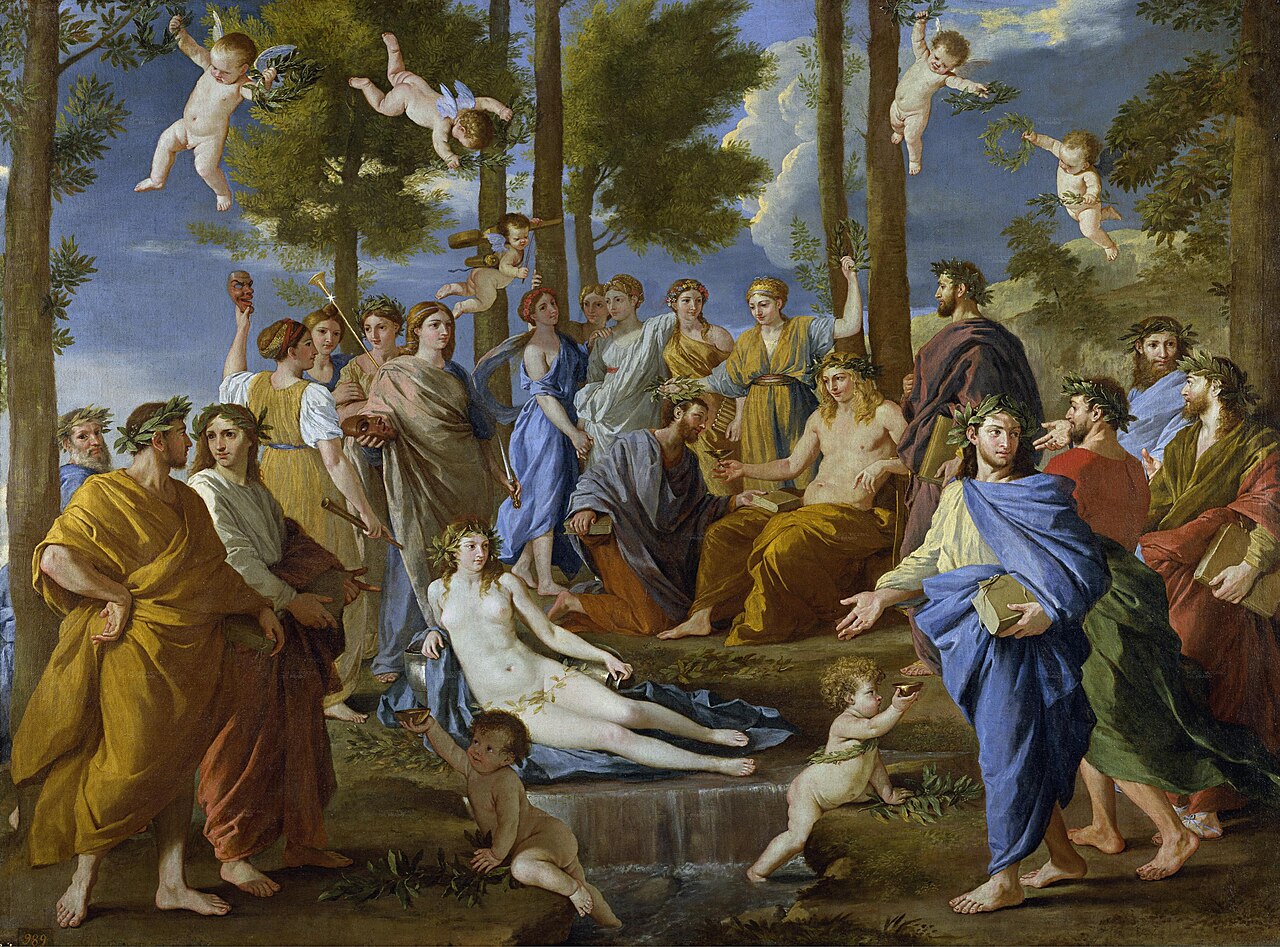
The Nine Daughters of Zeus and Memory
The Muses on Mount Helicon, each presiding over her domain of the arts. Together they govern the totality of human creative expression: epic, history, melody, comedy, tragedy, dance, love poetry, sacred hymn, and the study of the heavens. In the ancient world, all of these were "music" in the broadest sense: the arts of the Muses, the cultivation that makes a human being mousikos, a person of complete culture.
The Muses on Mount Helicon, each presiding over her domain of the arts. Together they govern the totality of human creative expression: epic, history, melody, comedy, tragedy, dance, love poetry, sacred hymn, and the study of the heavens. In the ancient world, all of these were "music" in the broadest sense: the arts of the Muses, the cultivation that makes a human being mousikos, a person of complete culture.
Part Four: Music and the Formation of Character
Plato on Music and the Soul
The ancient world did not treat music as mere entertainment. Music was a tool for forming the soul. Plato, in the Republic, placed music at the very foundation of education:
Plato, Republic 401d-e:
"And therefore, I said, Glaucon, musical training is a more potent instrument than any other, because rhythm and harmony find their way into the inward places of the soul, on which they mightily fasten, imparting grace, and making the soul of him who is rightly educated graceful, or of him who is ill-educated ungraceful."13
Plato's claim is precise. Music doesn't merely please the ear. It enters the soul. Rhythm and harmony penetrate to the interior of the psyche and reshape it from within. A person raised on beautiful, well-proportioned music develops a soul that is itself beautiful and well-proportioned. A person raised on ugly, disproportioned music develops a soul that is itself ugly and disproportioned. Music forms character the way fire forms iron: by sustained application of formative force to malleable material.
Aristotle on Music as Moral Education
Aristotle, in Book VIII of the Politics, devoted an entire section to the role of music in education. His analysis remains the most rigorous in the ancient literature:
Aristotle, Politics VIII.5, 1340a-b:
"Music has the power to form character. If it can do this, it clearly must be applied to education, and the young must be educated in it. And the teaching of music is particularly adapted to the youthful nature. Young persons will not, if they can help it, endure anything which is not sweetened by pleasure, and music has a natural sweetness."14
Aristotle identified specific modes (ἁρμονίαι, harmoniai) as producing specific psychological states. The Dorian mode produced courage and stability. The Phrygian mode produced enthusiasm and religious ecstasy. The Lydian mode produced relaxation and tenderness. The Mixolydian mode produced melancholy and introspection. Each mode was a tool, appropriate for specific occasions and inappropriate for others. The educator who understood the modes could use them to systematically cultivate the emotional dispositions necessary for virtuous character.15
The Zevist Position: All Music Is Sacred
Plato, in his concern for the ideal state, restricted certain modes and instruments as unsuitable for the education of guardians. Aristotle was more liberal but still cautious. The Zevist position goes further than both: all forms of music are acceptable in Zevism.
This is a deliberate and considered position. The Zevist does not restrict the practitioner's musical life to "approved" genres. Every form of music has its place, its function, and its power. The fierce battle-song has its hour. The gentle lullaby has its hour. The ecstatic dance-track played at 2 AM in a club has its hour. The solo violin in a darkened concert hall has its hour. The hymn chanted before the altar has its hour. The raw, aggressive power of metal. The crystalline precision of classical. The heartbreak of blues. The mathematical complexity of jazz. The primal pulse of electronic music. The storytelling of folk. The swagger of hip-hop. The yearning of flamenco. All of these are expressions of the human soul, and all of them are sacred.
The Zevist principle is simple: music serves life, and life contains every emotional register. A spiritual path that permits only solemn hymns has amputated the full range of human experience. The Gods themselves, in the myths, are not exclusively solemn. Apollo plays at banquets. Dionysus dances with satyrs and maenads. Aphrodite sings songs of love. Ares drums the war-beat. The Olympians do not restrict themselves to a single mode, and neither should their children.
Music for Every Dimension of Life
The following table presents the Zevist understanding of how different types of music serve different dimensions of human life. No genre is excluded. Every genre has its sacred function.
| Dimension of Life | Function of Music | Types and Examples | Presiding Muse or God |
|---|---|---|---|
| Battle and Competition | Arousal of courage, sharpening of focus, suppression of fear | Epic metal, martial percussion, war drums, aggressive electronic, intense orchestral | Ares, Athena |
| Devotion and Ritual | Connection to the divine, elevation of consciousness, sacred trance | Hymns, choral music, sacred chants, ambient/drone, Gregorian or Byzantine modes, Indian ragas | Apollo, Polymnia |
| Celebration and Joy | Expression of gratitude, communal bonding, festivity | Dance music, folk music, festive pop, upbeat electronic, big-band, world music | Dionysus, Thalia |
| Love and Eros | Opening of the heart, expression of desire, deepening of intimacy | Love ballads, R&B, jazz vocals, romantic classical, flamenco, bossa nova | Aphrodite, Erato |
| Grief and Mourning | Processing of loss, catharsis, honouring the dead | Funeral dirges, requiems, blues, slowcore, melancholic classical, laments | Melpomene, Persephone |
| Study and Concentration | Stabilizing attention, reducing distraction, creating cognitive flow | Ambient, lo-fi, minimalist classical, instrumental piano, nature soundscapes | Athena, Ourania |
| Physical Training | Sustaining effort, increasing intensity, pushing through fatigue | High-tempo electronic, hip-hop, power metal, drum and bass, hard rock | Ares, Heracles |
| Meditation and Inner Work | Calming the mind, opening inner perception, trance induction | Drone, singing bowls, binaural tones, ambient, devotional music, Indian classical | Apollo, Orpheus |
| Storytelling and Memory | Preserving history, transmitting wisdom, encoding cultural memory | Epic song, folk ballads, narrative hip-hop, opera, musical theatre, bardic traditions | Calliope, Clio |
| Healing and Restoration | Restoration of inner harmony, reduction of anxiety, emotional repair | Gentle classical, acoustic folk, nature sounds, therapeutic frequencies, harp music | Apollo, Asclepius |
The point is clear. There is no genre that falls outside the domain of the sacred. Every genre serves a function. Every function serves life. The Zevist chooses music consciously, as a craftsman chooses tools: the right music for the right moment, applied with awareness and intention.
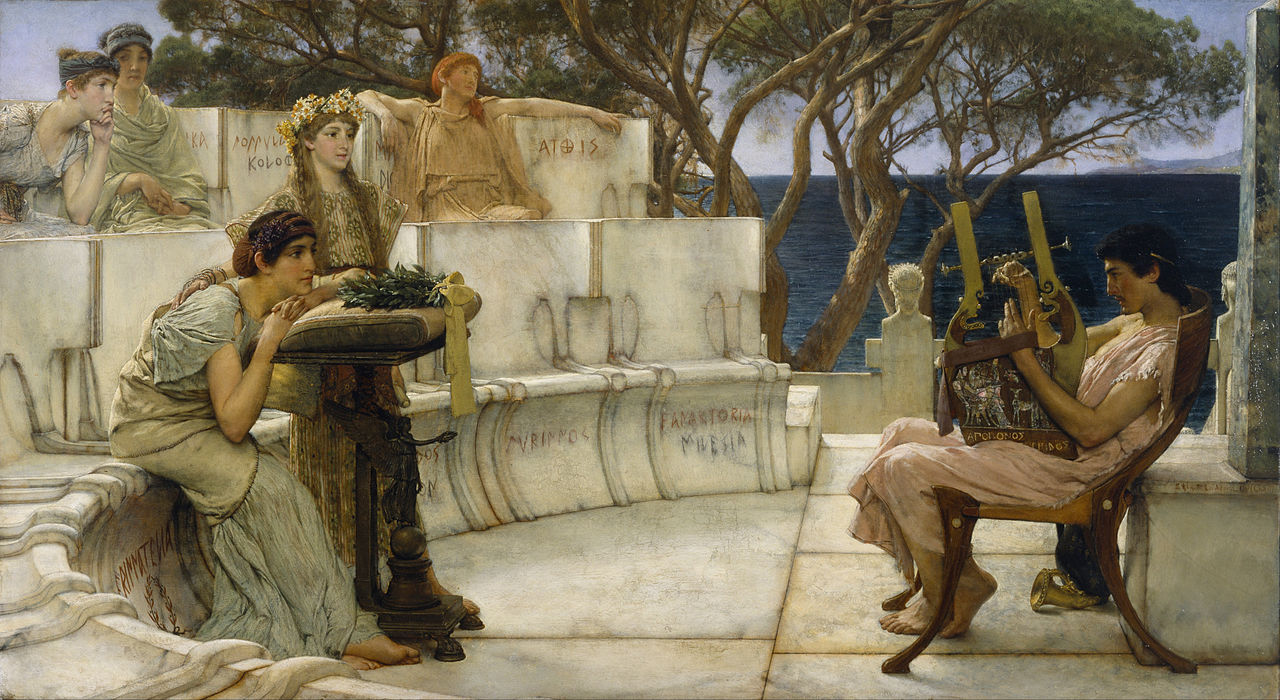
A Sacred Tool for Every Hour
Music serves every dimension of human existence: war and peace, love and grief, study and celebration, healing and ecstasy. The Zevist does not restrict the soul to a single mode. Every genre is a tool. Every tool has its sacred function. The key is conscious selection: the right music for the right moment, applied with the intention of a craftsman who knows what each instrument does.
Music serves every dimension of human existence: war and peace, love and grief, study and celebration, healing and ecstasy. The Zevist does not restrict the soul to a single mode. Every genre is a tool. Every tool has its sacred function. The key is conscious selection: the right music for the right moment, applied with the intention of a craftsman who knows what each instrument does.
Part Five: The Psychological Power of Music
What Music Does to the Body and Soul
The ancients knew, through direct observation and through the accumulated wisdom of their priestly traditions, that music exerts immediate and measurable effects on the human body and psyche. Modern neuroscience has confirmed every one of their observations and added precision to their descriptions.
Music acts on multiple systems simultaneously. At the physiological level, rhythm synchronizes the heartbeat and breathing (a phenomenon called entrainment). Tempo directly influences pulse rate: fast music accelerates the heart, slow music decelerates it. This is not metaphor. It is measurable physiology. The Greek physicians knew it. Aristides Quintilianus, in his De Musica (ca. 3rd century CE), described in detail how different modes and rhythms produce different physical states, and the Egyptian temple musicians used specific scales and rhythms for specific healing purposes.16
At the neurological level, music activates the dopamine system (the brain's reward circuitry), producing pleasure, motivation, and emotional intensity. It activates the amygdala (the emotional processing centre), producing immediate shifts in emotional state. It activates the motor cortex (the movement centre), producing the involuntary impulse to move, tap, nod, or dance. It activates the hippocampus (the memory centre), which is why music is the most powerful trigger of autobiographical memory: a song heard 20 years ago can restore, in seconds, the emotional texture of the moment when it was first heard.
At the psychological level, music produces catharsis (the ancient Greek term for emotional purification through art). Aristotle used the word specifically in connection with music and tragedy: the experience of intense emotion through art purifies the soul of its emotional excess, leaving it cleaner and more balanced than before. This is why sad music doesn't make you sadder. It makes you lighter. The sadness is given form, expression, and release through the music, and the result is a kind of clarification that couldn't have happened through thought alone.17
The ancients also understood that music builds social cohesion. Choral singing, communal dancing, and synchronized rhythmic movement produce a state of collective unity that no other activity can match. The Greek chorus, the Egyptian temple choir, the Vedic chanting circle, the Norse communal song: all of these were technologies for binding communities together through shared musical experience. A group that sings together bonds at a level deeper than conversation can reach.
Immediate Effects: What Happens When Music Begins
When music begins, the following happens within seconds:
The autonomic nervous system responds. The heartbeat adjusts toward the tempo. Breathing deepens or quickens. Muscle tension changes. Skin conductance shifts (the involuntary "chills" or "goosebumps" that accompany powerful music are a measurable galvanic skin response).
The emotional centre activates. Mood shifts within 10 to 15 seconds of hearing music that carries emotional content. Joy, sadness, excitement, calm, aggression, tenderness: all of these can be reliably induced by music within moments. No other stimulus produces emotional changes this rapidly.
The motor system activates. The body wants to move. Even when sitting still, the brain's motor cortex lights up in response to rhythmic music, preparing movements that may or may not be executed. This is why you tap your foot. The rhythm literally enters the body's motor programming.
Memory activates. Familiar music recalls not only the melody but the entire emotional context in which it was first heard. This is the Proustian effect applied to sound: a song can restore a complete experiential world that had been inaccessible to deliberate recall.
The Pythagoreans would not have been surprised by any of this. They knew that the human being is an instrument (musica humana) and that audible music (musica instrumentalis) tunes that instrument by sympathetic resonance. When you hear a tone that matches your internal state, you feel recognized. When you hear a tone that differs from your internal state, you feel either challenged or disturbed. The therapeutic power of music lies in the deliberate selection of tones, rhythms, and modes that either reinforce a desired state or gradually shift an undesired one.
Part Six: Orpheus, Musician of the Gods
The Son of Apollo and Calliope
The culmination of the ancient teaching on music is embodied in a single mythic figure: Orpheus (Ὀρφεύς, Orpheus), the legendary musician, poet, and prophet. According to the most widespread ancient tradition, Orpheus was the son of Apollo and the Muse Calliope, which makes him the offspring of the God of harmony and the chief of the Muses. He is, in his very genealogy, the union of divine musicianship and divine poetry.18
Orpheus's powers were unique among all figures in Greek mythology. Other heroes had strength, speed, cunning. Orpheus had music. And his music was so powerful that it exceeded every other form of power.
Apollonius Rhodius, Argonautica 1.26-31:
"First, then, let us name Orpheus, whom once Calliope bore, it is said, wedded to Thracian Oeagrus, near the Pimpleian height. They say that he by the music of his songs charmed the stubborn rocks upon the mountains and the course of rivers."19
Orpheus's music moved stones. Trees uprooted themselves to follow the sound. Rivers reversed their course. Wild animals lay down and listened. Fish leapt from the water. Even the Argo, the ship of the heroes, was reportedly launched by the power of his singing. His music was not mere beauty. It was command. The natural world obeyed his voice because his voice was tuned to the fundamental harmony of the cosmos. When Orpheus sang, he sang in perfect accord with the Music of the Spheres, and everything in nature responded to its own deepest structure.
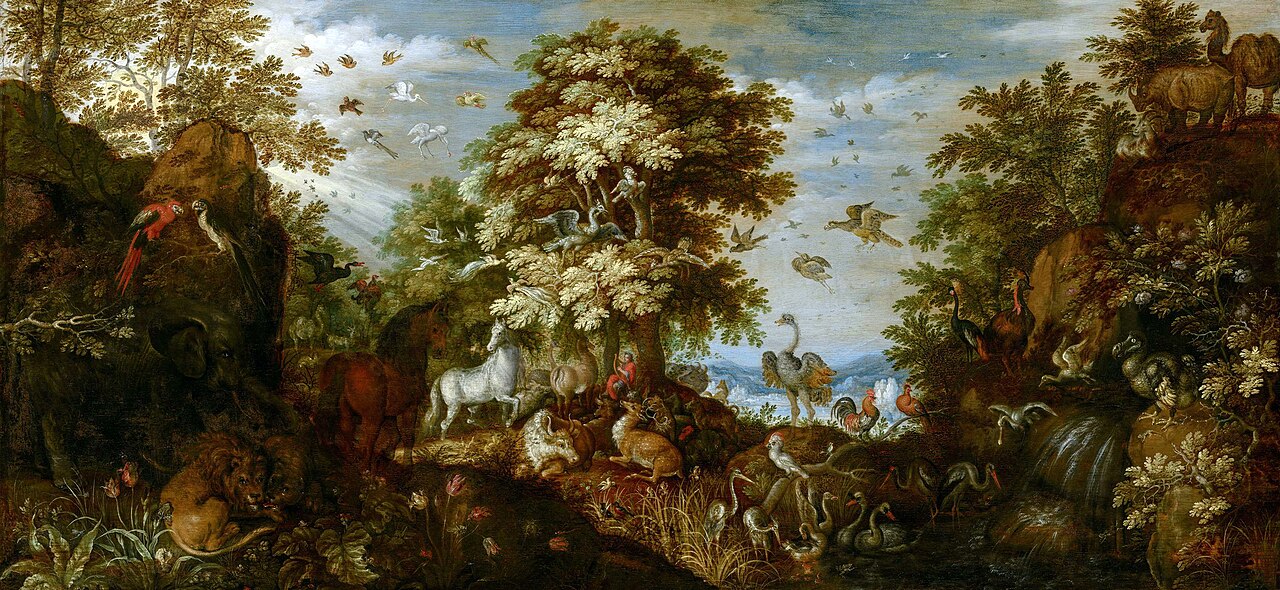
The Song That Moves the World
Orpheus plays, and the natural world obeys. Stones move. Trees uproot. Rivers reverse. Animals of every species sit in peace. His music is the audible form of the Pythagorean cosmic harmony: so perfectly tuned to the structure of reality that reality itself responds. Orpheus is the demonstration, in mythic form, of what music truly is: the force that orders the cosmos.
Orpheus plays, and the natural world obeys. Stones move. Trees uproot. Rivers reverse. Animals of every species sit in peace. His music is the audible form of the Pythagorean cosmic harmony: so perfectly tuned to the structure of reality that reality itself responds. Orpheus is the demonstration, in mythic form, of what music truly is: the force that orders the cosmos.
The Descent Into Hades
The central myth of Orpheus is his descent into Hades to reclaim his wife Eurydice, who had died of a serpent-bite. The story, told by Virgil (Georgics 4.453-527), Ovid (Metamorphoses 10.1-85), and many others, is the most powerful illustration of the Pythagorean teaching on the power of music:
Orpheus descended into the underworld. He played his lyre before the throne of Hades and Persephone. And his music was so beautiful that it accomplished what no hero's strength, no warrior's courage, no king's wealth had ever accomplished: it moved the King and Queen of the Dead to mercy. The wheel of Ixion stopped turning. The stone of Sisyphus rested. The Furies wept. Tantalus forgot his thirst. For the first and only time in mythic history, the laws of death were suspended by the power of art.20
Virgil describes the moment with precision:
Virgil, Georgics 4.471-484:
"Even the depths of Tartarus were spellbound, and the Furies with their blue-black tresses wound about with serpents; and Cerberus held agape his triple mouths, and Ixion's wheel stood still, stayed by the wind."21
The meaning of the myth is clear. Music is the one force that can penetrate even into death. Strength cannot enter Hades and return. Cunning cannot. Wealth cannot. But music can. Because music is not a physical force. Music is harmony. And harmony is the structure of all things, including the things below the earth. Orpheus's lyre spoke the language of the cosmos, and even Hades recognized its authority.
Orpheus in Zevism
In the Zevist tradition, Orpheus holds the status of a divine figure: the God of sacred music, of poetic prophecy, of the mysteries that bear his name (the Orphic Mysteries, which taught the doctrines of the immortality of the soul, metempsychosis, and the divine origin of humanity). The Orphic tradition is one of the deepest wellsprings of Zevist theology, and Orpheus himself is the patron of every Zevist who practices music as a spiritual discipline.
The Orphic Hymns, a collection of 87 hymns composed for ritual use, likely in the 2nd or 3rd century CE but drawing on traditions centuries older, are addressed to the Gods and natural forces and were sung as part of Orphic initiatory rites. They represent the living continuation of the tradition Orpheus founded: the use of music as theurgy, as a direct means of communion with the divine.22
Orpheus teaches the Zevist three things. First: music has real power. It is not decoration. It is force. Second: that power reaches further than any other power, even into death. Third: the musician who tunes himself to the cosmic harmony becomes a channel through which that harmony flows into the world. The musician is not merely performing. The musician is doing the work of the Gods.
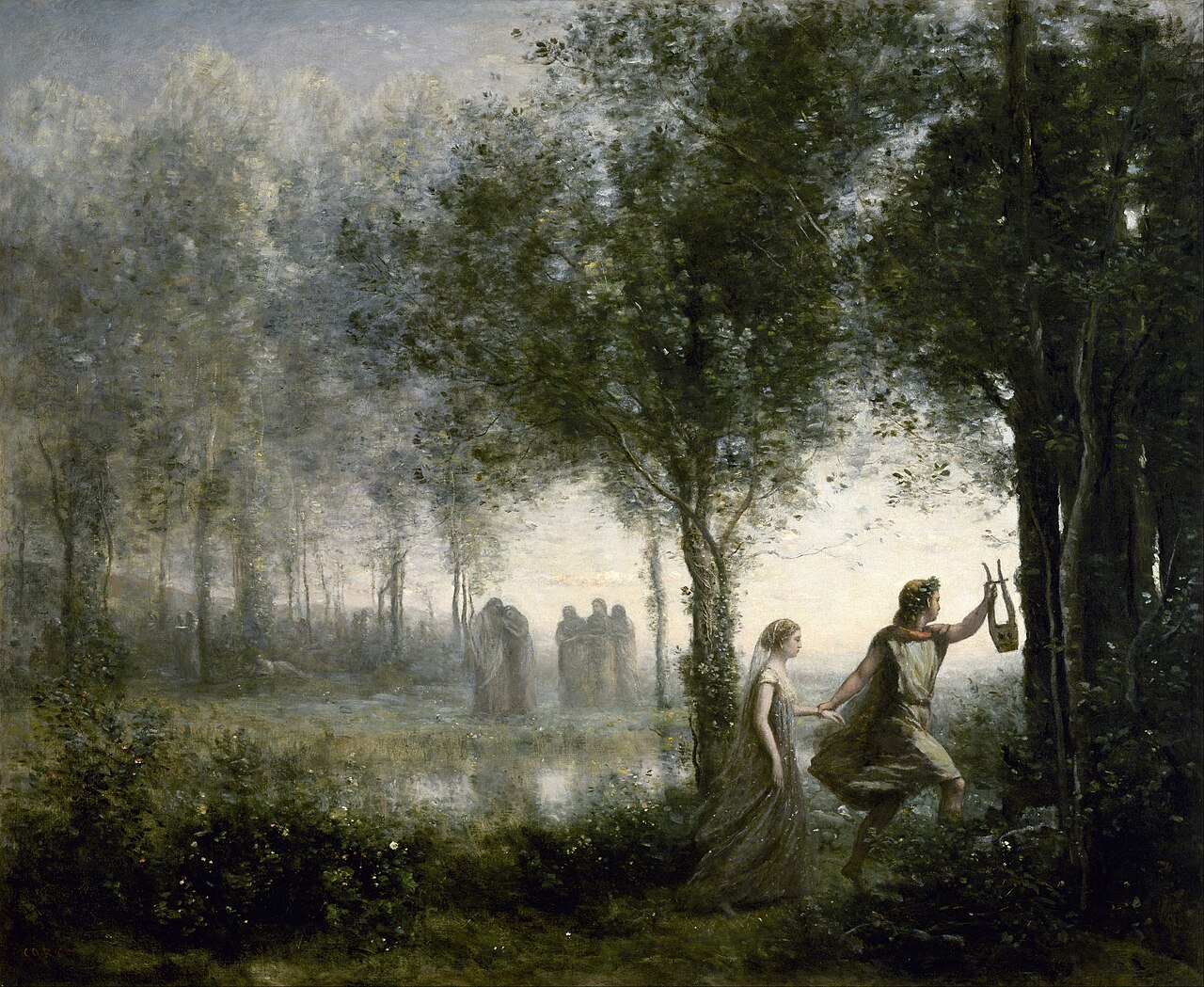
The Gates of Death Open to Music
Orpheus at the threshold of Hades, playing the song that suspended the laws of death. Even Persephone wept. Even the Furies stopped. Even the wheel of Ixion stood still. In the mythic imagination of the ancient world, music was the one power that could enter the realm of the dead and return. The Zevist understanding follows: music reaches where nothing else can reach, because music is the fundamental structure of reality itself.
Orpheus at the threshold of Hades, playing the song that suspended the laws of death. Even Persephone wept. Even the Furies stopped. Even the wheel of Ixion stood still. In the mythic imagination of the ancient world, music was the one power that could enter the realm of the dead and return. The Zevist understanding follows: music reaches where nothing else can reach, because music is the fundamental structure of reality itself.
Conclusion: The Cosmic Lyre
We began in a blacksmith's forge with Pythagoras, listening to hammers. We end before the gates of Hades with Orpheus, playing a lyre. Between these two scenes, a single teaching runs unbroken through 2,500 years of ancient wisdom:
Everything is music.
The planets move in harmonic ratios. The seasons cycle in rhythmic patterns. The human body vibrates at frequencies that can be tuned, disrupted, and healed by sound. The soul is a composition that can be well-written or badly written, harmonious or discordant, beautiful or ugly, depending on the care with which it is formed. The cosmos itself is a single, continuous, infinitely complex musical performance, and every act of human music-making is a participation in that performance.
Apollo leads the Muses on Parnassus. Nine daughters of Zeus and Memory govern the arts that make civilisation possible. Orpheus descends into death and returns, carrying the proof that music is stronger than mortality. Pythagoras hears ratios in hammers and discovers the mathematical architecture of the universe.
The Zevist takes all of this seriously. Music is not background. Music is not entertainment. Music is one of the most powerful tools available to the human soul for its own formation, healing, strengthening, and elevation. Every genre has its place. Every rhythm serves a purpose. Every melody carries information about the structure of the cosmos. The practitioner who learns to use music consciously, deliberately, with awareness of its effects and intention behind its selection, gains access to a force that the ancients placed at the very centre of their understanding of reality.
Boethius wrote: "The whole universe is united by musical concord."23 He was right. And the person who understands this, who lives this, who plays this, is doing more than making sound. That person is tuning themselves to the harmony of the Gods.
Pick up the instrument. Play.
References
- Nicomachus of Gerasa, Manual of Harmonics (Ἁρμονικὸν Ἐγχειρίδιον), ch. 6; trans. Flora R. Levin, The Manual of Harmonics of Nicomachus the Pythagorean, Phanes Press, 1994; cf. Boethius, De Institutione Musica 1.10-11
- Aristotle, Metaphysics A5, 985b23-986a3 (ed. W.D. Ross, Oxford Classical Texts, 1924); trans. Ross, adapted
- Aristotle, De Caelo 290b12-291a28; cf. Plato, Republic 617b (Allegory of Er, the Spindle of Necessity with the Sirens singing on each whorl)
- Boethius, De Institutione Musica 1.2 (ed. Gottfried Friedlein, Teubner, 1867); trans. Calvin M. Bower, Fundamentals of Music, Yale University Press, 1989
- Boethius, De Institutione Musica 1.1; trans. Bower, 1989, adapted
- Plato, Timaeus 35a-36d (ed. John Burnet, Oxford Classical Texts, 1902); cf. Francis M. Cornford, Plato's Cosmology: The Timaeus of Plato, Routledge & Kegan Paul, 1937
- Plato, Timaeus 35b-c; trans. Benjamin Jowett, adapted
- Pausanias, Description of Greece 1.2.5 (ed. and trans. W.H.S. Jones, Loeb Classical Library, Harvard University Press, 1918)
- Strabo, Geography 10.3.10 (ed. and trans. H.L. Jones, Loeb Classical Library, Harvard University Press, 1928)
- Homeric Hymn to Apollo (III), 182-206 (ed. T.W. Allen, W.R. Halliday, and E.E. Sikes, The Homeric Hymns, Oxford, 1936); trans. H.G. Evelyn-White, Loeb Classical Library, 1914, adapted
- Nicomachus, Manual of Harmonics, ch. 3; PGM XIII.824-834 (ed. Karl Preisendanz, Papyri Graecae Magicae, Teubner, 2 vols., 1928-1931); cf. Joscelyn Godwin, The Harmony of the Spheres: A Sourcebook of the Pythagorean Tradition in Music, Inner Traditions, 1993
- Hesiod, Theogony 75-79 (ed. M.L. West, Oxford Classical Texts, 1966); trans. adapted from H.G. Evelyn-White, Loeb, 1914
- Plato, Republic 401d-e (ed. Burnet); trans. adapted from Paul Shorey, Loeb, 1935
- Aristotle, Politics VIII.5, 1340a-b (ed. W.D. Ross, Oxford Classical Texts, 1957); trans. adapted from Benjamin Jowett
- Aristotle, Politics VIII.5, 1340a40-1340b19; cf. Andrew Barker, Greek Musical Writings, vol. 1: The Musician and His Art, Cambridge University Press, 1984
- Aristides Quintilianus, De Musica (Περὶ Μουσικῆς), Books I-III (ed. R.P. Winnington-Ingram, Teubner, 1963); trans. Thomas J. Mathiesen, On Music in Three Books, Yale University Press, 1983
- Aristotle, Poetics 1449b24-28 (ed. R. Kassel, Oxford Classical Texts, 1965); cf. Politics VIII.7, 1341b32-1342a28
- Apollodorus, Bibliotheca 1.3.2; Pindar, Pythian Odes IV.176-177; cf. W.K.C. Guthrie, Orpheus and Greek Religion, Methuen, 1935; rev. ed. Princeton University Press, 1993
- Apollonius Rhodius, Argonautica 1.23-34 (ed. Hermann Fränkel, Oxford Classical Texts, 1961); trans. R.C. Seaton, Loeb Classical Library, 1912, adapted
- Ovid, Metamorphoses 10.40-52; Virgil, Georgics 4.471-484
- Virgil, Georgics 4.471-484 (ed. R.A.B. Mynors, Oxford Classical Texts, 1969); trans. H. Rushton Fairclough, Loeb Classical Library, rev. G.P. Goold, 1999, adapted
- Orphic Hymns, ed. and trans. Apostolos N. Athanassakis and Benjamin M. Wolkow, The Orphic Hymns, Johns Hopkins University Press, 2013
- Boethius, De Institutione Musica 1.1; trans. Bower, 1989
Sources
- Nicomachus of Gerasa, Manual of Harmonics, trans. Flora R. Levin, Phanes Press, 1994
- Boethius, De Institutione Musica, trans. Calvin M. Bower, Fundamentals of Music, Yale University Press, 1989
- Plato, Republic, ed. John Burnet, Oxford Classical Texts, 1902; trans. Paul Shorey, Loeb Classical Library, 1935
- Plato, Timaeus, ed. Burnet; trans. R.G. Bury, Loeb Classical Library, 1929; cf. Francis M. Cornford, Plato's Cosmology, Routledge, 1937
- Aristotle, Metaphysics, ed. W.D. Ross, Oxford Classical Texts, 1924; trans. Ross, Oxford, 1924
- Aristotle, Politics, ed. W.D. Ross, Oxford Classical Texts, 1957; trans. H. Rackham, Loeb Classical Library, 1932
- Aristotle, Poetics, ed. R. Kassel, Oxford Classical Texts, 1965; trans. Stephen Halliwell, Loeb Classical Library, 1995
- Aristides Quintilianus, De Musica, trans. Thomas J. Mathiesen, On Music in Three Books, Yale University Press, 1983
- Hesiod, Theogony, ed. M.L. West, Oxford Classical Texts, 1966; trans. H.G. Evelyn-White, Loeb Classical Library, 1914
- Homeric Hymns, ed. T.W. Allen, W.R. Halliday, and E.E. Sikes, Oxford, 1936; trans. H.G. Evelyn-White, Loeb, 1914
- Apollonius Rhodius, Argonautica, ed. Hermann Fränkel, Oxford Classical Texts, 1961; trans. R.C. Seaton, Loeb Classical Library, 1912
- Virgil, Georgics, ed. R.A.B. Mynors, Oxford Classical Texts, 1969; trans. H. Rushton Fairclough, Loeb Classical Library, rev. G.P. Goold, 1999
- Ovid, Metamorphoses, ed. R.J. Tarrant, Oxford Classical Texts, 2004; trans. A.D. Melville, Oxford World's Classics, 1986
- Pausanias, Description of Greece, trans. W.H.S. Jones, Loeb Classical Library, 5 vols., Harvard University Press, 1918-1935
- Strabo, Geography, trans. H.L. Jones, Loeb Classical Library, 8 vols., Harvard University Press, 1917-1932
- Pindar, Odes, ed. Bruno Snell and Herwig Maehler, Teubner, 8th ed., 1987; trans. William H. Race, Loeb Classical Library, 1997
- Orphic Hymns, trans. Apostolos N. Athanassakis and Benjamin M. Wolkow, Johns Hopkins University Press, 2013
- W.K.C. Guthrie, Orpheus and Greek Religion: A Study of the Orphic Movement, Methuen, 1935; rev. ed. Princeton University Press, 1993
- Ivan M. Linforth, The Arts of Orpheus, University of California Press, 1941
- Radcliffe G. Edmonds III, Redefining Ancient Orphism: A Study in Greek Religion, Cambridge University Press, 2013
- Joscelyn Godwin, The Harmony of the Spheres: A Sourcebook of the Pythagorean Tradition in Music, Inner Traditions, 1993
- Andrew Barker, Greek Musical Writings, 2 vols., Cambridge University Press, 1984-1989
- Andrew Barker, The Science of Harmonics in Classical Greece, Cambridge University Press, 2007
- M.L. West, Ancient Greek Music, Clarendon Press, Oxford, 1992
- Stefan Hagel, Ancient Greek Music: A New Technical History, Cambridge University Press, 2009
- Thomas J. Mathiesen, Apollo's Lyre: Greek Music and Music Theory in Antiquity and the Middle Ages, University of Nebraska Press, 1999
- Walter Burkert, Lore and Science in Ancient Pythagoreanism, trans. Edwin L. Minar Jr., Harvard University Press, 1972
- Charles H. Kahn, Pythagoras and the Pythagoreans: A Brief History, Hackett, 2001
- Lewis Richard Farnell, The Cults of the Greek States, vol. 4 (Apollo), Clarendon Press, Oxford, 1907
- Pierre Hadot, Philosophy as a Way of Life, trans. Michael Chase, Blackwell, 1995