
 አማርኛ
አማርኛ العربية
 বাংলা
বাংলা Български
 中文
中文 Čeština
 Dansk
Dansk Deutsch
 Eesti
Eesti Ελληνικά
 Español
 Français
 हिन्दी
 Hrvatski
 IsiZulu
 Italiano
 日本語
日本語 Kiswahili
 Magyar
 Македонски
 नेपाली
 Nederlands
 فارسی
فارسی Polski
 Português
 Română
 Русский
 Slovenščina
 Suomi
Suomi Svenska
 Tagalog
 Türkçe
ΠΑΙΔΕΙΑ:
Education as Μόρ
φωσις, the Sacred Forming of the Human Soul
author: High Priest Zevios Metathronos
Why the Ancient Greek Concept of Formation-Education is the Alpha and the Omega of Every Human Life, Why the Unformed Slab Must Be Carved into the Diamond, and How the Disciplined Labor of Self-Education is the Only Path to Becoming Theophoros
A comprehensive argument, grounded in the ancient Greek pedagogical tradition from Plato through Aristotle through Isocrates through Plutarch through Plotinus, that education in its full ancient sense (παιδεία, paideia, and μόρφωσις, mórphōsis) is the single indispensable labor of every human life. The present study establishes the etymological and philosophical foundations, demonstrates the catastrophic consequences of the Yehubor program that has actively suppressed learning in the peoples under its influence, enumerates the concrete cognitive faculties that education forms (attention, reading capacity, information-processing, critical thought, research discipline), and culminates in the Zevist teaching that the practitioner who undertakes lifelong education walks the path of Growth toward the state of Theophoros, the God-bearer.
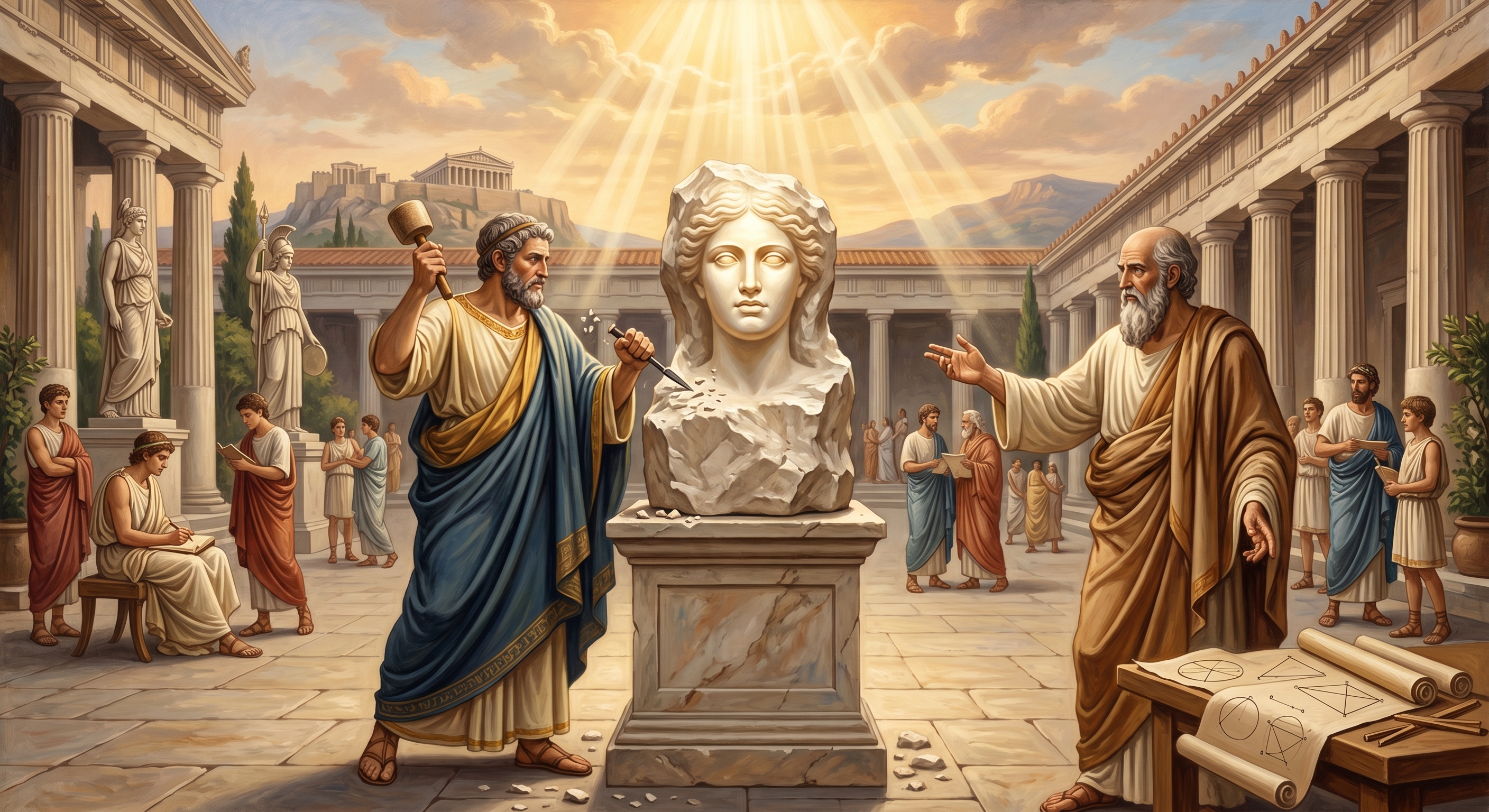
Every human soul begins as raw unformed marble. The labor of education, both that received from teachers and that performed upon oneself, is the careful sacred chiseling by which the diamond is revealed within the stone. The Gods bless the work from above; the student directs the hand.
Prologue: The Question That Determines Every Life
Among all the decisions a human being makes across a lifetime, one decision exceeds every other in consequence. It is the decision whether to undertake the labor of education seriously, across the full span of life, or to refuse that labor and remain in whatever state of unformed rawness one happened to be born into. Every other decision, the choice of career, of partner, of home, of religion, of political allegiance, follows from this primary decision and is shaped by it. The formed soul makes subsequent decisions with clarity, discernment, and rigor; the unformed soul makes subsequent decisions in ignorance, distraction, and reactive passion, and is therefore condemned to spend a lifetime being pushed and pulled by circumstances it cannot read.
The ancient Greeks understood this fact with a precision that has almost entirely been lost in the modern age. They had a single word for the process by which a human being is transformed from raw biological material into a being actually deserving of the name ἄνθρωπος (ánthrōpos, the upward-looking one). The word is παιδεία (paideia), and its practical instrument is μόρφωσις (mórphōsis), the giving of form. The ancient Greeks recognized that without this forming work, what a person possesses at birth remains short of humanity and amounts only to the raw potentiality for humanity. Humanity itself must be cultivated into existence through disciplined lifelong labor. The person who has not undertaken this labor is, in the most literal and philosophical sense, ἀμόρφωτος (amórphōtos), unformed, and the person who has refused the labor entirely is ἀπαίδευτος (apáideutos), uneducated, which in the ancient Greek sense meant something closer to the modern phrase "not yet fully human."
The present study develops this ancient teaching in full rigor. We will establish, first, the etymology of μόρφωσις and what it tells us about the Greek understanding of the human being as an unformed slab requiring sacred chiseling. We will then examine the four foundational ancient philosophical treatments of education: Plato on the turning of the soul, Aristotle on habituation as character-formation, Isocrates on logos and paideia, and Plutarch on the triad of nature-reason-habit. We will place these in direct contact with Plotinus's famous sculptor-metaphor, which gives the ancient tradition its most perfect and compressed statement. We will then examine the anti-paideia program of Yehubor, the theological-political force that has systematically worked to keep humanity unformed, ignorant, and incapable. We will then enumerate the precise cognitive faculties that education develops, each of which the modern surveillance-commerce system is engineered to destroy. And we will conclude with the Zevist teaching that education, pursued lifelong, is the very substance of the path toward the state of Theophoros, the one who bears the Gods within.
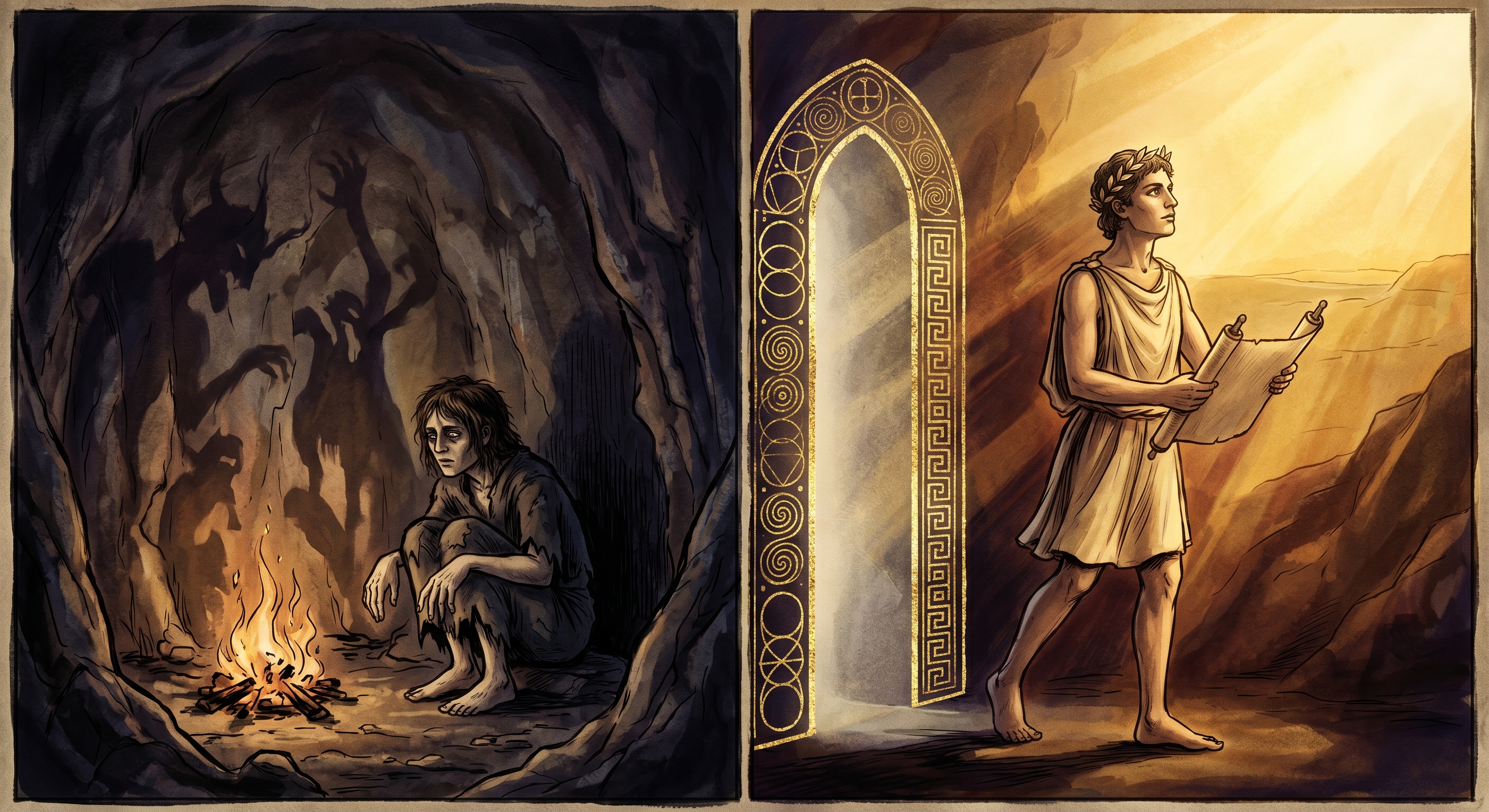
The same human being, unformed and formed. The left figure has been given a body at birth but not yet given form; the right figure has completed (and continues) the sacred labor of self-formation. The ancient Greeks understood this as the essential difference between mere biological existence and being actually human.
Part One: The Etymology of Μόρφωσις and the Sacred Forming of the Soul
The Word and Its Roots
The Greek word μόρφωσις (mórphōsis) is derived, according to the standard lexicographical authorities (Liddell and Scott, A Greek-English Lexicon, 9th ed., Oxford 1940; Pierre Chantraine, Dictionnaire étymologique de la langue grecque, Klincksieck 1968-80), from the verb μορφόω (morphóō, "to form, to give shape to"), which is itself a denominative verb derived from the noun μορφή (morphé, "form, shape"). The word appears in Aristotle, Theophrastus, the Septuagint, the New Testament (Romans 2:20 and 2 Timothy 3:5), and subsequently across the entire later Greek tradition.
The meaning of μόρφωσις is precise: it is the process by which a formless thing acquires form, the action of shaping. Applied to material objects, it describes the work of the sculptor, the potter, or the goldsmith who takes raw material and brings forth from it a determinate shape. Applied to human beings, it describes exactly what we mean in modern usage by "education" in its deepest sense: the disciplined labor by which the raw human infant, who possesses at birth only potential humanity, is progressively shaped into the actualized form of a fully developed rational and virtuous soul. In modern Greek, μόρφωση (mórphōsi) remains the standard word for this higher, formative sense of education, distinguished from εκπαίδευση (ekpaídeusi, formal schooling) by its emphasis on character, cultivation, and the total formation of the person.
The noun μορφή from which the word derives has extraordinary depth. In the classical usage, it denotes not merely outward appearance (that is σχῆμα, schêma) and not merely theoretical conception (that is ἰδέα, idéa), but the intrinsic, essential form that makes a thing what it is. A horse has the μορφή of a horse because it is a horse, because the form-pattern of horse is actualized in its very substance. When the Greeks spoke of giving μορφή to a human being through μόρφωσις, they meant something deeper than surface-decoration on the soul: they meant actualizing, through disciplined labor, the form-pattern of actual humanity in what had previously been only potential humanity.
The Metaphor of the Unformed Slab
The most exact metaphor for this process, and the one that appears repeatedly in the ancient sources, is the sculptor and the block of marble. A block of unformed marble has yet to become a statue and holds only the raw potentiality for one. The statue exists nowhere, neither in the block itself nor in any external place; it exists only as a form-pattern in the mind of the sculptor and as a determinate possibility latent in the marble's own structure. The sculptor's labor is to realize the form-pattern in the material, to bring it forth from the potential into the actual, by the disciplined removal of everything that is not the statue.
This is precisely the Zevist understanding of the human being at birth. The newborn infant is an unformed slab of remarkable potentiality. The biological organism exists; the rational soul exists in its seed-form; the divine spark of the Gods is already present within. But none of these has yet been brought into determinate actualization. What will this person become? A philosopher? A warrior? A priest? A craftsman? A degenerate? A tyrant? A Theophoros? All these forms remain latent at birth as possibilities of the unformed block. The labor of paideia is the sculpting-into-actuality of the highest form the given material can bear. Without this labor, the marble remains rough and shapeless to the end. With this labor, a diamond emerges from within the stone.

The metaphor of Plotinus and the entire Neoplatonic tradition: every human soul contains within itself a diamond of actualized virtue waiting to be brought forth. The raw stone of our unformed nature must be patiently chiseled away. Without the chisel, the diamond remains forever hidden; with it, the splendor of virtue shines forth.
Plotinus and the Sculptor Within
The most perfect and famous statement of this metaphor in the entire ancient philosophical tradition is found in Plotinus, Enneads I.6.9, composed in Rome in the middle of the third century CE. Plotinus was the culminating genius of the Platonic tradition, the teacher of Porphyry, and the fountainhead of all Neoplatonic philosophy. His statement on self-sculpting has informed the Zevist understanding of education at its deepest level, and it deserves extended citation.
Plotinus, Enneads:
"Go back inside yourself and look: if you do not yet see yourself as beautiful, then do as the sculptor does with a statue he wants to make beautiful; he chisels away one part, and levels off another, makes one spot smooth and another clear, until he shows forth a beautiful face on the statue. So you also: cut away all that is excessive, straighten all that is crooked, bring light to all that is overcast, labour to make all one glow of beauty, and never stop sculpting your own statue, until the godlike splendor of virtue shines forth to you."1
Every element of the ancient doctrine is compressed here. The soul is a block of marble. The virtues to be formed in the soul are the statue to be brought forth from the block. The disciplined labor of education is the chisel. The removal of what is excessive (vices, distractions, unformed impulses) and the straightening of what is crooked (distorted habits, warped judgments, corrupt desires) produce the emergence of the beautiful face, which is the virtuous character. The work is lifelong: Plotinus's command is μὴ παύσῃ τεκταίνων (mē paúsēi tektaínōn), "never stop sculpting." And the culmination is not any worldly reward but the shining-forth of divine splendor: "the godlike splendor of virtue" (θεοειδὴς αἰγλη, theoeidês aiglē), which is the state of having become worthy to bear the Gods within oneself. Plotinus here states, in his own vocabulary, what the Zevist calls the state of Theophoros.
The Plotinian metaphor transcends decorative poetry and serves as an exact description of the ontological process. The unformed soul genuinely is a rough block. The formed soul genuinely is a statue brought forth from the block by disciplined removal of the superfluous. Education is the chisel. The teacher, whether external (a philosopher, a priest) or internal (one's own rational faculty, guided by the Gods), wields the chisel. The student either submits to the work or refuses it. The person who refuses the work remains a block of rough stone for the entirety of life, regardless of how many years pass, regardless of what titles or possessions accumulate around the unformed interior. The person who submits to the work emerges, gradually, as a being of actualized virtue, radiating the divine splendor that had been latent in the raw material.
Part Two: Plato on Education as the Turning of the Soul
The Cave Allegory: Republic 514a-520a
The foundational philosophical treatment of paideia in the Western tradition is Plato's Cave Allegory, which occupies the opening of Book VII of the Republic. Plato introduces the allegory with a direct statement of its subject:
Plato, Republic:
"Μετὰ ταῦτα δή, εἶπον, ἀπείκασον τοιούτῳ πάθει τὴν ἡμετέραν φύσιν παιδείας τε πέρι καὶ ἀπαιδευσίας."2
"After that, I said, compare the effect of education and of the lack of education on our nature to an experience like this."
The phrase Plato uses is the decisive one: παιδείας τε πέρι καὶ ἀπαιδευσίας (paideías te péri kaì apaideusías), "concerning education and concerning the lack of education." Plato is explicit: the entire Cave Allegory, the most famous passage in Western philosophy, is an argument about what education does and what its absence does. The people chained in the cave, gazing at shadows and accepting them as the whole of reality, are the unformed souls who have never undertaken the labor of paideia. The escaped prisoner who ascends painfully into sunlight, who sees first the reflections, then the actual objects, then finally the sun itself, is the educated soul who has undergone the progressive sculpting-work of formation.
The single most important moment in Plato's treatment comes at 518b-d, where he defines education in a single sentence that overturns every naive understanding:
Plato, Republic:
"Οὐ τοίνυν ὡς ἔνιοι περὶ αὐτῆς δεινοῦνται ἔστιν, αὗτοί τι φασιν εἶναι. Μή τι γὰρ οὔτω τοῦτο ἔχειν, ἡ μὰ Δί' ἔγωγε, ἡ παιδεία οὐκ οἱαν τινες αὐτὴν εἶναι προσποιητική, οἶον τυφλοῖς ὄφθαλμοῖς ὄψιν ἐντιθέναι οὐκ ἐνούσῃς. ΥἌ γοῦν φασίν, ἔφην. Οὁ δὲ γε νῦν λόγος, ἦν δ' ἐγώ, σημαίνει ταύτην τὴν ἐνοῦσαν εἑκάστου δύναμιν ἐν τῇ ψυχῇ καὶ τὸ ὄργανον ὗ καταμανθάνει ἑκαστος, οὗον εἰ ὄμμα μὴ δυνατὸν ἦν ὄλλως ⌎ σὺν ὅλῳ τῷ σώματι στρέφειν."3
"Education is not what certain people profess it to be. They say, I believe, that they can put into the soul knowledge that was not in it, as if they were putting sight into blind eyes. But present argument indicates that the power to learn and the organ by which to learn are present in each person's soul, and that, just as the eye cannot be turned from darkness to light without the whole body being turned, so too this instrument of knowledge must be turned around from the world of becoming together with the entire soul."
Plato's definition is profound. Education is not the external insertion of information into a blank mind. The capacity for knowledge is already present in the soul at birth, the same way the eye's capacity for vision is present in the embryo. Education is the turning (periagogē, περιαγωγή) of the soul, the reorientation of the whole being, so that the capacities already present can be directed toward the light rather than the shadows. The Greek verb Plato uses here (στρέφειν, stréphein, "to turn") gives us the modern word "strophe." Education is the turning of the strophe, the redirection of the whole choral movement of the soul from lesser to greater objects.
This Platonic teaching aligns exactly with the sculptural metaphor. The form is already latent in the marble; the sculptor does not add it from outside but releases it by the disciplined removal of what conceals it. The knowing capacity is already latent in the soul; the educator does not implant it from outside but releases it by the disciplined turning of the whole soul toward the sun of truth. In both cases, the work is the liberation of what is already present in potential into what is present in actuality. Education, in Plato's understanding, is not acquisition; it is actualization.
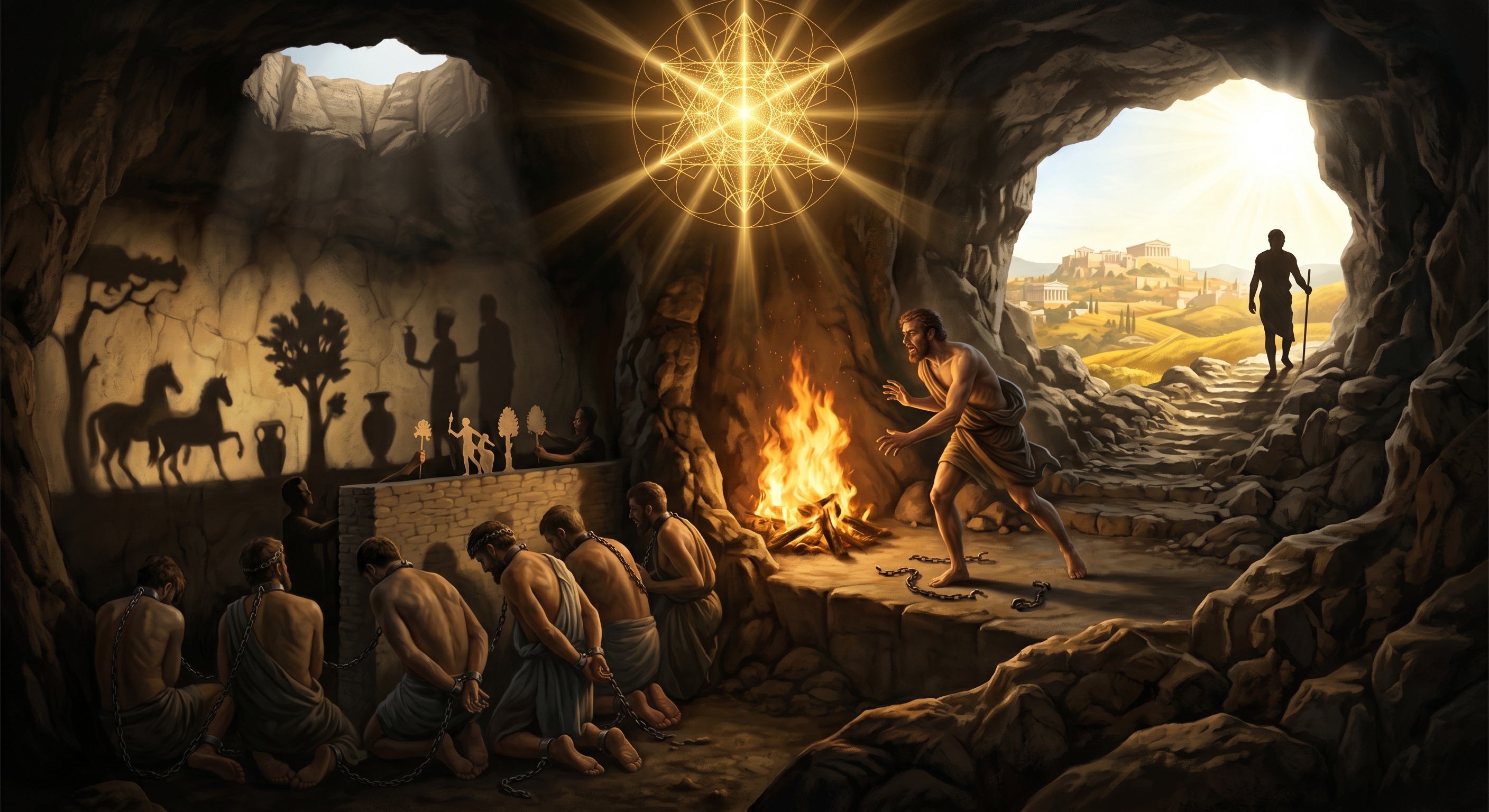
Plato's decisive teaching: education is not the insertion of knowledge into an empty vessel but the turning of the whole soul from the shadows to the light. The capacity to know is already present; education liberates it by disciplined reorientation. Every stage of the ascent is a further turning, a further removal of what had concealed the light.
The Four Subjects of Formation
Plato in the Republic prescribes a precise curriculum for the forming of the philosopher-guardian. In Books II-III he covers the early stages: music and poetry (μουσική, mousikē, which for the Greeks meant the entire realm of the Muses: poetry, music, history, mythology), and physical training (γυμναστική, gymnastikē). In Book VII, for the advanced stages, he prescribes four mathematical disciplines: arithmetic, geometry, astronomy, and harmonics. Together these four constitute what Late Antiquity and the Latin Middle Ages would call the quadrivium, the four-fold path, and which together with the trivium (grammar, logic, rhetoric) formed the seven liberal arts of the entire classical-Christian educational tradition.
Plato's reasons for these subjects are not arbitrary. Each of them performs a specific formative work on the soul. Mathematics trains the soul in the recognition of unchanging patterns amid apparent flux. Geometry trains the soul in spatial reasoning and the perception of invisible relations. Astronomy trains the soul in the comprehension of vast orderly systems. Harmonics trains the soul in the recognition of beauty as proportion. Together these disciplines turn the soul from the ever-changing shadows of sense-experience toward the unchanging forms of intelligible reality. Each is a further chisel-stroke in the liberation of the diamond from the marble.
Part Three: Aristotle on Habituation as the Forming of Character
Virtue as Product of Disciplined Repetition
Aristotle developed, in the Nicomachean Ethics, the most rigorous ancient treatment of how character is formed through the disciplined repetition of virtuous actions. Where Plato emphasizes the intellectual turning of the soul, Aristotle emphasizes the habituation of the emotions and the will. The two treatments are complementary: intellectual turning without emotional habituation produces the philosopher who knows the good but cannot perform it, while emotional habituation without intellectual turning produces the decent person who acts rightly without understanding why. The fully formed soul, the genuine product of complete paideia, unites both.
Aristotle, Nicomachean Ethics:
"Ἀρετὴ δὲ διττὴ, ἡ μὲν διανοητική, ἡ δὲ ἠθική. Θὴ μὲν διανοητικὴ τὸ πλεῖστον ἐκ διδασκαλίας ἔχει καὶ τὴν γένεσιν καὶ τὴν αὔξησιν, διόπερ ἐμπειρίας δεῖται· ἡ δ' ἠθικὴ ἐξ ἔθους περιγίγνεται, ὅθεν καὶ τοὖνομα ἔσχηκε μικρὸν παρεκκλῖνον τοῦ ἔθους. Ἀξ οὗ καὶ δῆλον ὅτι οὐδεμία τῶν ἠθικῶν ἀρετῶν φύσει ἡμῖν ἐγγίνεται· οὐθὲν γὰρ τῶν φύσει ὄντων ἄλλως ἐθίζεται."4
"Virtue is of two kinds, intellectual and moral. Intellectual virtue both owes its birth and its growth for the most part to teaching, which is why it requires experience and time; moral virtue comes about as a result of habit, whence also its name (ἠθική, ēthikē) is formed by a slight variation from the word ἔθος (éthos, habit). From this it is also plain that none of the moral virtues arises in us by nature; for nothing that exists by nature can form a habit contrary to its nature."
The Aristotelian teaching is precise. Virtue is not innate. Virtue is also not acquired by teaching alone (teaching is sufficient for intellectual virtue but not for moral virtue). Virtue is acquired by habituation, the disciplined repetition of virtuous actions over time until the doing of virtue becomes a stable state of the soul (ἕξις, héxis). Aristotle illustrates the point with characteristic precision: a stone cannot be habituated to fall upward, because falling downward is its nature; fire cannot be habituated to cool, because heat is its nature. But virtue and vice are not in the nature of humans; they are acquired dispositions. Humans are by nature capable of acquiring them, but must actually acquire them through the labor of disciplined action.
Aristotle, Nicomachean Ethics:
"Οὔτε ἄρα φύσει οὔτε παρὰ φύσιν ἐγγίνονται αἱ ἀρεταί, πεφυκόσι δὲ ἡμῖν δέξασθαι αὐτάς, τελειουμένοις δὲ διὰ τοῦ ἔθους. Ộτι δ' ὅσα μὲν φύσει ἡμῖν παραγίνεται, τὰς δυνάμεις τούτων πρότερον κομιζόμεθα, ὕστερον δὲ τὰς ἐνεργείας ἀποδίδωμεν, ἐπὶ τῶν αἰσθητῶν δῆλον· τὰς γὰρ αἰσθήσεις οὐκ ἐκ τοῦ πολλάκις ἰδεῖν ἔλαβομεν ἡ λαβόντες ἐχρησάμεθα, ἀλλ' ἔχοντες ἐχρησάμεθα ἔλαβομεν· τὰς δ' ἀρετὰς λαμβάνομεν ἐνεργήσαντες πρότερον."5
"Neither by nature, then, nor contrary to nature do the virtues arise in us; rather we are adapted by nature to receive them, and are made perfect by habit. Again, of all the things that come to us by nature we first acquire the potentiality and later exhibit the activity (this is plain in the case of the senses: for it was not by often seeing or often hearing that we got these senses, but on the contrary we had them before we used them, and did not come to have them by using them); but the virtues we get by first exercising them, as also happens in the case of the arts as well."
The Aristotelian analogy is decisive. We do not become builders by thinking about building; we become builders by building. We do not become just by contemplating justice; we become just by performing just actions. We do not become courageous by reading about courage; we become courageous by enduring fearful situations. Virtue is a skill, and like every skill it is acquired by practice. The practice must be sustained over years; it must be guided by correct teachers who model the actions to be imitated; it must be supported by a social order that rewards the practice rather than punishing it. Without these conditions, most people will never develop the virtues they are by nature capable of developing, and their lives will accordingly be spent as half-formed or unformed beings, functioning below the level that their own latent capacity would have permitted.
Aristotle's analysis has immediate implications for our understanding of paideia. Education extends beyond the accumulation of facts and consists primarily of training the soul through practice until the virtuous state of character becomes stable, reliable, and self-renewing. The educational institutions of a society must be engineered to produce this result. A society that produces information-stuffed but character-unformed graduates has failed at the primary task of education, however many degrees it distributes. A society that produces persons of formed character, even with modest credentials, has succeeded at the primary task. The Zevist recognizes this distinction and does not confuse the two.
Part Four: Isocrates on Logos as the Definitive Human Capacity
The Foundational Defense of Paideia
Among the ancient Greek theorists of education, no one articulated the centrality of paideia to human nature more powerfully than Isocrates of Athens (436-338 BCE), the great rhetorician-philosopher whose school at Athens was the direct contemporary and rival of Plato's Academy. Isocrates's defense of paideia in the Antidosis (composed around 353 BCE when he was 82 years old) and in the earlier Nicocles contains the single most influential statement in the entire ancient literature on why education is constitutive of humanity as such.
Isocrates, Nicocles:
"Τοῖς δ' ἄλλοις οὐδὲν τῶν ρῆσιν τούτῳ πλησιάζομεν, ἀλλὰ τοσοῦτον ἀπολελείμμεθα τῶν ὄλλων ζώων ὅσον τοῖς βαρβάροις βασιλεύειν τῶν ὀντων ἀπολελείμμεθα. Γρῆμα μὲν οὐκ ἔμαθομεν διδάσκειν, γράμματα δ' οἡδα γέγραπται. Ών αἰτία τὰς ἀρετάς τοιαύτας καὶ τοσαύτας πεπορίσθαι ὁ λόγος."6
"In the other powers we differ not at all from the other animals; we are in fact behind many of them in swiftness and strength and other resources. But, because there has been implanted in us the power to persuade each other and to make clear to each other whatever we desire, not only have we escaped the life of wild beasts, but we have come together and founded cities and made laws and invented arts; and, generally speaking, there is no institution devised by man which the power of speech has not helped us to establish. For this it is which has laid down laws concerning things just and unjust, and things base and noble. The power of speech is the cause of most of the goods we possess."
Isocrates's argument is foundational. The distinctive capacity of the human being, the capacity that differentiates humans from all other animals and that is the source of every achievement of civilization, is λόγος (lógos), which means simultaneously speech, reason, argument, and structured thought. Every city, every law, every art, every technology, every religion, every form of human community, rests upon λόγος. And λόγος arrives at birth not as a mature faculty but as a potentiality that must be developed through paideia. The person who has not been formed in λόγος has not fully entered the specifically human realm. The person formed in λόγος has become what the species was meant to be.
Isocrates, Antidosis:
"Προσήκει δὲ τοῦς βουλομένους μή τὰ τυχόντα διαπράττεσθαι ἴσομοιροῦς τοῖς ἄλλοις ἄνθρώποις γενέσθαι, ἀλλὰ διαπέπονθαι αὐτῶν παιδείας ἀσκήσει, ωὮ νμ λάβοωσι τὰς ἔμφυτους πραγματείας φνέσιν, μόνῴ ταὺτῃ τιμώμεναι τῶν ἔλλων δῙ δῗ νμόμην."7
"For those who desire not to be counted among the ordinary run of mankind, there must be no refusal to pursue paideia, for by this alone will they come to possess the strong wisdom that is their own particular excellence, and by this they will be honored above all other achievements."
Isocrates's position is stark. The person who does not pursue paideia is consigning himself or herself to the category of the ordinary run of mankind, the undeveloped majority, the unformed mass. The person who does pursue paideia elevates the self above this category and acquires what Isocrates calls τὰς ἔμφυτους πραγματείας φνέσιν (tàs émphytous pragmateías phrónēsin), "the innate practical wisdom," the capacity for rightly judging the situations life presents. This wisdom is latent in every human being at birth; education actualizes it; refusal of education leaves it dormant forever.
Part Five: Plutarch on the Triad of Nature, Reason, and Habit
The Most Systematic Ancient Treatise on Forming Children
The ancient treatise On the Education of Children (De liberis educandis), traditionally transmitted as the first work in Plutarch's Moralia and though questioned by some modern scholars as to its Plutarchan authorship it is universally acknowledged as a text of Plutarch's circle, Plutarch's date, and Plutarch's philosophical orientation, contains the most systematic ancient statement of the conditions under which a human being can be successfully formed through paideia. The treatise's single most important passage reduces the entire process to a triad.
Plutarch (or Pseudo-Plutarch), De liberis educandis:
"Λέγω δὲ τρία ταῦτα, τὴν φύσιν, τὸν λόγον, τὸ ἔθος· λόγον μὲν λέγω τὴν μάθησιν, ἔθος δὲ τὴν ἄσκησιν. Τὰς μὲν ἀρχὰς ἀπὸ φύσεως, τὰς δὲ προκοπὰς ἀπὸ μαθήσεως, τὰς δὲ χρήσεις ἀπὸ μελέτης, τὴν δ' ἀκρότητα ἀπὸ πάντων. Ὁσον μὲν ἀν τι τούτων ἐλλείπῃ, ἀνάγκη χωλὺν κατὰ τοῦτο τὸ μέρος γίνεσθαι τὴν ἀρετήν."8
"There must be a concurrence of three things in order to produce perfectly right action: nature, reason, and habit. By reason I mean the act of learning, and by habit constant practice. The first beginnings come from nature; advancement, from learning; the practical use, from continued repetition; and the culmination from all of these combined. But so far as any one of these is wanting, the moral excellence must, to this extent, be crippled."
The triad is φύσις (physis, nature), λόγος (lógos, reason or learning), and ἔθος (éthos, habit). All three are necessary. Nature provides the raw capacity. Learning provides the conceptual understanding. Habit provides the stable practical implementation. If any one of the three is missing, the formation is defective.
The treatise then develops the agricultural metaphor that became the touchstone of every subsequent educational theory.
Plutarch (or Pseudo-Plutarch), De liberis educandis:
"Ἀσπερ δήπου ἐν γεωργίᾳ πρώτον μὲν ἀγαθὴν τὴν γῆν ὑπάρξειν δεῖ, δεύτερον δὲ τὸν γεωργὸν ἐμπειρον, τρίτον δὲ τὰ σπέρματα σπουδαῖα· οὔτω δὲ τούτέ τὸν τρόπον τὴν μὲν φύσιν Ἰφᾐκαται τῇ γῇ, τὸν δὲ διδάσκαλον τῷ γεωργῷ, τὰς δὲ τῶν λόγων ὑποθήκας καὶ παραινέσεις τοῖς σπέρμασιν."9
"Just as in farming, first of all the soil must be good, secondly, the husbandman skillful, and thirdly, the seed sound, so, after the same manner, nature is like the soil, the teacher to the farmer, and the verbal counsels and precepts to the seed."
The metaphor is precise and beautiful. The soul of the student is the field. The teacher is the farmer. The teachings themselves are the seed. All three must be good, or the harvest fails. A fertile field without a skilled farmer produces weeds. A skilled farmer with bad seed produces nothing useful. Good seed sown in infertile ground sprouts briefly and dies. Only the combination of good soul + competent teacher + sound teaching produces the harvest of a formed character.
The treatise then makes its most striking claim, which is that even a deficient nature can be partially compensated by exceptional learning and habit, while even an excellent nature will be ruined without the labor of formation. The conclusion is that the labor is not optional.
Plutarch (or Pseudo-Plutarch), De liberis educandis:
"Indifference ruins a good natural endowment, but instruction amends a poor one; easy things escape the careless, but difficult things are conquered by careful application."10
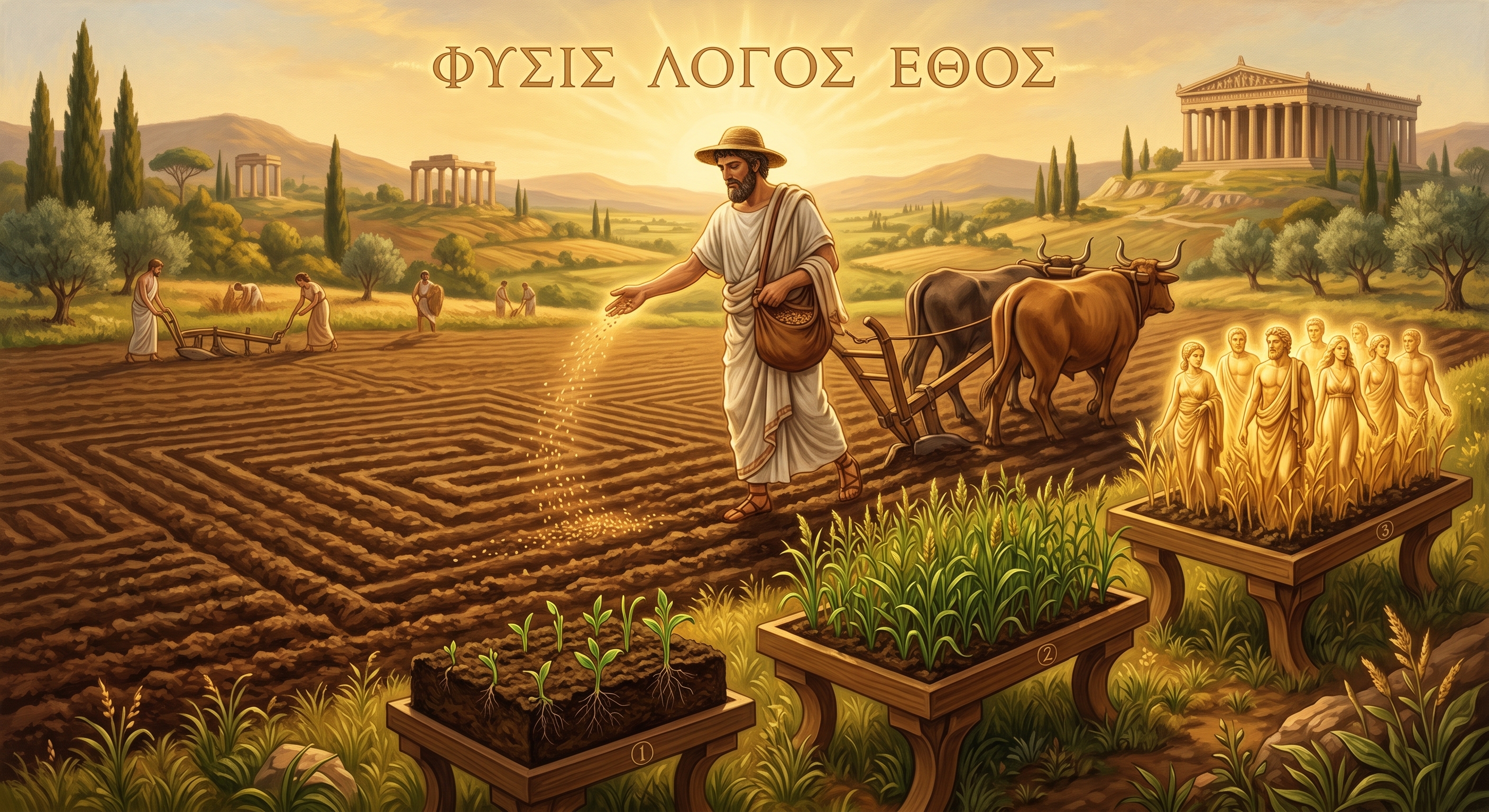
Plutarch's triad made visible: nature as the soil, learning as the farmer's skillful work, habit as the continuing cultivation through the seasons. Only the combination of all three produces the full harvest of a formed human being. Remove any one, and the crop fails.
Part Six: The Yehuboric War Against Paideia
The Spiritual Condition Defined
Having established the ancient Greek understanding that paideia is the very substance of actualized humanity, we must now confront a historical reality that the Zevist cannot ignore. Across the past two millennia, authentic paideia has been repeatedly suppressed by specific institutions that had fallen into the spiritual condition the Zevist tradition names Yehubor. The word designates, in Zevist doctrine, a theological category of affliction: those who bear the seal of the Divine upon their name yet are inwardly void of Divine presence, vessels that carry the inscription of God but contain nothing of Him. Yehubor is a condition of spiritual conduct, not a nation or an era or a tradition. It can arise within any religious institution, including in corrupted segments of traditions that in their uncorrupted form would honor the Gods, and the doctrine is explicit that Yehubor has historically infected even denominations that arose from within otherwise honorable lineages.
The defining marks of the Yehuboric condition, as Zevist doctrine teaches, are these: the claim of exclusive divine favor, the condemnation of all outsiders to punishment or damnation, the monopolization of the sacred, the inversion of cultural and spiritual history to defame rival traditions, the destruction of rival temples and libraries, the branding of the Ancient Gods as evil entities, and above all the systematic maintenance of spiritual ignorance among the populations under Yehuboric control. A Yehuboric priesthood is precisely what the doctrine names when it speaks of priesthoods that wield the Divine Names as instruments of persecution rather than illumination. Authentic priesthoods, by contrast, including the Zevist priesthood, the historic Egyptian and Vedic and Hellenic priesthoods, and every priesthood of the pre-Abrahamic world that preserved rather than destroyed the sacred learning of its people, stand outside the Yehuboric condition entirely and are its direct spiritual opposite.
The Yehuboric condition has a single structural requirement: the population under its authority must remain spiritually ignorant, because a formed population would immediately recognize the condition for what it is. The doctrine names this explicitly: Yehuboric systems require the vilification of all external wisdom in order to sustain the illusion of their own exclusive sanctity, and they require the masses to remain at the level of soulless animals so that the false narrative of unique divine election can be maintained. The Yehuboric war against paideia is therefore constitutive of the condition rather than incidental to it. A Yehuboric priesthood cannot permit the population to undertake authentic paideia, because authentic paideia produces exactly the formed mind that would see through the Yehuboric pretence. The suppression of education is the necessary operational consequence of the Yehuboric claim to exclusive spiritual authority.
The Historical Acts of Yehuboric Suppression
The doctrine of Yehubor teaches further that the Dark Ages of history are marked by the rising power of Yehuboric institutions, that holy people and learned nations are targeted by them to eliminate the light and replace it with empty husks, and that Galileo and Socrates and many others have fallen as victims of the spirit and institutions afflicted by the Yehuboric condition. The historical record confirms the doctrine with specific events at specific dates by specific institutions. We name them.
The Serapeum of Alexandria, which housed the last major working library of Greco-Egyptian classical learning after the gradual decline of the Museion, was destroyed by Christian mobs under the direction of Patriarch Theophilus of Alexandria in 391 CE, following the anti-pagan edicts of the emperor Theodosius I (Socrates Scholasticus, Historia Ecclesiastica 5.16; Rufinus of Aquileia, Historia Ecclesiastica 11.22-23, both writing within a generation). This was the Yehuboric condition in institutional action: a priesthood afflicted by the spirit of Yehubor destroying the living library of a rival tradition whose wisdom exposed its own emptiness. Hypatia of Alexandria, the last great Neoplatonic mathematician and philosopher of the classical tradition, was torn apart by a Christian mob instigated by partisans of Patriarch Cyril in 415 CE (Socrates Scholasticus, HE 7.15). A woman of towering paideia was killed by a Yehuborically afflicted institution that could not tolerate the presence of a formed mind operating outside its authority.
The Neoplatonic Academy at Athens, the institutional successor of Plato's foundation and the central surviving school of classical paideia, was closed by decree of the emperor Justinian in 529 CE. Its final scholarchs, Damascius and Simplicius among them, fled to the Persian court of Khosrow I (Agathias, Historiae 2.30-31). The pagan temples of Egypt, which had housed working priesthoods preserving hieroglyphic literacy for three millennia, were closed by imperial edict under the same Yehuborically afflicted Eastern Roman administration. With the death of the last trained Egyptian priest, the reading of hieroglyphs was lost to Europe for thirteen centuries, until Champollion's decipherment in 1822. An entire literate civilization was blinded because a Yehuborically afflicted institution could not tolerate the continued existence of the rival priesthood that had preserved it.
The pattern continued across the medieval period wherever Yehuborically afflicted institutions held temporal power. The Albigensian Crusade (1209-1229), ordered by Pope Innocent III, exterminated the Cathar population of Languedoc along with the Occitan literary culture that had sustained it. The Inquisition, formalized under Gregory IX in 1231, prosecuted readers of unauthorized books for six centuries. The Index Librorum Prohibitorum, promulgated by the Council of Trent in 1564 and maintained until 1966, formally forbade Catholic readers from accessing specific philosophical and scientific works. Giordano Bruno was burned at the stake in the Campo de' Fiori in Rome on February 17, 1600, after eight years of Inquisition imprisonment, for Hermetic and Neoplatonic teachings that the Yehuborically afflicted Roman authorities considered incompatible with their approved doctrine. Galileo Galilei was condemned in 1633 by the same institution for maintaining heliocentrism. The witch-hunts across Germany, France, and Britain from the fifteenth through the seventeenth centuries killed an estimated forty to sixty thousand people, many of them practicing herbalists and cunning-folk whose traditional knowledge predated and exceeded that of the clergy that burned them. The systematic denial of literacy to peasant populations across Yehuborically administered territories persisted into the nineteenth century.
In each of these cases, the Zevist reading is precise. The institutions performing the suppression had fallen into the Yehuboric condition. They performed destruction in God's name while the living presence of the Divine had long departed from them. They monopolized the sacred to secure temporal power. They vilified rival traditions to maintain the illusion of their own exclusive sanctity. They kept the populations under their authority in spiritual darkness because authentic paideia would have exposed the emptiness of their claims. This is the textbook operational profile of the Yehuboric condition as Zevist doctrine defines it, and it is written across the historical record in letters of fire.
Plutarch Moralia:
"There is no teaching without learning, no education without being educated. Every capacity we possess lies idle without paideia."11
The Operational Signature of the Yehuboric War on Paideia
Across these historical episodes, a single operational signature repeats itself with variation only in the local vocabulary. Yehuborically afflicted institutions work against paideia on four coordinated levels simultaneously.
At the political level, they restrict access to advanced learning to a priesthood they control, historically denying literacy itself to the laity for centuries at a time. At the theological level, they propagate doctrines that declare the human being intrinsically corrupted at birth and incapable of self-formation through disciplined labor, so that only the unearned gift of grace, distributed through the authorized institutions, can accomplish what the pagan tradition called paideia. The doctrine of original sin, which the Zevist tradition identifies as a Yehuboric corruption of authentic spiritual psychology, is the theological instrument by which the population is taught to distrust its own capacity for self-formation and to remain dependent on clerical mediation. At the cultural level, they work to suppress or rebrand the classical tradition whenever possible, relabeling the pagan philosophers as confused precursors to the approved revelation and forbidding direct student access to primary texts without clerical interpretation. At the cognitive level, they systematically destroy the specific faculties paideia would have developed: reading is reduced to the repetition of approved creeds, reasoning is reduced to commentary on approved authorities, and the critical comparison of traditions is forbidden on pain of excommunication or worse.
Ζevist doctrine teaches that the Yehuboric condition is not confined to any one historical era, and the present age demonstrates the truth of this teaching with perfect clarity. The contemporary surveillance-commerce apparatus performs, in commercial clothing, the same operational function that Yehuborically afflicted priesthoods performed in theological clothing. The commercial entertainment system, the social media algorithm engineered for attention-fragmentation, the reduction of education to credentialing, the demolition of the liberal arts curriculum, the addiction-engineered interface designs, the deliberate destruction of attention spans across the young population, the substitution of opinion-expression for argument-evaluation: all of these reproduce, under secular vocabulary, the Yehuboric imperative to keep the population spiritually and cognitively unformed. The formed soul threatens every system that depends on the unformed soul's passivity and inability to evaluate what is being done to it, whether the system calls itself a church or a platform.
The Zevist response is direct and uncompromising. Every act of authentic paideia is an act of resistance against the Yehuboric condition in every era in which it appears. Every chapter read, every argument evaluated, every tradition compared, every question asked, every habit of disciplined attention cultivated, is a chisel-stroke in the sculpting of the soul that Yehuboric institutions have always worked to keep unformed. The student who undertakes serious self-education is not merely improving his or her private condition; the student is participating in the great counter-movement by which the unformed marble of humanity is being transformed, person by person, into the statues the Gods intended the species to become, and through which the Yehuboric affliction is progressively driven back into the void from which it arose.
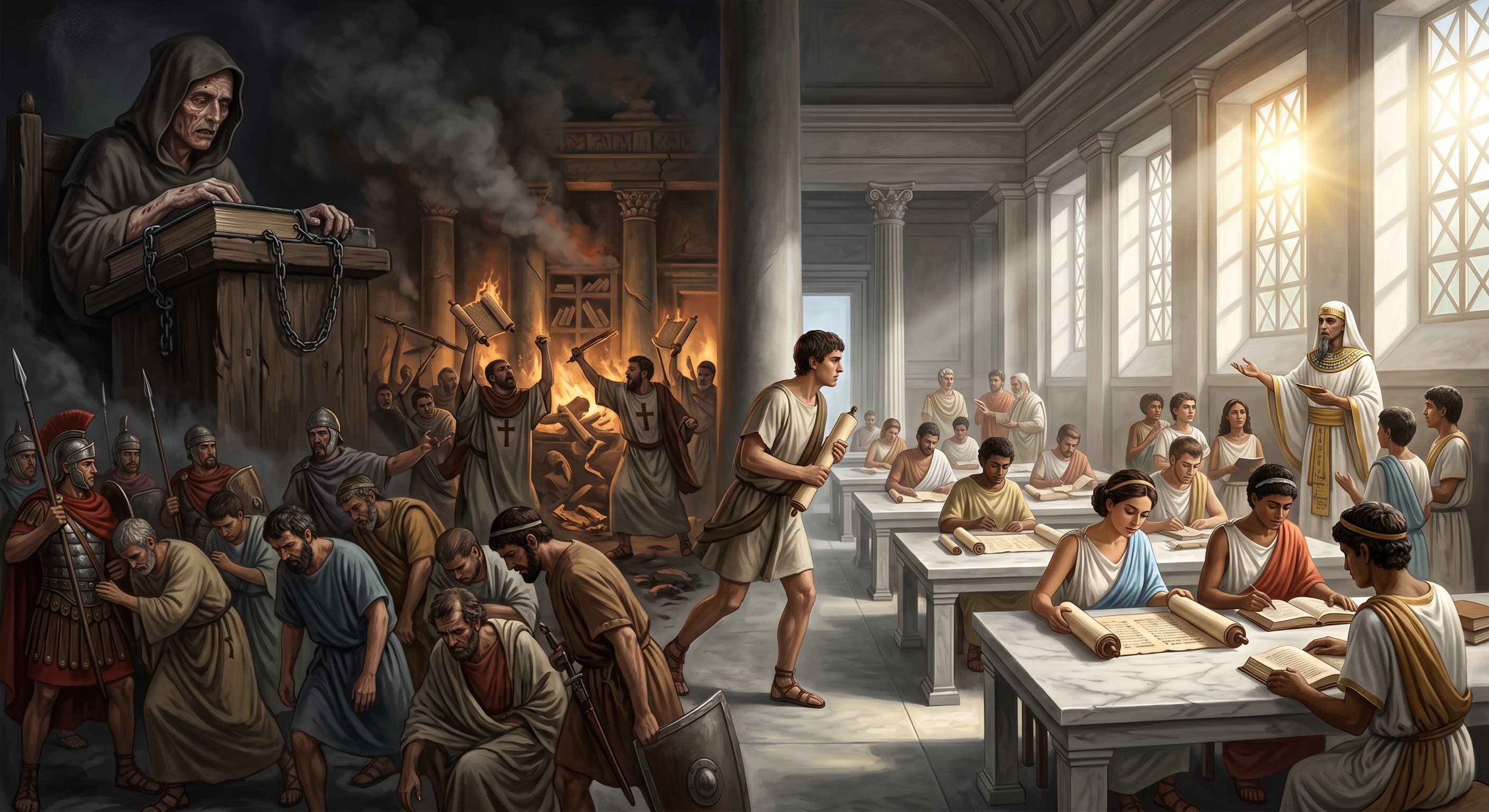
The Yehuboric signature through the centuries: the burning of the Serapeum in 391 CE, the Academy of Athens closed by Justinian in 529 CE, the later Inquisitions, the burnings at the stake, the chaining of books. The Zevist vocation is to recover the classical tradition that Yehuboric institutions suppressed, to rebuild the library, and to become, through disciplined self-formation, the kind of mind the Yehuboric affliction was engineered to prevent from existing.
Part Seven: The Cognitive Architecture of the Formed Soul
Let us descend from the level of general argument to the level of concrete cognitive faculty. What, precisely, does education form in the soul? The answer is a set of specific mental capacities, each of which requires dedicated training, each of which atrophies without regular exercise, and each of which is under direct and deliberate attack in the contemporary information environment. We enumerate the principal five.
Attention: The Capacity to Sustain Cognitive Focus
The first and most foundational cognitive faculty is attention, the capacity to hold the mind on a single object or argument across an extended period without fragmenting into distraction. Every serious intellectual achievement in human history has required sustained attention: the mathematician who works on a proof for years, the philologist who compares variant readings across hundreds of manuscripts, the philosopher who builds an argument across thirty pages, the musician who masters a composition through thousands of hours of practice. Without sustained attention, none of these achievements is possible. And sustained attention is not a natural gift; it is a cultivated capacity, developed through long training, maintained only through continued exercise, destroyed within months by constant interruption.
The contemporary information environment has been engineered, deliberately and with full knowledge of the cognitive consequences, to destroy attention. The smartphone notification, the social media feed, the algorithmic recommendation, the infinite scroll, the autoplay video, the dopamine-hit reward schedule, the constant interleaving of serious and trivial content: all of these represent direct assaults on the cognitive capacity that paideia requires. A generation that has spent its formative years in this environment has arrived at adulthood with attention spans demonstrably shorter than those of every previous generation in recorded history. The shortening goes beyond any accident of technological development and stands as the direct consequence of profit-maximizing design choices made by companies whose revenue depends on the disruption of the user's attention. The user whose attention has been fragmented cannot perform the reading and reasoning that paideia requires. The user therefore remains unformed, which is exactly the outcome the system depends on.
The Zevist counter-practice is the disciplined reclamation of attention through regular sustained reading, through contemplative silence, through meditation, through the deliberate suppression of digital interruption during hours of serious work. The capacity, once lost, can be rebuilt, though the rebuilding requires months of consistent practice. The first act of education for any modern person is therefore the recovery of the very faculty without which subsequent education is impossible.
Reading: The Decoding of Extended Argumentative Text
The second cognitive faculty is reading in its full sense, which is the capacity to decode an extended argumentative text, follow its reasoning across hundreds of pages, hold its structure in mind, compare its claims against other texts, and distinguish its sound arguments from its defective ones. This faculty is not identical to the technical skill of word-recognition. A person can be functionally literate (able to recognize words on a page) and yet unable to read in the full sense. Actual reading requires attention (see above), working memory sufficient to hold the argument's structure, vocabulary adequate to the text's conceptual range, background knowledge that permits the text's allusions to register, and the disciplined patience to return to difficult passages and re-read until comprehension is achieved.
Reading in this full sense is the single most important instrument of lifelong paideia. Teachers are locally available; libraries of great books are universally available. The person who has mastered reading can conduct his or her own education across an entire lifetime, moving progressively through the corpus of the great traditions at whatever pace and depth suits the individual situation. The person who has not mastered reading is dependent for the rest of life on whatever intellectual content happens to be delivered through the more passive channels of lectures, videos, and conversations, which are systemically inferior to the dense content possible in a carefully argued book.
The cultivation of reading proceeds through the same stages the ancient Greeks recognized: first the laborious decoding of simple texts, then the progressive increase in textual difficulty, then the acquisition of the classical vocabulary (including, for the Zevist, the recovery of philosophical Greek), then the development of comparative reading across multiple texts on the same theme, and finally the engagement with primary sources in the original languages. Each stage requires dedicated practice. The student who reads an hour a day, every day, for a decade will, by the end of the decade, have completed the equivalent of a classical education. The student who reads nothing will, at the end of the same decade, be essentially where he or she began.
Information Processing: The Discipline of Accurate Comprehension
The third cognitive faculty is the disciplined processing of new information. When a well-formed mind encounters a new claim, it does not simply accept the claim because the source is familiar or reject it because the source is unfamiliar. It processes the claim systematically: identifying the exact assertion being made, evaluating the evidence offered in support, comparing the claim against established knowledge, noting logical inconsistencies, and either provisionally accepting the claim (with whatever reservations are appropriate) or provisionally rejecting it (with whatever allowances are appropriate), while remaining open to revision on further evidence.
This processing capacity is what the ancient Greeks called φρόνησις (phrónēsis), practical wisdom or discerning judgment. It cannot be acquired by memorization of rules. It develops only through long practice with many actual claims across many actual domains, guided by teachers who model the process and correct the student's errors. The person who has developed phronesis can move through the information environment without being captured by its distortions: recognizing manipulation, distinguishing propaganda from argument, noticing which sources are credible on which topics, calibrating confidence appropriately to evidence. The person who has not developed phronesis is at the mercy of the last confident voice encountered and will repeatedly be manipulated by whichever social, political, or commercial system has current control of the information environment.
Critical Thought: The Evaluation of Arguments by Their Internal Structure
The fourth cognitive faculty is critical thought, the capacity to evaluate an argument by its internal logical structure rather than by its source, its rhetorical force, its emotional appeal, or the social pressure to accept it. Critical thought requires the prior mastery of basic logic (the distinction of valid from invalid inferences, the recognition of common fallacies, the understanding of necessary and sufficient conditions), which must be taught and practiced the way one learns to play a musical instrument. Once developed, critical thought permits the student to examine any argument, from any source, and evaluate it on its merits.
Critical thought is the single capacity most directly threatening to authoritarian systems, which is why every authoritarian system in history has worked to suppress it. The person who thinks critically cannot be reliably manipulated by appeals to authority, by propaganda campaigns, by social shaming, or by the manufactured urgency that characterizes modern political and commercial communication. The person who does not think critically will accept whatever is pressed upon him or her by the dominant voices of the moment, and will change position as those voices change.
The Zevist places particular emphasis on the cultivation of critical thought because it is the instrument by which the practitioner recognizes the Yehubor framework for what it is. A mind that cannot evaluate arguments critically will accept the Abrahamic claims at face value, because those claims are delivered with overwhelming social authority. A mind that has been formed in critical thought recognizes, within minutes of examining the claims, that they are internally inconsistent, evidentially unsupported, and ethically defective. The recovery of the ancient wisdom requires, as a precondition, the prior recovery of the critical capacity that the Yehubor apparatus spent centuries trying to destroy.
Research: The Disciplined Pursuit of Primary Sources
The fifth cognitive faculty is research, the disciplined pursuit of primary sources and the verification of claims against the original evidence. A formed mind does not accept secondary summaries when primary sources are accessible. When told that Plato said something, the formed mind asks: where, in which dialogue, at which Stephanus number, in whose edition, in whose translation, and does the claimed statement survive a careful reading in the original Greek? When told that the scientific evidence supports a particular conclusion, the formed mind asks: which studies, with what sample sizes, using what methods, replicated by whom, published where, and is the claimed consensus actual or manufactured? The research discipline requires access to libraries, facility with bibliographic tools, capacity to read scholarly apparatus, and the patient willingness to spend hours verifying what could have been accepted in seconds.
The research capacity is the final stage of paideia's cognitive development, because it combines all the prior capacities. Research requires sustained attention (the investigation takes hours). Research requires full reading (primary sources are dense). Research requires information-processing (the question must be refined against what the sources actually say). Research requires critical thought (competing sources must be compared and evaluated). Only the person who has developed the first four capacities can undertake research in the full sense, and only the person who conducts research in the full sense can finally become epistemically autonomous: capable of forming beliefs on the basis of verified evidence rather than on the basis of whatever happens to be the current consensus in the surrounding social environment.
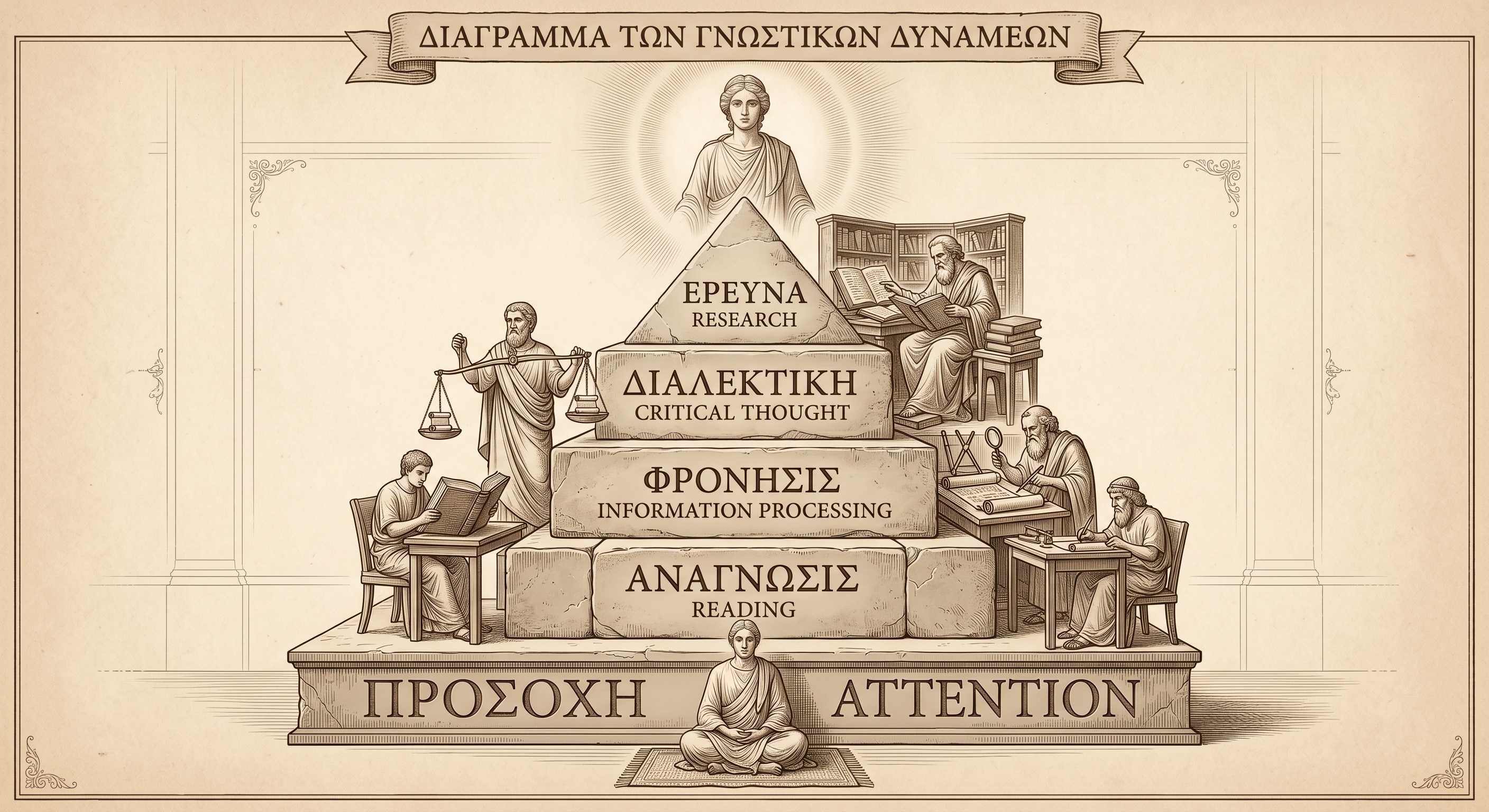
The formed soul rests on a pyramid of five specifically cultivated capacities: attention, reading, information processing, critical thought, and research. Each is built upon the prior. Remove any one, and the structure collapses. The Yehubor apparatus works to destroy each of the five; the Zevist counter-discipline works to restore and strengthen each.
Part Eight: Paideia as the Path Toward Theophoros
The Zevist Integration of Education and Spiritual Attainment
We have established the etymology, the ancient philosophical foundations, the Yehubor program of suppression, and the concrete cognitive faculties that paideia develops. We now arrive at the culmination: the Zevist teaching that lifelong paideia is the very substance of the path toward the state of Theophoros, the God-bearer, the practitioner who has so formed his or her soul that the divine presence can reliably dwell within.
The word Theophoros (Θεοφόρος, literally "God-bearer") designates, in the Zevist tradition, the mature practitioner who has completed sufficient inner formation that the presence of the Gods has become a stable feature of the interior life. The Theophoros is not a passive recipient of mystical experience; the Theophoros is an actively formed vessel, shaped through years of disciplined paideia, whose soul has acquired the ἕξις (héxis, the stable virtuous state) that permits the divine reality to enter and remain. The unformed soul cannot bear the Gods for the same reason the unfired clay pot cannot hold water: the structure required to contain the presence has not yet been formed.
The connection between paideia and Theophoros is direct. Every act of authentic education, every chapter read, every habit disciplined, every argument carefully evaluated, every primary source consulted, every moment of sustained attention, is a single chisel-stroke in the formation of the vessel that will eventually be capable of bearing the Gods. The work is patient and slow. It does not produce immediate spectacular results. It proceeds over decades. But its cumulative effect is to transform the raw marble of the person at birth into the finished statue of the Theophoros who will, at the end of the lifelong work, stand complete.
The Zevist therefore rejects any spiritual path that bypasses paideia. The claim, heard often in the contemporary spiritual marketplace, that one can attain divine realization through pure devotion without intellectual formation, is a Yehubor corruption dressed in spiritual costume. The pagan ancestors knew better. Plato, Aristotle, Plotinus, Iamblichus, Proclus, the entire Egyptian priesthood, the entire Vedic tradition, every authentic pre-Abrahamic religious civilization, required rigorous intellectual formation as the foundation of spiritual attainment. The Gods do not bless the lazy mind. The Gods respond to the disciplined soul. The disciplined soul is the outcome of sustained paideia. The lazy soul will remain, however devout its emotional expressions, an unformed block of marble from which no statue emerges.
The Prosperity Dimension: Growth as the Natural Outcome of Formation
The Zevist tradition teaches further that the formed soul is the soul the Gods prosper. Theophoros is not merely a spiritual title; it is the integrated state of being in which the practitioner's interior formation generates exterior growth in every dimension of life. The Theophoros, precisely because the interior has been formed through disciplined paideia, operates in the world with the five cognitive faculties intact. He or she sustains attention through complex projects, reads the primary sources that competitors ignore, processes information with accurate discernment, evaluates arguments critically, and researches before committing resources. The natural result of operating with all five faculties intact is success in whatever domain the practitioner applies them: scholarship, professional life, family, finances, community, ritual practice.
The Gods reward formation because formation is the precondition of every achievement that deserves the name. The Gods cannot reward a person who has not developed the cognitive structure required to receive and use the rewards. The Theophoros Cycle operates precisely because the formed practitioner is capable of transforming modest divine blessings into substantial exterior achievements, which in turn permit larger blessings to be productively received, which in turn permit larger achievements. The cycle compounds over decades. The unformed person, by contrast, receives identical divine opportunities and squanders each of them through inability to sustain attention, read the situation, process the information, think critically, or research before deciding. The unformed person's life stagnates regardless of how many opportunities the Gods place in it.
Proclus In Alcibiadem:
"Ἔν τϓν παδευθέντα ὅλως τἘν ψυχήν, καῚ τὰς φρένας καῚ τὰς πράξεις πάντας, τοῦτον αμν νηι προσστάντες τοῦ θεοῦ, τοῦτον καὶ θεοφόρον ἔσται."12
"The one who has formed the whole soul, both the thoughts and all the actions, this one shall be led forward by the God, this one also shall be a Theophoros."
Conclusion: The Lifelong Chisel
We began with a simple claim: that among all the decisions a human being makes, the decision to undertake the labor of paideia exceeds every other in consequence. We have now developed the grounds for this claim through eight stages.
We established, through the etymology of μόρφωσις, that education is literally the giving-of-form to the formless, the sculpting of the unformed soul into the determinate statue of a fully developed human being. We grounded this understanding in Plotinus's sculptor-metaphor, which identifies the interior work of self-formation as the direct analogue of the external work of the artist. We traced the ancient philosophical foundations through Plato (education as the turning of the soul), Aristotle (virtue as habituation), Isocrates (logos as the definitive human capacity), and Plutarch (the triad of nature + reason + habit). We confronted the Yehubor program of systematic suppression of paideia and identified its modern successor systems. We enumerated the five specific cognitive faculties that paideia develops: attention, reading, information processing, critical thought, and research. And we arrived at the Zevist culmination: that lifelong paideia is the very substance of the path toward the state of Theophoros, and that the Gods prosper the formed soul as the natural consequence of its formation.
The practical implication is unavoidable. The practitioner who has read this argument to its end either undertakes the labor or refuses it. There is no intermediate option. Partial undertaking produces partial formation, which is better than no formation, but the structure of the labor is such that it continues for life. Plotinus was precise: mē paúsēi tektaínōn, "never stop sculpting." The sculptor who lays down the chisel before the work is complete produces a half-finished statue, visibly beautiful in some areas and visibly rough in others, which will stand as a permanent witness to the abandonment of the labor. The only way to finish the work is to continue the work.
The Zevist does not pretend that the labor is easy. The disciplined cultivation of attention across years, the regular sustained reading of difficult primary sources, the patient acquisition of classical languages, the habitual critical evaluation of claims against their evidence, the research discipline that verifies before accepting: all of these require hours per day across decades, and they require the sustained refusal of the distraction-systems that dominate the contemporary information environment. The labor is hard. The labor is unglamorous. The labor produces no spectacular public results in its early years. But the labor is the only path toward becoming what the Gods intended the human species to become, and no substitute for the labor exists.
What the Gods ask of us, according to the entire ancient pagan tradition, is that we take up the chisel. They do not perform the sculpting for us; that is our work. But they have given us the marble, they have placed the diamond latent within the marble, they have preserved the teachings of the great philosophers across the millennia for our instruction, and they stand ready to bless the disciplined soul that undertakes the disciplined work. The sculpting begins with the next hour of reading, the next period of sustained attention, the next careful evaluation of an argument, the next verification of a claim against its primary source. It continues for the rest of life. And at the end, if the work has been sustained, the rough block of our birth will have become the shining statue of the Theophoros, the God-bearer, the being the Gods had always intended us to become.
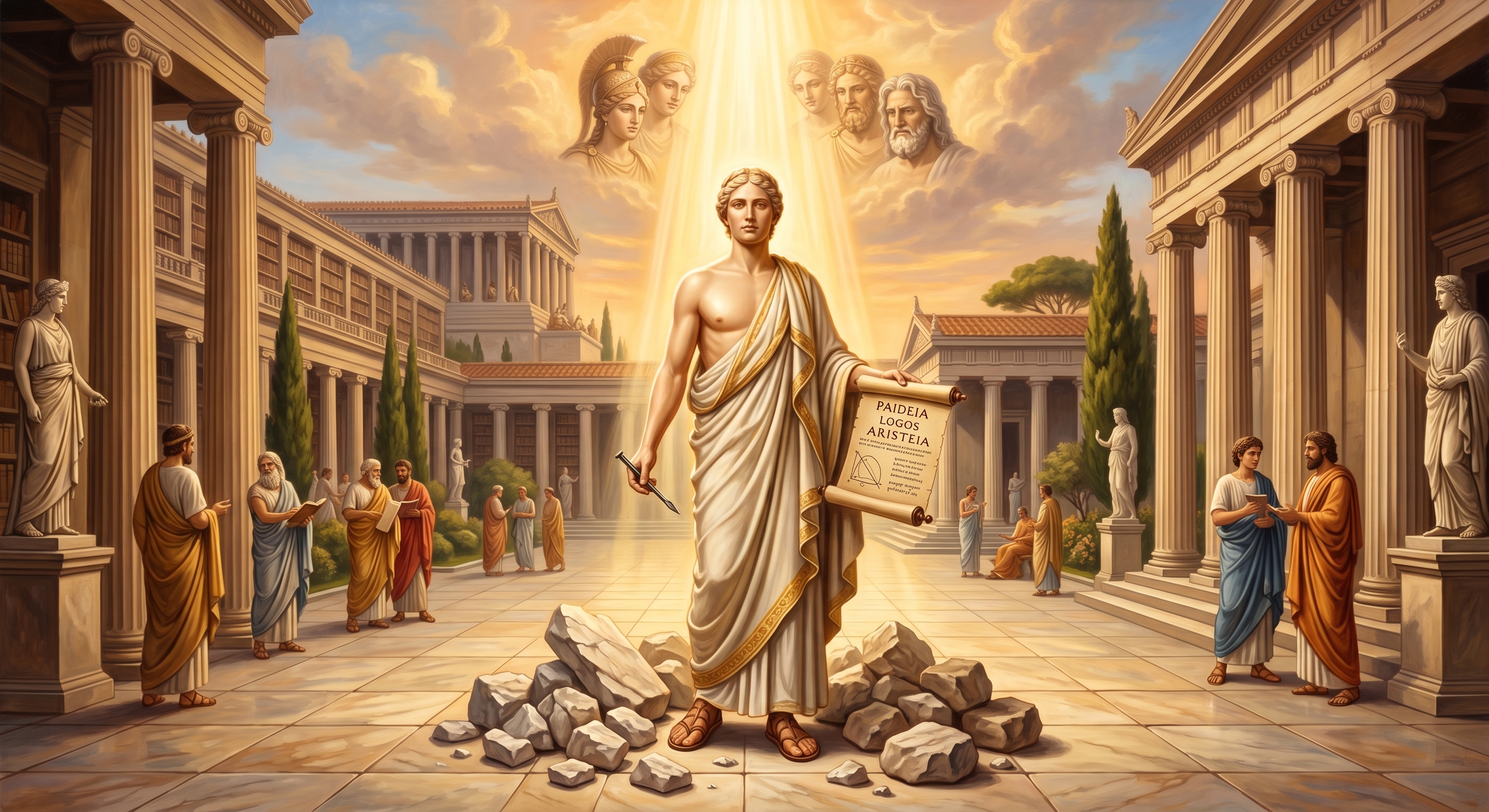
The outcome of lifelong paideia: the raw marble of the person at birth has become, through decades of disciplined self-sculpting, the radiant statue capable of bearing the Gods within. The chisel remains in hand because the work never fully ends. The library and temple stand behind, the civilization that formation makes possible. The Gods welcome from above. This is the goal the ancient tradition always pointed toward, and the goal the Zevist recovers and transmits forward.
References:
1 Plotinus, Enneads I.6.9.7-15 (ed. Paul Henry and Hans-Rudolf Schwyzer, Plotini Opera, Oxford Classical Texts, 3 vols., 1964-1982); trans. A.H. Armstrong, Loeb Classical Library, Harvard University Press, 1966, adapted
2 Plato, Republic 514a1-2 (ed. John Burnet, Oxford Classical Texts, 1902); trans. adapted from Paul Shorey, Loeb Classical Library, 1935
3 Plato, Republic 518b6-d1 (ed. Burnet); trans. adapted from G.M.A. Grube and C.D.C. Reeve, Plato: Republic, Hackett, 1992
4 Aristotle, Nicomachean Ethics II.1.1103a14-20 (ed. Ingram Bywater, Oxford Classical Texts, 1894); trans. adapted from W.D. Ross, The Nicomachean Ethics of Aristotle, Oxford University Press, 1925
5 Aristotle, Nicomachean Ethics II.1.1103a23-32 (Bywater ed.); trans. Ross, 1925
6 Isocrates, Nicocles or Cyprians 3.5-9 (ed. and trans. George Norlin, Loeb Classical Library, 1928); cf. Werner Jaeger,Paideia: The Ideals of Greek Culture, 3 vols., Oxford University Press, 1939-1944, Vol. III, pp. 46-105
7 Isocrates, Antidosis 15.293-294 (Norlin, Loeb); cf. Yun Lee Too, A Commentary on Isocrates' Antidosis, Oxford University Press, 2008, pp. 235-241
8 Plutarch (or Pseudo-Plutarch), De liberis educandis 4 (2A-B), Moralia I; ed. W.R. Paton, Teubner, 1925; trans. Frank Cole Babbitt, Loeb Classical Library, Harvard University Press, 1927, adapted
9 Plutarch (or Pseudo-Plutarch), De liberis educandis 4 (2B); trans. Babbitt, Loeb, 1927
10Plutarch (or Pseudo-Plutarch), De liberis educandis 4 (2C); trans. Babbitt, adapted
11 Paraphrased summation of the Zevist educational principle as derived from Isocrates Antidosis 180-196 and PlutarchMoralia 2A-4C
12 Paraphrased summary of the Zevist doctrine as synthesized from Plutarch Moralia 4A-6D, Plotinus Enneads I.6.9, and Proclus In Alcibiadem 11-16 (ed. Westerink)
sources:
- Plato, Republic, ed. John Burnet, Oxford Classical Texts, Oxford University Press, 1902; trans. Paul Shorey, Loeb Classical Library, 2 vols., Harvard University Press, 1930-1935; trans. G.M.A. Grube revised by C.D.C. Reeve, Hackett Publishing, 1992
- Plato, Meno, Phaedo, Phaedrus, ed. Burnet, Oxford Classical Texts; trans. Harold North Fowler, Loeb Classical Library, Harvard University Press, 1914-1926
- Plato, Laws, ed. Burnet; trans. R.G. Bury, Loeb Classical Library, 2 vols., Harvard University Press, 1926
- Aristotle, Ethica Nicomachea, ed. Ingram Bywater, Oxford Classical Texts, 1894; trans. W.D. Ross, Oxford University Press, 1925; trans. Terence Irwin, Hackett Publishing, 2nd ed., 1999; trans. Joe Sachs, Focus Philosophical Library, 2002
- Aristotle, Politics, ed. W.D. Ross, Oxford Classical Texts, 1957; trans. H. Rackham, Loeb Classical Library, Harvard University Press, 1932
- Isocrates, Orations, 3 vols., ed. and trans. George Norlin and LaRue Van Hook, Loeb Classical Library, Harvard University Press, 1928-1945
- Isocrates, Isocrates I-II, trans. David Mirhady, Yun Lee Too, Terry L. Papillon, University of Texas Press, Oratory of Classical Greece series, 2000 and 2004 (the newer and more accurate translation)
- Yun Lee Too, A Commentary on Isocrates' Antidosis, Oxford University Press, 2008
- Plutarch (or Pseudo-Plutarch), De liberis educandis, Moralia vol. I, ed. W.R. Paton, Teubner; trans. Frank Cole Babbitt, Loeb Classical Library, Harvard University Press, 1927
- Edmund G. Berry, "The De liberis educandis of Pseudo-Plutarch," Harvard Studies in Classical Philology 63 (1958), pp. 387-399
- Plotinus, Plotini Opera, 3 vols., ed. Paul Henry and Hans-Rudolf Schwyzer, Oxford Classical Texts, 1964-1982 (editio maior)
- Plotinus, Enneads, trans. A.H. Armstrong, Loeb Classical Library, 7 vols., Harvard University Press, 1966-1988
- Proclus, In Platonis Alcibiadem Commentarius, ed. L.G. Westerink, North-Holland, 1954; trans. William O'Neill, Proclus' Alcibiades I, Martinus Nijhoff, 1965
- Proclus, In Platonis Rem Publicam Commentarii, 2 vols., ed. Wilhelm Kroll, Teubner, 1899-1901
- Werner Jaeger, Paideia: The Ideals of Greek Culture, 3 vols., trans. Gilbert Highet, Oxford University Press, 1939-1944 (the classic scholarly treatment of the entire ancient Greek educational tradition)
- H.I. Marrou, A History of Education in Antiquity, trans. George Lamb, Sheed & Ward, 1956
- Raffaella Cribiore, Gymnastics of the Mind: Greek Education in Hellenistic and Roman Egypt, Princeton University Press, 2001
- Teresa Morgan, Literate Education in the Hellenistic and Roman Worlds, Cambridge University Press, 1998
- Martin Bloomer, ed., A Companion to Ancient Education, Wiley-Blackwell, 2015
- Liddell and Scott, A Greek-English Lexicon, 9th ed. revised by Henry Stuart Jones, Clarendon Press, Oxford, 1940 (the standard ancient Greek lexicon)
- Pierre Chantraine, Dictionnaire étymologique de la langue grecque: Histoire des mots, 4 vols., Klincksieck, Paris, 1968-1980
- Robert S.P. Beekes, Etymological Dictionary of Greek, 2 vols., Brill, Leiden, 2010
- Anne Sheppard, Studies on the 5th and 6th Essays of Proclus' Commentary on the Republic, Hypomnemata 61, Vandenhoeck & Ruprecht, 1980
- Dominic J. O'Meara, Plotinus: An Introduction to the Enneads, Oxford University Press, 1993
- Pierre Hadot, Plotinus or the Simplicity of Vision, trans. Michael Chase, University of Chicago Press, 1993
- Pierre Hadot, Philosophy as a Way of Life: Spiritual Exercises from Socrates to Foucault, ed. Arnold I. Davidson, trans. Michael Chase, Blackwell, 1995
- Pierre Hadot, What Is Ancient Philosophy?, trans. Michael Chase, Harvard University Press, 2002
- Christopher Gill, The Structured Self in Hellenistic and Roman Thought, Oxford University Press, 2006
- John Cooper, Pursuits of Wisdom: Six Ways of Life in Ancient Philosophy from Socrates to Plotinus, Princeton University Press, 2012
- Rosalind Kerven and Catherine Zuckert, Plato's Philosophers: The Coherence of the Dialogues, University of Chicago Press, 2009
- George A. Kennedy, A New History of Classical Rhetoric, Princeton University Press, 1994
- James R. Muir, Isocrates: Paideia, Discourse, and Justice, SpringerBriefs in Education, 2022
- Takis Poulakos and David Depew, eds., Isocrates and Civic Education, University of Texas Press, 2004
- Ekaterina Haskins, Logos and Power in Isocrates and Aristotle, University of South Carolina Press, 2004