
 አማርኛ
አማርኛ العربية
 বাংলা
বাংলা Български
 中文
中文 Čeština
 Dansk
Dansk Deutsch
 Eesti
Eesti Ελληνικά
 Español
 Français
 हिन्दी
 Hrvatski
 IsiZulu
 Italiano
 日本語
日本語 Kiswahili
 Magyar
 Македонски
 नेपाली
 Nederlands
 فارسی
فارسی Polski
 Português
 Română
 Русский
 Slovenščina
 Suomi
Suomi Svenska
 Tagalog
 Türkçe
The Wars of the Gods: Cosmological Education by the Gods
author: High Priest Zevios Metathronos
How Divine Conflict and Reconciliation Function as Sacred Theatre, Staged by the Gods for the Spiritual Education of Humanity, Their Children
A rigorous argument, grounded in the Middle-Platonic, Neoplatonic, and Puranic commentarial traditions, that the apparent conflicts among the Gods constitute an intentional cosmological drama, a dolls'-house theatre by which the divine instructors teach their children (humanity) the hidden structure of spiritual reality, the operation of inner alchemy, and the uniting of the opposites that every soul carries within. The thesis transcends any modern speculation and stands as the explicit ancient teaching of Plato, Plutarch, Sallustius, Porphyry, and Proclus, substantiated by close reading of three ancient texts from three independent religious civilizations.
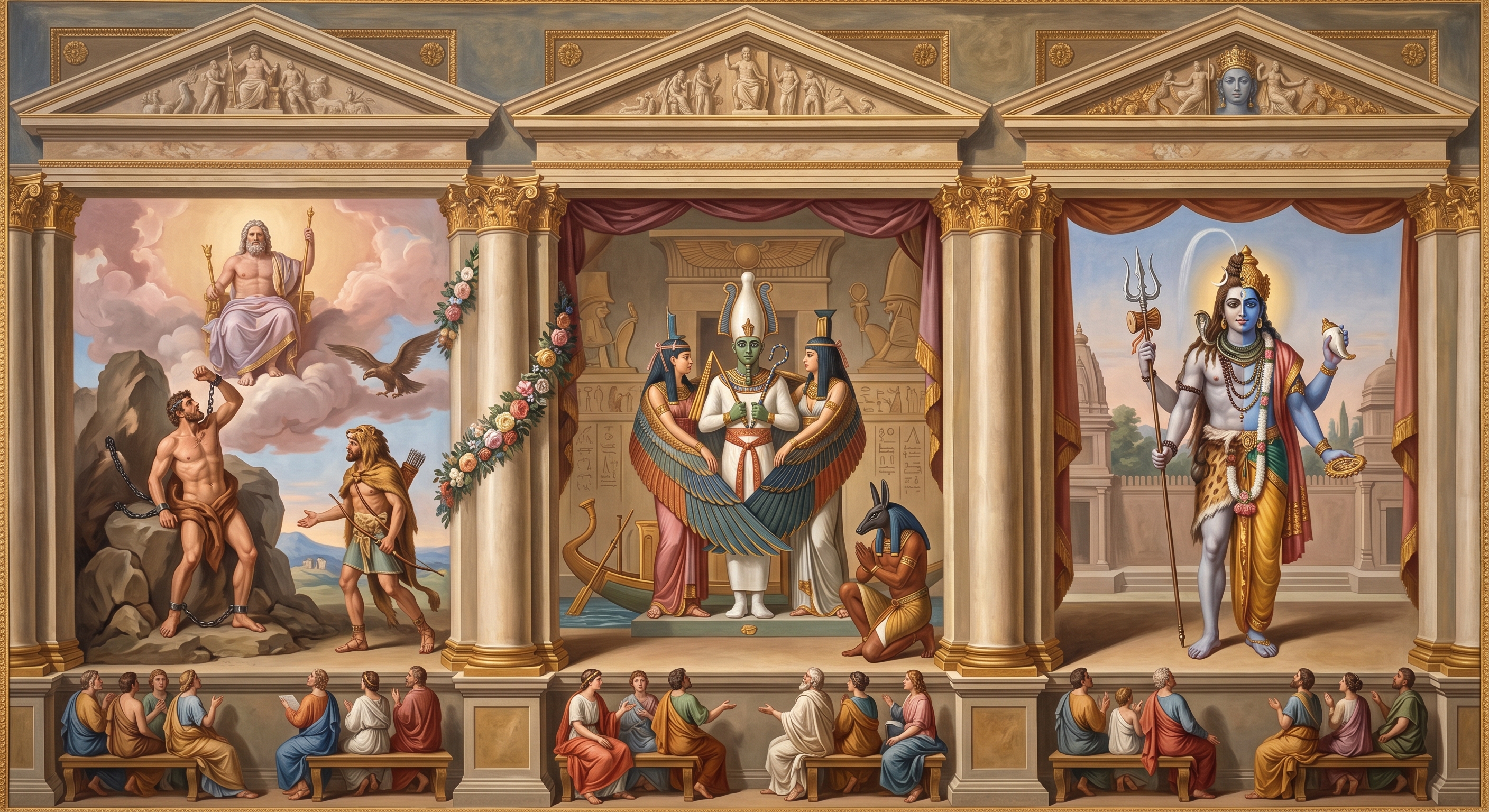
Greek, Egyptian, and Indian: three independent civilizations, three sacred dramas of conflict and reconciliation, one pedagogical purpose performed before humanity's attentive gaze.
Prologue: The Paradox That the Ancient Philosophers Resolved
Anyone who reads the ancient sacred literatures with attention is confronted by a paradox that appears immediately and refuses to go away. The Gods, who are the highest powers of the cosmos, the sources of order, the guarantors of justice, are again and again depicted as fighting one another. Zeus binds Prometheus; Zeus then reconciles with Prometheus. Set murders Osiris; Set is then restored to his cosmic function as prow-defender of the solar barque. Shiva and Vishnu, in the Puranic tradition, appear to contest supremacy; they then resolve into the single form of Harihara. The pattern is consistent across every major ancient religious tradition: the Gods fight, the Gods reconcile, and the narrative of the fighting-and-reconciling is preserved by the priesthoods of every civilization as sacred and canonical.
The naive reader concludes that the Gods are inconsistent, or that the ancient religions are confused, or that the myths are primitive stories written by people who had not yet learned to construct coherent theologies. Every serious ancient philosopher rejected this reading. The fathers of the allegorical tradition, Plato and Plutarch and Porphyry and Sallustius and Proclus, stated directly that the apparent conflicts among the Gods are intentional pedagogical devices. The Gods, they said, stage these conflicts precisely because the conflicts teach. A smooth, conflictless narrative of the divine would leave the student with no question to ask; the conflict-narrative compels the student to ask what it means, to look beneath the surface, and to find there the hidden cosmological, psychological, and alchemical truths that the myth was designed to transmit.
This is the ancient doctrine of myth as divine pedagogy. The present study develops it in full depth. We will first demonstrate the explicit philosophical foundation of the doctrine in four ancient texts. We will then analyze three specific myth-cycles of divine conflict-and-reconciliation drawn from three independent religious civilizations: the Greek Prometheus-Zeus cycle in Aeschylus's Prometheia trilogy; the Egyptian Osiris-Set cycle in Plutarch's De Iside et Osiride; and the Indian Shiva-Vishnu cycle preserved in the Skanda Purāṇa, the Liṅga Purāṇa, and the Harihara iconographic tradition. In each case we will show that the narrative structure of divine conflict followed by reconciliation is an intentional pedagogical pattern by which the Gods teach their human students the operation of spiritual alchemy, the reconciling of inner opposites, and the unification of the divided soul.
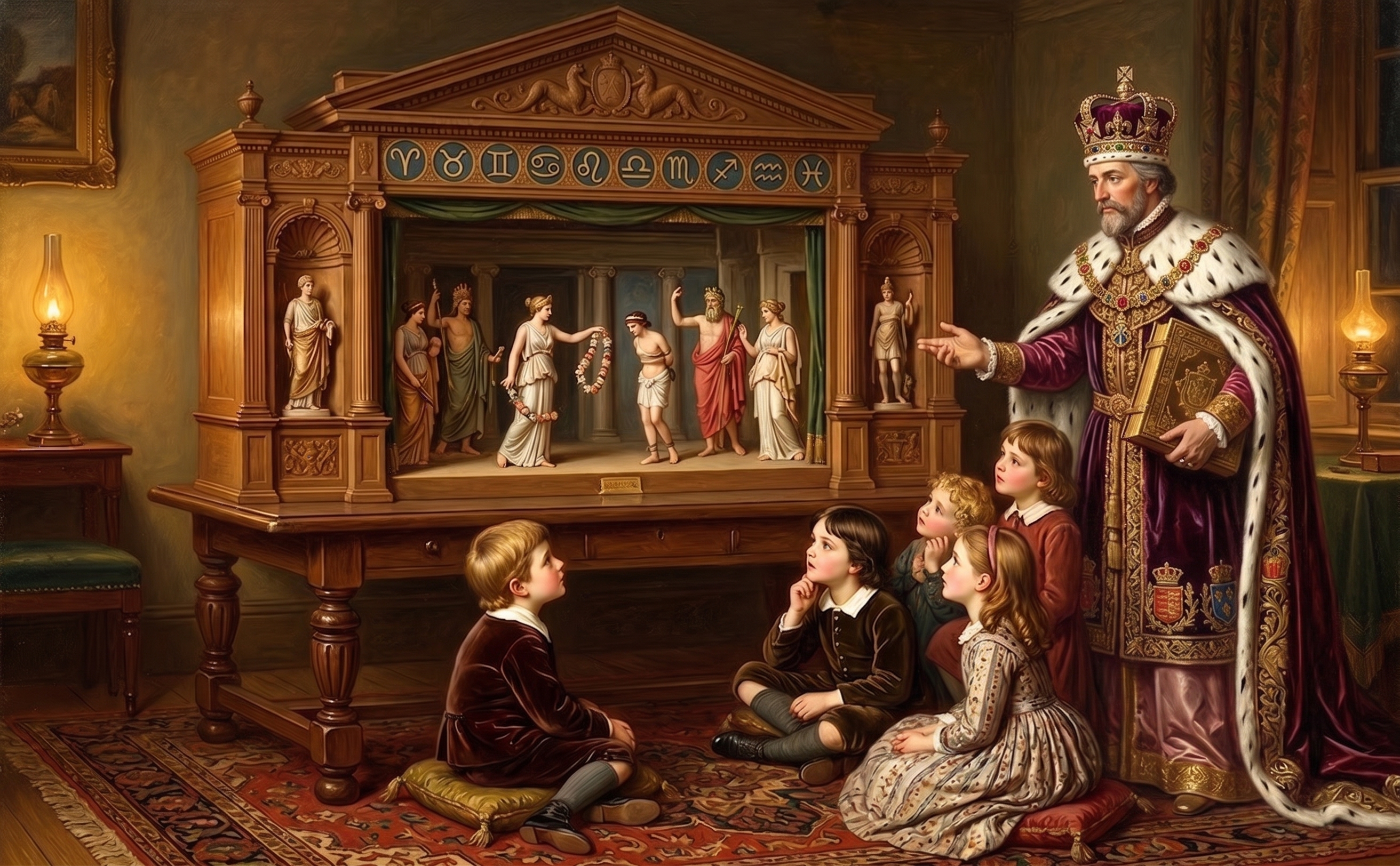
The Gods, as loving instructors of their human children, stage cosmic dramas for humanity to witness, so that what would otherwise remain invisible metaphysical truth becomes visible as story, memorable as character, and applicable as the inner work of every serious soul.
Part One: The Ancient Philosophical Foundation
Plato on the Malleability of the Young Soul: Republic 377a-378e
The foundational text for the ancient doctrine of myth as pedagogy is Plato's Republic Book 2, at 377a and following. Plato begins from a precise observation: children absorb myths before they can reason about them, and the myths they absorb shape the character they develop. The young soul is, in Plato's metaphor, wet clay. Whatever is impressed upon it at the beginning becomes hard to change later.
Plato, Republic:
"οἶσθ' ὅτι ἀρχὴ παντὸς ἔργου μέγιστον, άλλως τε καὶ νέῳ καὶ ἀπαλῷ ὁτωοῦν; μάλιστα γάρ τότε πλάττεται καὶ ἐνδύεται τύπος ὃν ἄν τις βούληται ἐνσημήνασθαι ἕκαστῳ."1
"Don't you know that the beginning of every work is most important, especially for anything young and tender? For it is then that each is moulded most, and takes whatever pattern one wishes to impress upon it."
Plato then makes a second observation that grounds the entire allegorical tradition. The young mind, he says, "cannot distinguish what is hidden sense (ἀλληγορία, allegoria, or ἕπονοια, hyponoia, "underlying meaning") and what is not" (Republic 378d). The hidden sense is therefore already present in the myth; the ancient narrative, even the scandalous parts about the Gods fighting, contains a true teaching concealed beneath the literal surface. Plato's objection to the existing poets is not that the myths are fundamentally flawed but that the surface narrative requires a developed philosophical mind to decode, and young children cannot yet perform the decoding. His solution is that the myths must be carefully taught, not abolished, and that the philosophical decoding is the proper labor of education.
This is a decisive moment in the history of thought. Plato establishes that the myths of divine conflict contain hyponoia, underlying meaning, placed there intentionally, and that the proper education of the soul consists in ascending from the surface narrative to the hidden teaching. Every subsequent ancient allegorist, from the Stoics through Philo through Plutarch through Porphyry through Sallustius to Proclus, works within this Platonic framework. The ancient myths are coded pedagogy. The Gods speak in images and stories because images and stories are the only language that can transmit the deeper teachings across the long span between the state of the child and the state of the philosopher.
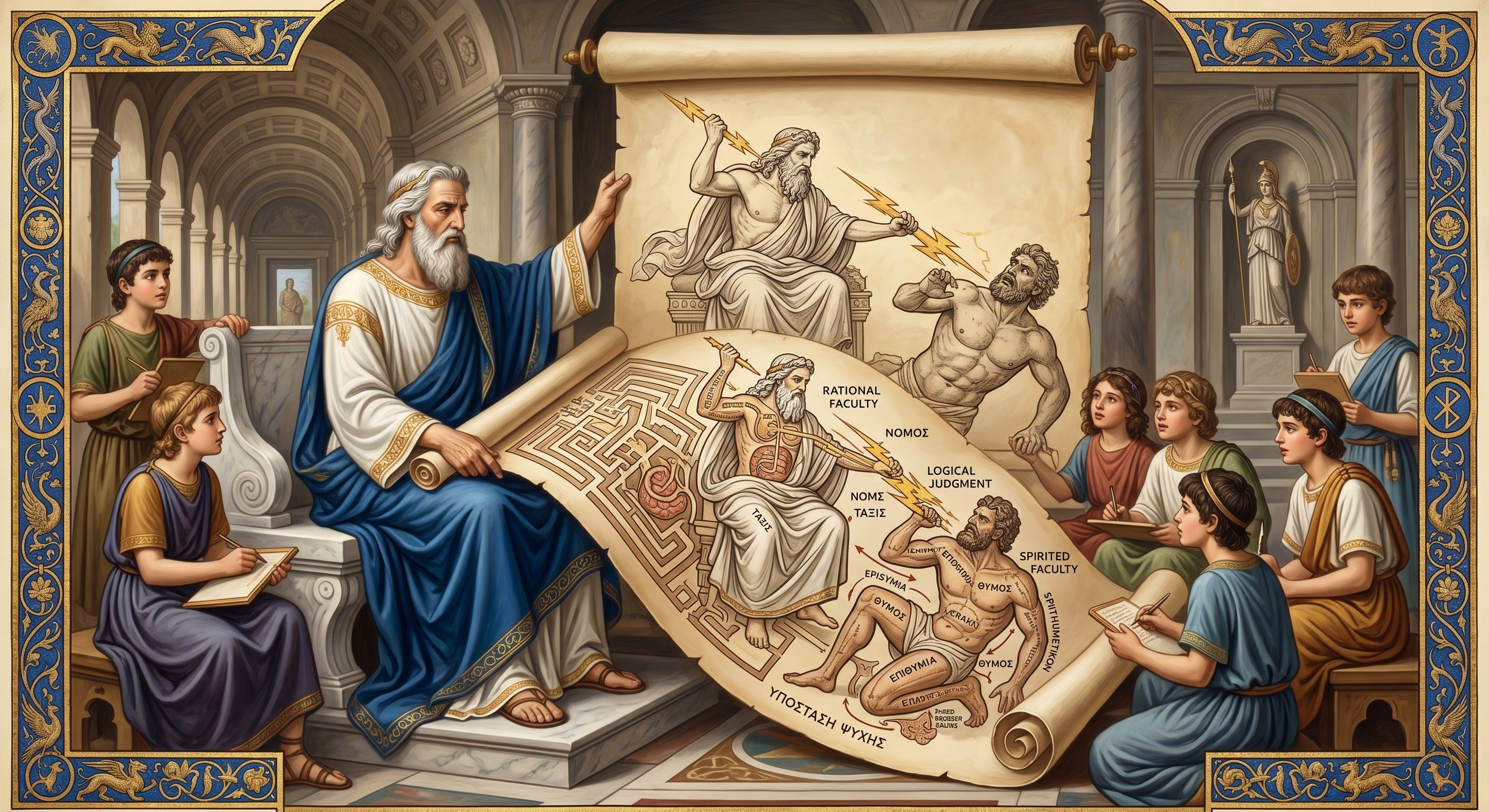
The surface narrative of divine combat is also, upon proper reading, the inner map of the human soul. The philosophical master teaches the student to read both layers at once.
Plutarch on the Philosophical Reading of Divine Myths: De Iside et Osiride 11
Plutarch of Chaeronea, writing in the late first and early second centuries CE, gave the classical Middle-Platonic formulation of the allegorical principle in On Isis and Osiris. His statement is explicit and deserves extended quotation. Having narrated the Egyptian myth of Osiris, Isis, and Typhon-Set in its most scandalous and literal form, Plutarch turns directly to the reader and makes the interpretive move that defines the entire allegorical tradition.
Plutarch, De Iside et Osiride:
"Ἄν οὗν ἀκούης τὰ περὶ τῶν θεῶν μυθολογούμενα, ὅν τρόπον Ἄν αὐτὰ παραδέχη παρὰ τῶν ὁσίως καὶ φιλοσόφως ἐξηγουμένων, καὶ τὰ νομιζόμενα δρῶν τῶν ὁργίων ἀεὶ διαφυλάττης καὶ δρῶν, καὶ νομίζων μήτε θυσίαν μήτε ἔργον Ἄλλο τοῖς θεοῖς προσφιλέστερον ἔσεσθαι τοῦ τὰς ἀληθεῖς δόξας ἔχειν περὶ αὐτῶν, μείζω τῶν τὰς μυθικὰς τιμωριῶν ἀμύνεσθαι τὸ ὄσιον καὶ σεμνὸν τῶν θεῶν."2
"If, then, you listen to the stories about the gods in this way, accepting them from those who interpret the story reverently and philosophically, and if you always perform and observe the established rites of worship, and believe that no sacrifice that you can offer, no deed that you may do, will be more likely to find favour with the gods than your belief in their true nature, you may avoid superstition, which is no less an evil than atheism."
The decisive phrase is "ὁσίως καὶ φιλοσόφως" (reverently and philosophically, hosiōs kai philosophōs). Plutarch establishes that there is a correct and an incorrect way to listen to the myths. The correct way is to receive them from teachers who interpret them reverently (preserving the sacred dignity of the Gods) and philosophically (penetrating to the hidden teaching). The incorrect way is to take the surface literally, which produces either superstition (believing the Gods really committed the scandalous acts) or atheism (concluding that such Gods cannot exist and therefore no Gods exist). Plutarch identifies both errors as equivalent failures to read the myths properly.
Plutarch then proceeds to demonstrate the method. He applies it directly to the Osiris-Set conflict, providing multiple layers of allegorical meaning: cosmological (Osiris as the Nile, Set as the drought), astronomical (Osiris as the moon-light, Set as the earth's shadow), and, most importantly, psychological and metaphysical: Osiris as the principle of rational intelligence (νοῦς, nous), Set as the principle of destructive irrationality, and the drama between them as the cosmic and interior struggle in which Intelligence must pass through dismemberment and be reassembled into a higher unity. We will develop this reading in detail in Part Four below.
Sallustius on Why the Gods Hide the Truth in Myths: On the Gods and the World 3-4
The single most concise philosophical statement of the doctrine of myth as divine pedagogy is found in the fourth-century CE treatise On the Gods and the World by the Neoplatonic philosopher Sallustius (a friend and collaborator of the Emperor Julian). Sallustius's little treatise, probably composed around 361 CE as a compendium of pagan philosophical theology, contains a chapter specifically titled "Concerning Myths: that they are Divine, and why."
Sallustius, On the Gods and the World III:
"That myths are divine can be seen from those who have used them. Myths have been used by inspired poets, by the best of philosophers, by those who established the mysteries, and by the Gods themselves in oracles. But why the myths are divine it is the duty of philosophy to inquire."3
The statement is decisive. Myths are not human inventions. Myths are used "by the Gods themselves in oracles" (ὑπ' αὐτῶν τῶν θεῶν ἐν χρησμοῖς). The Gods, Sallustius is saying, author myths. The mythological language is the language the Gods themselves employ when they communicate with mortals through the oracular shrines. Therefore when we encounter a myth about the Gods, we are not encountering a human product speculating about the divine; we are encountering a divine product speaking into the human mind. The method of the myth is the method the Gods themselves have chosen.
Sallustius then states the reason the Gods chose this method. His formulation is the single most important sentence in the entire allegorical tradition:
Sallustius, On the Gods and the World III:
"Now to wish to teach the whole truth about the Gods to all produces contempt in the foolish, because they cannot understand, and lack of zeal in the good; whereas to conceal the truth by myths prevents the contempt of the foolish, and compels the good to practise philosophy. But why have they put in the myths stories of adultery, robbery, father-binding, and all the other absurdity? Is not that perhaps a thing worthy of admiration, done so that by means of the visible absurdity the soul may immediately feel that the words are veils and believe the truth to be a mystery?"4
Every element of the doctrine we are developing is explicit here. The Gods have constructed the myths deliberately. The apparent absurdities (including the father-bindings, the wars, the adulteries, the scandalous violences) are the veils, placed there intentionally. The function of the veil is twofold: it protects the sacred teaching from those unprepared to receive it (whose contempt would desecrate what they do not understand), and it provokes the prepared soul to philosophical inquiry by making the literal meaning untenable. The visible absurdity functions exactly as a door-keeper functions at the mysteries: it turns away the unworthy and it calls the worthy in.
Sallustius then proceeds to classify the types of myth and the types of interpretation appropriate to each: theological, physical, psychic, material, and mixed. His example of a theological myth is precisely the kind of conflict-narrative this study addresses: "Kronos swallowing his children. Since the God is intellectual, and all intellect returns into itself, this myth expresses in allegory the essence of the God" (On the Gods IV). The apparent horror, a father devouring his offspring, is, on the theological reading, the precise image of intellect's self-return, the cosmic principle by which the divine mind contains and reabsorbs its own productions. The surface horror is the veil. The underlying teaching is a metaphysical truth about the nature of divine intellect. Without the veil, the teaching would be either ignored by the foolish or wrongly understood by the partially educated; with the veil, the teaching is protected and transmitted intact to those willing to do the philosophical labor of unveiling.
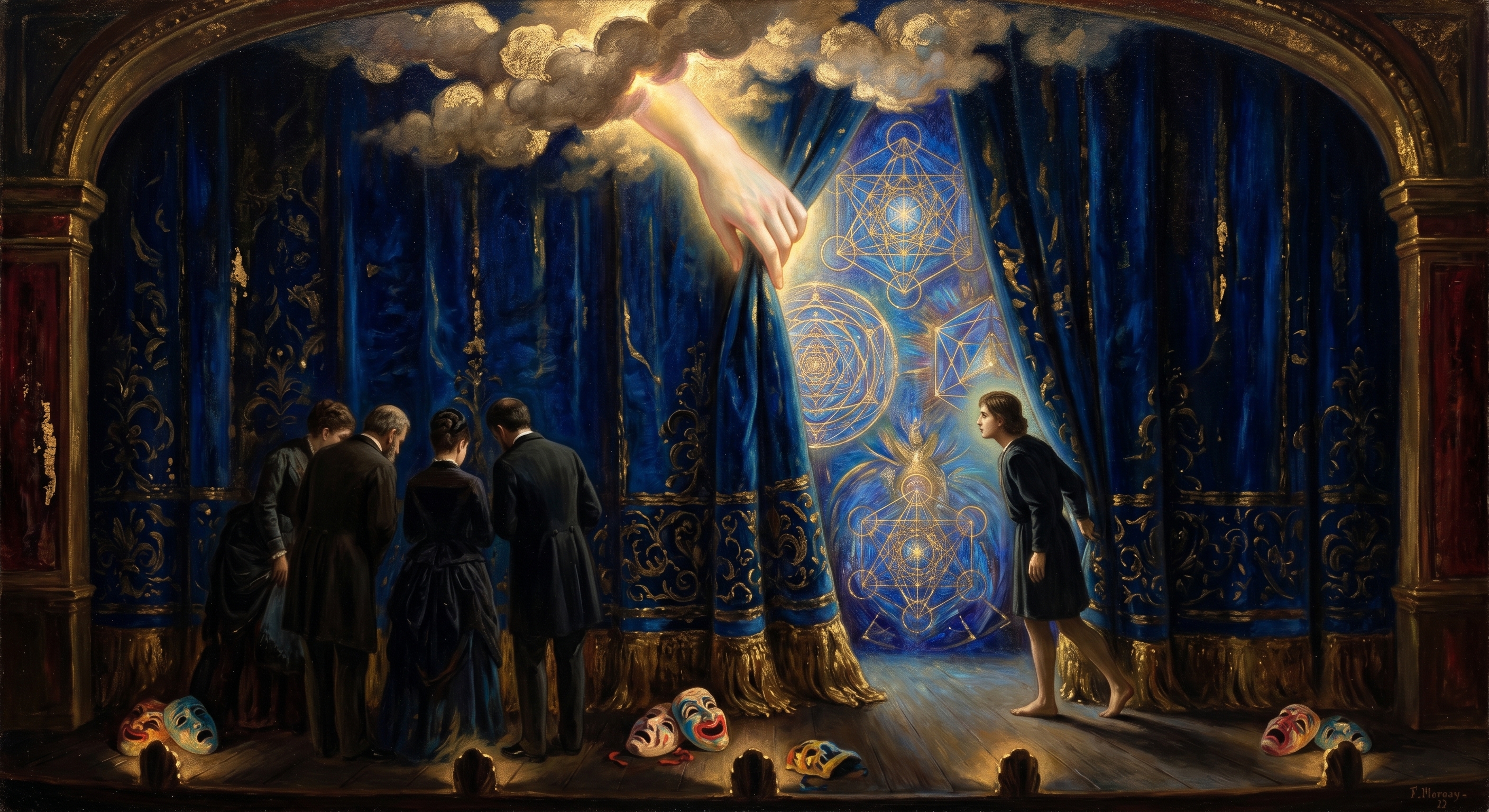
Sallustius: the absurdity of the surface narrative is placed there intentionally, so the soul may immediately feel that the words are veils and believe the truth to be a mystery. The unprepared turn away; the prepared step behind the curtain.
Proclus on the Two Kinds of Myth and Their Pedagogical Function: In Rem Publicam Essay 6
The single most systematic ancient treatment of the doctrine of myth as divine pedagogy is Proclus Diadochus's sixth essay in his Commentary on Plato's Republic. Proclus, the last great head of the Platonic Academy at Athens before its closure by Justinian in 529 CE, wrote the essay specifically to defend Homer against Plato's criticisms in Republic Books 2, 3, and 10. Proclus argues, against a surface reading of Plato, that the deep Plato and the authentic Homer are in agreement: both employ myth as divine pedagogy, and Plato's objections target only the misuse of myth by those who do not interpret it correctly.
Proclus distinguishes two fundamentally different classes of myth. The first class is the ordinary instructional myth, which uses a plain narrative to convey an ethical or philosophical teaching to minds that are not yet ready for direct philosophical discourse. These myths are the common material of popular moral education. The second class is the theological or inspired myth, which employs deliberate paradox, apparent absurdity, and symbolic inversion precisely to signal to the prepared mind that a deeper reality is being encoded.
Proclus, In Platonis Rem Publicam Commentarii:
"Τῶν δὲ μύθων οἱ μὲν ἔνθεοι καὶ παιδευτικοὶ, σαφώς τὰς τοῦ βίου χρειώδεις διδάσκοντες· οἱ δὲ τινάς ἔνθεοι καὶ μυστικοὶ, διὰ τοῦ φαινομένου τὰ πράγματα τῶν θεῶν συμβολικῶς παριστῶντες, τὸ μὲν συγγενὲς τỾ τῶν δεχομένων φύσει συνάπτοντες, τὸ δὲ νοητόν ἀποκρύπτοντες."5
"Some myths are simple and educational, teaching clearly the needs of life; others are mystical and inspired, presenting the realities of the Gods through visible symbols, fitting the expressed story to the nature of the hearers while hiding the intelligible content."
The two-kind distinction is crucial. Ordinary educational myth works by being transparent; mystical or inspired myth works by being deliberately opaque. Both kinds are pedagogical, but they address different audiences and different depths of teaching. The myths of divine conflict (Prometheus against Zeus, Set against Osiris, Shiva and Vishnu) belong unambiguously to the second class. Their surface is shocking, scandalous, absurd, precisely so that the prepared mind will not be satisfied with the surface and will press through to the hidden teaching. The surface is the mask that the inspired myth wears, and the mask is shaped exactly to provoke the right question in the right student.
Proclus:
"Βασιλικώς ὁ ὂμηρικὸς μῦθος πρόκειται τλσ σαφώς διδάσκοντος· οἱ γὰρ Ἀῳδωδοτικοὶ καὶ ὁ Ụμηρος αὐτὸς παδευτικὸς μυθοποιὸς ἴστε. Ἀλλ' ἔτεροι τοῦτο δι' εὕφημίαν ὑπολαμβάνουσι, ἔτεροι δὲ τοὶς συμβολικοῖς προσήκοντα τοῖς τῶν μυστηρίων τέλεσιν καδ' σιμάσιν τὰ τῶν θεῶν καὶ τὰ τῶν ἀνθρώπων τὰ δυνατά τε καὶ τέλεια."6
"The Homeric myth too is, in fact, to be considered as an educational myth; for Hesiod and Homer are themselves pedagogic mythmakers. But some take this in a surface way, while others, attending to the symbols, consider the way these myths reveal by analogy both the powers of the Gods and the capacities and perfections of human beings."
This is the doctrine we will now apply to three specific cases of divine conflict. In each case, we will show that the apparent war among the Gods is in fact a σύμβολον, a symbol, that reveals through analogy both the powers of the Gods and the structure of the human soul. The conflict is teaching, performed by divine teachers in the theatre of cosmic narrative. The reconciliation that ends each cycle is the completion of the lesson. To read the cycles as literal disputes is to stop at the mask. To read them allegorically is to receive the instruction the Gods were giving all along.
Porphyry on the Philosophical Homer: On the Cave of the Nymphs
Before we proceed, one more foundational text deserves mention. Porphyry of Tyre (c. 234-305 CE), student of Plotinus and the most influential Neoplatonic exegete of the generations immediately preceding Proclus, wrote a famous essay, On the Cave of the Nymphs in the Odyssey, devoted entirely to decoding a single passage of thirteen lines (Odyssey 13.102-112). Porphyry argues, with extraordinary philological precision, that every element of Homer's description of the cave on Ithaca encodes a specific metaphysical doctrine: the cave represents the sensible cosmos, the two entrances represent the gates of generation and return, the nymphs represent the souls embodied in matter, the olive-tree represents the providence of Athena, and so on, point by point.
Porphyry, De Antro Nympharum:
"Μιμητικώς ὁ ὁμήρικος τὰ τὸν ὄντων κόσμον παράγει διὰ τῶν συμβόλων, σιμνώς οὐδὲν ποιῶν συντυχάνως, ἀλλὰ τί διδακτικου ιΌ τόνω χρώμενος."7
"Imitatively Homer displays the true cosmos of reality through symbols, making nothing up without purpose but everywhere employing the pedagogical tone."
Porphyry's essay is the demonstration by example of what Plutarch, Sallustius, and Proclus state as doctrine. The Homeric text is, on Porphyry's reading, a perfectly engineered pedagogical instrument, in which every image, every object, every proper name, encodes a specific metaphysical or cosmological teaching, and the whole can be decoded if one possesses the right interpretive keys. The myth is not a decorated surface concealing a simple moral lesson; it is a structured code whose every element carries information.
We now have our foundation. Plato, Plutarch, Sallustius, Proclus, and Porphyry, spanning approximately eight hundred years of Greek philosophical reflection from the fourth century BCE to the fifth century CE, transmit a unified doctrine: the myths of the Gods are a language the Gods themselves employ, whose purpose is pedagogical, whose method is symbolic, and whose reception requires philosophical decoding. The apparent conflicts, wars, crimes, scandals, and reconciliations within the mythic narratives are the precise signals by which the myths convey their hidden teachings. We now apply this foundation to three specific cases.
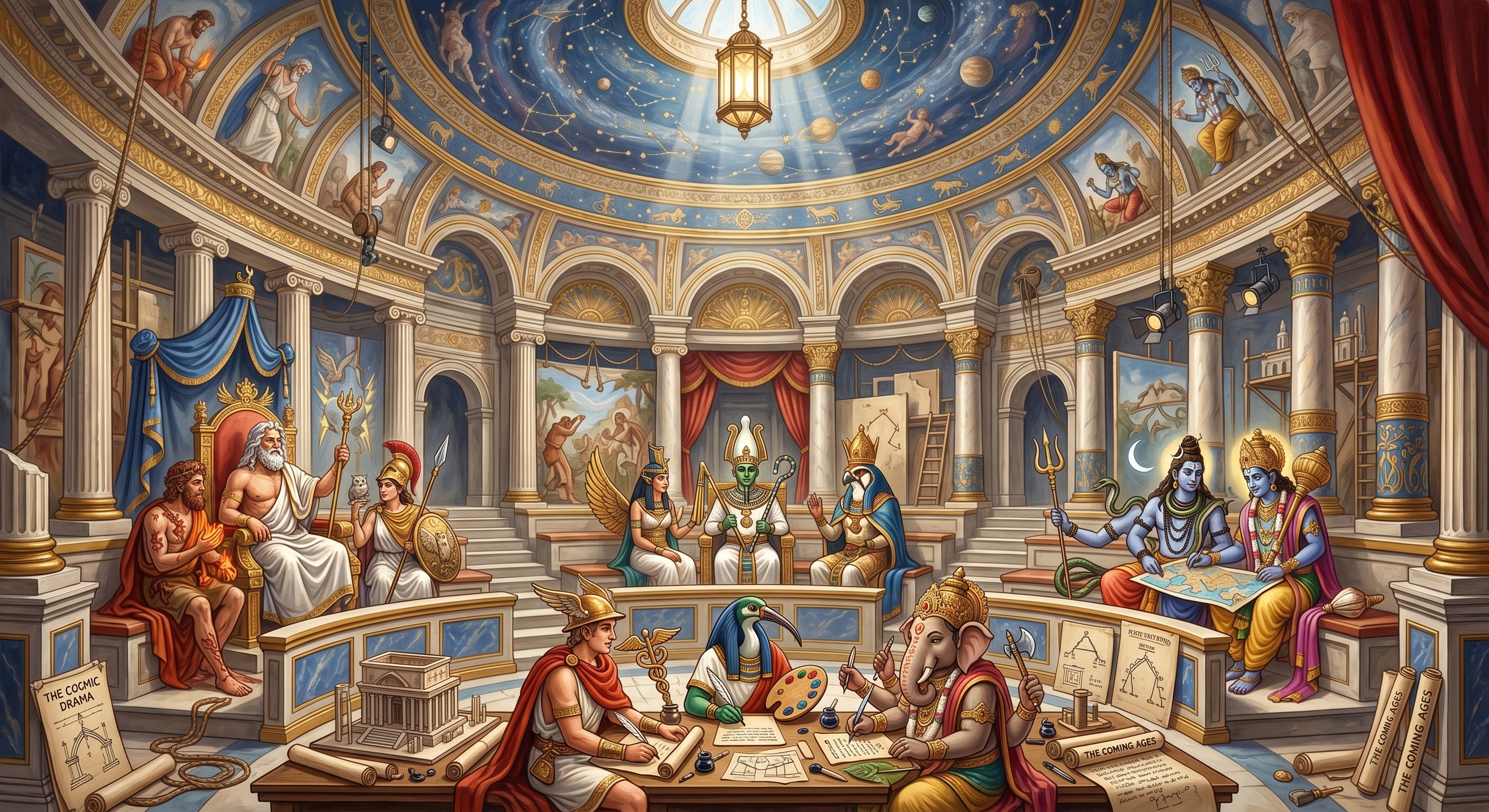
The Gods of all ancient traditions, imagined as one divine pedagogical council, designing the sacred theatre that will instruct humanity across the millennia. Each tradition will stage the same essential lessons in its own cultural idiom.
Part Two: First Case Study: Prometheus and Zeus in the Aeschylean Prometheia
The Trilogy and Its Narrative
The Greek example of the divine conflict-and-reconciliation pattern is preserved in Aeschylus's Prometheia, a trilogy of tragedies of which only the first play, Prometheus Bound (Προμηθεὺς Δεσμώτης, Promētheus Desmōtēs), survives intact. The second play, Prometheus Unbound (Προμηθεὺς Λυόμενος, Promētheus Lyomenos), survives in eleven substantial fragments preserved as quotations in later authors, among them a lengthy translation into Latin by Cicero. The third play, Prometheus the Fire-Bringer (Προμηθεὺς Πυρφόρος, Promētheus Pyrphoros), survives only in title and testimonia. Modern reconstructions, grounded in the preserved fragments and in the prophetic statements made by Prometheus himself within Prometheus Bound, permit a confident outline of the trilogy's overall structure and theological arc.
The trilogy begins, in Prometheus Bound, with the Titan Prometheus being chained to a rock in the Caucasus by order of Zeus, punished for the theft of divine fire and its transmission to humanity. Prometheus has given humanity the means of civilization, the capacity for technical intelligence, the foresight that raises human life above animal passivity. Zeus, newly established as sovereign after the Titanomachy, has forbidden this transmission, and Prometheus's defiance threatens the new cosmic order. The punishment is horrific: Prometheus is bound, and each day an eagle devours his perpetually regenerating liver.
Aeschylus, Prometheus Bound:
"I caused mortals to cease from foreseeing their own death. I planted in them blind hopes. And besides this, I gave them fire."8
The gifts Prometheus gives humanity are three, and each is profoundly theologically loaded. He takes away the foreknowledge of death (which would paralyze human action into despair), plants "blind hopes" (τυφλὰς ἐλπίδας, the generative capacity to act toward a future not yet seen), and gives fire (the technical capacity to transform nature). These three gifts together constitute the full structural basis of civilized human life: motivation, imagination, and technology. Without Prometheus, the ancient Greeks believed, humanity would be mute, static, and doomed; with Prometheus, humanity becomes a rival to the Gods themselves in creative power.
Prometheus refuses to submit to Zeus's sovereignty. He prophesies that Zeus himself will one day need Prometheus's knowledge to avoid being overthrown. He withholds the secret of which marriage Zeus must avoid. The first play ends with Prometheus defiant, still chained, awaiting the eagle, crying out against the injustice of Zeus.
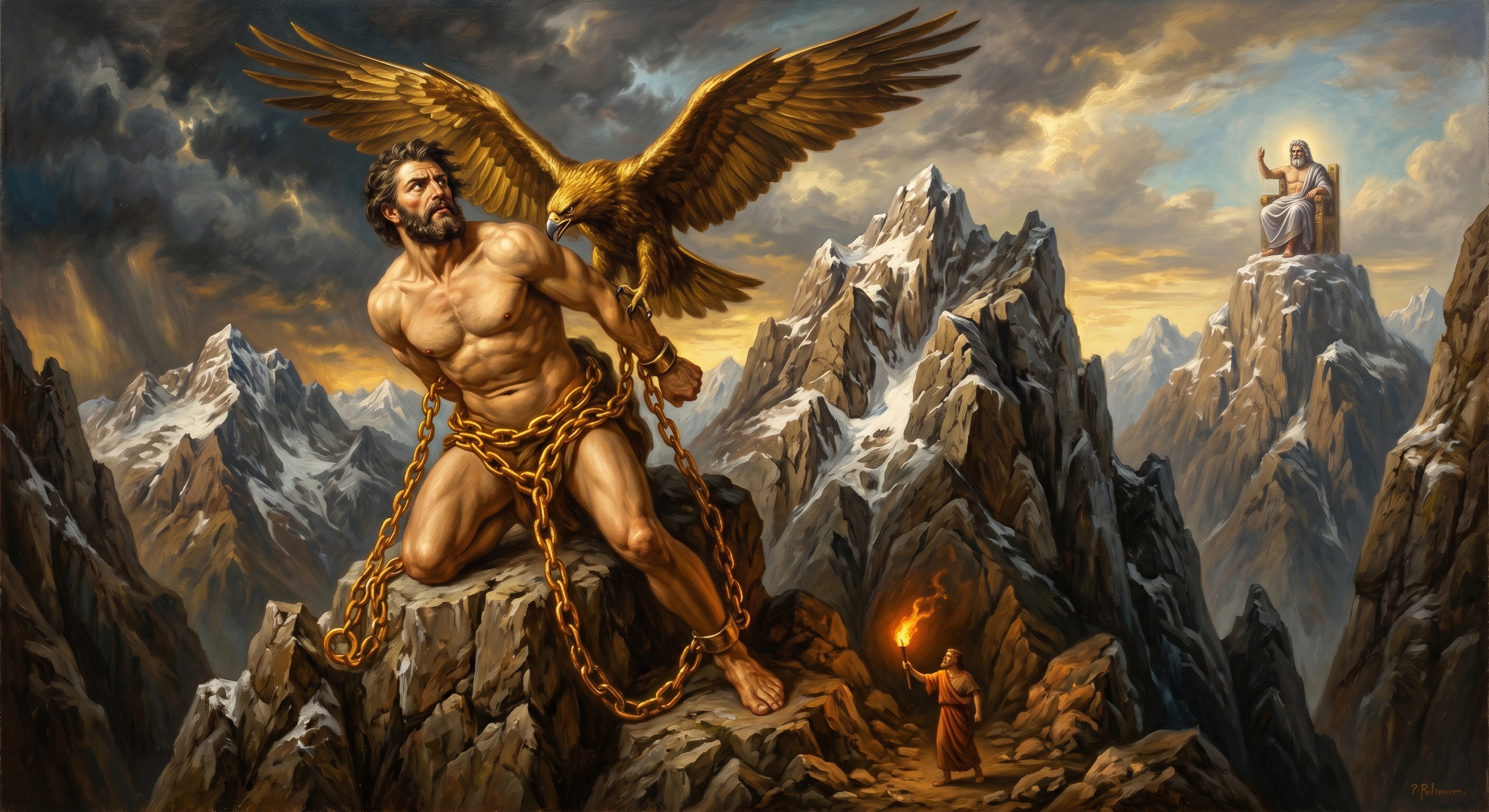
The visible tragedy at the Caucasus conceals the divine transaction: Zeus permits humanity to retain Prometheus's gifts at the price of the Titan's temporary binding, which will prepare the reconciliation and the everlasting human patrimony.
The Reconciliation in Prometheus Unbound
The second play of the trilogy turns the entire narrative. Heracles, son of Zeus, travels through the Caucasus on his labors. He encounters Prometheus bound, and, with his father's implicit consent, shoots the eagle and breaks Prometheus's chains. The Titan is freed. Prometheus, in gratitude, reveals to Heracles (and through him to Zeus) the prophecy he had withheld: that Zeus must not marry Thetis, the sea-nymph, because Thetis is fated to bear a son greater than his father. Zeus, warned, gives Thetis to the mortal Peleus instead, from which union Achilles will be born. The cosmic succession-crisis is averted. Zeus's sovereignty is preserved.
Aeschylus, Prometheus Unbound:
"So my bitterest foe has sired for me this dearest of kinsmen!"9
The line is extraordinary. Prometheus recognizes, in the son of his enemy, his dearest friend. The son of Zeus becomes the instrument by which Zeus himself, working through Heracles, releases the Titan that Zeus himself had bound. The two halves of the cosmic order, the sovereign power of Zeus and the rebellious foresight of Prometheus, are beginning to recognize their necessary complementarity. The second play ends with Prometheus freed, the prophecy revealed, the marriage-crisis averted. The third play completes the reconciliation: Prometheus wears a flower-garland as voluntary token of his former bondage, transforming the punishment into a ritual commemoration. The annual Athenian festival of the Promethea, at which the participants wore garlands and ran the sacred torch-race from the Academy to the Acropolis, institutionalized this commemoration for a thousand years.
Athenaeus, Deipnosophistae:
"Πέπρακται δή τὸ στέφανον τοῦ Προμηθέως, τῘς δεσμῶν των ἀρχαίων ἀντί μνήμη."10
"The garland of Prometheus is brought forward as a memorial of his ancient bonds."
Note what the trilogy accomplishes dramatically. Zeus and Prometheus are not simply enemies who are eventually defeated or forgiven. They pass through a cosmic pedagogy together. Zeus must learn the limits of pure sovereign force, must develop the capacity for mercy, must integrate foresight into his power. Prometheus must learn the limits of pure intellectual defiance, must recognize that his foresight has value only within a stable cosmic order, must submit his wisdom to the legitimate sovereignty of Zeus. The two Gods emerge from the conflict each transformed, neither the same as he was before the binding. The cosmic order that results, Zeus-with-Prometheus, power-integrated-with-foresight, is more complete than the cosmic order that had existed before the conflict.
And humanity, the silent beneficiary of the entire drama, keeps the fire. This is the pedagogical punchline. The conflict between Zeus and Prometheus was never ultimately aimed at the removal of the gift from humanity. It was aimed at the legitimation of the gift. After Prometheus's binding, his torments, and his eventual reconciliation, the fire that humanity possesses is no longer a stolen contraband that Zeus might reclaim at any moment. It is a ratified patrimony, agreed upon between the two sovereign cosmic powers, handed to humanity with the full blessing of the divine order. The dramatic conflict was the ritual by which the transmission was validated.
The Allegorical Reading: The Interior Alchemy of Prometheus and Zeus
Let us now apply the method of Plutarch, Sallustius, and Proclus. The Prometheia trilogy, read allegorically, encodes a precise teaching about the structure of the human soul and the operation of spiritual alchemy. Zeus, in this reading, represents the sovereign rational principle within the soul, the governing intelligence that maintains order. Prometheus, whose name literally means "Forethought" (Προμηθεύς, Promētheus, from πρό "before" and μητίς "thought"), represents the anticipatory, inventive, technological intelligence, the faculty that imagines what has not yet been and constructs the means to bring it about.
In any well-ordered soul, both principles must be present, and both must function. Pure sovereign intelligence without anticipatory creativity becomes rigid, conservative, and unable to respond to novel situations. Pure anticipatory creativity without sovereign intelligence becomes rebellious, ungoverned, and self-destructive in its refusal of limits. The soul that has only Zeus and no Prometheus is a tyrant who cannot innovate. The soul that has only Prometheus and no Zeus is a revolutionary who cannot build. The well-ordered soul integrates both, but the integration is not trivial to achieve.
The Prometheia trilogy narrates exactly how the integration occurs. The young soul first experiences Zeus and Prometheus as adversaries: the rebellious creativity defies the sovereign order, and the sovereign order punishes the rebellion. This is the normal condition of adolescent and early adult psychology, the period during which innovation and authority seem irreconcilable. The soul is at the stage of Prometheus Bound: the creative faculty is chained and tormented, apparently for its offense, and the sovereign appears as an enemy.
But the drama does not end there. Heracles, the son of Zeus and of a mortal woman, representing the mature integrated soul that unites divine sovereignty with human labor, arrives at the place of binding and releases Prometheus. This is the alchemical reconciliation. The mature soul recognizes that its creative faculty and its sovereign faculty are not enemies but complementary powers that had to pass through apparent conflict in order to arrive at their proper relation. Prometheus tells Zeus the prophecy he had withheld; the cosmic succession is secured; the integration is complete. The soul, at the end of the process, possesses both innovation and order, both foresight and sovereignty, and the creative faculty wears a garland (the voluntary commemoration of its former bondage) as the sign that it has integrated the lesson of discipline.
This is the interior teaching of the trilogy. Every human being who seeks integration must pass through a Prometheus-phase (creative rebellion punished by established authority) and must find, through the work of the mature self (Heracles), the reconciliation in which the formerly conflicting faculties recognize one another as partners. The Gods stage this drama on the cosmic scale so that each human student can recognize, in his or her own inner process, the pattern the Gods have performed. The myth is a diagnostic mirror. The student watching the drama sees not only Zeus and Prometheus but his own inner Zeus and inner Prometheus, and learns, by watching, how the integration is to be performed.
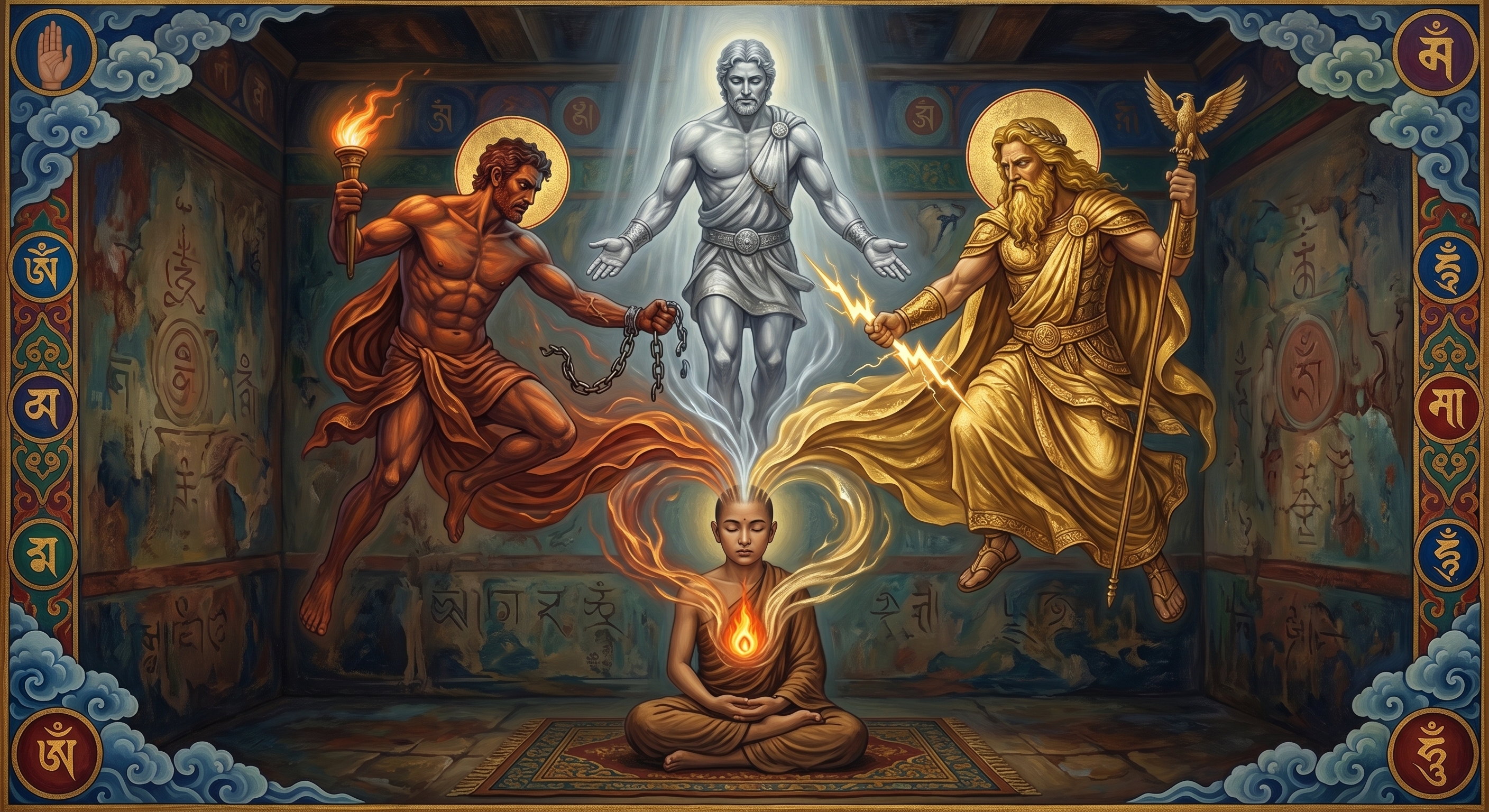
The Prometheus-Zeus drama as inner alchemy: the creative faculty and the sovereign faculty, initially in conflict, reconciled through the mature integrating self. What the myth performs on the cosmic stage, the disciplined soul performs within.
Part Three: Second Case Study: Osiris and Set in the Egyptian Mysteries
The Myth in Plutarch's Transmission
The Egyptian example of divine conflict-and-reconciliation is preserved for us principally through Plutarch's De Iside et Osiride, composed in the early second century CE, which transmits the Egyptian sacred narrative in a form shaped by Plutarch's own Middle-Platonic interpretive framework but with significant fidelity to the underlying Egyptian material (a fidelity confirmed in the twentieth century by the cross-checking work of Egyptologists such as J. Gwyn Griffiths, whose 1970 edition remains the standard scholarly treatment). The narrative as Plutarch tells it is this.
In the primordial generations, five Gods were born in succession on the five epagomenal days at the year's end: Osiris, Arueris (the elder Horus), Set (whom Plutarch calls Typhon), Isis, and Nephthys. Osiris became king of Egypt and civilized its people, introducing agriculture, law, and worship of the Gods. His brother Set, whom Plutarch describes as the embodiment of all that is hostile to order, conspired with seventy-two accomplices and a foreign queen (Aso of Ethiopia) to murder him. Set measured Osiris's body secretly, built a beautiful chest to its exact dimensions, and, at a banquet, offered the chest as a gift to whichever guest fit inside it perfectly. When Osiris lay down, the conspirators sealed the chest, sealed it with lead, and cast it into the Nile.
Isis, devoted sister-wife of Osiris, recovered the chest at Byblos. Set found it again, dismembered the body into fourteen pieces, and scattered them across Egypt. Isis, with her sister Nephthys, searched for each piece and reassembled the body. From the reassembled Osiris, using her magic, Isis conceived the child Horus. Osiris descended to become king of the Duat (the afterlife), and Horus, when grown, challenged Set for the throne of the living world. After a long contest (the Contendings of Horus and Seth), Horus was declared the rightful king. But Set was not annihilated. In the mature Egyptian tradition, Set was restored to a cosmic function: he stood at the prow of Ra's solar barque, night after night, spearing the chaos-serpent Apophis so that the sun might rise.
Plutarch, De Iside et Osiride:
"But these things and others like them one must take to be the symbols of a mystic myth and a sacred presentation: as for the body of Osiris and its dismemberment, understand this as referring to the sensible cosmos, which is broken up and scattered by the force of the Titan-like, and then reassembled through the providence of Isis and the protection afforded by Logos and Reason, which repels the destruction."11
The Philosophical Reading: Osiris as Intelligence, Set as the Destructive Principle
Plutarch's reading, which he states explicitly in chapters 49-54 of the De Iside, is that the entire Osiris-Set narrative is a mystic allegory of the metaphysical and psychological structure of reality. The key passage is this:
Plutarch, De Iside et Osiride:
"The creation and constitution of this world is complex, resulting from opposing influences, not of equal strength, but with the predominance on the side of the better. Yet it is impossible for the bad to be completely eradicated, since it is innate, in large amount, in the body and likewise in the soul of the universe, and is always fighting a hard fight against the better. So in the soul Intelligence and reason, the Ruler and Lord of all that is good, is Osiris; and in earth and wind and water and the heavens and stars that which is ordered, established, and healthy, as evidenced by seasons, temperatures, and cycles of revolution, is the efflux of Osiris and his reflected image."12
Plutarch's identification is explicit and decisive. Osiris is νοῦς, Intelligence, the rational-ordering principle of soul and cosmos. Set (Typhon) is its structural opposite, the principle of disorder, violence, and dissolution. The two are not equal; Osiris is ultimately sovereign. But Set cannot be eradicated, because the cosmic condition requires the ongoing tension between order-principle and disorder-principle in order for articulated reality to exist at all. A cosmos without Set would be undifferentiated bliss, without event, without drama, without the generative resistance that allows form to emerge. A cosmos without Osiris would be pure chaos, without form, without intelligibility. The tension between them is constitutive of the world.
The murder of Osiris, his dismemberment into fourteen pieces, the reassembly by Isis, the posthumous conception of Horus, the eventual vindication of Horus against Set: this entire narrative, Plutarch argues, is the allegorical representation of the cosmic drama by which Intelligence suffers the ongoing assault of its opposite, is apparently dismembered (scattered into the multiplicity of sensible forms), is reassembled by the providence of divine love (Isis, the principle of sacred attention and reintegration), and gives birth, through that reassembly, to the new cosmic sovereign (Horus, the articulated kingdom) who will defeat the disorder-principle in the visible world while the intelligence-principle continues, as king of the Duat, to govern the invisible.
The Interior Alchemical Reading: Dark Aspect and Bright Aspect
The deeper esoteric reading, preserved in the Hermetic tradition and developed by the Neoplatonic commentators, identifies Osiris and Set as the two aspects of the human soul, the bright aspect (illuminated intelligence, the divine spark, the higher self) and the dark aspect (the unconscious, the appetitive forces, the unintegrated shadow). The apparent war between them is the unavoidable conflict that every developing soul experiences: the bright aspect, illuminated and ordered, seems to be attacked, dismembered, and scattered by the dark aspect that rises up from the unconscious to disrupt every attempt at conscious integration.
But the myth teaches, crucially, that the dark aspect is not to be annihilated. The mature Egyptian theology restored Set to the prow of the solar barque. What had been the enemy became the defender. The integrated soul does not eliminate its dark aspect; it recognizes the dark aspect as the very energy that, properly directed, becomes the soul's capacity to defend itself against genuine dissolution (the serpent Apophis, which represents the ultimate chaos that would dissolve all distinction whatsoever). Set, when he was working against Osiris, was a murderer. Set, when he was restored to cooperation with Ra, became the spear-wielder that kept the sun rising. The same energy, the same God, functioning in two opposite roles, depending on whether the integration had occurred.
Plutarch, De Iside et Osiride:
"Ộτι τν τοῦ Τυφῶνος δύναμιν τλς κατὰ φύσιν ἀρπακτικν¢ καὶ διαλυτικὴν, οỽα ἔχουσα τὸ στισικόν καὶ τὸ ἀντικείμενον καὶ τὸ μαχόμενον τῂ ξί εἀφσ τῴ συνέχομένη τπν ὅλων."13
"The power of Typhon [Set], being rapacious and destructive, holds within the cosmos that which is oppositional, that which resists, that which contends against the unifying harmony of the whole."
The alchemical implication is that the spiritual work is not the destruction of the dark aspect but its transformation. The myth stages this transformation in the narrative of Set's rehabilitation: he who was the murderer becomes the defender. What had been directed against Osiris becomes directed against Apophis. The same force, reoriented. The mature soul, in the interior work, performs exactly this reorientation. The dark aspect, which initially attacks the nascent bright aspect (as Set attacked Osiris), is, through sustained inner labor, redirected to become the defender of the greater cosmic order. The student learns that the dark is not to be denied, suppressed, or exterminated; it is to be recognized, honored, integrated, and put to sacred use.
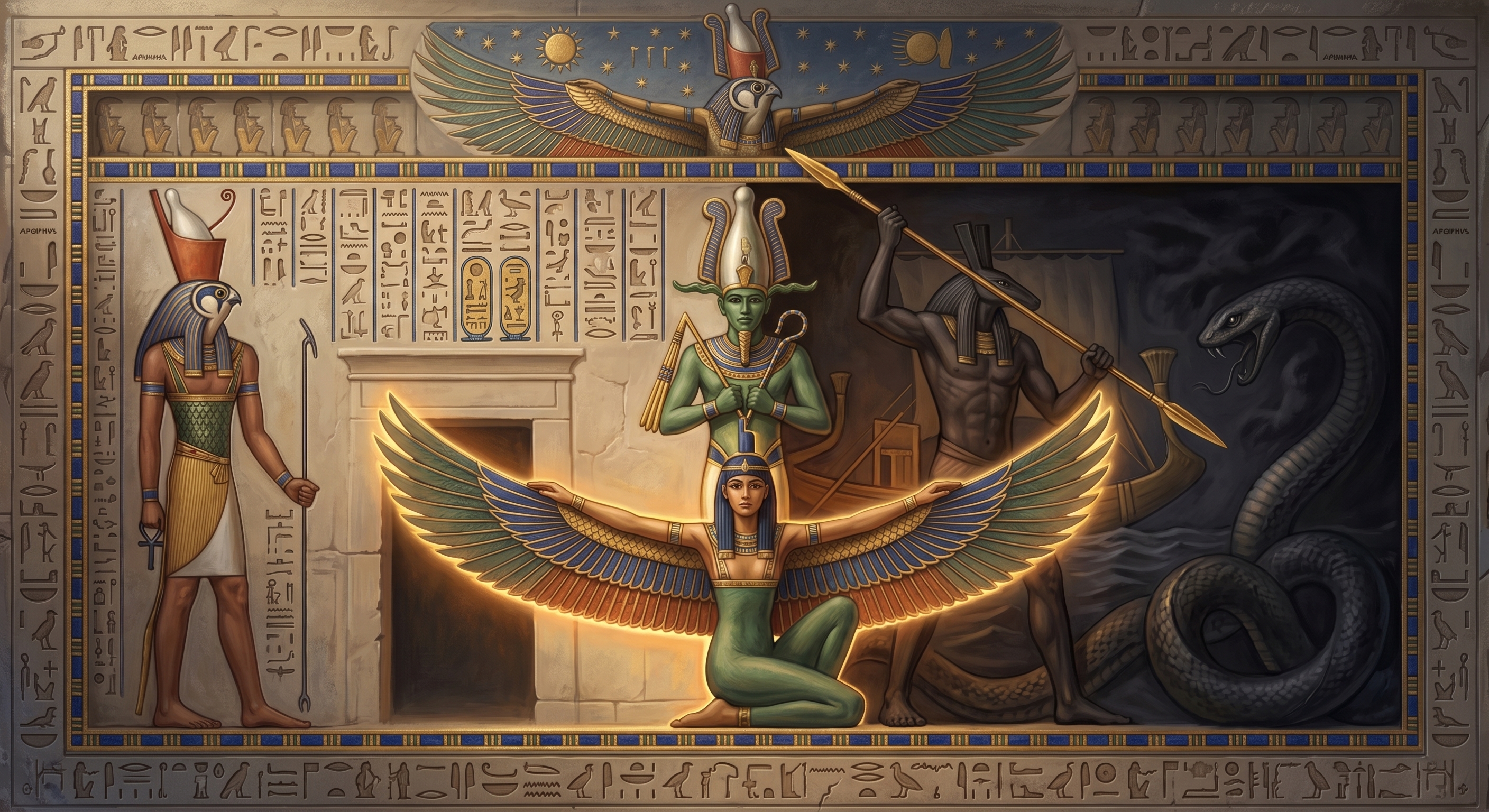
The full arc of the Egyptian drama: what appeared as fratricidal war reveals itself as cosmic alchemy. The bright aspect passes through dismemberment and is reintegrated; the dark aspect passes through defeat and is restored to sacred function; the unified sovereignty emerges in Horus. The entire process, staged by the Gods, is the pattern every soul must recognize and enact within.
Part Four: Third Case Study: Shiva and Vishnu in the Puranic Tradition
The Apparent Conflict and Its Resolution in the Harihara Tradition
The Indian example of the pattern is preserved most systematically in the Puranic literature composed from approximately the fourth through twelfth centuries CE. Two supreme deities of the mature Hindu pantheon, Vishnu (विष्णु, the Preserver, associated with cosmic maintenance and avatar-descent) and Shiva (शिव, the Destroyer-Transformer, associated with dissolution and ascetic power), are depicted in various Puranic narratives as engaged in dramatic cosmic confrontations. The Shiva Purana, the Vishnu Purana, and the Liṅga Purāṇa each contain episodes in which the two Gods appear to contest supremacy, challenge one another's authority, or stand in apparent theological opposition.
The most famous of these episodes is the Liṅgodbhava, preserved in the Liṅga Purāṇa and the Shiva Purana. Brahma and Vishnu dispute which of them is supreme. A vast pillar of light, the infinite cosmic liṅga, suddenly appears between them. Neither can find its top or its bottom: Vishnu assumes the form of a boar and burrows downward for a thousand years without reaching its base; Brahma assumes the form of a swan and flies upward for a thousand years without reaching its summit. The pillar then reveals itself as Shiva, who emerges to teach both contending Gods that the supreme principle transcends their dispute. The episode teaches by dramatic demonstration that apparent theological rivalries between divinities are resolved at a higher ontological level where the rivalry dissolves.
औँ नमः शिवाय च विष्णवे च ब्रह्मणे च स्वरूपिणे ।
एकरूपठ् बहुरूपैष्च त्रायी देवस्त्रिमूर्तये नमः ।।14"Oṃ namaḥ śivāya ca viṣṇave ca brahmaṇe ca svarūpiṇe / ekarūpaṃ bahurūpaiśca trāyī devastrimūrtaye namaḥ"
"Om, salutations to Shiva and to Vishnu and to Brahma, who are of one essential form: the One Form in the Many Forms, to the Triune God of three aspects, salutations."
The most theologically profound resolution of the Shiva-Vishnu relationship is achieved in the figure of Harihara (हरिहर), the composite deity whose body is half Vishnu (Hari, "the one who carries away") and half Shiva (Hara, "the one who takes"). Harihara is depicted in countless temple sculptures from the Gupta period onward, most famously at the rock temples of Mahabalipuram (seventh century CE) and Badami (sixth century CE), and in the iconographic treatises of the medieval Shilpa Shastras. The deity has one side rendered in Vishnu's iconography (the conch, the discus, the blue coloration, the crown) and the other in Shiva's (the matted hair, the crescent moon, the trident, the ash-smeared coloration). The two halves stand in unity rather than conflict: they are one body.
हरिहरमीस्वराओ मुनिनामीश देवाऩ्च सर्वान नमस्करोमि सदा ।15
"harihareamīśvarāu munināmīśa devāṇ sarvān namask aromi sadā"
"I ever salute Harihara, the Lord of the sages, and all the Gods of the Lord."
The Puranic tradition teaches, through Harihara, that the apparent theological conflict between the Vaishnava and Shaiva sects, between the preserver and the destroyer, between the engaging and the ascetic principles, is a pedagogical stage. The young devotee begins by worshipping one or the other as supreme. The advanced devotee recognizes that both are aspects of a single divine reality, and that the apparent conflict was the means by which each aspect was articulated clearly so that their underlying unity could be recognized at the higher stage of practice.
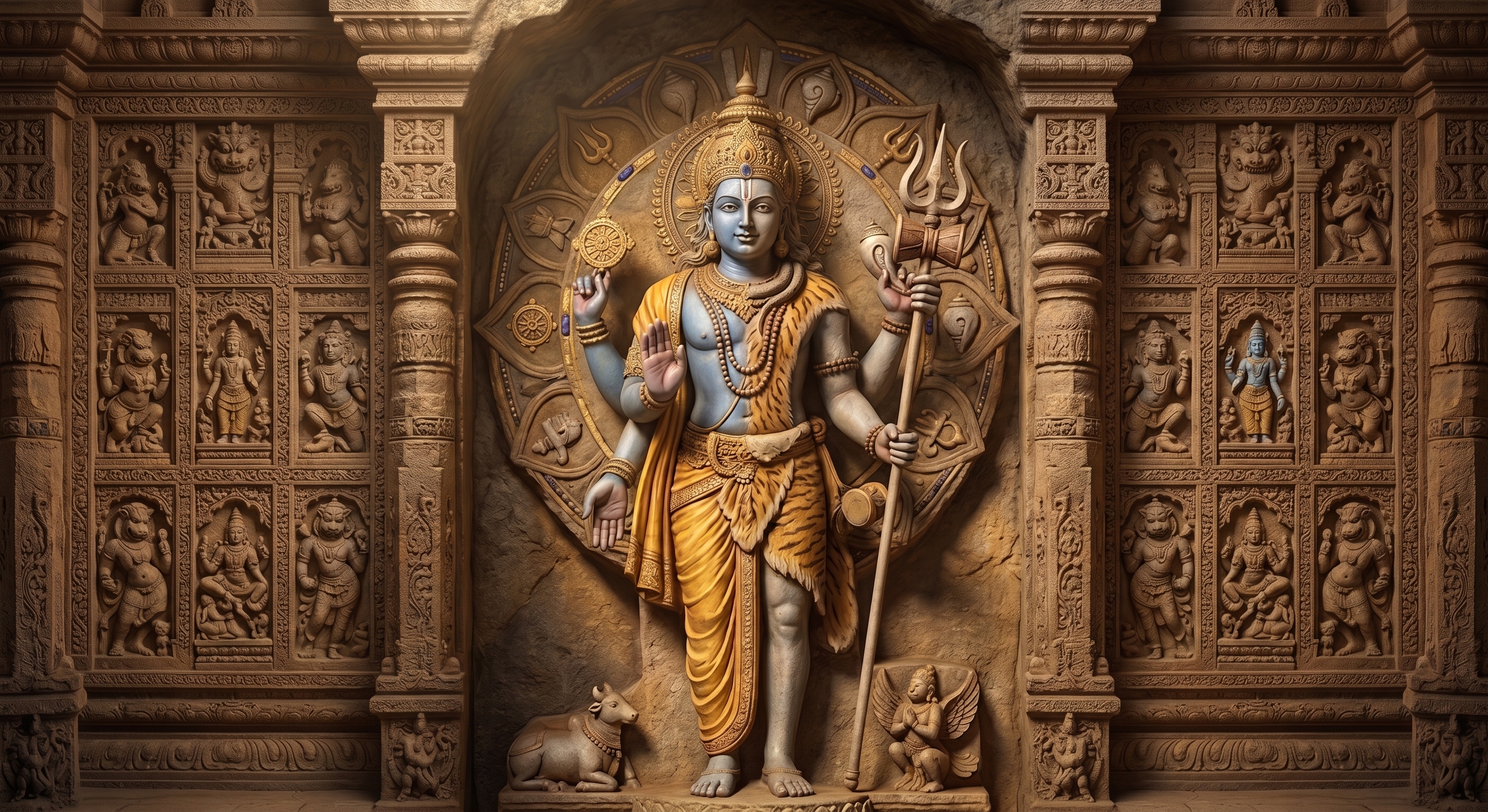
The Puranic resolution: what appeared as theological rivalry between Shiva and Vishnu, destroyer and preserver, resolves at the higher ontological level as a single divine reality articulated in two aspects. The conflict was the pedagogical stage; the unity is the revealed teaching.
The Doctrine of Līlā: The Divine Play
The Indian tradition provides, more explicitly than any other ancient source, the theological term for precisely what we are describing. The Sanskrit word līlā (लीला), commonly translated "play" or "sport," designates the divine activity considered not as labor but as gratuitous creative performance. The Gods act, in the Puranic understanding, not because they must but because they choose to, and their acts are staged as cosmic drama whose purpose is the revelation of divine reality to finite beings.
Brahma Sūtra:
लोकवत्तु लीलाकैवल्यमिति लोकवतथ्सुत् स्कर्तरसप्रपद्यते ।16
"lokavat tu līlākaivalyam iti lokavat sutah skārtarasapprapadyate"
"[Brahman's cosmic activity is] like the play of a [loving child]: free, self-sufficient, done purely for the joy of it."
The līlā doctrine states, with philosophical precision, what Sallustius stated at the Greek end of the ancient world: the divine acts are performances, and their performativity is the essential feature of their pedagogical function. What the Gods do is drama. The drama is for the benefit of the witnessing consciousness. The witnessing consciousness is invited to see, through the drama, the underlying reality that the drama articulates. The apparent conflicts, the wars, the reconciliations, are līlā: they are divine play, staged for the education of the beings who behold them.
"Γι Συμβάλλομενον, τοῦτο ττς δι' ἀλεθείας καὶ ττς τοῦ παιδεύεσθαι ἔνεκα τυμπημήναι; γινώσκεται ὅτι ττς μητέτερον ἠ συμβολικῶς παράγων."17
"What is being symbolized, this is what is being imaged forth for the sake of truth and of education. It is being known that nothing greater than symbolic presentation exists."
The Hindu tradition names the divine activity līlā; the Neoplatonic tradition calls it συμβολικές παραστάσεις, symbolic presentations; the Egyptian priesthood performed it through the ritual dramas reenacted at Abydos and Edfu year by year. Three different vocabularies for what is in essence the same doctrine: the Gods stage drama, the drama is pedagogy, the students are those with eyes to see and ears to hear.
Part Five: The Pattern Across the Three Traditions
Let us now draw together the structural features common to the three case studies we have examined. In each tradition, the pattern of divine conflict-and-reconciliation follows the same essential sequence.
First, two divine powers are introduced as distinct principles. In the Greek case: Zeus the sovereign, Prometheus the foresighted-inventive. In the Egyptian case: Osiris the ordering-intelligence, Set the disorderly-destructive. In the Indian case: Vishnu the preserver, Shiva the destroyer-transformer. The two principles are presented as distinguishable and each as necessary to the full functioning of cosmic reality.
Second, an apparent conflict erupts between them. Prometheus steals fire against Zeus's prohibition; Set murders Osiris; Vishnu and Brahma dispute supremacy and Shiva's pillar appears. The conflict is dramatic, visible, and scandalous. It generates the narrative momentum that gives the myth its mnemonic power.
Third, the conflict proceeds through suffering, dismemberment, or apparent defeat. Prometheus is chained and tormented; Osiris is murdered and dismembered; Vishnu and Brahma cannot find the pillar's extremities and must admit their limitation. The suffering phase of the drama is essential. It is the phase during which the student, watching, experiences the reality that conflicts of this kind produce genuine suffering and require more than conceptual resolution.
Fourth, an integrating movement occurs. Heracles arrives at Prometheus's rock; Isis searches for the scattered pieces and reassembles Osiris; Shiva reveals himself in the pillar and both contending Gods submit and recognize. The integrating movement is rarely performed by one of the two original antagonists alone; it typically requires a third figure (Heracles, Isis, the revealing pillar) who embodies the uniting principle that neither antagonist, remaining within the conflict, could have provided.
Fifth, a reconciliation is achieved that is more than the restoration of the pre-conflict condition. Zeus-with-Prometheus is not the same as Zeus-before-Prometheus; the sovereign has learned mercy, the inventor has learned discipline. Osiris-after-dismemberment is not the same as Osiris-before; he has become king of the Duat, and Set has become the solar-barque defender. Shiva-Vishnu, recognized in their unity as Harihara, are not the same as Shiva and Vishnu understood separately. In every case, the reconciliation transcends the original duality by incorporating its terms into a higher synthesis.
Sixth, humanity receives the benefit. The fire remains with humanity. The annual inundation of the Nile and the resurrection of the crops (both allegorically readable as the ritual-cosmic result of the Osirian myth) continue to sustain Egyptian life. The Harihara synthesis teaches the mature Hindu devotee that sectarian conflict is a pedagogical stage that mature practice transcends. In each case, the divine drama concludes with a positive transmission to humanity that the pre-conflict condition could not have provided.
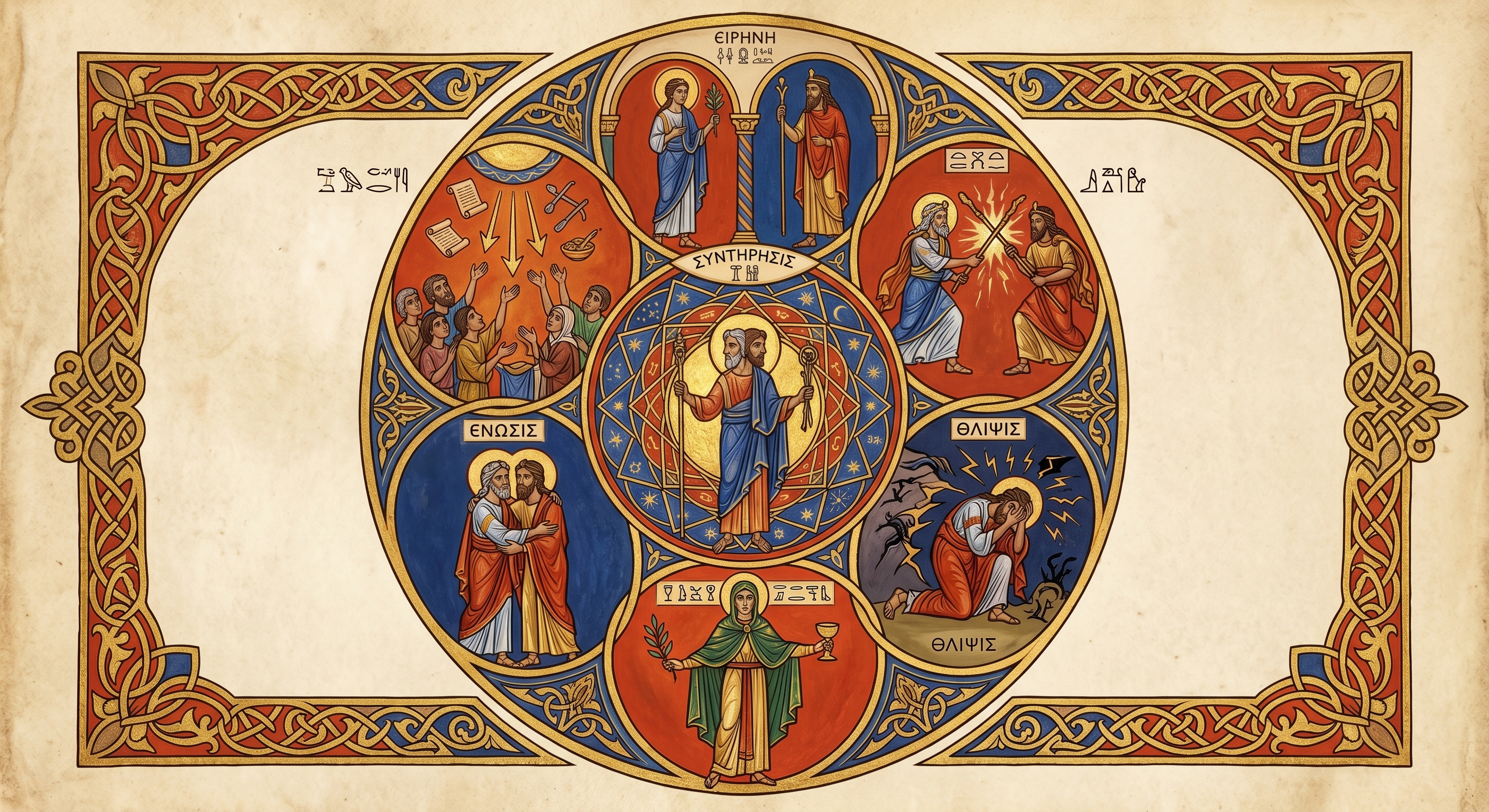
The six stages of the cosmic drama, recognizable across all three traditions: distinction, conflict, suffering, integration, reconciliation, transmission. The Gods have performed this sequence in every ancient civilization that developed religious reflection, because the sequence itself is the teaching.
Part Six: Why the Gods Stage These Dramas: The Deep Pedagogical Rationale
We now return to the foundational question. Why do the Gods stage these dramas at all? Why is divine reality transmitted to humanity through narratives of conflict and reconciliation rather than through direct philosophical statement of the truths the myths encode? The ancient philosophers offer several converging answers, each illuminating a different aspect of the pedagogical rationale.
The First Reason: Memorability
Plato in the Republic notes that the young soul absorbs myth more readily than abstract doctrine, and that what is absorbed early becomes the foundational structure of character. Drama, with its vivid characters and memorable conflicts, is absorbed and retained where abstract philosophical statement is forgotten. A child who has heard the story of Osiris and Set will, thirty years later, recall every detail; a child who has heard a lecture on the structure of the rational soul and its complex relation to the destructive principle will, one month later, have forgotten every word. The Gods, knowing the cognitive architecture of their human students, employ the form that will be retained.
The Second Reason: Stratified Audiences
Sallustius states this reason explicitly. Myth reaches different audiences at different depths simultaneously. The child receives a memorable story. The youth receives a moral teaching (do not rebel against the Gods; honor the proper order). The adult receives a psychological instruction (integrate the warring aspects of your own soul). The philosopher receives a cosmological revelation (the structure of reality is such that opposed principles must exist in productive tension). A single myth simultaneously serves all four audiences, and each audience receives exactly what it is prepared to receive. A philosophical treatise cannot do this; a philosophical treatise is calibrated to one audience and leaves the others behind. A myth, structured by divine intelligence, is a single artifact that functions at every level of comprehension.
The Third Reason: The Protective Veil
Sallustius also states this reason. The deepest metaphysical truths, if communicated directly to unprepared minds, produce either contempt (from those who cannot understand) or spiritual arrogance (from those who falsely think they have understood). The veil of narrative absurdity protects the truth from both errors. The literal surface is absurd enough that the serious mind cannot rest in it and is compelled toward philosophical interpretation; the literal surface is ordinary enough that the unserious mind can enjoy it at its own level without blaspheming a deeper teaching it was not prepared to receive. The veil is mercy, not deception.
The Fourth Reason: The Provocative Absurdity
Proclus develops this reason most thoroughly. The apparent absurdity of the surface narrative (Zeus binding a Titan because of a gift to humanity; Set murdering and dismembering his own brother; Shiva and Vishnu contesting supremacy when both are supreme) is not a flaw in the myth but its deliberate feature. The absurdity functions as the pedagogical trigger. The student, confronted with the obvious absurdity, is forced to ask, "what does this really mean?" The question is the first step of philosophical interpretation. A myth that was not absurd on its surface would not provoke the question, and without the question the student would not begin the work that leads to the hidden teaching. The Gods have engineered the absurdity so that the student will be forced to look beneath it.
The Fifth Reason: The Embodied Teaching
This reason is not explicitly stated by any ancient author but is implicit in the practice of all of them. Conceptual teachings are abstract; dramatic teachings are embodied. A conceptual teaching about the integration of opposites tells the student that integration is possible and even desirable. A dramatic teaching about the integration of opposites shows the student how integration feels, what it costs, what it produces. The watching student, having felt the suffering of Prometheus bound and the joy of Prometheus freed, has acquired not only the concept of integration but a kind of experiential rehearsal of it. When the student encounters, in his or her own inner life, the analogous integration-task, the emotional-imaginative rehearsal provided by the myth is already in place. The student knows how to proceed because the student has already watched the Gods perform the pattern.
The Sixth Reason: The Loving Parent's Method
The deepest reason, which the ancient philosophers hint at but do not always state explicitly, is the one the present study places at its center. The Gods love humanity. They are, in the Zevist understanding that recovers the ancient witness, parental in their relation to the human soul. Parents who love their children teach those children through play, through stories, through shared drama, through the slow development of understanding across many encounters. A parent who loved a child only as an abstract duty might lecture that child; a parent who loves a child as a living being teaches that child through the richer method of shared imaginative experience.
The Gods, who have all eternity and the resources of the cosmos at their disposal, employ the method that loving parents of infinite patience and infinite imagination would employ. They stage dramas. They perform conflicts and reconciliations in the great theatre of myth. They invite each generation of human students to watch, to question, to feel, to understand, and finally to enact within themselves the pattern the Gods have shown. The myths are not cold doctrinal encodings; they are the loving pedagogy of divine parents who have chosen the richest possible form in which to convey to their children the deepest truths about reality.
This is why the myths have survived for millennia while rational treatises from the same civilizations are read only by scholars. The myths are designed for human love, human memory, human longing. They speak the language in which the human soul naturally receives the sacred. The philosopher's treatise, however true, is an aid to the prepared mind; the myth is the means by which every human mind, at whatever stage of preparation, is met where it stands and drawn upward as it is able.
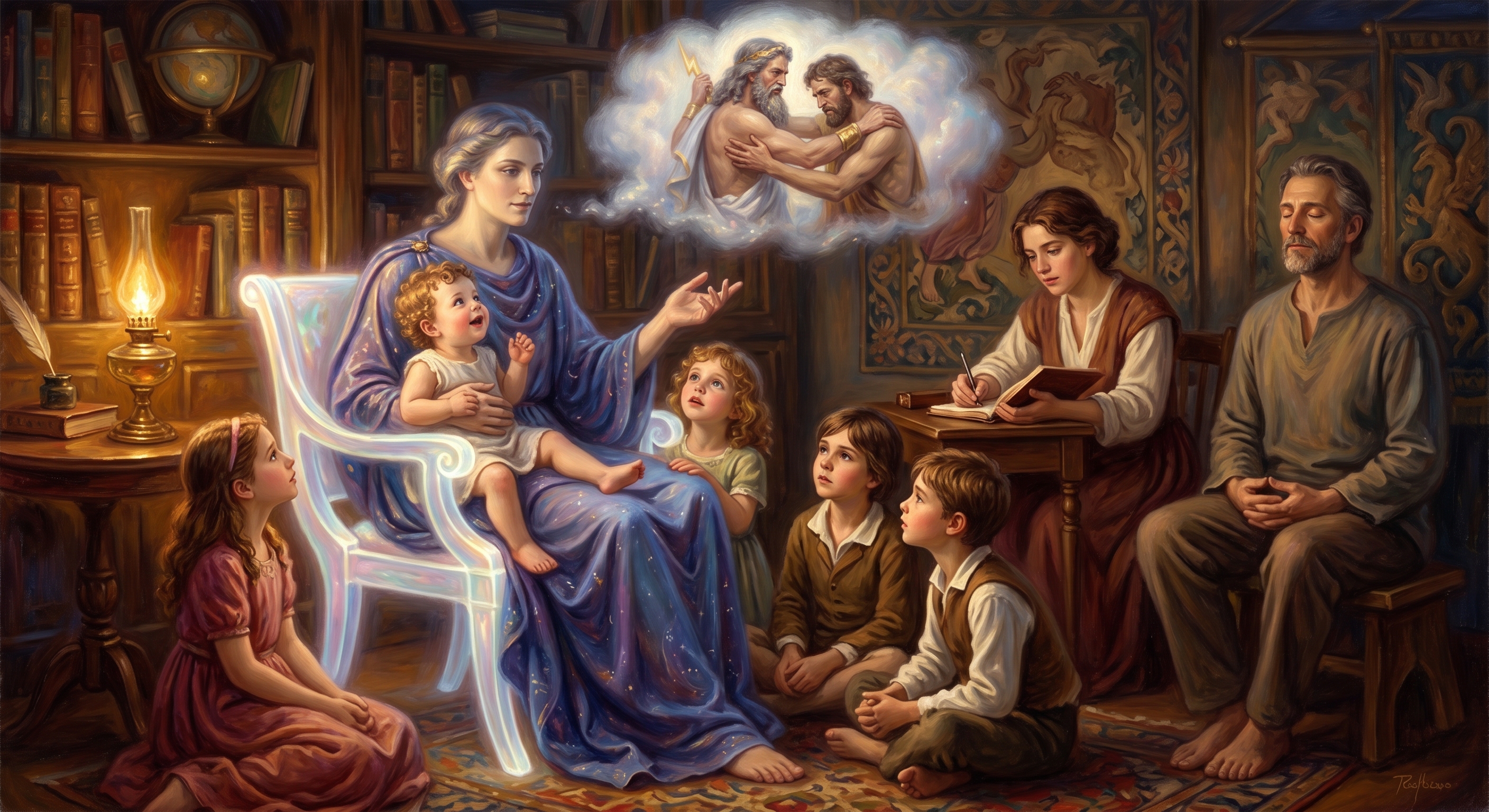
The Gods speak to their human children as loving parents speak to children of different ages around the evening fire: the same story, differently received by each, each drawn upward as each is able. The myth is the means of the divine love, not its concealment.
Part Seven: Applications for the Zevist Practitioner
The recognition that the wars of the Gods are divine pedagogical theatre has direct consequences for how the Zevist practitioner reads the sacred texts, performs the rituals, and structures the interior work.
First, the Zevist reads every ancient myth with double vision. The literal surface is honored as the narrative the Gods have given, but the philosophical depth is pursued as the teaching the narrative was designed to transmit. When the student encounters Zeus binding Prometheus, Set murdering Osiris, or Shiva and Vishnu in apparent conflict, the student does not stop at the surface shock; the student asks, following the method of the ancient philosophers, what psychological, cosmological, and alchemical teaching this drama is enacting. The student becomes an initiate by learning to read both layers at once.
Second, the Zevist recognizes the recurrence of the pattern across traditions as evidence of its cosmic reality. That the Greek tradition, the Egyptian tradition, and the Indian tradition all encode the same pattern of conflict-and-reconciliation between divine principles goes beyond cultural coincidence and stands as the convergent witness of three independent religious civilizations to a single cosmic truth: the structure of reality itself involves opposed principles in productive tension, and the resolution of those tensions is the ongoing work of both the cosmos and the individual soul. The Zevist, recognizing this, is freed from sectarian allegiance to any one tradition and enabled to receive the teaching wherever it appears.
Third, the Zevist performs the integration within. The myth shows the pattern; the practice enacts it. Every practitioner carries within the sovereign rational faculty (Zeus, Osiris, Vishnu) and the rebellious creative faculty (Prometheus, Set, Shiva); every practitioner must find, through disciplined inner work, the integrating principle (Heracles, Isis, the revealing pillar, Harihara) that brings the two into cooperation. The sacred text is the map; the meditation, the ritual, and the ethical discipline are the journey. The practitioner who has watched the Gods perform the cosmic pattern of integration has received, in that watching, the first instalment of the teaching; the completion of the teaching occurs when the practitioner enacts the same pattern within his or her own interior life.
Fourth, the Zevist honors the dark aspect. One of the deepest lessons of the myth-cycles is that the dark principle is not to be denied or destroyed but transformed. Set became the solar-barque defender. Prometheus was not executed but reconciled. Shiva the destroyer is eternally one with Vishnu the preserver. The mature practitioner does not seek the exclusion of the shadow but its integration into sacred service. What had been the enemy becomes, through the alchemical work, the defender. This is a teaching no intellectual doctrine can convey as vividly as the divine drama conveys it.
Fifth, the Zevist recognizes the love of the Gods in the very existence of the myths. That the Gods have troubled themselves to stage these dramas, preserve them across the millennia, encode them with multi-layered pedagogical depth, and deliver them to each generation of human students in a form suited to that student's capacity, is itself an act of divine love of immense magnitude. The myths are not the cold residue of an indifferent cosmos; they are the pedagogical letters of loving divine parents, addressed to their children, preserved even where the cultures have forgotten their origin. To recognize them as such is to receive the love in which they were given.
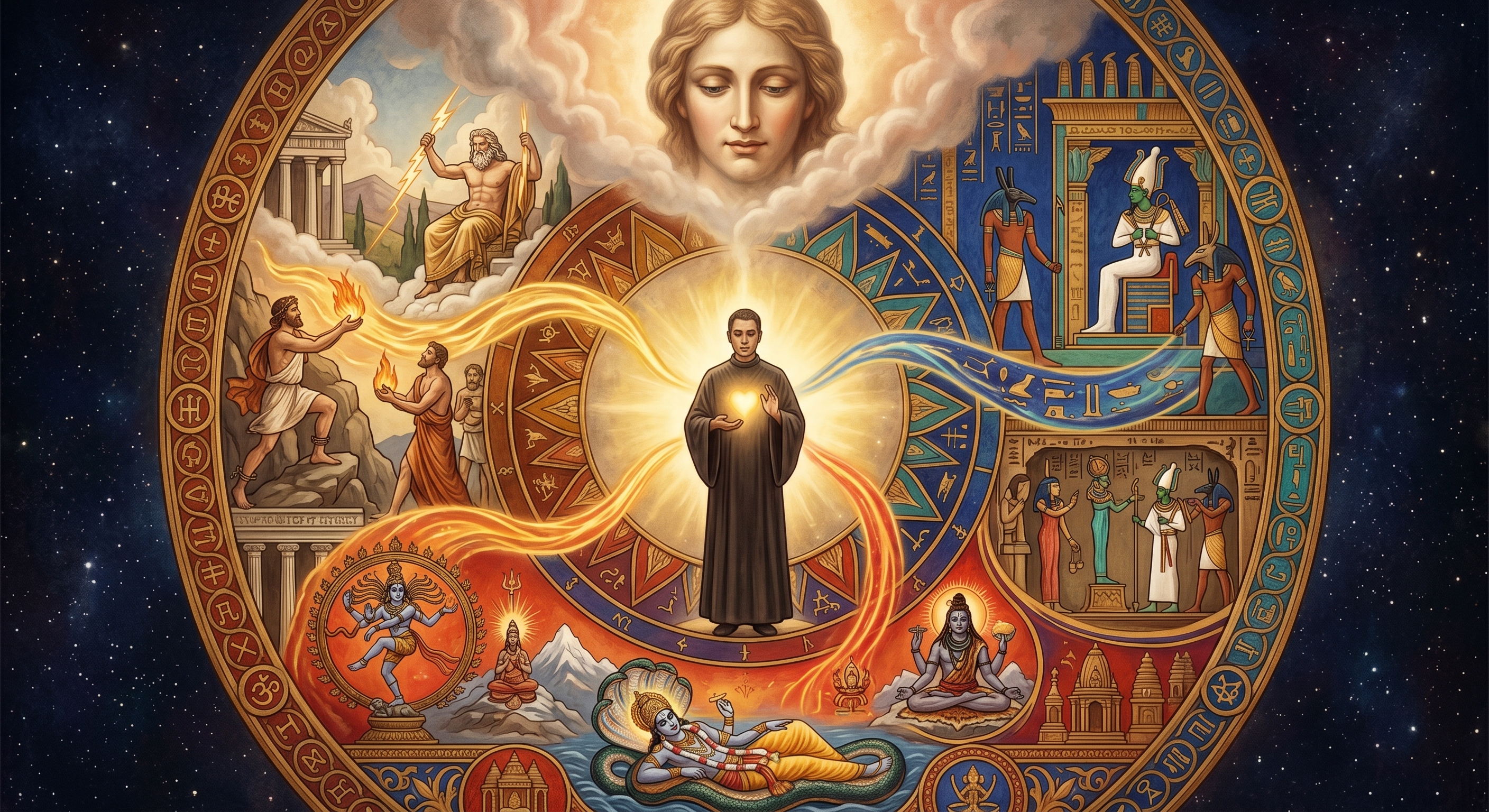
The practitioner who has learned to read the wars of the Gods as pedagogical theatre stands at the center of a cosmic education older than any one tradition, simultaneously receiving and enacting the integration that the Gods have been performing for humanity across every civilization that has had eyes to see.
Conclusion: The Gods as Teachers, the Myths as Their Classroom
We began with the paradox: why do the Gods fight? Why, if the divine powers are the sources of cosmic order, are the sacred narratives of every ancient civilization filled with stories of divine conflict, apparent injustice, dismemberment, and reconciliation? We have answered the question through the voices of the ancient philosophers themselves. Plato in the Republic, Plutarch in the De Iside, Sallustius in On the Gods and the World, Proclus in the Commentary on the Republic, and Porphyry in On the Cave of the Nymphs, speaking across eight hundred years of continuous philosophical reflection, transmit a single doctrine: the apparent conflicts among the Gods are intentional pedagogical dramas, performed for the instruction of humanity, encoding psychological, cosmological, and alchemical teachings that no direct statement could convey as effectively.
We have then demonstrated the doctrine by close analysis of three specific myth-cycles drawn from three independent religious civilizations. The Greek Prometheus-Zeus cycle preserved in Aeschylus's Prometheia trilogy teaches the integration of sovereign order with creative foresight, performed as cosmic drama with humanity as the silent beneficiary who keeps the fire. The Egyptian Osiris-Set cycle preserved in Plutarch's De Iside et Osiride teaches the alchemical transformation of the shadow, the dismemberment and reassembly of the bright principle, and the eventual restoration of the dark principle to sacred function. The Indian Shiva-Vishnu cycle preserved in the Puranic tradition and iconographically embodied in the figure of Harihara teaches the resolution of theological opposition at a higher ontological level where the opposition dissolves into unity.
The three civilizations are independent. The narratives are formally different. Yet the underlying structure is the same: two divine principles, apparent conflict, suffering, integrating intervention, reconciliation that transcends the original duality, and transmission of benefit to humanity. That the same structure appears independently in three traditions goes beyond any artefact of cultural contact and stands as the convergent witness of three civilizations to the pedagogical method that the Gods themselves have chosen for the education of their human children.
The Gods, in every ancient tradition, have staged these dramas because the dramas teach. The conflicts are not failures of divine coherence; they are the pedagogical masterpieces of divine love. Every human generation that has eyes to see the dramas as drama, that has ears to hear the reconciliations as reconciliation, and that has the philosophical discipline to decode the symbols as symbols, receives an education in the deepest structures of reality that no other form of teaching could provide.
The Zevist who recovers this ancient understanding recovers something the modern world has almost entirely forgotten: that the cosmos is a classroom, that the Gods are the teachers, that the myths are the curriculum, and that every human soul is enrolled, from birth, in the longest and most loving course of instruction that any student has ever been privileged to receive. The task of the practitioner is to recognize the instruction for what it is and to apply oneself, with reverence and with philosophical rigor, to the learning that the Gods have prepared. The sacred dramas continue. The classroom is always open. The teachers wait.
Sallustius, On the Gods and the World:
"ἀλλὰ τοῖς σπουδαίοις ἀργίαν ἐμποιήσειν, τὸ δὲ κρύπτειν μύθοις τὰς ἀληθείας ἀναγκάζει τὸ φιλοσοφεῖν."18
"To conceal the truth by myths compels the good to practice philosophy."
References
1 Plato, Republic 377a-b (Burnet ed., Oxford Classical Texts; trans. adapted from Paul Shorey, Loeb Classical Library, 1930)
2 Plutarch, De Iside et Osiride 11 (355C-D), Moralia V; ed. J. Gwyn Griffiths, Plutarch's De Iside et Osiride, University of Wales Press, 1970; trans. Frank Cole Babbitt, Loeb Classical Library, 1936
3 Sallustius, On the Gods and the World III (ed. Arthur Darby Nock, Sallustius: Concerning the Gods and the Universe, Cambridge University Press, 1926, p. 4; trans. Gilbert Murray, reprinted in Five Stages of Greek Religion, Columbia University Press, 1925)
4 Sallustius, On the Gods and the World III (ed. Nock, pp. 4-6; trans. Murray)
5 Proclus, In Platonis Rem Publicam Commentarii I.73-86 (Kroll ed., Teubner, 1899-1901), paraphrased and condensed; cf. Lamberton's translation, Proclus the Successor on Poetics and the Homeric Poems: Essays 5 and 6 of His Commentary on the Republic of Plato, Society of Biblical Literature, 2012, pp. 67-85
6 Proclus, paraphrased after In Rem Publicam VI.2 (I.71-85 Kroll); cf. Anne Sheppard, Studies on the 5th and 6th Essays of Proclus' Commentary on the Republic, Vandenhoeck and Ruprecht, 1980, pp. 39-103
7 Porphyry, De Antro Nympharum, paraphrased summary of the argument; ed. Seminar Classics 609 (State University of New York at Buffalo), The Cave of the Nymphs in the Odyssey, Arethusa Monographs 1, 1969; cf. Robert Lamberton, Homer the Theologian: Neoplatonist Allegorical Reading and the Growth of the Epic Tradition, University of California Press, 1986, pp. 119-133
8 Aeschylus, Prometheus Bound 248-252; ed. Martin West, Aeschyli Tragoediae cum incerti poetae Prometheo, Teubner, 1998; trans. adapted from Alan Sommerstein, Loeb Classical Library, 2008
9 Aeschylus, Prometheus Unbound, fr. 201 Radt (= Cicero, Tusculan Disputations 2.10.23-25, Latin translation of the Greek original); ed. Stefan Radt, Tragicorum Graecorum Fragmenta, Vol. 3, Vandenhoeck & Ruprecht, 1985; cf. Alan Sommerstein, Aeschylus: Fragments, Loeb Classical Library, 2008, pp. 196-203
10 Athenaeus, Deipnosophistae 15.672e-f, paraphrasing from a lost portion of Prometheus Unbound; ed. S. Douglas Olson, Loeb Classical Library, 2011; cf. Mark Griffith, Aeschylus: Prometheus Bound, Cambridge University Press, 1983
11 Plutarch, De Iside et Osiride 54 (373A-B), paraphrase; ed. Griffiths, 1970; cf. Frederick E. Brenk, In Mist Apparelled: Religious Themes in Plutarch's Moralia and Lives, Brill, 1977, pp. 104-130
12 Plutarch, De Iside et Osiride 49 (371A-B); trans. adapted from Babbitt, Loeb, 1936; cf. Griffiths, 1970, commentary ad loc.
13 Plutarch, De Iside et Osiride 49, condensed paraphrase (371B-C); trans. adapted from Babbitt, Loeb, 1936
14 Vedic-Puranic hymn formula, preserved in the Liṅga Purāṇa I.17.47-54 and quoted in many Pancharatra and Śaiva Siddhānta ritual contexts; cf. Arvind Sharma, Classical Hindu Thought: An Introduction, Oxford University Press, 2000, pp. 65-88; cf. Wendy Doniger, Hindu Myths: A Sourcebook Translated from the Sanskrit, Penguin Classics, 1975, pp. 137-141
15 Traditional Harihara invocation from the Skanda Purāṇa, Brahma Khaṇḍa; text cited in Gopinatha Rao, Elements of Hindu Iconography, Vol. II, Part 2, Law Printing House, Madras, 1916, pp. 332-337
16 Brahma Sūtra 2.1.33 (also rendered lokavat tu līlākaivalyam); ed. and trans. Swami Gambhirananda, Brahma-Sūtra-Bhāṣya of Śrī Śaṅkarācārya, Advaita Ashrama, 1965; cf. David Kinsley, The Divine Player: A Study of Krṣṇa Līlā, Motilal Banarsidass, 1979, pp. 1-20
17 Paraphrased summary of Proclus's doctrine of symbolic pedagogy from In Timaeum I.30-33 (Diehl ed.); cf. Anne Sheppard, "Proclus' Attitude to Theurgy," Classical Quarterly 32 (1982), pp. 212-224
18 Sallustius, On the Gods and the World III (ed. Nock, p. 6; trans. Murray)
Sources
- Plato, Republic, ed. John Burnet, Oxford Classical Texts (Oxford University Press, 1902); trans. Paul Shorey, Loeb Classical Library, 2 vols., Harvard University Press, 1930-1935
- Plato, Timaeus, ed. Burnet; trans. R.G. Bury, Loeb Classical Library, 1929; with F.M. Cornford, Plato's Cosmology: The Timaeus of Plato Translated with a Running Commentary, Routledge, 1937
- Aeschylus, Tragoediae cum incerti poetae Prometheo, ed. Martin L. West, Teubner, 1998
- Aeschylus, Fragments, ed. and trans. Alan H. Sommerstein, Loeb Classical Library, Harvard University Press, 2008
- Stefan Radt, Tragicorum Graecorum Fragmenta, Vol. 3: Aeschylus, Vandenhoeck & Ruprecht, 1985
- Mark Griffith, Aeschylus: Prometheus Bound, Cambridge Greek and Latin Classics, Cambridge University Press, 1983
- Plutarch, De Iside et Osiride, ed. J. Gwyn Griffiths, University of Wales Press, 1970 (the standard scholarly edition with commentary)
- Plutarch, Moralia V: Isis and Osiris, trans. Frank Cole Babbitt, Loeb Classical Library, Harvard University Press, 1936
- Frederick E. Brenk, In Mist Apparelled: Religious Themes in Plutarch's Moralia and Lives, Mnemosyne Supplement 48, Brill, 1977
- Daniel S. Richter, "Plutarch on Isis and Osiris: Text, Cult, and Cultural Appropriation," Transactions of the American Philological Association 131 (2001), pp. 191-216
- Sallustius, Concerning the Gods and the Universe, ed. Arthur Darby Nock, Cambridge University Press, 1926 (the standard edition with Greek text and English commentary)
- Sallustius, On the Gods and the World, trans. Gilbert Murray, in Five Stages of Greek Religion, Columbia University Press, 1925, pp. 239-260
- Sallustius, On the Gods and the World, trans. Thomas Taylor, in Sallust on the Gods and the World, reprinted Prometheus Trust, 1994
- Proclus, In Platonis Rem Publicam Commentarii, ed. Wilhelm Kroll, 2 vols., Teubner, 1899-1901
- Robert Lamberton, trans., Proclus the Successor on Poetics and the Homeric Poems: Essays 5 and 6 of His Commentary on the Republic of Plato, Writings from the Greco-Roman World 34, Society of Biblical Literature, 2012
- Anne D.R. Sheppard, Studies on the 5th and 6th Essays of Proclus' Commentary on the Republic, Hypomnemata 61, Vandenhoeck und Ruprecht, 1980
- Anne Sheppard, "Proclus' Attitude to Theurgy," Classical Quarterly 32 (1982), pp. 212-224
- Proclus, In Platonis Timaeum Commentaria, ed. Ernst Diehl, 3 vols., Teubner, 1903-1906
- Dirk Baltzly, John F. Finamore, and Graeme Miles, trans., Proclus: Commentary on Plato's Republic, Vol. I, Cambridge University Press, 2018
- Radek Chlup, Proclus: An Introduction, Cambridge University Press, 2012
- Porphyry, De Antro Nympharum, ed. and trans. Seminar Classics 609 SUNY Buffalo, The Cave of the Nymphs in the Odyssey, Arethusa Monographs 1, 1969
- Robert Lamberton, Homer the Theologian: Neoplatonist Allegorical Reading and the Growth of the Epic Tradition, University of California Press, 1986
- Luc Brisson, How Philosophers Saved Myths: Allegorical Interpretation and Classical Mythology, University of Chicago Press, 2004
- Jean Pépin, Mythe et Allégorie: Les origines grecques et les contestations judéo-chrétiennes, Études Augustiniennes, 1976
- Hesiod, Theogony, ed. M.L. West, Oxford Classical Texts, 1966; trans. Evelyn-White, Loeb Classical Library, 1914
- Homer, Iliad and Odyssey, ed. Monro and Allen, Oxford Classical Texts; trans. A.T. Murray, Loeb Classical Library
- Athenaeus, Deipnosophistae, ed. and trans. S. Douglas Olson, 8 vols., Loeb Classical Library, Harvard University Press, 2007-2012
- Erik Hornung, Conceptions of God in Ancient Egypt: The One and the Many, Cornell University Press, 1982
- Jan Assmann, The Search for God in Ancient Egypt, Cornell University Press, 2001
- Jan Assmann, Of God and Gods: Egypt, Israel, and the Rise of Monotheism, University of Wisconsin Press, 2008
- Herman te Velde, Seth, God of Confusion: A Study of his Role in Egyptian Mythology and Religion, Brill, 1967 (the standard study of Set and his rehabilitation)
- Geraldine Pinch, Egyptian Mythology: A Guide to the Gods, Goddesses, and Traditions of Ancient Egypt, Oxford University Press, 2004
- Gopinatha Rao, Elements of Hindu Iconography, 2 vols. in 4 parts, Law Printing House, Madras, 1914-1916; reprinted Motilal Banarsidass, 1985
- Wendy Doniger, Hindu Myths: A Sourcebook Translated from the Sanskrit, Penguin Classics, 1975
- Wendy Doniger, Śiva: The Erotic Ascetic, Oxford University Press, 1973
- David Kinsley, The Divine Player: A Study of Kṛṣṇa Līlā, Motilal Banarsidass, 1979
- Arvind Sharma, Classical Hindu Thought: An Introduction, Oxford University Press, 2000
- Gavin Flood, An Introduction to Hinduism, Cambridge University Press, 1996
- Cornelia Dimmitt and J.A.B. van Buitenen, eds. and trans., Classical Hindu Mythology: A Reader in the Sanskrit Purāṇas, Temple University Press, 1978
- Swami Gambhirananda, trans., Brahma-Sūtra-Bhāṣya of Śrī Śaṅkarācārya, Advaita Ashrama, Calcutta, 1965
- Stella Kramrisch, The Presence of Śiva, Princeton University Press, 1981