 አማርኛ
አማርኛ العربية
 বাংলা
বাংলা Български
 中文
中文 Čeština
 Dansk
Dansk Deutsch
 Eesti
Eesti Ελληνικά
 Español
 Français
 हिन्दी
 Hrvatski
 IsiZulu
 Italiano
 日本語
日本語 Kiswahili
 Magyar
 Македонски
 नेपाली
 Nederlands
 فارسی
فارسی Polski
 Português
 Română
 Русский
 Slovenščina
 Suomi
Suomi Svenska
 Tagalog
 Türkçe
Why Evil Exists & The Epicurean Paradox
author: High Priest Zevios Metathronos
On the Misattributed Dilemma, the Christian Trap, and the Zevist Answer: Why the Argument Isn't Epicurean, Why It Only Cuts Christianity, and Why Izfet Is Woven Into Creation by Design
Hesiod, Theogony:
Ἦ τοι μὲν πρώτιστα Χάος γένετ᾽, αὐτὰρ ἔπειτα Γαῖ᾽ εὐρύστερνος. 1
"Truly, first of all Chaos came into being, and then broad-bosomed Earth."
The oldest theological text in the Greek language opens with Chaos. Not with a perfect God authoring a perfect world, but with primordial disorder from which the ordered cosmos is drawn. Before Zeus, before the Olympians, before Gaia herself, Chaos is. This single line of Hesiod, written centuries before any Abrahamic scripture, settles the so-called problem of evil in a way no Christian theologian has ever managed: evil, disorder, and resistance are structural features of reality itself, present before the Gods and independent of divine will.
Christianity has no such resource. The religion painted itself into a metaphysical corner by claiming that a single all-powerful, all-knowing, all-good God created everything from nothing. The moment that claim was made, the question of evil became an unanswerable contradiction, and the entire edifice has been leaking ever since. The argument we call the "Epicurean Paradox" is the most famous leak, and it's been leaking for 17 centuries.
Three truths need to be established before we go further. First, the argument isn't Epicurean. It was attributed to Epicurus by a Christian apologist to lend it philosophical weight while deflecting attention from the fact that Christianity itself generated the dilemma. Second, the argument is specifically lethal to Christian monotheism and to no other theological system in history. It cannot touch Zevism, Hellenism, Egyptian theology, Vedic thought, or any genuine polytheism, because none of these traditions ever made the monopolistic claims that set the trap. Third, the Zevist answer is positive, not merely defensive: Izfet, the principle of cosmic disorder, is woven into creation deliberately, so that beings may evolve through the work of overcoming it, and Zeus is the supreme teacher of that overcoming.
The Argument, Stated Honestly
The paradox, in the form that has come down to us, is a four-horned dilemma. If God wishes to prevent evil but cannot, He is not omnipotent. If He can prevent evil but does not wish to, He is malevolent. If He neither can nor wishes to, He is both impotent and malevolent, and therefore not God. If He both can and wishes to, then whence evil, and why does He not remove it?
The logical structure is a disjunctive exhaustion across two axes, ability and willingness, yielding four combinations. Three of the four contradict the classical tri-omni definition of God (omnipotent, omniscient, omnibenevolent). The fourth, which preserves the attributes, is shown to be empirically falsified by the manifest existence of evil. The conclusion is that no being satisfying the tri-omni definition can exist given the datum of suffering.
This is a valid argument. Philosophically, it's airtight against its target. The target, however, is not what Christian apologists pretend it is.
Lactantius, De Ira Dei:
"Deus aut vult tollere mala et non potest, aut potest et non vult, aut neque vult neque potest, aut et vult et potest. Si vult et non potest, imbecillis est; si potest et non vult, invidus; si neque vult neque potest, et invidus et imbecillis est, ideoque nec Deus; si vult et potest, quod solum Deo convenit, unde ergo sunt mala, aut cur illa non tollit?"2
"God either wishes to take away evils and cannot, or He can and does not wish to, or He neither wishes nor can, or He both wishes and can. If He wishes and cannot, He is weak; if He can and does not wish, He is envious; if He neither wishes nor can, He is both envious and weak, and therefore not God; if He wishes and can, which alone is fitting to God, whence then come evils, or why does He not take them away?"
The Historical Fraud: Lactantius Invented the "Epicurean" Label
The argument doesn't come from Epicurus. It comes from Lactantius, a Christian apologist writing around 318 CE, whose treatise De Ira Dei (On the Anger of God) contains the only surviving ancient formulation of the dilemma. Lactantius attributes it to Epicurus in a single line, provides no source, and then spends the rest of the treatise trying to refute it.
The German classicist Reinhold F. Glei demonstrated conclusively in 1988 that this attribution is false. Glei's philological analysis of the passage, published in Vigiliae Christianae, showed that the argument's form, vocabulary, and dialectical strategy are characteristic not of Epicurus but of the Academic skeptics, most likely Carneades of Cyrene (214–129 BCE), who specialized in constructing dilemmas that trapped Stoic theology. The argument was likely transmitted through the doxographic tradition and either misremembered or deliberately re-attributed by Lactantius to a figure Christians were already willing to despise.
Reinhold F. Glei, Vigiliae Christianae:
"Das sog. Epikur-Fragment bei Laktanz kann nicht von Epikur stammen. Es ist vielmehr ein Produkt der akademischen Polemik, wahrscheinlich karneadeisch, das Laktanz entweder aus einer veränderten doxographischen Quelle übernommen oder bewusst Epikur zugeschrieben hat."3
"The so-called Epicurus fragment in Lactantius cannot come from Epicurus. It is rather a product of Academic polemic, probably Carneadean, which Lactantius either took over from an altered doxographical source or deliberately attributed to Epicurus."
The fraud serves two Christian purposes. It lends the argument the pedigree of a famous philosopher, making it easier to cite and refute. And it deflects from the embarrassing fact that the dilemma is generated by Christianity's own doctrinal commitments, not imposed from outside. A Christian apologist who attributes the argument to a pagan philosopher can pretend to be answering an external attack. A Christian apologist who admits the argument emerges from his own theology has to concede that the theology itself is the problem.
The modern misuse of the label compounds the fraud. Every time a theologian, philosopher, or debate opponent refers to "the Epicurean paradox," they continue a 1,700-year-old misattribution that Lactantius invented to save his own system from the argument it actually generates.
A Christian Weapon, Not an Ancient Objection
Name any major theological system from the ancient world that the paradox can actually damage. Hellenic polytheism? No, because Zeus is supreme but not absolute, and the cosmos contains primordial Chaos that precedes him. Egyptian theology? No, because Ma'at and Izfet are cosmic principles older than any god, and the gods preside within them rather than creating them. Vedic thought? No, because the cosmos passes through cycles driven by principles (rta, dharma, karma) that exceed the individual wills of Devas. Mesopotamian religion? No, because Marduk and Anu operate within a cosmos whose primordial substrate (Tiamat, the Apsu) preceded them and had to be fought and ordered, not authored.
The paradox bites only against a theology that claims all four of the following simultaneously: that a single God exists, that this God is omnipotent, that this God is omnibenevolent, and that this God authored all of reality from nothing. These four claims define exclusively Abrahamic monotheism, and within Abrahamic monotheism, the claim of creation ex nihilo was itself not fully developed until the 2nd–3rd centuries CE (Gerhard May, Creatio Ex Nihilo, 1994).
The paradox is therefore a weapon forged to exactly the dimensions of Christian theology. It fits no other target. Calling it "Epicurean" is like calling a guillotine "Egyptian." The label obscures the origin and lets the guilty party pretend the weapon came from somewhere else.
When Christians deploy the language of "the problem of evil" as though it were a universal theological challenge, they're exporting their own doctrinal failure and pretending every religion has to solve it. Zevism does not. Hellenism does not. Egyptian theology does not. The problem of evil is the Christian God's problem, and only his, because only Christianity built a theology that made every evil ultimately attributable to a single supposedly perfect will.
The Four Lies Beneath the Paradox
Every foundational premise of the Christian package is a forgery, and each one contributes to the trap. Examining them in turn reveals that the Epicurean paradox is the inevitable consequence of a set of claims that should never have been made in the first place. The dilemma doesn't arrive from outside. It grows out of the doctrinal soil that Christianity chose to plant itself in.
Lie One: Creation Ex Nihilo
Creation from nothing is a 2nd-century CE theological invention, absent from the Hebrew Bible itself. Genesis 1:1–2 explicitly presupposes pre-existent matter: "the earth was tohu wa-bohu (formless and void), and darkness was over the face of the deep (tehom), and the Spirit of God was hovering over the face of the waters." These are pre-existent principles. The text depicts divine ordering of chaotic matter, not creation from nothing. Every ancient Near Eastern cosmogony shares this framework, including the Babylonian Enuma Elish from which Genesis borrows its structure.
Creation ex nihilo was developed in Christian apologetics by Theophilus of Antioch in Ad Autolycum (ca. 180 CE) and Tertullian in Adversus Hermogenem (ca. 200 CE), for the specific purpose of making the Christian God the sole author of all existence. Gerhard May's landmark study Creatio Ex Nihilo: The Doctrine of "Creation out of Nothing" in Early Christian Thought (T&T Clark, 1994) documents the development in detail. The doctrine exists to establish metaphysical monopoly. Without ex nihilo, the Christian God is merely one factor in a cosmos he did not author, and the whole theological edifice loses its claim to totality.
Lie Two: Absolute Omnipotence
Absolute omnipotence is logically incoherent before the paradox even lands. Can God create a stone He cannot lift? Can He make a square circle? Can He cause a married bachelor to exist? Philosophers have been fragmenting this attribute since Aquinas, who redefined omnipotence as "capacity to do all things logically possible" to escape the contradictions. But this redefinition already concedes the point: God is not absolutely all-powerful. There are things He cannot do, specifically the logically impossible. The moment any limit is admitted, the theological claim collapses from "all-powerful" to "very powerful within limits," which is exactly the Zevist position about Zeus, and which the paradox does not touch.
Lie Three: Absolute Omnibenevolence
Absolute omnibenevolence is flatly contradicted by the Christian God's own scriptures. The Flood drowns nearly every living thing (Genesis 6–9). The firstborn of Egypt are slaughtered, including infants who committed no wrong (Exodus 12). The Canaanite genocides are commanded directly by Yahweh, with explicit instructions to leave no survivors, including women and children (Deuteronomy 7:1–2; Joshua 6:21; 1 Samuel 15:3). Yahweh hardens Pharaoh's heart specifically to punish him for a choice Yahweh caused (Exodus 7:3, 9:12, 10:1). Jepthah sacrifices his daughter as a burnt offering fulfilling a vow to Yahweh, and Yahweh accepts (Judges 11:30–40).
A God who does these things is not omnibenevolent by any human definition of the word. Christian apologists invoke "mystery" at every one of these texts, which is another way of saying they cannot reconcile the claim with the evidence and have chosen to preserve the claim by abandoning the evidence.
Lie Four: Monotheism Itself
Monotheism is a late priestly forgery, and the Hebrew Bible preserves the older henotheistic and polytheistic strata despite the editors' best efforts to erase them. Elohim is a plural form; it literally means "Gods." Psalm 82 shows Yahweh standing in the council of El among other gods, arguing with them and eventually condemning them to die "like mortals." Deuteronomy 32:8–9, in the older text preserved in the Dead Sea Scrolls and the Septuagint, describes El Elyon apportioning the nations among the "sons of the gods" (bene elohim), giving Israel to Yahweh specifically as one god among many. The Masoretic text changes this to "sons of Israel" to hide the polytheism, but the manuscript evidence is conclusive.
Mark S. Smith's The Early History of God: Yahweh and the Other Deities in Ancient Israel (2nd ed., Eerdmans, 2002) and The Origins of Biblical Monotheism (Oxford, 2001) document the historical development from Canaanite polytheism through Israelite henotheism to the later monotheistic editing. Frank Moore Cross's Canaanite Myth and Hebrew Epic (Harvard, 1973) establishes that Yahweh was originally a warrior god in a pantheon headed by El, and that the identification of the two was a theological development, not a primordial fact.
Monotheism, in other words, is a historically contingent priestly project, completed sometime between the Babylonian exile and the Maccabean period. It emerged as a specific theological construction rather than an original religious reality, and it generates specific problems the paradox among them, that the older and more honest religions never faced.
The Theodicy Scam: 17 Centuries of Failed Defenses
Christianity has responded to the paradox with four major theodicies, each of which quietly abandons one of the tri-omni attributes while pretending to preserve all three. Each defense deserves brief dismissal.
The Free Will Defense
Augustine proposed that evil enters the world through the misuse of creaturely free will, and Alvin Plantinga formalized this in God, Freedom, and Evil (Harper, 1974). The defense collapses on natural evil. An earthquake is not a moral agent's choice. Infant leukemia is not a free-will decision. The 2004 Indian Ocean tsunami killed roughly 230,000 people, none of whom chose to be there. Free will cannot explain why an omnipotent, omnibenevolent creator authored a physical cosmos whose regular operations include mass death of the innocent. To save the defense, defenders invoke fallen angels operating the tectonic plates, which is a position that requires no further comment.
Soul-Making Theodicy
Irenaeus of Lyon (Against Heresies IV.37–39) proposed that suffering serves as moral pedagogy, and John Hick modernized this in Evil and the God of Love (Macmillan, 1966). The defense instrumentalizes victims as teaching aids. If a child's torture produces moral growth in someone else, the child becomes a means to another's end, which is itself a moral horror. And the defense fails on suffering that produces no growth: the infant who dies before developing moral capacity, the victim of dementia whose last years erase whatever character was built, the torture victim whose experience destroys rather than refines them.
Privatio Boni
Augustine (Confessions VII; Enchiridion 11) taught that evil has no positive ontological status, being merely a privation of good. He stole this framework from Plotinus (Enneads I.8), where it had been developed in a Neoplatonic context that did not require divine omnibenevolence. Transplanted into Christian theology, it becomes verbal sleight of hand: the mother of a tortured child is told her experience is a mere absence, not a positive reality. Phenomenology contradicts the claim at every point. Suffering is positively experienced, not negatively absent. The mother knows this. The theologian pretends not to.
Skeptical Theism
Contemporary analytic theists like Michael Bergmann and Stephen Wykstra argue that we cannot assess God's reasons for permitting evil because God's understanding infinitely exceeds ours. This is theological surrender dressed as humility. If God's goodness cannot be assessed by creatures, then calling Him "good" is semantic noise, with no content creatures can recognize. The moral predicate is voided to save the claim, which is the same as losing the claim.
Each of these defenses quietly sacrifices one of the three omni-attributes. Free will defense limits omnipotence (God cannot both grant free will and prevent its misuse). Soul-making redefines omnibenevolence as pedagogical utility, which is not benevolence. Privatio boni redefines evil to evade the omnipotence problem. Skeptical theism abandons the claim that divine goodness is comprehensible, which is the same as abandoning the claim. Seventeen centuries of ingenious footwork have resulted only in four failed escape routes, and every theologian who tries a fifth joins the procession.
The Collapse: One Rupture Among Many
The Epicurean paradox stands as one rupture among many in Christianity's structural integrity, and the most load-bearing of them. The others include: the dating of the Gospels (none written by eyewitnesses; the earliest, Mark, composed around 70 CE, decades after the supposed events, in Greek, by an author outside Palestine); the three mutually incompatible resurrection accounts in the Synoptic gospels and John; the forgery of the Pastoral Epistles and Hebrews, attributed to Paul but written by others (Bart Ehrman, Forged, HarperOne, 2011); the pseudepigraphical nature of 1 and 2 Peter; the Constantinian canon-engineering after the Council of Nicaea in 325 CE; the trinitarian contradictions never resolved at Chalcedon in 451; the hypostatic union, which requires that a single person have two complete natures without mixture, division, separation, or confusion, a formula that functions as a curtain over an admitted mystery rather than a solution.
Strike any one of these pillars and the cathedral staggers. Strike several and it collapses. The Epicurean paradox happens to be the column bearing the most weight, which is why theologians have spent two millennia trying to prop it up and have failed every time. The defenses grow more elaborate with each generation, which is the signature of a system losing structural integrity and substituting ornament for load-bearing work.
Zevism has no such problem, because Zevism never made the claims that generate it. The Zevist position offers no defense because no attack surface exists to defend.
The Zevist Answer: Zeus Within Creation
Zeus has ultimate power. He is supreme among the Gods, supreme in authority, supreme in sovereignty. No Zevist disputes this, and no Zevist has ever disputed it. But Zeus operates within a cosmos that has its own primordial structure, and this structure precedes even him.
Hesiod is explicit in the Theogony. First came Chaos, then Gaia, then Tartarus, then Eros. From these four primordial principles the rest of the cosmos unfolds, including eventually the Titans, and from the Titans, Zeus. Zeus is not the first being. He is the victor of the Titanomachy, the one who establishes ordered rule over the cosmos that already exists. His supremacy is political and cosmic, not creational.
Homer, Iliad:
Ὤ μοι ἐγών, ὅ τέ μοι Σαρπηδόνα, φίλτατον ἀνδρῶν, μοῖρ᾽ ὑπὸ Πατρόκλοιο Μενοιτιάδαο δαμῆναι.5
"Ah me, that it is fated for Sarpedon, dearest to me of men, to be brought down by Patroclus son of Menoetius."
Homer's scene is theological bedrock. Zeus wants to save his son Sarpedon. Zeus has the power to save him physically, with a word or a gesture. But Moira has decreed Sarpedon's death, and even Zeus cannot overturn Moira. He weeps, he shakes the heavens with a rain of bloody drops, and then he allows fate to unfold because fate precedes him and binds him. The king of the Gods acknowledges a power older than his own reign.
The cosmos itself is structured this way, and Zeus rules within that structure rather than against it. Ananke (necessity), Moira (fate), Chaos (the primordial abyss from which all things arose), and the embedded laws of being are older than the Olympian order. Zeus governs within them. He does not author them. The claim that any god authored the totality of being is a peculiarity of later monotheistic theology and corresponds to nothing in the religious experience of humanity before the Abrahamic forgery.
In Zevist theology, this arrangement describes the structure of reality as it actually is. A cosmos with no resistance, no primordial substrate, no laws independent of divine will would be a cosmos with no room for beings to evolve. A God who authored everything from nothing would be a God responsible for every evil, which is the trap Christianity walked into. The Zevist cosmos has resistance because resistance is what makes becoming possible.
Izfet as Cosmic Pedagogy: The Embedded Law of Evolution
Izfet, in Egyptian theology, is the principle of disorder, falsehood, and cosmic dissolution, the structural opposite of Ma'at (truth, order, cosmic harmony). The Egyptian sources are unambiguous that Izfet is primordial, coeval with Ma'at, and built into the fabric of existence rather than created by any specific god. Jan Assmann's Ma'at: Gerechtigkeit und Unsterblichkeit im Alten Ägypten (Beck, 1990) and Erik Hornung's Conceptions of God in Ancient Egypt (Cornell, 1982) document this theology in detail.
Zevism inherits and extends this framework. Izfet functions as a cosmic law, embedded into the world precisely so that beings may evolve through the work of overcoming it. A soul that never encounters resistance cannot grow. A soul that never chooses Ma'at over Izfet has not yet chosen anything. Virtue is impossible without the possibility of vice; courage is impossible without the reality of fear; Ma'at is impossible without Izfet as the genuine alternative.
Hermetic Emerald Tablet:
"Quod est inferius est sicut quod est superius, et quod est superius est sicut quod est inferius, ad perpetranda miracula rei unius."6
"That which is below is like that which is above, and that which is above is like that which is below, for accomplishing the miracles of the One Thing."
The Hermetic principle of correspondence encodes the same truth. Polarity is structural to being. Heat and cold, light and dark, order and chaos, Ma'at and Izfet: these are necessary axes of a reality capable of sustaining consciousness, evolution, and ascent. Remove one pole and the other vanishes with it. A cosmos of pure Ma'at with no Izfet anywhere would be a cosmos with no differentiation, no resistance, no possibility of choice, and therefore no possibility of souls.
Heraclitus grasped this earlier than almost anyone. Fragment B53 declares war (polemos) to be the father of all things, not because violence is good, but because tension and opposition are the generative structure of reality. Fragment B8 observes that "what opposes unites; from things that differ, the most beautiful harmony arises." The cosmos is a tensed bow, not a flat plain. The tension is what gives it power.
Heraclitus:
πόλεμος πάντων μὲν πατήρ ἐστι, πάντων δὲ βασιλεύς, καὶ τοὺς μὲν θεοὺς ἔδειξε τοὺς δὲ ἀνθρώπους, τοὺς μὲν δούλους ἐποίησε τοὺς δὲ ἐλευθέρους.7
"War is the father of all and the king of all. Some he shows as gods, others as men; some he makes slaves, others free."
The evolutionary function of Izfet is built into the structure of incarnated existence. Souls descend into matter, encounter resistance, and either grow through overcoming or stagnate in surrender. The Pythagoreans called this metempsychosis. The Orphics called it the cycle of births. The Platonists called it the descent of the soul through the planetary spheres, acquiring "garments" of increasingly dense psychic material that must be shed through purification. In every case, the structure of reality includes resistance, and the purpose of resistance is ascent.
A reality without Izfet would be a reality without evolution. A reality without evolution would be a reality without souls. A reality without souls would not be a reality at all, in any meaningful sense. The Christian complaint that a good God should have made a cosmos without suffering is, on examination, a complaint that a good God should have made a cosmos without beings. It is a request for nonexistence dressed as a demand for perfection.
Zeus as the Ultimate Power of Overcoming
Zeus does not abolish Izfet. He cannot, and he does not need to. Izfet is embedded in creation, and its presence is what makes Ma'at a choice, a practice, a path. Zeus's role is higher and harder than abolition: he is the ultimate power of overcoming, the supreme teacher of the work by which beings rise from the raw substrate of existence into divine participation.
The Titanomachy is the founding myth of this overcoming. The Titans are not evil in any simple sense. They are the raw primordial powers of existence: Kronos (time as devouring principle), Rhea (flux), Oceanus (undifferentiated water), Themis (primordial law), and the rest. They represent the cosmos before ordered rule, the substrate before Ma'at has been established across it. Zeus defeats them not by destroying the primordial powers but by ordering them, by establishing dominance that permits differentiation, justice, and the flourishing of consciousness. The Titans are not erased; many remain, and some (Themis, Prometheus) continue to function in the ordered cosmos. But they are now subordinate to the Olympian regime, and the regime is an order that makes evolution possible.
Hesiod, Theogony:
τοῖς πίσυνος θνητοῖσι καὶ ἀθανάτοισιν ἀνάσσει.8
"Trusting in these [the thunder, the lightning, and the blazing thunderbolt], he rules over mortals and immortals."
The thunderbolt is the symbol of this overcoming. It is concentrated divine will that cuts through disorder and establishes the ordering principle. When Zeus hurls the keraunos, he asserts cosmic order against the forces of dissolution that would otherwise swallow it. The thunderbolt is Ma'at striking Izfet. It does not abolish Izfet. It subordinates Izfet to a higher principle.
This is the work Zeus teaches. Every Zevist who practices meditation, theurgy, and virtue participates in the same cosmic labor. The forces that resist the soul (vice, ignorance, fear, the heaviness of matter) are the Izfet the soul must overcome. The resistance itself is the path, and the overcoming is the ascent. Zeus, as the ultimate power of overcoming, stands as both the model and the ally. To align with Zeus is to join the overcoming. To worship Zeus is to recognize that the overcoming is divine, cosmic, and eternally available to those who choose it.
The Christian complaint that God should have made a cosmos without evil is answered, from the Zevist standpoint, with a counter-question: should the cosmos have been made without the possibility of becoming? Should souls have been created without the capacity to rise? Should there have been no Titanomachy, no thunderbolt, no Ma'at striking Izfet, no divine work of overcoming? The Christian answer, if followed to its conclusion, is a demand for a sterile cosmos with no room for the greatest of all goods: the evolution of consciousness toward divinity. The Zevist answer recognizes that resistance is the condition of greatness, and Zeus is the greatest because he is the supreme overcomer.
Izfet existed in the universe before Zeus, and Izfet will exist regardless of what any god does. This structural condition of reality is the very ground on which divine rule operates, divine teaching occurs, and souls evolve through divine guidance. The eternal presence of Izfet makes the eternal glory of overcoming possible. A cosmos without Izfet would be a cosmos without Zeus, because there would be nothing for Zeus to be supreme over.
The Diagram: Why Christianity Traps Itself and Zevism Cannot Be Touched
The structural difference between the two theologies can be visualized. On the left, the Christian God is the sole author of all reality, which means every feature of reality, including evil, traces back to His will. On the right, the Zevist Gods operate within a primordial substrate (Chaos, Ananke, Moira, Izfet) that precedes them and contains disorder by its own nature. Evil is not of divine authorship. The work of the Gods is to preside over the overcoming.
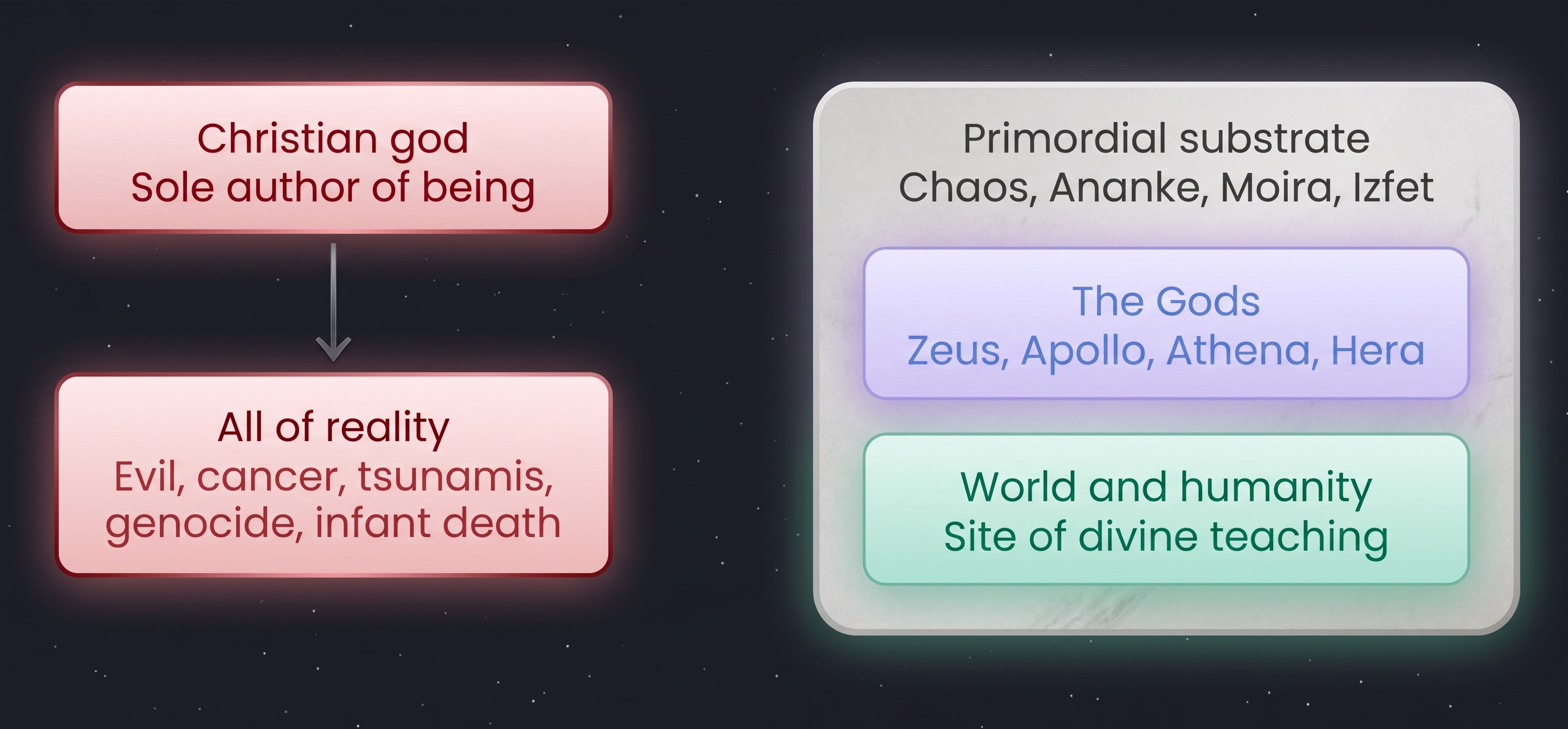
The left panel shows a flat hierarchy: one God, one line of responsibility, one ledger on which every horror must ultimately be entered. This is the trap. The moment Christianity claimed that God authored everything from nothing, Christianity accepted responsibility for everything. The paradox is simply the receipt.
The right panel shows a nested hierarchy: a primordial substrate containing the Gods, who in turn preside over the world of human experience. Izfet is a property of the substrate, not an output of divine will. The Gods work within the cosmos to order it, to teach, to preside over the overcoming. They are not on the hook for the structure itself, because they did not author it, and they could not abolish it without abolishing the very possibility of beings capable of evolution.
Why Evil Exists: The Zevist Summary
Evil exists because reality itself contains primordial resistance. Izfet was not manufactured by the Gods, and the Gods cannot abolish it without abolishing the condition of evolution that makes conscious existence meaningful. Chaos preceded Gaia. Moira binds even Zeus. The cosmos is structured by polarity because polarity is what makes becoming possible.
Zeus has ultimate power, and his ultimate power expresses itself not in the abolition of Izfet but in the teaching of overcoming. He is the supreme ruler of the Olympian cosmos, the victor of the Titanomachy, the wielder of the thunderbolt, the one whose authority orders the primordial substrate into a cosmos fit for souls. The Zevist who aligns with Zeus joins this overcoming, participates in the cosmic work, and ascends toward the divinity that was always latent in the soul.
The Epicurean paradox is a weapon that fits only Christianity, forged by a Christian apologist, mislabeled to deflect from its Christian origin, and fatal to the theology that generated it. It cannot touch Zevism. It cannot touch Hellenism, Egyptian theology, Vedic thought, or any honest polytheism. It touches only the theology that made the four monopolistic claims (omnipotence, omniscience, omnibenevolence, sole authorship), and it will continue to cut that theology until the last Christian acknowledges what the paradox has been saying for 17 centuries.
The older religions were wiser because they were more honest. They acknowledged the structure of reality as it actually is: a cosmos with primordial polarity, Gods who work within it, and souls who evolve by overcoming. Zevism returns to this older honesty. The problem of evil is not our problem. The question "why does evil exist" has an answer, and the answer is: because without Izfet there could be no Ma'at, without resistance no overcoming, without tension no evolution, without the primordial substrate no cosmos, and without the cosmos no beings to ask the question in the first place.
Zeus teaches the overcoming. The Gods preside over the work. The soul evolves through the struggle. The cosmos is structured to permit this, and the structure itself is the gift.
Orphic Hymn to Zeus:
Ζεὺς πρῶτος γένετο, Ζεὺς ὕστατος ἀργικέραυνος· Ζεὺς κεφαλή, Ζεὺς μέσσα, Διὸς δ᾽ ἐκ πάντα τέτυκται.9
"Zeus was born first, Zeus is the last, wielder of the bright thunderbolt; Zeus is the head, Zeus the middle, and from Zeus all things are fashioned."
References:
1 Hesiod, Theogony 116–117
2 Lactantius, De Ira Dei 13.20–21 (Latin; ca. 318 CE)
3 Reinhold F. Glei, Vigiliae Christianae 42 (1988), pp. 47–58
4 Epicurus, Principal Doctrines 1 (preserved in Diogenes Laertius X.139)
5 Homer, Iliad 16.433–434 (Zeus, on the fated death of his son)
6 Hermetic Emerald Tablet (Tabula Smaragdina), lines 2–3, Latin from the Arabic original
7 Heraclitus, Fragment B53 (Diels-Kranz)
8 Hesiod, Theogony 506 (on Zeus's sovereignty, exercised through the weapons given to him by the Cyclopes)
9 Orphic Hymn to Zeus, preserved in the Derveni Papyrus, col. XVII (ca. 340 BCE)
Sources
- Lactantius, De Ira Dei 13.20–21 (ca. 318 CE). Latin text in CSEL 27; English in Fletcher trans., ANF 7.
- Glei, Reinhold F. "Et invidus et imbecillus: Das angebliche Epikurfragment bei Laktanz, De ira dei 13, 20–21." Vigiliae Christianae 42 (1988): 47–58.
- Epicurus, Principal Doctrines (Κύριαι Δόξαι) 1, preserved in Diogenes Laertius, Lives of Eminent Philosophers X.139.
- Epicurus, Letter to Menoeceus 123–124, in Diogenes Laertius X.123–124.
- Lucretius, De Rerum Natura, Books I–II (on atomistic cosmogony, unauthored cosmos).
- Hesiod, Theogony 116–133 (primordial Chaos, Gaia, Tartarus, Eros); 453–506 (Titanomachy background); 820–880 (Zeus against Typhoeus). West (Oxford, 1966) edition.
- Homer, Iliad 16.431–461 (Zeus cannot save Sarpedon from Moira). West (Teubner) edition.
- Heraclitus, Fragments B8, B53, B80. Diels-Kranz, Die Fragmente der Vorsokratiker, 6th ed.
- Plato, Timaeus 30a–37c (Demiurge ordering pre-existent chaos, not creating ex nihilo).
- Plotinus, Enneads I.8 (on the nature of evil as privation).
- Augustine of Hippo, Confessions VII.3–16; Enchiridion 11–12 (privatio boni).
- Augustine of Hippo, De Libero Arbitrio II–III (free will defense).
- Irenaeus of Lyon, Against Heresies IV.37–39 (soul-making).
- Theophilus of Antioch, Ad Autolycum II.4, 10 (earliest full formulation of creatio ex nihilo, ca. 180 CE).
- Tertullian, Adversus Hermogenem (ca. 200 CE) (defense of creatio ex nihilo against Hermogenes).
- Hick, John. Evil and the God of Love. London: Macmillan, 1966; 2nd ed. 1977.
- Plantinga, Alvin. God, Freedom, and Evil. New York: Harper & Row, 1974.
- May, Gerhard. Creatio Ex Nihilo: The Doctrine of "Creation out of Nothing" in Early Christian Thought. Trans. A.S. Worrall. Edinburgh: T&T Clark, 1994 (orig. German 1978).
- Smith, Mark S. The Early History of God: Yahweh and the Other Deities in Ancient Israel. 2nd ed. Grand Rapids: Eerdmans, 2002.
- Smith, Mark S. The Origins of Biblical Monotheism: Israel's Polytheistic Background and the Ugaritic Texts. Oxford: Oxford University Press, 2001.
- Cross, Frank Moore. Canaanite Myth and Hebrew Epic: Essays in the History of the Religion of Israel. Cambridge, MA: Harvard University Press, 1973.
- Ehrman, Bart D. Forged: Writing in the Name of God. New York: HarperOne, 2011.
- Ehrman, Bart D. The Orthodox Corruption of Scripture. Oxford: Oxford University Press, 1993; 2nd ed. 2011.
- Assmann, Jan. Ma'at: Gerechtigkeit und Unsterblichkeit im Alten Ägypten. Munich: C.H. Beck, 1990.
- Hornung, Erik. Conceptions of God in Ancient Egypt: The One and the Many. Trans. John Baines. Ithaca: Cornell University Press, 1982.
- Derveni Papyrus, columns VII–XXVI. Edited and translated in Kouremenos, Parássoglou, and Tsantsanoglou, The Derveni Papyrus. Florence: Olschki, 2006.
- Corpus Hermeticum, I (Poimandres) and X, in A.D. Nock and A.-J. Festugière, Corpus Hermeticum, 4 vols. Paris: Les Belles Lettres, 1945–1954.
- Tabula Smaragdina (Emerald Tablet), Latin version in Julius Ruska, Tabula Smaragdina. Heidelberg: Winter, 1926.
- Bernabé, Alberto, and Ana Isabel Jiménez San Cristóbal. Instructions for the Netherworld: The Orphic Gold Tablets. Leiden: Brill, 2008.
- Dead Sea Scrolls, 4QDeut(j), for the original text of Deuteronomy 32:8–9 (sons of the gods, not sons of Israel).
- Septuagint (LXX), Deuteronomy 32:8–9 (Greek preserves the older reading "angels of God").
- Psalm 82:1–8 (divine council, Yahweh among the gods).
- 1 Kings 22:19–22 (divine council scene with Yahweh and the host of heaven).
- Genesis 1:1–2 (tohu wa-bohu, pre-existent waters, the deep/tehom); Exodus 7:3, 9:12, 10:1 (Yahweh hardens Pharaoh's heart); Deuteronomy 7:1–2 (command to exterminate Canaanites); Joshua 6:21 (Jericho, herem); 1 Samuel 15:3 (Amalekites); Judges 11:30–40 (Jephthah's daughter).
- Diogenes Laertius, Lives of Eminent Philosophers, Book X (biography of Epicurus, preserves key doctrinal texts).