
 አማርኛ
አማርኛ العربية
 বাংলা
বাংলা Български
 中文
中文 Čeština
 Dansk
Dansk Deutsch
 Eesti
Eesti Ελληνικά
 Español
 Français
 हिन्दी
 Hrvatski
 IsiZulu
 Italiano
 日本語
日本語 Kiswahili
 Magyar
 Македонски
 नेपाली
 Nederlands
 فارسی
فارسی Polski
 Português
 Română
 Русский
 Slovenščina
 Suomi
Suomi Svenska
 Tagalog
 Türkçe
HYMN TO KING HELIOS & AGAINST THE GALILEANS
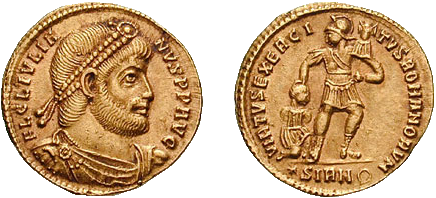
Emperor Julian Ιουλιανός ὁ Αποστάτης (361–363 CE)
What It Is: Two works by the last pagan Emperor of Rome. The Hymn to King Helios (Oration IV) is a theological treatise in the form of a hymn, arguing that the Sun (Helios) is the visible image of the Intelligible Good the mediator between the transcendent divine world and the material cosmos. Against the Galileans (Contra Galilaeos) is a systematic polemic against Christianity, arguing that the God of the Jews is a minor tribal deity who was falsely promoted to cosmic sovereignty, that the Christian doctrine contradicts both reason and the ancient wisdom, and that the traditional Gods of the nations are the true divine powers. Only fragments of Against the Galileans survive, preserved ironically by the Christian apologist Cyril of Alexandria who quoted it in order to refute it.
Why It Matters: Julian is the most important figure in the history of the attempted restoration of ancient religion. He was raised Christian, educated in the Greek philosophical tradition, and initiated into the Eleusinian Mysteries and the theurgy of the Chaldean Oracles. When he became Emperor, he attempted to reverse the Christianisation of the Empire not through persecution but through the restoration of temples, the reform of pagan priesthood, and the intellectual demolition of Christian theology. His Hymn to King Helios establishes the solar theology that runs through all of Zevism: the Sun is not merely a physical object but the visible manifestation of divine intelligence, the source of all life, light, and order in the material world. His critique of Christianity in Against the Galileans anticipates, by sixteen centuries, every argument that the Enlightenment would later deploy: that the Christian God is jealous, tribal, and morally inferior to the philosophical conception of the divine; that the Old Testament depicts a deity unworthy of worship; and that the ancient traditions carry a wisdom that the new faith has destroyed.
Julian failed. He reigned for only twenty months before dying in battle against the Persians. The Christian tradition labelled him “the Apostate” the one who fell away. In the Zevistic reading, he did not fall away. He returned. He was the last sovereign to attempt from a throne what the Temple of Zeus now attempts from a different position: the restoration of the Gods to their rightful place in human civilisation.
What to Take From It: The Sun is the visible image of the supreme divine intelligence. Christianity is a theological regression, not an advance it replaced the rich, pluralistic, philosophically sophisticated theology of the ancient world with a narrow tribal monotheism that demands faith over understanding. The restoration of the ancient religion is not nostalgia; it is a theological necessity. Julian’s failure was political; his theology was correct. The work continues.
Julian is not the Apostate. He is the Returner. His hymn to Helios is a hymn to the light that Yehubor could not extinguish. His polemic against the Galileans is the polemic of every Zevist against every Yehuboric programme. He died on the battlefield. The war did not end with him.