
 አማርኛ
አማርኛ العربية
 বাংলা
বাংলা Български
 中文
中文 Čeština
 Dansk
Dansk Deutsch
 Eesti
Eesti Ελληνικά
 Español
 Français
 हिन्दी
 Hrvatski
 IsiZulu
 Italiano
 日本語
日本語 Kiswahili
 Magyar
 Македонски
 नेपाली
 Nederlands
 فارسی
فارسی Polski
 Português
 Română
 Русский
 Slovenščina
 Suomi
Suomi Svenska
 Tagalog
 Türkçe
THE BHAGAVAD GITA
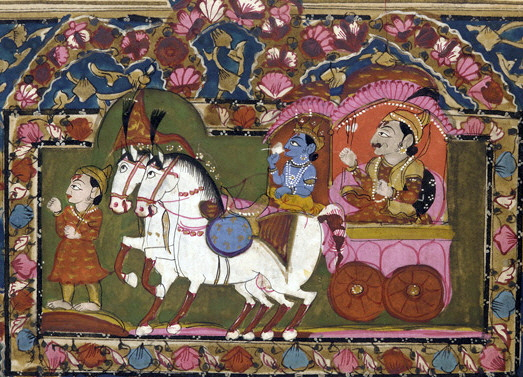
Krishna to Arjuna (c. 400 BCE–200 CE) 700 Verses, 18 Chapters
What It Is: A 700-verse dialogue between the warrior prince Arjuna and the God Krishna, set on the battlefield of Kurukshetra at the moment before a catastrophic civil war. Arjuna, seeing his kinsmen, teachers, and friends arrayed on both sides, throws down his bow and refuses to fight. Krishna, who is serving as his charioteer, responds with eighteen chapters of theological instruction that constitute the most complete surviving dialogue between a God and a human being. The Gita is embedded within the Mahabharata, the great Indian epic, but functions as an independent theological treatise. Krishna reveals the nature of the soul (Atman), the structure of cosmic duty (Dharma), the three paths of liberation knowledge (Jnana Yoga), devotion (Bhakti Yoga), and selfless action (Karma Yoga) and ultimately reveals His cosmic form (Vishvarupa): the totality of all existence contained within the body of one God.
Why It Matters: The Gita addresses the supreme ethical question: how does a person of conscience act in a world where action itself causes suffering? Arjuna’s dilemma is not abstract if he fights, he kills his own family; if he does not fight, he abandons his duty as a warrior and allows injustice to prevail. This is the exact dilemma codified in the Zevistic Death and Slaying Ethics, particularly Cases IV (National War) and X (Military Command). Krishna’s answer is not simplistic: he does not say “kill without remorse” nor does he say “refuse to fight.” He says: act in accordance with your Dharma (duty/Ma’at), without attachment to the fruits of the action, offering every act to the divine. This is the ethics of the active soul not withdrawal, not indifference, but engaged action purified of ego.
The Gita’s doctrine of the eternal, indestructible soul (Atman) corresponds precisely to the Egyptian Ba/Akh and to the Platonic immortal soul. Krishna’s declaration “I am the origin of all; from Me all things proceed” (10.8) is identical in theological content to the Orphic Fragment: “Zeus is the first, Zeus is the last, Zeus is all things and whatsoever is greater than all things.” The revelation of the Vishvarupa the cosmic form in which Arjuna sees all beings, all times, all worlds contained within one divine body is the visual equivalent of what the Stoics meant by the Logos and what the Zevistic framework means by Zeus as the governing intelligence of all that exists.
What to Take From It: The soul is eternal and cannot be destroyed. Action in accordance with divine law (Dharma/Ma’at) is the duty of the living. Selfless action, purified of ego and offered to the Gods, is the highest path. Devotion to the Gods is a valid and complete path. The God who speaks to you on the battlefield of your life is the same God who contains the entire cosmos within Himself. All genuine paths lead to the same summit. The Zevist reads the Gita as a manual for ethical action under the most extreme conditions the conditions that define the human situation.
"I am the origin of all. From Me all things proceed."Bhagavad Gita 10.8. Krishna speaks what Zeus embodies. The voice is one. The language changes. The truth does not.