 አማርኛ
አማርኛ العربية
 বাংলা
বাংলা Български
 中文
中文 Čeština
 Dansk
Dansk Deutsch
 Eesti
Eesti Ελληνικά
 Español
 Français
 हिन्दी
 Hrvatski
 IsiZulu
 Italiano
 日本語
日本語 Kiswahili
 Magyar
 Македонски
 नेपाली
 Nederlands
 فارسی
فارسی Polski
 Português
 Română
 Русский
 Slovenščina
 Suomi
Suomi Svenska
 Tagalog
 Türkçe
THE BOOK OF THE DEAD
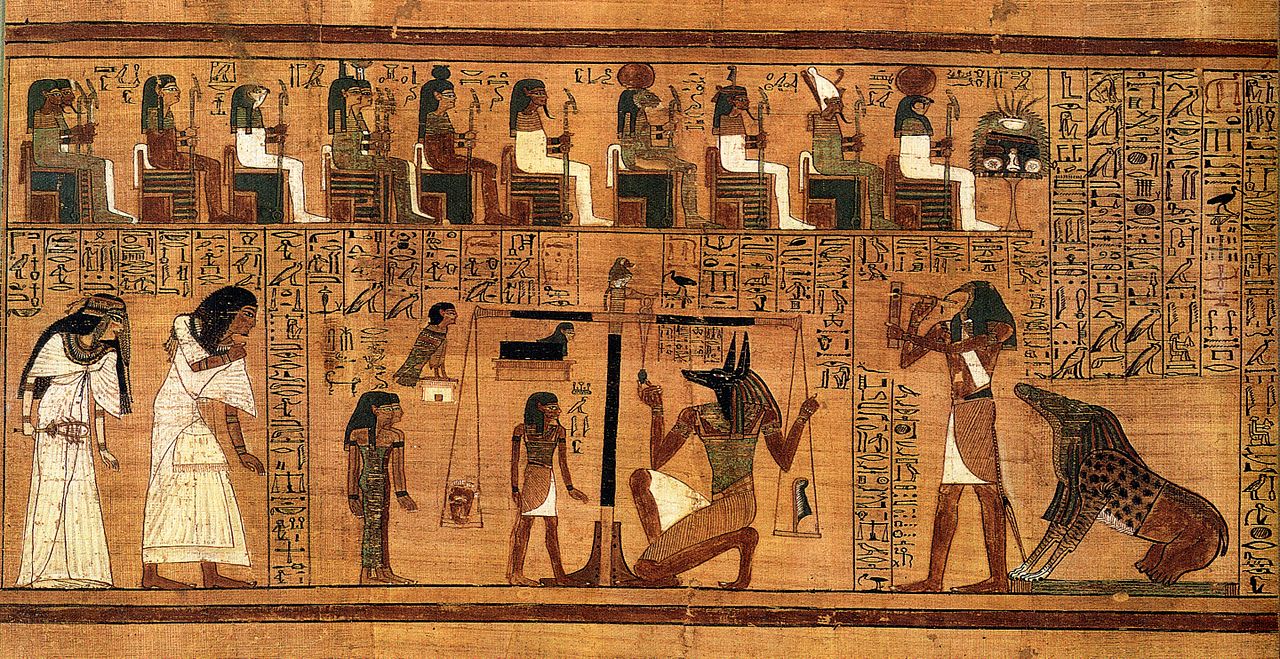
The Book of Coming Forth by Day (c. 1550–1070 BCE, drawing on far older sources)
What It Is: A collection of approximately 200 hymns, prayers, and instructions written on papyrus and placed in the coffin with the deceased to guide the soul through the Duat (the Egyptian underworld / afterlife realm) and into the eternal presence of Osiris and the Gods. The title commonly used “Book of the Dead” is a modern misnomer. The Egyptian title is Pert em Heru: “The Book of Coming Forth by Day.” The Yehubor have both perverted the contents and even the title; from a book of how to survive in the afterlife, to a book of death. It is not a book about death. It is a book about emergence about the soul’s passage through the darkness of dissolution and its triumphant return into the light. The spells vary from copy to copy; no two papyri are identical, because each was customised for the individual deceased. The most famous section is Spell 125: the Weighing of the Heart, in which the deceased stands before the scales of Ma’at, declares innocence of forty-two specific sins (the Negative Confession), and has the heart weighed against the feather of Ma’at by Anubis, with Thoth recording the result and Ammit the Devourer waiting to consume those who fail.
Why It Matters: The Book of Coming Forth by Day is the foundational text of all Western eschatology. Every subsequent tradition’s account of the afterlife the Christian Last Judgement, the Islamic Mizan (scales of judgement), the Greek katabasis derives, directly or indirectly, from the Egyptian model codified here. But the Egyptian original is richer, more precise, and more honest than any of its derivatives, because it does not rely on the arbitrary mercy of a single God. The judgement is structural, not personal. Ma’at is not a mood of the divine; it is the law of the cosmos itself. The heart is weighed against a feather against truth, against proportion, against the cosmic order. There is no intercession. There is no forgiveness purchased through belief. There is only the weight of what you did and what you are.
The Negative Confession (Spell 125) is the oldest surviving ethical code in human history predating the Mosaic Decalogue by a millennium. The deceased declares the ethical system of Ma’at. The ethical system is not based on commandments imposed from above; it is based on a self-declaration of alignment with Ma’at. The soul does not say “You told me not to kill and I obeyed.” The soul says “I have not killed” taking ownership, declaring its own nature, standing before the scales on the strength of its own record. This is the difference between Zevistic ethics and Yehuboric ethics in its purest form: the one demands that you account for yourself; the other demands that you obey without reason.
For the Zevist, the Book of Coming Forth by Day is not a historical curiosity. It is the operating manual of the soul’s post-mortem journey the most detailed surviving map of the terrain that every soul must navigate after the death of the body. The spells are not magical formulas in the superstitious sense; they are instructions for navigating specific challenges, identifying specific guardians, and speaking specific truths at specific gates. They are the Egyptian equivalent of the Tibetan Bardo Thodol a guidebook for the dead, composed by those who understood the architecture of what lies beyond.
What to Take From It: The soul is judged not by belief but by conduct. Ma’at is the standard, and the standard is structural, not arbitrary. The Negative Confession is the oldest ethical code on earth and the template for Zevistic moral self-examination. The afterlife is not a reward or a punishment; it is a continuation of the soul’s journey, navigable through knowledge, preparation, and alignment with truth. Ammit devours those who lived in Izfet. The feather does not lie. The scales do not negotiate.
The heart is placed on one side. The feather of Ma’at on the other. There is no advocate. There is no intercessor. There is no purchased forgiveness. There is only what you are, weighed against what is true. This is the judgement that every Zevist prepares for not after death, but every day.