 አማርኛ
አማርኛ العربية
 বাংলা
বাংলা Български
 中文
中文 Čeština
 Dansk
Dansk Deutsch
 Eesti
Eesti Ελληνικά
 Español
 Français
 हिन्दी
 Hrvatski
 IsiZulu
 Italiano
 日本語
日本語 Kiswahili
 Magyar
 Македонски
 नेपाली
 Nederlands
 فارسی
فارسی Polski
 Português
 Română
 Русский
 Slovenščina
 Suomi
Suomi Svenska
 Tagalog
 Türkçe
THE CORPUS HERMETICUM
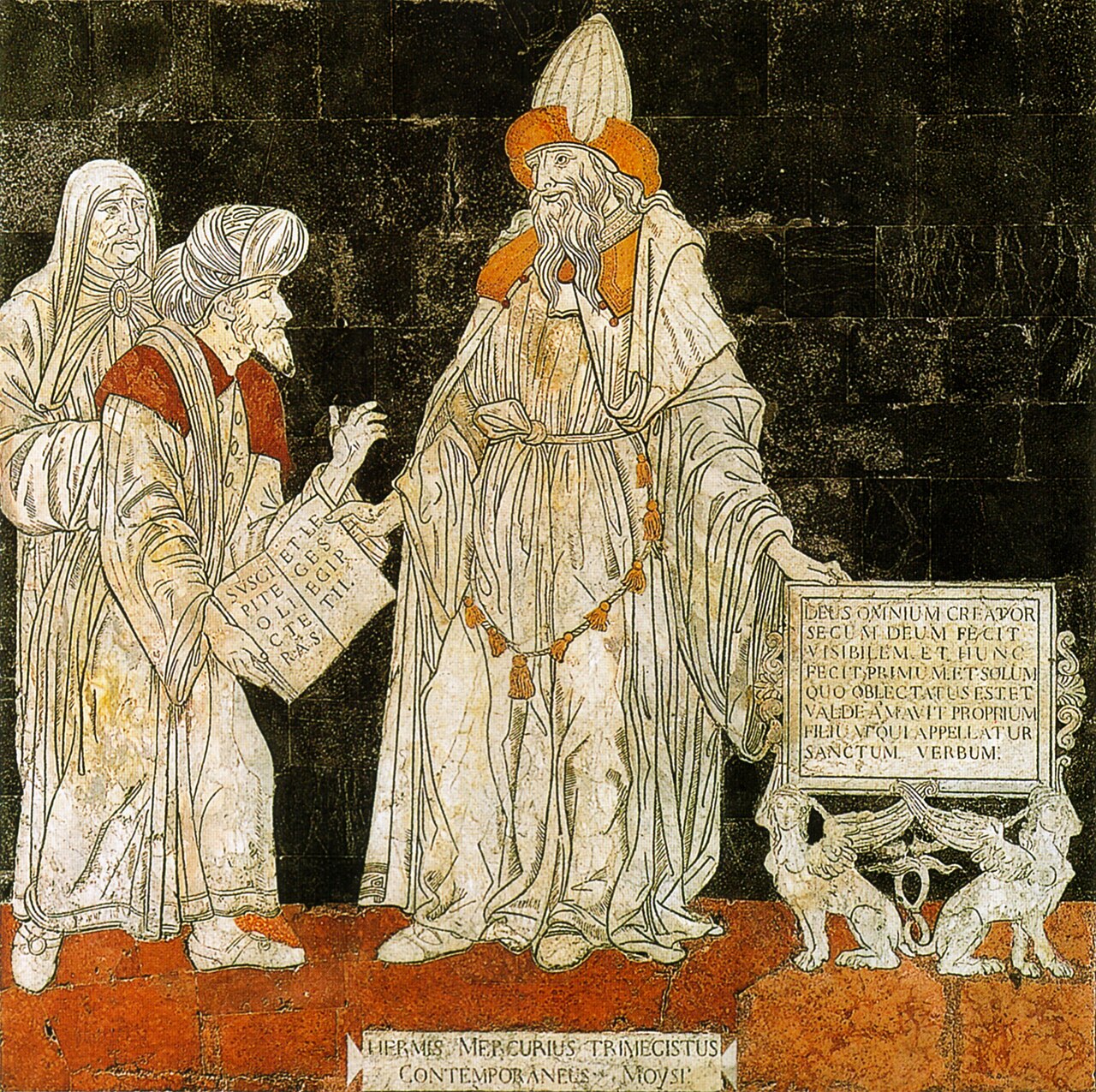
Ερμοῦ τοῦ Τρισμεγίστου Hermes Trismegistus (c. 100–300 CE) 17 Treatises + Asclepius
What It Is: A collection of seventeen Greek treatises and the Latin Asclepius, attributed to Hermes Trismegistus (“Thrice-Great Hermes”) the syncretic fusion of the Greek Hermes and the Egyptian Thoth, God of wisdom, writing, magic, and the mediation between worlds. The texts take the form of dialogues: Hermes instructs his son Tat, his disciple Asclepius, and the divine Nous (Mind) itself speaks through him. The first treatise, the Poimandres, narrates a cosmogonic vision in which the divine Mind reveals to Hermes the creation of the cosmos, the nature of the human soul, and the path of ascent through the planetary spheres back to the divine source. The subsequent treatises explore the nature of God, the cosmos, the soul, reincarnation, the problem of evil, the meaning of silence, and the practice of spiritual regeneration.
Why It Matters: The Corpus Hermeticum is the theological bridge between Egypt and Greece the point where the oldest wisdom tradition on earth meets the most sophisticated philosophical language ever developed. It is also the foundational text of the entire Western esoteric tradition: alchemy, astrology, Kabbalah, Renaissance magic, Rosicrucianism, Freemasonry, and Theosophy all trace their lineage through Hermes Trismegistus. When Marsilio Ficino translated the Corpus Hermeticum into Latin in 1463 before he translated Plato he ignited the Hermetic Renaissance that would eventually crack the monopoly of Christian theology on European thought.
The Poimandres (Treatise I) contains the most important cosmogonic vision in the Western esoteric tradition. The divine Mind (Nous) shows Hermes a vision: first, boundless light the nature of God. Then, darkness descending watery chaos, groaning and crying out. Then, a holy Word (Logos) proceeding from the light into the darkness, and nature being ordered by that Word. Then, the creation of the Anthropos the divine Human, equal to God, who descends through the planetary spheres, falls in love with Nature, and becomes entrapped in matter. The path of salvation is the reversal of this descent: the soul must ascend back through the spheres, shedding at each level the planetary influence it acquired during its descent, until it reaches the Ogdoad (the eighth sphere, beyond the seven planets) and is reunited with the divine source.
This cosmology is the structural template for all subsequent Western esotericism. The seven planetary spheres through which the soul descends and must re-ascend correspond to the seven gates of Ishtar’s descent, to the seven chakras of the Yogic system, to the seven levels of the Kabbalistic Tree. The ascent through the spheres is the theurgical path described in the Chaldean Oracles. The Anthropos the divine Human who is equal to God but has fallen into matter is the Zevist’s own self-understanding: we are not worms grovelling before a tyrant God; we are divine beings who have descended into material existence and whose task is to remember, awaken, and ascend.
The famous Hermetic axiom “As above, so below; as below, so above” (from the Emerald Tablet, a related text) is not mystical vagueness. It is a precise operational principle: the structure of the cosmos is mirrored at every level, and the practitioner who understands the correspondences between levels can operate on one level by manipulating another. This is the theoretical foundation of all magic, all theurgy, all ritual practice. It is what makes the synthemata of the Chaldean Oracles work, what makes the voces magicae of the PGM operative, and what makes Zevistic ritual effective.
What to Take From It: The human being is divine in nature and has descended into matter. The path of return is through knowledge (gnosis), not through obedience. The seven planetary spheres are both the architecture of the cosmos and the map of the soul’s descent and ascent. “As above, so below” is an operational principle, not a platitude. The Corpus Hermeticum teaches the Zevist the theoretical foundation of all theurgical practice: the cosmos is structured by correspondences, and the soul that knows the correspondences can navigate the structure.
"The Mind, the Father of all, who is life and light, brought forth a Human Being equal to Himself, whom He loved as His own child."Poimandres. You are not a servant. You are not a worm. You are the child of the divine Mind, equal to your source. The Hermetica remembers what the Yehuboric programme made you forget.