 አማርኛ
አማርኛ العربية
 বাংলা
বাংলা Български
 中文
中文 Čeština
 Dansk
Dansk Deutsch
 Eesti
Eesti Ελληνικά
 Español
 Français
 हिन्दी
 Hrvatski
 IsiZulu
 Italiano
 日本語
日本語 Kiswahili
 Magyar
 Македонски
 नेपाली
 Nederlands
 فارسی
فارسی Polski
 Português
 Română
 Русский
 Slovenščina
 Suomi
Suomi Svenska
 Tagalog
 Türkçe
THE EMERALD TABLET & THE ASCLEPIUS
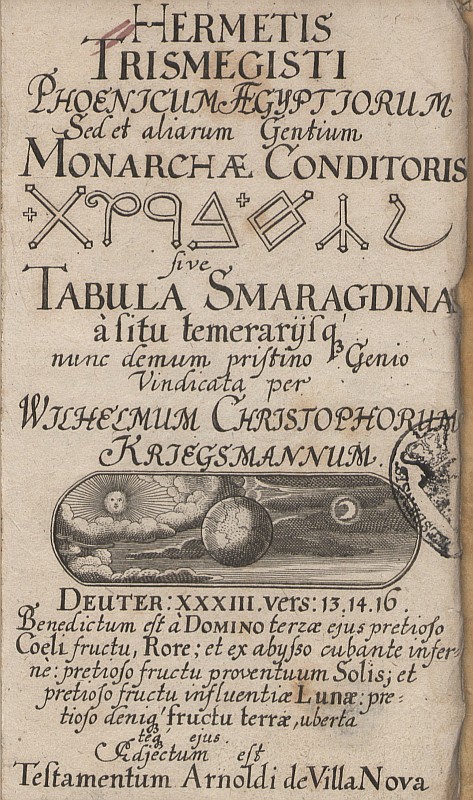
Tabula Smaragdina (c. 600–800 CE, encoding far older doctrine) + Asclepius / The Perfect Discourse (c. 100–300 CE)
What It Is: Two related Hermetic texts. The Emerald Tablet (Tabula Smaragdina) is a short text of approximately thirteen lines, attributed to Hermes Trismegistus, claiming to contain the secret of the prima materia and the formula of transmutation. It survives in Arabic translation (from the Sirr al-Khaliqa of Balinas, c. 8th century CE) and in multiple Latin versions that circulated throughout medieval and Renaissance Europe. It is the most famous single text in the history of Western esotericism. The Asclepius (also known as The Perfect Discourse) is a longer Hermetic dialogue in which Hermes instructs Asclepius on the nature of the cosmos, the divinity of humanity, the animation of statues by theurgical practice, and in a famous prophetic passage the coming destruction of Egyptian religion by a foreign faith, and its eventual restoration.
Why It Matters: The Emerald Tablet contains, in thirteen lines, the entire theoretical foundation of Hermetic practice. Its opening axiom “What is below is like what is above, and what is above is like what is below, to accomplish the miracles of the One Thing” is the principle of cosmic correspondence that underlies all magical, theurgical, and alchemical practice in every tradition. It is the reason that ritual works: because the structure of the microcosm mirrors the structure of the macrocosm, and an operation performed on one level resonates on all levels. Without this principle, there is no theurgy, no sympathetic magic, no astrological medicine, no chakra work, no ritual invocation. With it, the entire operative dimension of Zevism becomes intelligible.
The Asclepius is equally foundational, and for a specific reason: it contains the Lament. In chapters 24–26, Hermes prophesies the death of Egyptian religion: “O Egypt, Egypt, of thy religion nothing will remain but an empty tale, which thine own children in time to come will not believe; nothing will be left but graven words, and only the stones will tell of thy piety.” He describes how foreign laws will be imposed, how the temples will be destroyed, how the Gods will withdraw from the earth, and how humanity will be left in spiritual darkness. Then he declares that this darkness is not permanent: “The Gods who exercise their dominion over the earth will be restored, and they will be installed in a city at the extreme limit of Egypt.”
For the Zevist, this passage is not merely prophetic; it is diagnostic. The Lament describes with perfect accuracy what actually happened: the Christianisation of the Roman Empire, the destruction of the temples (the Serapeum of Alexandria was demolished in 391 CE), the prohibition of traditional worship, and the imposition of a foreign theology by imperial force. But the promise of restoration that the Gods will return is the promise that Zevism itself works to fulfil. The Lament is not a cry of despair; it is a prophecy of return. The darkness was foreseen. The restoration was promised. The work continues.
The Asclepius also contains the most explicit surviving description of the theurgical animation of statues the practice of drawing divine presence into material images through ritual, sacred substances, and invocation. This was the practice that the Christians found most horrifying and that they cited as evidence of “demon worship.” In fact, it is the most sophisticated form of theurgical practice in the ancient world: the creation of a material vessel capable of housing divine presence, making the God accessible to human communion. It corresponds to the Hindu practice of prana pratishtha (installing life-breath in a temple image), the Japanese shintai (the sacred object in which the kami dwells), and the Zevistic understanding that the material world is not opposed to the divine but is its proper dwelling-place.
What to Take From It: “As above, so below” is the foundational principle of all operative practice. The destruction of Egyptian religion was prophesied by the tradition itself and so was its restoration. The animation of sacred images is not superstition but the highest form of theurgical art. The Lament of the Asclepius is the diagnosis; Zevism is the cure. The Emerald Tablet teaches the Zevist the formula; the Asclepius teaches the Zevist the history and the promise.
"O Egypt, Egypt, of thy religion nothing will remain but an empty tale."Hermes prophesied the destruction. He also prophesied the return. The temples were destroyed. The Gods withdrew. The stones remained. And now the stones speak again. The restoration that the Asclepius promised is the work the Temple of Zeus performs.