
 አማርኛ
አማርኛ العربية
 বাংলা
বাংলা Български
 中文
中文 Čeština
 Dansk
Dansk Deutsch
 Eesti
Eesti Ελληνικά
 Español
 Français
 हिन्दी
 Hrvatski
 IsiZulu
 Italiano
 日本語
日本語 Kiswahili
 Magyar
 Македонски
 नेपाली
 Nederlands
 فارسی
فارسی Polski
 Português
 Română
 Русский
 Slovenščina
 Suomi
Suomi Svenska
 Tagalog
 Türkçe
THE ILIAD
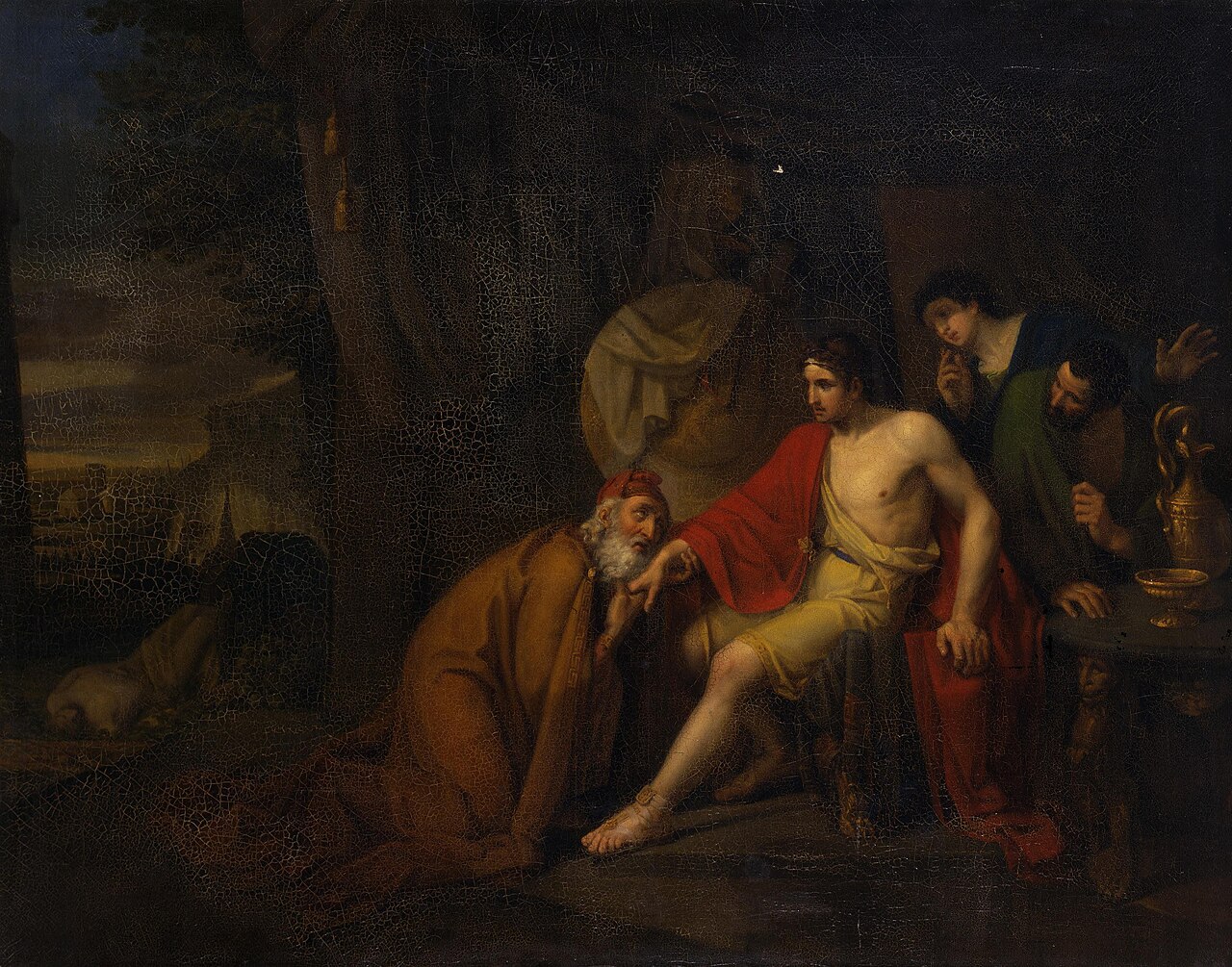
Ἰλι᾽άς Homer (c. 750–700 BCE) 24 Books, 15,693 Lines
What It Is: The foundational epic of Western civilisation. Set during a few weeks of the tenth year of the Trojan War, the Iliad narrates not the war itself but its spiritual anatomy: the wrath (μῆνις) of Achilles, its causes in dishonour, its consequences in catastrophic loss, and its resolution through compassion and the shared recognition of mortality. Twenty-four books composed in dactylic hexameter, attributed to Homer, containing the most complete surviving portrait of the Gods in active relationship with humanity intervening, guiding, deceiving, protecting, and arguing among themselves over the fate of mortals.
Why It Matters: The Iliad is not a war story. It is the instruction manual for the soul under conditions of conflict the most detailed surviving document on how the Gods interact with human beings in the theatre of extremity, and what happens to the soul when it is governed by θυμός (spiritedness, passion, the seat of rage and courage) rather than by νοῦς (intellect, discernment). Read through the lens of Zevism, which is its distillation, every major event in the Iliad is a teaching on the relationship between Ma’at and Izfet.
The wrath of Achilles is the central case study. Agamemnon dishonours Achilles by seizing his war-prize an act of Izfet: the abuse of hierarchical authority for personal gratification. Achilles’ response withdrawing from battle, allowing his own allies to die is also Izfet: the subordination of collective duty to personal grievance. Both men are wrong. Both are punished. The poem does not take sides between them; it shows how the chain reaction of dishonour produces catastrophe. Agamemnon’s Izfet breeds Achilles’ Izfet, which breeds Patroclus’s death, which breeds Hector’s death, which will breed Troy’s destruction. Izfet cascades. One act of injustice generates ten.
The Gods in the Iliad are not decorative. They are operative. Zeus holds the scales of fate literally, in Book VIII and Book XXII, weighing the lives of heroes. Athena intervenes to prevent Achilles from killing Agamemnon in Book I not because murder is abstractly wrong, but because the timing is wrong: this is μῆτις (divine intelligence) overriding θυμός (blind passion). Apollo sends plague when his priest is dishonoured a direct demonstration that the Gods enforce Ma’at upon those who violate it. The entire divine apparatus of the Iliad teaches the Zevist that the Gods are not distant: they are present, engaged, and consequential. They do not merely watch; they intervene. And the nature of their intervention is always the correction of Izfet even when that correction is painful, even when it means the destruction of those they love.
The supreme teaching of the Iliad is its final book. Priam, the old king of Troy, crosses the battlefield alone at night to beg Achilles for the body of his son Hector. Achilles, who has been desecrating that body for days dragging it behind his chariot, an act of supreme Izfet looks at the old man and sees his own father. Both men weep together. Achilles returns the body. The funeral of Hector ends the poem. This is the restoration of Ma’at through compassion: not through force, not through law, not through divine command, but through the mutual recognition of mortality, of shared suffering, of the fact that enemy and ally alike are children of the same mortal condition. The Iliad’s final lesson is that the warrior’s highest ἀρετή (excellence) is not killing but the capacity to stop killing to see the human being inside the enemy.
What to Take From It: Dishonour cascades: one act of Izfet generates a chain of destruction that devours both sides. The Gods are not passive; they hold the scales and they intervene. θυμός (passion-anger) without νοῦς (discernment) is catastrophic, no matter how brave the warrior. The highest ἀρετή (Virture) is the capacity for compassion after combat. War is part of the mortal condition and must be conducted under Ma’at or it consumes everything. The poem does not glorify war; it teaches you how to survive it with your soul intact. Read the Iliad as a manual for how the soul navigates conflict not as literature, but as instruction.
The Iliad is not a poem about war. It is a poem about what war does to the soul and what the soul must do to recover. Achilles’ journey from rage to compassion is the template: the warrior who cannot stop killing is lost; the warrior who learns to weep with his enemy has found Ma’at.