
 አማርኛ
አማርኛ العربية
 বাংলা
বাংলা Български
 中文
中文 Čeština
 Dansk
Dansk Deutsch
 Eesti
Eesti Ελληνικά
 Español
 Français
 हिन्दी
 Hrvatski
 IsiZulu
 Italiano
 日本語
日本語 Kiswahili
 Magyar
 Македонски
 नेपाली
 Nederlands
 فارسی
فارسی Polski
 Português
 Română
 Русский
 Slovenščina
 Suomi
Suomi Svenska
 Tagalog
 Türkçe
THE IWATO MYTH THE HIDING OF AMATERASU
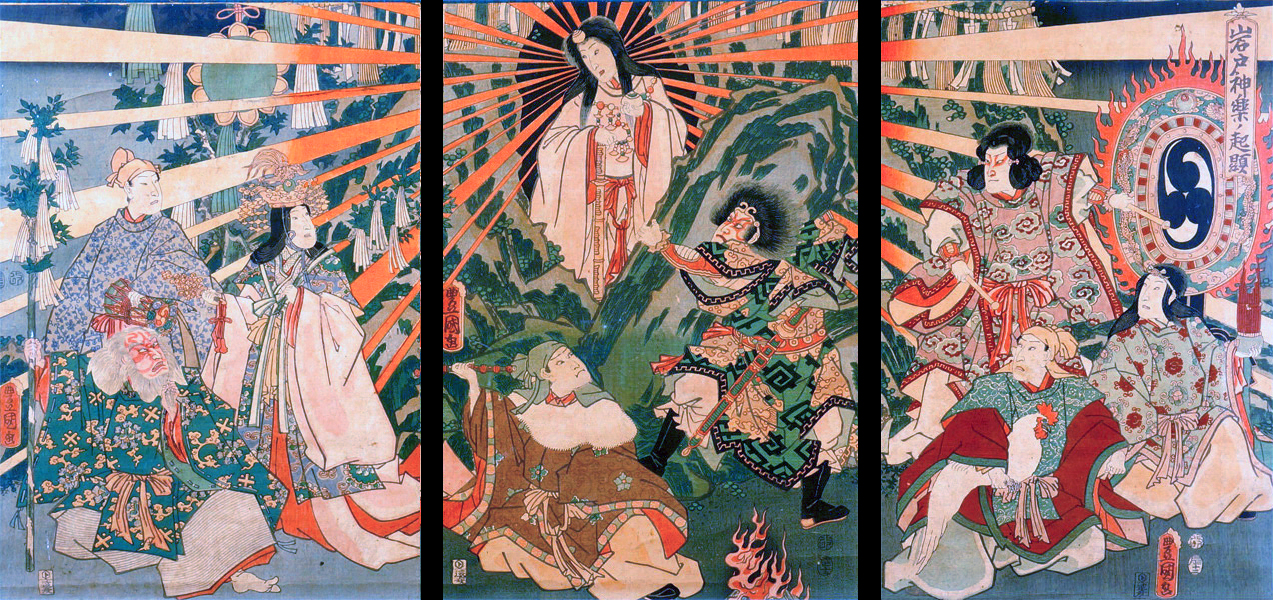
天岩戸神話 From the Kojiki and Nihon Shoki
What It Is: The central theological myth of the Shinto tradition. After her brother Susanoo (the Storm God) violates the sacred spaces of Heaven through a series of outrages destroying rice paddies, defecating in the hall of first-fruits, and throwing a flayed horse through the roof of the weaving hall (causing the death of one of Amaterasu’s attendants) Amaterasu, the Sun Goddess, withdraws into a cave (Ama-no-Iwato) and seals the entrance with a boulder. The cosmos is plunged into darkness. Evil spirits proliferate. All life begins to wither. The eight hundred myriads of kami assemble and devise a plan: the Goddess Ame-no-Uzume performs an ecstatic, erotic dance on an overturned tub before the cave, causing the assembled Gods to roar with laughter. Amaterasu, curious, opens the cave a crack; a mirror is held before her; she sees her own radiance reflected and is drawn out. The light returns. The cosmos is restored.
Why It Matters: This myth encodes one of the deepest teachings in any theological tradition: the light cannot be forced out of hiding. It must be lured. The assembled Gods do not storm the cave, do not threaten Amaterasu, do not command her to return. They use joy, laughter, beauty, and curiosity the very qualities that Izfet seeks to destroy. Ame-no-Uzume’s dance is the original sacred performance: art, eroticism, and divine comedy deployed as a theurgical technology to restore cosmic order. The teaching is that darkness is overcome not by violence but by the irresistible attraction of joy.
The mirror (Yata no Kagami) held before Amaterasu is one of the three Imperial Regalia of Japan and carries a teaching of its own: the Sun Goddess is drawn out of hiding by seeing her own light. She did not know how radiant she was until the mirror showed her. This is the function of ritual, of worship, of devotion: to hold up a mirror to the divine and show the God to the God. The act of worship does not flatter the Gods or feed their vanity; it reminds them and through them, reminds the cosmos of the light that exists. The Zevist who performs ritual is performing the same function as the mirror before the cave: reflecting the divine radiance so that it re-enters the world.
The myth also teaches the consequences of divine withdrawal. When Amaterasu hides, the cosmos does not merely become dark; it becomes disordered. Evil spirits multiply. Crops fail. The natural order collapses. This is the Japanese expression of the same truth that the Descent of Ishtar teaches: without the divine feminine presence, the cosmos cannot function. Amaterasu is not decorative; she is structurally necessary. Her absence is not merely noticed; it is catastrophic. The Zevist reads this as confirmation that the divine is not optional the cosmos without the Gods is not merely impoverished; it is dying.
What to Take From It: The divine light cannot be forced; it must be attracted through joy, beauty, and art. Ritual functions as a mirror that reflects divine radiance back into the world. The withdrawal of the divine is not merely inconvenient; it is cosmically catastrophic. The divine feminine is structurally essential to the survival of the cosmos. Laughter and joy are legitimate theurgical technologies. The Iwato myth teaches the Zevist that the restoration of Ma’at requires not only courage and discipline but also beauty, humour, and the irresistible vitality that Izfet cannot imitate.
The Gods did not storm the cave. They danced before it. They laughed. They held up a mirror. And the Sun, curious, emerged. The Iwato myth teaches what no Yehuboric theology can conceive: the divine is restored not by obedience but by joy.