
 አማርኛ
አማርኛ العربية
 বাংলা
বাংলা Български
 中文
中文 Čeština
 Dansk
Dansk Deutsch
 Eesti
Eesti Ελληνικά
 Español
 Français
 हिन्दी
 Hrvatski
 IsiZulu
 Italiano
 日本語
日本語 Kiswahili
 Magyar
 Македонски
 नेपाली
 Nederlands
 فارسی
فارسی Polski
 Português
 Română
 Русский
 Slovenščina
 Suomi
Suomi Svenska
 Tagalog
 Türkçe
THE KOJIKI
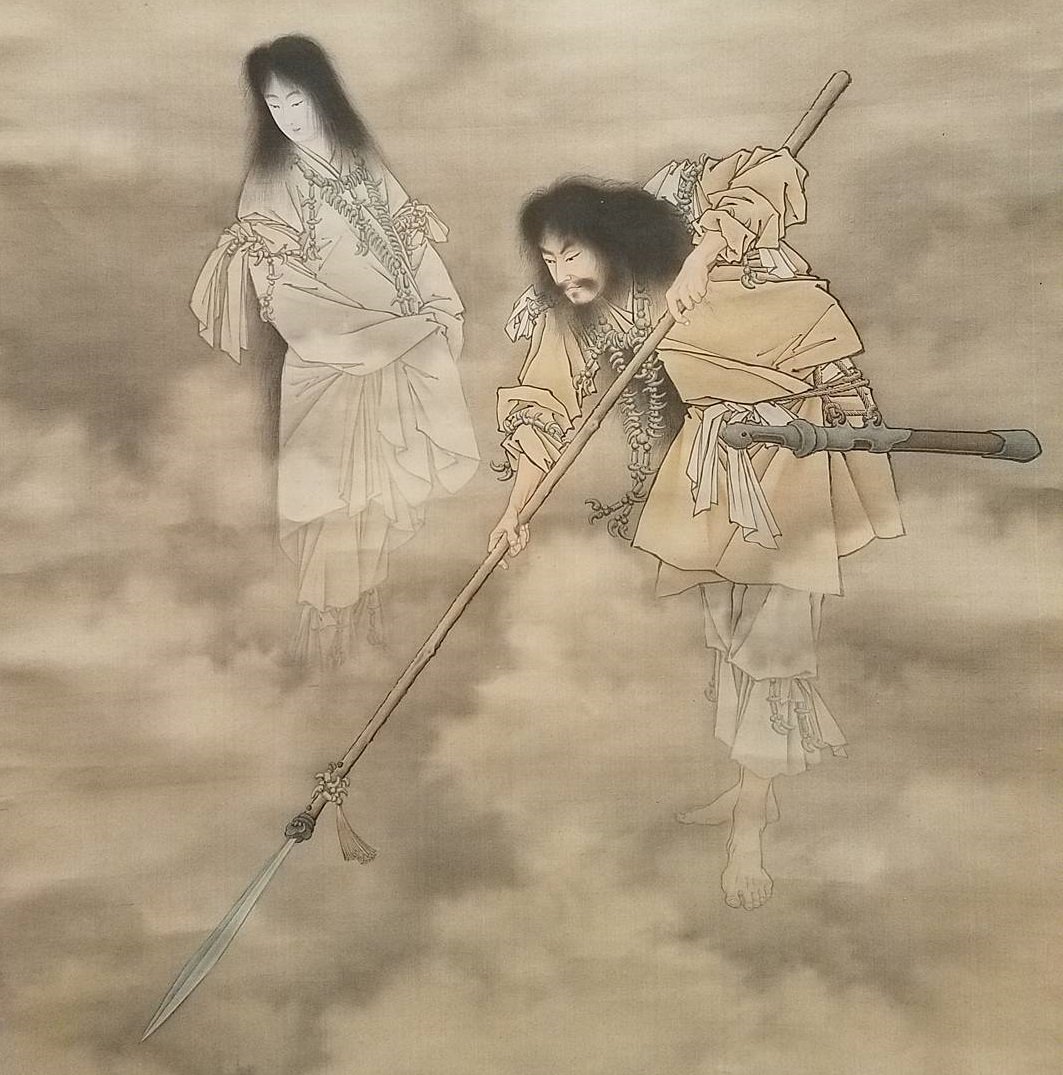
古事記 Record of Ancient Matters (712 CE) 3 Books
What It Is: The oldest surviving chronicle of Japan, compiled by Ō no Yasumaro from oral tradition at the command of Empress Gemmei. It narrates the cosmogony of the Shinto tradition: the spontaneous emergence of the first Gods (kami) from primordial chaos, the creative acts of the divine couple Izanagi and Izanami (who stir the cosmic ocean with a jewelled spear and generate the islands of Japan and the pantheon of Gods), the descent of Izanagi to the underworld of Yomi to retrieve his dead wife, the purification of Izanagi upon his return (from which the supreme deities Amaterasu, Tsukuyomi, and Susanoo are born), and the subsequent sacred history of the Gods and the divine lineage of the Japanese imperial house. It is written in a hybrid of archaic Japanese and classical Chinese, and its earliest sections preserve oral tradition of immense antiquity.
Why It Matters: The Kojiki demonstrates that the theological patterns found in Egypt, Greece, India, and Mesopotamia are also present in a civilisation that developed largely independent of Western influence. The emergence of the cosmos from chaos, the divine creative couple that generates the world, the descent to the underworld (Izanagi’s journey to Yomi is structurally identical to Orpheus descending for Eurydice and Ishtar descending to Irkalla), the supreme solar deity (Amaterasu, the Sun Goddess, corresponds to Ra, Helios, and Surya) these are universal patterns because they describe universal realities. The Kojiki confirms that the ancient theology is not regional. It is planetary.
The purification of Izanagi after his return from the underworld is of particular theological significance. Having entered the realm of death and decay, Izanagi performs misogi ritual purification by water and from this act of cleansing the three most important kami are born: Amaterasu (the Sun) from the washing of his left eye, Tsukuyomi (the Moon) from his right eye, and Susanoo (the Storm) from his nose. The teaching is precise: the greatest divine powers emerge not from an act of creation in the usual sense but from an act of purification after contact with death. The soul that descends, confronts the underworld, and purifies itself upon return generates new divine power. This is the initiatory pattern of the Descent of Ishtar, the Nekuia of the Odyssey, and the Eleusinian Mysteries confirmed at the eastern edge of the world by a tradition with no contact with any of them.
What to Take From It: The divine is in the natural world, not above it or opposed to it. The kami dwell in the landscape in mountains, rivers, trees, waterfalls, and stones. Purification (harae/misogi) is the foundation of spiritual practice, corresponding to the Egyptian Ma’at and the Greek katharsis. The cosmos is generated by divine creative pairs, not by a solitary creator. The descent to the underworld and the return are the universal initiatory template. The same theology, the same patterns, the same truths confirmed from the East.
Izanagi descended to the land of the dead. He returned. He purified himself in flowing water. And from that purification, the Sun was born. The Kojiki confirms from the farthest East what Egypt, Greece, and India declared: the soul that confronts death and purifies itself generates light.