
 አማርኛ
አማርኛ العربية
 বাংলা
বাংলা Български
 中文
中文 Čeština
 Dansk
Dansk Deutsch
 Eesti
Eesti Ελληνικά
 Español
 Français
 हिन्दी
 Hrvatski
 IsiZulu
 Italiano
 日本語
日本語 Kiswahili
 Magyar
 Македонски
 नेपाली
 Nederlands
 فارسی
فارسی Polski
 Português
 Română
 Русский
 Slovenščina
 Suomi
Suomi Svenska
 Tagalog
 Türkçe
THE NIHON SHOKI
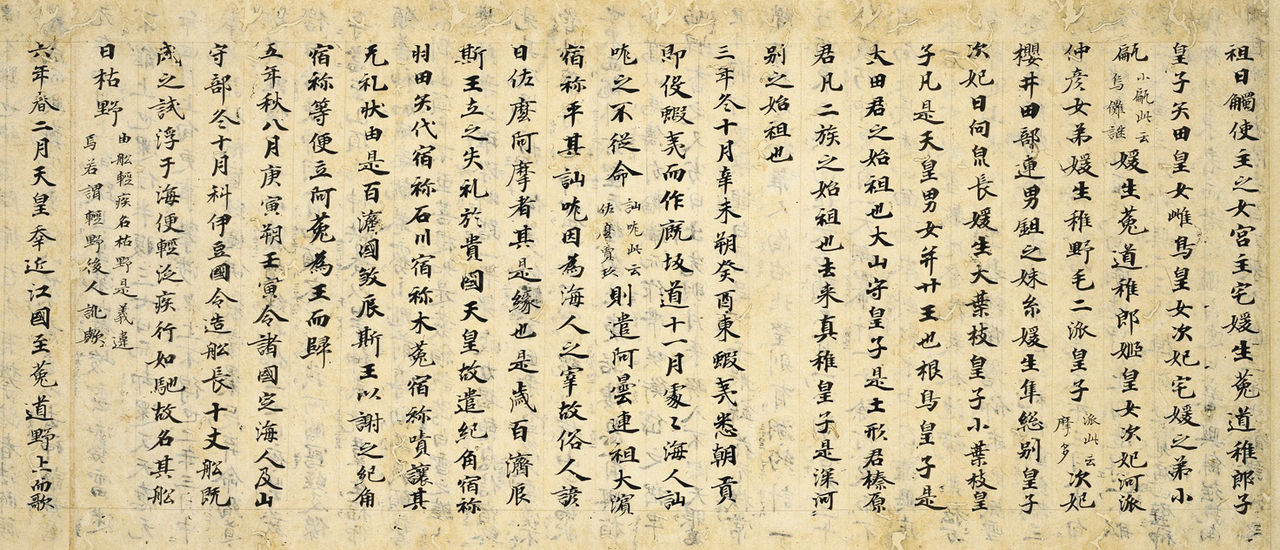
日本書紀 The Chronicles of Japan (720 CE) 30 Books
What It Is: The second oldest chronicle of Japan, completed eight years after the Kojiki. Written entirely in classical Chinese (the prestige literary language of East Asia at the time), the Nihon Shoki presents an alternative and more elaborated account of the same cosmogonic and mythological events recorded in the Kojiki, with the critical addition of variant versions. Where the Kojiki typically preserves one version of each myth, the Nihon Shoki records multiple variants sometimes as many as six or seven for a single episode preserving the diversity of regional traditions that coexisted before the imperial compilation standardised them.
Why It Matters: The Nihon Shoki is theologically invaluable precisely because it preserves the variants. In every living theological tradition, the same truth is expressed through multiple narratives. The Kojiki gives the canonical version; the Nihon Shoki gives the full spectrum. The story of how Amaterasu came to rule the heavens, for instance, appears in several versions with different emphases, different details, and different theological implications. This is not contradiction; it is the natural condition of a living mythology the same condition that produced multiple accounts of the Trojan War in Greece, multiple creation narratives in Egypt, and multiple cosmogonic hymns in the Rigveda. The Zevist reads variant myths not as errors but as complementary angles on the same divine reality.
The Nihon Shoki’s account of the Age of the Gods (Kamiyo) is more systematic and more cosmologically structured than the Kojiki’s. It opens with an explicit cosmogonic statement: in the beginning, heaven and earth were not yet separated; the In (Yin) and Yō (Yang) were not yet divided. The cosmos existed as a formless chaos, like an egg, containing within itself the seeds of all differentiation. When the light and pure element rose, it became heaven; when the heavy and turbid element settled, it became earth. This is recognisably the same cosmogonic model as the Greek separation of Heaven (Ouranos) from Earth (Gaia), the Egyptian emergence of the Atum from the Nun, and the Babylonian separation of heaven and earth from the body of Tiamat. The universal pattern is confirmed: the cosmos begins as undifferentiated unity and differentiates through a process of separation, purification, and ordering.
What to Take From It: Multiple versions of the same myth are not contradictions but complementary perspectives. Living theology is naturally diverse. The cosmogonic pattern of separation from primordial unity is universal. The Nihon Shoki preserves the full breadth of Japanese sacred narrative and confirms that the theological patterns of Zevism are found even in traditions that developed in complete independence from the Mediterranean world.
The Nihon Shoki records not one version but many because the Gods speak to different peoples in different voices, and every voice carries truth. The Zevist reads variants not as contradictions but as the natural richness of a theology that is alive.