
 አማርኛ
አማርኛ العربية
 বাংলা
বাংলা Български
 中文
中文 Čeština
 Dansk
Dansk Deutsch
 Eesti
Eesti Ελληνικά
 Español
 Français
 हिन्दी
 Hrvatski
 IsiZulu
 Italiano
 日本語
日本語 Kiswahili
 Magyar
 Македонски
 नेपाली
 Nederlands
 فارسی
فارسی Polski
 Português
 Română
 Русский
 Slovenščina
 Suomi
Suomi Svenska
 Tagalog
 Türkçe
THE VÖLSUNGA SAGA
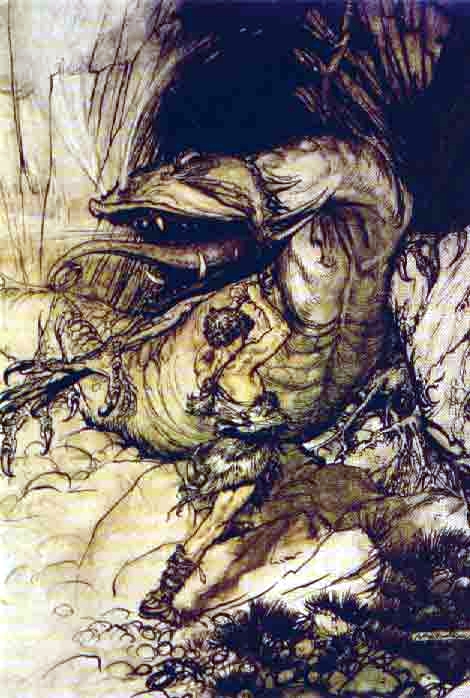
The Saga of the Völsungs (c. 1250–1270 CE, recording older oral and poetic tradition)
What It Is: A prose saga narrating the legendary history of the Völsung dynasty, from the divine origins of the lineage (descended from Odin) through the exploits of Sigmund, the birth of Sigurd (Siegfried), the slaying of the dragon Fáfnir, the acquisition of the cursed gold hoard, the awakening of the valkyrie Brynhildr, and the catastrophic chain of betrayal, murder, and destruction that the cursed gold brings upon everyone who possesses it. It is the primary source for Wagner’s Ring cycle and the broader Germanic heroic tradition.
Why It Matters: The Völsunga Saga is the Norse Mahabharata: an epic narrative in which personal heroism is systematically destroyed by the cascading consequences of greed, betrayal, and cursed wealth. The gold hoard taken from Fáfnir carries a curse that corrupts everyone who possesses it not through supernatural malice but through the psychological effects of possessing something that everyone else desires. The hoard is Izfet in material form: a concentration of value that generates envy, treachery, and murder wherever it goes. Sigurd, the greatest hero, is betrayed and killed not by a monster but by the people closest to him, motivated by desire for his gold and his wife. Brynhildr, the greatest of the valkyries, destroys herself and others out of wounded love and violated honour.
The saga teaches what the Iliad teaches and what the Mahabharata teaches: that Izfet cascades. One act of injustice in this case, the original theft of the gold from the dwarf Andvari generates a chain of consequences that devours everything it touches across multiple generations. No one in the saga is purely evil; everyone acts from motives that are at least partially comprehensible: loyalty, love, honour, ambition. But the cursed gold distorts every motive, turning loyalty into conspiracy, love into jealousy, honour into vengeance. The Völsunga Saga is the most devastating illustration in the Norse tradition of the principle that wealth acquired through injustice destroys the acquirer.
The figure of Sigurd is the Northern Achilles: divinely descended, supernaturally gifted, fated to die young. Like Achilles, his greatness is inseparable from his doom. Like Achilles, he is brought down not by a superior enemy but by the failure of the social order around him. His tragedy teaches the Zevist that individual áreté (excellence) is not sufficient to overcome systemic Izfet. The hero who operates in a corrupted system will be consumed by it, no matter how great his personal virtue. This is the same lesson as Karna in the Mahabharata: personal nobility cannot redeem structural injustice.
What to Take From It: Wealth acquired through injustice carries a curse that destroys all who possess it. Izfet cascades across generations. Individual heroism cannot overcome systemic corruption. Betrayal comes from within, not from without. The Völsunga Saga is the Norse instruction manual on the relationship between personal virtue and structural Izfet and on the devastating truth that virtue alone, without systemic Ma’at, is not enough.
The gold was cursed. Everyone who held it was destroyed. Not by the curse by their own desire. The Völsunga Saga teaches what every Zevist must learn: Izfet does not need a God to enforce it. It enforces itself, through the weakness of those who possess what they did not earn.