
 አማርኛ
አማርኛ العربية
 বাংলা
বাংলা Български
 中文
中文 Čeština
 Dansk
Dansk Deutsch
 Eesti
Eesti Ελληνικά
 Español
 Français
 हिन्दी
 Hrvatski
 IsiZulu
 Italiano
 日本語
日本語 Kiswahili
 Magyar
 Македонски
 नेपाली
 Nederlands
 فارسی
فارسی Polski
 Português
 Română
 Русский
 Slovenščina
 Suomi
Suomi Svenska
 Tagalog
 Türkçe
High Priestess
Enheduanna
author: Arcadia
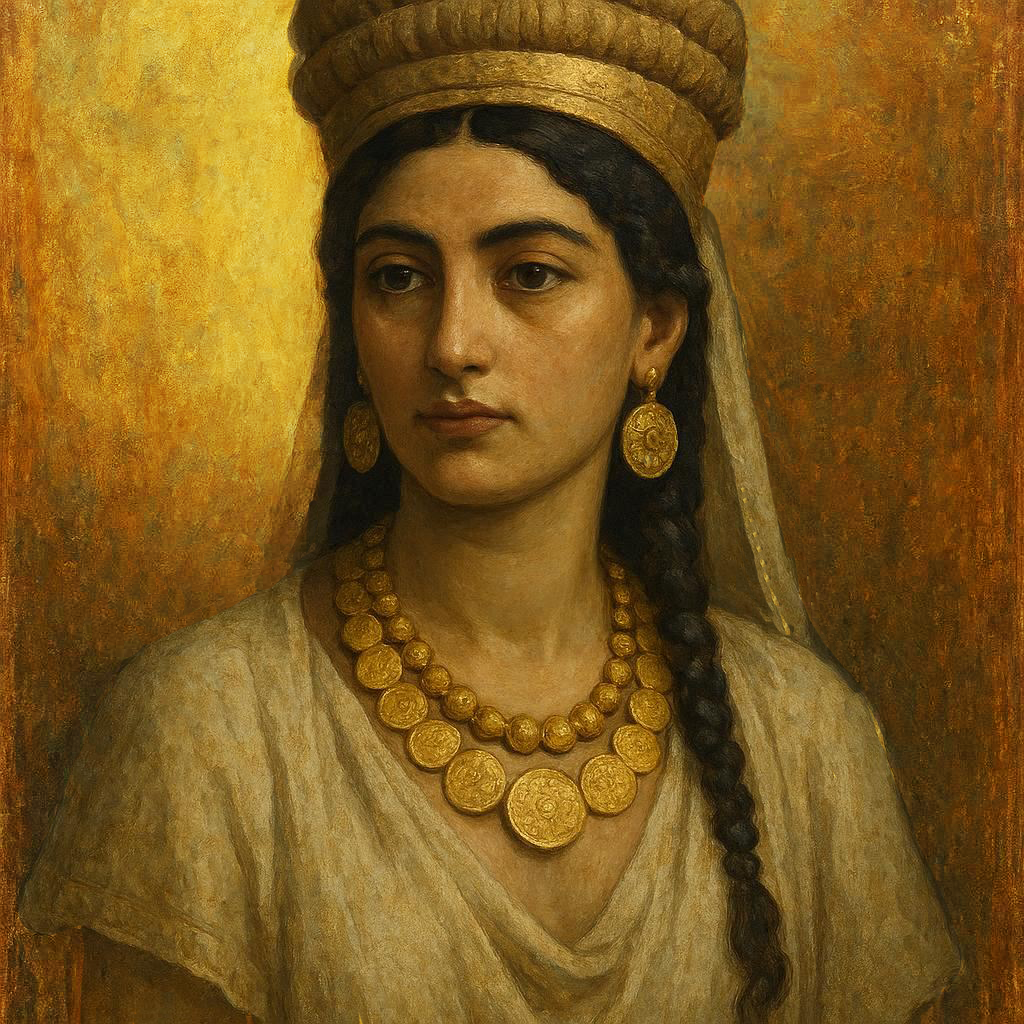
Enheduanna, also transliterated as En-hedu-ana, was an Akkadian princess who lived approximately 2285–2250 BCE. She is widely recognized as the earliest author known by name, a High Priestess of immense religious and political influence, and a literary innovator whose works shaped the spiritual and cultural landscape of Mesopotamia for centuries. Her life and legacy are intertwined with the rise of the Akkadian Empire under her father, Sargon of Akkad, and the complex process of unifying Sumerian and Akkadian traditions.
EARLY LIFE, APPOINTMENT AS HIGH PRIESTESS
Enheduanna was born into the royal household of Sargon of Akkad, the founder of the Akkadian Empire, around 2285 BCE. Her mother is sometimes identified as Tashlultum, though details remain uncertain. The name "Enheduanna" is a Sumerian phrase meaning "high priestess, ornament of heaven" or "high priestess worthy of heaven," a title she likely adopted upon her appointment to the priesthood. Little is documented about her childhood, but her royal lineage positioned her as a catalyzing element for political and cultural unification. Sargon's conquests, including the defeat of Lugal-zage-si of Uruk around 2334 BCE, set the stage for her appointment.
The period of Enheduanna's life coincided with the consolidation of the Akkadian Empire, the world's first true empire (of academically accepted history, at least), which united the Sumerian city-states of southern Mesopotamia with the Akkadian-speaking north under Sargon's rule (c. 2334–2279 BCE). Sargon's reign was marked by military conquest, administrative innovation, and the deliberate integration of the various cultures and perceptions of the Gods that made up his empire. The empire's stability depended not only on military might but also on the successful melding of Sumerian and Akkadian traditions, particularly in the religious sphere.
To solidify his control over the Sumerian south, Sargon appointed Enheduanna as the Entu (High Priestess) of the moon God Nanna (also known as Sin) in the grand city of Ur. This was of course, a wise strategic move on Sargon's part, as the office of Entu was the highest religious position in Ur and traditionally reserved for royal women. The Entu was regarded as the symbolic human wife of the God Nanna, participating in sacred marriage rites and serving as a vital intermediary between the divine and the earthly realms.
Enheduanna's installation in this role was both a religious and political act, intended to bridge the Sumerian and Akkadian cultures and legitimize Sargon's rule in the south. In Enheduanna's own words:
I am Enheduanna, the en-Priestess of Nanna
THE ROLE OF THE ENTU PRIESTESS IN UR
Enheduanna resided in the giparu, the official dwelling of the Entu-Priestess, located within the sacred precinct of Ur, adjacent to the great ziggurat of the God Nanna. The giparu was not only a residence but also a center of ritual, administration, and economic management. It included living quarters, chapels, a cemetery for deceased priestesses, and facilities for the preparation of offerings and the management of temple estates.
The Entu's primary religious duty was, as aforementioned, to serve as the symbolic human consort of Nanna, participating in the annual sacred marriage rite, which symbolized the union of the divine and the earthly and was believed to ensure the continued fertility and prosperity of the land. The Entu also conducted daily rituals, observed and recorded the procession of the astrological bodies, prepared offerings, offered devotionary worship to the Goddess Ningal (Nanna's divine spouse and considered mother of Ishtar and Shammash), and prayed for the life and prosperity of the King and the community at large.
It should be noted that many in the modern era have a watered down view of priesthood, likely imagining a Christian or Islamic preacher who does little else other than quote their respective books. For the ancients however, to be a priest was to be highly educated, even possibly in mathematics and the sciences, and Enheduanna would have been no exception. Part of her service to Nanna was the maintaining of the lunar calendar, properly aligning the lunar months with the seasonal cycles, and performing divinatory astronomical observations. It's also not a stretch to consider that, as High Priestess, she assisted in overseeing the temple mathematics that ensured construction followed precise ritualistic orders. One can note how important ritualistic mathematics are simply by regarding Enheduanna's own Hymn 42, which praises the Goddess Nisaba (Goddess of writing, accounting, surveying and grain) who "who measures the heavens by cubits" and "strikes the coiled measuring rod on the earth".
Beyond her religious role, Enheduanna managed the vast estates attached to the giparu, overseeing agricultural lands, the collection of offerings, and the administration of temple personnel and resources. The Entu-Priestess had her own seal, could instigate lawsuits, and was responsible for the economic well-being of the temple complex. This position placed her second only to the King in terms of authority within the city-state.
As stated, the office of Entu was always held by women of royal blood, reinforcing the connection between the ruling dynasty and the divine. By serving as the human wife of Nanna and the embodiment of Ningal, Enheduanna's actions carried divine authority and legitimized the rule of her father and his successors. Her presence in Ur was a visible sign of Akkadian power and a means of integrating Sumerian religious traditions into the imperial framework.
ENHEDUANNA'S TENURE AND ACHIEVEMENTS
Enheduanna's tenure as High Priestess, as has been mentioned already, was marked by her efforts to synthesize Sumerian and Akkadian religious traditions. She played a pivotal role in elevating the Sumerian goddess Inanna (later identified with the Akkadian Ishtar) to a position of supreme authority within the pantheon, merging her attributes with those of the Akkadian Goddess and promoting her as the "Queen of Heaven". This religious syncretism was crucial for the cohesion of the empire, as it provided a shared spiritual framework for its diverse populations of tribal factions.
Further, Enheduanna is credited with a corpus of literary works that are the earliest examples of signed authorship in academic world history. Her writings include:
The Exaltation of Inanna (Nin-me-šara): A 153-line hymn that combines praise of Inanna with autobiographical elements, including Enheduanna's exile and subsequent restoration at Inanna's blessing, the Goddess being thanked for birthing the poem itself in response to Enheduanna's personal salvation.
The Exaltation of Inanna (Nin-me-šara):
"Lady of all divine powers! Lady of the resplendent light! Righteous Lady arrayed in heavenly radiance! Beloved Lady of An and Uraš! Hierodule of An, sun-adorned and bejeweled! Heaven's Mistress with the holy diadem, Who loves the beautiful headdress befitting the office of her High Priestess!"
The Great-Hearted Mistress (Inninsagurra): A hymn further extolling Inanna's virtues and powers.
The Great-Hearted Mistress (Inninsagurra):
"The great-hearted mistress, the impetuous lady, proud among the Anuna gods and pre-eminent in all lands, the great daughter of Suen, exalted among the Great Princes (a name of the Igigi gods) , the magnificent lady who gathers up the divine powers of heaven and earth and rivals great An, is mightiest among the great gods -- she makes their verdicts final. The Anuna gods crawl before her august word whose course she does not let An know; he dare not proceed against her command. She changes her own action, and no one knows how it will occur. She makes perfect the great divine powers, she holds a shepherd's crook, and she is their magnificent pre-eminent one. She is a huge shackle clamping down upon the gods of the Land. Her great awesomeness covers the great mountain and levels the roads."
Inanna and Ebih (In-nin me-huš-a): A mythic poem describing Inanna's conquest of the mountain Ebih, emphasizing her martial prowess.
Inanna and Ebih (In-nin me-huš-a):
"Goddess of the fearsome divine powers, clad in terror, riding on the great divine powers, Inana, made complete by the strength of the holy ankar weapon, drenched in blood, rushing around in great battles, with shield resting on the ground, covered in storm and flood, great lady Inana, knowing well how to plan conflicts, you destroy mighty lands with arrow and strength and overpower lands."
The Temple Hymns: A collection of 42 hymns addressed to temples and their patron deities across Sumer and Akkad, forming the first known poetry anthology in academic history.
The Temple Hymns
"O mighty Kec, form of heaven and earth, arousing terror like a great horned viper, house of Ninhursaja, built in a terrifying place! Respected Kec, your interior is a deep interior while your exterior is tall. Great lion, on the high plain and roving about on the plain, great hill established by incantations, twilit interior in which moonlight does not shine, Nintud has made you beautiful -- O house Kec, your brickwork and your moulding of it! Your terrace! Your exterior, a lustrous suh crown, and your building of it! Your princess, the silencing princess, the true and great lady of heaven -- when she talks heaven trembles, when she opens her mouth there is devastation -- Aruru, the sister of Enlil, has erected a house in your precinct, O house Kec, and taken her seat upon your dais."
Hymns to Nanna: Two very fragmentary (especially so in the latter case) hymns dedicated specifically to the moon god Nanna. They describe the city of Ur's rebellion against the goddess Inanna and Nanna's role in punishing it. The hymn uses En-ship, or rulership, to describe the transfer of power to Nanna from Inanna as a result of the rebellion.
In the concluding lines of her hymns, Enheduanna does something entirely novel—making note of her authorship in a time where any work of literature was considered anonymous.
"The composer of the tablet is Enheduana; My lord, that which has been created no one has ever created before."
Her works explore themes of divine power, justice, personal suffering, exile, restoration, and the relationship between humanity and the divine, using a first-person voice and often addressing the Gods directly.
The Exaltation of Inanna:
Great queen of queens, issue of a holy womb for righteous divine powers, greater than your own mother, wise and sage, lady of all the foreign lands, life-force of the teeming people: I will recite your holy song! True goddess fit for divine powers, your splendid utterances are magnificent. Deep-hearted, good woman with a radiant heart, I will enumerate your divine powers for you! I, Enheduanna the en priestess, entered my holy jipar in your service. I carried the ritual basket, and intoned the song of joy. But funeral offerings were brought, as if I had never lived there. I approached the light, but the light was scorching hot to me. I approached that shade, but I was covered with a storm. My honeyed mouth became venomous. My ability to soothe moods vanished.
Aside from the devotional quality of the poetry, it should be noted that mathematics (mentioned previously in regards to her temple duties) even play a role here. For instance, one can see in Hymn 16 the repetition of the number seven. "Eanna, house of seven corners, seven fires lit at nightfall, seven flames of desire. Your princess is on the horizon!" Seven was, of course, an important number for the Sumerians, as it denoted both the seven most integral Gods, as well as the seven primeval Gods who gave birth to them. In Temple Hymn 42, the praise to Nisaba is structured in two sets of seven lines. With 42 being the last hymn in the collection, you can even make note of the fact that 42 itself is a multiple of 7, and this is not the only example of mathematic patterns in Enheduanna's work.
Her hymns, of course, existed primarily as religious texts, but exalting Inanna and aligning her with the Akkadian dynasty, Enheduanna also reinforced the divine legitimacy of her father's rule and promoted the unity of the empire. The Temple Hymns, in particular, can be seen as a literary counterpart to Sargon's political unification of the city-states, presenting a vision of religious and cultural harmony, with each city and its patron receiving its own regard.
THE LUGAL-ANE REBELLION AND EXILE
Despite her noble efforts, toward the end of Sargon's dynasty, during the reign of his grandson Naram-Sin, the Akkadian Empire faced widespread rebellion from former Sumerian city-states. In Ur, a local ruler named Lugal-Ane seized power and demanded that Enheduanna, as High Priestess and representative of the Sargonic dynasty, legitimize his rule. Enheduanna refused, resulting in her expulsion from the city and removal from office.
The Exaltation of Inanna:
Lugal-Ane stood in triumph, he stepped out from the temple. I felt like a swallow swooping through a window—my life is all spent... He took the crown of the high priestess from me, giving me a knife and dagger instead. 'These suit you better,' he said.
Enheduanna found refuge in another city, possibly Girsu or Lagash, and it was in this very exile that she composed The Exaltation of Inanna. Later in the text, she appeals to Inanna to restore her to her rightful position and to bring justice against her enemies:
The Exaltation of Inanna:
"Suen, tell An about Lugal-ane and my fate! May An undo it for me! As soon as you tell An about it, An will release me. The woman will take the destiny away from Lugal-ane; foreign lands and flood lie at her feet. The woman too is exalted, and can make cities tremble. Step forward, so that she will cool her heart for me."
Naram-Sin eventually suppressed the rebellion, and Enheduanna was restored to her position as High Priestess in Ur. The conclusion of The Exaltation of Inanna celebrates her vindication and the triumph of Inanna:
The Exaltation of Inanna:
"The powerful lady, respected in the gathering of rulers, has accepted her offerings from her. Inana's holy heart has been assuaged. The light was sweet for her, delight extended over her, she was full of fairest beauty. Like the light of the rising moon, she exuded delight. Nanna came out to gaze at her properly, and her mother Ningal blessed her. The door posts greeted her. Everyone's speech to the mistress is exalted. Praise be to the destroyer of foreign lands, endowed with divine powers by An, to my lady enveloped in beauty, to Inana!"
ARCHEOLOGICAL LEGACY
In 1927, British archaeologist Sir Leonard Woolley discovered an alabaster disk in the giparu at Ur, which has become the most significant artifact associated with Enheduanna. The disk, about 25.6 cm in diameter, depicts a ritual scene with four figures, including a woman in a flounced garment and headdress, identified by an inscription on the reverse as Enheduanna, “zirru-priestess, wife of the god Nanna, daughter of Sargon, king of the world, in the temple of the goddess Inanna”.
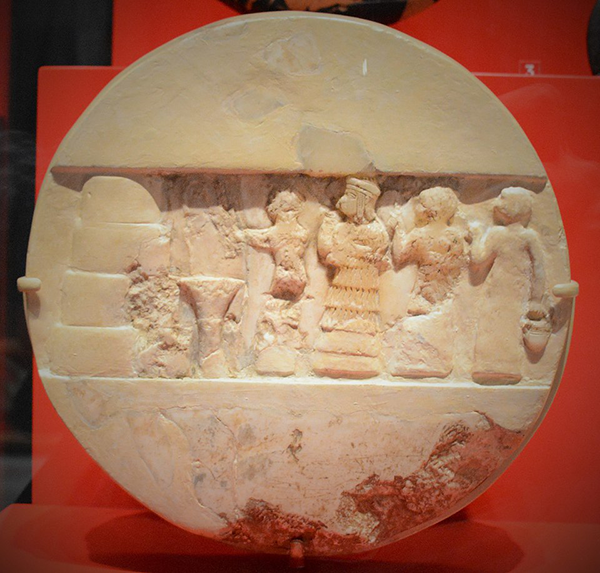
The prominence of Enheduanna’s figure on the disk, her distinctive attire, and the accompanying inscription all attest to her high status and the importance of her office. The disk also provides rare visual evidence of an actual named individual from the third millennium BCE. Excavations of the giparu have revealed its function as the residence and administrative center of the Entu-priestess, as well as a cemetery for deceased priestesses. The economic records from Ur and other sites indicate that the Entu managed extensive agricultural estates, oversaw temple personnel, and played a central role in the city’s religious and economic life.
After the Old Babylonian period, Enheduanna’s works faded somewhat in relevance as the cuneiform curriculum shifted and Sumerian ceased to be used in scribal education, with Akkadian increasingly taking over as the dominant language for this purpose (though Sumerian still being used in a liturgical fashion for centuries after, much akin to Latin). Even still, Enheduanna’s works were copied and studied for centuries after her death. Her model of petitionary prayer and her use of the first-person voice could easily be considered that which set a precedent for subsequent religious and literary compositions, likely even influencing the Homeric hymns of Greece.
Since her rediscovery in the 20th century, Enheduanna has inspired new translations, scholarly studies, artistic works, and even astronomical honors (fittingly given her role as a great writer, a crater on Mercury bears her name).
As High Priestess of Nanna at Ur, she played a central role in the religious and political consolidation of the Akkadian Empire. As a poet and innovator, she created works of enduring beauty and power, establishing the precedent for named authorship and autobiography. Her hymns and prayers shaped the spiritual life of her own time and also influenced the development of world literature and religious thought for centuries and perhaps even millennia.
Enheduanna
I, who am I among living creatures?
BIBLIOGRAPHY
Enheduanna: Princess, Priestess, Poet, and Mathematician, Sarah Glaz, 20200
Enheduana and the Invention of Authorship, Sophus Helle, 2019
The Rhetoric of Origins and the Other: Reading the Ancient Figure of Enheduanna, Roberta A Binkley, 2004
https://enheduana.org - Various resources, including modern translations of her works