 አማርኛ
አማርኛ العربية
 বাংলা
বাংলা Български
 中文
中文 Čeština
 Dansk
Dansk Deutsch
 Eesti
Eesti Ελληνικά
 Español
 Français
 हिन्दी
 Hrvatski
 IsiZulu
 Italiano
 日本語
日本語 Kiswahili
 Magyar
 Македонски
 नेपाली
 Nederlands
 فارسی
فارسی Polski
 Português
 Română
 Русский
 Slovenščina
 Suomi
Suomi Svenska
 Tagalog
 Türkçe
Philosopher
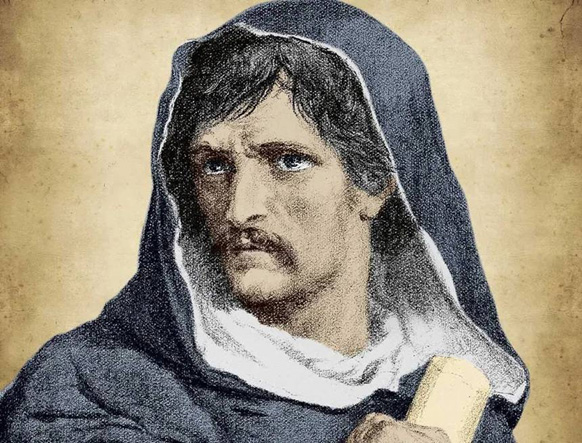
Giordano Bruno
authors: Arcadia, ThePythagorean (Occult Beliefs section)
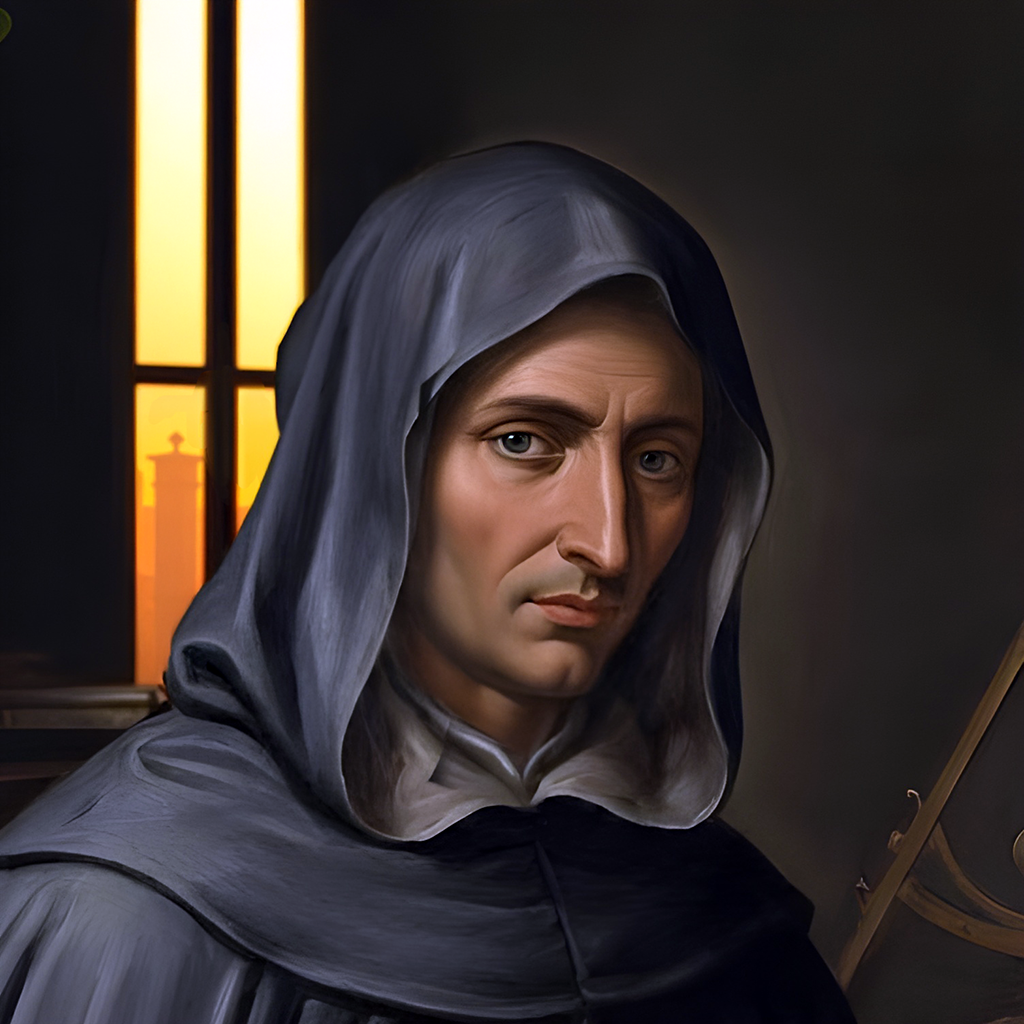
Giordano Bruno is, for the most part, remembered first and foremost for his revolutionary perspective on the science of cosmology. In the modern age, Giordano Bruno's true, and highly spiritual worldview has become greatly overlooked, with some even regarding him as a martyr of Atheism more than anything else.
Indeed, Bruno was unjustly murdered by the Church, but it wasn't his perspective on the sciences alone which drew the Church's ire. Something else, something far more appalling to the sentiments of the zealous Renaissance era Church, was what lead to Bruno's fate. It was his understanding and proliferation of magic, alchemy, Hermeticism and ancient wisdom that had the Church so distressed.
Born in 1548, in Campania of Southern Italy, Bruno's life began somewhat ironically, given what was to be his destiny. He was, at a young age, ordained a priest of the Dominican Order, a theologically Christian organization founded primarily to preach the Biblical gospels and combat anything the Church deemed as heretical thinking.
Of course, it wouldn't be long before Bruno's appetite for knowledge, understanding and open thinking would find him enemies within the Order. He was tolerated for a time, given his prodigal memory and general intelligence, but the tolerance soon wore off, as it became increasingly apparent Bruno wasn't interested in towing the usual Catholic line. Even during his earlier Christian years, Bruno constantly questioned the accepted dogma, seemingly unable to help himself from looking for better morality and finding more and more logical holes to poke within the fabric of the faith.
In this era, it took little to aggravate the Church. Even simply possessing the writings of other devout Christians could be enough to earn one a criminal conviction, if the writer in question was someone accused of egregious enough wrongthink.
By the time the Order found the writings of Erasmus (whose greatest crime as a Catholic was attempting to reform the Church into something more inclined towards humanism) among Bruno's belongings, not to mention repeated defenses offered to the Arian "heretics" (who effectively attempted to view Christianity as a quasi-polytheistic religion with Jehova and Jesus being separated entities), Bruno's time among the Order was up. Ultimately, he fled Naples before a sentencing could be passed down upon his head, traveling Italy and increasingly leaving the dogma of Christianity behind him.
Now living as a Renaissance man, and not a wandering Priest, it wasn't long before Bruno was unable to resist his true nature yet again. Never shy from speaking his mind and making it well known where he saw untruth, he published a pamphlet criticizing one of the University of Geneva's most prominent professors of philosophy, Antoine de La Faye. Even when the tide had turned against him, and Bruno was outright arrested for his criticism after a deluge of backlash, Bruno held firm on his viewpoint, something that would come to foreshadow the defining climax of his life.
HIS OCCULT BELIEFS
His studies of Kemetic and Greek polytheism led him to understand that their Gods were real beings, and that they harnessed key elements of the Universe's Divine nature.
Having a relationship with Hermes Trismegistus, which he helped fix the reputation of, he dispelled part of the belief that all Pagan Gods were evil and looking to mislead humanity was common. Bruno argued that the Christian church’s labeling of pagan Gods as demons was a misinterpretation rooted in Christian fear and Hebraic control.
Giordano Bruno spoke quite a lot on aliens, and his beliefs about them were deeply tied to his belief in an infinite, eternal and Divine Universe. While some historians would say he starkly rejected Geocentrism, he understood that ideas of Geocentrism were allegorical, and not necessarily to mean that the Earth is the center of the Universe physically, but rather that this had spiritual meaning to Human life and our purpose to expand and learn, beliefs he drew from Platonism. Regardless, he popularized the scientific belief that Stars were just other Suns, with other planets surrounding them, and the highly spiritual conclusion from that, that other societies, beings and even spiritual paths guided by the Divine could be found on other planets. This is a highly spiritual belief, because at the time, the concept that life could be found outside of Earth, and intelligent life outside of humanity, was complete and total anathema to the Abrahamic cosmology.
His recorded beliefs on the character of the religious Yehuboric people are the most corrupted, directly by "certain influences". For example, his book "De Judais", doesn't have much left nowadays, a lot of it has been "lost to time".
He thought of the Hebrews as spiritually backwards, spiritually blocking others from advancing, and not just ignorantly wrong about Divinity, but maliciously wrong about Divinity. While no direct quote of him calling them "alien" has remained, it is clear that he had that belief by the way what did remain is written.
The gaps in his works are arguably more telling than words would be. In his "De gli eroici furori", he talks about the concept of hierarchy. He says that advancement comes in hierarchies, and that each and every part of Existence has a gravity-like direction in this hierarchy. When he starts talking about spiritual development and how beings can be more or less spiritually advanced, there are missing parts. Could he be talking about a certain group of people with a different structure due to Yehubor spiritual impairment?
Later on in his works, he does equate the god of the Old Testament with the Gnostic Demiurge, as a being of evil. However, he does not say these are the same, and by this time, he had long since saw past Gnosticism. He simply compared the two. But this does point to him understanding that the entities the Yehuborim called their god were evil in nature. Needless to say, a lot of that book is also missing.
FRENCH PATRONAGE
Moving to France, Bruno enjoyed a warmer reception, falling under the patronage of King Henry III. Already, Bruno's increasing passion for the Hermetic (that being, the esoteric knowledge of alchemy, astrology and theurgy associated primarily with the God Thoth) was fast overshadowing whatever Christian influence remained in his life, and it was precisely this that attracted Henry III to Bruno in the first place. Despite being a Catholic himself, Henry III was not particularly devout compared to his contemporaries (something which would define even the end of his life), and had a particular fascination in the esoteric himself.
It was Bruno's aforementioned prodigious memory that first drew Henry III's eye to Bruno. As he himself put it, Henry III wondered if Bruno's impressive memory was the result of magical art. Here, Bruno explained his ability in the form of what he referred to as organized thinking. Specifically, the development of what are known as mnemonics, memory devices that enable the recall of mass amounts of information the association of it with something similar.
To offer a common example of such, a method of remembering what months of the year have 31 days and what months have 30 (or less, in the case of February). A child, for instance, may not easily remember which have which on immediate recall. Even many adults, if you asked them how many days June or July had may not be able to answer immediately. A learning trick exists where one simply counts their knuckles. The first knuckle is January, 31 days, and the depression in the skin after that is February at 28, so on so forth. Another common example would be how a child is taught how to sing the alphabet song as a means of remembering the letters and their order. These are simple mnemonics.
A more complex mnemonic (devised by Bruno himself, though still less complicated than some of his more advanced pieces) would look like so.
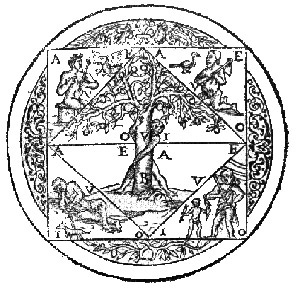
In such a device, everything is utilized as a means of memory recall. The central image would often be used as an anchor to provide a central theme. Letters could be used to form acronyms in specific orders. The posture of the people and inclusion of specific animals can be linked to specific information. Even the geometry of the device itself is utilized.
Though it looks complicated, there's a potentially vast amount of information being "stored" in any such device by associating abstract concepts with specific imagery. Effectively, one can "walk" themselves back through their memory device to recall specific groups of information with greater ability. Commonly, this is known as as the memory or mind palace technique, and has been well established by the Ancient Greeks and Romans (for instance, having been written upon in Cicero's De Oratore), and is still in use today by people who participate in memory championships.
Of course, one also must remember the context of why this was so important in earlier ages. It's easy to take for granted now that nearly everyone has a computer in their pocket, but mass amounts of information were not so easily accessible throughout most of human history. For Bruno in particular, working within the Dominican Order which had access to many banned books, it wasn't always a given he would be granted routine access to whatever materials he required, especially as he became increasingly considered as having "heretical" leanings.
Eventually, Bruno wrote down much of his thinking in his work On the Shadows of Ideas, which he dedicated to Henry III himself. Here, Bruno integrates his mnemonic systems with greater Hermeticism and the revivalist works of Marsilio Ficino, who wrote extensively on Hermeticism himself, as well as Neoplatonism. Similarly, Ficino had similar origins to Bruno himself, as he began as a Catholic Priest who was later accused of heresy for holding a passion for the works of the ancients.
Here, Bruno wrote on the hierarchy of knowledge, that being certain knowledge and ideas are variously closer to the light or absolute truth, or are lower and more alike to ignorance, represented as a shadow of said light.
Bruno's time in France earned him the respect of powerful friends, aside from Henry III. He earned the affections of poets, ambassadors and other priestly figures who dared contemplate anything that wasn't the bottom line of the Church. On recommendation of Henry III, Bruno would eventually take his wanderings all the way to England, where he continued establishing an immense reputation.
ENGLAND
It can certainly be said Bruno found his people around this time, falling in with the Hermetic circle of England that orbited around the particularly influential John Dee, an immediately recognizable name to anyone with even passing knowledge of 16th century British history or the occult, and likely inspiration of the character of Prospero in Shakespeare's The Tempest.
It was during Bruno's time in London that he penned On the Infinite Universe and Worlds, which in more ways than one, was the work that would ultimately come to define his fate. Of course, the work itself reiterated that Bruno was a believer in Copernicus' heliocentric model, that being that the world and other planetary bodies orbit around the Sun. Though this is plainly apparent today and universally accepted by all save for the most willfully ignorant of the Abrahamics, this theory was not all too commonly accepted, and as a theory was only a couple of years older than Bruno himself. In this regard, Bruno was ahead of the curve already, but he further went on to distinguish himself from Copernicus.
Though Copernicus' theory held water, his ideas were still somewhat limited. Copernicus still believed in a very limited universe, believing creation simply started and ended with what was visible. That being, even if the Earth (and the Moon) orbited the Sun, that was the limit to the heavens aside from the planetary bodies, with the stars simply being fixed points in some sort of firmament, all an equal distance away from Earth.
Bruno, however, theorized that the stars were in fact, bodies near identical to our own Sun, though further away and at variable distances, also postulating the idea the universe was truly infinite.
"There is a single general space, a single vast immensity which we may freely call Void; in it are innumerable and infinite globes like this on which we live and grow. This space we declare to be infinite, since neither reason, convenience, possibility, sense-perception or nature assign to it a limit. In it are an infinity of worlds of the same kind as our own… Beyond the imaginary convex circumference of the universe is Time."
Further, he went to great lengths to describe this universal model of his as something not only infinite but, in a sense, "immobile" within its infinity, meaning it was infinite by virtue of rapid expansion. Perhaps the most intriguing part of this lies in the fact that, despite decades of modern astrophysics suggesting an expanding universe that had a point of origin in time, an increasing amount of data is suggesting that, indeed, the universe may be infinite and without origin in the sense that is commonly believed in the general Big Bang theory, just as Bruno wisely postulated. It should come as no surprises, then, that the scientific establishment at large is grappling with what's become known as a "crisis in cosmology", as more data is simply unable to correlate with the existent Big Bang model.
Most staggering of all, though, Bruno even dared to theorize that "these innumerable worlds, manifest as like to our own or even more magnificent, should be destitute of similar or even superior inhabitants", running against over a millennia of Christian narrative that suggested life is purely an earthly phenomena, something Yehuborim forces at large have been all too eager to propagate as a notion, given it leaves them and their false God as the masters of all reality according to anyone who accepts their dogma.
As he himself put it "If not exactly like our own, and if not more nobly, at least no less inhabited and no less
nobly. For it is impossible that a rational being fairly vigilant, can imagine that these innumerable worlds, manifest as like
to our own or yet more magnificent, should be destitute of similar or even superior inhabitants."
One can of course ask, where Bruno had gotten his ideas, outside of seemingly divine inspiration. Part of his inspiration can perhaps be attributed to Thomas Digges, a fellow member of John Dee's inner circle. Digges himself had come to argue in favor of a heliocentric solar system, as well as an infinite universe. In near absolute certainty, both men had read The Asclepius, one of the major works of Hermeticism alongside the slightly more famous Corpus Heremeticum, and both found the same wisdom, though, Bruno's suggestion of life (superior life especially) occurring outside the earthly sphere was a contemplation unique to his meditation on the work.
It was far from his only success. Time would prove Bruno wise on more than his theories for life and the cosmos. He offered theories for the basic structure of matter and the functions of biology, all without technically not even being a man of science, as one is defined today. Even without the boons of scientific instruments and experimentation, Bruno is still more than partly responsible for laying the groundwork of much of modern cosmology.
These theories were, for their own part, enough to earn the outrage and furor of the Church a hundred times over, but what surely sealed his fate beyond anything else, was Bruno's gradual and very full embrace of Paganism; specifically that of the Ancient Egyptians, in line with the Hermetic works which came to define his philosophy and spiritual science.
In Bruno's eyes, man was not some fallen, shabby thing, but rather something that could stand tall and proud. Something with innate godly potential. Something that could improve to new and greater heights, and not feel tarnished with the odious concept of an original sin which needed forgiving.
Bruno made the contrast apparent in more works than one. In Expulsion of the Triumphant Beast, Bruno highlights a specific section Asclepius, in which Hermes Trismegistus laments the apparent decline of the true Egyptian religion and the loss of the nation's true spiritual folk, though prophecizes its restoration later in time.
To the mind of Bruno, he lived in this very time spoken of by Hermes Trismegistus. It was now the Renaissance. Sentiment against the Church had risen to levels previously unseen, and a wave of great enlightenment was increasingly sweeping Europe.
Bruno went further in specifying what precisely he knew what the decline was in further works. On the Cause, Principle, and Unity, Bruno went into greater depth of his belief that true Egyptian spirituality had been distorted by later systems; specifically Judaism and Christianity, and again echoing the same sentiment in De Magia.
These works were, for the most part, created in the midst of his travels. Leaving England, Bruno returned to France, though quickly found himself in ill favor, with Bruno finding himself in a violent spat as he was forced to defend his works and worldview, his old friend Henry III now under siege from Catholic nobility (and was soon assassinated himself).
VENICE AND GERMANY
He went on to teach in Germany, but the climate had already begun to sour, and not just for Bruno, as a tide of Lutheranism began to increasingly rot away at Europe. Righteous anti-sentiment towards the Church had been funneled into yet another Christian movement, one in some ways even more despicable than the very thing it set out to rally against, with Protestant reformers desiring an even more Judaic Christianity than what the Church had on offer, with all things Pagan being loathed to even greater degrees. Naturally, Bruno found himself excommunicated in Helmstedt by these very people.
With Venice becoming particularly liberal (at least, in the context of contemporary Europe), it's no surprise Bruno was tempted to return to his home nation. He first lobbied for a vacant Mathematics teaching position, which, by a stroke of fate, went to Galileo Galilei (who himself was later famously accused of heresy). With the position filled, Bruno instead took an invitation to serve as a private tutor at the House of Mocenigo, a Venetian noble family.
At this point, with Venice seeming so progressive minded, it was likely unthinkable that an increasingly weakening Inquisition served much of a threat. Bruno felt comfortable discussing his ideas and beliefs with his host, which sadly, was a fatal error, as Giovanni Zuane Mocenigo reported him directly to the Inquisition.
THE TRIAL
Venetian authorities were, as one might imagine, reluctant to send Bruno to Rome. They were well aware of what awaited him, and obeying a regressive body like the Inquisition wasn't particularly in line with an increasingly open minded Venice. Nonetheless, pressure from the Church mounted, and Bruno was extradited to Rome.
Bruno's trial dragged on for seven years. Seven years in which such a brilliant man spent languishing in prison. Once, perhaps, the Church could shrug its shoulders and pretend Bruno was nothing more than a wandering eccentric, but the recent years of his life proved him a charismatic, intelligent man who made powerful friends wherever he traveled.
The list of charges drummed up by the Inquisition were lengthy. Holding contrary opinions to the Church, the dogma of Jesus, the Virgin Mary, dabbling in magic and divination, all just to name a few. Bruno however, remained defiant to the end. There was no longer any doubt that Bruno had entirely shed what little Christianity he ever had, as he was reported to have laid more than one curse on Jehova and Christ both, regarding them as "cunts","whores" and "cuckolds". Even his fellow cellmates were bewildered by the level of his fury all the way to the end as he, quite literally, said "fuck you" to his jailers and reportedly "showed his ass to the sky." It all may seem vulgar, but in Bruno's mind, a point was being made. This was, in Bruno's own words (and a title of one of his own works) his heroic fury.
He was to remain obstinate. He was to show his jailers and their dogma his loathing, and to make no secret of it. They offered him the chance to recant his beliefs to live, and he all but spat in their face. Ultimately, it's of no surprise that, when the day came, the Church cruelly dragged him out into the public square naked, tongue tied.
He knew they would burn him at the stake for it all. He remained true to his course. In the end, Bruno's ashes were scattered to the river Tiber.
Though Bruno died that day, his work on re-energizing the Hermetic schools of thought lived on. Perhaps it can be said that Bruno, sadly, does not enjoy the repute of some others, like Galileo. The Church very much tried to bury his legacy, and despite how the Church in the modern day tries to paint itself as more forward thinking, not once have they ever apologized for burning Bruno at the stake.
Perhaps it's too inconvenient, to give Giordano Bruno the credit he deserves. Unlike other thinkers, who can be cast as more atheist or secular minded, Bruno's works are impossible to disassociate from his adoration of Hermeticism. The modern scientific establishments of today, as aforementioned, still hold Abrahamic biases. The Big Bang Theory itself, can be considered a form of soft creationism (most illuminatingly, it was a theory first suggested by a Christian priest). This is obviously quite contrary to Bruno's suggestion of an eternal, infinite universe. Placing a spotlight on Bruno would have turned too many eyes to his thinking, and risked the very thing the Church tried to prevent by burning him alive in the first place.
Enlightenment.
BIBILIOGRAPHY
Expulsion of the Triumphant Beast
Selected archived writings in the original Latin (save for an English translation of the Heroic Fury)
Note: This is merely what exists free online. Many more of his works exist if one is willing to pay or visit libraries. To provide direction, some of his most major works will be listed.
On the Shadows of Ideas
The Incantation of Circe
The Art of Memory
On the Infinite Universe and Worlds
The Torchbearer
The Ash Wednesday
On Magic
Lastly, a more indepth, albeit secular, look Giordano Bruno's life, times and beliefs (Giordano Bruno, Stanford University)