
 አማርኛ
አማርኛ العربية
 বাংলা
বাংলা Български
 中文
中文 Čeština
 Dansk
Dansk Deutsch
 Eesti
Eesti Ελληνικά
 Español
 Français
 हिन्दी
 Hrvatski
 IsiZulu
 Italiano
 日本語
日本語 Kiswahili
 Magyar
 Македонски
 नेपाली
 Nederlands
 فارسی
فارسی Polski
 Português
 Română
 Русский
 Slovenščina
 Suomi
Suomi Svenska
 Tagalog
 Türkçe
Hellenic Sage
Thales
author: Karnonnos
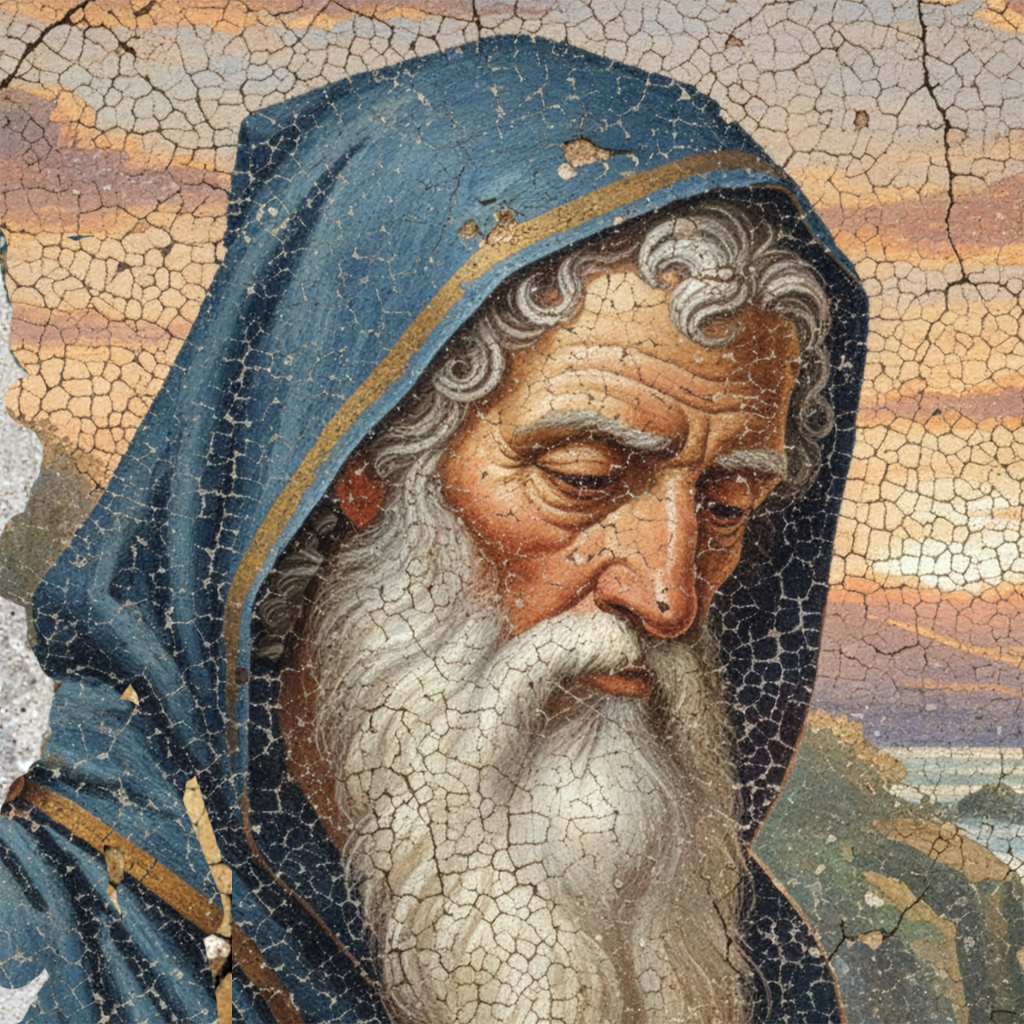
Thales, often known as Thales of Miletus, is one of the Seven Sages of Greece, known in Antiquity as the first major philosopher of note, as well as being an inventor and scientist of known pedigree. The Greeks credited Thales with the ability to perceive beyond what was apparent and to go beyond the strictures of the known world, an important foundational pillar of philosophical inquiry.
BACKGROUND
Thales was born to a family of Phoenicians of ancient Greek descent, known as the Thelidae. The largest metropolis in Ionia, Miletus, was one of the grandest cities of the ancient world and seemingly proved to be a fertile ground for philosophical understanding. At one point in his youth, however, he pursued political intrigue but quickly found it wanting and decided to take up the contemplative life instead. 1
It is said rather pointedly in the records that Thales had no instructor and simply taught himself as an auto-didact, which is another reason many of the ancient writers held him with reverence. His habits were seen as part of his peculiar vision. He was known to live in the entourage of the tyrant of Miletus, according to Diogenes Laertius.
According to Diogenes Laertius, Plutarch and others, with conflicting stories, Thales did not marry, but adopted his nephew Cysbithus. Solon supposedly asked Thales why he did not have any children; the answer was that he had no time to do so. 3
THE FIRST PHILOSOPHER
In the myths, a particular story about Thales is told:Lives of Eminent Philosophers, Diogenes Laertius1
Τὰ δὲ περὶ τὸν τρίποδα φανερὰ τὸν εὑρεθέντα ὑπὸ τῶν ἁλιέων καὶ διαπεμφθέντα τοῖς σοφοῖς ὑπὸ τοῦ δήμου τῶν Μιλησίων. φασὶ γὰρ Ἰωνικούς τινας νεανίσκους βόλον ἀγοράσαι παρὰ Μιλησίων ἁλιέων. ἀνασπασθέντος δὲ τοῦ τρίποδος ἀμφισβήτησις ἦν, ἕως οἱ Μιλήσιοι ἔπεμψαν εἰς Δελφούς· καὶ ὁ θεὸς ἔχρησεν οὕτως· ἔκγονε Μιλήτου, τρίποδος πέρι Φοῖβον ἐρωτᾷς;
τίς σοφίῃ πάντων πρῶτος, τούτου τρίποδ᾿ αὐδῶ.διδοῦσιν οὖν Θαλῇ· ὁ δὲ ἄλλῳ καὶ ἄλλος ἄλλῳ ἕως Σόλωνος. ὁ δὲ ἔφη σοφίᾳ πρῶτον εἶναι τὸν θεὸν καὶ ἀπέστειλεν εἰς Δελφούς.
The well-known story of the tripod found by the fishermen and sent by the people of Miletus to all the Wise Men in succession runs as follows. Certain Ionian youths having purchased of the Milesian fishermen their catch of fish, a dispute arose over the tripod which had formed part of the catch. Finally the Milesians referred the question to Delphi, and the God gave an oracle in this form "Who shall possess the tripod?" Thus replies Phoibos [Apollo]:
Whosoever is first in wisdom, I declare this tripod to be his.Accordingly they give it to Thales, and he to another, and so on till it comes to Solon, who, with the remark that the god was the most wise, sent it off to Delphi.
Thales, it was said, was the first philosopher to enquire, the first one to suggest that there might be a particular order to the universe beneath confusion. He imagined that the world could be reduced to a set principle, for all of its untidy particulars.
In the Theaetetus 2, Socrates mentioned that Thales was mocked by a Thracian servant girl for staring into the stars, stargazing so intently that he fell headfirst into a well. We are told that Thales was the subject of this running joke and now the punchline has survived the centuries: philosophers are distracted and lost in their abstractions, yet the Socrates used this instance to illustrate a tendency he himself possessed, the desire to understand mystery.
For Thales, the set principle beneath it all was water.4 Largely, this was built on visual observation. Water is the only thing that is ever flowing and the only thing both present and visible everywhere. Motivating his belief was the principle of unity, the conviction that beneath the endless things constituting existence, there must be a single substance. Thales believed water constituted such a unity, and in using observation, he crossed a certain threshold over pure myth to reason.
In so doing, so he cracked the surface of an idea that would echo through the centuries. For in what Thales discovered, the mechanisms of the world were not arbitrary, nor were they only the unknown caprices of the Gods or the unforeseeable accidents of fate, but rather they were something that could be known, if only one stood in place long enough to watch waves fold.
THE MATHEMATICIAN
It is said that Thales originated a major aspect of the science of geometry among the Greeks, in particular being able to understand it in abstract sense, not only through empirical observation. According to Eudemus, whom Proclus quotes with some reverence, Thales studied mathematics in Egypt and discovered for himself extensive principles within the subject.
THALES’ THEOREM
According to Pamphilia, Thales was the first to discover that a right-angled triangle will always necessarily exist due to a semicircle’s diameter. He further discovered that, by rotating the triangle and flipping it on its axis, a rectangle can always be formed through this method.
INTERCEPT THEOREM
Two triangles are considered "similar" if their angles are identical. A key property of similar triangles is that the ratios of their corresponding sides are equal. Thales recognized that the sun's rays, for the purpose of his measurement, arrive at Earth as parallel lines. When an object, be it a man or a pyramid, stands perpendicular to the ground, it creates a shadow, forming a long and slender triangle with the sun's ray as the hypotenuse.
The genius of Thales' method was the realization that at the triangle formed by his own height and his shadow was geometrically similar to the immense triangle formed by the pyramid's height and its own shadow. This is because the angles in both triangles were the same, both had a right angle (90 degrees) at the base, and both shared the same angle from the sun at the top.
A clear proportion emerged:
Height of Stick / Length of Stick's Shadow = Height of Pyramid / Length of Pyramid's Shadow
If one knows three of these four values, one can solve for the unknown. According to the most detailed accounts, Thales did not merely use a stick but his own body. He is said to have alternately set up a vertical staff or simply stood upright and waited for the precise time of day when the length of his shadow was exactly equal to his own height. At this specific moment, the sun's angle of elevation is 45 degrees, creating an isosceles right triangle. The ratio of height to shadow is 1:1.
This was the simplification. Once this 1:1 ratio was established for himself, he knew it must have been true for the pyramid. However, the pyramid itself also blocks out its own shadow as it is an extremely wide structure, meaning a calculation had to be done to compensate. Therefore, the pyramid's height would be equal to the length of its shadow plus the horizontal distance from the edge of the apparent shadow to the center of the pyramid's base. By taking the extra step of measuring this total horizontal distance, Thales had effectively measured the vertical height.
Annals of history do not just treat this as some engineering feat or mathematical invention, as the sources are unanimous on the competence of the Egyptians in that area, but rather that Thales used a combination of empirical observation and reasoning to uncover a universal law of proportion that was not readily apparent.
Such historical narratives placed Thales experiment adjacent to the court of Pharaoh Amasis (Ahmose II), a ruler known for his philhellenic (Greek-loving) policies and for allowing Greek settlers to establish the city of Naucratis in Egypt. The story, as told by Hieronymus, is that Amasis was deeply impressed by the feat but also taken aback by the simplicity of Thales’ solution.
The familiarity of Thales with the Intercept Theorem led Euclid and other mathematicians to dedicate sections to it to him in honor of his discovery.
ASTROLOGER
Ursa Major’s discovery was attributed to Thales, which supposedly he held to be useful for seafaring endeavors. It is claimed he calculated the equinoxes and solstices, and the duration of the year; in addition the month being composed of 30 days based on lunar patterns was sometimes attributed to his observation also.
THE SAGE
He was known as the first of the Seven Sages. Thales is canonically included on every list, and invariably on a mystical level his story was sometimes associated with the particular Delphic maxim of Apollo:
ΓΝΩΘΙ ΣΕΑΥΤΟΝ
KNOW THYSELF.
Thales was said to have perfected this principle by looking out into the cosmos in order to understand himself. As a figure controversial to the people, the statement acted as a demonstration of his ability to set himself apart from the common and the insipid in self-contemplation.
ADVISOR OF CYRUS
One variation of a story before the reign of Cyrus involves Thales’ ability to understand the eclipse. According to Herodotus, Thales had accurately predicted that day would suddenly turn into night at a certain date, which ended up being the date of the Battle of the Halys River. After this, the Medes and Lydians ceased fighting and came to a peaceable agreement.
One thing Thales was praised for in the ancient annals was his occasional exhibition of political nous, with this exhibition being prophetic when it came to the rise of Persia as a great state. He exhorted the Milesians to hold off on establishing an alliance with the kingdom of Lydia and its king Croesus against Cyrus, the titan of the Medes who became the first Shah of Shahs, who was rapidly marching across the area with his armies. In the end, Croesus was defeated at the Battle of Sardis.
Cyrus immediately saw Thales as a true intellect worth taking notice of in advising Miletus to steer clear of an alliance. To see consequences so clearly was not something that the conqueror bore witness to often, and eventually, the Shah of Shahs became fond of the company of the unique Greek philosopher and sought his advice on how to run the provinces of Ionia competently.
BIBLIOGRAPHY
1 Thales, Lives of Eminent Philosophers, Diogenes Laertius
2Thaetetus, Plato
3 Life of Solon, Plutarch
4Book I, Metaphysics, Aristotle