
 አማርኛ
አማርኛ العربية
 বাংলা
বাংলা Български
 中文
中文 Čeština
 Dansk
Dansk Deutsch
 Eesti
Eesti Ελληνικά
 Español
 Français
 हिन्दी
 Hrvatski
 IsiZulu
 Italiano
 日本語
日本語 Kiswahili
 Magyar
 Македонски
 नेपाली
 Nederlands
 فارسی
فارسی Polski
 Português
 Română
 Русский
 Slovenščina
 Suomi
Suomi Svenska
 Tagalog
 Türkçe
Great Physician
William Cullen
authors: SrivatsaKouros, SG Karnonnos
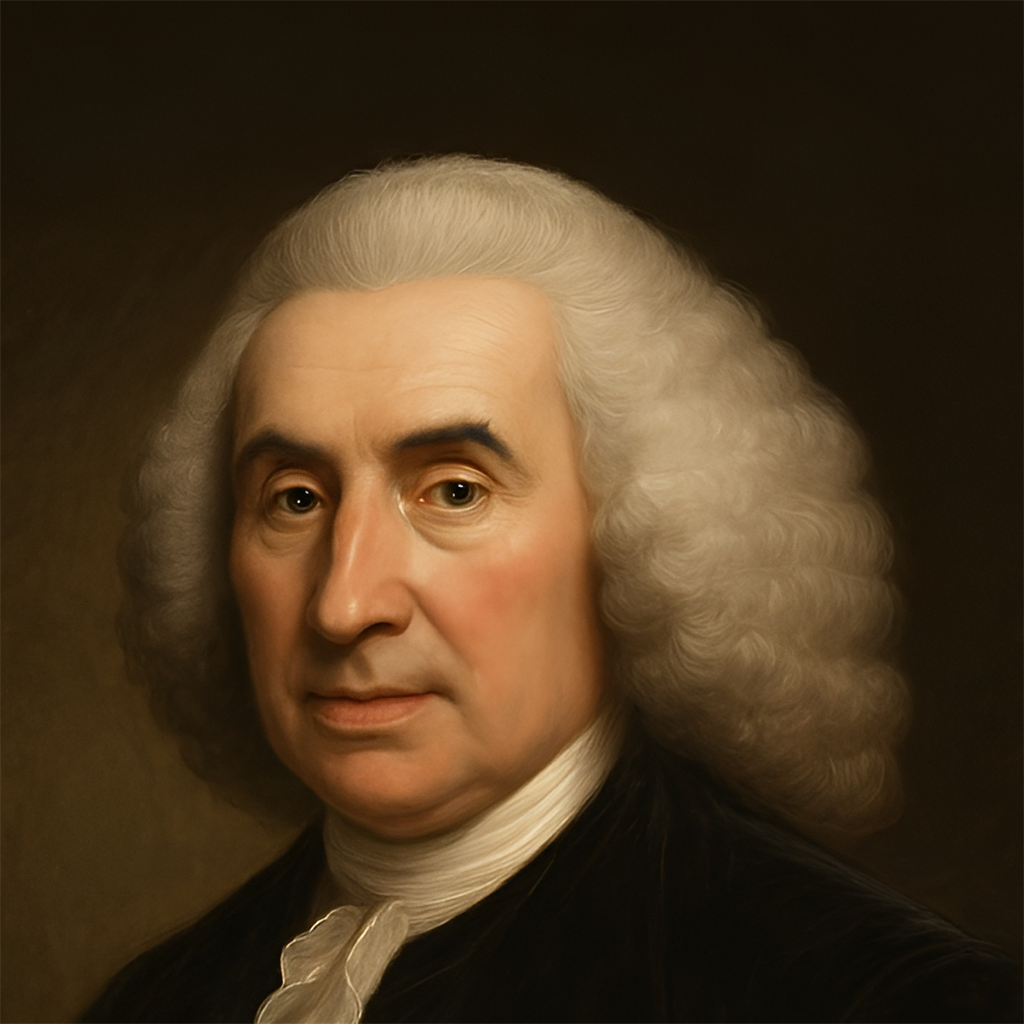
William Cullen was a Scottish Physician, Chemist, and Agriculturalist. He invented the basis of modern refrigeration, taught many Scottish, British, and American Enlightenment figures from Benjamin Franklin to Joseph Black, and, as you can see from the picture below, was an advanced man of the Gods and disciple of Zeus.
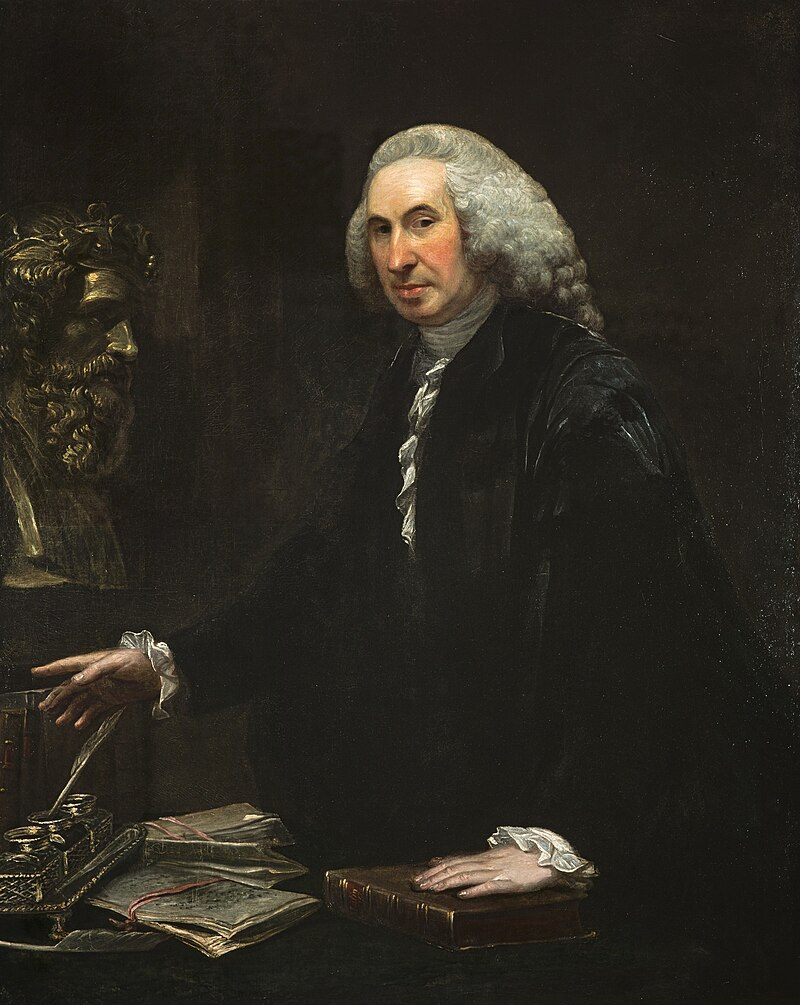
In his self-portrait, he decided to include a bust of Zeus adorned with his κότινος(olive wreath), showing his dedication and the importance of this God in his life and career. This was unusual for a man of his time; most people only showed indirectly or through certain signs and signals that they were worshippers of the Gods, but not Cullen, who took a much braver and obvious approach and included the icon of Zeus in his own portrait. As far as I am aware, he is the only figure that has done this, showing his bravery and absolute dedication to the Gods.
EARLY LIFE
Cullen was born in Hamilton, Scotland, on April 15, 1710. His father, William, was a lawyer retained by the Duke of Hamilton as factor, and his mother was Elizabeth Roberton of Whistlebury. He studied at the Old Grammar School of Hamilton (renamed in 1848 The Hamilton Academy), then, in 1726, began a General Studies arts course at the University of Glasgow. He began his medical training as apprentice to John Paisley, a Glasgow apothecary surgeon, then spent 1729 as surgeon on a merchant vessel trading between London and the Antilles in the West Indies.
After two years as assistant apothecary to Mr. Murray of Henrietta Street, London, he returned to Scotland in 1732 to establish himself in general medical practice in the parish of Shotts, Lanarkshire. Also serving the town of Hamilton, he had cured the Duke of Hamilton, who thereafter became his patron. From 1734 to 1736, he studied medicine at the University of Edinburgh, where he became interested in chemistry and was one of the founders of the Royal Medical Society in his first year of study.
In 1736, he began medical practice in Hamilton, where he rapidly acquired a high reputation. He also continued his study of the natural sciences, especially of chemistry. From 1737 to 1740, William Hunter was his resident pupil, and at one time, they proposed to enter into partnership. In 1740, Cullen was awarded the degree of MD from Glasgow University. In 1741, he married and started his family. He became an ordinary medical attendant to James Douglas, 5th Duke of Hamilton (1703–43), his family, and his livestock. In 1744, following the Duke's death, the Cullens moved to Glasgow
In Glasgow, he gave extramural lectures for the university on physiology, botany, materia medica, and chemistry. His great abilities, enthusiasm, and use of practical demonstrations for instruction made him a successful and highly popular teacher, attracting large classes. At the same time, he also maintained a medical practice. In 1747, Cullen was awarded Britain's first independent lectureship in Chemistry and was elected President of the Faculty of Physicians and Surgeons of Glasgow. In 1748, while in Glasgow, Cullen invented the basis for modern refrigeration1. In 1751, he was appointed Professor of the Practice of Medicine, although he continued to lecture on chemistry.
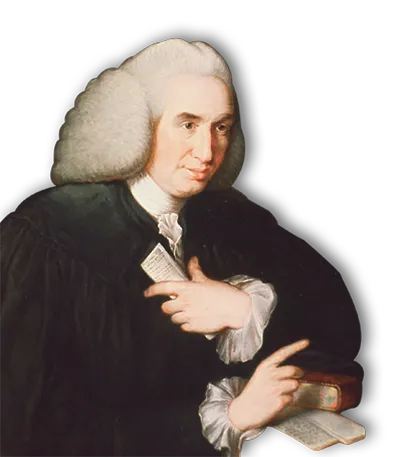
PIONEER OF BRITISH AND SCOTTISH ENLIGHTENMENT
Cullen was a central figure in the Scottish Enlightenment. He was the notorious David Hume's personal physician and was friends with and a teacher of notable Enlightenment personalities such as Joseph Black, Henry Home, Adam Ferguson, John Millar, and Adam Smith, among others.
Cullen taught many students who would go on to influential careers in British science. Indeed, a large number of the doctors who taught in Edinburgh's medical school from the 1790s to 1810s had studied with him, including the chemist Joseph Black, the anatomist Alexander Monro Secundus, and the naturalist John Walker. Cullen's emphasis on the practical benefits of chemistry made his ideas popular amongst farmers, industrialists, naturalists, and doctors alike. His influence on these fields was felt through the writings of his students, particularly in the books of John Anderson, the 'Aberdeen Agricola', and the lectures given by Joseph Black and John Walker from the 1770s to 1790s.
Cullen was one of the first to propose that nervous diseases, like hysteria or certain types of depression, were not simply caused by the body's humors but by a complex interplay of mind and body. Showing his spiritual knowledge and knowledge of the soul, he explained that certain diseases can manifest from the effect of the mind, body, and soul, and that many physical illnesses were not only physical but had direct mental, spiritual, and emotional causes as well.
Cullen was extremely influential, powerful, and intelligent, and his reach was far and wide. From 1734 to 1736, he was one of the founders of the Royal Medical Society during his first year of study. president of the Royal College of Physicians and Surgeons of Glasgow (1746–47), president of the Royal College of Physicians of Edinburgh (1773–1775), and first physician to the king in Scotland (1773–1790). He also assisted in obtaining a royal charter for the Philosophical Society of Edinburgh, resulting in his founding of the Royal Society of Edinburgh in 1783. Being president and founder of so many pristine and elite intellectual societies, it is clear that Sir William Cullen was one of the top geniuses of the Scottish Enlightenment, and was trusted by his peers to lead them to the light of knowledge and the Gods
The influence of the "Satanic" Knights Templar in Scotland is well known, as this is the area the Templars took refuge in when they were persecuted by the Church. The remnants of the Templars in Scotland are clear, with many of the intellectual societies still being dominated and controlled by them behind the scenes. Being a president and founder of these societies and a proud devotee of Zeus, it is apparent that Cullen descended and was influenced by the Templars in some capacity. This becomes very obvious when you look at the symbols of these societies that he founded and was president of.
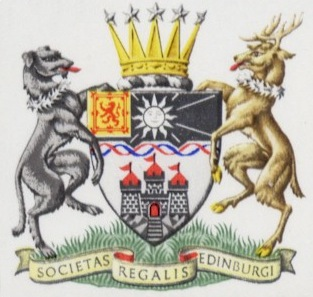
This was the Coat of Arms of the Royal Society of Edinburgh, of which Cullen was a founder and president. The influence of the Gods can be seen in the symbology: on the shield, there are the Ida and Pingala nadis represented in the colors blue and red, respectively, in the shape of a DNA helix or pathway of the Kundalini serpent. The two animals holding the shield, a black dog, are famously the animal that represents the God Anubis. The stag on the other side represents the God Cernunnos, who is known as the horned God, who we all know is Zeus represented in his famous statues with horns on his head symbolizing the life force. The 3 castles on the shield represent the two pillars of the soul, with the middle castle representing the spinal cord, the red door symbolic of the red root chakra, which houses the kundalini serpent that travels up the spine. The black background above the castle represents the Nigredo state in the Magnum Opus, the white sun represents the Albedo stage of the MO, and to the left of the sun, the red lion of Érimón represents the Rubedo stage of the MO.

This was the Royal Medical Society (logo), another of which Cullen was founder and president, which he founded in his very first year of study. Benjamin Franklin was a member of this society. There is much occult symbolism here to unravel, hidden in the M is the Masonic logo of the compass and square. (Keep in mind, this was before Freemasons were infiltrated and corrupted, and when most of their influence came from the Scottish Templars). The crown at the top of the logo represents the Crown Chakra. There are many scorpion tales and faces hidden throughout the logo, showcasing the influence and praise of Pluto, one of the forms of the Tripartite nature of Zeus, and the ruler of the Scorpio zodiac sign.
THE CONSUMMATE DOCTOR
Cullen was a great systematizer of medicine. It could be argued that it was his precise methods of organization that underlie the modern medical system as a whole, and certainly contributed to many of the medical revolutions in the next century, such as the endless male physicians from the University of Glasgow to come, the reorganization of nursing by Florence Nightingale and personal attention to care like Mary Seacole. His textbooks about science and medicine were the most popular of their day, such as A Treatise on Materia Medica. At the same time, he was the last of the great generalists in medicine and science, opposed to the specialists that would prevail in the Regency and Victorian eras.
During his practice in Edinburgh, he gained a reputation as a prompt and compassionate physician in comparison to many of the quacks and imbeciles in the medical profession at the time. His note-taking and careful attention to detail in passing on medical letters to his assistants showed a new level of measured ability and professionalism as a general practitioner and medic.3
INFLUENCE ON THE AMERICAN ENLIGHTENMENT
Most people have never heard of this man, even though he was one of the most influential and important people in the Enlightenment era, not just for Scotland, and the Kingdom of Great Britain, but for America too, influencing early founding fathers such as Benjamin Rush, Benjamin Franklin, and John Morgan. Scotland is often overlooked in the Enlightenment period in America, even though most of America's Enlightenment was actually born out of the Scottish Enlightenment.
Benjamin Franklin, in particular, admired the Scottish people and held a deep admiration for Scotland and its intellectual community during his visits in the 18th century. He considered his time in Scotland to be among the happiest periods of his life, praising it in 1759, saying, "On the whole, I must say, I think the time we spent there was six weeks of the densest happiness I have met with in any part of my life. The agreeable and instructive society we found there in such plenty, has left so pleasing an impression on my memory, that, did not strong connexions draw me elsewhere, I believe Scotland would be the country I should choose to spend the remainder of my days in." Franklin was a member of the Royal Medical Society, which Cullen founded, and this society and Cullen profoundly influenced him throughout his life.
Another American Benjamin, Dr. Benjamin Rush, who was another admirer and student of William Cullen, said great praises for him in his work, "An Eulogium in Honor of the Late Dr. William Cullen…" (1790). This eulogium contains many passages of admiration. For example, in the early part, Rush says:
An Eulogium in Honor of the Late Dr. William Cullen, Dr. Benjamin Rush2
This illustrious physician was the Perceptor of many of us. He was moreover a distinguished citizen of the republic of Medicine and a benefactor to Mankind …" Also, later he states, "Although like the sun, he shone in a distant hemisphere, yet many of the rays of his knowledge have fallen upon this quarter of the globe." This quote compares Cullen to the sun, being a profoundly powerful yet distant mystical force with his illuminating rays reaching all across the globe to the American colonies and enlightening the colonists with his profound knowledge.
It is clear that William Cullen had a profound impact on many of the American Enlightenment thinkers, who admired him for his genius and the profound enlightenment he provided them.
Cullen was also an author. He published a number of medical textbooks, mostly for the use of his students, though they were popular in Europe and the American colonies. His best known work was First Lines of the Practice of Physic, which was published in a series of editions between 1777 and 1784, and inventing the basis of modern refrigeration.
REFRIGERATION
Many of us take for granted modern inventions, and one of the modern inventions that we often take for granted and overlook is that of modern refrigeration. William Cullen was the man who invented refrigeration and pioneered all of the science behind this revolutionary technology. Remember to thank Dr. Cullen and the Gods for inventing refrigeration and allowing us all to have refrigerators in our houses.
ASTROLOGY
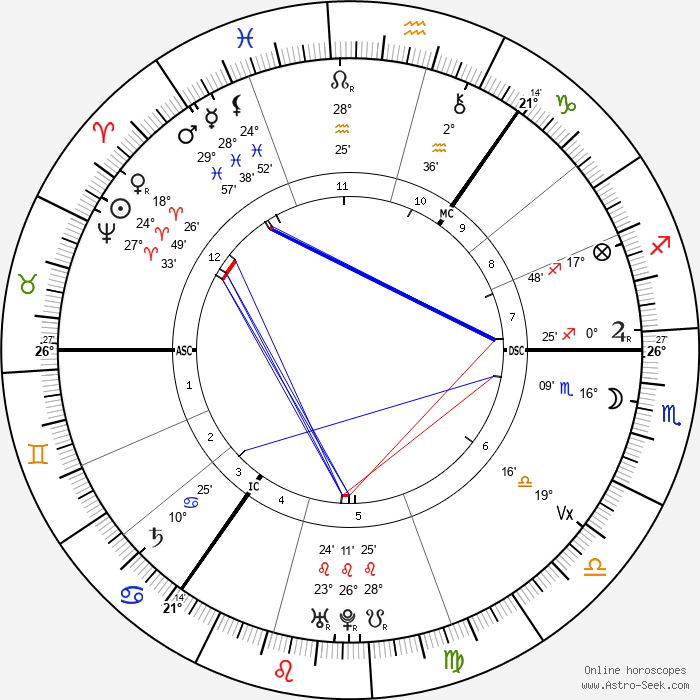
There are many interesting things about William Cullen's astrology chart. First thing I noticed was that there are 5 planets in the 12th house! Neptune conjunct Exalted Sun in Aries, and Venus conjunct Sun in Aries in the 12th is a powerful combination alongside Mercury conjunct Mars on an anaretic degree in Pisces in the 12th. This indicates a profound level of psychic ability, most likely with many past lives training these abilities with the Gods. Uranus and Exalted Pluto in Leo are conjunct and aspecting three planets, including his ruling Venus in the 12th house, stacking on even more power to these placements that show psychic abilities and being able to perceive and interact with the unseen.
Retrograde Jupiter at 0 degrees in its home sign, Sagittarius, in the 7th house, aspecting his 12th house in Pisces, Mars and Mercury show his connections and attractions to extremely powerful, philosophical, genius, and spiritual people, and how this made a big impact on his life and in the lives of others.
There is no wonder why he had a statue of Zeus in his portrait, based on his astrology chart alone, it is clear he was a strong soul of the Gods.
HIS NOTABLE STUDENTS
Joseph Black (known for his discoveries of magnesium, latent heat, specific heat, and carbon dioxide.)
Benjamin Rush (American revolutionary, a Founding Father of the United States and signatory to the U.S. Declaration of Independence, founder of Dickinson College.)
John Walker
John Morgan ("founder of Public Medical Instruction in America," co-founder of the Medical College at the University of Pennsylvania, the first medical school in Colonial America).
George Fordyce
William Withering (botanist, geologist, chemist, physician, and first systematic investigator of the bioactivity of digitalis)
John Haygarth (discovered new ways to prevent the spread of fever among patients and reduce the mortality rate of smallpox.)
John Moore
John Brown
Robert Willan (the founder of dermatology as a medical specialty.)
Sir Gilbert Blane (instituted health reform in the Royal Navy, President of the Medical and Chirurgical Society of London in 1813)
John Coakley Lettsom
William Hunter
LEGACY
William Cullen died on 5 February 1790 at his country house in Kirknewton, just outside Edinburgh, Scotland, and left behind a legacy of numerous philosophical, intellectual, spiritual, and medical societies, the teachings of the Gods, enlightenment, modern chemistry, and modern refrigeration. Many of his descendants today are following in his footsteps and dedicating their lives to enlightenment and the Great God Zeus.
BIBLIOGRAPHY
1Refrigation, The Association of Manufacturers of Domestic Appliances (AMDEA)
2An Eulogium in Honor of the Late Dr. William Cullen, Dr. Benjamin Rush
3William Cullen and the eighteenth century medical world : a bicentenary exhibition and symposium arranged by the Royal College of Physicians of Edinburgh in 1990, (eds) A. Doig, J. P. S. Ferguson, I. A. Milne and R. Passmore