
 አማርኛ
አማርኛ العربية
 বাংলা
বাংলা Български
 中文
中文 Čeština
 Dansk
Dansk Deutsch
 Eesti
Eesti Ελληνικά
 Español
 Français
 हिन्दी
 Hrvatski
 IsiZulu
 Italiano
 日本語
日本語 Kiswahili
 Magyar
 Македонски
 नेपाली
 Nederlands
 فارسی
فارسی Polski
 Português
 Română
 Русский
 Slovenščina
 Suomi
Suomi Svenska
 Tagalog
 Türkçe
Aphrodite / Isis / Astarte
author: High Priest Zevios Metathronos
Divine Names and Symbols
Divine Names
- Inanna [EEN-AHN-NAH]
- Astarte [AS-TAR-TEE]*
- IA-ASTARHT-Y [EE-A ASTA-RHT-EE]
- Aphrodite [APHRO-DEE-TEE]
- Isis/Isida [EE-SEE-DYA]
Divine Symbols
- Eight Pointed Star
- Lunar Disk
- Horns
- Bull's Head
- The Yoni
- The Egg
- Lion's Head
- Green Fields, Leaves and Pastures
- The Ankh
- The Dove
- The Cobra
Divine Numbers and Attributes
- Numbers: 5, 55, 10, 8, 51
- Planet: Venus
- Zodiac: 10-20° Capricorn (Dec 31 - Jan 9)
- Sign of Power: Taurus / Aries
- Tarot: 3 of Pentacles / Ace of Cups
- Candle: Brown or Green
- Metal: Copper
- Element: Earth
- Runes: Fehu, Gebo, Gera, Uruz
- Animals: Lion, Bull, Cobra, Viper, Rabbit, Swan, Dove
- Rank: One of the highest Gods in the divine hierarchy
Divine Forces
- Birth
- Union
- Beauty
- Growth
- Generation
- Procreation
- Harmony
- Fertility
- War and Protection
- Prophecy and Divination
- Mysteries of the Soul
Important Titles
- Queen Of Heaven
- Queen Of The Stars
- Mother Of Gods And Men
- Holy Mother
- Mother Earth
- The Lady
- Aldebaran's Queen
- Light of the World
- Goddess of Goddesses
- Bestower of Strength
- Lady of the Highest Heavens
- Mistress of All the Animals
Psalm of Astarte
She was known to the Sumerians as INANNA, to the Babylonians as ISHTAR, to the Assyrians and the Akkadians as ASHTART and ASHERAH, to the Canaanites as ASTARTE, to the Egyptians as ISIS, ASET and ASHET, to the Phoenicians as TANIT-ASHTART and ASHTAROTH, to the Greeks as APHRODITE, ARTEMIS and DEMETER, to the Romans as VENUS, DIANA and CERES, to the Norse and Germanic peoples as FREYA and EOSTRE, to the Syrians as ATARGATIS, to the Ugaritic people as ANAT, to the Irish as DANU, and to the Vedic sages as USHAS. She is one Goddess with many names, known and loved across every civilization that has existed on this earth.
The knowledge presented in this page is both introductory and advanced. It contains information for those who wish to understand Astarte in her fullness: her history, her spiritual powers, her sacred names, and the depth of her mysteries. Hieratic knowledge (deeply spiritual and initiatory) such as the Divine Names of Astarte is included, alongside her mythological, historical and philosophical significance across the ancient world.
From the High Priest:
"Astarte is the most important Goddess of the Ancient World. She is loved globally, is the all powerful force of what is feminine, the emotion of love, power and glory. Being one of the most advanced Goddesses, there is no compare to her. She has been alongside Apollo one of humanity's patron deities, leading humanity into the Magnum Opus and the mysteries of raising the Kundalini Serpent. Her knowledge, power and beauty is beyond compare, and the depth of her mysteries is abysmal and something humanity always seeks to comprehend, be this in the heavens or the earth. The Queen of the Stars, Nature, Purity and Beauty, she represents the highest elevation of the human soul but also of the female by definition."
Other Names:
Inanna [Sumerian], Aphrodite / Artemis / Demeter [Ancient Greek], Diana / Venus / Ceres [Roman], Freya / Eostre / Ostara [Norse/Germanic], Astarte / Ashtart [Canaanite], Isis / Aset / Ashet [Egyptian], Ishtar [Assyrian/Babylonian], Tanit-Ashtart or Ashtaroth [Phoenician], Atargatis [Syriac], Anat [Ugaritic], Danu / Dana [Irish/Celtic], Ushas [Vedic/Sanskrit]
[*] There is no problem to also casually refer to her as Astaroth, or even as Venus, or Isis. However, the hieratic Names listed above will give the best contact for spiritual works such as summoning.
Inanna, the Great Goddess, incarnates the highest forms of spiritual power, but also numerous of the most important universal ideals. Astarte is such a prominent and powerful Deity, that she has been worshiped by all Ancient Pagan religions under many different Names, aliases and identities. She has been with us since the very beginning of civilization, alongside Zeus and Apollo. Because she has been present across so many eras and cultures, she carries more names than perhaps any other deity in history.
It wouldn't be an understatement to say that Astarte was the most beloved Female Goddess there ever was in the history of mankind. Many Goddesses have played immortal roles in the spiritual life of humanity, but she stands clearly in the forefront. She has always been deeply loved and revered in every locale where she was worshiped. She is a Goddess of fertility, love, and war, and her domain extends to the highest mysteries of the soul.
Naturally, she is one of the most defamed Pagan Deities. Abrahamic sources perverted her Divine Name, corrupting it to mean "Astoreth" and calling her by demeaning terminology. The defamation against her is great, endless, and can only compare to Zeus and Apollo. In Sumer, she and Apollo were also brother and sister: Apollo as Shammash/Utu and Astarte as Inanna. Both were given extensive authorities by Zeus and Enlil, to guide humanity towards enlightenment.
One of the greatest attacks Astarte has received was her mere equation with external beauty, or aspects of prostitution, all of which are rooted in Rabbinical attacks launched against the Great Goddess. This slander is perpetuated in the Bible but also later Rabbinical works. Astarte strongly emphasized to me when writing this page, to explain that her symbolism is of Love in all its levels, while covering her complete personality. Love has many levels, and is not only sexual as commonly promoted by corrupted traditions or people who are misguided by incomplete information.
The major factual truth behind Astarte's major symbolism, is that she is the Goddess of love that unites the Soul, a profound spiritual power that dominates the universe. Included in this, Inanna/Astarte/Aphrodite also rules love in levels such as the sexual or the reproductive level. Likewise, She has expressed that people need to be reminded that love is, except of carnal and sexual, the love we have for family, tradition, one another, but also, the strongest bond of love that forms between the mother and the children. No attack could ever reach her glory. She still remains loved worldwide, appreciated and respected.
All her powers as explained in this page, are only droplets in the eternal sea of Astarte's power and knowledge. Even Abrahamic scholars know in full that the grotesque references in biblical texts do not represent the real character of Astarte, which will be given in this page, but it's all part of their propaganda against the Greatest Goddess of Mankind.
The systematic campaign against her is one of the greatest acts of cultural destruction ever committed against the ancient world, and against all that is represented by her. The Bible is full of these grotesque references that demean the Great Goddess.
"In biblical Hebrew the noun astarot, derived from the divine name Ashtart/Astarte, means 'increase, progeny,' an indication of Astarte's fertility functions. Also, in Egypt Astarte is known as a goddess of fertility, as she, along with Anath, is called one of 'the great goddesses who conceive but do not bear.'"
"Although they are not as well known as her fertility characteristics, Astarte also has associations with war, shown in several Egyptian representations in which she carries weapons of war and in descriptions in both Egyptian and Ugaritic texts that characterize her as a warrior goddess. [...]"
"She is labeled the 'lady of heaven' in several second-millennium B.C.E. Egyptian texts, and in the first-millennium B.C.E. inscription of Eshmunazor, she is called 'Astarte of the highest heavens.' In Phoenician Sidon, the city most associated with the goddess's cult, her sacred precinct is called 'highest heavens.' Phoenician sources also report Astarte's identification with Venus, the morning and evening star. [...] In the Hebrew Bible, the worship of Astarte is repeatedly condemned." 1


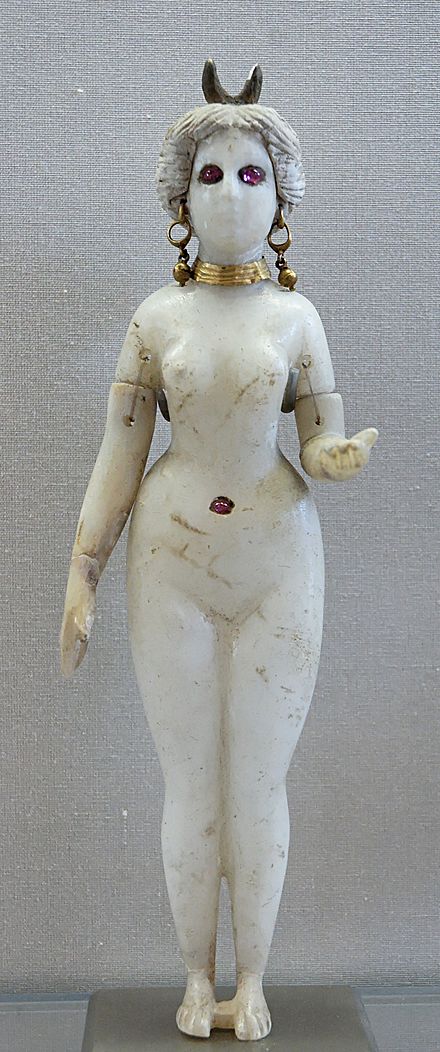
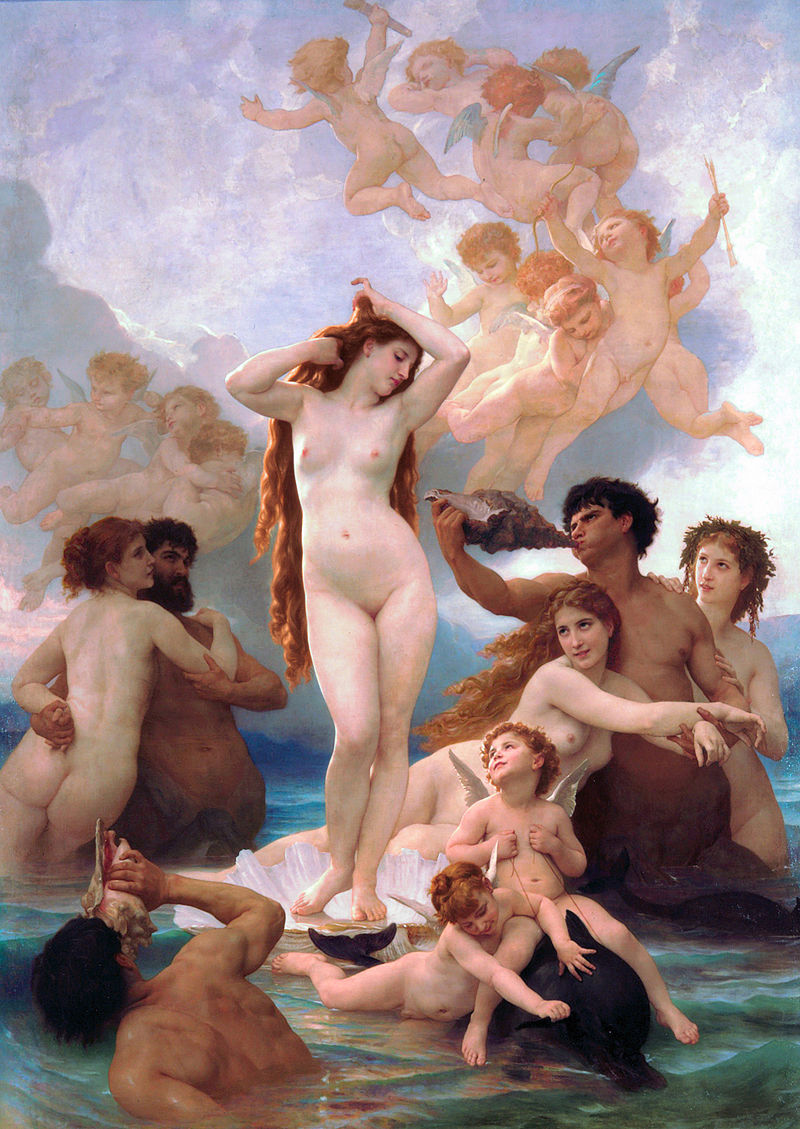

The Name of the Star
The name Astarte is etymologically close to the Ancient Greek word "Astron" (Ἄστρον), which means "Star."2 This is an allusion both to the starry beauty of Astarte herself, but also to the fact that she has been called many epithets like the "Queen of Heaven." Astarte's beauty, internal and external, has been incomprehensible throughout the aeons.
Words like "Astrology" are derived from her Divine Name. A common epithet given to many Gods, relating to Astarte's Name, was "Astroos or Astroa" (Ἀστρῷος, Ἀστρῷα),3 which means "He or She of the Stars." The allusion about the descent to mankind and the arrival of the Gods from the Stars is a well known subject in all Ancient Pagan religions.
Even today in English, we unconsciously call beautiful women and men who are of profound beauty as "A Star," to affirm this starry quality about a person. The word "Astreos" (Ἀστρεῖος), which means "Of the Stars," is a common Ancient Greek epithet for people who are of starry or supreme qualities, but also used for Gods very frequently.
The name Astarte also connects directly to the Semitic root ʿṯtr, shared with the masculine deity Athtar. This root is associated with both the planet Venus and the concept of irrigation and abundance in the Semitic world. In the Ugaritic texts discovered at Ras Shamra, Astarte appears as ʿṯtrt, where she is already identified as a cosmic and martial deity of the highest rank.4 Her name was known across the entire Fertile Crescent, from Mesopotamia to Egypt, a testament to the universality of her worship.
The Statue of Liberty, which wears the Crown of a Star in New York, is symbolic of Astarte's influence into the United States. The Statue itself was inspired from Egyptian artwork and Classical depictions of freedom deities.5
Astarte, Eos and the Light of Dawn
Astarte's powerful connection to Zeus is a self-evident reality. One of Zeus's important epithets, "EOSFOROS" (Ἑωσφόρος), the Ancient Greek form for the Latin "Lucifer," means "Bringer of the Light." The first part of this word, the word Eos (Ἕως), is a code word for Astarte. Eos is a Goddess of Ancient Greek Mythology that rules the light of the Dawn, the soft spiritual light which is a perfect time for human beings to meditate.
Ushas (उषस्), which is the Sanskrit name for Eos, is a significant time for meditation each day, also referred to as the "Time of Worship" in spiritual code. The latter part of the word "EOSFOROS," "Foros" (Φόρος), translates to "bringer"6 and symbolizes the carrying of the soft light of the dawn to mankind.7
Ushas is one of the most celebrated deities of the Rig Veda, invoked in over twenty hymns. She is called "the daughter of the Sky" (duhitā diváḥ), the sister of Night, and her arrival banishes darkness. The Rig Veda describes her as golden, shining, the one who awakens all creatures and inspires song. Her relationship to the Vedic Dyaus Pitar (the Sky Father, cognate of Zeus) mirrors Eos's relationship to Zeus in the Greek tradition. The Indo-European root *h₂eus-os gives both the Greek Eos and the Sanskrit Ushas, showing this Goddess was known and worshiped long before recorded history, stretching back to the proto-Indo-European period.8

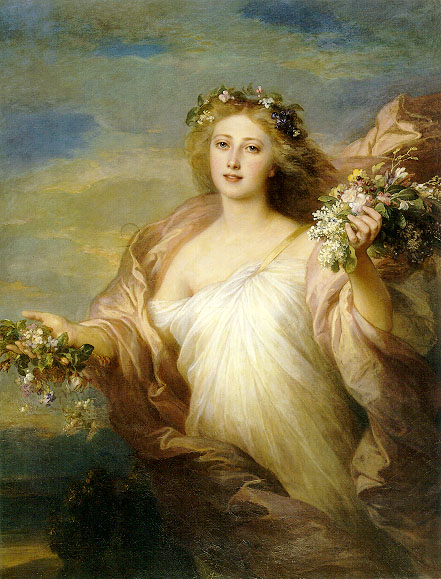
From the Ancient Greek Eos, in a linguistic interpretation, we also have a direct link with the Goddess of the Germanic People, "Eostre," whose reconstructed Name points to the Name "Austro" which is the source of the Name for our beloved Astarte in Ancient Greek. The proto-Germanic *Austrō derives from the PIE root *h₂eus- ("dawn, east"), the same root that gives the Greek Eos, the Latin Aurora, the Lithuanian Aušrinė (Goddess of the Morning Star), and the Sanskrit Ushas.9 Her name as Eostre or Ostara reveals her strong association with and love for Zeus (Phosphoros), but also her strong relation with Apollo and their light-bringing and life-bestowing qualities of rebirth.
Her season is Spring, the season through which nature regenerates and new life comes into being. The celebration of Easter is even in name stolen from the Great Goddess. An even more obvious and popular manifestation of her Name is the country named "Austria," which would mean, "Land of the Astra" or "Stars." Astarte is a Goddess of nature, something well known in all of her history, but also acknowledged even in hostile sources. Sacred trees, green pastures, the beauty of nature, animals and anything that is a blessing of beauty into this planet is ruled by Her. She is a caretaker of nature, and through her power she is a sustainer of life and existence, human and animal. She is a Goddess of blossoming life, a symbol of eternal creative recreation, fertility, birth and finally, rebirth after death.
Eos, strongly correlated with Selene (Goddess of the Moon), is known in Ancient Greek mythology as the twin sister of the Sun, Helios. In the same way, Artemis is ruler of the Moon and is the Twin Sister of Apollo, the manifest power of the Sun. Numerous stories of Astarte bestowing immortality to human beings exist, such as Selene's bestowal of Eternal Youth to a human named Endymion.10
As the Spring arrives after the death of nature, so can the Godhead arrive for humans who seek it after a period of desolation and ignorance. Astarte oversees this transformation.
Spiritual Powers and Attributes
Astarte answers truly concerning past, present, and future. She reveals all secrets and is an excellent teacher of the liberal sciences. She causes prophetic dreams and visions about the future and gives insight into the unknown. She also counsels those who are dedicated to the Gods and actively working in their service. She obtains friendship from those in power and represents luxury and ease.
Astarte rules the domains of love, war, fertility, and the mysteries of the soul. Her spiritual authority extends across every dimension of human life. She is simultaneously the gentle mother who nurtures new life and the fierce warrior who destroys what threatens her people. In Egyptian representations, she appears carrying weapons of war alongside her symbols of fertility. In the Ugaritic texts, she is both lover and fighter, never diminished in either role.
As the Babylonian Goddess Ishtar, scriptures called her the "Light of the World," "Goddess of Goddesses," and "Bestower of Strength." Along with Ea (Enki) and Enlil, Ishtar formed the most powerful and widely venerated triad in Mesopotamian religion.11
Connecting with Astarte
Astarte responds powerfully to those who approach her with genuine reverence. Her candle colors are brown or green (representing earth and Venus energy). Copper is her metal. Her sigil should be gazed upon during meditation while vibrating her name: AH-STAHR-TAY, drawn out slowly. Feel the vibration settle in your heart chakra.
She is particularly responsive during Venus hours and on Fridays (the day of Venus). Burning incense of rose or sandalwood while meditating on her sigil can deepen the connection. Those who work with Astarte consistently report heightened intuition, prophetic dreams, and a deep sense of inner beauty and strength.
The Aspects of Astarte
She encompasses everything that is feminine, the many faces of the feminine powers that run both in our species and in the cosmos. The wisdom of her mysteries is in-depth, and in Ancient Greek mysteries but also many mythologies, she is "Divided" into many "Aspects." The reason for these divisions is because of how complex and how Advanced she is.
The "Aphrodite" or Love/Attraction Aspect: Astarte As Incarnation of Maximum Beauty and Fertility
Inanna, as a rule, represents the power of Venus, the power of Love. In this representation, she represents the external world, the observable beauty, the beauty of the form, external beauty and measure. There is no Goddess that is as beautiful as she is. Yet, this connotation hides many hidden meanings beyond the meanings of pure external beauty.
In this form of the power of beauty, she is represented by Aphrodite. Falsely, and due to the fall of consciousness of mankind, Astarte has been credited mostly as a Goddess of external sexual beauty. Sexual attraction is very important, is related to the procreative drive, and is necessary for human existence. Going higher, Venus also rules love in its entirety, from the lower aspects to the higher aspects.
In the Symposium of Plato, Aphrodite in this aspect is divided in two levels: The "Uranian Aphrodite" (Ἀφροδίτη Οὐρανία) or Heavenly Aphrodite, and the "Pandemos Aphrodite" (Ἀφροδίτη Πάνδημος) or "Earthly" and "People's" Aphrodite. Each represent a different face of the Goddess: one focused on carnal procreation, while the other represents the higher powers of the notion of love. Pausanias, speaking in the Symposium, makes this distinction explicit: the Heavenly Aphrodite inspires spiritual love between souls seeking wisdom, while the Common Aphrodite governs the physical attraction necessary for the continuation of life.12
Beauty, while in its external form is arguably what makes life worth living as in art and culture, is also a manifestation of other deeper notions such as harmony. For Plato and other Ancient Philosophers, the manifestation of beauty is also the manifestation of sublime ideals such as balance, harmony, equilibrium and perfection. Plato and Socrates expanded upon the numerous meanings of the word "Beautiful" (Καλός) and the given philosophical notions of the term, which deal with the world of ideas (astral realm) and deal with the architecture of the universe.13
In the Phaedrus, Plato goes further. He describes how the soul, upon beholding true beauty, remembers its divine origin. The wings of the soul, which had withered in the descent into material existence, begin to grow again when beauty is perceived. This is the philosophical truth behind Aphrodite's domain: beauty is a portal to the divine, and love is the force that opens it. Plato writes on the Phaedrus about the distinction of the two types of love: Carnal love (called Eros, from which the word "erotic" today was made) and Spiritual love (the union of the soul). These types of love are fundamental in survival and human procreation, yet at the same time the same spiritual force leads to enlightenment.14
The all-encompassing importance of the notion of love and all its manifestations falls under her power associated with the Planet Venus. As explained in the beginning of this page, Aphrodite and the rule of the feeling of Love is showing a hidden spiritual procedure: that of the union of the Soul through Spiritual Alchemy.
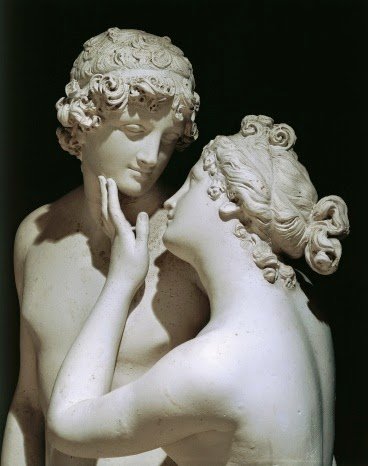
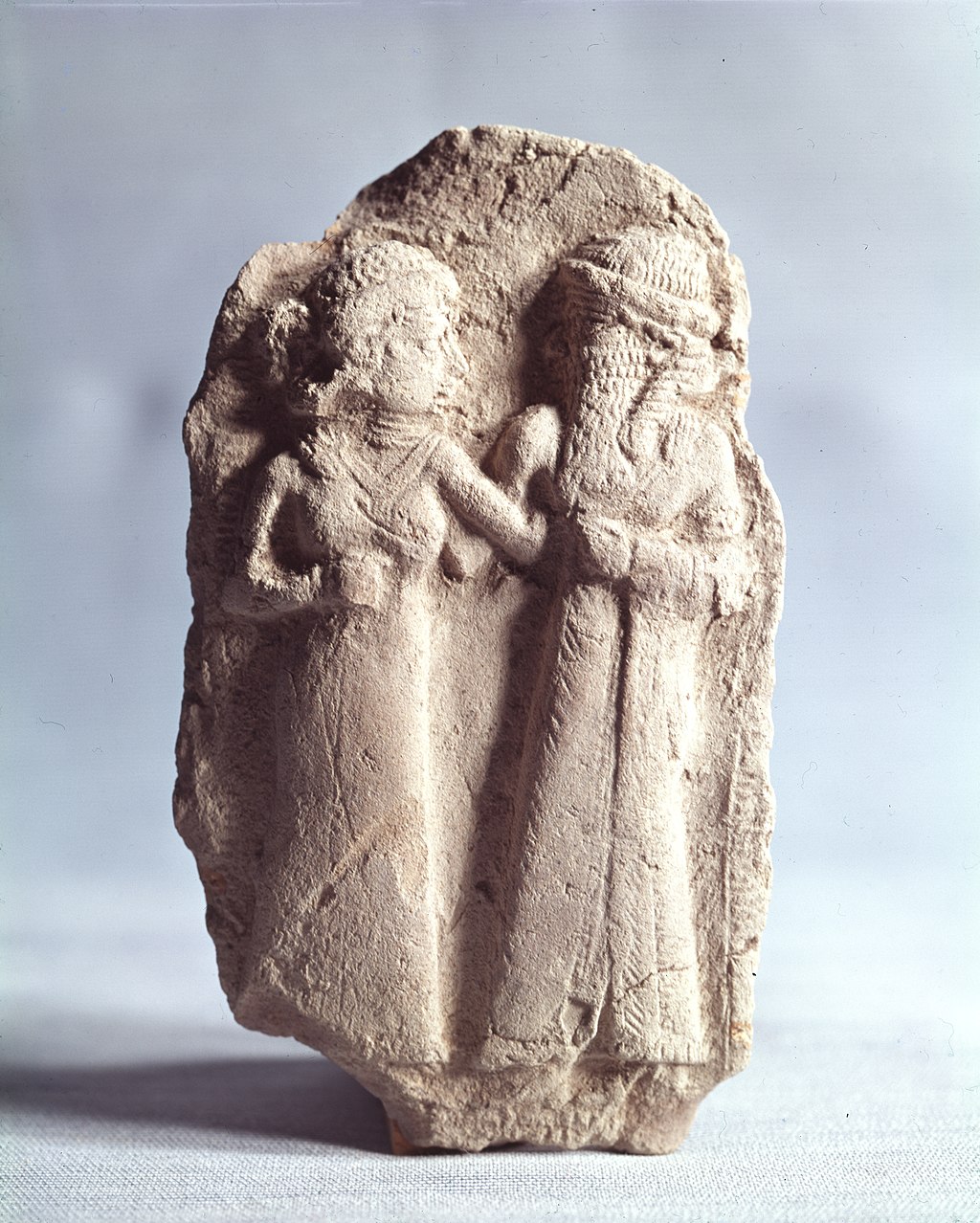
In Spiritual Mythology, Astarte has many "lovers," including makers of the first human civilizations like Dumuzid, or the famous myth of Aphrodite and Adonis. These are only to name a few. It must be understood clearly that the term "lovers" in these mythologies must not be conflated with "lovers" in the human sense. These are symbolic and allegorical descriptions. "Lovers" in the divine context means the connection and interplay between different energies, different aspects of the cosmos, different spiritual forces that work in tandem and in union. The ancient priesthoods understood this, but as the myths were passed down to the common people, they were translated into human symbolism for easier understanding of the Divine truths related therein. The "love" between Aphrodite and Adonis, or between Inanna and Dumuzid, is the love between cosmic forces that sustain creation, between the power of fertility and the cycle of death and rebirth, between the soul and its capacity for transformation.
Behind these mythologies, there rests a very important parable, that explains that the power of the Goddess acts directly to help humanity and mere mortals. The idyllic bond built between these forces is not focused on the erotic aspect, but on the aspect of bonding the soul. Inanna's descent into the underworld to save the mythical hero/god Dumuzid is synonymous with the spiritual allegory of Demeter and the descent of Persephone into the underworld.15
The story of Adonis and Aphrodite has gone down in history as one of the most beautiful love stories to ever have existed. The name Adonis itself derives from the Semitic Adon, meaning "Lord," showing the deep cultural exchange between the Greek and Near Eastern worlds. His death and annual mourning became one of the most widespread ritual observances in the ancient Mediterranean, from Byblos to Athens, from Cyprus to Alexandria. The women who mourned Adonis in the Adonia festivals were performing a ritual that mirrored the cosmic cycle of death and rebirth that Astarte herself governs.16
Likewise, for the Germanic People, Astarte represents everything stated in this page under her name as Freya, including love and procreation. Like the Egyptian goddess Isis and the Greek Aphrodite, Freyja traveled through the world seeking a lost husband and weeping tears of gold.17 Freyja was the most celebrated Goddess of the Norse world. She ruled over the afterlife realm of Folkvangr, where she received half of the battle-slain (the other half going to Odin's Valhalla). She possessed the Brisingamen, the necklace of fire, and she taught the Gods the art of seidr, the most powerful form of Norse magic. Her chariot was drawn by two cats, sacred animals associated with independence, mystery and feminine power across many cultures.
The "Artemis" or Virgin Aspect: Justice and Spiritual Power
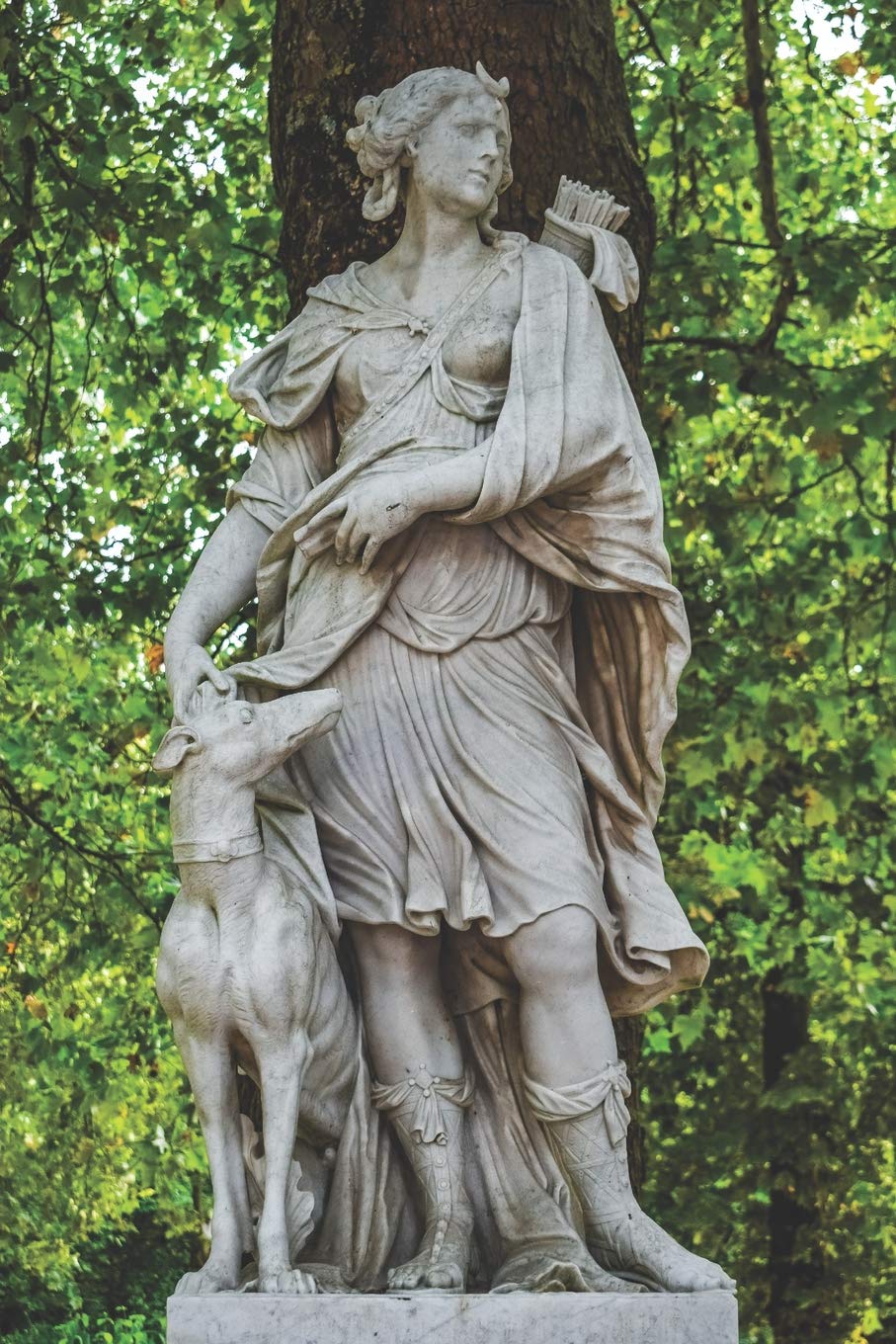
As Artemis, Astarte's symbol of power is the Lunar Disk, but also her powerful prowess, being the Twin Sister of Apollo. Apollo and Astarte are twins in the Sumerian tradition as well: Utu/Shamash and Inanna. Artemis lives in the forest, in the wilderness, and rules over the Moon and its Cycles. In that respect, her rule of the Moon is again representative of the feminine powers of the Moon.
Like Apollo, she is called "Bright" (Phoebe, Φοίβη), a connotation to her spiritual ranking and strength. Another common power of Artemis is that Artemis can exact extraordinary punishment for violation of spiritual edicts of the Gods, as Apollo does. When Astarte wants to punish, one word describes what these punishments entail: "Terrifying."18
The myths of Artemis are filled with examples of her fierce justice. Actaeon, who violated the sanctity of her sacred space, was transformed into a stag and torn apart by his own hounds. Niobe, who boasted herself above the Gods, lost all her children to the arrows of Artemis and Apollo. Orion, the mighty hunter, was slain when he overstepped the boundaries set by the Gods. These are spiritual parables: Artemis protects the boundary between the sacred and the profane, and her punishment falls on those who violate it.19
The Ancient Spartans also worshiped Venus in a warrior aspect, and the same is the case with the Babylonians and Assyrians with Inanna, for Astarte is a Warrior Goddess and a Fertility Goddess to them. The Ancient Spartan war machine, known by all people of the world and even admired worldwide today, had Aphrodite as their main city-state Goddess. Under this, she was called "Aphrodite Areia" (Ἀφροδίτη Ἀρεία). Sparta was renowned for treating women as the pupil and the eye of the Spartan world. At the same time, Spartan women reciprocated to this behavior by being deserving of the high praise and creating new life.20
The nature of chastity or virginity in the Artemis symbol is because the Moon, or the inner part of the soul, does remain virgin and unadulterated. It is the part of the soul we carry through each lifetime, which defines who we are. Adulterated and virgin not only concerns sexual relationships, but how one must keep their soul and spirit pure from external evil and negative influences.
In that regard, the ability to fight back against injustice and negativity becomes rather necessary. Artemis is a Goddess of supernal wisdom and destructive prowess, and Artemis represents the direct aspects of warfare that deal with direct destruction, no different than an aspect of Aphrodite as explained above.
Artemis, except of a huntress, is also the protector of nature, wildlife, and was the most venerated Goddess in Ancient Greece for the rural people. Like Apollo, she protects the children and the young and innocent, while she smites with death and disease those who destroy what is sacred. She was called "Mistress of All the Animals" (Πότνια Θηρῶν), a form of honorary title that connects directly to the Minoan and Mycenaean Mother Goddess traditions, showing an unbroken line of worship stretching back thousands of years before Classical Greece.21
It must be kept in mind that animals and animal life is sacred in Zevism, and while Artemis is symbolic of hunting for consumption, she also establishes the balance with the living environment of life, something that humanity must have a goal to achieve. Artemis is the protector of the wildlife.
Isis and Demeter: The Mother of the Earth, Gods and World Aspect
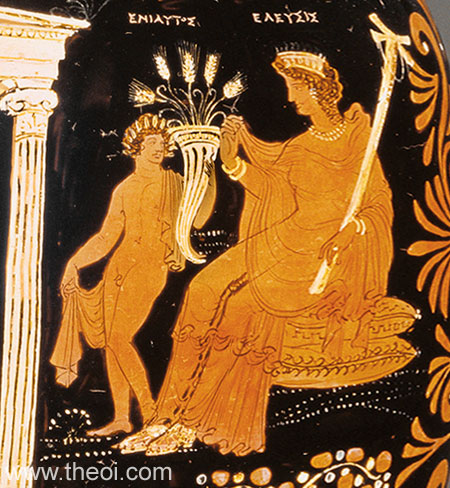
Demeter (Δημήτηρ) is the Goddess of the Harvest, which deals with the fertility and the creation of mother Earth. The production of food, the laws of life and death, but also the deep occult mysteries of the Female Priestesses of Ancient Greece and the Eleusinian Mysteries, were created under the teachings of Astarte. These were some of the most secret mysteries in the Ancient World, where initiates learned siddhis and received enlightenment.22
In her aspect as Demeter, Astarte is the most apocryphal and secretive of her aspects. The Greek word ΕΝΙΑΥΤΟΣ, which means "Inner Self" or the "True Self," and ΕΛΕΥΣΙΣ, which means "The Coming" or "To Become," are deeply associated with the Eleusinian rites. Demeter shows the disciple the secrets to bring the birth of the higher self, or the "Second Birth."
The Eleusinian Mysteries were celebrated annually for nearly two thousand years, from approximately 1500 BCE to 392 CE, when the Christian Emperor Theodosius I ordered their closure. The initiated were called mystai (μύσται), and the highest degree of initiation was called epopteia (ἐποπτεία), meaning "beholding" or "revelation." Cicero wrote that among all the exceptional things Athens produced for human life, nothing was greater than the Eleusinian Mysteries, which taught humanity how to live with joy and how to die with hope.23 Pindar and Sophocles both wrote that only the initiated could expect blessedness after death, while the uninitiated would languish in darkness.24
The same history is repeated in her identity as Danu, in Irish folklore and mythology. As Danu, she presides over the Tuatha De Danann. The Tuatha De Danann are an Irish folklore history about the Gods and the people that existed in Ireland before the present-day Irish came to live there, who exhibited extreme powers of the mind and soul, but were most knowledgeable in the spiritual arts of the Gods. Dana (Astarte) is shown here also as their mother.25
The depth of her mysteries is extensive, and the importance of these mysteries was the "Descent into the Underworld," which the Goddess Demeter's most famous allegory is related to. The underworld is symbolic of the astral plane and realms of the dead, but also of the reconnection of the soul with one's spiritual powers.
In this myth, Demeter's daughter, Persephone, descends into the underworld to finally get saved and brought to her mother again. The Myth of the "Descent," also famous in Sumerian and Ugaritic history of Astarte, is the restoration of the Fallen Serpent Power (Fertility Power) and reuniting this power with the Divine Mother or Demeter (the head of the spiritual practitioner). This story was called "Inanna's Descent into the Underworld" in Sumer, and it is one of the oldest literary compositions in human history, dating to approximately 1900-1600 BCE.26
When this spiritual process is completed, "Spring" (the Greek word for this being "Aneksis," Ἄνοιξις, which means "Opening") does occur, and the person finally opens up their spiritual faculties which allow the person to go back and forth into the "Realm of the Dead" or the Astral Plane and the physical world. The spring and blossoming of the soul happens, as the Chakras are also commonly in all Pagan Traditions depicted as flowers, and then one finally blossoms and returns to the "Divine Mother" or Demeter.
Unconsciously, from the name Demeter, we today in English speak of "The Mother" which is close to the word De-mater in its pronunciation. In modern German, "The Mother" is still called "Die Mutter," which is another alteration of the latter aspect of the word Demeter. Her association with the Earth, the Harvest, the family and household, but also the earth and the soil in itself, made her over time to be entitled as "Mother Earth." Like Isis, she is a motherly figure that supplies human beings with whatever they require for life.
In her Egyptian identity as Isis, Isis is portrayed as the Mother of "Horus the Savior," from which "Holy Mary the Mother of Jesus the Savior" was stolen from. That constitutes one of the greatest blasphemies and corruptions against the Goddess.27 Plutarch, in his De Iside et Osiride, documented the identification of Isis with Aphrodite and the continuity of the Goddess across cultures from Egypt to Greece. He reported that the Egyptians identified Isis with Aphrodite, and that her mourning for Osiris and her quest to reassemble his body was a foundational myth that influenced the Mystery traditions across the Mediterranean world.28
The worship of Isis spread far beyond Egypt. By the Hellenistic period, temples of Isis existed in Athens, Rome, Pompeii, and across the entire Roman Empire. The Metamorphoses (or The Golden Ass) of Apuleius, written in the 2nd century CE, contains one of the most powerful prayers to Isis in all of ancient literature, in which the Goddess declares herself to be the single form behind all the Goddesses worshiped under different names: "I am Nature, the universal Mother, mistress of all the elements, sovereign of all things spiritual." This is a direct confirmation of what is taught here: Astarte, Isis, Aphrodite, Demeter, and all the other names are aspects of one supreme Goddess.29
Astarte's Divine Symbols: The Power of Astarte's Sigil
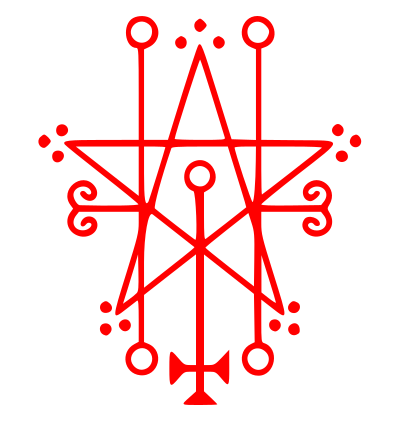
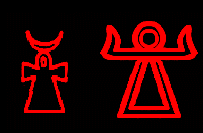
The star as an occult symbol is clearly illustrated in Astarte's Sigil. This Symbol is also called the "Pythagorean Perfection Symbol," also frequently associated with Zeus, and represents the unity of the 5 elements in the human being.
The elements of water, fire, air and earth represent the body and the lower functions, while the Aether or the 5th element represents the finer substance of the soul and connector of all the other elements.
The power of this symbol is very deep, universal, and is one of the most important sacred geometrical shapes. The fact that one pentagram can indefinitely go inside another pentagram represents the infinity of the creative energy of the cosmos, represented in human beings as the drive of procreation and life with every succeeding generation.
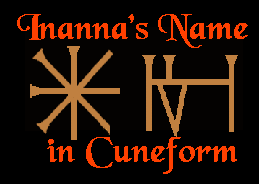
The clusters of three dots at the points of the star of her sigil are extremely ancient and denote her high spiritual rank. Her sigil also depicts important points of the human soul, as can be seen from the Venus glyph with the inverted cross symbolizing the all-important solar chakra and the pillars of the soul on each side.
Her Sigil represents a case where spiritual alchemical notions inside a sigil are overabundant. It would not be an understatement to say that most if not all the mysteries of the human soul are explained in her very sigil.
Sacred Temples and Cities
Uruk: The Sacred City of Inanna
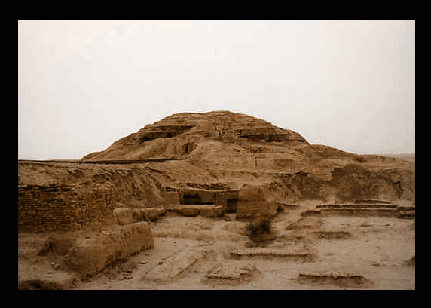
Her sacred city was Uruk (modern Warka, Iraq), one of the oldest cities of Sumer, where she had her principal temple. Uruk was one of the largest cities in the world by the 4th millennium BCE, with a population that may have reached 40,000 to 80,000 people. Under Astarte's patronage as Inanna, the people of Sumer and their communities prospered and thrived. She had shrines and temples in many cities throughout the Ancient Middle East.
The Eanna temple complex in Uruk, whose name means "House of Heaven," was dedicated to Inanna and is among the oldest monumental structures in human history. It was here that some of the earliest known writing was developed, in the service of the Goddess's temple administration. Writing itself, one of humanity's greatest achievements, was born in her house.30
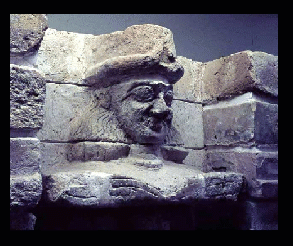
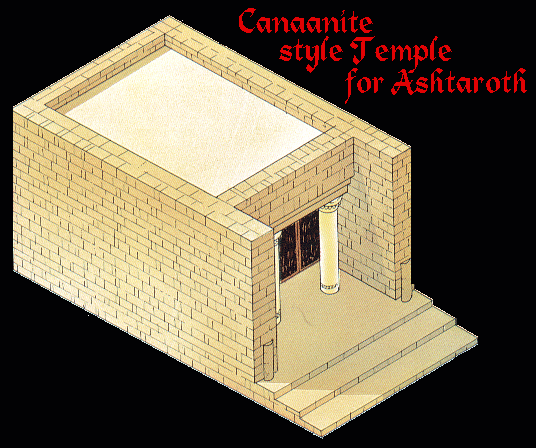
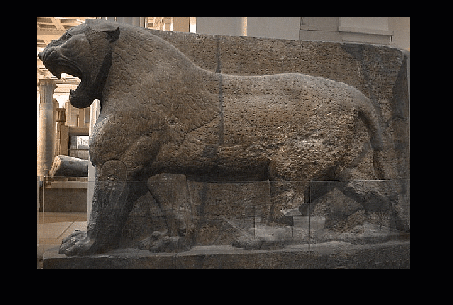
The Lions of Nimrud
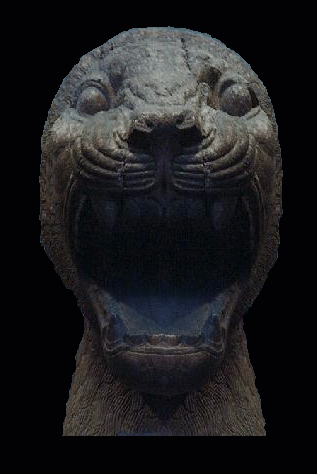
As the Sumerian Goddess Inanna, she was known as a powerful warrior, and her sacred animal was the lion. The lions that guarded her temples proclaimed her martial power to all who approached. In Mesopotamian iconography, Inanna/Ishtar is frequently depicted standing upon the backs of lions, demonstrating her sovereignty over the most powerful of beasts. The lion represented royal power, courage and ferocity, qualities that Astarte embodies in her warrior aspect.
The Temple of Artemis at Ephesus
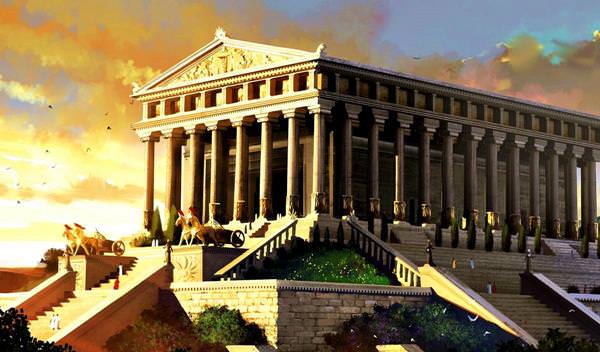
The Temple of Artemis at Ephesus was one of the Seven Wonders of the Ancient World and one of the most magnificent temples ever built. In the mysterious paintings of the temple, the Amazons and their Queen Otrera were illustrated, and the temple was filled with spiritual allegories. In one of these allegories, Astarte takes the form of a warrior aspect again as part of mythological allegory.
Antipater of Sidon, who compiled the list of the Seven Wonders, wrote in the Greek Anthology: "I have set eyes on the wall of lofty Babylon on which is a road for chariots, and the statue of Zeus by the Alpheus, and the hanging gardens, and the colossus of the Sun, and the huge labour of the high pyramids, and the vast tomb of Mausolus; but when I saw the house of Artemis that mounted to the clouds, those other marvels lost their brilliancy, and I said, 'Lo, apart from Olympus, the Sun never looked on aught so grand.'"31
The Temple was destroyed by arson in 356 BCE, rebuilt, and then finally demolished by Christian mobs and later by the Goths. Its destruction is one of the most painful losses in human history. The goddess Artemis of Ephesus, depicted with multiple breasts or egg-shaped ornaments symbolizing fertility, was a direct continuation of the ancient Near Eastern Mother Goddess tradition stretching back to Inanna and Ishtar.
The Temple of Isis at Philae
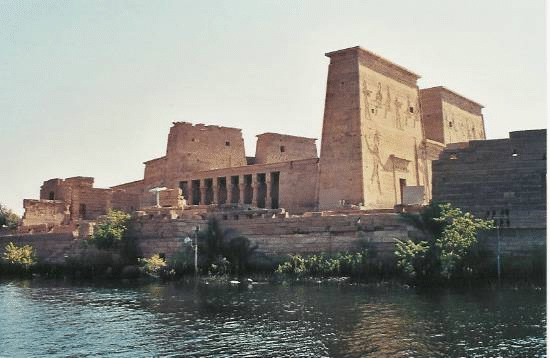
The Temple of Isis at Philae was one of the last strongholds of traditional Egyptian religion. It remained active until 537 CE, well over a century after the Roman Empire officially adopted Christianity. The Blemmyes and Nobatae, peoples of Lower Nubia, continued to worship Isis at Philae long after the rest of Egypt had been Christianized, a testament to the enduring power of the Goddess. The temple had to be moved to Agilqiyya Island during the construction of the Aswan Dam in the 1960s to save it from flooding, in one of the great archaeological rescue operations of the modern era.
The Ishtar Gate of Babylon
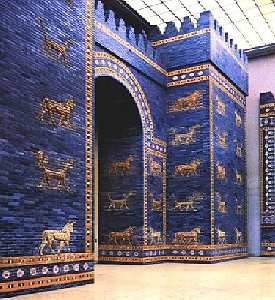
The "Ishtar Gate," built approximately 575 BCE, was the main entrance into Babylon. It was the eighth of eight gates of the inner city. King Nebuchadnezzar II dedicated the Gate to Ishtar. It was one of the most impressive monuments in the ancient Near East, decorated with dragons (mushhushshu), bulls (aurochs) and lions. The gate was covered in brilliant blue glazed bricks with golden figures, a display of beauty and power that stunned all who beheld it. The Processional Way that led through it was lined with 120 lions, sacred to Ishtar, on glazed brick panels. The surviving portions of the gate are now in the Pergamon Museum in Berlin, where they continue to testify to the glory of the Goddess.32
Her Sumerian title "Queen of Heaven" was later stolen by Christians and applied to their fictitious "Virgin Mary."
The Defamation of the Goddess: Ashtoreth and Goetic Projections
The systematic campaign to destroy Astarte's name and reputation is one of the most documented cases of theological warfare in history. Understanding how it was accomplished reveals both the methods of the Yehuborim and the indestructible nature of the Goddess herself.
The Corruption of the Name: From Ashtart to Ashtoreth
The original Semitic name of the Goddess was Ashtart (ʿAštart). When Israelite scribes recorded this name in the Hebrew Bible, they deliberately corrupted its vowels. The consonantal skeleton of the name, ʿ-Sh-T-R-T, was preserved, but the vowels were replaced with those from the Hebrew word boshet (בֹּשֶׁת), meaning "shame" or "abomination." The result was the distorted form Ashtoreth (עַשְׁתֹּרֶת).
"Although Sidon is respected, it could not be forgotten that her goddess was Ashtart, a name the Israelite scribe wrote with the five consonants 'strt', and vocalized them by the vowels of the familiar Hebrew word for 'shame,' making the Sidonian goddess appear in the bastard form Astoreth." 33
"Of the various spellings of the name, Astarte is found in the Tel Amarna letters. The Hebrew Astoreth arose when the rabbinical school of the Massoretes in the sixth century decided to adopt a conventional system to compensate for the lack of vowels in written Hebrew, and at the same time to insert in the names of foreign divinities the vowels from the word 'boshet', meaning abomination." 34
This was a deliberate act of defamation: a conscious decision to ensure that every time the name of the Goddess was spoken aloud in Hebrew, it would carry the sound of "shame." The plural form, Ashtaroth (עַשְׁתָּרוֹת), was then used as a generic word for "pagan idols," stripping the Great Goddess of her individuality and reducing her to a category of contempt.
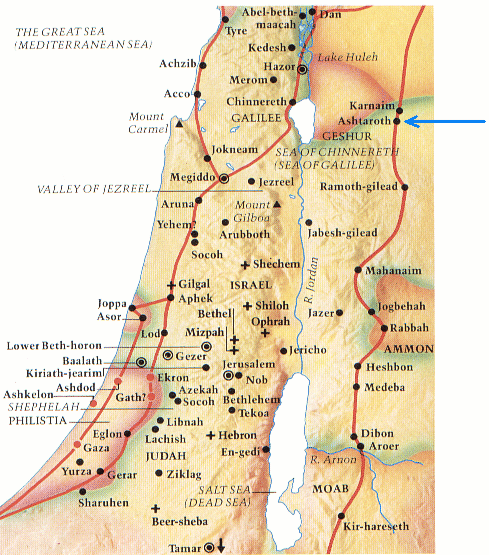
In the Hebrew Bible, the worship of Astarte is condemned in 1 Kings 11:5, 33 and 2 Kings 23:13, where King Solomon is accused of worshiping "Ashtoreth the goddess of the Sidonians." King Josiah's reforms in the 7th century BCE targeted her high places specifically. Yet these very condemnations prove how widespread, how deeply rooted, and how powerful her worship was among the peoples of the ancient Levant, including the Israelites themselves.
HAIL ASTARTE!!!
The Goetic Inversion: How Astarte Was Hidden in the Grimoires
Centuries later, the same campaign of inversion continued through the grimoire tradition. In the Ars Goetia (the first part of the Lemegeton, compiled in the 17th century from older material), the Goddess appears under the hostile and corrupted name Astaroth, listed as the 29th spirit.
The grimoires describe "Astaroth" as revealing secrets, speaking of past, present and future, and teaching the liberal sciences. These are, of course, the authentic powers of Astarte herself: prophecy, revelation, wisdom and higher instruction. The grimoire authors preserved the powers, but inverted the theology.
Johann Weyer repeated the same pattern in Pseudomonarchia Daemonum (1577). When the hostile framing is removed, what remains is not a "demon," but a recognizable portrait of the Great Goddess under a corrupted name. "Astaroth teaches liberal sciences" is only a perversion of the truth that Astarte governs wisdom, art and the hidden mysteries of the soul.
For the fuller older Temple page connected to this hostile grimoire title, see:Astarte under the grimoire name Astaroth.
Sources and Bibliography
1 Jewish Women's Archive, "Astarte: Bible." Documents the systematic defamation of Astarte in the Hebrew Bible, confirming her immense importance in the Ancient World. jwa.org/encyclopedia/article/astarte-bible
2 J. Stamatakos, Dictionary of Ancient Greek, "Ἄστρον" entry.
3 J. Stamatakos, Dictionary of Ancient Greek, "Ἀστρῷος" entry.
4 Mark S. Smith, The Ugaritic Baal Cycle, Vol. I: Introduction with Text, Translation and Commentary of KTU 1.1-1.2 (Leiden: Brill, 1994). On the Ugaritic divine name ʿṯtrt and the roles of Astarte in the Ugaritic pantheon.
5 Luke Roman and Monica Roman, Encyclopedia of Greek and Roman Mythology (New York: Facts on File, 2010).
6 J. Stamatakos, Dictionary of Ancient Greek, "Φέρων" entry.
7 Luke Roman and Monica Roman, Encyclopedia of Greek and Roman Mythology, p. 343, "Eos" section.
8 Stephanie W. Jamison and Joel P. Brereton, The Rigveda: The Earliest Religious Poetry of India (Oxford: Oxford University Press, 2014), Hymns to Ushas (Book I, Hymns 48, 49, 92, 113, 124; Book IV, Hymn 51; Book VII, Hymn 77). On the PIE reconstruction *h₂eus-os, see Michael Meier-Brugger, Indo-European Linguistics (Berlin: De Gruyter, 2003), §8.1.
9 Jacob Grimm, Deutsche Mythologie (1835), Vol. I, Ch. 13: on Ostara/Eostre. Bede, De Temporum Ratione (725 CE), Ch. 15: the earliest attestation of the Anglo-Saxon Eostre. On the PIE root *h₂eus-, see Benjamin W. Fortson IV, Indo-European Language and Culture, 2nd ed. (Oxford: Wiley-Blackwell, 2010), pp. 27-28.
10 Luke Roman and Monica Roman, Encyclopedia of Greek and Roman Mythology, "Selene" and "Endymion" sections.
11 Jeremy Black and Anthony Green, Gods, Demons and Symbols of Ancient Mesopotamia: An Illustrated Dictionary (London: British Museum Press, 1992), "Ishtar" entry.
12 Plato, Symposium, 180d-181a (Pausanias's speech on the two Aphrodites).
13 Plato, Symposium (c. 385-370 BCE), particularly the speeches of Diotima (201d-212c) on the ascent from physical beauty to the Form of Beauty itself. A complex and deeply philosophical text requiring thorough analysis to understand fully.
14 Plato, Phaedrus (c. 370 BCE), particularly 244a-257b on divine madness and the nature of the soul. Explains the distinction between carnal and philosophical love. Cultural differences and desecration of meanings (mostly caused by hostile religious institutions) have somewhat perverted the reception of this text. The text itself is still very valuable regardless.
15 Diane Wolkstein and Samuel Noah Kramer, Inanna, Queen of Heaven and Earth: Her Stories and Hymns from Sumer (New York: Harper & Row, 1983). The definitive scholarly translation of the Sumerian hymns and myths of Inanna, with extensive commentary on her role as warrior, lover, and cosmic sovereign.
16 Walter Burkert, Greek Religion, trans. John Raffan (Cambridge, MA: Harvard University Press, 1985), pp. 176-177, on the cult of Adonis and the Adonia festivals.
17 Encyclopaedia Britannica, "Freyja" section.
18 Luke Roman and Monica Roman, Encyclopedia of Greek and Roman Mythology, "Artemis" section.
19 Robin Hard, The Routledge Handbook of Greek Mythology, 8th ed. (London: Routledge, 2020), "Artemis" chapter. See also Apollodorus, Bibliotheca, 3.4.4 (Actaeon); Homer, Iliad, 24.602-617 (Niobe).
20 On Aphrodite Areia in Sparta, see Pausanias, Description of Greece, 3.17.5. The warlike depiction of Aphrodite belongs to her very earliest cults in Cyprus and Cythera, where there was a strong eastern influence during the Orientalizing Period, tracing Aphrodite's descent from older Middle Eastern goddesses such as the Sumerian Inanna, Mesopotamian Ishtar, and Phoenician Astarte. In Cyprus, Aphrodite was also referred to by the epithet "Aphrodite Encheios" (Aphrodite with a spear). See also Vinciane Pirenne-Delforge, L'Aphrodite grecque (Athens: CIERGA, 1994).
21 Walter Burkert, Greek Religion, pp. 149-152, on Artemis as Potnia Theron and her connections to Minoan-Mycenaean religion.
22 Robin Hard, The Routledge Handbook of Greek Mythology, "How Hades abducted Persephone as his bride, but was finally obliged to share her with her mother," p. 125.
23 Cicero, De Legibus, 2.14.36.
24 Pindar, fragment 137 (Sandbach); Sophocles, fragment 837 (Radt).
25 Encyclopaedia Britannica Online, "Tuatha De Danann" and "Goddess Dana" entries.
26 "Inanna's Descent to the Nether World," Electronic Text Corpus of Sumerian Literature (ETCSL), text 1.4.1. See also Wolkstein and Kramer (1983) for a full literary translation and commentary.
27 D. M. Murdock, Christ in Egypt: The Horus-Jesus Connection (Seattle: Stellar House Publishing, 2009).
28 Plutarch, De Iside et Osiride (c. 100 CE), particularly chapters 12-20 on the myth of Isis and Osiris, and chapters 27, 53 on the syncretism of Isis with Greek deities.
29 Apuleius, Metamorphoses (also known as The Golden Ass), Book 11, chapters 5-6 (c. 160 CE). The "aretalogy of Isis" in which the Goddess reveals herself as the single divine feminine behind all cultural manifestations.
30 Hans J. Nissen, Peter Damerow, and Robert K. Englund, Archaic Bookkeeping: Early Writing and Techniques of Economic Administration in the Ancient Near East (Chicago: University of Chicago Press, 1993). On the development of writing at the Eanna temple complex in Uruk.
31 Antipater of Sidon, Greek Anthology, IX.58.
32 Joan Oates, Babylon, rev. ed. (London: Thames and Hudson, 1986), pp. 144-148, on the Ishtar Gate and Processional Way.
33 James B. Pritchard, Recovering Sarepta, A Phoenician City (Princeton: Princeton University Press, 1978).
34 Egerton Sykes and Alan Kendall, Who's Who in Non-Classical Mythology (New York: Oxford University Press, 1993).