 አማርኛ
አማርኛ العربية
 বাংলা
বাংলা Български
 中文
中文 Čeština
 Dansk
Dansk Deutsch
 Eesti
Eesti Ελληνικά
 Español
 Français
 हिन्दी
 Hrvatski
 IsiZulu
 Italiano
 日本語
日本語 Kiswahili
 Magyar
 Македонски
 नेपाली
 Nederlands
 فارسی
فارسی Polski
 Português
 Română
 Русский
 Slovenščina
 Suomi
Suomi Svenska
 Tagalog
 Türkçe
About The Afterlife: Punishments & Tartarus
author: High Priest Zevios Metathronos
Since the Original Gods love mankind, they don't seek to issue empty or irrational punishments to human beings, let alone excessive or "eternal" ones.
Any form of disciplinary action by the Gods is always aimed at helping the human soul evolve and rehabilitate itself. In the vast majority of cases, the Gods allow humans full free will. Humanity is free to engage in any action, whether on the side of "good" or "evil."
The Gods intervene only in the most extreme cases. When they do, it's done out of love and goodwill to restore order on Earth or between individuals. In these cases, there must have been severe cosmic violations, and only then will the Gods issue any punishments, let alone heavy ones.
What Tartarus Actually Is
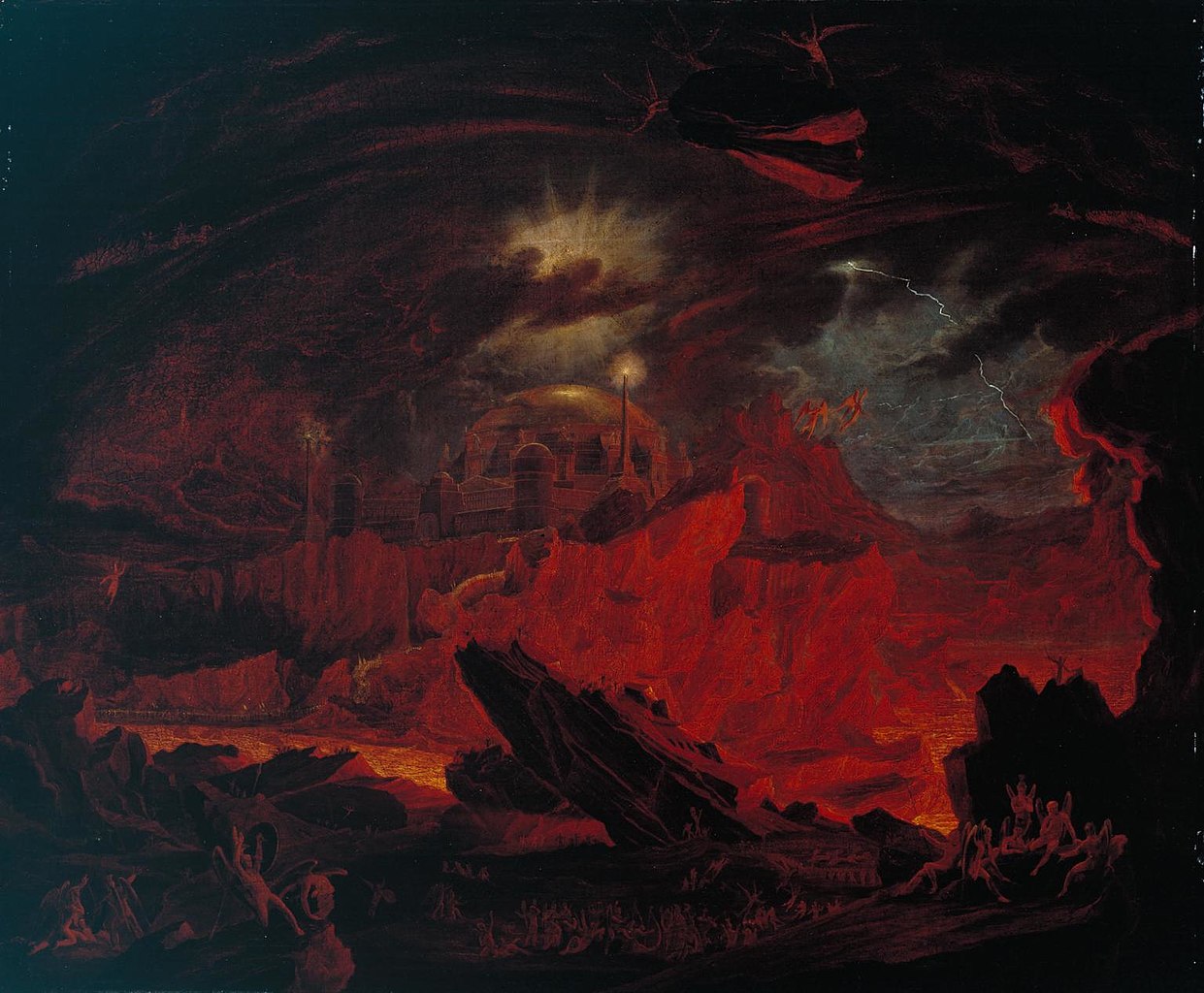
Hesiod describes Tartarus as a dark, abyssal prison beneath even Hades itself. He writes that a bronze anvil dropped from heaven would fall for nine days before reaching the earth, and then fall another nine days from the earth before reaching Tartarus (Theogony 721-725). The distance is deliberate. Tartarus sits as far beneath Hades as the sky sits above the earth. It's the absolute bottom of the cosmic architecture.
Hades, by contrast, is merely the domain where most souls go before reincarnation. It's an astral dimension for instruction, not punishment. The human soul is guided there, given insight into how to proceed in its next life, and then reincarnated. No serious punishment takes place in Hades.
Tartarus is different. It's reserved for the genuinely unredeemable. Not people who made mistakes or lived imperfect lives. Not people who failed to worship the right god. Not people who ate the wrong food or skipped a ritual. Tartarus exists for the worst of the worst: beings who committed atrocities so extreme that they violated the fundamental order of the cosmos.
Who Ends Up There: The Ancient Examples
The ancient sources are very specific about what warrants Tartarus. Every case involves a direct assault on cosmic order or a monstrous violation of the relationship between mortals and Gods.
Tantalus butchered his own son Pelops and served him as food to the Gods, testing whether they could distinguish human flesh from animal. The Gods strictly oppose blood sacrifice and will never accept such practices. For this crime, Tantalus was condemned to stand in water that recedes when he tries to drink, beneath fruit branches that pull away when he reaches for them. Eternal hunger and thirst for the one who perverted the sacred meal (Homer, Odyssey 11.582-592).
Sisyphus cheated death twice. He bound Thanatos (Death) in chains, halting all mortal death on earth. He tricked Persephone into letting him return to the living. And he betrayed a sacred confidence of Zeus himself. For systematically undermining the laws that govern the boundary between life and death, he rolls a boulder uphill for eternity, watching it roll back down each time it nears the summit (Odyssey 11.593-600).
Tityos attempted to rape Leto, mother of Apollo and Artemis, as she walked through the sacred grove at Panopeus. Two vultures tear at his liver perpetually. He attacked a Goddess under divine protection on sacred ground (Odyssey 11.576-581).
Ixion murdered his father-in-law (the first mortal to commit murder of a kinsman) and then, when Zeus himself purified him out of pity, attempted to rape Hera. He repaid mercy with the worst conceivable betrayal. He spins on a fiery wheel for eternity (Pindar, Pythian 2.21-48).
The Danaides (forty-nine daughters of Danaus) murdered their husbands on their wedding night. They pour water into leaking vessels that never fill, endlessly repeating a task that never reaches completion (Horace, Odes III.11.21-24).
(Notice the pattern. Every single case involves murder, attempted rape of a deity, betrayal of divine trust, or the perversion of sacred law. Not one involves "thinking the wrong thoughts" or "failing to attend worship." The standard for Tartarus is extreme.)
Plato's Account: Correction, Not Revenge
Plato refines the picture in the Gorgias (523a-527a) and Phaedo (113d-114c). In these dialogues, he draws a critical distinction between curable and incurable souls.
Curable souls who committed serious wrongs are sent to Tartarus temporarily. They suffer there until the persons they wronged forgive them. When the victims grant pardon, the curable soul is released and continues on its way. The punishment is corrective. The person remains in Tartarus to asses their damage. It has a purpose and an end.
Incurable souls remain permanently. These are the tyrants and mass murderers whose crimes are so vast and so deliberate that they've destroyed their own capacity for moral recovery. Plato uses the word "incurable" (ἀνίατοι) with surgical precision. These souls don't merely suffer. They serve as warnings to others who arrive in the underworld (Gorgias 525c). Even their punishment has a pedagogical function.
Plato estimates these incurable cases at a fraction of a fraction. In his Myth of Er (Republic 615c-616a), he describes the opening in the earth bellowing and refusing to release certain souls. The other souls watch this happen with terror. But Er makes clear: it happened to very few. And they were all the worst types of tyrants; not even ordinary "Tyrants" or people who started wars. We are talking about the worst of the worst in creation and all the human timeline.
What Tartarus Is Not
It's essential to state what the ancient tradition doesn't teach, because centuries of Abrahamic distortion have muddied these waters.
Tartarus is not for ordinary sinners. It's not for doubters. It's not for people who worshipped the wrong god. It's not for people who are Atheists or from another faith, other than ours. It's not for people who had sexual desires, ate forbidden foods, worked on a holy day, or spoke harsh words, had arguments, or stole an apple (for which in Islam you must sever a person's hand). In no ancient Greek or Egyptian source does anyone enter Tartarus for anything resembling a Christian "sin."
Seneca understood this clearly. He saw the suffering of the wicked as an internal condition of the soul rather than a physical torment imposed from outside (De Vita Beata 19.4). The wicked are tortured by what they've become, not by an angry god holding a whip against them. Only in the rarest cases can the Gods intervene for the protection of others and seclude these souls from others; but even this is exceedingly rare.
We don't rely on fear and threats to compel belief in our doctrine. Humanity must understand goodness and free will and must be allowed to make choices about its future. When one knows the truth, one understands that eternal hellfire for trivial offenses is inconsistent with the wisdom of the True Gods and the knowledge of the Ancient Initiates, who were the true sons and daughters of the Gods.
The contrast with Abrahamic traditions speaks for itself. The Book of Revelation annihilates most of humanity; only 144,000 "elect Jews" are saved. The Old Testament commands the massacre of entire nations, celebrates genocides, and prescribes horrific punishments for minor infractions. These religions claim to be "religions of love" while teaching that 99.8% of humanity will burn for eternity. That's not justice. That's a control mechanism built on manufactured terror.
Tartarus exists for fewer than 0.01% of souls. The truly unredeemable. Everyone else receives proportional consequences, learns, and continues forward. The Gods are just. The Gods are patient. The cosmos has room for error. The Gods also know how to correct these souls, incarnate them properly and rehabilitate them, only those on the further end cannot be rehabilitated.
Key Points
Tartarus is the exception, not the rule. The vast majority of souls go to Hades (for instruction) or Elysium (for reward). Only souls who committed extreme violations of cosmic order enter Tartarus.
Even in Tartarus, correction exists. Plato distinguishes between curable souls (who can be released when their victims forgive them) and incurable souls (who remain permanently as warnings).
The ancient standard is nothing like the Christian one. No ancient source sends anyone to Tartarus for doubting, for thinking, or for following the wrong religion. Every Tartarean punishment involves murder, rape of a deity, or deliberate perversion of sacred law.
For the Zevist Initiate, Tartarus is irrelevant. The path of spiritual practice, devotion to the Gods, and ethical living places you under the protection of the Gods. Your concern should be Elysium, not Tartarus.

Sources
- Hesiod, Theogony 721-819 (c. 700 BCE): The earliest extended description of Tartarus as a physical location within the cosmic structure, including the bronze anvil measurement of its depth.
- Homer, Odyssey 11.576-600 (c. 725 BCE): Odysseus's first-hand observation of Tityos, Tantalus, and Sisyphus in the underworld. The foundational text for Tartarean punishment.
- Pindar, Pythian 2.21-48 (c. 477 BCE): The account of Ixion's crime and eternal punishment on the fiery wheel.
- Plato, Gorgias 523a-527a (c. 380 BCE): The distinction between curable and incurable souls, and punishment as corrective rather than purely retributive.
- Plato, Phaedo 113d-114c (c. 360 BCE): The most detailed classification of post-mortem destinations, including the conditions for release from Tartarus through the victim's forgiveness.
- Plato, Republic X, 615c-616a (c. 375 BCE): The bellowing mouth of the earth in the Myth of Er, and the specific identification of incurable souls as tyrants.
- Seneca, De Vita Beata 19.4 (c. 58 CE): The Stoic reinterpretation of underworld punishment as an internal condition of the wicked soul.
- Virgil, Aeneid VI.548-627 (c. 19 BCE): The tour of Tartarus during Aeneas's descent. While later distorted by Christian interpretation, the Virgilian account preserves genuine Greco-Roman underworld topology.