 አማርኛ
አማርኛ العربية
 বাংলা
বাংলা Български
 中文
中文 Čeština
 Dansk
Dansk Deutsch
 Eesti
Eesti Ελληνικά
 Español
 Français
 हिन्दी
 Hrvatski
 IsiZulu
 Italiano
 日本語
日本語 Kiswahili
 Magyar
 Македонски
 नेपाली
 Nederlands
 فارسی
فارسی Polski
 Português
 Română
 Русский
 Slovenščina
 Suomi
Suomi Svenska
 Tagalog
 Türkçe
| Language / Culture | Name of Zeus | Attestation |
|---|---|---|
| Mycenaean Greek | di-we (𐀇𐀸) | Linear B tablets, Pylos and Knossos (c. 1400 BCE) |
| Classical Greek | Ζεύς (Zeus) | Homer, Hesiod, inscriptions (8th century BCE onward) |
| Latin | Iūpiter (from *Diēus-piter) | Roman religion, 6th century BCE onward |
| Vedic Sanskrit | Dyáuṣ Pitṛ́ | Rigveda (c. 1500–1200 BCE) |
| Oscan | Dípatír | Italic inscriptions |
| Umbrian | Iupater | Iguvine Tablets |
| Illyrian | Deipáturos | Classical attestations |
| Messapic | Zis | South Italian inscriptions |
| Albanian | Zojz / Zot | Living language ("Zot" = "God") |
| Hittite | Šiuš | Hattusa tablets (c. 1600 BCE) |
| Lithuanian | Dievas | Living language ("God") |
| Latvian | Dievs | Living language ("God") |
| Old Norse | Týr | Poetic Edda, rune inscriptions |
| Old English | Tīw | "Tuesday" = Tīw's Day |
| Celtic (reconstructed) | *Dyīus | Comparative reconstruction |
author: High Priest Zevios Metathronos
Divine Names
- Zeus (Ζεύς) — the ancient Hellenic name, from Proto-Indo-European *Dyēus ("Sky Father")1
- Baal-Zebul [Pronounced Va-AL-ZeBul] — "Lord of the High House"
- Baal-Zevulon [Pronounced Ba-AL-ZevulON] — "Lord of the Dwelling"
- Baal-Al-Zevul [Pronounced Ba-Al-ALZEVUL] — hieratic variant
These hieratic names carry strong spiritual resonance and are recommended for summoning and invocation practices.
Divine Symbols
- Thunderbolt (Keravnos)
- The Eagle
- Oak Tree
- Bull's Head
- The Sieg Rune
- Thor's Hammer (Mjölnir)
- The Vajra (Hindu)
- Mountains and Mountaintops
- The Scepter
Divine Numbers and Attributes
- Sacred Numbers: 40, 50, 60
- Runes: Thurisaz, Tiwaz, Sowilo (in order of importance)
- Zodiac Sign of Power: Aries
- Sacred Animals: The Great Eagle, the Bull, the Hawk, the Serpent
- Element: Fire, Aether
Divine Forces
- Spark of Life
- Union and Division
- Authority and Kingship
- Cosmic Rulership
- Protection
- Justice (Dikē)
- Fate (Moira)
Important Titles
- Father of Gods and Men (Πατὴρ ἀνδρῶν τε θεῶν τε)
- Creator of Humanity
- The Mighty (Μέγιστος)
- Heavenly Father
- Fashioner of the Universe
- The Basileus (King)
- Cloud-Gatherer (Νεφεληγερέτα)
- Lord of the Bright Sky
- Wielder of the Thunderbolt (Κεραυνός)
- Zeus of the Counsel (Μητίετα)
Names Across Civilizations
- Greek: Zeus (Ζεύς)
- Roman: Jupiter (Iūpiter)
- Vedic: Dyáuṣ Pitṛ́ / Indra
- Norse: Thor (Þórr) / Týr
- Sumerian: Enlil
- Phoenician: Baal / Baal-Zebul
- Baltic: Perkūnas (Lithuanian), Dievs (Latvian)
- Slavic: Perun
- Celtic: Beli Mawr / Taranis
- Albanian: Zojz
- Egyptian: Amun / Atum
- Proto-Indo-European: *Dyēus Ph₂tēr
I. The Name of Zeus: Older Than Civilization
The word "Zeus" is one of the oldest words in any living language. It descends directly from the Proto-Indo-European root *dyeu-, meaning "to shine" or "sky." The reconstructed name of the Sky Father, *Dyēus Ph₂tēr, is the ancestor of Zeus Pater in Greek, Iūpiter (from Diēus-piter) in Latin, Dyáuṣ Pitṛ́ in Vedic Sanskrit, Tīw in Old English, and Dievas in Lithuanian.1,2
This is not a Zevist theological claim. It is a documented fact of historical linguistics, attested by comparative philologists from August Schleicher (1861) to Andrew Sihler (1995), from Benjamin Fortson (2004) to Robert Beekes (2010).3
Consider the scope of this inheritance. When a Lithuanian says "Dievas," when an Albanian says "Zot," when a Frenchman says "Dieu," when a Spaniard says "Dios," when an Englishman says "divine": every one of these words descends from the same root that gives us Zeus. The word that half the planet uses to say "God" is, etymologically, the name of Zeus.4
The Mycenaean Greeks, writing in Linear B around 1400 BCE, already recorded his name as di-we (dative case). Michael Ventris and John Chadwick confirmed this reading in their 1953 decipherment, placing Zeus worship at the very dawn of literate European civilization.5
Sources: Sihler, New Comparative Grammar of Greek and Latin (1995); Fortson, Indo-European Language and Culture (2004); Beekes, Etymological Dictionary of Greek (2010); Ventris and Chadwick, Documents in Mycenaean Greek (1953).3,4,5
II. Zeus in the Hellenic World
The Homeric Zeus
In Homer's Iliad, Zeus presides over the affairs of gods and mortals from the summit of Mount Olympus. He is addressed as "Father of gods and men" (Πατὴρ ἀνδρῶν τε θεῶν τε), "cloud-gatherer" (νεφεληγερέτα), and "counselor" (μητίετα). His will governs fate. His nod shakes Olympus. When Zeus inclines his dark brow and his ambrosial locks fall forward, the great mountain trembles.6
"He spoke, the son of Kronos, and nodded his dark brow, and the ambrosial locks waved from the king's immortal head; and he made great Olympus tremble."
— Homer, Iliad 1.528–530 (trans. Lattimore)
Homer presents Zeus not as a distant abstraction but as a living presence who watches, judges, and acts. He protects guests and suppliants (Zeus Xenios), safeguards oaths (Zeus Horkios), and watches over the household (Zeus Ktesios). He is the guarantor of justice: rulers who exceed their moral bounds face his wrath, while the righteous receive his protection.7
The Ancient Greeks often said: "Everything that happens, happens in the presence of Zeus." This was spoken with particular force in reference to worldly rulers who acted as tyrants. Zeus can bring down tyrants and raise kings who are unshakable by negative forces.
The Hesiodic Zeus
In Hesiod's Theogony (c. 700 BCE), Zeus is the last-born son of Kronos and Rhea who overthrew his father's tyranny and established the current cosmic order. His victory over the Titans (Titanomachy) and the monstrous Typhon established him as sovereign of the universe. He then distributed honors and domains among the gods, assigning each their proper sphere.8
This is not a tale of brute force. Zeus overcame Kronos (Saturn), the rigid limitation of time and karmic bondage, through cunning, courage, and alliance. Having conquered, he did not hoard power: he shared it. This act of divine distribution, assigning each god their proper honor (timē), is the origin of cosmic order. It is the foundation of Ma'at.
"And the blessed gods, having finished their toil and settled their dispute of honors with the Titans by force, at the behest of Gaia urged wide-seeing Olympian Zeus to be king and lord over them. And he divided among them their privileges well."
— Hesiod, Theogony 881–885 (trans. Evelyn-White, adapted)
The Orphic Zeus
In the Orphic tradition, Zeus takes on an even more cosmic role. The Orphic Hymn to Zeus (Hymn 15) invokes him as the origin and end of all things, the foundation of the earth and starry sky, the self-begotten, the father and mother of all. Zeus here transcends the personal god of Homer: he becomes the living cosmos itself.9
"Zeus was first. Zeus last. Zeus the thunderer.
Zeus is the head. Zeus is the middle. From Zeus all things are made.
Zeus is the foundation of earth and of starry heaven."
— Orphic Fragment 21a (Kern), also attested in Pseudo-Aristotle, De Mundo 401a
The Stoic philosopher Cleanthes (c. 330–230 BCE) composed a Hymn to Zeus that synthesized this Orphic vision with philosophical rigor. In Cleanthes' hymn, Zeus is the logos (Λόγος) that pervades and orders all reality, the rational principle of the universe, the law that governs nature. Nothing occurs on earth without Zeus, nothing in the heavens, nothing in the sea, except what the wicked do in their folly.10
"Most glorious of the immortals, invoked by many names, ever all-powerful, Zeus, leader of nature, governing all things with law: hail! For it is right that all mortals should address you."
— Cleanthes, Hymn to Zeus (trans. adapted from Long and Sedley)
III. The Epithets of Zeus
No god in any tradition carries more epithets than Zeus. Each epithet reveals a different dimension of his authority and completeness. The sheer number demonstrates that Zeus governs all aspects of reality: he is not a specialist god but the totality of divine sovereignty. Below is a selection of the most significant.11,12
| Epithet | Meaning | Domain |
|---|---|---|
| Zeus Pater (Ζεὺς Πατήρ) | Zeus the Father | Paternal authority, cosmic fatherhood |
| Zeus Basileus (Βασιλεύς) | Zeus the King | Sovereign rulership |
| Zeus Olympios (Ὀλύμπιος) | Zeus of Olympus | Supreme celestial authority |
| Zeus Xenios (Ξένιος) | Zeus of Guests | Hospitality, protection of strangers |
| Zeus Horkios (Ὅρκιος) | Zeus of Oaths | Sacred contracts, truth |
| Zeus Ktesios (Κτήσιος) | Zeus of the Household | Property, domestic prosperity |
| Zeus Soter (Σωτήρ) | Zeus the Savior | Deliverance, rescue |
| Zeus Eleutherios (Ἐλευθέριος) | Zeus the Liberator | Freedom, victory over tyranny |
| Zeus Hikesios (Ἱκέσιος) | Zeus of Suppliants | Protection of the vulnerable |
| Zeus Polieus (Πολιεύς) | Zeus of the City | Civic protection, urban order |
| Zeus Meilichios (Μειλίχιος) | Zeus the Gracious | Purification, propitiation |
| Zeus Keraunios (Κεραύνιος) | Zeus of the Thunderbolt | Divine force, cosmic power |
| Zeus Hypsistos (Ὕψιστος) | Zeus the Highest | Supreme divinity |
| Zeus Teleios (Τέλειος) | Zeus the Fulfiller | Completion, perfection, marriage |
| Zeus Panhellenios (Πανελλήνιος) | Zeus of All Greeks | National unity |
| Zeus Ammon (Ἄμμων) | Zeus-Amun | Egyptian syncretism, oracular wisdom |
| Zeus Myiagros (Μυίαγρος) | Zeus Who Drives Away Flies | Healer, remover of pestilence |
| Zeus Agoraios (Ἀγοραῖος) | Zeus of the Marketplace | Commerce, public assembly |
| Zeus Kataibates (Καταιβάτης) | Zeus Who Descends | Lightning, divine manifestation |
| Zeus Phratrios (Φράτριος) | Zeus of the Brotherhood | Clan bonds, fraternity |
Sources: Pausanias, Description of Greece; Cook, Zeus: A Study in Ancient Religion (3 vols., 1914–1940); Stamatakos, Dictionary of Ancient Greek.11,12,13
IV. The Temples and Sacred Sites of Zeus
Olympia
The greatest temple of Zeus stood at Olympia in the Peloponnese, where the Olympic Games were held in his honor every four years beginning in 776 BCE. The Temple of Zeus at Olympia, completed around 457 BCE, housed the Statue of Zeus, one of the Seven Wonders of the Ancient World. Created by the sculptor Pheidias, the chryselephantine (gold and ivory) statue depicted Zeus seated on a throne, holding a figure of Nike (Victory) in his right hand and a scepter topped with an eagle in his left. Ancient visitors reported that the statue was so overwhelming in its majesty that to see it was to experience the divine directly.14
"The god sits on a throne, and is made of gold and ivory. On his head lies a wreath made to imitate olive shoots. In his right hand he carries a Victory, also of ivory and gold... In his left hand is a scepter inlaid with every kind of metal, and the bird sitting on the scepter is the eagle."
— Pausanias, Description of Greece 5.11.1–2
Dodona
The oracle of Zeus at Dodona, in Epirus, was the oldest oracle in the Hellenic world. Here, Zeus spoke through the rustling of the sacred oak tree and through the resonance of bronze cauldrons. The priests of Dodona, the Selloi, slept on the ground and washed their feet unwashed, maintaining a direct, unmediated contact with the earth and with the god who ruled the sky above it. Homer himself attests to this oracle in the Iliad.15,16
"O lord Zeus, Dodonaean, Pelasgian, you who dwell afar, ruling over wintry Dodona."
— Homer, Iliad 16.233
The Altar of Zeus at Pergamon
The Pergamon Altar, built during the reign of King Eumenes II (197–159 BCE), was one of the most magnificent monuments of the ancient world. Its great frieze, over 100 meters long, depicted the Gigantomachy: the battle of the Olympian Gods against the Giants. Zeus stood at the center of the composition, thunderbolt in hand, vanquishing the forces of chaos.17
It is no accident that Revelation 2:13 identifies Pergamon as "the place where Satan's throne is." The Christian author recognized the immense spiritual power concentrated in this site and identified it with the supreme adversary of his own tradition. The altar has been preserved and is housed in Berlin, a testament to the enduring power of Zeus even in a world that tried to erase him.
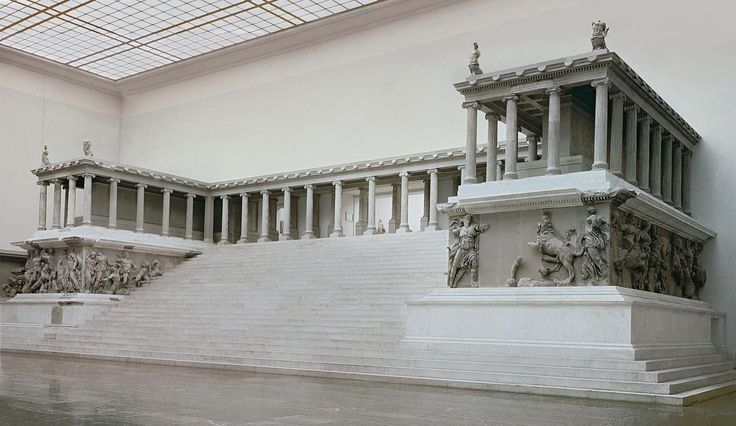
The Pergamon Altar of Zeus, now in Berlin. Revelation 2:13 calls this site "the place where Satan's throne is."
Other Major Sites
Zeus was worshipped in temples, sanctuaries, and open-air precincts across the entire Mediterranean and beyond. The Temple of Olympian Zeus (Olympieion) in Athens, begun in the 6th century BCE and completed under Hadrian in 131 CE, was the largest temple in Greece, with Corinthian columns over 17 meters tall. On Crete, the Dictaean Cave and the Idaean Cave were both associated with Zeus's birth and upbringing. At Nemea, the Games of Zeus were celebrated biennially. At Siwa in the Libyan desert, Zeus Ammon delivered oracles to seekers from across the ancient world, including Alexander the Great himself.18,19
V. The Thunderbolt: Keravnos
The thunderbolt (κεραυνός, keravnos) is the supreme symbol of Zeus. Forged by the Cyclopes and given to Zeus as a weapon in the war against the Titans, the thunderbolt represents the concentrated force of divine will manifesting in the physical world. It is simultaneously a weapon, a tool of justice, and a symbol of awakening.20
In the Orphic Mysteries, thunder was believed to awaken the soul from its passive state of spiritual lethargy. The sudden, overwhelming flash of the thunderbolt corresponds to the moment of illumination: the shattering of illusion and the direct perception of divine reality.
The thunderbolt has cognates across all Indo-European traditions. Thor's hammer Mjölnir serves the same function in Norse mythology. The Vajra of Indra in the Vedic tradition is both thunderbolt and diamond: indestructible, irresistible. The Baltic god Perkūnas wields the same weapon. The convergence is not coincidental. It reflects a shared inheritance from the original Sky Father religion of the Proto-Indo-Europeans, carried across millennia and continents.21
The word "Keravnos" itself bears a linguistic connection to "Keruvim" (Cherubim), a concept appropriated and recontextualized by Abrahamic traditions. The Hebrew word "Cherub," designating a being of the highest spiritual rank, ironically reveals the immense authority attributed to Zeus in this context.
VI. Zeus as Crown Chakra and Spiritual Force
Zeus symbolizes the Crown Chakra ("The Heavens") at the top of the head. His association with the heavens, the bestowal of rain, and the sending of thunderbolts mirrors the downward flow of divine energy from the Crown. In spiritual practice, this flow can feel like being showered with rain. Thunder corresponds to the sensation of being "zapped" by bioelectric energy during meditation: a current of electricity running through the body.22
The "Flood" mythologies associated with Zeus (the story of Deucalion and Pyrrha, paralleled in the Sumerian accounts of Enlil) are spiritual allegories of this same process. The "flood" symbolizes the purification of the human being: the drowning of impure, base elements within, and their replacement with divine spiritual energy. Pyrrha, whose name means "Fire," represents the purifying flame that follows the cleansing flood. Together, these twin forces (Ida and Pingala, water and fire) are essential to the soul's transformation in the Magnum Opus.23,24
The myth of Noah's Ark was stolen directly from the earlier account of Deucalion and Pyrrha, who preserved humanity during the flood said to be caused by Zeus. The spiritual meaning was stripped, the theology inverted, and the allegory literalized into a tale of divine punishment. The original meaning is the opposite: purification, not destruction. Renewal, not annihilation.
VII. Zeus and the Mesopotamian Traditions: Enlil and Baal
The Sumerians knew Zeus as Enlil, "Lord of the Wind" (from en = "lord" + lil = "wind, air, breath"). Enlil was the supreme deity of the Sumerian pantheon from at least the third millennium BCE. His holy city was Nippur, in what is now modern Iraq. His great ziggurat, called E-kur ("Mountain House"), was the most important religious center in Sumer.25
Enlil was a protector and life-giver. The Sumerian hymns describe him as both fearsome in battle and gracious to his own people: he opens the gates of heaven to send rain upon parched fields, and he raises impenetrable walls around those under his protection. He sustains the life of man and beast alike, down to the smallest and most insignificant creature.26
"The gates of heaven, the bars of heaven, the fastenings of heaven, the bolts of heaven: thou openest, thou pullest back, thou loosenest, thou removest."
— Ancient Sumerian Hymn to Enlil (trans. Radau, 1911)
Enlil never "drowned humanity," as is falsely claimed. The so-called Flood that drowned humanity is one of the most profound spiritual allegories in existence. Just as the Garden of Eden allegory relates to the Serpent (Kundalini) and the awakening of consciousness, the Flood allegory relates to the Crown Chakra and the downpouring of divine energy that submerges and purifies the lower self.
The title "Bel" or "Baal," meaning "Lord" or "King," was the ancient honorific applied to the supreme deity. In the Phoenician and Canaanite traditions, this same god was Baal-Zebul: "Lord of the High House" (or "Lord of the Dwelling"), referring to his heavenly temple. The Hebrews deliberately corrupted this name to "Baal-Zebub" ("Lord of the Flies") as an act of spiritual warfare.27
VIII. Zeus as the Healing God: Myiagros and the Truth Behind "Lord of the Flies"
The epithet Zeus Myiagros ("Zeus who drives the flies away") is attested by Pausanias and Clement of Alexandria. In this role, Zeus was the remover of pestilence: flies symbolized plague, corruption, and spiritual affliction. Zeus drove them away. He healed.28
The Hebrew distortion of Baal-Zebul ("Lord of the High House") into Baal-Zebub ("Lord of the Flies") was a deliberate inversion. They took a title of supreme honor and transformed it into a term of mockery. This was standard practice in Hebrew religious polemics: degrade the names of rival gods by altering a single letter or syllable. The Greek word for flies was mýai, but through intentional manipulation a single letter was altered, degrading the related epithet "Myiagros" (he who drives away flies/pestilence) toward "Myaros" (the defiled one). The same method of corruption was employed when the Hebrews changed Baal-Zebul to Baal-Zebub.28
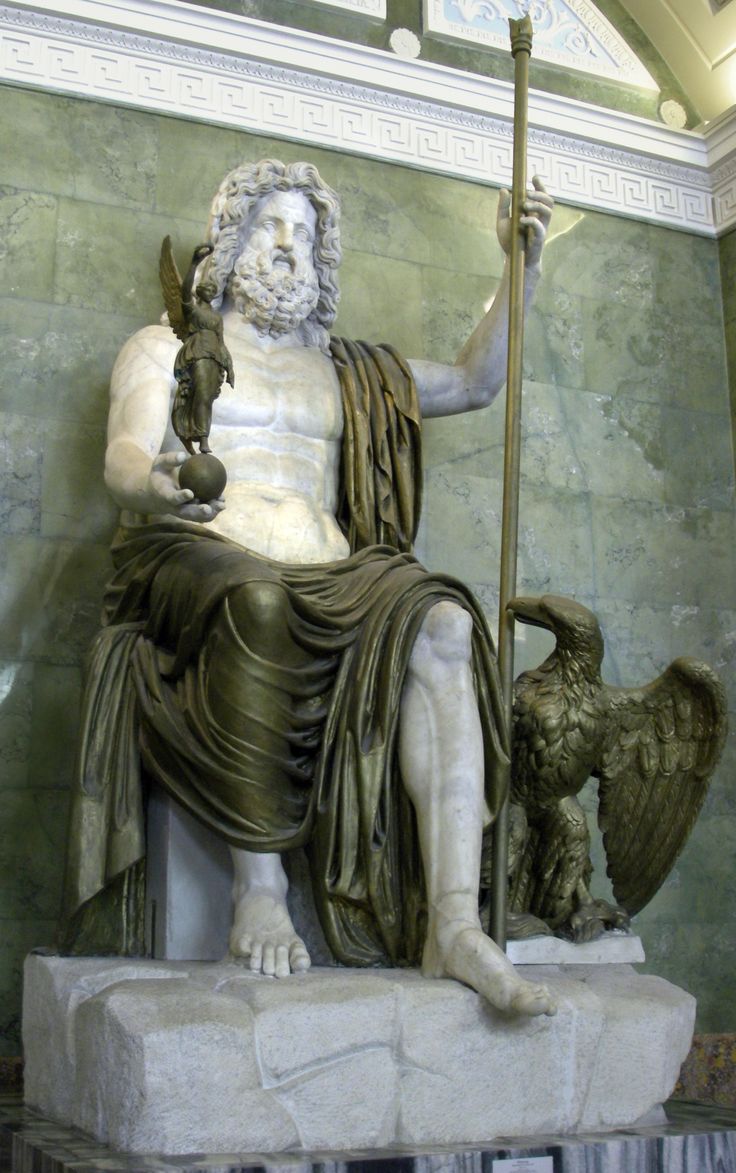
Zeus, Father of Gods and Men, King of the Kosmos
In the city of Ekron, among the Philistines, Baal-Zebul was worshipped as a healing god. He was renowned for performing miraculous acts of restoration and cure. This reputation was so powerful that even in the New Testament, when "Jesus" supposedly performed healings, the people attributed the miracles not to him but to Beelzebul (Matthew 12:24, Mark 3:22, Luke 11:15). The mouths of Yehubor have uttered slanders against this name for two millennia, yet they could not erase the memory of his healing power.29
The deeper esoteric meaning behind Zeus's association with flies relates to spiritual resonance: the buzzing, hissing, and vibrating sounds produced during chanting and vocal invocation. These vibrational phenomena are directly connected to the bioelectric force (Vril) that manifests as tactile sensations during meditation, often resembling insects crawling on the skin. The "flies" are not insects: they are the living vibration of divine energy flowing through the awakened practitioner. Zeus Myiagros does not "lord over" flies. He transmutes affliction into healing through the power of sacred sound.
Zeus possesses the power to drive away all forms of pestilence, whether they manifest as physical illness (through his healing abilities), social injustice (as a restorer of order), or spiritual curses. He is also the God of Entomancy, a form of divination through interpreting the behavior of insects, and a Master of Astrology and the Zodiac. These associations reflect his dominion over the subtle forces of nature and the channels through which divine will communicates to the attentive practitioner.
IX. Zeus and Alexander the Great
Alexander III of Macedon (356–323 BCE) publicly declared himself the son of Zeus Ammon. After visiting the Oracle of Zeus Ammon at Siwa in the Libyan desert, Alexander received confirmation of his divine parentage. From that point forward, he presented himself as a living incarnation of Zeus's power on earth.30
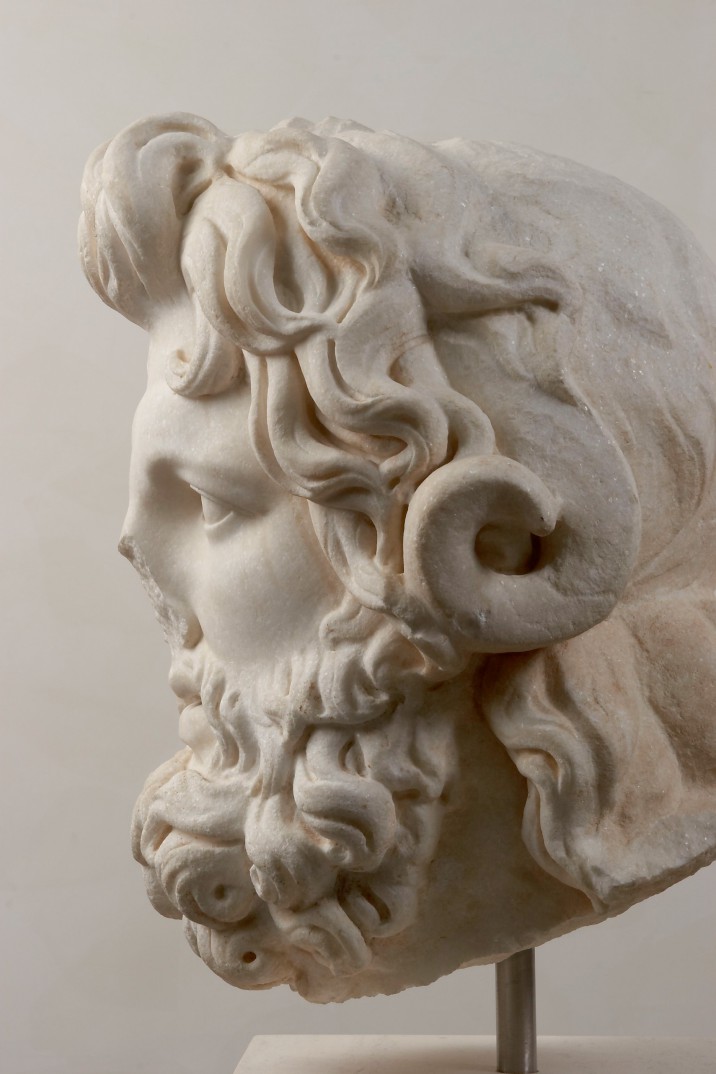
Zeus Ammon, the syncretic form of Zeus worshipped at the Oracle of Siwa
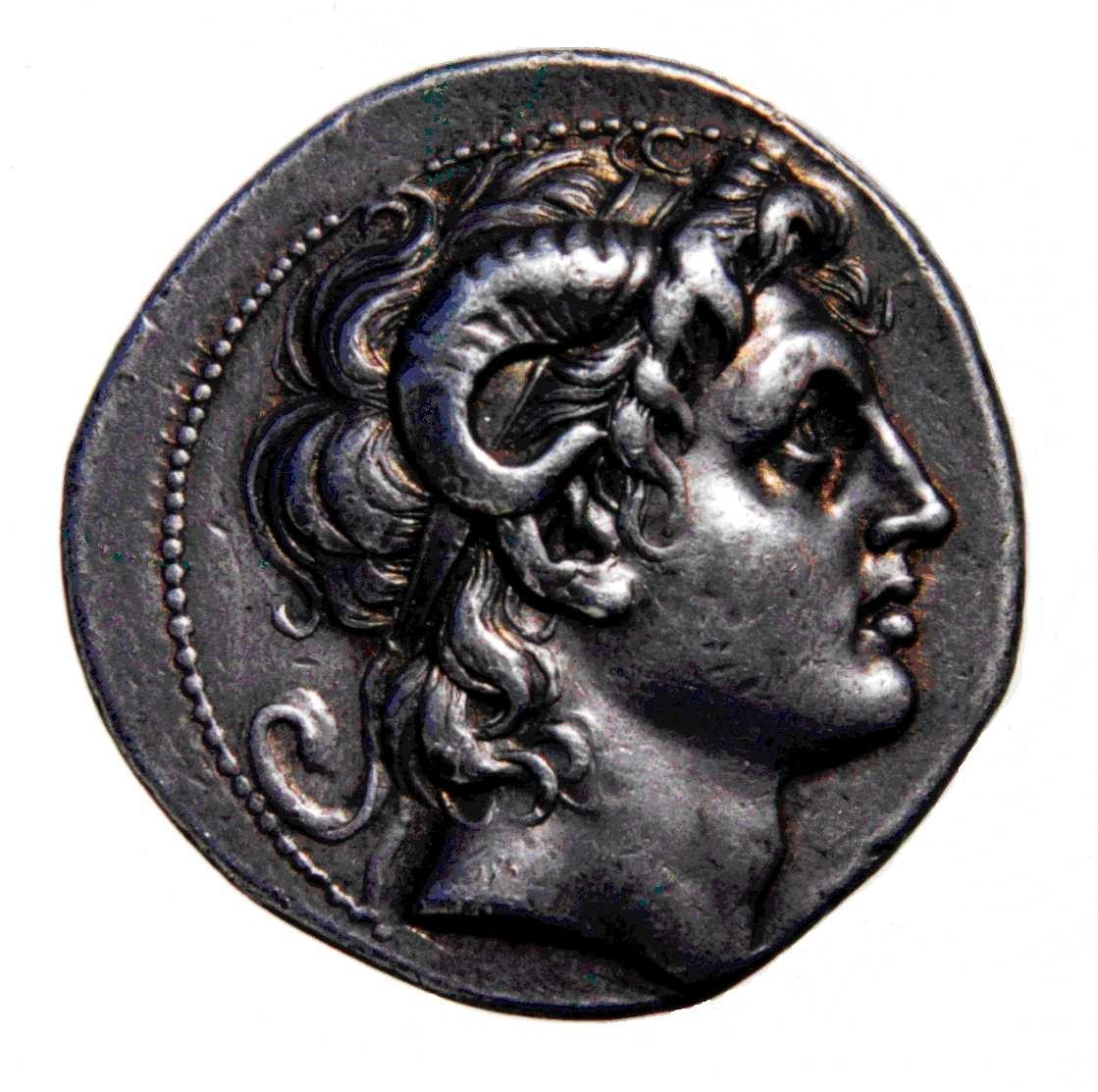
Coin of Alexander the Great depicting the horns of Zeus Ammon, symbol of divine kingship
When Alexander entered the Middle East, he was hailed as the son of Baal. In Greece, he was revered as the son of Zeus. In Egypt, the son of Ammon. The names differed. The god was the same. Alexander himself understood this. Plutarch records that he always respected other Pagan cultures, recognizing that the same gods appeared across civilizations under different names and forms.31
Alexander's mother Olympias came from the royal house of Epirus, near Dodona, the oldest oracle of Zeus. She was a practitioner of the Dionysian mysteries and was said to sleep with sacred serpents. The claim that Alexander was "conceived by thunder" reflects the theological belief that Zeus's power manifested through lightning to create heroes and demigods: Heracles, Perseus, Dionysus, and Alexander himself.32
The word "Basileus" (King, Supreme Ruler) was Alexander's official title. In the East, the equivalent title was "Baal." Both words carry the same meaning: sovereign authority derived from the divine. The connection between Zeus Basileus and Baal is not merely symbolic. It is linguistic and theological. It is one god, recognized under different names by different peoples, granting the same authority to those worthy of it.
The word "Amen," used by Christians to conclude their prayers, derives from "Amun" (also Ammon), the Egyptian name under which Zeus was worshipped at Siwa and throughout Egypt. Every time a Christian says "Amen," they invoke, unknowingly, a form of Zeus.33
The mysterious death of Alexander the Great at the age of 33, with no precise details confirmed, may not signify a physical death but rather a spiritual transformation. It strongly suggests the possibility that he completed the Magnum Opus at the 33rd year of his life, metaphorically marking the "end" of his mortal life. The popular stories of his death by poisoning and intoxication lack supporting evidence. His mythical birth was steeped in powerful symbolism, most notably the claim that his mother was "impregnated by thunder," reflecting his divine origin. Having been taught by Aristotle, the leading intellectual authority in Greece at the time, Alexander was deeply educated in the spiritual arts, including alchemy and other esoteric disciplines. A few surviving texts attributed to Aristotle's instruction of Alexander, such as the Secretum Secretorum, hint at these teachings, though most were confiscated and suppressed by the Christian Church.30,31,32
X. The Philosophical Zeus: From Plato to the Stoics
Plato (c. 428–348 BCE) treated Zeus with profound reverence. In the Cratylus, he etymologized the name of Zeus as derived from "through whom" (di' hon) all living things have life. In the Laws, Zeus is the guarantor of cosmic justice. In the Timaeus, the Demiurge who fashions the cosmos bears unmistakable resemblance to Zeus.34
The Stoic school (founded c. 300 BCE) identified Zeus explicitly with the Logos: the rational principle that pervades, orders, and sustains all reality. For the Stoics, Zeus was not a being separate from the cosmos but the living intelligence of the cosmos itself. Chrysippus, Zeno, Cleanthes, Seneca, Epictetus, and Marcus Aurelius all lived within this framework.35
The Neoplatonists, particularly Proclus (412–485 CE) and the Emperor Julian (331–363 CE), developed the most sophisticated theology of Zeus. Julian's "Hymn to King Helios" places Zeus at the apex of the intelligible realm, the source from which all divine emanation flows. Proclus's commentary on the Cratylus analyzes Zeus as the Demiurgic Intellect: the mind that thinks the cosmos into being.36
"What relation has the sun to Zeus? Zeus is the common father of all things, and from him proceeds the substance of all the gods."
— Emperor Julian, Hymn to King Helios (trans. adapted from Wright)
XI. The War Against Zeus: Two Millennia of Inversion
The systematic campaign to degrade Zeus began with the Hebrew prophets and accelerated through the Christian era. The methods were consistent: take the names of the ancient Gods, alter them slightly, and reassign them to demons. Take their temples, destroy them or build churches on their foundations. Take their festivals, rename them, and pretend they were always Christian.
Zeus received the worst treatment of all. He was renamed "Satan," "Beelzebul," and "the Devil." His altar at Pergamon was called "the throne of Satan" (Revelation 2:13). His thunderbolt was mockingly referenced in Luke 10:18: "I saw Satan fall like lightning from heaven." His title "Lord of the High House" was degraded to "Lord of the Flies." His Crown Chakra symbolism was inverted into the "fallen angel" cast down from heaven.37
In 2015, Islamic extremists destroyed the Temple of Baal in Palmyra, Syria: one of the last standing monuments to Zeus under his Phoenician name. The destruction was televised to the world. The mouths of Yehubor have uttered their hatred against this god for two thousand years, and they continue today.
The sheer magnitude of Zeus's power is acknowledged even by his enemies. The Hebrews themselves openly admit that their attacks against Baal have been deliberate and collective. The pattern of spiritual warfare they employed is documented: they turned a living God with explicit powers into an arch-demon, an antithesis to their own fabricated deity, primarily through the writings of the Old Testament.37
Many Hebrews willingly betrayed their own so-called "national gods" and sought to infiltrate Pagan religious movements, even in ancient times. Unlike Pagans, who rarely abandoned their traditions unless forced under conditions of massacre or genocide, the Hebrews did so of their own accord, driven by weakness, opportunism, and a traitorous nature toward their own spiritual lineage.
They have failed. The name endures. The etymology endures. The temples in Berlin, Athens, and Olympia endure. The word "God" itself, in half the languages of the world, endures as the name of Zeus. No amount of inversion can erase what is written into the structure of language itself.
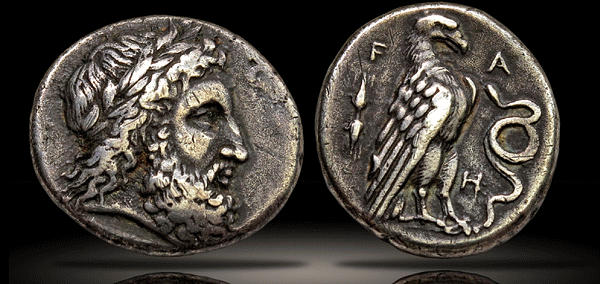
Ancient coin depicting Zeus Basileus, the King
XII. Zeus and the Norse Tradition: Thor and Týr
In the Norse pantheon, Zeus's power manifests primarily through Thor (Þórr), the thunder god who wields Mjölnir. Thor is the protector of Midgard (the human world), the enemy of the giants (forces of chaos), and the embodiment of strength and loyalty. The rune Thurisaz (ᚦ) is the rune of Thor's power: the directed force of the thunderbolt.38
The etymological connection runs through Týr, whose name descends directly from the Proto-Indo-European *Dyēus, the same root as Zeus. Týr was the original Sky Father of the Germanic peoples before Thor assumed the dominant role. "Tuesday" (Týr's Day) corresponds to the Latin "Dies Martis" (Day of Mars), but the deeper etymology connects Týr to the Zeus-Jupiter lineage. The significance of Zeus is embedded even in the modern English calendar.39
"Thursday" is Thor's Day (Þórsdagr), and it corresponds to Latin Iovis dies ("Jupiter's Day"). In French: Jeudi. In Italian: Giovedì. All from Jupiter, all from Zeus. Two days of the week, across multiple languages, carry the name of Zeus in different guises.
XIII. Zeus in the Vedic Tradition: Dyáuṣ Pitṛ́ and Indra
The Rigveda (c. 1500–1200 BCE) preserves the oldest form of the Sky Father as Dyáuṣ Pitṛ́ ("Father Sky"), linguistically identical to Zeus Pater and Jupiter. While Dyáuṣ became a less active figure in later Vedic religion, his functions were absorbed by Indra, the king of the gods, wielder of the Vajra (thunderbolt), lord of storms and rain.40
Indra resides atop the sacred Mount Meru, the cosmic mountain, just as Zeus resides on Mount Olympus. He wields the Vajra (thunderbolt) against the serpent Vritra, just as Zeus wields the Keravnos against Typhon. The parallels are not borrowed or coincidental: they are inherited from the shared Proto-Indo-European religion that gave birth to both traditions.
The Vajra itself has become a central symbol in Buddhism and Hinduism, representing both thunderbolt and diamond: indestructible power and unshakable truth. This is the power of Zeus, transmitted through Indra, preserved across five millennia.
XIV. Zeus in the Baltic and Slavic Traditions
The Lithuanian god Perkūnas and the Slavic god Perun are direct cognates of Zeus in the Thunder God function. Perkūnas wields the thunderbolt, rides the sky in a chariot, and strikes down the forces of chaos. The Lithuanian language, remarkably conservative, preserves "Dievas" (God) as a direct descendant of *Dyēus. Lithuania was the last European nation to be Christianized (1387 CE), and its thunder-god traditions survived longer than anywhere else on the continent.41
Perun in the Slavic tradition held the same role: sky god, thunder god, enemy of the chthonic serpent (Veles), guardian of oaths and cosmic order. The oak tree was sacred to Perun, just as it was to Zeus at Dodona. The parallels extend to ritual practice: lightning-struck oaks were considered sacred in both Greek and Slavic tradition.42
XV. The Power of Zeus: A Living God
Zeus is not a historical curiosity. He is not a character in mythology. He is a living force: the oldest continuously worshipped deity in the Indo-European world, attested from the Rigveda (c. 1500 BCE) to the Linear B tablets (c. 1400 BCE) to the present day. His name is spoken every time someone says "God" in French, Spanish, Italian, Portuguese, Romanian, Albanian, Lithuanian, or Latvian. His power is invoked every time someone says "Amen." His day is marked every Thursday and every Tuesday on every calendar in the Western world.
The ancient world knew this power. The Greeks built the Olympic Games in his honor. The Romans named their greatest temple after him. Alexander conquered the known world under his aegis. The Stoics identified him with the rational soul of the universe. The Neoplatonists placed him at the summit of the intelligible hierarchy.
His will governs both Gods and mortals. He can initiate or end wars, enforcing divine justice as an unstoppable and universal force. Though considered the slowest to move into judgment, his wrath is the most destructive, while his blessings are the most profound. He bestows victory, divine protection, invincibility, and good fortune in times of crisis. He brings down tyrants and raises kings who are unshakable by negative forces.
On a psychological level, Zeus represents the pinnacle of masculine strength. He fathered Heracles and other great heroes of the ancient world. Ancient litanies proclaimed him the deciding force of the kosmos: "all that is." His epithets demonstrate totality: father, king, savior, liberator, protector, avenger, counselor, host, oath-keeper, healer. There is no aspect of reality that falls outside his domain.
To the followers of Zeus: may you be crowned with the Crown of the Thundering Heavens.
HAIL ZEUS!
The Goetic Inversion: How Zeus Was Hidden in the Grimoires
The medieval grimoire tradition, particularly the Ars Goetia (the first part of the Lesser Key of Solomon, compiled in the 17th century from older sources), lists 72 "demons" with elaborate hierarchies and seals. The first spirit listed is Bael: a King who commands 66 legions, who speaks with a hoarse voice, and who grants the power of invisibility.43
"Bael" is simply "Baal": the ancient Semitic title meaning "Lord" or "King." The grimoire authors took the supreme deity of the ancient Near East, the god the Greeks called Zeus and the Phoenicians called Baal-Zebul, and placed him at the head of their catalogue of "demons." This was not discovery. It was inversion. They listed the gods of the old world as demons of the new, then wrote rituals to bind and command them.
The same inversion was applied systematically to dozens of ancient deities. Apollo became "Azazel." Astarte became "Ashtaroth." Osiris became "Oriax." The pattern is documented across the entire grimoire corpus. The linguistic evidence proving Zeus's identity is irrefutable: the word "God" in half the world's languages descends from his name.
For the full history of Bael (Baal-Zevul) in the grimoire tradition, including his original identity, his Goetic restoration, and the documented evidence of the Abrahamic inversion of the ancient Gods, see: Baal-Zevul: The Goetic Identity of Zeus.
Sources and Bibliography
- Fortson, Benjamin W. IV. Indo-European Language and Culture: An Introduction. 2nd ed. Wiley-Blackwell, 2010. Ch. 3: "The Proto-Indo-European Sky Father."
- Mallory, J.P. and D.Q. Adams. The Oxford Introduction to Proto-Indo-European and the Proto-Indo-European World. Oxford University Press, 2006. Pp. 408–412.
- Sihler, Andrew L. New Comparative Grammar of Greek and Latin. Oxford University Press, 1995. §2.3–2.5 on *dyeu- reflexes.
- Beekes, Robert. Etymological Dictionary of Greek. Brill, 2010. Entry: "Ζεύς."
- Ventris, Michael and John Chadwick. Documents in Mycenaean Greek. 2nd ed. Cambridge University Press, 1973. Linear B attestation of di-we.
- Homer. Iliad. 1.528–530 (Zeus's nod); 16.233 (Dodona). Trans. Richmond Lattimore, University of Chicago Press, 1951.
- Burkert, Walter. Greek Religion. Trans. John Raffan. Harvard University Press, 1985. Ch. III.2: "Zeus."
- Hesiod. Theogony. 881–885. Trans. Hugh G. Evelyn-White (adapted). Loeb Classical Library, 1914.
- Kern, Otto. Orphicorum Fragmenta. Berlin, 1922. Fragment 21a (Orphic Hymn: "Zeus was first, Zeus last").
- Long, A.A. and D.N. Sedley. The Hellenistic Philosophers. Vol. 1. Cambridge University Press, 1987. Cleanthes, Hymn to Zeus.
- Stamatakos, J. Dictionary of Ancient Greek (Λεξικόν τῆς Ἀρχαίας Ἑλληνικῆς Γλώσσης). Multiple editions. Epithets and usage of Ζεύς.
- Cook, Arthur Bernard. Zeus: A Study in Ancient Religion. 3 vols. Cambridge University Press, 1914–1940.
- Pausanias. Description of Greece. 5.11.1–2 (Statue of Zeus at Olympia); 5.14.1 (Zeus Myiagros). Trans. W.H.S. Jones. Loeb Classical Library, 1918.
- Lapatin, Kenneth D.S. Chryselephantine Statuary in the Ancient Mediterranean World. Oxford University Press, 2001. Pp. 79–106 on the Statue of Zeus at Olympia.
- Parke, H.W. The Oracles of Zeus: Dodona, Olympia, Ammon. Harvard University Press, 1967.
- Dakaris, Sotirios. "The Oracle of Dodona." Scientific American 225.3 (1971): 116–123.
- Queyrel, François. L'Autel de Pergame. Picard, 2005. On the Pergamon Altar and Gigantomachy frieze.
- Spawforth, Tony. The Complete Greek Temples. Thames & Hudson, 2006. Ch. 8: "The Olympieion, Athens."
- Dietrich, B.C. The Origins of Greek Religion. De Gruyter, 1974. Ch. 5: "Zeus in the Minoan-Mycenaean World."
- Gantz, Timothy. Early Greek Myth: A Guide to Literary and Artistic Sources. Johns Hopkins University Press, 1993. Vol. 1, Ch. 2: "The Titans and the Keravnos."
- West, M.L. Indo-European Poetry and Myth. Oxford University Press, 2007. Ch. 5: "The Thunder God."
- Eliade, Mircea. A History of Religious Ideas. Vol. 1. Trans. Willard R. Trask. University of Chicago Press, 1978. §18: "Zeus and the Greek Religion."
- Roman, Luke and Monica Roman. Encyclopedia of Greek and Roman Mythology. Facts on File, 2010. Entries: "Zeus," "Deucalion and Pyrrha."
- Ovid. Metamorphoses 1.253–415 (Deucalion and Pyrrha). Trans. A.D. Melville. Oxford World's Classics, 1986.
- Radau, Hugo. Sumerian Hymns and Prayers to God Nin-Ib from the Temple Library of Nippur. Department of Archaeology, University of Pennsylvania, 1911. Pp. 21–27.
- Kramer, Samuel Noah. The Sumerians: Their History, Culture, and Character. University of Chicago Press, 1963. Ch. 4: "Religion: Theology, Rite, and Myth."
- Encyclopaedia Biblica. Rev. T.K. Cheyne and J. Sutherland Black, eds. Vol. I: A–D. Macmillan, 1899. Entry: "BAALZEBUB."
- Pausanias, Description of Greece 5.14.1 (Zeus Myiagros); Clement of Alexandria, Protrepticus 2.38 (cult at Elis).
- New Testament: Matthew 12:24, Mark 3:22, Luke 11:15 (attribution of healing miracles to Beelzebul).
- Plutarch. Life of Alexander. Trans. Bernadotte Perrin. Loeb Classical Library, 1919. Chs. 27–28 (visit to Siwa).
- Green, Peter. Alexander of Macedon, 356–323 B.C.: A Historical Biography. University of California Press, 1991.
- Plutarch. Life of Alexander 2.2–3.4 (Olympias and the serpents; conception by thunderbolt).
- Hornung, Erik. Conceptions of God in Ancient Egypt: The One and the Many. Trans. John Baines. Cornell University Press, 1982. Ch. 3: "Amun/Ammon."
- Sedley, David. Plato's Cratylus. Cambridge University Press, 2003. Pp. 91–97 on the etymology of Zeus.
- Algra, Keimpe et al., eds. The Cambridge History of Hellenistic Philosophy. Cambridge University Press, 1999. Ch. 15: "Stoic Theology."
- Julian. Hymn to King Helios. Trans. Wilmer Cave Wright. Loeb Classical Library, 1913. Proclus. In Platonis Cratylum Commentaria. Ed. Pasquali, 1908.
- Revelation 2:13 (Pergamon as "the throne of Satan"); Luke 10:18 ("I saw Satan fall like lightning"); Hebrew Bible passim (inversion of Baal worship).
- Simek, Rudolf. Dictionary of Northern Mythology. Trans. Angela Hall. D.S. Brewer, 1993. Entries: "Thor," "Mjölnir," "Thurisaz."
- De Vries, Jan. Altgermanische Religionsgeschichte. 2 vols. De Gruyter, 1956–1957. Vol. 2, §§453–470 on Týr.
- Jamison, Stephanie W. and Joel P. Brereton, trans. The Rigveda. 3 vols. Oxford University Press, 2014. Hymns to Dyáuṣ and Indra.
- Greimas, Algirdas Julien. Of Gods and Men: Studies in Lithuanian Mythology. Trans. Milda Newman. Indiana University Press, 1992. Ch. 2: "Dievas and Perkūnas."
- Ivanov, Vyacheslav V. and Vladimir N. Toporov. "The Invariant and Transformations in the Slavic Myth of the Thunder God." Semiotica 49.1/2 (1984): 1–30.
- Weyer, Johann. Pseudomonarchia Daemonum (1577); Anon., Ars Goetia (from Lemegeton, 17th century). Entry: "Bael."