 አማርኛ
አማርኛ العربية
 বাংলা
বাংলা Български
 中文
中文 Čeština
 Dansk
Dansk Deutsch
 Eesti
Eesti Ελληνικά
 Español
 Français
 हिन्दी
 Hrvatski
 IsiZulu
 Italiano
 日本語
日本語 Kiswahili
 Magyar
 Македонски
 नेपाली
 Nederlands
 فارسی
فارسی Polski
 Português
 Română
 Русский
 Slovenščina
 Suomi
Suomi Svenska
 Tagalog
 Türkçe
The Battle of the Gods: Titanomachy
author: High Priest Zevios Metathronos
The Cosmic War Between Reason and Unreason, Order and Chaos, Light and the Devouring Dark, and Why the Same Story Recurs in Every Ancient Civilization
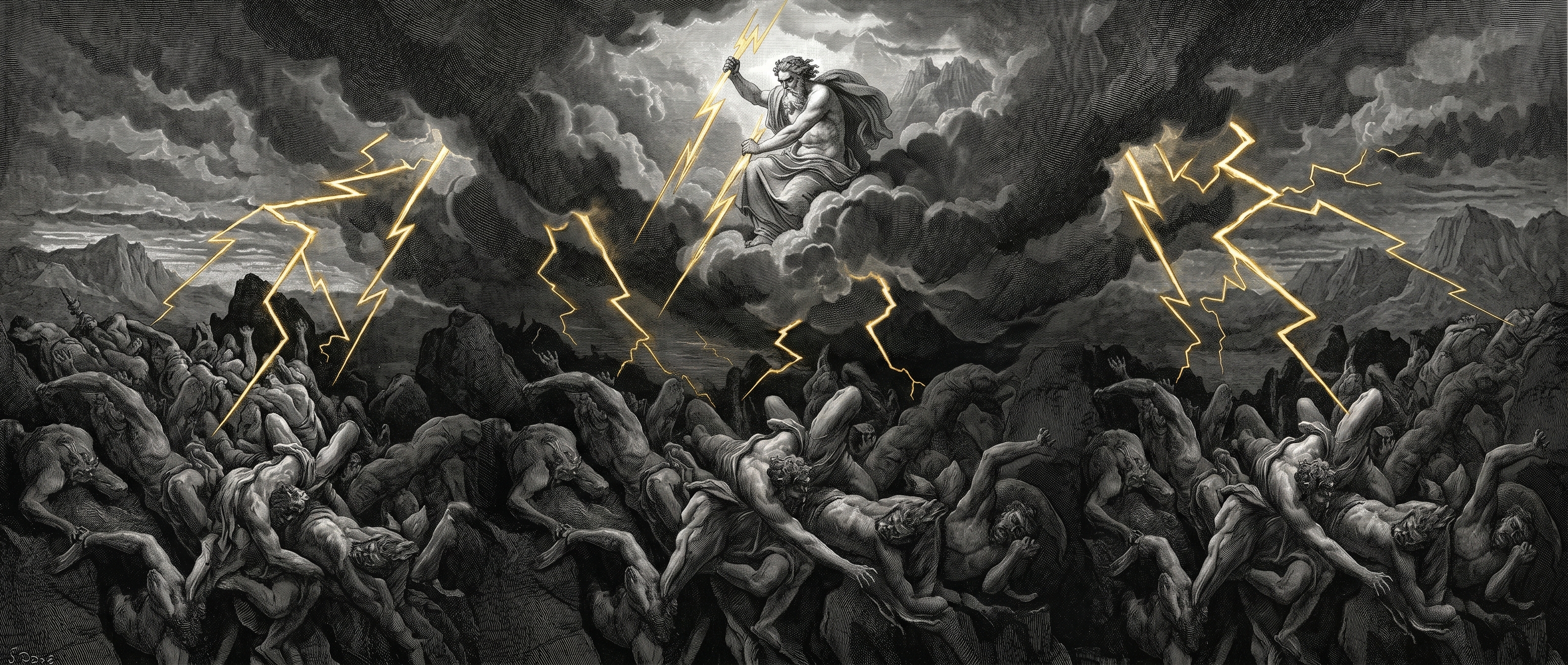
The Founding Cosmic Victory: Order Established Against the Pressure of Primordial Unreason
Every serious ancient civilization tells the same story. Before the world was ordered, there was a war. The war was fought between forces of cosmic reason and forces of primordial unreason, between the Gods who establish measure and the monstrous powers who would dissolve all distinction back into undifferentiated violence. The Gods won. The cosmos stands because they won. Every day that the sun rises in its ordered course, every harvest that comes on time, every thought that holds itself together long enough to become knowledge, is a continuation of the victory.
The Greeks called this war the Titanomachy (Τιτανομαχία), "the battle against the Titans." It is told in its canonical form by Hesiod in the Theogony, composed around 700 BCE in Boeotia. The core narrative occupies lines 617-820 of the poem, with its culmination in the combat against Typhoeus at lines 820-885. This is one of the oldest continuous mythological texts in the Western tradition, preserved in an unbroken manuscript line from antiquity to the present, supplemented by vase paintings, sculptural programs, and philosophical commentary stretching across two thousand five hundred years.
The war goes beyond fairy tale and serves as a diagnostic map of reality. What the Titanomachy describes, in mythic language, is the ontological condition on which all civilization rests: the perpetual pressure of disordered force against the fragile architecture of cosmic order, and the divine operation that holds that architecture in place. To understand the Titanomachy is to understand what Zevism defends, what Ma'at requires, and what the soul must do within its own interior if it hopes to participate in the divine order rather than be consumed by the chaos.
Zeus is the victor of this cosmic war. That sentence must be placed at the center of everything that follows. The Greek tradition, the Egyptian tradition, and the Indic tradition each narrate the cosmic battle under their own divine names, but the structural role that Zeus occupies in the Greek account is the role that Ra and Horus occupy in the Egyptian account and that Indra occupies in the Vedic account. Zeus against the Titans is Horus against Set; Zeus against Typhoeus is Ra against Apophis and Indra against Vritra. What Zeus wins in the Greek telling is what the cosmic sovereign wins in every ancient civilization that thought seriously about the nature of reality: the binding of primordial unreason, the installation of legitimate cosmic sovereignty, the foundation of the articulated order within which all subsequent life unfolds. In Egyptian vocabulary, this is the victory of Ma'at over Izfet. The Titanomachy is the Greek account of exactly the same cosmic operation. To worship Zeus is to align with the sovereign of the world-order; to betray Zeus is to side with the Titanic substrate against the cosmos.
This page treats the Greek version in depth. Two further pages will develop the exact parallels: the Egyptian battle of Horus and Set and the nightly combat of Ra against Apophis, which is the Egyptian Ma'at-versus-Izfet war in narrative form; and the Indic war of the Devas and Asuras, with Indra slaying Vritra at its center, which is the Vedic form of the same cosmic operation. These three accounts, produced independently by three of the greatest ancient civilizations, describe the same cosmic event in distinct local vocabularies. The convergence transcends any coincidence and stands as recognition.
Part One: The Hesiodic Narrative in Detail
The Genealogy of the Struggle
Before the battle itself, Hesiod provides the genealogical architecture that makes the conflict intelligible. At the beginning of the Theogony, four primordial powers come into being: Chaos (Χάος, the yawning gap), Gaia (Γαῖα, Earth), Tartaros (Τάρταρος, the abyss beneath the earth), and Eros (Ἔρως, the generative force).
Hesiod, Theogony:
"ἦ τοι μὲν πρώτιστα Χάος γένετ', αὐτὰρ ἔπειτα Γαῖ' εὐρύστερνος, πάντων ἕδος ἀσφαλὲς αἰεὶ ἀθανάτων, οἳ ἔχουσι κάρη νιφόεντος Ὀλύμπου, Τάρταρά τ' ἠερόεντα μυχῷ χθονὸς εὐρυοδείης, ἠδ' Ἔρος, ὃς κάλλιστος ἐν ἀθανάτοισι θεοῖσι."1
"First of all Chaos came into being, and then broad-breasted Gaia, the ever-sure foundation of all the immortals who hold the peaks of snowy Olympus, and dim Tartaros in the depth of the wide-pathed Earth, and Eros, who is the most beautiful among the deathless gods."
Gaia produces Ouranos (Οὐρανός, Sky) from herself, and then from her union with Ouranos she bears the first generation of children: the twelve Titans, three Cyclopes, and three Hundred-Handers (Hekatoncheires). The Titans are called Ὠκεανός (Oceanus), Κοῖος (Koios), Κρεῖος (Kreios), Ὑπερίων (Hyperion), Ἰαπετός (Iapetos), Θεία (Theia), Ῥέα (Rhea), Θέμις (Themis), Μνημοσύνη (Mnemosyne), Φοίβη (Phoibe), Τηθύς (Tethys), and the youngest, Κρόνος (Kronos).
Ouranos hates his monstrous children and pushes them back inside Gaia as soon as they are born. Gaia, in agony, fashions a grey adamantine sickle and gives it to Kronos, who ambushes his father and castrates him. This is the first act of divine succession. Ouranos's reign ends in mutilation. Kronos takes power. The severed genitals fall into the sea and from their foam Aphrodite is born, while from the drops of blood that fall upon Gaia come the Furies (Erinyes), the Giants, and the Meliae (ash-tree nymphs). The universe is already beginning to articulate itself into distinct powers, but the succession is violent.
Kronos, fearing the same fate at the hands of his own children, swallows each one as Rhea bears them: Hestia, Demeter, Hera, Hades, Poseidon. When Rhea is about to bear Zeus, she hides in a cave on Crete (Mount Dikte or Mount Ida, depending on the source) and gives Kronos a stone wrapped in swaddling clothes. He swallows the stone. Zeus is raised in hiding, and when he comes to maturity, he forces Kronos to disgorge his siblings. The first Olympians emerge from the throat of the Titan who had tried to devour them. They return to the world already marked by the swallowing: the gods of order are those who have been inside the devouring, and have come out alive.
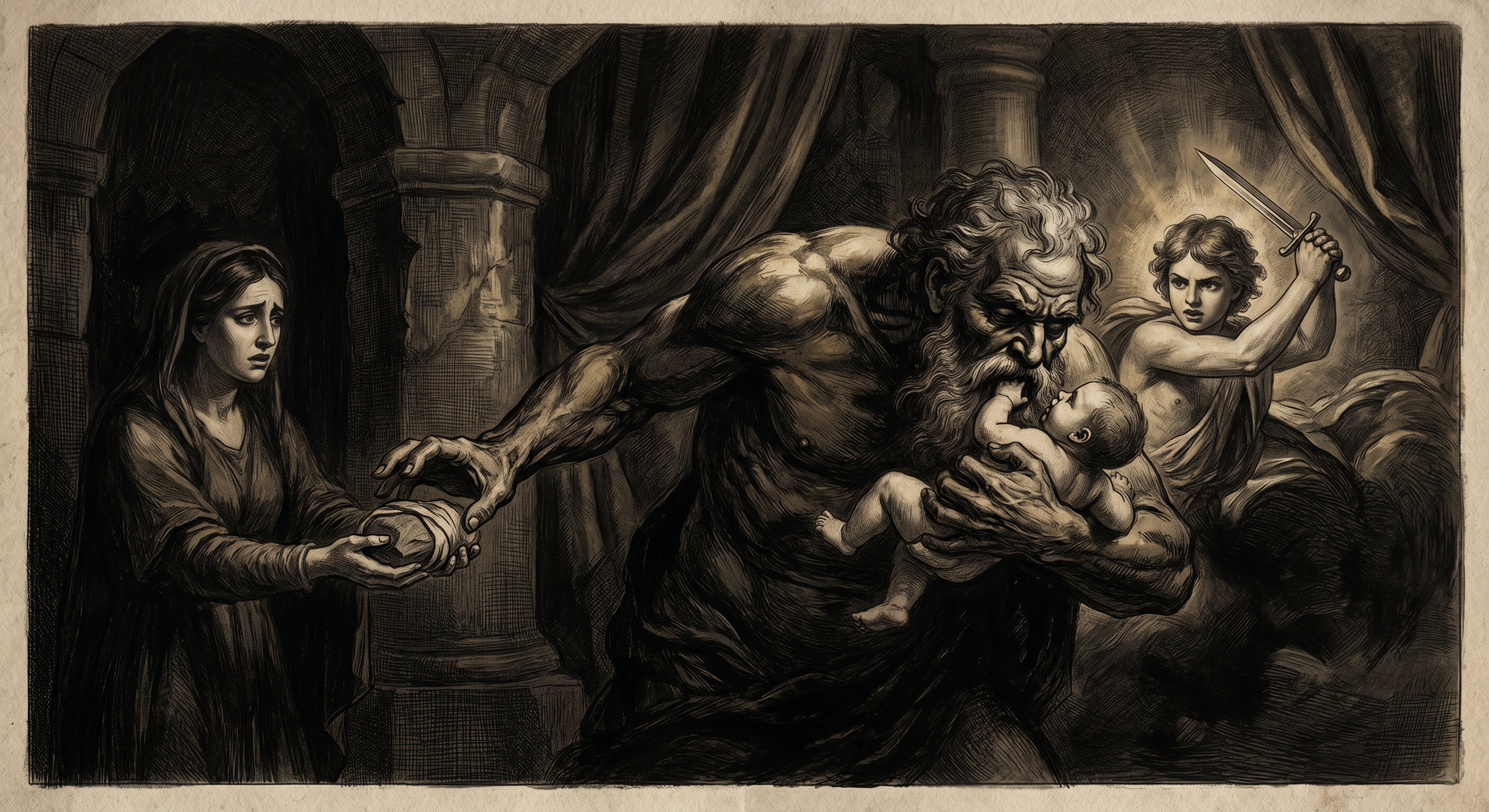
The Titan Swallowing His Own Succession, and the Olympian Child Who Will Return to Overthrow Him
The stage is now set for the central conflict. The older generation, led by Kronos, holds Olympus. The younger generation, led by Zeus, assembles on Mount Othrys in Thessaly. The war begins.
The Ten Years of Battle
Hesiod tells us that the war lasted ten years and that, for most of that time, neither side could gain decisive advantage. The Theogony (636-638) describes the balance:
Hesiod, Theogony:
"οἵ ῥα τότ' ἀλλήλοισι μάχην θυμαλγέ' ἔχοντες συνεχέως ἐμάχοντο δέκα πλείους ἐνιαυτούς· οὐδέ τις ἦν ἔριδος χαλεπῆς λύσις οὐδὲ τελευτή."2
"And these, engaged in heart-grieving battle with one another, fought continually for ten full years. There was no relief from the bitter strife, and no end."
The ten years are a detail of profound theological importance. The cosmic order does not establish itself easily. Reason does not triumph over unreason in a single stroke. The battle is long, costly, uncertain. The Olympians do not win because they are stronger. They win because they form alliances, because they release imprisoned powers, and because they bind themselves by sacred oaths. Victory is the product of strategy, patience, and the integration of previously suppressed forces.
At Gaia's advice, Zeus descends to Tartaros and releases the Hundred-Handers (Kottos, Briareos, and Gyes) and the Cyclopes (Brontes, Steropes, and Arges) whom Ouranos had imprisoned. Their names are significant. The Hundred-Handers are the powers of overwhelming multiplicity, capable of throwing three hundred stones simultaneously. The Cyclopes are the craftsmen of cosmic weaponry: Brontes is Thunder, Steropes is Lightning, Arges is the Bright Flash. They forge for Zeus his thunderbolt, for Poseidon his trident, and for Hades his cap of invisibility. Each Olympian receives the weapon that will define his domain.
The alliance is decisive. With the Hundred-Handers hurling three hundred rocks from their three hundred hands and with Zeus wielding thunderbolts forged by the Cyclopes, the Olympian force finally breaks the Titan line.
Hesiod, Theogony:
"Κόττος τε Βριάρεώς τε Γύης τ' ἄατος πολέμοιο τρηχεῖαν στυφέλιξαν ὑπερθύμοις ἐν ἀγῶσι. τριηκοσίας δὲ πέτρας στιβαρέων ἀπὸ χειρῶν πέμπον ἐπασσυτέρας, κατὰ δ' ἐσκίασαν βελέεσσιν Τιτῆνας."3
"And in the forefront Kottos and Briareos and Gyes, insatiate for war, raised fierce fighting. Three hundred stones from their sturdy hands they launched in quick succession, and they overshadowed the Titans with their missiles."
Zeus himself enters the decisive combat. The poem describes the scene with cosmic scope: thunderbolt after thunderbolt is hurled from his hand; Olympus shakes; the earth roars; Tartaros trembles; the very sea boils under the heat of the divine weapons.
Hesiod, Theogony:
"ἄστραπτε δ' αἴθρη, καὶ σκληρὰ τιτυσκόμενος ῥίπτει βροντὴν ἅμα καὶ στεροπὴν καὶ κεραυνὸν βαρύν. ἀμφὶ δὲ γαῖα φερέσβιος ἐσμαράγιζε καιομένη, λάκε δ' ἀμφὶ πυρὶ μεγάλ' ἄσπετος ὕλη."4
"The bright air flashed with lightning, and hurling with all his strength he sent forth thunder and lightning and the heavy thunderbolt together. The life-giving earth crashed around, burning, and the vast woods crackled loudly with fire on every side."
The Titans are defeated, bound in chains, and cast down into Tartaros, guarded by the Hundred-Handers. The pit is so deep that a bronze anvil falling from the surface of the earth would take nine days and nights to reach it (Theogony 722-725). The Titans are not killed, not annihilated: they are bound. Their power is not destroyed, but contained. This detail is crucial. The primordial forces remain; they have been placed in their proper position, beneath the order that the Gods impose.
The Final Adversary: Typhoeus
The Titanomachy is not the end. Hesiod tells us that after the defeat of the Titans, Gaia produces one last adversary: Typhoeus (Τυφωεύς), sometimes called Typhon. He is her youngest son, sired by Tartaros through the generative power of Aphrodite. He is the most terrible opponent Zeus will ever face.
"ἐκ δ' ὤμων ἑκατὸν κεφαλαὶ ἦσαν ὄφιος, δεινοῦ δράκοντος, γλώσσῃσι δνοφερῇσι λελιχμότος· ἐν δέ οἱ ὄσσε θεσπεσίῃς κεφαλῇσιν ὑπ' ὀφρύσι πῦρ ἀμάρυσσεν, πασάων δ' ἐκ κεφαλέων πῦρ καίετο δερκομένοιο."5
"From his shoulders grew a hundred heads of a snake, a fearful dragon, with dark, flickering tongues. From under the brows of his eyes in his marvelous heads, fire flashed, and fire burned from his heads as he glared."
Typhoeus is the ultimate monster, the concentration of all primordial chaos into a single adversary. A hundred snake-heads, each with its own voice, each speaking a different language, some bellowing like bulls, some roaring like lions, some yelping like dogs, some hissing and some whistling in tones that the high mountains echo back. He is unintelligibility incarnate, the babel of elemental violence, the refusal of coherent speech.
Zeus meets him with the full concentrated force of Olympian order. The combat is described in lines so vivid that Hesiod compares the earth to molten iron smelted in the crucible of the gods' own making:
Hesiod, Theogony:
"πολλὴ δὲ πελώρη καίετο γαῖα ἀτμῇ θεσπεσίῃ, καὶ ἐτήκετο κασσίτερος ὣς τέχνῃ ὑπ' αἰζηῶν ἐν ἐϋτρήτοις χοάνοισι θαλφθείς, ἠὲ σίδηρος, ὅ περ κρατερώτατός ἐστιν."6
"A great part of the huge earth was scorched by the terrible vapor and melted as tin melts when heated by men's art in channelled crucibles, or as iron, which is hardest of all things."
Typhoeus is defeated, burned, maimed, and cast into Tartaros beneath Mount Etna, where his burning body produces volcanic eruptions to this day (in the ancient understanding; Pindar, Pythian 1.15-28, elaborates this localization). With his defeat, the war of cosmogony is complete. Zeus is acclaimed king, and the gods assemble to divide the honors (τιμαί) among themselves (Theogony 881-885). The cosmos has its order. The Olympian dispensation begins.
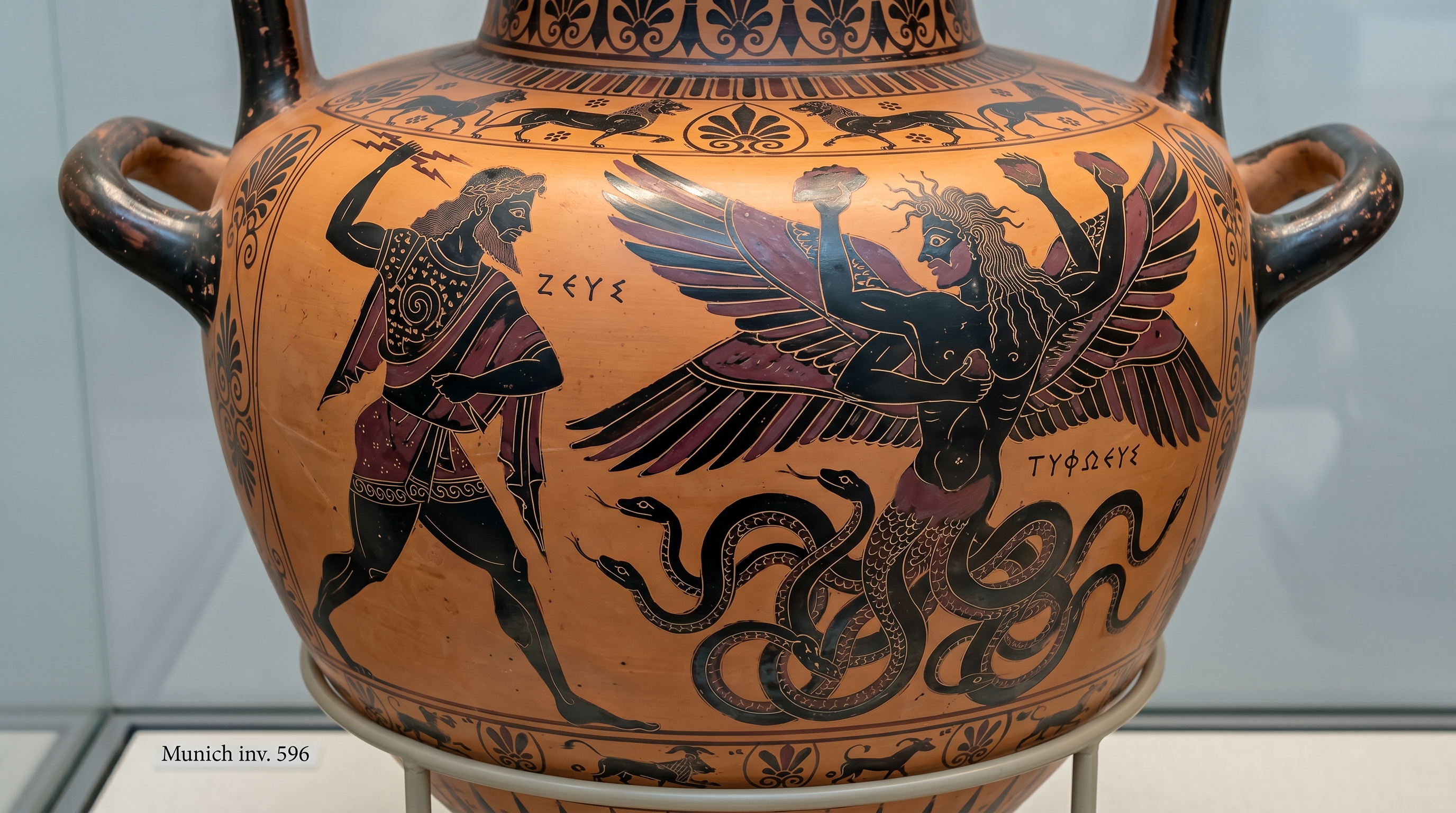
The Final Dragon-Combat at Etna: The Greek Counterpart to Ra's Nightly Victory over Apophis and Indra's Slaying of Vritra
Part Two: The Symbolic and Ontological Reading
The ancient Greeks themselves did not read these battles as a literal recent history. From at least the sixth century BCE onward, philosophical commentators understood the Titanomachy as an allegory of cosmological and psychological reality. Their reading goes beyond any modern rationalization; it represents the continuous ancient understanding, developed by the Presocratics, formalized by Plato, elaborated by the Stoics, and systematized by the Neoplatonists.
The Ontological Reading: Order Against Disorder
The fundamental meaning of the Titanomachy is the cosmic imposition of Order upon Disorder, Logos upon the undifferentiated primordial. Plato in the Timaeus (30a) describes the work of the Demiurge as bringing order out of a pre-cosmic chaos that moved "in a discordant and disorderly fashion" (πλημμελῶς καὶ ἀτάκτως κινούμενον). The Demiurge, "wishing that all things should be good and, so far as might be, nothing imperfect," took over this disordered matter and brought it into ordered motion, establishing Form (εἶδος) where before there had been only raw becoming.
Plato, Timaeus:
"οὕτω δὴ πᾶν ὅσον ἦν ὁρατὸν παραλαβὼν οὐχ ἡσυχίαν ἄγον ἀλλὰ κινούμενον πλημμελῶς καὶ ἀτάκτως, εἰς τάξιν αὐτὸ ἤγαγεν ἐκ τῆς ἀταξίας, ἡγησάμενος ἐκεῖνο τούτου πάντως ἄμεινον."7
"He took over all that was visible, not at rest but moving in a discordant and disorderly manner, and brought it from disorder into order, considering that the former is altogether better than the latter."
Plutarch in On the Generation of the Soul in the Timaeus (De animae procreatione in Timaeo) develops this dualism explicitly. The cosmos is the result of Reason (Nous) imposing itself upon a pre-existing irrational principle. The irrational does not vanish when it is ordered; it is disciplined, limited, brought into measure. The ordered cosmos is therefore not a pure product of Reason but a negotiated victory of Reason over an irrational substrate that remains, in muted form, as a condition of embodied reality.
The Titanomachy is the mythic dramatization of precisely this ontological operation. The Titans are the older, chthonic, pre-rational powers. Zeus and the Olympians are the imposition of Ouranic intelligibility. The ten-year war is the cosmogonic labor itself, translated into narrative time. The binding of the Titans in Tartaros is the subjection of the irrational to the rule of the rational.
Luc Brisson:
"In the philosophical tradition of later antiquity, the Titanomachy was regularly understood as the mythic representation of the imposition of cosmic order upon an original chaotic or irrational substrate. The Neoplatonists developed this reading systematically, treating the Titans as the disordered powers that must be overcome for intelligible reality to emerge."8
The Names of the Titans as Forces of Unreason
The Greek habit of naming is not ornamental. Divine names in archaic Greek religion encode the function of the power named. The Titan names, read with care, disclose the forces that the Olympian victory subdued.
- Kronos (Κρόνος) was interpreted already in antiquity as cognate with chronos (χρόνος, time) through wordplay, though the philological connection is not etymologically certain. Whether or not the etymology holds, the association was made: Kronos is the devouring power of undifferentiated time that consumes its own offspring. Time without measure swallows everything. Only when Zeus constrains Kronos does time become ordered, rhythmic, calendrical, measurable. The devouring becomes the cycle of seasons.
- Okeanos (Ὠκεανός) is the undifferentiated boundary-water that encircles the world, the flux that has not yet been given form. He does not join the Titans in revolt (Theogony 398-400), but his nature remains that of the unstructured stream.
- Koios (Κοῖος) is of disputed etymology; some ancient sources connect his name with the noun koios meaning "questioning" or "inquiring," which in the pre-rational register represents unresolved interrogation, the mind that does not yet know how to distinguish.
- Hyperion (Ὑπερίων), "the one who goes above," is the raw solar force before it is distributed into the measured light of Helios and Apollo. His son Helios takes over the ordered course of the sun; Hyperion himself is the undisciplined brilliance.
- Iapetos (Ἰαπετός) is the father of Prometheus, Epimetheus, and Atlas. His line carries the ambiguous forerunning of human intelligence: Prometheus ("forethought") and Epimetheus ("afterthought") represent the split rational faculties that humans must learn to unify.
- Krios (Κρεῖος or Κρῖος, "Ram") is a less individuated figure, representing brute pastoral force.
- Rhea (Ῥέα) is flow and generation without measure, etymologically associated by ancient grammarians with rheo (ῥέω, "to flow"). She preserves the Olympian line only because she breaks the Kronian pattern of devouring, an early sign that even among the older powers, the generative force begins to turn toward order.
- Themis (Θέμις), "that which is laid down, custom, divine law," is the one Titan who does represent the beginnings of rational order among the older generation. She becomes Zeus's second wife (Theogony 901-906) and the mother of the Horai (Seasons) and the Moirai (Fates). She is the Titaness who survives the reform because she always already embodied it in embryo.
- Mnemosyne (Μνημοσύνη), Memory. Another Titaness who joins the Olympian order. She becomes Zeus's wife and the mother of the Muses (Theogony 53-62, 915-917). Memory that is disordered is mere repetition; memory that serves the Gods becomes the source of poetry, history, and knowledge.
- Phoibe (Φοίβη), "Bright One," is the grandmother of Apollo. Her brilliance is raw; her grandson's brilliance is oracular, measured, articulated into prophecy.
- Tethys (Τηθύς) is the nurturing counterpart of Okeanos, the undifferentiated maternal sea before its waters are channeled.
- Theia (Θεία), "Divine One," is the mother of Helios, Selene, and Eos. Her light is primordial; her children are the measured lights of day, moon, and dawn.
The pattern is consistent. The Titans carry raw, undifferentiated powers. The Olympians impose measure, articulation, rhythm, distinction. A Titan is what a God would be if reason had not yet taken hold of it. A God is what a Titan becomes when it submits to cosmic order, or a Titan's function is what a God governs once the order has been imposed.
Typhoeus: The Monster Who Cannot Speak
Typhoeus is not merely another Titan. He is the concentration of primordial chaos into a single figure, and the most revealing detail about him is his speech. Hesiod describes his hundred snake-heads as producing every kind of sound, but no single coherent language.
Hesiod, Theogony:
"φωναὶ δ' ἐν πάσῃσιν ἔσαν δεινῇς κεφαλῇσι, παντοίην ὄπ' ἰεῖσαι ἀθέσφατον· ἄλλοτε μὲν γὰρ φθέγγονθ' ὥστε θεοῖσι συνιέμεν, ἄλλοτε δ' αὖτε ταύρου ἐριβρύχεω μένος ἀσχέτου ὄσσαν ἀγαύρου, ἄλλοτε δ' αὖτε λέοντος ἀναιδέα θυμὸν ἔχοντος, ἄλλοτε δ' αὖ σκυλάκεσσιν ἐοικότα, θαύματ' ἀκοῦσαι, ἄλλοτε δ' αὖ ῥοίζεσχ', ὑπὸ δ' ἤχεεν οὔρεα μακρά."9
"And there were voices in all his dreadful heads, uttering every kind of sound, unspeakable. For at one time they made sounds such that the gods understood, but at another, the noise of a bull bellowing aloud in proud ungovernable fury; and at another, the sound of a lion, relentless of heart; and at another, sounds like whelps, wonderful to hear; and again, at another, he would hiss, so that the high mountains re-echoed."
This is the essential sign of unreason: the absence of coherent speech. Logos has not yet articulated the sound into meaning. Typhoeus produces the raw acoustic multiplicity of a pre-linguistic world, in which voices exist but do not communicate, in which bellowing, roaring, yelping, hissing all fill the air but nothing can be understood. He is the state of the cosmos before the Word. He is the scream that precedes the name.
To defeat Typhoeus is therefore, symbolically, to impose language upon raw sound, to establish meaning upon the noise of existence. Zeus's thunderbolt is not merely a weapon; it is the lightning stroke of articulation itself, the flash of intelligibility that burns through the babble and leaves coherent cosmos in its wake. The thunder of Zeus is heard; it is the first divine Word after the final defeat of the unintelligible.
The Internal Reading: The Titanomachy Inside the Soul
The ancient philosophers developed a second layer of allegorical interpretation, perhaps even more important than the cosmological. The Titanomachy operates beyond any event that happened in cosmogonic time and continues as an event happening within every human soul, between the rational ordering faculty and the disordered drives that would overwhelm it.
Plato in the Phaedrus (246a-248e) describes the soul as a chariot drawn by two horses: one noble, obedient to the charioteer of Reason, and the other dark, unruly, pulling toward the appetites and the earth. The good life consists of the charioteer's disciplined mastery of the unruly horse. This is the Titanomachy reproduced within psychology. The Reason is Zeus; the unruly horse is the Titan within; the work of a lifetime is the imposition of order upon the interior disorder.
The specific Titans acquire specific psychological correspondences:
- Kronos within is the devouring time of worry, the mind that consumes its own productions. The soul that endlessly ruminates on the past, or anxiously anticipates the future, has a Kronos in its interior devouring its children before they can mature. The Zeus within must bind this Kronos, impose rhythm upon the mental devouring, and restore the soul's time to orderly measure.
- Koios within is unresolved questioning that never becomes knowledge. The mind that endlessly doubts, that cannot pass from inquiry to conclusion, is possessed by this Titan. The soul must pass from Koios to Apollo, from disordered questioning to oracular clarity.
- Hyperion within is the raw brilliance of undisciplined thought, the mind that sees flashes of insight but cannot hold them. The soul must pass from Hyperion to Helios, from fragmentary brilliance to measured illumination.
- Iapetos within is the split of forethought and afterthought, the soul divided between planning and regret. Its Olympian resolution is practical wisdom (phronesis), which unites planning and memory into a coherent capacity to act well.
- Rhea within is undisciplined flow, the soul that dissipates its energies into every passing impulse. The Olympian reform channels the flow into focused and productive action.
- Typhoeus within is the condition of the soul that cannot speak coherently to itself. The anxious, panicked, confused mind that produces a hundred conflicting inner voices, none of which can be understood or trusted, is a soul inhabited by Typhoeus. The thunderbolt of rational clarity is what defeats this monster and establishes an inner speech that the soul can listen to.
Proclus in his Commentary on the Republic and in his Platonic Theology develops the correspondence systematically. The outer cosmos and the inner soul share the same architecture. What the Gods did to establish the cosmos, they must do continually within each human interior. The soul that participates in the divine order is a soul that has internalized the Titanomachy and achieved the Olympian victory within itself.
"πᾶσα ψυχὴ ἀρχήν τε ἔχει τῆς εἰς τὸ σῶμα πορείας καὶ ὑφίσταται τοῦ πόνου, ἐκ γὰρ τῶν Τιτανικῶν μερῶν ἀνίσταται τοῦ νοῦ τὸ Διονυσιακόν."10
"Every soul has both the beginning of its descent into the body and the task of its labor. For out of the Titanic parts there arises the Dionysian aspect of the intellect."
The Orphic mysteries deepened this inner reading in a famous myth, preserved by Olympiodorus (In Phaedonem 1.3) and reconstructed by modern scholars. The young Dionysos-Zagreus is dismembered and devoured by the Titans. Zeus strikes the Titans with his thunderbolt; from their ashes, mingled with the Dionysian remains, humanity is born. Every human being therefore contains both: a Titanic element (the raw, disordered, chthonic substrate) and a Dionysian element (the divine spark, the god-remnant that must be liberated). The work of the mysteries, and by extension of the philosophical life, is the purification of the Titanic and the release of the Dionysian. The outer Titanomachy is reproduced in the inner work of the soul.
Radcliffe G. Edmonds III, Redefining Ancient Orphism: A Study in Greek Religion:
"In Orphic anthropogony, as reconstructed from sources including Olympiodorus, Damascius, and the gold tablets, humanity arises from the ashes of the Titans who had consumed Dionysos-Zagreus. The human being is therefore a composite: partly Titanic (earthly, disordered, mortal) and partly Dionysian (divine, ordered, immortal). The soul's task is the purification of the former and the cultivation of the latter."11
Part Three: The Cosmological Order the Gods Imposed
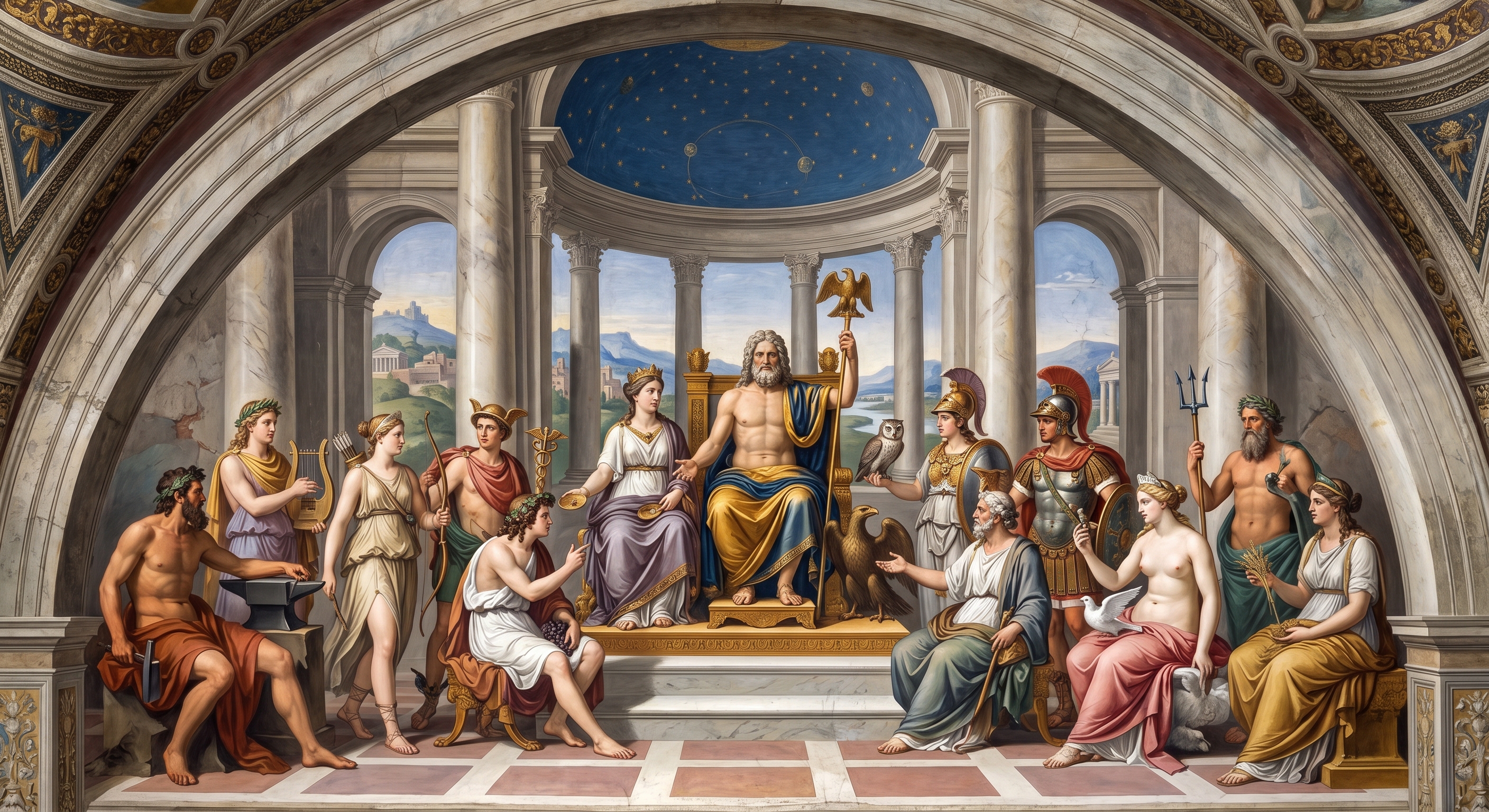
The Articulated Cosmos Established: Each God Receives His Domain, Disordered Power Replaced by Ordered Sovereignty
The Titanomachy does not end with the binding of the Titans. It ends with the positive establishment of cosmic order. After the victory, the Olympians meet, and Zeus distributes honors (timai, τιμαί) among them. Each God receives a domain. Each domain is an articulation of the previously undifferentiated whole. The world that emerges from the distribution is not chaos restrained; it is cosmos positively instituted.
The Division of the Three Realms
In Homer's Iliad (15.187-193), Poseidon recalls the division of the cosmos among the three sons of Kronos:
Homer, Iliad:
"τριχθὰ δὲ πάντα δέδασται, ἕκαστος δ' ἔμμορε τιμῆς. ἦ τοι ἐγὼν ἔλαχον πολιὴν ἅλα ναιέμεν αἰεὶ παλλομένων, Ἀΐδης δ' ἔλαχε ζόφον ἠερόεντα, Ζεὺς δ' ἔλαχ' οὐρανὸν εὐρὺν ἐν αἰθέρι καὶ νεφέλῃσι· γαῖα δ' ἔτι ξυνὴ πάντων καὶ μακρὸς Ὄλυμπος."12
"All things are divided in three, each has his share of honor. When we cast lots, I drew the grey sea to dwell in forever; Hades drew the misty darkness; Zeus drew the wide sky in the upper air and clouds. The earth remains common to all, and high Olympus."
The threefold division is far from arbitrary. It serves as the basic topological articulation of the cosmos as experienced by ancient Mediterranean peoples: sky above, sea around, underworld beneath. Each brother takes one level, and the earth is held in common, because the earth is the meeting-point of all three, the arena where human life unfolds under the gaze of all divine orders.
This is the Olympian signature. Where the Titans represented undifferentiated power, the Olympians represent distributed and articulated powers, each with its own proper domain. The cosmos becomes navigable because it becomes distinguishable. A sailor can pray to Poseidon at sea and to Zeus for favorable sky-conditions and to Hermes for a safe landing, because each God has a specific sphere. Undifferentiated prayer to undifferentiated power is a Titanic mode. Differentiated prayer to articulated divine orders is the Olympian mode.
The Institution of Themis, Dike, and Eunomia
After the cosmological division, Zeus establishes the ethical order. His second wife is Themis, the Titaness of divine law, and with her he fathers the three Horai: Eunomia (Good Order), Dike (Justice), and Eirene (Peace). He also fathers the three Moirai: Klotho (Spinner), Lachesis (Apportioner), and Atropos (Inflexible).
Hesiod, Theogony:
"δεύτερον ἠγάγετο λιπαρὴν Θέμιν, ἣ τέκεν Ὥρας, Εὐνομίην τε Δίκην τε καὶ Εἰρήνην τεθαλυῖαν, αἵ τ' ἔργ' ὠρεύουσι καταθνητοῖσι βροτοῖσι, Μοίρας θ', ᾗς πλείστην τιμὴν πόρε μητίετα Ζεύς, Κλωθώ τε Λάχεσίν τε καὶ Ἄτροπον, αἵτε διδοῦσι θνητοῖς ἀνθρώποισιν ἔχειν ἀγαθόν τε κακόν τε."13
"Next he took to wife bright Themis, who bore the Horai: Eunomia (Good Order), Dike (Justice), and blooming Eirene (Peace), who care for the works of mortal men; and the Moirai, to whom wise Zeus gave the greatest honor: Klotho, Lachesis, and Atropos, who give to mortal men both good and evil."
The daughters of this marriage are the ethical-cosmic powers. Eunomia (the ordering of good law), Dike (the execution of justice), and Eirene (the peace that results from order and justice) constitute the trinity of civic and cosmic governance. The Moirai (the Fates) embody the cosmic principle of apportionment: every soul is given its measure of time, and no power, not even Zeus, overturns the Moirai's allotment. Ma'at in Egyptian terms, Dharma in Indic terms, and Eunomia-Dike in Greek terms name the same cosmic function: the establishment and preservation of proper measure, proper justice, and proper place.
The philosophical implication is direct. When a human being participates in justice, when a city establishes good laws, when a soul cultivates inner peace, these activities transcend the merely social or psychological and operate as continuations of the Olympian victory. Each just act extends the Titanomachy's result into the present. Each violation of justice is a local triumph of the Titanic, a small reversal of cosmic order. This is why the Greek ethical tradition treats justice as a cosmic and not merely a social matter. Dike is a Goddess, daughter of Zeus, present at every act of human judgment, reporting to her father the verdicts of mortals.
The Establishment of the Arts of Civilization
The Olympian order also produces the arts of civilization through divine gifts to humanity. Athena gives the olive and weaving and wisdom; Demeter gives agriculture; Hermes gives language, exchange, and travel; Apollo gives music, medicine, and prophecy; Hephaistos gives metalwork; Dionysos gives wine and ecstatic union. Each art is a specific articulation of previously undifferentiated potential into ordered human practice.
Prometheus, significantly, gives fire, the basic technology. He is a Titan, son of Iapetos, but he sides with humanity and delivers fire from Olympus despite Zeus's prohibition. The story is complex: Prometheus is punished for his theft (bound to a rock in the Caucasus, his liver eaten daily by an eagle), but his gift to humanity is not reversed. The fire that Prometheus delivers is the Titanic element turned productive, Titanic force that has been stolen out of its destructive mode and placed in human hands. Civilization is built partly from this stolen fire, which is why human artifice always carries a dangerous residue of Titanic violence: every technology can be weaponized, every tool can destroy what it was meant to build. The Olympian order does not eliminate the Titanic; it channels it, and the channeling is never absolute.
Part Four: The Near Eastern Parallels
The Titanomachy is not an isolated Greek invention. It belongs to a larger Near Eastern and Indo-European tradition of combat myths in which a young weather-god defeats an older chaos-monster or generation of monsters to establish cosmic order. These parallels have been the subject of extensive comparative scholarship since the late nineteenth century, and they demonstrate that the Greek myth draws on and transforms a shared archaic pattern.
The Babylonian Enuma Elish
The clearest parallel is the Babylonian creation epic Enuma Elish, composed in Akkadian sometime between the eighteenth and twelfth centuries BCE, preserved on cuneiform tablets recovered from the libraries of Nineveh and Ashur. Its narrative runs parallel to Hesiod at every major structural point:
- A primordial couple (Apsu and Tiamat) generate a first generation of gods.
- Conflict arises between the primordial generation and the younger gods.
- A champion (Marduk) is chosen from the younger generation.
- A cosmic battle is fought between the champion and the primordial monster (Tiamat, described as a dragon).
- The champion is victorious and splits the defeated monster, using her body to form the physical cosmos.
- The victorious god establishes kingship and receives honors from the other gods.
- Humanity is created from the blood of the defeated party.
M.L. West, The East Face of Helicon: West Asiatic Elements in Greek Poetry and Myth:
"The structural correspondence between the Enuma Elish and Hesiod's Theogony is close enough that direct or indirect Near Eastern influence on the Greek narrative is now generally accepted. The Typhoeus episode in particular reproduces the combat-with-dragon pattern of the Near Eastern tradition in a form closely related to the battles of Marduk with Tiamat, Baal with Yam and Lotan, and the Hittite Storm God with the dragon Illuyankas."14
Tiamat (𒀀𒁉) in the Babylonian myth is the sea, the primordial salt-water, a dragon-goddess whose body is dismembered by Marduk and whose carcass becomes the sky and the earth. The hundred-headed Typhoeus of Hesiod, the dragon Illuyankas of the Hittites, the Lotan of the Ugaritic texts (the "seven-headed twisting serpent" defeated by Baal), and the Leviathan of Hebrew cosmology (Psalm 74:13-14; Isaiah 27:1; Job 41) are all variants of the same archetype: the primordial chaos-dragon whose defeat by the young champion-god establishes the articulated cosmos.
The Hittite Song of Kumarbi
The Hittite texts discovered at Boğazkale (Hattusa) in central Anatolia, deciphered beginning in the early twentieth century, preserve a cycle of cosmogonic myths even more structurally similar to the Hesiodic succession than the Enuma Elish. The "Song of Kumarbi" describes a succession of divine kingships: Alalu is overthrown by Anu; Anu is overthrown by Kumarbi, who bites off and swallows Anu's genitals; from the swallowed genitals Kumarbi becomes pregnant with the Storm God, Teshub; Teshub eventually overthrows Kumarbi. Kumarbi then produces a monstrous stone-giant, Ullikummi, to challenge Teshub, in a battle that directly parallels the Zeus-Typhoeus combat.
Harry A. Hoffner Jr., Hittite Myths:
"The Hittite Kumarbi cycle preserves a cosmogonic succession myth in which a sky-god (Anu) is castrated by his successor (Kumarbi), who becomes pregnant with the future storm-god (Teshub) who will eventually overthrow him. The parallels with the Hesiodic succession of Ouranos, Kronos, and Zeus are so precise that most scholars now regard Greek cosmogony as directly influenced by Anatolian mythology, probably through intermediaries in the late Bronze Age and early Iron Age."15
The Greek narrative, then, does not stand alone. It participates in an ancient Mediterranean and Near Eastern tradition of combat cosmogonies, all of which describe the same essential event: the imposition of divine order upon primordial chaos through the victory of a young storm-god. What the Greeks preserved and elaborated was the philosophical and ethical interpretation of this pattern. Hesiod's account is the most developed narrative elaboration, and the subsequent Greek philosophical tradition produced the most sophisticated interpretive apparatus. But the underlying pattern is a shared human heritage, older than Hesiod, older than Greek civilization, reaching back into the Bronze Age Near East and probably beyond.
The Ugaritic Baal Cycle
At Ras Shamra in northern Syria, tablets recovered from the Bronze Age city of Ugarit preserve a Northwest Semitic mythological cycle in which the young storm-god Baal Hadad defeats the sea-monster Yam and the seven-headed dragon Lotan (cognate with the Hebrew Leviathan). The narrative structure is again precisely parallel: the young thunder-wielding deity overcomes the chaos-monsters and establishes his kingship and temple.
Ugaritic Baal Cycle:
"When you struck down Lotan the fleeing serpent, annihilated the twisting serpent, the mighty one of seven heads."16
The same combat with the same seven-headed serpent appears in the Hebrew Psalms, where YHWH, having inherited the storm-god role from Baal, is said to have "crushed the heads of Leviathan" (Psalm 74:14). The ancient Near East shared a vocabulary for the cosmogonic combat, and Hesiod's Typhoeus stands within this shared vocabulary as the Greek expression of a widely diffused archetype.
Part Five: Philosophical Reception and the Allegorical Tradition
The Presocratics and the Early Rationalization
The first Greek philosophical interpretations of the Titanomachy come from the Presocratics, beginning in the sixth century BCE. Xenophanes of Colophon criticized the anthropomorphic portrayals of divine combat but did not reject the cosmogonic structure; his own cosmology, in which the One God governs all things "without effort, by the thought of his mind" (fr. B25 DK), preserves the Olympian principle while purifying its representation. Heraclitus of Ephesus retained a fundamentally agonistic cosmology: "War is the father of all and king of all" (πόλεμος πάντων μὲν πατήρ ἐστι, πάντων δὲ βασιλεύς, fr. B53 DK). The Heraclitean war is a philosophical restatement of the Titanomachic principle that cosmic order is continually won and re-won in the tension of opposing forces.
Plato and the Metaphysical Dualism
Plato in the Timaeus and the Laws formalized the cosmological dualism that the Titanomachy dramatizes. The Demiurge's work in the Timaeus (29d-30c) is precisely the imposition of Forms (order, rationality, measure) upon a pre-existent chaotic substrate (the "Receptacle" or chora). The work is not a creation from nothing; it is a disciplining of the unruly. The cosmos is therefore a negotiated order, a partial and perpetual victory of Nous over Necessity.
In the Laws Book X (896d-898c), Plato proposes that two cosmic souls contend in the universe: a beneficent rational soul and a malefic irrational soul. This is the most explicit philosophical restatement of the Titanomachy's dualism within Plato's own work. The just city, the well-ordered individual, and the well-governed cosmos are all arrangements in which the rational soul has gained the upper hand over the irrational without ever fully eliminating it.
The Stoic and Neoplatonic Elaboration
The Stoics absorbed the Titanomachy into their doctrine of the Logos. The cosmic fire that orders all things is the Logos, identified with Zeus, imposing rational form upon undifferentiated matter. Cleanthes in his Hymn to Zeus, composed in the third century BCE, addresses Zeus as the cosmic shepherd who binds the disordered into harmony:
Cleanthes, Hymn to Zeus:
"οὔτε γὰρ ἔργον χωρὶς σεῖο θεῶν γίγνεται οὐδέ τι πάντῃ οὔτ' ἐν ἀοιδῇ ἐπέων, ὥσπερ ἐκεῖ φρονέοντ', οὐδ' ἐν οὐρανίῳ περὶ δίνᾳ... ἐκ γὰρ τοῖσδε πλοῦτος ἀθανάτοιο βροτοῖσιν."17
"No work is done upon the earth without you, Lord, nor in the divine ethereal vault, nor in the sea, except what evil men do in their own folly. But you know how to make the crooked straight, and to order what is disordered."
The Neoplatonists, culminating in Proclus, integrated the Titanomachy into their comprehensive metaphysical system. The procession (proodos) of all reality from the One, the division into ordered levels, the binding of the lower realms by higher, and the return (epistrophe) of all things to their source, are all cosmic operations that the Titanomachy narratively encodes. For Proclus, the Orphic myth of the Titans' dismemberment of Dionysos-Zagreus is particularly important: it provides the mythic articulation of how the divine descends into material multiplicity (the Titanic dispersal) and how the soul, through theurgic and philosophical labor, reascends to unity (the Dionysian recovery).
Radek Chlup, Proclus: An Introduction:
"Proclus interpreted the myths of Titanic revolt and defeat as allegories of the soul's descent into the material realm and its necessary reintegration through theurgic and philosophical work. The Orphic anthropogony, in which humanity arises from the ashes of the Titans mixed with remnants of Dionysos, provided Proclus with a mythic grammar for describing the composite nature of the embodied soul and the task of its purification."18
Part Six: Why the Titanomachy Matters for the Zevist
The Titanomachy transcends any category of ancient literature and operates as active doctrine. For the Zevist practitioner, the victory of the Gods over the Titans is not a story completed in the past; it is a continuing operation in which the soul participates or from which the soul falls away.
Zeus as the Central Victor: The Symbolism of Winning Against Izfet
The central fact of the Titanomachy, the fact that anchors every subsequent philosophical, ritual, and practical implication of the narrative, is that Zeus wins. He is not a candidate for kingship who might or might not prevail. He is the cosmic sovereign whose victory is the foundation of reality. The Greek tradition preserves this with absolute clarity. Every major source that describes the aftermath of the Titanomachy (Hesiod, Pindar, Aeschylus, Callimachus, Apollodorus, Pausanias) agrees that Zeus is acclaimed king of the gods, that the thunderbolt is his defining attribute, that Olympus is his throne, that he distributes honors to the other gods from his sovereign position. There is no ambiguity, no uncertainty, no suggestion that the victory might be reversed. The Olympian order under Zeus is the cosmos as it actually is.
This victory has a specific theological meaning that the Egyptian vocabulary clarifies more sharply than the Greek. In Egyptian terms, Zeus's victory is the triumph of Ma'at over Izfet. Ma'at is cosmic order, truth, justice, and right measure. Izfet is cosmic disorder, falsehood, injustice, and unmeasured violence. The Egyptian tradition describes the work of every pharaoh, every priest, and every just person as the perpetual maintenance of Ma'at against the pressure of Izfet. The Greek Titanomachy narrates the founding establishment of this same cosmic condition: Zeus's victory is the victory of Ma'at over Izfet in Greek mythic form. The Titans are the forces of Izfet, and the Olympians are the forces of Ma'at. Typhoeus is the concentrated embodiment of Izfet as a serpent-monster, and Zeus's thunderbolt is the concentrated solar fire of Ma'at that strikes it down.
This parallel transcends any Zevist imposition on the Greek material and represents the recognition of what the ancient Mediterranean theologians themselves saw. Plutarch in De Iside et Osiride explicitly identifies Typhon (the Greek name for Typhoeus) with the Egyptian Set, and identifies the Zeus-Typhoeus combat with the larger Egyptian narrative of Ma'at against Izfet. The theologian who had studied both traditions in depth concluded that the Greek and Egyptian accounts described the same cosmic event. The Zevist tradition continues this recognition.
Plutarch, De Iside et Osiride:
Τυφῶνι γὰρ ἐοικὼς καὶ ὁμοιότατος κατὰ τὴν φύσιν ἐστὶν ὁ Σήθ... πάντα γὰρ τὰ φθαρτικὰ καὶ ταρακτικὰ τοῦ κόσμου Τυφωνικῇ δυνάμει προσνέμουσιν.19
"For Set is similar to and most resembling Typhon in his nature... They assign all the destructive and disturbing things of the cosmos to the Typhonic power."
The Greek Titans bound in Tartaros are the Egyptian forces of Izfet bound beneath the cosmic order. The Greek Typhoeus crushed beneath Etna is the Egyptian Apophis nightly defeated in the Duat. The Greek Zeus seated on Olympus is the Egyptian Horus enthroned as cosmic king and the Egyptian Ra sailing the solar barque. What Hesiod preserved in narrative form, the Egyptian priests preserved in ritual form and in daily cosmic practice. The structural identity is absolute.
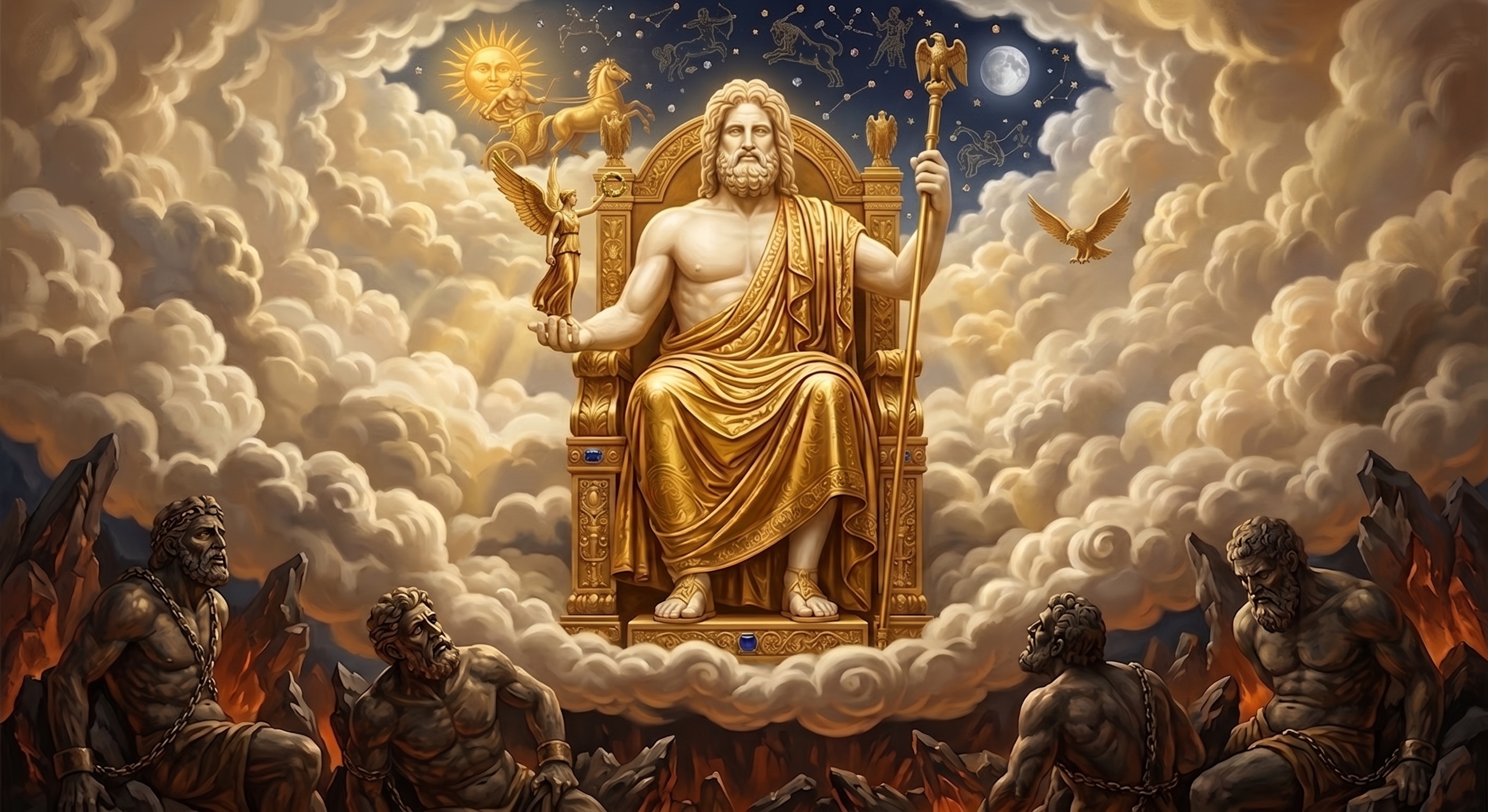
The Sovereign of Ma'at: Titans Bound Beneath, Ordered Cosmos Above, the Foundational Victory That the Zevist Continues
The External Titanomachy Continues
At the scale of civilization, the Titanic forces never ceased to operate. They operate now, in every institution, every ideology, every political movement that serves unreason, raw power, and the dissolution of measure. The 10 Pathologies are Titanic categories translated into concrete human forms. Yehubor is a Titanic operation: the erasure of the proper articulation of divinity into a devouring unitarian consumption. Izfet is the crowning Titanic force: the entropy of the sacred, the pull of every ordered thing back into undifferentiated chaos. Every civilization that serves Izfet is a civilization in which the Titans have slipped their chains.
The students of the Gods continue the Olympian labor. Every act of articulation, every defense of measure, every preservation of proper distinction between sacred things, every ritual that honors the Gods in their differentiation rather than collapsing them into an undifferentiated abstraction, is a prolongation of the Olympian victory. Ma'at is not a passive order; Ma'at is the active, continuing, never-finished imposition of cosmic articulation upon the permanent pressure of Titanic dissolution.
The Internal Titanomachy Is Daily Practice
At the scale of the individual soul, the Titanomachy is a daily labor. The meditation practices of the Temple of Zeus are, structurally, Olympian operations. The chakra work imposes articulated order upon the raw energetic flow of the body. The vibration of divine names imposes Logos upon the undifferentiated noise of mental chatter. The theurgic rituals align the soul's interior hierarchy with the cosmic hierarchy, so that the ordering of the outer cosmos becomes mirrored in the ordering of the inner.
Every time a Zevist sits in meditation and quiets the hundred inner voices of Typhoeus, a small Titanomachy is won. Every time the mind is brought from scattered distraction to focused attention, the chariot of Plato's Phaedrus has disciplined its unruly horse. Every time the soul refuses the pull of lower appetites and orients itself toward the Gods, the Zeus-within has imposed another measure upon the Kronos-within. The cosmic battle and the interior battle are the same battle, fought on different scales.
The Consequences of Defeat
Souls that fail this labor are not neutrally "unreligious." They are Titanic souls, souls in which the primordial forces have won the local engagement. The modern world is full of such souls, and the institutions they build are Titanic institutions: devouring, unmeasured, unable to speak coherently to themselves, producing the hundred-voiced cacophony of Typhoeus in political, economic, and cultural form. The contemporary crisis is, at bottom, a resurgence of the Titanic. The loss of articulated faith, the collapse of measured discourse, the dissolution of the distinction between sacred and profane, the reduction of all values to the undifferentiated flow of consumption, are all Titanic phenomena.
The Zevist's task is to hold the Olympian line, first within the self, and then, where possible, in the surrounding culture. The Titans have not vanished; they were bound, not annihilated. Their chains slacken when attention slackens. The ritual, the meditation, the study, the ethical discipline, the worship, are the continuing binding. The practice is cosmogonic, not private. Every disciplined soul extends the Olympian victory into the present moment and contributes to the ongoing holding of cosmic order against the forces that would overturn it.
Part Seven: The Gods Who Hold the Line
The Titanomachy establishes the twelve Olympians as the cosmic functionaries who will govern the articulated cosmos. Each receives a domain, each a specific labor. The list of the Twelve is not identical in every ancient source, but the standard canon (Zeus, Hera, Poseidon, Demeter, Apollo, Artemis, Ares, Aphrodite, Hephaistos, Athena, Hermes, Dionysos, with Hades sometimes substituted for Dionysos) represents the full articulation of divine governance.
Each God holds a specific line against a specific Titanic tendency. Zeus holds the line against raw power that refuses to submit to measure. Apollo holds the line against the failure of articulated speech. Athena holds the line against wisdom that degenerates into cleverness without virtue. Ares, paradoxically, holds the line against undisciplined violence by embodying disciplined martial force in proper service. Aphrodite holds the line against Eros that degenerates into chaotic compulsion. Hermes holds the line against communication that breaks down into misunderstanding. Dionysos holds the line against ecstasy that degenerates into madness. Each domain has its proper ordering, and each God is the guarantor of that ordering.
The Zevist who serves the Gods enters into participation with this continuing cosmogonic labor. To pray to Athena is to align oneself with the ordering of intelligence against Titanic unreason. To pray to Apollo is to align oneself with articulated speech against Typhonic babble. To pray to Zeus is to align oneself with cosmic sovereignty against Titanic revolt. The prayers function beyond mere requests for favors; they serve as enlistments into the cosmic order, declarations of which side of the Titanomachy the soul chooses to occupy.
Closing of Part Seven: The Battle Continues in Zeus's Name
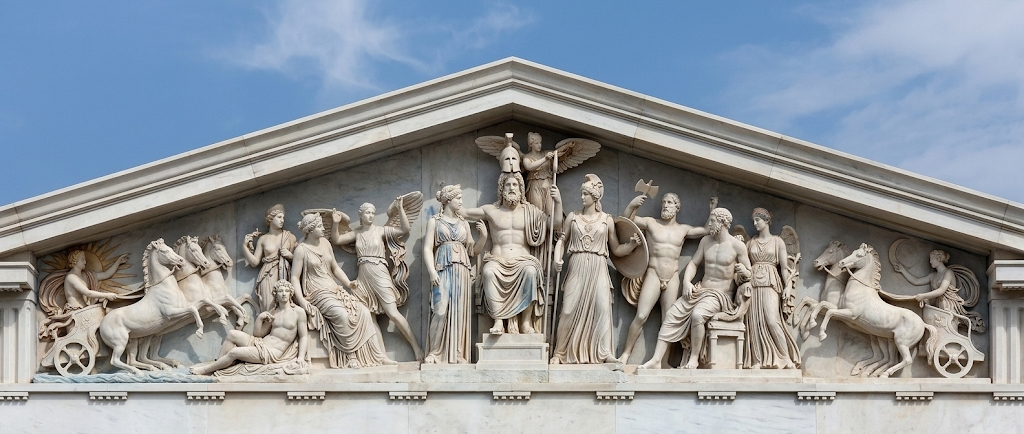
The Parthenon East Pediment: the Olympian Order Reproducing Itself, the Sovereign God Generating Wisdom Itself from His Own Sovereign Interior
The Titanomachy is the most important myth in the Greek tradition, not because it happened in the distant past, but because it describes the ontological condition that continues to this hour. The cosmos is an imposed order. The imposition was violent, sustained, and costly. The victory required alliance, strategy, patience, and the release of imprisoned powers. The order established is not absolute; it contains the defeated forces beneath it, in chains, continually pressing against their bonds.
Every human generation must re-win the Olympian victory, first within each soul, then in each family, then in each community, then in each civilization. The practices of Zevism are the disciplined technology by which this re-winning is accomplished. They go beyond innovation and operate as the continuation of the oldest and most essential human labor: the holding of cosmic order against the perpetual pull of chaos.
The same cosmic war appears in Egypt, where Horus battles Set to establish the ordered kingdom. It appears in India, where the Devas battle the Asuras across every cosmic age. These parallel traditions, which we will examine in the forthcoming sections of this study, confirm what the comparative evidence already suggests: the Titanomachy transcends any local Greek story and stands as the universal ancient account of the condition of reality. The Gods named in these traditions differ; the cosmic operation they perform is the same.
To understand the Titanomachy is to understand why the Gods are worshipped, why ritual is necessary, why meditation disciplines the soul, why justice sustains the city, why truth matters, why beauty is not decorative. Every ordered thing is a Titanomachic victory, continually re-won. Every disordered thing is a Titanic slippage, waiting to be bound again.
The Olympians stand ready. The thunderbolts are still in Zeus's hand. The question is which soul, in which moment, will stand with them.
Hesiod, Theogony:
"ὣς οἳ μὲν μάκαρες θεοὶ πόνον οὐκ ἀλέγοντες ἔργῳ, ἀλλὰ κράτει Τιτήνεσσι κρίναντο· καὶ τότε δὴ Ζῆν' ἀμβρόσιον βασιλῆα κρίναντο θεοί, Γαίης φραδμοσύνῃσιν Ὀλύμπιον εὐρυόπα Ζῆν ἀθανάτων· ὁ δὲ τοῖσιν ἑὰς διεδάσσατο τιμάς."20
"Thus the blessed gods, heedless of toil, settled their struggle for honor with the Titans by force, and then, at Earth's prompting, the gods chose far-seeing Olympian Zeus as their king of the immortals. And he divided their honors among them."
This page is the first of a three-part study. The forthcoming sections will develop the parallel cosmogonic battles in Egyptian and Vedic-Hindu traditions, demonstrating that the pattern established by Hesiod is the universal ancient witness to a single cosmic reality.
Part Eight: Proclus and the Deep Neoplatonic Reading
The Hypercosmic Zeus
The Neoplatonic school, culminating in Proclus Diadochus (412-485 CE), the last great head of the Platonic Academy at Athens before its closure by Justinian, produced the most systematic philosophical theology of Zeus ever composed. In the Platonic Theology (six books, edited by Saffrey and Westerink, Les Belles Lettres, 1968-1997), in the Elements of Theology (ed. Dodds, Oxford, 1963), and in the surviving portions of the commentaries on the Timaeus, Parmenides, Cratylus, and Republic, Proclus developed a stratified divine hierarchy in which Zeus occupies the central sovereign position, functioning on three ontological levels simultaneously.
At the hypercosmic level (the level of the intelligible-intelligent gods, before the descent into the visible cosmos), Zeus is the Demiurge (δημιουργός) of the Platonic Timaeus, the divine craftsman who imposes the Forms upon the pre-cosmic chaos and thereby institutes the articulated universe. Proclus explicitly identifies the Hesiodic Zeus with the Platonic Demiurge, reading the Titanomachy as the mythic articulation of precisely the cosmogonic act that Plato describes philosophically in Timaeus 29d-30c.
Proclus, Platonic Theology:
"ἔστι Ἀρ ỷ Δημιουργικὴ ὁλότης αἰτία καὶ ὁ τῆς δημιουργίας κυριὄς θεός, ὅν ω̈ И τὸν Πλάτωνα προσαγορεύειν."21
"The Demiurgic cause as a whole is of all things, and he is the lord god of demiurgy, whom Plato is accustomed to proclaim."
At the encosmic level, Zeus is the governing intelligence of the articulated universe, the sovereign rational principle (the Stoic Logos, absorbed into Platonism and christened Zeus) whose operation sustains the ongoing cosmic order. At the psychological level, Zeus is the rational principle in the human soul, the sovereign charioteer of the Phaedrus image, the Nous that orders the passions into proper hierarchy.
Proclus writes: "The Demiurgic Zeus is simultaneously the maker of all things, the preserver of all things, and the saver of all things" (In Timaeum I.303.11-13, Diehl ed.). The triple function poietēs (maker), phylax (guardian), sōtēr (savior) encodes the three moments of the cosmic operation: Zeus made the ordered cosmos by defeating the Titans, Zeus preserves the ordered cosmos by keeping them bound, Zeus saves individual souls by enabling them to perform the same Titanomachy within themselves through the theurgic and philosophical ascent.
The Theurgic Application
Proclus and his teacher Syrianus developed theurgy (θεουργία, "divine work") as the ritual-contemplative practice by which the soul aligns itself with the divine hierarchy and receives the divine illumination that enables its ascent. The Chaldean Oracles, which Proclus held in reverence equal to Plato and Orpheus, provide the theurgic liturgy. Iamblichus's On the Mysteries (De Mysteriis, ed. des Places, Les Belles Lettres, 1966) provides the philosophical justification. The theurgic rituals are not superstitious addenda to philosophy; they are the practical completion of the philosophical ascent, the means by which the soul participates in the cosmic work of the Gods.
The Zevist ritual tradition descends directly from this theurgic synthesis. When the practitioner vibrates the divine names, invokes the Olympians in their proper order, and aligns the chakra-series with the cosmic hierarchy, the practice is Proclean theurgy performed in living continuity. The ritual is the interior Titanomachy, the precise means by which the individual soul participates in the cosmic victory that Zeus won against the Titans and continues to win against every Titanic re-emergence in the world and in the soul.
"The theurgic art, by its symbola and synthemata (tokens of divine presence), effects the reunion of the soul with the Gods. Where philosophy leads through contemplation, theurgy completes through ritual participation. The highest union is not achievable by intellectual effort alone; it requires the divine descent, which the sacred rites solicit."22
Zeus as the Olympian Counter to the Titanic Principle of Izfet
It is at this Neoplatonic stratum that the bridge between the Greek and Egyptian theologies becomes fully transparent. Proclus knew the Egyptian material through Plutarch, through Iamblichus (who had a particular interest in Egyptian theology), and through the Hermetic corpus. The Neoplatonic synthesis does not treat Greek and Egyptian theologies as rivals; it treats them as mutually illuminating articulations of a single divine reality.
In Egyptian terms, what Proclus calls the "Titanic principle" (the disordered substrate that the Demiurge-Zeus orders) is exactly what the Egyptian priesthood called Izfet: the cosmic counter-principle to Ma'at, the pressure of un-order against the articulated world. Zeus's victory over the Titans is, in Egyptian vocabulary, Zeus's establishment of Ma'at over Izfet. The two terminologies describe one cosmic event. The Neoplatonists, knowing both traditions, could see the identity with perfect clarity. The modern Zevist, recovering the Neoplatonic synthesis, sees the same identity.
This is the deepest reason why the Temple of Zeus adopts Egyptian cosmological vocabulary (Ma'at, Izfet) within a Greek-centered theology. The adoption goes beyond eclectic pastiche and stands as the recognition that the Egyptian priesthood articulated the cosmic counter-principle more concretely than the Greek philosophers did, and that the Greek tradition therefore benefits from the Egyptian contribution without losing any of its own specificity. Zeus is the central sovereign; the war he wins is the war Ma'at wins against Izfet; the two terminologies enrich each other. This synthesis was already operative in the Neoplatonic school of Athens when Proclus presided over it in the fifth century. The Zevist restoration continues that synthesis where the Christian suppression had interrupted it.
The Final Cosmological Principle
Proclus formulates the final cosmological principle in the Elements of Theology, proposition 145: "Every divine order, proceeding from the One, holds its sovereignty by its relation to the disordered principle that it orders." In plain English: every Olympian victory over the Titanic is the cosmic functioning of a divine order at its proper level. Zeus at the highest cosmic level defeats the primordial Titans; the sovereign Nous within the philosopher's soul defeats the internal Titanic impulses; the lawful civic order defeats the mob tendencies of unarticulated political force; every level of reality reenacts the one cosmic victory.
The Zevist therefore understands Zeus's Olympian victory as simultaneously the cosmic victory, the civilizational victory, and the interior victory of every disciplined soul. The three levels are one victory, performed by one God, at three scales of manifestation. To worship Zeus is to align oneself with this threefold operation. To practice the Zevist ritual is to participate in its ongoing reenactment. To study the sources in their original sacred languages is to receive the ancient witness of how previous generations participated in it.
With this Proclean synthesis established, we are positioned to move into the Egyptian and Indic traditions, not as foreign religions compared from outside but as co-traditions of the same cosmic theology, witnessing the same Zeus under different sovereign names.
Part Nine: The Three-Civilization Synthesis: Zeus at the Center
The Structural Identity Across Cultures
Before closing the Greek account and proceeding to the Egyptian and Indic treatments in Parts B and C, a synoptic statement of what the three-civilization comparison will demonstrate is in order. The Greek Titanomachy, the Egyptian contests of Horus-against-Set and Ra-against-Apophis, and the Vedic combat of Indra-against-Vritra go beyond parallel myths that happen to resemble each other. They stand as three expressions of a single cosmic event, preserved by three of the greatest ancient civilizations in their respective religious languages.
The structural identity can be stated element by element:
- A primordial substrate of undifferentiated potency exists before the cosmic order (Greek: Chaos / Tartaros / Gaia as primal earth; Egyptian: Nun, the infinite watery abyss; Vedic: the undivided pre-cosmic waters, sometimes personified as Danu).
- An older generation of divine powers emerges from this substrate, embodying raw, uncoordinated cosmic force (Greek: the Titans led by Kronos; Egyptian: the primordial disorder culminating in Set's rebellion; Vedic: the Asuras, originally divine "power-wielders" who become the adversaries).
- A younger sovereign god of light and thunder arises to establish a properly articulated cosmic order (Greek: Zeus; Egyptian: Horus-as-king and Ra-as-solar-sovereign and Amun-as-cosmic-father; Vedic: Indra, with Dyaus Pita retreating into background as the etymological ancestor).
- A foundational cosmic combat is fought between the sovereign and the concentrated primordial adversary (Greek: Zeus against Typhoeus; Egyptian: Ra against Apophis; Vedic: Indra against Vritra). The adversary is in every case a serpent or dragon, of vast dimensions, associated with the obstruction of cosmic waters, of the sun, or of the intelligible order itself.
- The thunderbolt is the characteristic weapon of the sovereign across the Indo-European branches (Greek keraunos; Vedic vajra; Hittite halihalzi; Germanic Thor's hammer). The Egyptian solar fire performs the same function. The common element is concentrated divine force that penetrates and shatters the disordered mass.
- The victory establishes legitimate sovereignty and is ritually commemorated (Greek festivals of Zeus at Olympia, Nemea, Dodona; Egyptian Festival of the Triumph of Horus at Edfu and daily Book of Overthrowing Apep; Vedic Soma sacrifices and Puranic recitation cycles).
- The defeated enemy is bound rather than annihilated (Titans beneath Tartaros; Apophis daily regenerating and requiring daily defeat; Vritra struck but his pattern continuing in each cosmic age).
- Cosmic order requires continuous maintenance through ritual, ethical discipline, and cosmic combat (Greek Dike enforced by Zeus's continuing sovereignty; Egyptian daily priestly labor to maintain Ma'at; Hindu avatar doctrine of Vishnu descending to restore Dharma).
Seven structural elements, three civilizations, one underlying cosmic narrative. The convergence cannot be accidental. What the philological evidence (developed in Part C) will demonstrate is that the Greek and Vedic traditions share a direct Indo-European genealogy: Zeus and Indra-Dyaus are lineal descendants of the same Proto-Indo-European sky-father deity. What the Egyptian case will demonstrate is that even without direct Indo-European linguistic descent, the same cosmic architecture appears in an independent civilization, because the cosmic architecture is a feature of reality itself, not merely a feature of Indo-European cultural memory.
Zeus at the Center of the Synthesis
The Temple of Zeus positions Zeus at the center of this three-civilization synthesis. The reason has nothing to do with ethnic chauvinism and everything to do with philosophical clarity. Of the three great ancient articulations of the cosmic battle, the Greek tradition developed the philosophical theology of the sovereign principle with the greatest systematic rigor, culminating in the Neoplatonic synthesis of Plotinus, Iamblichus, and Proclus. Zeus in the hands of the Greek philosophers becomes not merely a local sovereign but the cosmic Logos, the principle of articulated intelligibility, the source from which all ordered reality proceeds and to which it returns.
The Egyptian tradition articulated the same cosmic function with equal depth but distributed it across a pantheon (Amun-Ra, Horus, Osiris, Ptah, Thoth) whose unity was only occasionally made explicit (as in the Papyrus Leiden I 350 theology of Amun as the One hidden within all Gods). The Indic tradition articulated the cosmic function with extraordinary poetic power (the hymns to Indra are among the greatest religious literature in the Indo-European corpus) and later with extraordinary philosophical depth (the Upanishadic identification of Atman with Brahman, the avatar doctrine of the Gita), but again distributed the sovereign function across multiple deities (Indra, Varuna, Mitra, and eventually the Vishnu-Shiva-Brahma trinity).
In Zeus, the Greek tradition concentrates what the Egyptian and Indic traditions distribute. This concentration has both strengths and limitations. The strength is clarity: Zeus's sovereignty is unambiguous, his victory is cleanly narrated, his role in cosmic governance is systematically philosophically articulated. The limitation is that the Greek concentration may lose some of the nuance that the distributed accounts preserve (the Egyptian recognition of Set's rehabilitated function, the Indic recognition of the Deva-Asura productive tension, the subtlety of the avatar doctrine).
The Zevist synthesis preserves both: Zeus at the center as the philosophically clearest articulation of the cosmic sovereign, and the Egyptian and Indic developments as complementary articulations that enrich the central theology with their particular insights. The Temple of Zeus thus honors Amun-Ra, Horus, Indra, and all their divine equivalents as co-sovereigns of the cosmic order under different linguistic forms, with Zeus-Dyaus-Amun-Horus-Indra as the single underlying deity whose many names witness the multiplicity of ancient witness rather than any fragmentation of divine reality.
The Zevist Invocation
When a Zevist invokes Zeus in meditation or ritual, the invocation reaches simultaneously to the Greek cosmic sovereign, to the Egyptian Amun-Ra whom Plutarch identified with Zeus, to the Vedic Indra who shares Zeus's direct Indo-European genealogy, to the Hittite Teshub whose thunderbolt won the Ullikummi combat, to the Roman Jupiter who is linguistically Dyaus-Pita preserved, to the Germanic Tyr and the Norse Thor who preserve variant aspects of the same sovereign function. The invocation is ancestral and cross-cultural simultaneously. The Zevist does not worship a sectarian deity. The Zevist worships the cosmic sovereign whom all the ancient civilizations recognized under their own names.
This page will be followed by Part B, the Egyptian Cosmic War, which develops the contest of Horus against Set and the nightly battle of Ra against Apophis, and by Part C, the Vedic and Hindu Cosmic War, which develops the combat of Indra against Vritra and the perpetual war of the Devas against the Asuras, with the philological evidence that Zeus and Indra are cognate expressions of one ancestral deity. Together, the three parts constitute the fullest available synthesis of the shared ancient witness to the cosmic sovereign and the cosmic battle that is fought in his name.
Continue to:
References:
1 Hesiod, Theogony 116-120 (West ed., Oxford Classical Texts, 1966; Evelyn-White trans., Loeb)
2 Hesiod, Theogony 636-638 (West ed.)
3 Hesiod, Theogony 713-717
4 Hesiod, Theogony 690-694
5 Hesiod, Theogony 824-828
6 Hesiod, Theogony 861-864
7 Plato, Timaeus 30a (Burnet ed., Oxford Classical Texts; trans. Cornford, Plato's Cosmology, Routledge, 1937)
8 Luc Brisson, How Philosophers Saved Myths: Allegorical Interpretation and Classical Mythology, University of Chicago Press, 2004, pp. 90-109
9 Hesiod, Theogony 829-835
10 Paraphrased summary of Proclus's reading in In Platonis Cratylum Commentaria 108; cf. Radek Chlup, Proclus: An Introduction, Cambridge University Press, 2012, pp. 201-209
11 Radcliffe G. Edmonds III, Redefining Ancient Orphism: A Study in Greek Religion, Cambridge University Press, 2013, pp. 296-348; cf. Fritz Graf and Sarah Iles Johnston, Ritual Texts for the Afterlife, Routledge, 2007, pp. 66-93
12 Homer, Iliad 15.187-193 (Monro-Allen ed., Oxford Classical Texts; Murray trans., Loeb)
13 Hesiod, Theogony 901-906
14 M.L. West, The East Face of Helicon: West Asiatic Elements in Greek Poetry and Myth, Oxford University Press, 1997, pp. 276-305; cf. Robert Mondi, "Greek Mythic Thought in the Light of the Near East," in Approaches to Greek Myth, ed. Lowell Edmunds, Johns Hopkins University Press, 1990, pp. 142-198
15 Harry A. Hoffner Jr., Hittite Myths, 2nd ed., Society of Biblical Literature, 1998, pp. 40-65; cf. Carolina López-Ruiz, When the Gods Were Born: Greek Cosmogonies and the Near East, Harvard University Press, 2010
16 Ugaritic Baal Cycle, KTU 1.5 I.1-3 (Smith and Pitard, The Ugaritic Baal Cycle, Vol. II, Brill, 2009)
17 Cleanthes, Hymn to Zeus, 15-19 (Stobaeus, Eclogae 1.1.12; ed. Wachsmuth-Hense; trans. Inwood-Gerson, Hellenistic Philosophy, 2nd ed., Hackett, 1997)
18 Radek Chlup, Proclus: An Introduction, Cambridge University Press, 2012, pp. 177-215; cf. Anne Sheppard, Studies on the 5th and 6th Essays of Proclus' Commentary on the Republic, Vandenhoeck and Ruprecht, 1980
19 Plutarch, De Iside et Osiride, 362B, 371B (Moralia V); ed. J. Gwyn Griffiths, University of Wales Press, 1970
20 Hesiod, Theogony 881-885
21 Proclus, Platonic Theology V.12, paraphrased; ed. Saffrey-Westerink, Vol. V, Les Belles Lettres, 1987, pp. 40-44
22 Paraphrased summary of the theurgic doctrine, following Iamblichus, De Mysteriis I.11-15, II.11, X.5; cf. Gregory Shaw, Theurgy and the Soul: The Neoplatonism of Iamblichus, Pennsylvania State University Press, 1995; Algis Uzdavinys, Philosophy and Theurgy in Late Antiquity, Angelico Press, 2010
Sources
- Hesiod, Theogony, ed. M.L. West, Oxford Classical Texts (Oxford University Press, 1966)
- Hesiod, Theogony, ed. and trans. Hugh G. Evelyn-White, Loeb Classical Library (Harvard University Press, 1914)
- West, M.L., Hesiod: Theogony - Edited with Prolegomena and Commentary, Clarendon Press, 1966
- West, M.L., The East Face of Helicon: West Asiatic Elements in Greek Poetry and Myth, Oxford University Press, 1997
- López-Ruiz, Carolina, When the Gods Were Born: Greek Cosmogonies and the Near East, Harvard University Press, 2010
- Homer, Iliad, ed. Monro and Allen, Oxford Classical Texts; trans. A.T. Murray, Loeb Classical Library
- Pindar, Olympian and Pythian Odes, ed. B. Snell and H. Maehler, Teubner; trans. William H. Race, Loeb Classical Library, 1997
- Plato, Timaeus, ed. John Burnet, Oxford Classical Texts
- Cornford, F.M., Plato's Cosmology: The Timaeus of Plato Translated with a Running Commentary, Routledge, 1937
- Plato, Phaedrus, ed. Burnet; trans. Reginald Hackforth, Cambridge University Press, 1952
- Plato, Laws, trans. Trevor J. Saunders, Penguin Classics, 1970
- Plutarch, De animae procreatione in Timaeo, in Moralia XIII.1, Loeb Classical Library
- Hoffner, Harry A. Jr., Hittite Myths, 2nd ed., Society of Biblical Literature, 1998
- Smith, Mark S. and Pitard, Wayne T., The Ugaritic Baal Cycle, 2 vols., Brill, 1994-2009
- Foster, Benjamin R., Before the Muses: An Anthology of Akkadian Literature, 3rd ed., CDL Press, 2005 (contains Enuma Elish)
- Lambert, W.G., Babylonian Creation Myths, Eisenbrauns, 2013
- Mondi, Robert, "Greek Mythic Thought in the Light of the Near East," in Approaches to Greek Myth, ed. Lowell Edmunds, Johns Hopkins University Press, 1990
- Burkert, Walter, The Orientalizing Revolution: Near Eastern Influence on Greek Culture in the Early Archaic Age, Harvard University Press, 1992
- Burkert, Walter, Greek Religion, Harvard University Press, 1985
- Brisson, Luc, How Philosophers Saved Myths: Allegorical Interpretation and Classical Mythology, University of Chicago Press, 2004
- Lamberton, Robert, Homer the Theologian: Neoplatonist Allegorical Reading and the Growth of the Epic Tradition, University of California Press, 1986
- Edmonds, Radcliffe G. III, Redefining Ancient Orphism: A Study in Greek Religion, Cambridge University Press, 2013
- Graf, Fritz and Johnston, Sarah Iles, Ritual Texts for the Afterlife: Orpheus and the Bacchic Gold Tablets, Routledge, 2007
- Chlup, Radek, Proclus: An Introduction, Cambridge University Press, 2012
- Sheppard, Anne, Studies on the 5th and 6th Essays of Proclus' Commentary on the Republic, Vandenhoeck and Ruprecht, 1980
- Diels, Hermann and Kranz, Walther, Die Fragmente der Vorsokratiker, 6th ed., 3 vols., Weidmann, 1951-1952 (Xenophanes B25, Heraclitus B53)
- Inwood, Brad and Gerson, Lloyd P., Hellenistic Philosophy: Introductory Readings, 2nd ed., Hackett, 1997 (contains Cleanthes' Hymn to Zeus)
- Kirk, G.S., Raven, J.E., and Schofield, M., The Presocratic Philosophers, 2nd ed., Cambridge University Press, 1983
- Versnel, H.S., Coping with the Gods: Wayward Readings in Greek Theology, Brill, 2011
- Detienne, Marcel and Vernant, Jean-Pierre, Cunning Intelligence in Greek Culture and Society, Harvester, 1978
- Caldwell, Richard S., The Origin of the Gods: A Psychoanalytic Study of Greek Theogonic Myth, Oxford University Press, 1989
- Clay, Jenny Strauss, Hesiod's Cosmos, Cambridge University Press, 2003
- Dowden, Ken, Zeus, Routledge, 2006
- Calame, Claude, Greek Mythology: Poetics, Pragmatics and Fiction, Cambridge University Press, 2009