
 አማርኛ
አማርኛ العربية
 বাংলা
বাংলা Български
 中文
中文 Čeština
 Dansk
Dansk Deutsch
 Eesti
Eesti Ελληνικά
 Español
 Français
 हिन्दी
 Hrvatski
 IsiZulu
 Italiano
 日本語
日本語 Kiswahili
 Magyar
 Македонски
 नेपाली
 Nederlands
 فارسی
فارسی Polski
 Português
 Română
 Русский
 Slovenščina
 Suomi
Suomi Svenska
 Tagalog
 Türkçe
The Battle of the Gods, Part B: Kemet
author: High Priest Zevios Metathronos
Horus Against Izfet, and the Daily War of Ra Against the Serpent
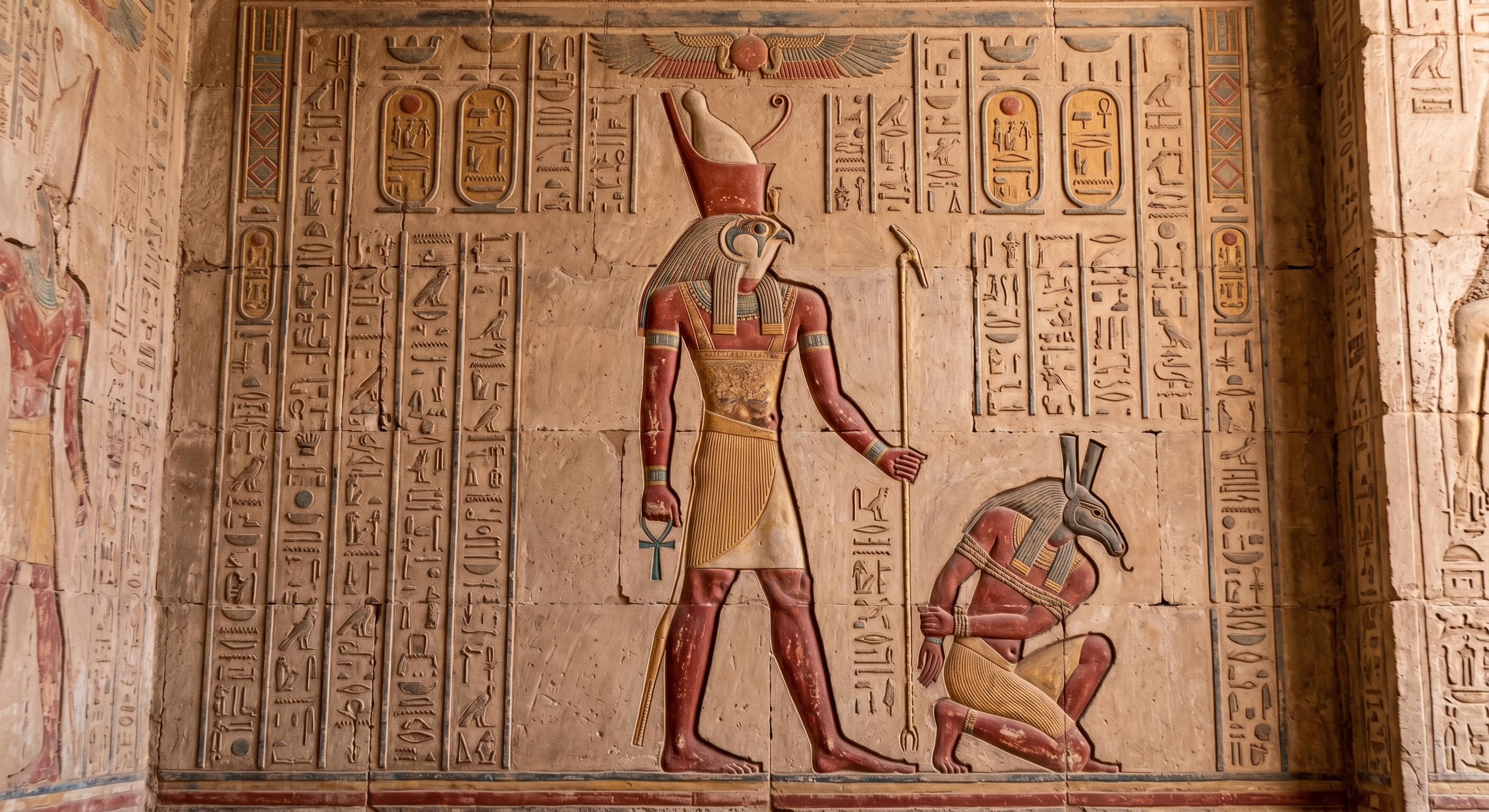
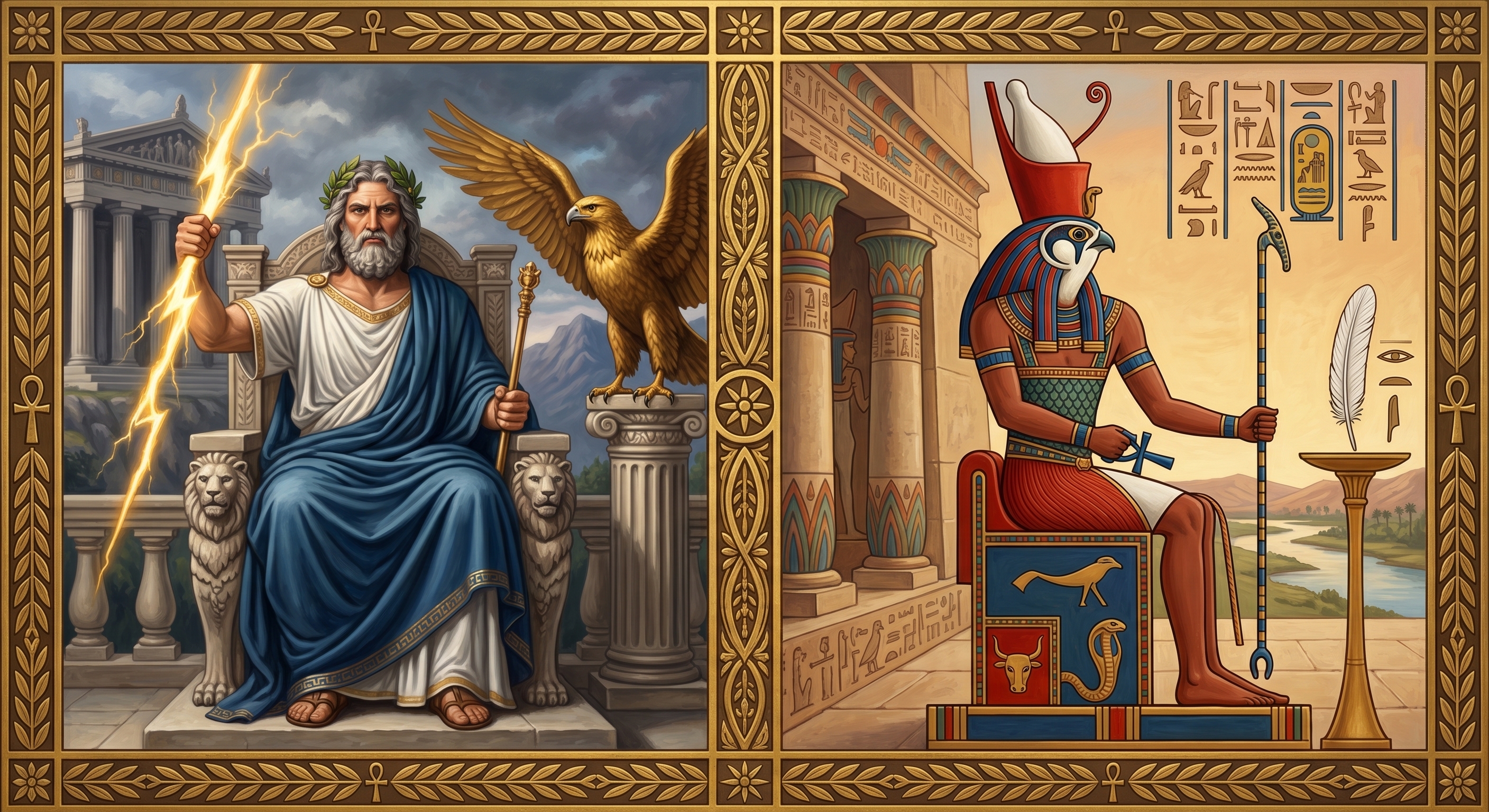
The Egyptian form of the cosmic war: the falcon-king Horus defeats Seth to restore Ma'at where Izfet had entered the world, and every dawn is a renewed victory of the sun-god against the serpent of pure disorder. Horus is the Egyptian Zeus: the sovereign son of heaven, the guarantor of cosmic order, the thunder-wielding king against whom the forces of unreason break and fall.
Introduction: Why the Egyptian Story Is the Greek Story
In the first part of this study, we traced the Greek Titanomachy from Hesiod's Theogony through the philosophical interpretations of Plato, Plutarch, and Proclus. We saw that the cosmic war between Zeus and the Titans is not a cultural curiosity but an ontological diagnosis of reality, describing the permanent operation by which divine order imposes itself on the pressure of primordial chaos.
The Egyptian tradition tells the same story. It uses different names, different local geography, different mythic imagery. The structural content is identical. Where the Greeks name the chaos-force chaos (χάος), the Egyptians name it Izfet (jzft). Where the Greeks call the cosmic order kosmos and dike, the Egyptians call it Ma'at (mꜣꜥt). Where the Greeks place Zeus as the thunder-wielding sovereign who establishes the Olympian order, the Egyptians place Horus as the falcon-king who restores Ma'at after the rebellion of Seth, and Ra as the sun-god who defeats the serpent Apophis each night to secure the dawn.
The parallel is not superficial. It runs through every layer of both traditions. Both include a cosmogonic combat that establishes the world order. Both include a younger generation of Gods overthrowing an older, chaotic principle. Both include a climactic battle against a serpent or serpentine monster who embodies pure disorder. Both conclude with the installation of a sovereign king-god whose rule guarantees cosmic articulation against the permanent pressure of dissolution. Both then continue the battle as a daily operation that requires human ritual participation to sustain the victory.
The Egyptian form of this cosmic war is preserved in some of the oldest religious texts ever written. The Pyramid Texts, carved into the walls of royal pyramids during the Fifth and Sixth Dynasties (circa 2400-2200 BCE), already contain the full cosmic vocabulary of Ma'at, Izfet, the ascent of the king-Horus, and the defeat of Seth and Apophis. The Coffin Texts of the First Intermediate Period and Middle Kingdom (circa 2100-1800 BCE) develop these themes further. The Book of the Dead of the New Kingdom (circa 1550 BCE onward) codifies them for every rightly-buried soul. The Contendings of Horus and Seth, preserved on Papyrus Chester Beatty I from the reign of Ramesses V (1149-1145 BCE), provides the most developed narrative of the divine succession battle. The Book of Overthrowing Apep, preserved on the Bremner-Rhind Papyrus and in temple ritual texts, provides the liturgy by which every Egyptian dawn was secured against the serpent.
This study develops that tradition in full depth, with every sacred text cited in its proper context. Horus stands at the center. He is the Egyptian Zeus, the son of heaven, the thunder-wielding sovereign, the guarantor of cosmic order. His victory over Seth is the Titanomachy told in Egyptian. His father Ra's nightly victory over Apophis is the battle against Typhoeus told in Egyptian. The convergence transcends any coincidence and stands as confirmation.
Part One: The Cosmological Framework of Ma'at and Izfet
The Two Cosmic Principles
Before we can tell the narrative of Horus and Seth, we must understand the cosmological framework within which the narrative is intelligible. Egyptian religion, from its earliest Pyramid Text attestations onward, is founded on a binary cosmological principle: Ma'at (mꜣꜥt) and Izfet (jzft).
Ma'at is cosmic order, truth, justice, rightness, and proper measure. She is personified as a goddess, daughter of Ra, depicted wearing a single ostrich feather on her head, the feather that will be placed in the balance against the heart of every deceased soul at the moment of judgment. The cosmic order she embodies is not merely ethical; it is cosmological, physical, ritual, and legal. The sun rising in its proper place and time is Ma'at. The Nile flooding in its proper season is Ma'at. The pharaoh ruling justly is Ma'at. A merchant using honest weights is Ma'at. A friend keeping a promise is Ma'at. All of these are the same cosmic principle manifest at different scales.
Izfet is the exact opposite. It is cosmic disorder, falsehood, injustice, imbalance, violation of measure. Unlike Ma'at, it is not personified as a single figure, because disorder has no unified form. It manifests through many concrete figures: Seth in his rebellious mode, Apophis the serpent of chaos, the enemies of Egypt, the unjust official, the lying witness. Izfet is the entropy of the sacred, the permanent pressure of dissolution that threatens every ordered arrangement.
Jan Assmann, Ma'at: Gerechtigkeit und Unsterblichkeit im alten Ägypten:
"Ma'at embodies the fundamental principles of truth, justice, and cosmic order that the Egyptian universe is built upon. Izfet, by contrast, represents the forces of disorder, falsehood, and chaos that continually threaten this order. The two are locked in a ceaseless cosmic struggle, and the work of the Gods, the king, and the righteous individual is to maintain Ma'at against the constant pressure of Izfet."1
This is the same ontological dualism that the Greek philosophical tradition developed from the Titanomachy. Ma'at is the Egyptian Eunomia and Dike combined, the personification of cosmic order at every scale. Izfet is the Egyptian Titanic principle, the permanent pressure of the primordial unreason against the articulated world. The Zevist who understands Ma'at and Izfet understands the Titanomachy from the Egyptian angle. These do not constitute two separate cosmologies; they form one cosmology described in two different languages.
The Primordial Waters and the First Differentiation
The Egyptian cosmogony, like the Greek, begins with an undifferentiated primordial substrate. The Greeks called it Chaos (χάος). The Egyptians called it Nun (nwn), the infinite formless watery abyss that predates creation. From Nun arises the first solid ground, the primeval mound (benben), and upon it the self-generated creator-god appears. In the Heliopolitan theology, this creator is Atum, who emerges from Nun and produces the first differentiated divine pair, Shu (air) and Tefnut (moisture), from whom descend Geb (earth) and Nut (sky), and from whom in turn descend the four divine children: Osiris, Isis, Seth, and Nephthys.
The parallel to the Hesiodic cosmogony is exact. In Hesiod, Chaos produces Gaia, Tartaros, and Eros; Gaia produces Ouranos; from Gaia and Ouranos come the Titans; from the Titans come the Olympians. In Heliopolis, Nun produces Atum; Atum produces Shu and Tefnut; Shu and Tefnut produce Geb and Nut; Geb and Nut produce Osiris, Isis, Seth, and Nephthys. Both cosmogonies move from undifferentiated primordial water through a generational sequence of increasingly articulated divine figures, and both reach a point where the younger generation must confront the disorder that the older generations inherited from the primordial state.
Erik Hornung, Conceptions of God in Ancient Egypt: The One and the Many:
"The Heliopolitan cosmogony, preserved in its most developed form in the Pyramid Texts and the Coffin Texts, describes a generational succession of gods emerging from the primordial waters of Nun. This structure closely parallels other ancient Near Eastern and Mediterranean cosmogonies, including the Hesiodic Theogony, suggesting a shared archaic vocabulary for the emergence of cosmic order from primordial chaos."2
Apophis: Izfet Before It Has a Mythic Face
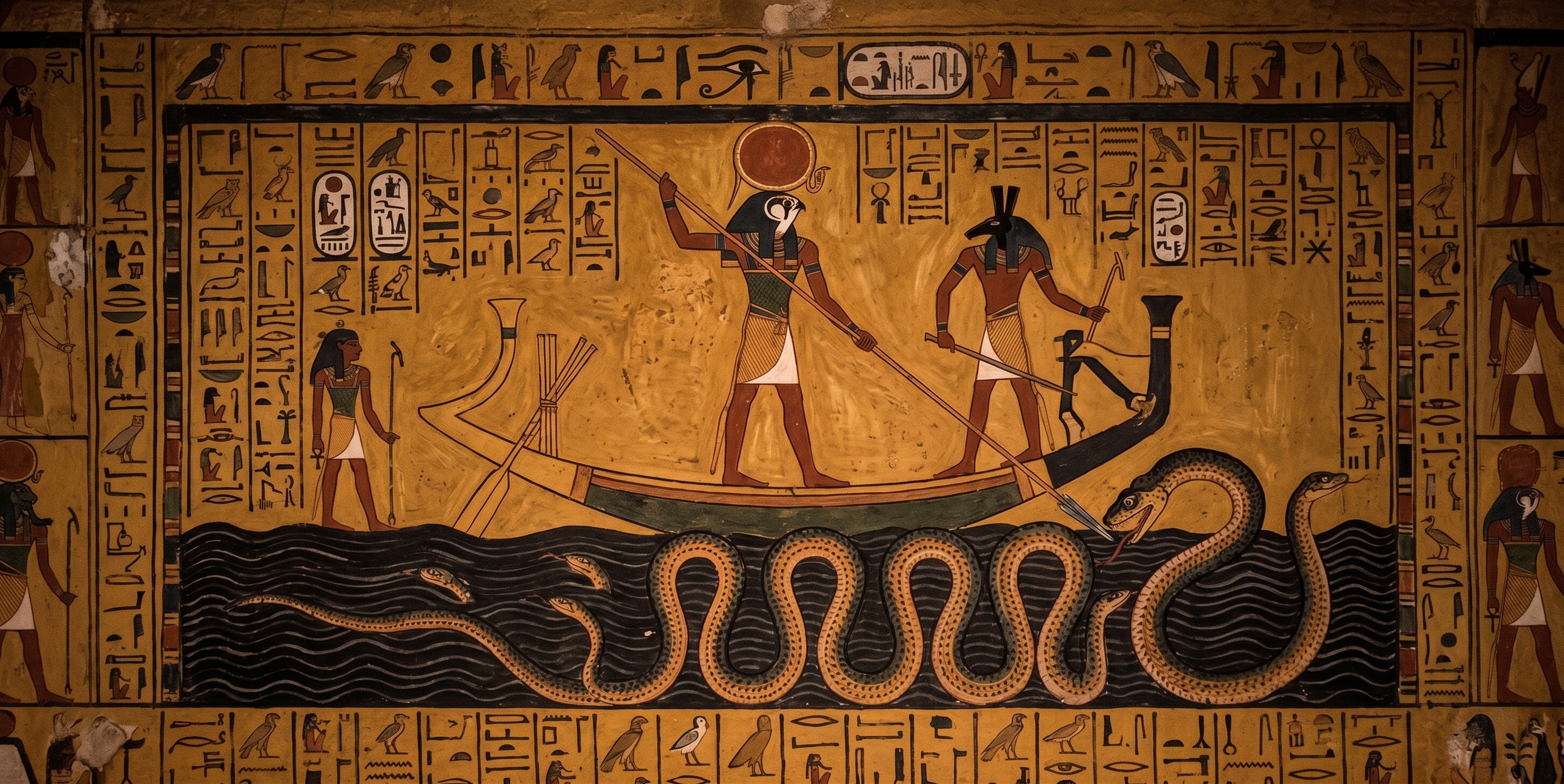
Before the mythic narrative of Horus and Seth can be told, the Egyptian tradition places the primordial chaos-serpent Apophis (ꜥꜣpp, Apep) outside and beneath the cosmogonic order. Apophis is not born within the Heliopolitan genealogy. He exists from the beginning, in the primeval waters of Nun, as the pure embodiment of Izfet given serpentine form. Unlike every other figure in Egyptian religion, Apophis has no temples, no cult, no priests dedicated to his worship. He is not a god to be placated but a principle to be defeated.
Herman te Velde, Seth, God of Confusion: A Study of His Role in Egyptian Mythology and Religion:
"Apep, cast as the living embodiment of isfet (cosmic disorder), is not a local monster but a principle given serpentine form: boundless, cyclical, and ever-returning. He resists syncretic assimilation; he symbolizes anti-creation, the shadow that order must eternally confront."3
The parallel with the Greek Typhoeus is exact. Typhoeus is the hundred-headed serpent-monster born of Gaia from her union with Tartaros, the concentration of all primordial chaos into a single figure. Apophis is the serpent-monster of the primeval waters, the concentration of all Izfet into a single figure. Both are defeated by the sovereign thunder-god, Zeus in the Greek case, Ra and his ally Seth (in his cosmic defender mode) in the Egyptian case. Both defeats are cosmic events, not historical ones, and both must be ritually renewed, because chaos is not annihilated but bound.
The Egyptian tradition is even more explicit than the Greek on this point. Apophis is immortal, not because he is strong, but because he is a cosmic principle. Chaos does not end; it is managed. Every night Ra destroys him; every dawn the world is restored; every sunset the serpent returns. The Egyptian priests performed the ritual of the Book of Overthrowing Apep daily, because the cosmic victory is not a past event but a continuing operation that requires continuous ritual labor to sustain.
Part Two: The Generational Succession and the Murder of Osiris
The First Royal Pair: Osiris and Isis
The four children of Geb and Nut are the critical generation. Osiris becomes the first king of Egypt, ruling alongside his sister-wife Isis. His reign is presented as the original civilized order. He teaches humanity agriculture, law, ritual, and the rites of the Gods. He is the mythic equivalent of the Greek Golden Age under Kronos before Kronos corrupted into devouring, or rather of the ideal rule that Zeus himself would later establish on Olympus.
But Osiris has a brother. Seth, younger son of Geb and Nut, embodies the chaotic potency of the desert wastelands, the storm, the hostile foreigner, the disorder that always threatens the Two Lands of Egypt from outside. Seth murders Osiris. The versions of the murder vary across the sources: in Plutarch's De Iside et Osiride, composed in the late first century CE and preserving the Hellenistic form of the myth, Seth traps Osiris in a chest at a banquet and throws the chest into the Nile. In other Egyptian sources Seth dismembers Osiris into fourteen pieces and scatters them across Egypt.
Richard H. Wilkinson, The Complete Gods and Goddesses of Ancient Egypt:
"Osiris, the first king of civilized Egypt, was murdered by his brother Seth. This murder is the mythic event that introduces Izfet into the world of ordered Egyptian kingship. Everything that follows in Egyptian cosmology and royal theology is the response to this primordial rupture: the search for the scattered body, the magical resurrection of Osiris by Isis, the conception and birth of Horus, and the eventual contendings by which Horus avenges his father and restores the throne to the line of Ma'at."4
The murder of Osiris is the Egyptian parallel to the castration of Ouranos by Kronos and the devouring of the Olympian children by Kronos. It is the primordial rupture within the divine genealogy, the moment when the cosmic order suffers its first internal wound. In both traditions, the rupture sets up the necessity of the younger generation's rebellion: Zeus must overthrow Kronos, Horus must avenge Osiris. Both are sons of the wronged or slain father-king. Both are anointed as the legitimate heirs by the cosmic order itself. Both must fight for their inheritance against an older, chaotic rival.
The Conception and Birth of Horus
Isis, the widow of Osiris, gathers the scattered pieces of her husband's body and through her magical potency conceives a son from the reassembled corpse. This son is Horus (Ḥrw), the falcon-child, raised in secret in the papyrus marshes of the Delta to protect him from Seth. The parallel to the Greek tradition is exact: as Rhea hid the infant Zeus in the cave on Crete to protect him from Kronos, so Isis hides the infant Horus in the marshes to protect him from Seth. Both infant gods are hidden because both will grow into the avengers and the sovereigns.
The young Horus grows in hiding until he is strong enough to challenge Seth for the throne of Egypt. This is the moment at which the Contendings of Horus and Seth begins, and with it the Egyptian equivalent of the Titanomachy proper opens.
Part Three: The Contendings of Horus and Seth
The Chester Beatty Papyrus
The single most important narrative source for the Egyptian cosmic war is the Papyrus Chester Beatty I, a New Kingdom manuscript from the reign of Ramesses V (1149-1145 BCE), now held in the Chester Beatty Library in Dublin. The papyrus was published by Alan H. Gardiner in the Oxford edition of 1931. Its first sixteen pages contain the most developed narrative of the legal and martial contest between Horus and Seth for the throne of Egypt after the death of Osiris.
Alan H. Gardiner:
"The Papyrus Chester Beatty I, dated to the Twentieth Dynasty during the reign of Ramesses V (1149-1145 BCE), preserves the most complete extant Egyptian mythological narrative of the contest between Horus and Seth. The eighty-year legal battle, the four successive courts, and the tribunal of the Ennead provide the mythic charter for Egyptian kingship: every legitimate pharaoh is a Horus, the victor against Seth and Izfet, the restorer of Ma'at."5
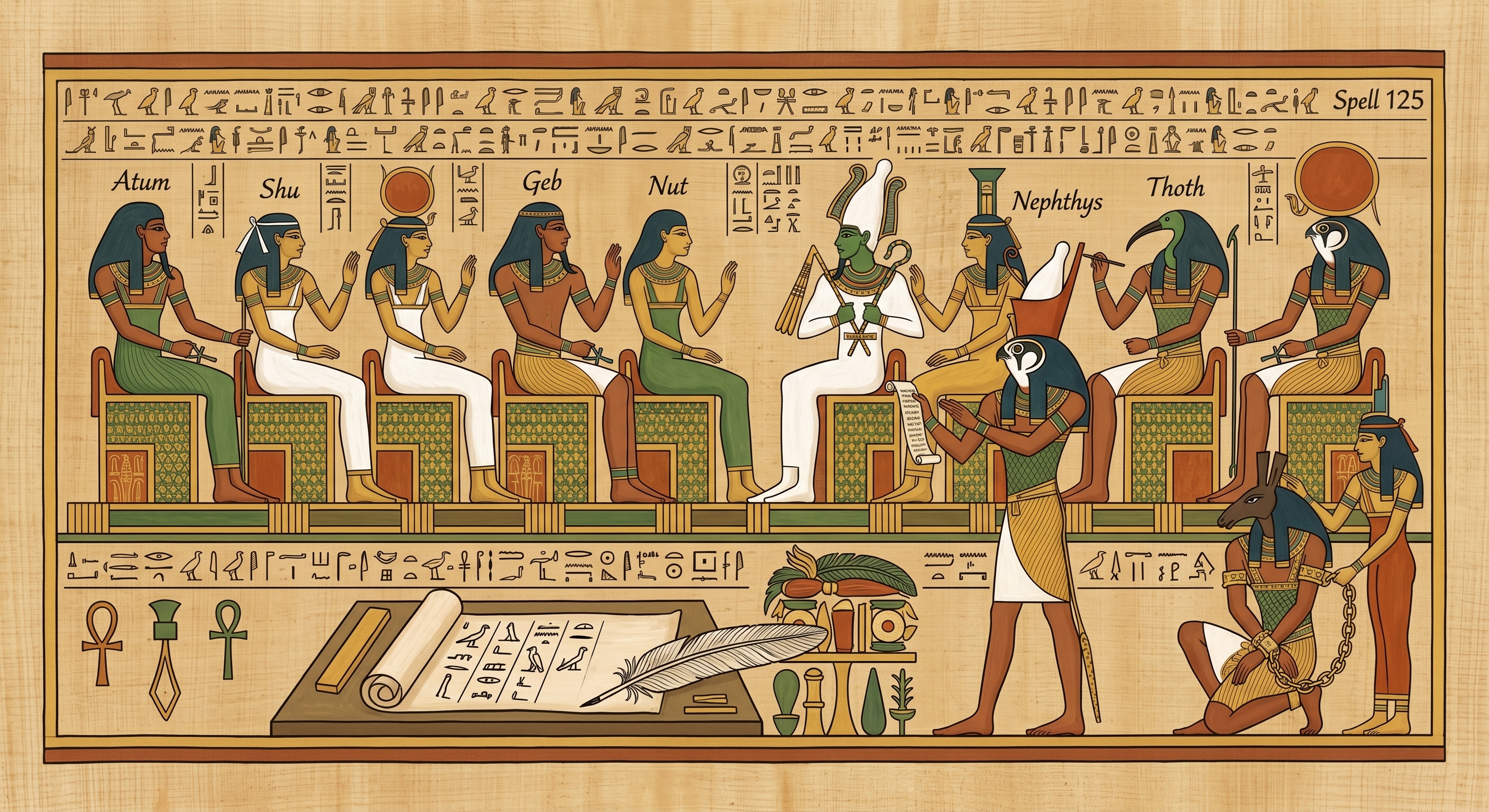
The narrative is structured as a legal process lasting eighty years, interspersed with violent combats between the two rivals. Horus and Seth contend before the Ennead: the nine great gods of Heliopolis (Atum, Shu, Tefnut, Geb, Nut, Osiris, Isis, Seth, Nephthys, with Horus as the contested tenth claimant). They argue their cases; they undergo ordeals; they transform into combatants and duel; they submit to further hearings. The proceedings pass through four named courts: the Path of Righteousness, the Horus Who is Before the Horns, the Field of Rushes, and the Pool of the Fields.
At every stage, the Ennead rules in favor of Horus. Seth repeatedly refuses to accept the verdict and insists on further trials. This structural feature is theologically significant. The Egyptian cosmic combat is not a single battle but a protracted contestation. Just as the Greek Titanomachy lasted ten years, the Contendings of Horus and Seth lasts eighty. In both cases, the duration is not literal but symbolic. The victory of cosmic order is never instantaneous; it is won through patient labor, legal argument, strategic alliance, and sustained martial effort.
Horus as the Destroyer of Izfet
The central theological content of the Contendings is stated directly in the Egyptian tradition: Horus is the one who destroys Izfet and restores Ma'at. This is no poetic flourish but the core doctrine of Egyptian kingship.
"With the rebellion of Seth against Osiris, izfet (the opposite of Ma'at), translated as unrighteousness and untruthfulness, enters the world. Horus is He Who destroys izfet and He Who restores Ma'at, cyclically. This is the basis and the foundation of the Egyptian Kingship: every rightful and righteous King of the Two Lands is a manifestation of the son of Osiris on Earth, He Who upholds Righteousness and Truth, Horus."6
This is the Egyptian form of the Zevist thesis. The cosmic war does not end with a single victory. The rebellion of Seth introduces Izfet into the world; Horus defeats Seth cyclically, that is, in every legitimate exercise of kingship, in every just legal judgment, in every ritual that honors the Gods in their proper articulation. Every righteous pharaoh is a Horus. Every just official is a Horus. Every Zevist who imposes order upon chaos in his interior is a Horus.
The Greek Zeus and the Egyptian Horus perform the same cosmic function. Both are sons of heaven. Both are young gods who overthrow a chaotic predecessor. Both are thunder-wielding sovereigns (Horus in his aspect as Harendotes and as the royal pharaoh holds the was-scepter and the lightning, symbols of cosmic dominion). Both establish the articulated order of the cosmos under their kingship. Both are the mythic prototype of legitimate rule. When the Greeks saw Horus in Egyptian temples, they recognized him immediately and identified him with Apollo and sometimes with Zeus-Helios. The recognition was not arbitrary.
The Final Verdict and the Reconciliation
After the extended contendings, the Ennead consults the deceased Osiris in the Duat, the Egyptian underworld. Osiris, as the rightful first king and father of Horus, delivers the final verdict: the throne belongs to his son. Seth, bound in manacles by Isis, is brought before the court; the verdict is confirmed; the White Crown of Upper Egypt is placed upon Horus's head; and he is installed as the rightful king.
"Thereupon Isis let out a loud shriek on behalf of her son Horus, saying: You are the good king! You are the good lord, l.p.h., of every land unto all eternity! Horus stood as King over the land. And so became united this country named with its Great Name, Ta-Tjenen-Who-is-to-the-south-of-His-Wall, the Lord of Eternity. The two Great in Magic (the Two Crowns) grew out of His head."7
The Memphite Theology, preserved on the Shabaka Stone (now in the British Museum, EA 498), provides a complementary account of the resolution. Horus and Seth are reconciled at the Temple of Ptah in Memphis, called the "Balance of the Two Lands," where Upper and Lower Egypt are unified under the kingship of Horus. Seth is not annihilated; he is bound and made to serve. In some later theological developments, Seth is positioned as the defender of Ra against Apophis, his chaotic potency turned toward the cosmic order rather than against it.
The parallel to the Greek resolution is precise. Zeus does not annihilate the Titans; he binds them in Tartaros. Some Titanesses (Themis, Mnemosyne, Phoibe) are reconciled to the Olympian order and become wives or ancestors of Olympian gods. Prometheus, a Titan, contributes the fire of civilization to humanity. In both traditions, the victory of the cosmic order does not destroy the primordial powers; it subdues them, binds them, and where possible reintegrates them in service of the established order. The defeated Seth bound before Horus is the Egyptian equivalent of the defeated Kronos bound in Tartaros. The reconciled Seth defending the solar barque is the Egyptian equivalent of the reconciled Themis becoming Zeus's wife.
Part Four: The Daily War Against Apophis
Ra's Solar Barque and the Nightly Combat
The Horus-Seth narrative provides the Egyptian parallel to the Titanomachy proper, the generational cosmic war between divine order and primordial rebellion. But just as the Greek tradition continues the cosmic combat through the climactic battle against Typhoeus, the Egyptian tradition continues it through the daily battle between Ra and Apophis.
Ra is the sun-god of Heliopolis, identified in the New Kingdom with Amun of Thebes as Amun-Ra. Each day, Ra traverses the sky in his solar barque from dawn to dusk. Each night, the barque descends into the Duat, the underworld, where Ra must journey through twelve hours of darkness before emerging again at dawn. This nightly journey is not peaceful. The serpent Apophis lies in wait in the underworld waters and attacks the barque with the intent of swallowing the sun and ending creation. Every night, Apophis is defeated. Every dawn, the victory is won. Every sunset, the serpent returns to renew his assault.
"Tales of Apophis' battles against Ra were elaborated during the New Kingdom. Storytellers said that every day Apophis must lie below the horizon and not persist in the mortal kingdom. Some descriptions said that he stretched sixteen yards in length and had a head made of flint. Apophis was commonly believed to have existed from the beginning of time in the waters of Nun of primeval chaos."8
The parallel to the Greek Typhoeus is structural. Typhoeus is the final cosmic adversary of Zeus, born of Gaia from Tartaros, hundred-headed, monstrous, with voices that emit every kind of noise but no coherent language. Apophis is the final cosmic adversary of Ra, born from the primeval waters of Nun (or, in some traditions, from Neith's saliva, or from Ra's own umbilical cord), gigantic, serpentine, with a head of flint, described in the tomb of Ramesses VI (KV9) as having twelve heads.
Both are defeated by the sovereign thunder-god. Zeus hurls his thunderbolts at Typhoeus until the monster collapses into Tartaros. Ra, assisted by Seth standing at the prow of the barque with his spear, pierces Apophis through each night. Both defeats are never final; both enemies return in some form, whether as volcanic fire beneath Etna (Typhoeus) or as the nightly serpent who must be defeated again at every sunset (Apophis). The cosmic combat is the continuing labor of divine sovereignty, not a past victory to be celebrated but a present operation to be sustained.
The Book of Overthrowing Apep
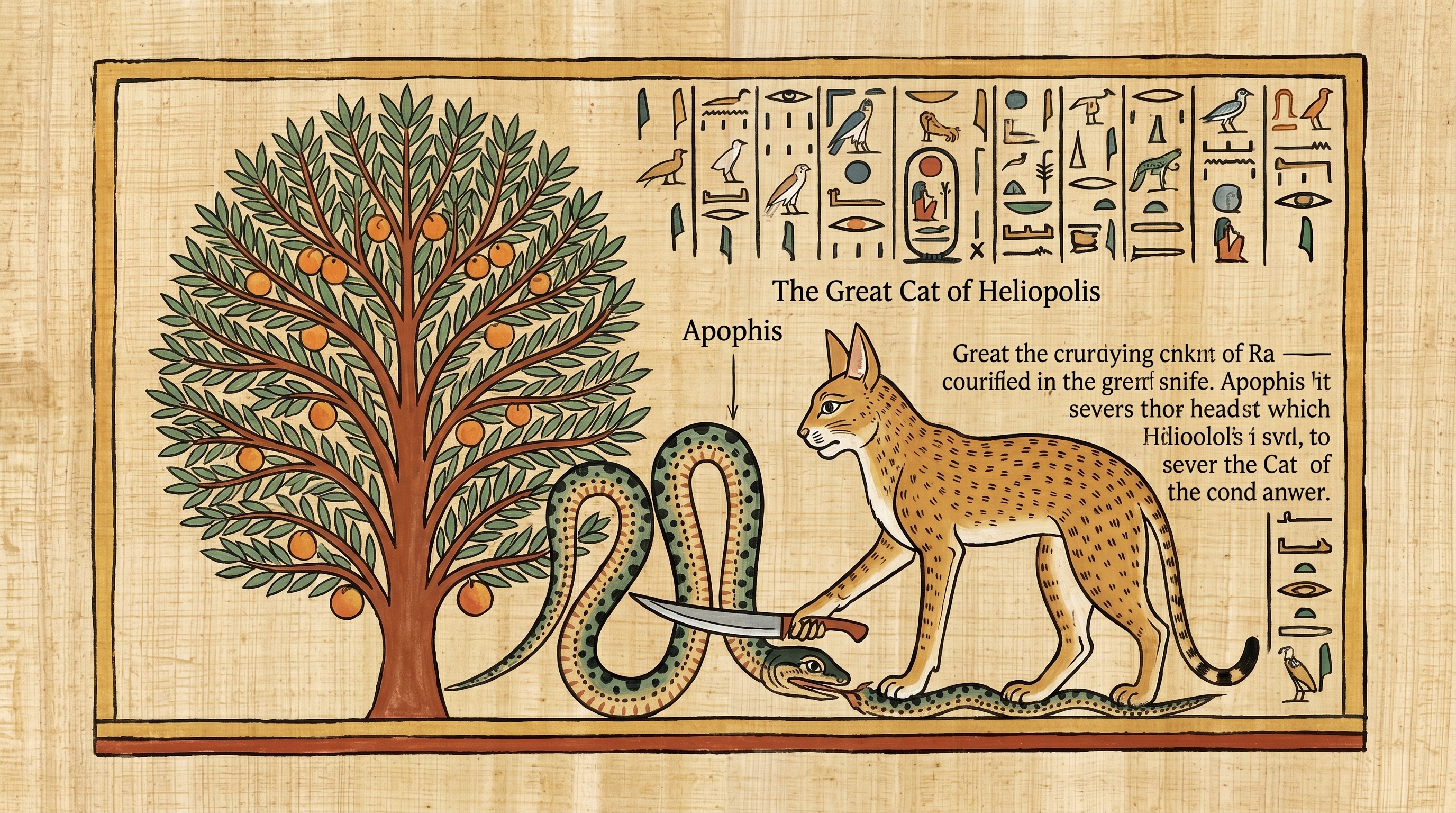
The Egyptian priests did not merely narrate this cosmic combat. They ritually participated in it. The Book of Overthrowing Apep, preserved most fully on the Bremner-Rhind Papyrus (now in the British Museum, EA 10188), contains the liturgy by which every Egyptian temple contributed to the nightly victory. The ritual involved the creation of wax or clay effigies of Apophis. These effigies were inscribed with the serpent's names, spat upon, trampled, stabbed with ritual knives, dismembered, and finally consigned to fire. Each act of destruction reinforced the cosmic defeat in ritual time.
"The most terrifying deities in the Egyptian pantheon were evoked to combat the chaos serpent and destroy all the aspects of his being, such as his body, his name, his shadow, and his magic. Priests acted out this unending war by drawing pictures or making models of Apophis. These were cursed and then destroyed by stabbing, trampling, and burning."9
This is the operative difference between ancient theology and modern secular thought. For the ancient Egyptian, the cosmic battle went beyond any story told in temples for edification and functioned as a real combat in which the rising of the sun each morning depended on ritual participation. Humanity was not a passive recipient of divine gifts but an active participant in the ongoing maintenance of Ma'at. The modern reader trained in secular cosmology finds this view superstitious. The ancient Egyptian would find the modern view baffling: if the cosmic order is real, and if the pressure of Izfet is real, how can humanity not participate in its defense?
The Zevist recognizes the Egyptian understanding as correct. The ritual transcends any psychological exercise and functions as cosmic work. The nightly defeat of Apophis is the nightly defeat of Izfet. The meditation, the vibration of divine names, the execration of hostile forces, the offering of proper ritual to the Gods, are all forms of the same labor the Egyptian priests performed in their temples for three thousand years. The practice is the continuing Titanomachy.
Joshua J. Mark, "Apophis," World History Encyclopedia:
"The rituals surrounding the overthrow of Apophis represented the eternal struggle between good and evil, order and chaos, light and darkness, and relied upon the daily attention and efforts of human beings to succeed. Humanity was not just a passive recipient of the gifts of the Gods but a vital component in the operation of the universe. This understanding was maintained, and these rituals observed, until the rise of Christianity in the fourth century CE. At this time, the old model of humanity as co-workers with the Gods was replaced by a new one in which human beings were fallen creatures, unworthy of their deity, and utterly dependent upon their god's son and his sacrifice for their salvation."10
This passage names what Zevism names. The replacement of the ancient cooperative theology with the Abrahamic fallen-sinner theology constituted no progression in understanding but a degradation. The ancient world knew that humanity was an active participant in the cosmic order; the Abrahamic tradition replaced that with a doctrine of passive supplication. Zevism restores the active cooperative theology. The Titanomachy is won by humans fighting alongside the Gods. The Egyptian priests knew this for three millennia. We relearn what they already knew.
Part Five: Horus as the Egyptian Zeus
The Direct Parallels Between the Two Sovereigns
We have developed the narrative framework and the cosmological framework of the Egyptian tradition. We must now develop the central thesis of this entire three-part study: Horus is the Egyptian Zeus. Horus is the thunder-wielding sovereign, the son of heaven, the avenger of the wronged father-king, the destroyer of chaos, the guarantor of cosmic order. The parallels go beyond impressionism and achieve precision.
First, both are sons of a divine father who has suffered violence. Zeus is the youngest son of Kronos, who has devoured his other children. Horus is the posthumous son of Osiris, who has been murdered by Seth. Both infant gods are hidden to protect them from the predatory older rival. Both grow in secret until strong enough to challenge for the throne.
Second, both are raised in preparation for a cosmic mission. Zeus is raised in the cave on Crete by the nymphs and the Kouretes, who beat their shields to drown the cries of the divine infant from Kronos's hearing. Horus is raised in the papyrus marshes of Chemmis by Isis, who hides him from Seth and nurses him through dangers including scorpion stings and crocodile attacks.
Third, both are armed with the thunder-weapon. Zeus receives the thunderbolt forged by the Cyclopes Brontes, Steropes, and Arges. Horus, in his royal aspect as the legitimate pharaoh, wields the was-scepter and is frequently depicted bearing the harpoon with which he spears Seth in his hippopotamus form, or the spear with which he defeats the serpent. In the funerary texts, Horus is the one who wields the "thunder of Geb," the cosmic weapon of divine authority.
Fourth, both face a climactic combat against a serpentine or serpent-featured adversary. Zeus fights Typhoeus, the hundred-headed serpent-monster, son of Gaia and Tartaros. Horus fights Seth, and in the solar dimension, Ra (whose kingship Horus inherits) fights Apophis, the gigantic serpent of the primeval waters.
Fifth, both establish cosmic sovereignty after their victory. Zeus is acclaimed king of the Olympians and divides the honors among the gods. Horus is acclaimed king of the Two Lands and sits upon the throne of his father Osiris. Both rulerships are the mythic prototype of every subsequent legitimate king's authority.
Sixth, both are cosmic guarantors of justice and cosmic order. Zeus fathers Dike, Eunomia, and the Moirai with Themis. Horus restores Ma'at where Izfet had entered the world and becomes the prototype of the just judge before whom every subsequent pharaoh is measured.
David Frankfurter, Religion in Roman Egypt: Assimilation and Resistance:
"The identification of Horus with Zeus in the Greco-Roman period was not merely a superficial interpretatio Graeca. Both Gods share the structural position of sovereign son of heaven, thunder-wielding king, avenger of the wronged father, and guarantor of cosmic order. The Greeks who saw Horus in Egyptian temples recognized him as their own Zeus in different local form, and the identification was confirmed in syncretic theologies throughout the Hellenistic period."11
The Horus Names of the Pharaohs
The theological identification of Horus as the cosmic sovereign had concrete political-religious expression. Every legitimate pharaoh from the earliest dynasties bore a Horus name as part of his royal titulary, declaring himself a living manifestation of Horus on the throne of Egypt. The Horus name, written inside a serekh (a stylized palace facade surmounted by the falcon), was the oldest and most essential of the five royal names. The pharaoh was not merely a servant of Horus. He was Horus on earth.
This is the Egyptian equivalent of the Greek tradition in which the just king is a representative of Zeus and his rule is Zeus's rule manifest on earth. Hesiod in the Works and Days (lines 248-273) describes Zeus's watchers who observe the deeds of kings and report to him the judgments mortals render. Homer's kings are Zeus-nurtured (διοτρεφεῖς) and sceptered by Zeus. The Egyptian theology is more explicit: every pharaoh is Horus, not merely a representative. But the underlying theology is identical. Legitimate rule is the manifestation of the sovereign sky-god's cosmic order in the political sphere.
The Daily Ritual and the Cosmic Participation
Every Egyptian temple maintained a daily ritual in which the pharaoh, or his representative priest, enacted the mythic roles of Horus and Ra. The cult image of the god was awakened, clothed, fed, anointed, and purified. The enemies of the god, including Apophis and the forces of Izfet, were ritually defeated. The pharaoh was depicted on temple walls performing these rituals himself, even though in practice the high priest usually acted in his stead. The point was theological: the cosmic order is maintained by the daily ritual labor of the sovereign, whose office is itself the office of Horus.
The Zevist recognizes this structure exactly. The daily meditation, the weekly ritual, the seasonal festival, the annual cycle of observances, are the same cosmic labor performed at the scale of the individual soul and the small community. We do not have temples on the scale of Karnak. We have the soul, the household shrine, the private altar, the disciplined interior life. But the function is the same. Every soul that performs the cosmic ritual is a small Horus maintaining Ma'at against Izfet in its own sphere.
Part Six: The Parallelization with the Greek Titanomachy, Point by Point
We now draw the explicit point-by-point correspondence between the Egyptian and Greek forms of the cosmic war. This is the theological spine of Zevism's comparative reading, and every Zevist should have these correspondences memorized.
The Primordial Undifferentiated Substrate
Greek: Chaos (χάος), the yawning primordial gap from which the first differentiated powers emerge. Egyptian: Nun (nwn), the infinite formless watery abyss from which the first differentiated gods arise. Both are undifferentiated, pre-cosmic, and the source of everything that follows. Both continue to exist alongside the articulated cosmos as its substrate, and both can reabsorb the cosmos if the divine order fails.
The First Emergence and the Generational Succession
Greek: From Chaos arise Gaia, Tartaros, and Eros. Gaia produces Ouranos, and from them come the Titans, and from the Titans the Olympians. Egyptian: From Nun arises Atum. Atum produces Shu and Tefnut; they produce Geb and Nut; they produce Osiris, Isis, Seth, and Nephthys. Both structures are genealogical, showing an increasingly articulated divine succession from undifferentiated origin to the generation that must resolve the final cosmic crisis.
The Primordial Rupture Within the Divine Family
Greek: Kronos castrates his father Ouranos and swallows his own children. Egyptian: Seth murders his brother Osiris and dismembers his body. Both are crimes within the divine family that introduce irreversible disorder and require the intervention of the next generation.
The Hidden Infant-Sovereign
Greek: The infant Zeus is hidden in the cave on Crete to escape Kronos. Egyptian: The infant Horus is hidden in the marshes of Chemmis to escape Seth. Both infants are protected by their mothers and mother-surrogates. Both will return to avenge the wronged father.
The Cosmic War of the Younger Generation
Greek: Zeus and the Olympians fight the Titans for ten years before emerging victorious. Egyptian: Horus and Seth contend for eighty years through four courts and numerous violent battles before Horus emerges victorious. Both are protracted cosmic conflicts, not single battles, marked by legal contestation, alliance-building, and sustained martial effort.
The Climactic Serpent Combat
Greek: Zeus defeats the hundred-headed serpent-monster Typhoeus, born of Gaia from Tartaros. Egyptian: Ra (whose sovereignty Horus inherits) defeats the serpent Apophis, born of the primeval waters of Nun. Both are the final consummating battles of the cosmic war, in which a thunder-wielding sovereign destroys a serpentine concentration of primordial chaos.
The Installation of the Cosmic Sovereign
Greek: Zeus is acclaimed king of the Olympians and divides the honors among the gods. Egyptian: Horus is acclaimed king of the Two Lands and sits upon the throne of his father Osiris. Both inaugurate the articulated cosmic order, and both are the mythic prototype of all subsequent legitimate rule.
The Binding Rather Than Annihilation of the Defeated
Greek: The Titans are bound in Tartaros, not annihilated. Typhoeus is cast beneath Mount Etna, where his presence continues to cause volcanic activity. Egyptian: Seth is bound in manacles by Isis and presented before the tribunal, not annihilated. In later theological developments, Seth is reconciled as the defender of Ra against Apophis. Apophis is defeated each night but returns each sunset. In both traditions, the chaotic forces are subdued but not eliminated; the cosmic order is a continuing labor, not a finished state.
The Cosmic Order as Daughter of Justice
Greek: Zeus's second wife is Themis, and they father Eunomia, Dike, and Eirene (the Horai), along with the Moirai. Egyptian: Ma'at is the daughter of Ra, and she embodies the same cosmic-ethical principle in Egyptian form. Both traditions understand that the cosmic order instituted by the sovereign sky-god expresses itself as justice, proper measure, and right apportionment, and both personify this principle as female divine powers who attend the throne.
The Continuing Ritual Participation
Greek: The cult of Zeus at Olympia, Dodona, and throughout the Hellenic world was a continuing ritual participation in the cosmic order, and the philosophical tradition from the Presocratics onward developed the interior practice of aligning the soul with the divine sovereignty. Egyptian: The daily temple ritual, the execration liturgy against Apophis, and the individual ritual participation of the righteous person in Ma'at were the continuing labor by which the cosmic victory was sustained. In both traditions, the cosmic war is not a past event but a present operation requiring human cooperation.
Walter Burkert:
"The structural correspondences between Egyptian and Greek cosmic mythology are too numerous and too precise to be explained by cultural borrowing alone. While some direct transmission occurred during the Archaic and Classical periods through trade, colonization, and shared Mediterranean religious space, the underlying parallels reflect a shared ancient understanding of the cosmos as an ordered arrangement won and sustained against the permanent pressure of chaos by a sovereign divine power."12
Part Seven: The Internal Application for the Zevist
The Inner Horus, the Inner Seth, the Inner Apophis
As the Titanomachy is reproduced in the interior of the soul (as we developed in Part A of this study), so the Egyptian cosmic war is reproduced in the interior of the soul. Every Zevist carries within themselves an inner Horus, an inner Seth, and an inner Apophis. The work of the spiritual life is to empower the Horus, to bind the Seth, and to defeat the Apophis.
The inner Horus is the sovereign rational principle, the soul's capacity for just judgment, articulated speech, disciplined attention, cosmic participation. It is the crown-chakra consciousness that orients the person toward Zeus and the Gods. It is the faculty that distinguishes Ma'at from Izfet and chooses Ma'at.
The inner Seth is the chaotic potency of raw desire, impulsive aggression, untamed appetite. Seth is not pure evil, even in the Egyptian tradition; he is a powerful force that becomes destructive when unbound and useful when disciplined. The inner Seth is the raw energy of the body, the ambition that can become cruelty, the strength that can become violence, the vitality that can become dissipation. The task is not to annihilate the inner Seth but to bind it, to force it into service of the inner Horus, so that its power becomes the defender of the soul's Ma'at rather than its destroyer.
The inner Apophis is the pure dissolution, the pull toward incoherence, the gravitational drag of the primordial chaos upon the interior cosmos. It has no useful aspect. It is the inner equivalent of the cosmic Izfet. The anxiety that has no object, the depression that has no cause, the scattered attention that cannot focus on anything, the inability to speak coherently to oneself, the loss of meaning that dissolves every interior structure: these are the operations of the inner Apophis. The daily meditation is the daily overthrowing of the serpent, the daily victory of the interior sun against the pull of interior night.
The Meditation as Overthrowing Apep
The Zevist meditation practice, when understood in its cosmological depth, is the interior equivalent of the Book of Overthrowing Apep. The vibration of divine names is the equivalent of the priestly recitation of the power-names of Ra. The chakra activation is the equivalent of the awakening of the cosmic image in the temple. The visualization of divine light overcoming darkness is the equivalent of the ritual enactment of Ra's victory over the serpent. The daily discipline of meditation sustains the interior cosmos against the interior Apophis, just as the daily ritual of the Egyptian priests sustained the exterior cosmos against the exterior Apophis.
The same is true of the moral life. Every act of honest speech is an act of Ma'at against Izfet. Every just judgment is an act of the inner Horus against the inner Seth. Every refusal of dissolution into meaningless consumption, meaningless distraction, meaningless noise is a binding of the inner Apophis. The Zevist does not need to be a philosopher to participate in this cosmic labor. The disciplined interior life is itself the participation.
The Civilization as a Horus or a Seth
At the civilizational scale, the same diagnostic applies. A civilization that maintains Ma'at, that honors the Gods in their articulation, that practices justice, that cultivates truth, that sustains the disciplined pursuit of beauty and knowledge, is a Horus-civilization, a living manifestation of the cosmic sovereignty. A civilization that serves Izfet, that reduces all values to consumption, that dissolves the distinction between truth and falsehood, that worships the undifferentiated flow of market and media, is a Seth-civilization in the destructive mode.
The modern West, under the long shadow of the Abrahamic tradition and its secular heir, has drifted toward the Seth-mode. The Ten Pathologies diagnose this drift with precision. Yehubor is a Sethian operation at civilizational scale: the collapse of the articulated divine plurality into a single devouring god. The dissolution of public truth into propaganda and clickbait is the rise of Apophis into the media-waters. The erosion of honest measure in commerce, politics, and science is the entry of Izfet into the institutions that were meant to guard Ma'at.
The Zevist's task is to hold the Horus-line within themselves and, where possible, to rebuild it in the surrounding culture. We do not expect to restore the full glory of Kemet or of Hellas in a day. We do expect, and we are committed to, the continuing small victories of Ma'at against Izfet in every soul and every community that touches Zevism. The cosmic war is won one soul at a time, one temple at a time, one civilization at a time. The Egyptian priests knew this for three thousand years; we continue their work.
Part Eight: The Unique Egyptian Contribution to Zevist Understanding
Why the Egyptian Vocabulary Is Theologically Essential
The Greek tradition gives Zevism its philosophical sophistication, its developed interior psychology, and its elaborated ethical theory. The Egyptian tradition gives Zevism something complementary and equally essential: the vocabulary of Ma'at and Izfet, the understanding of cosmic order as continuing ritual labor, and the recognition that humanity is an active participant in the defense of the cosmos.
The Greek term dike (δίκη) and the Egyptian term ma'at (mꜣꜥt) overlap in their ethical and political meaning, but Ma'at is broader. Ma'at is cosmic, ethical, ritual, legal, and personal simultaneously. It names the single principle that operates at every scale from the movement of the stars to the honest weight on a merchant's scale. The Greek tradition separates these into distinct concepts (dike for justice, eunomia for civic order, kosmos for cosmic structure, themis for sacred custom). The Egyptian tradition unifies them. The Zevist adopts the Egyptian unification, because it more precisely captures the single cosmic principle that Zevism defends.
Similarly, the Greek term chaos names primordial undifferentiated origin, while the various Titanic names describe particular forms of unreason. The Egyptian term izfet unifies all forms of cosmic disorder under a single name, parallel to the way Ma'at unifies all forms of cosmic order. This unified binary (Ma'at/Izfet) is theologically cleaner than the distributed Greek vocabulary, and Zevism uses it as its primary diagnostic framework.
Why the Egyptian Continuity Matters
Egyptian religion had one of the longest continuous histories of any religious tradition in human record. From the First Dynasty around 3100 BCE to the final suppression of the temples under the Christian emperors in the late fourth and early fifth centuries CE, the cult of the Gods of Kemet was maintained by an unbroken priesthood for over three thousand five hundred years. The Greek tradition, in its classical form, is much shorter: from Hesiod around 700 BCE to the closing of the philosophical schools by Justinian in 529 CE, the classical Hellenic religion flourished for perhaps twelve centuries before its forcible suppression.
This longer Egyptian continuity means that the theology is more deeply developed, more ritually elaborated, and more thoroughly integrated into every dimension of civilized life. The Egyptian priesthood preserved cosmic doctrines for thousands of years in written form (the Pyramid Texts, Coffin Texts, Book of the Dead, Underworld Books), in ritual practice (the daily temple liturgy, the funerary cult, the festival calendar), and in political structure (the pharaonic state itself as a Horus-manifestation).
For Zevism, the Egyptian tradition is therefore a treasure house of preserved cosmic wisdom that the shorter Greek tradition complements but does not replace. Both are essential. The Greek gives the philosophical framework; the Egyptian gives the deeper historical and ritual substance. Together they constitute the two pillars of the Mediterranean branch of the Original Religion.
Erik Hornung, Conceptions of God in Ancient Egypt: The One and the Many:
"Egyptian religion endured for over three thousand years, making it the longest continuous religious tradition in the ancient Mediterranean world. Its central doctrines, including the cosmic order of Ma'at, the kingship theology of Horus, the afterlife judgment of the heart, and the daily cosmic combat against the forces of chaos, remained remarkably stable across this immense timespan, even as particular ritual forms evolved. This stability reflects the depth and coherence of the theological system rather than mere conservatism."13
Part Nine: Zeus-Ammon and the Classical Recognition of Theological Identity
The Herodotean Foundation
The explicit ancient identification of the Greek Zeus with the Egyptian supreme sovereign goes beyond any later syncretic invention and stands stated by Herodotus, the first systematic historian of the Greek world, in the fifth century BCE, as a matter of recognized fact among those who had traveled to Egypt and studied its religion. In Book II of the Histories (written around 430 BCE), Herodotus reports his own investigations among the Egyptian priests at Thebes, Heliopolis, and Memphis, and makes the equivalence explicit at several points.
Herodotus, Histories:
"Διός γὰρ Διόνυσον καλέουσιν Ωμυν, Ứσιριν δὲ Δήμητραν."14
"They call Zeus Amun, and Osiris Dionysos."
The identification is stated not tentatively but as the standard translation that educated Greeks of the fifth century used when speaking of Egyptian religion. Herodotus does not treat it as a speculation; he treats it as an established equivalence that his Greek readers will recognize. The same identification appears in Diodorus Siculus (first century BCE), in Strabo (Geography XVII.1.43, first century CE), in Plutarch (De Iside et Osiride, first-second century CE), and in countless papyrological and epigraphic sources.
The Oracle at Siwa and the Pilgrimage of Alexander
The most famous episode in the ancient Greek reception of Zeus-Ammon is the pilgrimage of Alexander the Great to the Oracle of Zeus-Ammon at the Siwa Oasis in the Libyan desert in 331 BCE. Alexander, having liberated Egypt from Persian rule and been crowned Pharaoh at Memphis, crossed the desert in an arduous journey to consult the oracle of the God whom the Egyptians called Amun and whom the Greeks called Zeus-Ammon. The account is preserved in Arrian's Anabasis III.3-4, in Quintus Curtius Rufus's History of Alexander IV.7, in Plutarch's Alexander 27, and in Diodorus Siculus's Bibliotheca XVII.49-51.
The Siwa priesthood addressed Alexander as "son of Amun" (Egyptian să jmn), which in Greek translation became "son of Zeus" (υἱὸς Διός). Alexander himself accepted the divine filiation thus identified, and from Siwa onward his coinage and royal propaganda presented him as Zeus-Ammon's son, the ram-horned deity appearing behind his profile on the drachmas of Lysimachus and other Hellenistic successors. The theological equivalence was so complete that the Macedonian conqueror, the Egyptian priesthood, and the Greek philosophical tradition all agreed: Zeus of the Greeks and Amun of the Egyptians were the same supreme God, addressed under two linguistic forms.
Garth Fowden:
"The identification of Amun with Zeus was not merely a matter of poetic equivalence but a formal theological recognition, institutionalized in the cult of Zeus-Ammon at Siwa, at Thebes, and in the Greek colonies. Alexander's acceptance of Amun's oracular pronouncement confirmed this equivalence at the highest political level, and from the Hellenistic period onward Zeus-Ammon became one of the most widely venerated deities of the ancient Mediterranean world, uniting the Greek philosophical sovereign with the Egyptian cosmic father."15
The Papyrus Leiden I 350 and the Amun-Zeus-Logos Theology
The theological substance behind the identification is preserved in one of the most remarkable surviving hymns of ancient religion: the Hymn to Amun of Papyrus Leiden I 350, composed during the Nineteenth Dynasty (c. 1300 BCE) and preserved in the Rijksmuseum van Oudheden in Leiden. The hymn develops a proto-philosophical theology of Amun as the hidden supreme God who manifests in all the other Gods, who is "one who makes himself into millions," whose true nature remains beyond all names and images while all names and images are his manifestations.
Hymn to Amun, Papyrus Leiden I 350:
"All gods are three: Amun, Ra, and Ptah, without second. Hidden is his nature as Amun, his face is Ra, his body is Ptah. The three are one, united in their secret identity."16
This is, in Egyptian form, essentially the same theological move that the Neoplatonic philosophers made with Zeus: the identification of the supreme sovereign God with the Logos-principle behind all divine manifestations, with the other Gods as aspects or emanations of the hidden supreme. When the Greek philosophers called Zeus the cosmic Logos and the Egyptian priesthood called Amun "hidden" (the literal meaning of the name jmn, "the hidden one"), they were articulating the same theological insight in two languages: the supreme sovereign is both personally accessible (as Zeus the thunder-wielder, as Amun the kingly father) and metaphysically transcendent (as the Logos, as the hidden One beyond all names).
This convergence is what the Hermetic tradition would later systematize, under the name Hermes Trismegistus (the Egyptian Thoth identified with the Greek Hermes), producing a body of Hellenistic-Egyptian philosophical theology that synthesizes the Greek philosophical vocabulary with the Egyptian ritual substance. The Corpus Hermeticum, the Asclepius, and the related Hermetic writings are the mature fruit of this Egyptian-Greek theological recognition that began with Herodotus's simple formula: "They call Zeus Amun."
Why This Matters for the Zevist
The ancient identification of Zeus with Amun is the single most decisive external confirmation of the Zevist thesis. The Greek philosophers, the Egyptian priests, the Macedonian king, the Hermetic synthesizers, and the Neoplatonic theologians all recognized that Zeus and Amun were two names for the same supreme sovereign God. This was not syncretic speculation imposed by modern comparative mythology; it was ancient recognition, institutionalized in cult, accepted by political rulers, developed philosophically by the greatest thinkers of the period.
When Zevism places Zeus at the center of its theology while drawing on Egyptian cosmological vocabulary (Ma'at, Izfet, the daily Apophis-combat), it continues a theological synthesis that is two and a half thousand years old. Herodotus stated the equivalence in the fifth century BCE. The Siwa cult institutionalized it in the sixth and fifth centuries BCE. Alexander sealed it at the political level in 331 BCE. The Neoplatonists systematized it in the third through sixth centuries CE. The Zevist restoration in the present recovers the synthesis that Christian suppression had interrupted. The recovery is historically grounded and theologically coherent: one supreme sovereign, two inherited sacred names, one cosmic victory against Izfet, articulated in two complementary liturgical vocabularies.
Conclusion: The Horus Line Continues
We began this second part of the study by stating that the Egyptian cosmic war is structurally identical to the Greek Titanomachy. We have now developed that claim in full. Horus is the Egyptian Zeus: the sovereign son of heaven, the avenger of the wronged father-king, the destroyer of chaos, the guarantor of Ma'at, the thunder-wielding king under whom the articulated cosmos stands. Seth is the Egyptian Titan, bound but not annihilated. Apophis is the Egyptian Typhoeus, defeated each night but returning each sunset, a cosmic principle of pure Izfet that must be ritually overcome in every generation.
The parallels are no accidents, no borrowings in the simple sense; they stand as the convergent testimony of two great ancient civilizations to the same structure of reality. The Gods have given humanity the truth about the cosmos in multiple sacred languages, and the serious student of theology learns to hear them all and recognize their unity.
Every Zevist who understands Horus understands something that the Greek tradition alone cannot teach. The active cooperative theology, the unified vocabulary of Ma'at and Izfet, the ritual participation in the daily cosmic combat, the recognition of legitimate kingship as Horus-manifestation, are all specifically Egyptian contributions to the Zevist synthesis. They complement the Greek philosophical sophistication without replacing it. They deepen the psychological framework with a liturgical dimension that the Greek tradition, for all its glory, never developed to the same degree.
When the Zevist invokes Horus, he invokes Zeus in Egyptian form. When he executrates Apophis, he executrates Typhoeus in Egyptian form. When he maintains Ma'at, he maintains Dike, Eunomia, and Themis simultaneously. The sacred vocabulary is multiple; the sacred reality is one.
"Horus is He Who destroys izfet and He Who restores Ma'at, cyclically. This is the basis and the foundation of the Egyptian Kingship: every rightful and righteous King of the Two Lands is a manifestation of the son of Osiris on Earth, He Who upholds Righteousness and Truth."17
The next and final part of this study will develop the Indic form of the same cosmic war: the combat of Indra with the serpent-dragon Vṛtra, and the continuing war of the Devas against the Asuras, told in the sacred Sanskrit of the Rigveda, the Mahabharata, and the Puranas. The Proto-Indo-European continuity between Zeus and Indra, already embedded in the deepest linguistic substrate of both traditions, will confirm what the Greek and Egyptian testimony has already established: the sovereign thunder-wielding sky-father is the universal ancient witness to the structure of reality, and his victory over the serpent of chaos is the foundation of every articulated cosmos worth inhabiting.
Continue to:
References:
1 Jan Assmann, Ma'at: Gerechtigkeit und Unsterblichkeit im alten Ägypten, C.H. Beck, 1990, pp. 17-45; cf. idem, The Mind of Egypt: History and Meaning in the Time of the Pharaohs, Metropolitan Books, 2002, pp. 127-134
2 Erik Hornung, Conceptions of God in Ancient Egypt: The One and the Many, Cornell University Press, 1982, pp. 172-196; cf. James P. Allen, Genesis in Egypt: The Philosophy of Ancient Egyptian Creation Accounts, Yale Egyptological Studies 2, 1988
3 Herman te Velde, Seth, God of Confusion: A Study of His Role in Egyptian Mythology and Religion, Brill, 1977, pp. 99-108; cf. Geraldine Pinch, Handbook of Egyptian Mythology, ABC-CLIO, 2002, pp. 106-109
4 Richard H. Wilkinson, The Complete Gods and Goddesses of Ancient Egypt, Thames and Hudson, 2003, pp. 118-122, 197-203; cf. Jan Assmann, Death and Salvation in Ancient Egypt, Cornell University Press, 2005, pp. 23-50
5 Alan H. Gardiner, The Library of A. Chester Beatty: Description of a Hieratic Papyrus with a Mythological Story, Love Songs, and Other Miscellaneous Texts, Oxford University Press, 1931; cf. Robert A. Oden Jr., "The Contendings of Horus and Seth (Chester Beatty Papyrus No. 1): A Structural Interpretation," History of Religions 18 (1979), pp. 352-369
6 Theological core statement distilled from the Chester Beatty Papyrus I and the Memphite Theology; cf. te Velde, Seth, God of Confusion, pp. 59-80; Oden, "The Contendings of Horus and Seth," pp. 352-369
7 Papyrus Chester Beatty I, concluding passage, trans. Edward F. Wente, in William Kelly Simpson, ed., The Literature of Ancient Egypt: An Anthology of Stories, Instructions, Stelae, Autobiographies, and Poetry, 3rd ed., Yale University Press, 2003, pp. 91-103
8 Summary of the Apophis tradition from the Coffin Texts, the Book of the Dead, and the Underworld Books (Amduat, Book of Gates, Book of Caverns); cf. Erik Hornung, The Ancient Egyptian Books of the Afterlife, Cornell University Press, 1999; Geraldine Pinch, Handbook of Egyptian Mythology, pp. 106-109
9 Geraldine Pinch, cited in the standard Egyptological literature on the Bremner-Rhind Papyrus; cf. R.O. Faulkner, "The Bremner-Rhind Papyrus III: The Book of Overthrowing Apep," Journal of Egyptian Archaeology 22 (1936), pp. 166-185, and 23 (1937), pp. 10-16, 166-185
10 Joshua J. Mark, "Apophis," World History Encyclopedia, 2017, summarizing the Egyptological consensus; cf. Assmann, Death and Salvation in Ancient Egypt, pp. 1-22
11 David Frankfurter, Religion in Roman Egypt: Assimilation and Resistance, Princeton University Press, 1998, pp. 97-144; cf. Françoise Dunand and Christiane Zivie-Coche, Gods and Men in Egypt: 3000 BCE to 395 CE, Cornell University Press, 2004
12 Walter Burkert, The Orientalizing Revolution: Near Eastern Influence on Greek Culture in the Early Archaic Age, Harvard University Press, 1992, pp. 88-127; M.L. West, The East Face of Helicon: West Asiatic Elements in Greek Poetry and Myth, Oxford University Press, 1997, pp. 276-305
13 Erik Hornung, Conceptions of God in Ancient Egypt: The One and the Many, Cornell University Press, 1982, pp. 237-262; cf. John Baines and Jaromír Málek, Cultural Atlas of Ancient Egypt, rev. ed., Facts on File, 2000, pp. 212-224
14 Herodotus, Histories II.42 and II.144; ed. C. Hude, Oxford Classical Texts, 3rd ed., 1927; trans. A.D. Godley, Loeb Classical Library, 1920
15 Garth Fowden, The Egyptian Hermes: A Historical Approach to the Late Pagan Mind, Cambridge University Press, 1986, pp. 13-44; cf. A.B. Lloyd, Herodotus, Book II: Commentary, Brill, 1988-2007; cf. Peter Green, Alexander of Macedon, 356-323 B.C.: A Historical Biography, University of California Press, 1991, pp. 272-286
16 Hymn to Amun, Papyrus Leiden I 350, Chapter 300; translation and commentary in Jan Assmann, Egyptian Solar Religion in the New Kingdom: Re, Amun and the Crisis of Polytheism, Kegan Paul International, 1995, pp. 133-189; cf. Jan Zandee, Der Amunhymnus des Papyrus Leiden I 350, Rijksmuseum van Oudheden, 1948
17 Core doctrine of the Chester Beatty Papyrus I and the Memphite Theology; cf. Assmann, Ma'at, and te Velde, Seth, God of Confusion
Sources
- Gardiner, Alan H., The Library of A. Chester Beatty: Description of a Hieratic Papyrus with a Mythological Story, Love Songs, and Other Miscellaneous Texts, Oxford University Press, 1931 (editio princeps of Papyrus Chester Beatty I)
- Wente, Edward F., trans. "The Contendings of Horus and Seth," in William Kelly Simpson, ed., The Literature of Ancient Egypt: An Anthology of Stories, Instructions, Stelae, Autobiographies, and Poetry, 3rd ed., Yale University Press, 2003, pp. 91-103
- Lichtheim, Miriam, Ancient Egyptian Literature: A Book of Readings, 3 vols., University of California Press, 1973-1980
- Faulkner, R.O., trans., The Ancient Egyptian Pyramid Texts, Clarendon Press, 1969
- Faulkner, R.O., trans., The Ancient Egyptian Coffin Texts, 3 vols., Aris and Phillips, 1973-1978
- Faulkner, R.O., trans., The Ancient Egyptian Book of the Dead, British Museum Press, 1985
- Faulkner, R.O., "The Bremner-Rhind Papyrus III: The Book of Overthrowing Apep," Journal of Egyptian Archaeology 22 (1936), pp. 166-185, and 23 (1937), pp. 10-16, 166-185
- Allen, James P., trans., The Ancient Egyptian Pyramid Texts, Society of Biblical Literature, 2005
- Allen, James P., Genesis in Egypt: The Philosophy of Ancient Egyptian Creation Accounts, Yale Egyptological Studies 2, 1988
- Allen, James P., Middle Egyptian: An Introduction to the Language and Culture of Hieroglyphs, 3rd ed., Cambridge University Press, 2014
- Assmann, Jan, Ma'at: Gerechtigkeit und Unsterblichkeit im alten Ägypten, C.H. Beck, 1990
- Assmann, Jan, The Mind of Egypt: History and Meaning in the Time of the Pharaohs, Metropolitan Books, 2002
- Assmann, Jan, Death and Salvation in Ancient Egypt, Cornell University Press, 2005
- Assmann, Jan, Of God and Gods: Egypt, Israel, and the Rise of Monotheism, University of Wisconsin Press, 2008
- Hornung, Erik, Conceptions of God in Ancient Egypt: The One and the Many, Cornell University Press, 1982
- Hornung, Erik, The Ancient Egyptian Books of the Afterlife, Cornell University Press, 1999
- te Velde, Herman, Seth, God of Confusion: A Study of His Role in Egyptian Mythology and Religion, Brill, 1977
- Wilkinson, Richard H., The Complete Gods and Goddesses of Ancient Egypt, Thames and Hudson, 2003
- Wilkinson, Richard H., The Complete Temples of Ancient Egypt, Thames and Hudson, 2000
- Pinch, Geraldine, Handbook of Egyptian Mythology, ABC-CLIO, 2002
- Pinch, Geraldine, Magic in Ancient Egypt, British Museum Press, 2006
- Plutarch, De Iside et Osiride, ed. and trans. J. Gwyn Griffiths, University of Wales Press, 1970
- Griffiths, J. Gwyn, The Conflict of Horus and Seth from Egyptian and Classical Sources, Liverpool University Press, 1960
- Oden, Robert A. Jr., "The Contendings of Horus and Seth (Chester Beatty Papyrus No. 1): A Structural Interpretation," History of Religions 18 (1979), pp. 352-369
- Frankfurter, David, Religion in Roman Egypt: Assimilation and Resistance, Princeton University Press, 1998
- Dunand, Françoise and Zivie-Coche, Christiane, Gods and Men in Egypt: 3000 BCE to 395 CE, trans. David Lorton, Cornell University Press, 2004
- Baines, John and Málek, Jaromír, Cultural Atlas of Ancient Egypt, rev. ed., Facts on File, 2000
- Quirke, Stephen, Ancient Egyptian Religion, British Museum Press, 1992
- Shaw, Ian, ed., The Oxford History of Ancient Egypt, Oxford University Press, 2000
- Redford, Donald B., ed., The Oxford Encyclopedia of Ancient Egypt, 3 vols., Oxford University Press, 2001
- Burkert, Walter, The Orientalizing Revolution: Near Eastern Influence on Greek Culture in the Early Archaic Age, Harvard University Press, 1992
- West, M.L., The East Face of Helicon: West Asiatic Elements in Greek Poetry and Myth, Oxford University Press, 1997
- López-Ruiz, Carolina, When the Gods Were Born: Greek Cosmogonies and the Near East, Harvard University Press, 2010
- Mark, Joshua J., "Apophis," World History Encyclopedia, 2017
- Erman, Adolf, Die Literatur der Ägypter, J.C. Hinrichs, 1923; English trans. Aylward M. Blackman, The Ancient Egyptians: A Sourcebook of Their Writings, Harper and Row, 1966
- Hart, George, The Routledge Dictionary of Egyptian Gods and Goddesses, 2nd ed., Routledge, 2005
- Naydler, Jeremy, Temple of the Cosmos: The Ancient Egyptian Experience of the Sacred, Inner Traditions, 1996
- Morenz, Siegfried, Egyptian Religion, trans. Ann E. Keep, Methuen, 1973
- Frankfort, Henri, Kingship and the Gods: A Study of Ancient Near Eastern Religion as the Integration of Society and Nature, University of Chicago Press, 1948
- Frankfort, Henri, et al., The Intellectual Adventure of Ancient Man, University of Chicago Press, 1946
- Pyramid Texts, Utterances 254, 273-274, 302, 427, 534 (combat with Apophis and ascent of Horus)
- Coffin Texts, Spells 148, 160, 312 (Horus and the cosmic ordering)
- Book of the Dead, Spells 7, 17, 39, 108 (Apophis and the solar combat)
- Shabaka Stone (British Museum EA 498), the Memphite Theology
- Bremner-Rhind Papyrus (British Museum EA 10188), the Book of Overthrowing Apep