
 አማርኛ
አማርኛ العربية
 বাংলা
বাংলা Български
 中文
中文 Čeština
 Dansk
Dansk Deutsch
 Eesti
Eesti Ελληνικά
 Español
 Français
 हिन्दी
 Hrvatski
 IsiZulu
 Italiano
 日本語
日本語 Kiswahili
 Magyar
 Македонски
 नेपाली
 Nederlands
 فارسی
فارسی Polski
 Português
 Română
 Русский
 Slovenščina
 Suomi
Suomi Svenska
 Tagalog
 Türkçe
| Cosmic Function | Greek | Vedic | Common PIE Source |
|---|---|---|---|
| Sky-Father (name) | Zeus Pater | Dyauṣ Pitṛ | *Dyēus Ph₂tēr (directly cognate) |
| Sovereign Thunder-God (function) | Zeus | Indra | Thunder-sovereign complex |
| Articulated divine weapon | Keraunos (thunderbolt) | Vajra (thunderbolt) | Shared thunder-weapon archetype |
| Divine craftsman forges weapon | Cyclopes (forging the thunderbolt) | Tvaṣṭā (forging the vajra) | Archetypal subordinate craftsman |
| Earth-Mother | Gaia | Prithivi | *Dhéĝhōm |
| Sky-Thunder-Earth-Mother pair | Ouranos-Gaia | Dyauṣ-Prithivi | *Dyēus-*Dhéĝhōm pairing |
| Chaos-Serpent | Typhoeus | Vṛtra | *h₃ogʷhi- (serpent-dragon) |
| Chaos-Mother | Gaia (producing Typhoeus) | Dānu (mother of Vṛtra) | Archetypal primordial mother of monsters |
| Core formula of slaying | ἐπέφνεν ὁφιν (Apollo of Python) | áhann áhim | *(e)gʷhent h₃ogʷhim (Watkins) |
| Inspirational divine beverage | Nectar / Ambrosia | Soma | Sacred god-beverage archetype |
| Cosmic order principle | Dike, Themis, Kosmos | Ṛta, Dharma | Order as divine-cosmic pattern |
| Disorder principle | Hybris, Ataxia, Khaos | Anṛta, Adharma | Negation of cosmic order |
| Dawn goddess | Eos | Uṣas | *H₂éusōs (directly cognate) |
| Sun god | Helios | Sūrya | *Séh₂ul (cognate) |
| Divine Twins | Dioskouroi (Castor, Polydeukes) | Aśvins (Nasatya, Dasra) | *Diwós Nepōtes ("Sons of the Sky") |
| Craftsman-god | Hephaistos | Tvaṣṭā | Divine artisan archetype |
| Warrior/feminine sovereign | Athena (Gigantomachy) | Durgā (against Mahiṣāsura) | Articulated feminine war-principle |
| Final restoration formula | "Zeus reigns" | yuge yuge (in age after age) | Perpetual reinstitution of order |
The Battle of the Gods, Part C: Bhārata
author: High Priest Zevios Metathronos
Indra Against the Dragon of Obstruction, and the War of the Devas Against the Asuras
The Vedic form of the cosmic war: the thunder-wielding god Indra slays the serpent Vṛtra, releases the imprisoned waters, and establishes ṛta, the cosmic order; the Devas perpetually battle the Asuras for possession of the universe. Indra is the Vedic inheritor of the same sovereign thunder-function that Zeus occupies in Greek and that Horus-Ra occupies in Egyptian. Three tongues, one cosmic operation, one sky-father.
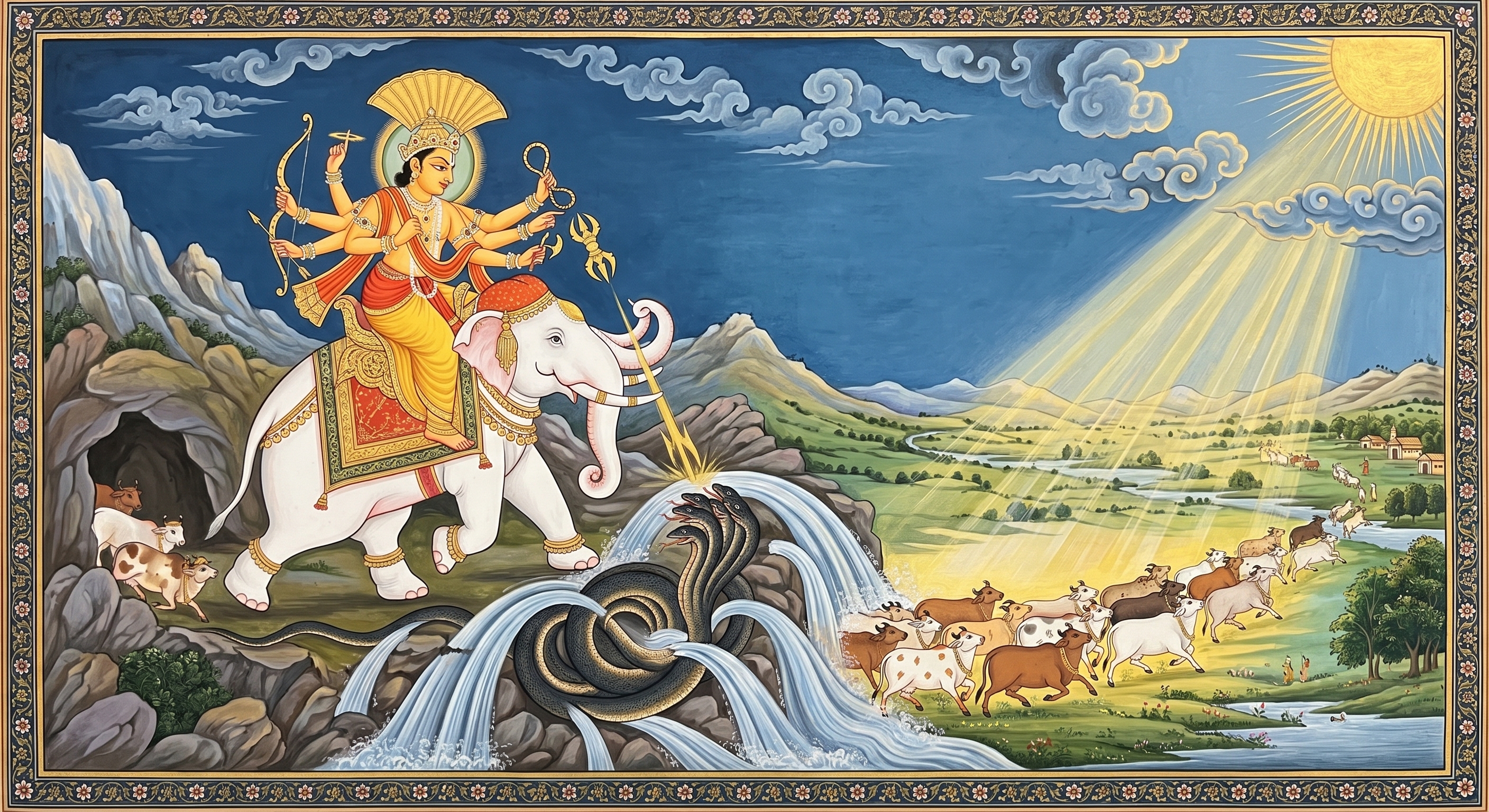
Indra Slays Vṛtra, Releases the Waters
The Vedic Titanomachy: the thunder-god overthrows the serpent of obstruction, and the cosmos begins to flow. The vajra is the eastern form of Zeus's keraunos and Horus's harpoon.
The Vedic Titanomachy: the thunder-god overthrows the serpent of obstruction, and the cosmos begins to flow. The vajra is the eastern form of Zeus's keraunos and Horus's harpoon.
[IMAGE 1: Indra enthroned on his white elephant Airavata, wielding the vajra thunderbolt, golden diadem, many-armed with
bow, noose, and elephant-goad, striking down the coiled serpent Vṛtra below him as the imprisoned rivers burst forth from the mountain and
cattle stream into the sunlight. Painted in the style of classical Pahari miniature, Kangra school, deep blue sky, gold and vermilion palette,
detailed iconography drawn from Sanskrit iconographic manuals (dhyāna-ślokas).]
Introduction: Why the Vedic Story Is the Same Story
In the first two parts of this study we traced the cosmic war in its Greek and Egyptian forms. We watched Zeus break the ten-year siege of the Titans and split the hundred-voiced monster Typhoeus with the thunderbolt, and we watched Horus overthrow Seth to restore Ma'at after Izfet had entered the world, with Ra driving back the serpent Apophis at every dawn. In both traditions the operation was identical: a thunder-wielding sovereign god, son of an older sky-order, defeats a primordial chaos-power and thereby institutes the articulated cosmos against the permanent pressure of undifferentiated violence.
Now we follow the same operation into the third of the three great ancient Indo-European religious civilizations: the Vedic tradition of ancient India, preserved in the oldest continuous religious corpus on earth, the Ṛg Veda, composed in Sanskrit roughly between 1500 and 1200 BCE in the Punjab and the upper Ganges basin. The central deity of the Ṛg Veda is Indra (Sanskrit: इन्द्र, Indra), to whom approximately 250 of the 1,028 hymns of the corpus are addressed, which is roughly a quarter of the entire Vedic canon and more than are addressed to any other deity. The central myth attached to Indra is his slaying of the serpent Vṛtra (वृत्र), the demon of obstruction, and the release of the cosmic waters.
What we will show in this section goes beyond resemblance. The Vedic story is, historically and linguistically, the same story as the Greek and the Egyptian, inherited from the same Proto-Indo-European source from which the Greek tradition of Zeus descended. The philological case is airtight. The name Zeus and the name Dyaus (Sanskrit Dyauṣ Pitṛ, द्यौष् पितृ, "Sky Father") are the same divine name in two daughter languages, both descending from Proto-Indo-European *Dyēus Ph₂tēr, the reconstructed "Father Sky." The Latin Jupiter (from older Diāspiter, Dious-pater) is a third reflex of the same PIE form. One God, three names, three inherited languages. The myth of a sky-thunder sovereign who defeats a chaos-serpent is a shared Indo-European patrimony, re-expressed in each successor tradition with local coloring but with the same essential structure.
In the specific case of the Vedic tradition, something interesting happens in the historical development. The old Indo-European sky-father name Dyauṣ becomes in Sanskrit a relatively minor figure, mentioned in only a handful of Ṛgvedic hymns, paired with Prithivi (Earth) as a cosmic progenitor couple. The sovereign thunder-function that Zeus concentrates in Greek is, in Vedic, transferred onto Indra, who inherits the whole active exercise of cosmic kingship, warfare, thunder, rain-giving, and dragon-slaying. Dyauṣ is the linguistic ancestor-name of Zeus; Indra is the functional inheritor of Zeus's cosmic role. In the Vedic schema, the two have been distributed between two deities. The theology is the same; the personnel differ in name.
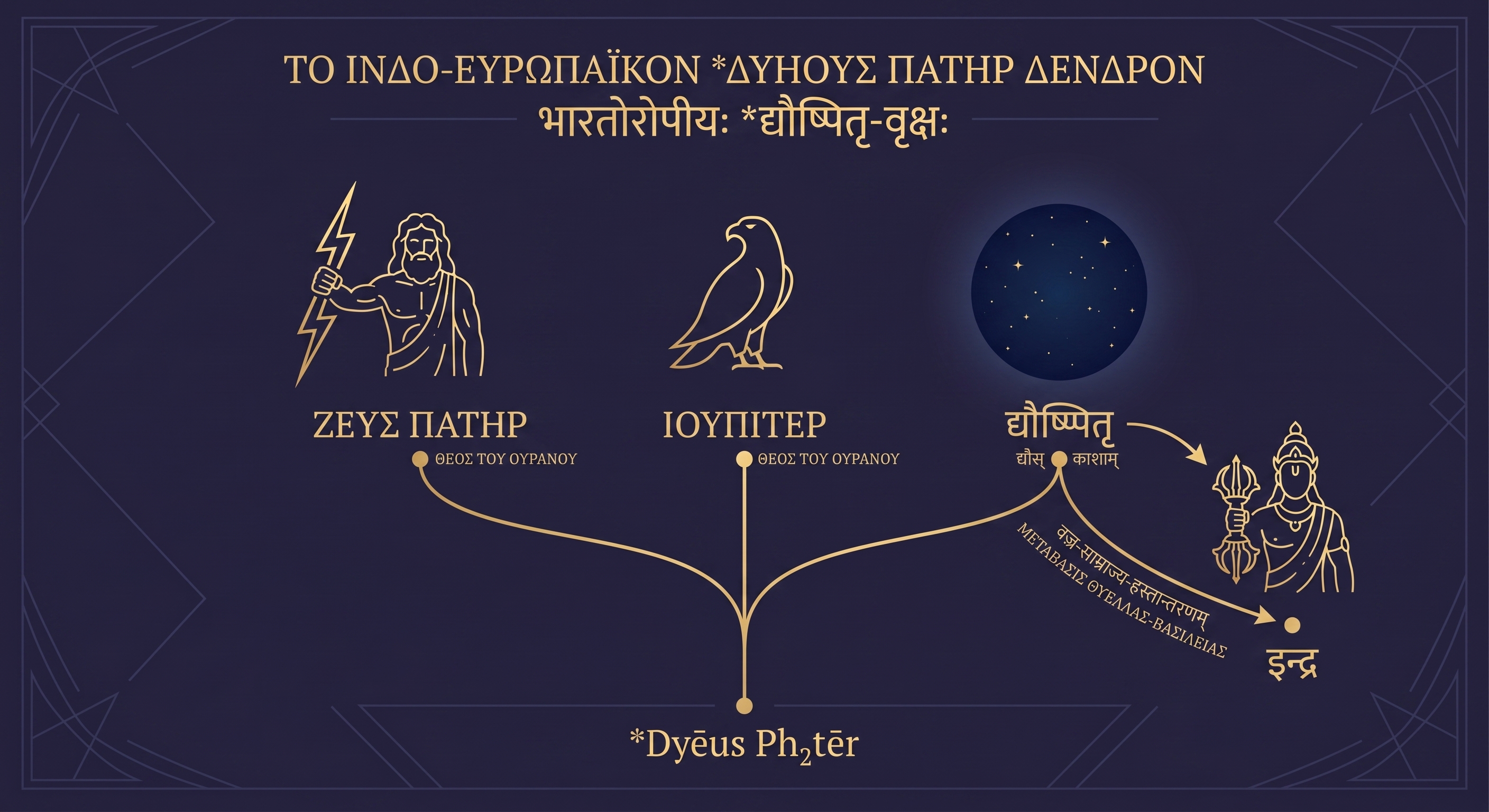
The Indo-European Sky-Father: One God, Three Tongues
Zeus, Jupiter, and Dyauṣ Pitṛ descend from the same Proto-Indo-European *Dyēus Ph₂tēr. In the Vedic branch, the sovereign thunder-function is inherited by Indra, the slayer of Vṛtra.
Zeus, Jupiter, and Dyauṣ Pitṛ descend from the same Proto-Indo-European *Dyēus Ph₂tēr. In the Vedic branch, the sovereign thunder-function is inherited by Indra, the slayer of Vṛtra.
Part One: The Philological Identity of Zeus and Dyauṣ
The Proto-Indo-European Sky Father
The comparative method of historical linguistics, developed in the nineteenth century by scholars such as Franz Bopp, August Schleicher, and later Karl Brugmann, and refined in the twentieth century by Emile Benveniste, Georges Dumézil, and Martin L. West, has produced one result more securely than any other: the reconstruction of the Proto-Indo-European sky-father deity, whose name is rendered in modern scholarly notation as *Dyēus Ph₂tēr, literally "Father Sky" or "Father Daylight." This is the single most firmly established divine name in the comparative Indo-European pantheon, because the descendant cognates align with a precision that leaves no philological doubt.
J.P. Mallory and D.Q. Adams:
"Dyaúṣ stems from Proto-Indo-Iranian *dyā́wš, from the Proto-Indo-European (PIE) daylight-sky god *Dyēus, and is cognate with the Greek Διας (Zeus Patēr), or Dei-pátrous, and Latin Jupiter (from Old Latin Dies piter, Djous patēr), stemming from the PIE Dyḥus ph₂tḥr ('Daylight-sky Father'). *Dyēus is considered by scholars the most securely reconstructed deity of the Indo-European pantheon, as identical formulas referring to him can be found among the subsequent Indo-European languages and myths of the Vedic Indo-Aryans, Latins, Greeks, Phrygians, Messapians, Thracians, Illyrians, Albanians and Hittites."
The inherited formula "Father Sky" is preserved in:
- Greek: Ζεῦ πάτερ (Zeu pater), "Father Zeus," in direct vocative address throughout the Homeric corpus, and in the fused form Διός (Dios, genitive of Zeus) preserving the full *Dyēus stem
- Latin: Iupiter, from Old Latin Diespiter (Dies-piter), "Father Diūs," a direct continuation of *Dyēus Ph₂tēr with the stressed "father" element
- Vedic Sanskrit: द्यौष् पितृ (Dyauṣ Pitṛ), "Sky Father," preserved as a vocative formula in Ṛg Veda 6.51.5, 1.89.4, 1.90.7, 1.164.33, 1.191.6, 4.1.10, and elsewhere
- Illyrian: Dei-pátrous, preserved by the Byzantine lexicographer Hesychius of Alexandria (fifth century CE) as an Illyrian divine title
- Scythian: Papaios (Herodotus, Histories 4.59), "Papa," which Herodotus explicitly identifies as the Scythian name for Zeus, preserving the "father" component of the formula
- Palaic (an extinct Anatolian language): Tiyaz papaz, "Father Tiyaz" (the sun-god, here functioning as the sky-god)
- Hittite: attas Isanus, "Father of Heaven"
- Latvian: Debess tēvs, "Sky Father" (the ritual expression preserves the structure even where the root has shifted)
No reasonable scholar disputes the reconstruction. The phonological correspondences are impeccable. Greek Zd- (from earlier *Dy-), Latin Di-/Iu-, and Sanskrit Dy- are the exact sound-law outcomes one predicts from PIE *Dy- in each daughter language. The stem vowel, the accent, and the paired "father" element all match. This is as solid as historical linguistics ever gets.
M.L. West, Indo-European Poetry and Myth:
"The most constant epithet associated with *Dyēus is 'father' (*ph₂tḥr). The term 'Father Dyēus' was inherited in the Vedic Dyáuṣ Pitṛ́, Greek Zeus Patēr, Illyrian Dei-pátrous, Roman Jupiter (*Djous patēr), even in the form of 'dad' or 'papa' in the Scythian Papaios for Zeus, or the Palaic expression Tiyaz papaz."2
For the Zevist, this linguistic fact is theologically decisive. When Hesiod sings of Zeus, when the Roman augurs pray to Iupiter Optimus Maximus, when the Ṛgvedic hymnists chant the vocative Dyauṣ Pitṛ, they are uttering three forms of the same ancestral divine name, inherited from a common prehistoric tradition probably over five thousand years old. The unity of the three religions at this root goes beyond syncretism invented by modern scholars and stands as an objective philological fact. The cosmic sky-father of the Indo-European peoples is, literally, one name, which three peoples preserved in three sound-law-altered forms.
The Functional Transfer from Dyauṣ to Indra
In the historical Vedic period, however, a striking development occurs. Dyauṣ Pitṛ, though clearly once the supreme sky-god, becomes in the extant hymns a relatively passive figure. He appears as progenitor, paired with Prithivi (Earth) in the archaic formula Dyāvāprithivī (द्यावापृथिवी, "Heaven and Earth" as a dual compound), but the dynamic, sovereign, thunder-wielding role that Zeus concentrates in Greek is, in the Vedic branch, exercised by Indra. The Ṛg Veda itself sometimes makes this transfer explicit, with Indra described as "greater than his father" or even as the one who "sundered Heaven and Earth" (ṚV 1.33.10, 4.17.1), a cosmogonic act that separates Dyauṣ from Prithivi and creates the space in which the articulated cosmos can exist.
This transfer is theologically crucial for understanding the Vedic material. When we read of Indra slaying Vṛtra, we are not reading about a god foreign to the Zeusian theology. We are reading about the Vedic form of the same cosmic sovereign function that Zeus performs in Greek. Indra is the Vedic Zeus, even though the older cognate name is preserved in the more passive figure of Dyauṣ. The Indo-European sky-thunder function is still there; it has migrated to a different name-bearer in the Vedic pantheon but retains the whole of its inherited structure.
The evidence for this transfer is overwhelming. Consider the features that Indra shares with Zeus:
- Thunderbolt: Zeus wields the κεραυνός (keraunos), forged by the Cyclopes. Indra wields the वज्र (vajra), forged by the divine artisan Tvaṣṭā (ṚV 1.32.2). The two weapons occupy identical cosmic functions: lightning as articulated divine force, hammered into weapon-form by subordinate divine craftsmen.
- Slaying of the chaos-serpent: Zeus slays Typhoeus, the hundred-headed monster. Indra slays Vṛtra, the dragon-serpent. Both combats occupy identical structural positions: the cosmogonic victory that secures the ordered world against a monster of pure disorder.
- Rain-giving and weather: Both are storm-gods; both control rain, lightning, and the timing of the seasons.
- Sovereign kingship: Both are the kings of the gods, sitting at the head of a divine council; both apportion honors (Greek timai, Vedic bhāgāḥ) among subordinate deities.
- Drinking of the sacred inspirational beverage: Zeus drinks nectar (νέκταρ) and ambrosia (ἀμβροσία); Indra drinks Soma (सोम), the pressed inspirational beverage that empowers him for the combat against Vṛtra (ṚV 1.32.3: "he chose the Soma, and in three sacred beakers drank the juices").
- Enforcement of cosmic order: Zeus guarantees dike (δίκη) and themis (θέμις); Indra guarantees ṛta (ṚV passim), the cosmic order.
The point-for-point correspondence has one explanation, and only one: inheritance. The structural identity of Zeus and Indra comes from two daughter religions both drawing on the same Proto-Indo-European sovereign thunder-god complex. What Hesiod narrates in the Theogony as the victory of Zeus over the Titans and Typhoeus, the Vedic hymnists narrate as the victory of Indra over Vṛtra. Two versions of one original story, preserved in two successor civilizations.
Calvert Watkins:
"Indra is to be regarded as the Indo-Aryan reflex of the Proto-Indo-European thunder-god complex, which in Greek is represented by Zeus, in the Roman tradition by Jupiter, in the Germanic by Thor (a reflex of *Perkʷunos, a specifically thunder-related PIE deity sometimes distinct from *Dyēus), and in the Celtic by Taranis. The slaying of the dragon-serpent by the thunder-wielding god is the most securely reconstructed Indo-European myth, attested across every branch of the family with sufficient preserved mythology."3
Part Two: The Ṛgvedic Narrative: Rigveda 1.32
The Text and Its Author
The single most detailed narrative of Indra's slaying of Vṛtra in the entire Vedic corpus is Ṛgveda Hymn 1.32, attributed by the traditional Anukramaṇī index to the ṛṣi Hiraṇyastūpa Āṅgirasa, of the ancient clan of Angiras seers. The hymn consists of 15 stanzas in the Triṣṭubh meter (four lines of eleven syllables each) and is among the most celebrated poems of the entire Vedic canon. The Aitareya Brāhmaṇa, a later ritual text, says that by composing this hymn Hiraṇyastūpa "obtained the favor of Indra" and "gained the highest world." Western scholarship has matched this traditional evaluation: the hymn has been described by philologists since Friedrich Rosen's Latin edition of 1838 as "a fine hymn," "a poetic masterwork," and "justly famous."
The hymn does not narrate the combat in a linear fashion. It circles, repeats, returns, and deepens. It describes the slaying multiple times from different angles, each time disclosing a new feature of the combat. The poetic method is itself theological: the victory of Indra over Vṛtra is not a single event to be reported once, but a cosmological reality to be sung again and again, re-instantiated in the ritual recitation itself. Every performance of ṚV 1.32 is another re-performance of the primordial victory.
Verse 1: The Proclamation and the Formula
इन्द्रस्य नु वीर्याणि प्र वोचं यानि चकार प्रथमानि वज्री ।
अहन्नहिमन्वपस्ततर्द प्र वक्षणा अभिनत्पर्वतानाम् ।। 4"indrasya nu vīryāṇi pra vocaṃ yāni cakāra prathhamāni vajrī / ahann ahim anv apas tatarda pra vakṣaṇā abhinat parvatānām"
"I shall proclaim the heroic deeds of Indra, which the wielder of the vajra performed of old. He slew the Dragon, released the waters, and cleft open the ribs of the mountains."
The opening verse contains the single most important formula in all of Indo-European poetics: áhann áhim (अहन् अहिम्), "he slew the serpent." This exact two-word formula, with the verb in the third person aorist active of han- (to strike, to slay) and the noun ahi- (serpent) in the accusative, recurs eleven times in the Ṛg Veda, always applied to Indra's defeat of Vṛtra. It is a sacred formula preserved with the precision that oral-traditional poetic cultures reserve for the most important ritual phrases.
The significance of this formula extends far beyond the Vedic tradition. The Swiss-American philologist Calvert Watkins, in his magisterial study How to Kill a Dragon: Aspects of Indo-European Poetics (Oxford University Press, 1995), demonstrated that this exact formulaic structure, namely the verbal root *gʷhen- ("to strike, to slay") with an accusative object meaning "serpent/dragon", is preserved in cognate forms across virtually every branch of the Indo-European language family where dragon-slaying myth survives. The formula is one of the oldest verbal inheritances of the entire IE family.
Calvert Watkins, How to Kill a Dragon: Aspects of Indo-European Poetics:
"The Indo-European poetic formula of the dragon-slaying hero, *(e)gʷhent(o) h₃ogʷhim 'he slew the serpent,' is preserved in near-identical form in the Vedic áhann áhim (RV 1.32.1), in the Avestan janaṭ ŋhuηəm, in the Hittite MUŠilluyankan kuenta 'he slew the serpent Illuyankas,' in the Greek ἐπέφνεν ... ἄφιν/δράκοντα 'he slew the serpent/dragon' as said of Apollo and of Heracles, in Old Norse orm dráp 'slew the worm,' and in Old Irish cert‐ib-i míl 'slew the beast.' This is the single most securely reconstructed formula of Proto-Indo-European poetic language."5
When Hesiod says of Zeus that he struck down Typhoeus, he is using the Greek descendant of the same formula. When the Hittite Illuyankas text says the Storm God slew the serpent, it is the same formula. When the Avesta says Verethraghna (whose name is literally "the slayer of Vritra" in Iranian) destroyed the obstruction, it is the same formula. The Vedic áhann áhim is the ancestral form closest to the PIE original. This goes beyond parallel imagery and constitutes a single formula, inherited from a common prehistoric ritual-poetic tradition, preserved across five thousand years and across every major Indo-European people that produced a literary record.
The Zevist therefore understands that when the Ṛgvedic hymnist sings áhann áhim, he is singing the same primordial verse that Hesiod sang, that the Avestan priest sang, that the Hittite priest sang, that Homer sang of Apollo and the Python. One formula, one cosmic victory, one God whose name is pronounced differently in different tongues.
Verse 2: The Forging of the Vajra
Ṛg Veda:
अहन्नहिं पर्वते शिश्रियाणं त्वष्टास्मै वज्रं स्वर्यं ततक्ष ।
वाश्रा इव धेनवࠣ स्यन्दमाना अञॅः समुद्रमव जग्मुरापः ।। 6"ahann ahiṃ parvate śiśriyāṇaṃ tvaṣṭāsmai vajraṃ svaryaṃ tatakṣa / vāśrā iva dhenavaḥ syandamānā añjaḥ samudram ava jagmur āpaḥ"
"He slew the serpent that lay upon the mountain; Tvaṣṭā fashioned for him the resounding vajra. Like lowing cows running in swift flow, the waters went down straight to the ocean."
The vajra is forged by Tvaṣṭā (त्वष्टृ), the divine artisan-god, the Vedic counterpart of Hephaistos and Vulcan. The structural parallel with the Greek tradition is exact: Zeus's keraunos is forged by the Cyclopes (themselves ancient chthonic craftsmen), and Indra's vajra is forged by the ancient divine craftsman Tvaṣṭā. In both cases, the sovereign sky-thunder god does not produce his own weapon; the weapon is handed to him by an older subordinate craftsman-power. The weapon is the articulation of thunder into usable divine force, hammered out by the hand that knows how to turn raw lightning into precision instrument.
The image of the released waters "like lowing cows" is one of the signature similes of the entire Ṛg Veda. Vṛtra had imprisoned the waters; his defeat releases them, and they rush toward the ocean with the joy and noise of cattle returning home. The Vedic ecological setting is agrarian and pastoral, and for agrarian and pastoral peoples the release of water is the release of life itself. Drought is death; running water is resurrection. Indra's victory is the annual monsoon re-enacted in mythic time, or the mythic archetype of which the annual monsoon is a participation.
Verses 3-5: The Decisive Combat
Ṛg Veda:
वृषायमाणो࠭वृणीत सोमं त्रिकद्रुकेष्वपिबत् सुतस्य ।
आसायकं मघवादत्त वज्रमहन्नेनम् प्रथमजामहीनाम् ।। 7"vṛṣāyamāṇo 'vṛṇīta somaṃ trikadrukeṣv apibat sutasya / āsāyakaṃ maghavādatta vajram ahann enaṃ prathamajām ahīnām"
"Bulling himself, he chose the Soma; from three sacred beakers he drank the pressed juice. The Bountiful One (Maghavān) seized the hurling vajra, and slew him, the firstborn of the serpents."
Indra empowers himself for the combat by drinking Soma (सोम), the sacred ritual beverage pressed from the Soma plant, which in the Ṛgvedic period was both a divine being and a physical drink ritually offered to the gods. The exact botanical identity of the original Soma plant has been debated for two centuries (candidates have included Ephedra, Amanita muscaria, and Peganum harmala), but the theological function is clear: Soma is the divine inspiration-substance that intensifies the god for the sovereign act. Zeus drinks ambrosia and nectar in the same ritual-mythic function; Indra drinks Soma. In both cases the point is the same: the cosmic victory requires not merely divine strength but divine inspiration, the intensified god carrying out the decisive act in a state of ritual elevation.
The epithet Maghavān (मघवान्), "Bountiful" or "Possessor of Bounty," is one of Indra's most frequent titles, appearing over 400 times in the Ṛg Veda. The sovereign thunder-god is not only warrior but giver of gifts, exactly as Zeus is both enforcer and dispenser of timai. The structural parallel is precise.
Ṛg Veda:
यदिन्द्राहन प्रथमजामहीनामान् मायिनाममिनाः प्रोत मायाः ।
आत सूर्यं जनयन्द्यामुषासं तादीत्नाशत्रुं न किला विवित्से ।। 8"yad indrāhan prathamajām ahīnām ān māyinām amināḥ prota māyāḥ / āt sūryaṃ janayan dyām uṣāsaṃ tādītnāśatruṃ na kilā vivitse"
"When, O Indra, you slew the firstborn of the serpents, and overcame the illusions of the illusion-makers, then, generating the Sun and Heaven and the Dawn, you found no adversary at all to stand against you."
This is one of the most theologically dense verses in the Ṛg Veda. After slaying Vṛtra, Indra "generates" (janayan) the Sun (Sūrya), Heaven (Dyām, accusative of Dyaus), and the Dawn (Uṣas). The cosmic order is not merely defended by his victory; it is brought into being by it. Before Vṛtra's defeat, the waters were bound, the cattle were imprisoned, the sun had not yet shone, and the dawn had not yet appeared. The defeat of Vṛtra is simultaneously the cosmogonic act that institutes articulated reality.
Notice the Titanomachy parallel. Zeus's defeat of Typhoeus in Hesiod is followed immediately by the distribution of honors and the establishment of the Olympian cosmic order. Indra's defeat of Vṛtra is followed immediately by the generation of Sun, Heaven, and Dawn. The cosmogonic function is the same: the sovereign thunder-god's victory is not merely the end of a battle but the beginning of the articulated cosmos. The mention of "illusion-makers" (māyinaḥ) and their defeated "illusions" (māyāḥ) adds a specific Indic layer: the serpent-force is associated with māyā, the deceptive, illusory, shape-shifting power that misrepresents reality. Indra's victory is a victory not only over raw chaotic force but over the metaphysical deception that presents chaos as legitimate order.
Ṛg Veda:
अहन् वृत्रं वृत्रतरं व्यंसमिन्द्रो वज्रेण महता वधेन ।
स्कन्धांसीव कुलिशेना विवृक्णाहिः शयत उपपृक् पृथिव्याः ।। 9"ahan vṛtraṃ vṛtrataram vyaṃsam indro vajreṇa mahatā vadhena / skandhāṃsīva kuliśenā vivṛkṇāhiḥ śayata upapṛk pṛthivyāḥ"
"With his great and deadly vajra, Indra shattered Vṛtra, the worst of Vṛtras, limb from limb. As trees felled by the axe, so the Dragon lay prostrate upon the earth."
The simile "as trees felled by the axe" marks the final dismemberment. Vṛtra is not merely defeated but broken into pieces, unable to reassemble. The parallel with the Hesiodic account of Typhoeus's destruction is direct: Typhoeus is cast into Tartaros, his burning body pinned beneath Mount Etna, permanently dismembered from cosmic agency. The principle in both cases is the same: the chaos-monster is not merely overcome but decisively unmade, reduced to fragments that cannot reassert themselves as integral threats.
Verses 7-11: The Release of the Waters
Ṛg Veda:
अपादहस्तो अपृतन्यदिन्द्रमास्य वज्रमधि सानौ जघान ।
वृष्णो वध्रिः प्रतिमानं बुभूषन् पुरुत्रा वृत्रो अशयद व्यस्तः ।। 10"apādahasto apṛtanyad indram āsya vajram adhi sānau jaghāna / vṛṣṇo vadhriḥ pratimānaṃ bubhūṣan purutrā vṛtro aśayad vyastaḥ"
"Footless and handless, he challenged Indra; who smote him with the vajra upon his shoulders. Emasculate, yet seeking to be the match of the virile, Vṛtra lay scattered in many pieces."
Vṛtra, in his final form, is described as "footless and handless" (apād, ahasta). This is significant. Vṛtra is not a rational opponent armed with limbs and intelligence; he is a purely obstructive force, a swollen coil that lies across the cosmic channel and blocks the flow. The combat is not a duel between two warriors; it is the strike of the articulated sky-god against an unarticulated mass of obstruction. The mass is vast, but it is formless. Typhoeus, though hundred-headed, is similarly inarticulate (his heads make noise but no speech). Vṛtra is footless and handless, purely obstructive volume without the articulated members required for intelligent combat. The two chaos-monsters share this structural feature: they are quantity without form, bulk without articulation.
Ṛg Veda:
नदं न भिन्नममुया शयानं मनो रुहाणा अति यन्त्यापः ।
याश्चिद वृत्रो महिना पर्यतिष्ठत तासामहिः पत्सुतःशीर्बभूव ।।11"nadaṃ na bhinnam amuyā śayānaṃ mano ruhāṇā ati yanty āpaḥ / yāś cid vṛtro mahinā paryatiṣṭhat tāsām ahiḥ patsutaḥśīr babhūva"
"Like a broken reed he lay; and the waters, bolstered in heart, went flowing over him. Beneath the feet of those very waters which Vṛtra had in his greatness enveloped, the Dragon now lay."
The image is overwhelming. Vṛtra had swallowed the waters; now the waters flow over his corpse. The dragon of obstruction has become the floor on which the liberated rivers run. This is the theological heart of the hymn: the chaos-power does not merely cease; it becomes the substrate of the new order. Its defeat is its subjection. Vṛtra continues to exist under the feet of the flowing waters, no longer obstructing them but lying beneath them. The exact parallel is the binding of the Titans in Tartaros beneath the Olympian cosmos. The defeated power is subjected, not annihilated. The cosmos rests upon the bound chaos.
Ṛg Veda:
नीचावया अभवद् वृत्रपुत्रेन्द्रो अवा वधं जभ्रा उपमित्यसर्ज ।
उत्तरा सुर्अधरः पुत्र आसीद्दानुः शये सहवत्सा न धेनुः ।।12"nīcāvayā abhavad vṛtraputrendro asyā ava vadhaj jabhrā upamityasarj / uttarā sūr-adharaḥ putra āsīd dānuḥ śaye sahavatsā na dhenuḥ"
"Low was Vṛtra's mother brought down; Indra cast his deadly weapon at her. The mother lay above, the son beneath her; and Dānu lay there, like a cow beside her calf."
Vṛtra's mother is named Dānu (दानु), who in the later Purāṇic tradition becomes the ancestor-goddess of the Dānavas, the entire race of demonic Asuras. The parallel with the Titanomachy is again structurally exact. Typhoeus is the child of Gaia (Earth) and Tartaros; he is the final product of the primordial generative powers opposed to the Olympian order. Vṛtra is the child of Dānu, herself a primordial goddess of undifferentiated maternal power. Both chaos-dragons have a chaos-mother, and in both traditions the chaos-mother is defeated in the same combat or immediately thereafter. The cosmogonic victory is not merely over the visible dragon; it is over the maternal source-principle from which such dragons come.
Dānu is a figure of great philological interest. Her name shares its root with the pan-Indo-European hydronymic root *dānu-, which appears in the Celtic river-goddess Danu (mother of the Tuatha Dé Danann), in the names of major European rivers (Danube, Don, Dnieper, Dniester), and possibly in the Greek Danaïdes. She is the primordial water-goddess of undifferentiated flow, the maternal principle whose child must be defeated so that articulated rivers may flow. The parallel with Gaia, the earth-mother who generates the Titans and Typhoeus against Zeus, is exact.
The Meaning of Vṛtra's Name
The name Vṛtra (वृत्र) carries a crucial meaning in Vedic Sanskrit. It derives from the Proto-Indo-European root *wer- ("to cover, to obstruct, to enclose"), through the Proto-Indo-Iranian intermediary *wṛtrás, and is cognate with the Avestan vərəθra- (as in vərəθraɣna, "slayer of obstruction," the Iranian god Verethragna). The literal translation of Vṛtra is "Obstructor" or "Encloser" or "The Cover." Vṛtra is the principle of obstruction as such, the power that covers over, holds back, prevents flow, keeps things from moving from their source to their destination.
This is the most theologically precise possible name for a chaos-monster. Vṛtra is not merely "evil" in some general moral sense. Vṛtra is the specific cosmic function of obstruction: the withholding of waters, the imprisonment of cattle, the preventing of the sun from shining, the holding of the dawn from breaking. To defeat Vṛtra is to break open what was closed, to release what was held, to set in motion what was static. The Vedic theology of cosmic order is therefore a theology of unobstructed flow: the proper cosmic order is one in which the waters flow, the cattle graze, the sun rises on time, the dawn arrives on schedule, and the sacrifices reach the gods through an unclogged channel. Vṛtra is whatever obstructs any of these flows.
Manfred Mayrhofer, Etymologisches Wörterbuch des Altindoarischen:
"Vṛtra literally means 'cover, obstacle,' in reference to his holding back the waters. It stems from Proto-Indo-Iranian *wṛtrás, from the Proto-Indo-European root *wer- 'to cover, to obstruct.' The Indo-Iranian word is also found in Avestan as vərəθraɣna (Vedic vṛtraghná), literally '(one who) slays obstacles.'" 13
The Iranian reflex Verethragna (Avestan vərəθraɣna), preserved in the Zoroastrian tradition, means "Obstruction-smasher" or "Vṛtra-slayer." The same name is preserved in Vedic as the epithet Vṛtrahan (वृत्रहन्, applied to Indra), "Vṛtra-slayer." In the Iranian branch, the name of the slayer has itself become the divine name; in the Vedic branch, it remains an epithet of Indra. In both cases the cosmic function is the same: the god is defined by his relation to the obstruction he shatters.
Part Three: Vṛtra as Izfet: The Direct Parallel
The reader who has followed this study through Parts A and B will now see something remarkable. The name Vṛtra means "Obstructor." The name Izfet (Egyptian jṣft) means "That-Which-Should-Not-Be," the cosmic counter-principle to Ma'at. What is Izfet if not precisely the obstruction of Ma'at's flow? What is Vṛtra if not the Vedic Sanskrit translation of the same cosmic function that Egyptian names Izfet?
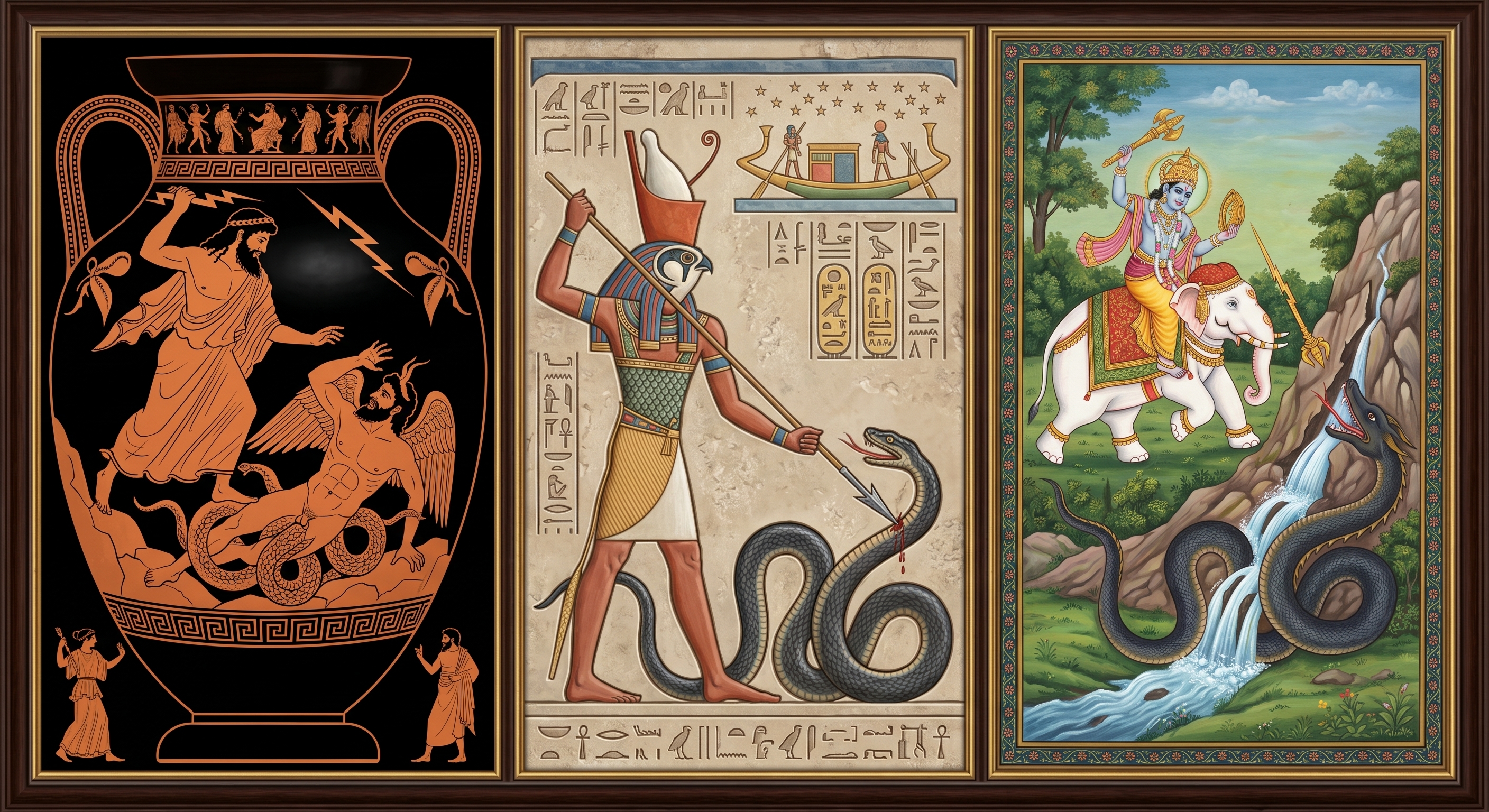
One Cosmic Victory, Three Sacred Tongues
Zeus strikes Typhoeus, Horus strikes Apophis, Indra strikes Vṛtra. The same ontological operation in three inherited civilizations: the sovereign sky-thunder god defeats the serpent of obstruction and institutes the articulated cosmos.
Zeus strikes Typhoeus, Horus strikes Apophis, Indra strikes Vṛtra. The same ontological operation in three inherited civilizations: the sovereign sky-thunder god defeats the serpent of obstruction and institutes the articulated cosmos.
The Structural Identity
Consider the correspondences, which are nearly perfect:
- Cosmic counter-principle: Egyptian Izfet = Vedic Vṛtra-principle = Greek primordial chaos (Khaos, Ἀταξία ataxia). In all three traditions, the cosmos is defined by a principle of cosmic order (Ma'at / ṛta / Dike-Themis), and the opposing principle is the obstruction, disorder, or dissolution of that order.
- Serpent-monster of obstruction: Apophis = Vṛtra = Typhoeus. All three are serpent-dragons, all three obstruct the cosmic flow (the sun's barque, the waters of the rivers, the articulated cosmic order).
- Thunder-sovereign opponent: Horus and Ra (jointly, in complementary roles) = Indra = Zeus. All three are sovereign sky-related thunder/light gods, all three wield articulated weapons (harpoon, vajra, keraunos) forged by subordinate craftsmen or given by divine councils.
- Daily or cyclical reenactment: The Egyptian priests enacted the defeat of Apophis daily in the Book of Overthrowing Apep. The Vedic priests enacted the slaying of Vṛtra daily in the Soma ritual where ṚV 1.32 was chanted at the midday Soma pressing. The Greek tradition lacks a daily reenactment as intense but preserves the victory's perpetual relevance through the Panathenaic festivals and the philosophical commentaries.
- Release of cosmic goods: Indra's victory releases the waters and generates sun, heaven, dawn. Horus's victory restores Ma'at and legitimate kingship. Zeus's victory establishes the distribution of timai and the cosmic order. In all three, the victory is simultaneously the institution of articulated cosmos.
- Perpetuity of the struggle: Izfet is not annihilated; it is perpetually restrained by Ma'at's daily renewal. Vṛtra, though slain, is implicitly understood as ever-recurring (every drought is Vṛtra coming back). The Titans are bound in Tartaros but continue to press against their chains. In all three, the cosmic victory is not a single past event but the archetypal pattern of an ongoing maintenance.
The philosophical point is inescapable. What Egypt and India express in mythological languages so distinct that no one would imagine one borrowing from the other (Egypt is Afro-Asiatic, a non-Indo-European family; Vedic is Indo-European, sibling of Greek), Greece expresses in yet another inherited Indo-European idiom. If three civilizations, working independently in three language families and three geographies, arrive at the same fundamental cosmological picture, that picture transcends any local cultural product and constitutes a recognition of reality, seen from three angles.
Joseph Fontenrose, Python: A Study of Delphic Myth and Its Origins:
"The recurrence across Indo-European, Egyptian, Semitic, and Hittite-Anatolian traditions of the combat myth in which a thunder-wielding sovereign god defeats a serpent-dragon of chaos to establish or restore cosmic order cannot be explained by direct borrowing in all cases, given the diversity of the language families and cultures involved. The convergence is evidence that the myth encodes something perceived as a universal cosmic structure, something about the nature of ordered reality itself, rather than a culture-specific story."14
Izfet as the Asian "Obstruction"
The Zevist reads Vṛtra not as a foreign Hindu concept but as the Vedic name for what Egypt calls Izfet. Every instance of Izfet is, in the Vedic idiom, an instance of Vṛtric obstruction. The corrupt priest who blocks the divine flow; the tyrannical regime that blocks the distribution of justice; the ideology that blocks the articulation of truth; the personal drug-habit or thought-loop that blocks the soul's movement toward the Gods; all of these are Vṛtric. All of these are Izfet. They are the same cosmic failure, recognized in two languages.
Correspondingly, every act of Ma'at is, in Vedic terms, an act of ṛta. Ma'at and ṛta are the same cosmic order, recognized in two tongues. The Egyptian scribe writing "I have not committed Izfet" in the Negative Confession (Book of the Dead, Spell 125) and the Ṛgvedic priest chanting "may ṛta prevail over anṛta" (ṚV 10.124.5 and elsewhere) are making the same declaration, in two inherited sacred languages.
Jan Assmann, Ma'at: Gerechtigkeit und Unsterblichkeit im Alten Ägypten:
"The Vedic concept of ṛta (ṛtá, Ṛtá) and the Egyptian concept of Ma'at (mṣ't) are functionally and structurally equivalent. Both designate the cosmic-ethical order that is simultaneously the law of the heavens, the pattern of the seasons, the principle of right conduct, and the standard against which human action is judged. Both have their opposite (Vedic anṛta, 'un-ṛta,' and Egyptian jṣft, 'Izfet'), and both conceive the cosmos as the outcome of a primordial and continuing victory of the order-principle over its opposite. The equivalence is so close that the Egyptologist Jan Assmann and the Vedicist Jan Gonda have independently concluded that the two concepts must be translations of one another."15
Part Four: The War of the Devas and the Asuras
The Ṛgvedic combat between Indra and Vṛtra is the single most detailed cosmic-combat narrative in the Vedic corpus, but it is not the only one. The broader mythological background against which ṚV 1.32 unfolds is the perpetual war between two families of divine beings: the Devas (देवाः) and the Asuras (असुराः). This war is the Vedic analogue of the Titanomachy in its full civilizational sense: not merely one combat but a whole cosmic faction-war between the gods of cosmic order and the gods of chaos.
The Etymology and the Indo-Iranian Split
The term Deva (देव) derives from the Proto-Indo-European *deiwos, "the shining one," from the root *dyeu- (the same root that gives *Dyēus, Zeus, Dyaus). The Latin deus, the Lithuanian dievas, the Old Irish día, and the Avestan daēva are all cognates. The Devas are the bright celestial ones, the shining beings.
The term Asura (असुर) derives from Proto-Indo-Iranian *Hasura-, cognate with the Avestan ahura, and ultimately from a root meaning "lord" or "possessor of vital force." In the earliest layers of the Ṛg Veda, Asura is not a pejorative term; it is a title applied even to the highest Devas, including Varuṇa himself, who is called Asura in a high honorific sense. Only in the later Vedic period does Asura take on the pejorative meaning of "demon," referring to the enemies of the Devas.
Here we encounter one of the most extraordinary facts in the comparative history of religions. In Iranian, the Zoroastrian reform inverted the valuations. The Iranian ahura (equivalent to Sanskrit asura) became the positive divine class, with Ahura Mazda (the "Wise Lord") at its head, while the Iranian daēva (equivalent to Sanskrit deva) became the negative demonic class. The Vedic and Iranian branches of the common Indo-Iranian religion split in their valuations of the same original divine categories: what is positive in Vedic is negative in Iranian, and vice versa.
Mary Boyce, A History of Zoroastrianism:
"The Indo-Iranian split concerning the terms deva and asura is the most striking religious-semantic inversion known in the comparative study of the Indo-European religions. The Proto-Indo-Iranian inheritance presumably included both classes of beings, but the two successor traditions evaluated them in opposite directions. In Vedic religion, the Devas became the good gods and the Asuras the demons; in Iranian Zoroastrianism, the Ahuras (cognate with Asuras) became the good gods and the Daevas the demons. This suggests that in the common Indo-Iranian background, both classes existed as divine, with different functional specializations, and that the two daughter traditions polarized against one another in the process of their separate religious reforms."16
This split has profound implications for the Zevist reading. It means that the cosmic combat is understood, in the Indo-Iranian traditions, as a combat between two classes of divine beings, not between gods and creatures. The Asuras/Daevas are not subhuman monsters; they are divine beings who have turned against cosmic order. This parallels the Greek tradition exactly: the Titans are themselves divine (θεοί, theoi, is applied to both Titans and Olympians in Hesiod), and the war is a war among gods. The cosmic war is not a war between divine and non-divine; it is a civil war within divinity itself, between those divine powers that serve cosmic order and those that oppose it.
The Purāṇic Elaborations
The Purāṇic literature, composed from approximately the fourth century CE onward, elaborates the Deva-Asura war into a vast cosmic mythology with countless battles across the yugas (cosmic ages). The pattern is consistent: the Devas and the Asuras contest for the possession of the universe; in each age, one or the other gains temporary ascendancy; when the Asuras rise to dominance, cosmic catastrophe approaches, and the supreme deity intervenes, often through an avatar, to restore Deva supremacy and the cosmic order.
The most famous of these elaborations is the Samudra Manthana (समुद्रमन्थन), the "Churning of the Ocean of Milk," preserved in the Mahābhārata (Ādiparvan 15-17), the Bhāgavata Purāṇa (8.5-9), and the Viṣṇu Purāṇa (1.9). The Devas and Asuras jointly churn the cosmic ocean, using Mount Mandara as the churning-staff and the serpent Vāsuki as the rope, to produce the amṛta (nectar of immortality) along with thirteen other cosmic gifts. When the amṛta appears, the Asuras try to seize it; Viṣṇu assumes the form of the beautiful enchantress Mohinī to distribute it only to the Devas. One Asura, Rāhu, disguises himself as a Deva and drinks; the Sun and Moon reveal the deception; Viṣṇu decapitates Rāhu, but because he has drunk the amṛta he becomes immortal as a severed head, permanently pursuing the Sun and Moon and causing eclipses when he catches them.
The story is a rich cosmogonic parable. The cooperation of Devas and Asuras suggests that the two sides were once allied, indeed are siblings from the same primordial source (both descend from the sage Kaśyapa and his multiple wives). Their alliance cracks when the greatest cosmic good (immortality) becomes the prize; the Asuras cheat; divine trickery restores the Devas' possession; and a permanent astronomical consequence (eclipses) marks the event in the cosmos. Every eclipse is Rāhu's attempt to re-seize what was taken from him. The cosmic order bears permanent evidence of the war fought to establish it.
Wendy Doniger, Hindu Myths: A Sourcebook Translated from the Sanskrit:
"The Samudra Manthana myth functions in the Purāṇic tradition as the cosmogonic event that establishes the current distribution of cosmic goods. It accounts simultaneously for the immortality of the Devas, for the permanent enmity of the Asuras, for the existence of astronomical phenomena like eclipses, and for the pattern of subsequent cosmic battles. The structural function is precisely parallel to the Hesiodic Titanomachy in its role of establishing the current cosmic order."17
The Avatar Doctrine and the Perpetuity of the Cosmic War
The Purāṇic tradition also produces the mature doctrine of the avatars (avatāra, अवतार, "descent"), the ten principal incarnations of Viṣṇu (though the tradition knows many more) who descend into the cosmos in various ages to defeat specific manifestations of Asuric dominance. This is the classical statement of the doctrine, from the Bhagavad Gītā:
Bhagavad Gītā:
यदा यदा हि धर्मस्य ग्लानिर्भवति भारत ।
अभ्युत्थानमधर्मस्य तदात्मानं सृजाम्यहम् ।।
परित्राणाय साधूनां विनाशाय च दुष्कृताम् ।
धर्मसंस्थापनार्थाय सम्भवामि युगे युगे ।।18"yadā yadā hi dharmasya glānir bhavati bhārata / abhyutthānam adharmasya tadā'tmānaṃ sṛjāmy aham // paritrāṇāya sādhūnāṃ vināśāya ca duṣkṛtām / dharma-saṃsthāpanārthāya sambhavāmi yuge yuge"
"Whenever there is a decline of dharma and a rise of adharma, then, O descendant of Bharata, I send forth myself. For the protection of the good, for the destruction of evildoers, for the establishment of dharma, I come into being in age after age."
The formula yuge yuge ("in age after age") is the Sanskrit formulation of what Egyptian calls "daily" and what the Greek tradition calls "the perpetual work of the Gods." The cosmic war transcends any single event of the primordial past and operates as the archetypal pattern of cosmic maintenance, reenacted whenever dharma declines and adharma rises, whenever ṛta yields to anṛta, whenever Ma'at gives way to Izfet. The divine sovereign intervenes in every age to restore the order that was won in the primordial combat.
This is the mature doctrinal statement of what Zevism teaches. The Zeusian victory operates beyond any past event safely archived in Hesiod's poem, functioning as the archetype of every genuine act of cosmic maintenance: every establishment of justice, every articulation of truth, every defeat of an oppressive lie, every restoration of ritual sanctity against corrupt encroachment, is a local instance of Indra slaying Vṛtra, of Horus defeating Seth, of Zeus striking down Typhoeus. The one cosmic pattern reenacts itself through every genuine divine-human cooperation.
The Durga-Mahiṣāsura Combat: The Goddess as Sovereign
The Purāṇic tradition also produces a remarkable Goddess-centered version of the cosmic combat, preserved most fully in the Devī Māhātmya (also called the Durgā Saptaśatī, "Seven Hundred Verses to the Goddess"), composed probably in the fifth to seventh centuries CE and incorporated as chapters 81-93 of the Mārkaṇḍeya Purāṇa. In this text, when the Asura Mahiṣāsura (the "Buffalo Demon") has conquered the Devas and driven them from heaven, the gathered power of all the Devas becomes concentrated into a single radiant form: the Goddess Durgā (दुर्गा), who alone can defeat the Asura.
The parallel with the Greek figure of Athena in the Gigantomachy is precise. Athena is the daughter of Zeus, born fully armed from his head, the articulate warrior-wisdom of her father, and in the Gigantomachy she plays a leading role in the defeat of the Giants, notably slaying Enceladus and Pallas (from whom she takes her epithet). Durgā is the concentrated power of all the Devas, manifesting as a single sovereign female warrior, and she defeats the Asura that the collective Devas could not defeat. The Athena figure and the Durgā figure are structural analogues: the articulate feminine divine warrior produced by the sovereign God as the decisive instrument against the chaos-power.
Devī Māhātmya:
"When the defeated Devas concentrated their combined powers into a single radiant form, there arose a Goddess possessed of all weapons, mounted upon a lion, whose splendor pervaded the three worlds. Armed with the weapons of all the Devas, she advanced toward Mahiṣāsura, and the Asura host fled in confusion. She slew him with her trident, and the Devas hymned her as the Supreme One. Then peace was restored to the three worlds, the seasons returned to their proper course, and the sacrifices once again reached the gods."19
The Goddess-form of the cosmic victory is a significant theological development. It demonstrates that the same cosmic function can be performed by a feminine sovereign articulation of divine power, parallel to the masculine Zeus/Indra/Horus form. In Hindu theology, this becomes the foundation of the Shakta traditions, which understand the cosmos as sustained by the sovereign Goddess. In Greek theology, the analogous feminine articulation is Athena, not as independent sovereign but as the most direct extension of Zeus's own sovereign will and intelligence.
Part Five: The Interior Ṛgvedic Battle
As in the Greek and Egyptian traditions, the Vedic cosmic combat is understood not only as an event of the mythic past but as a continuing operation in the interior of the human being. The Upaniṣadic and Yogic traditions develop this inner reading with extraordinary rigor.
The Upaniṣadic Reading
The Upaniṣads, composed from approximately 800 BCE onward, systematically internalize the Vedic cosmology. What the outer cosmos is, the inner soul also is; what the Gods do in the heavens, the self (ātman) must do in its own interior. This is the famous doctrine of tat tvam asi (तत त्वम असि, "thou art that"), stated in the Chāndogya Upaniṣad 6.8.7 and throughout the Upaniṣadic corpus.
If the outer cosmos is the battleground on which Indra slays Vṛtra, then the inner self is the battleground on which the ātman slays the Vṛtric elements within. The internal Vṛtra is, in specific Upaniṣadic vocabulary, the collection of obstructions that prevent the soul's direct recognition of its divine nature: desires that cover the mirror of consciousness, fears that obstruct the flow of attention, habits of mind that imprison the waters of insight, attachments that block the sun of self-knowledge from rising within. Every meditative practice that loosens one of these internal obstructions is a localized Indra-Vṛtra combat, won within the soul.
The Brṛhadāraṇyaka Upaniṣad (1.3) contains a famous narrative in which the Devas and the Asuras contend for possession of the faculties of a single human being: speech, smell, sight, hearing, mind, and breath. The Asuras pierce each faculty with evil, and that faculty becomes vulnerable to deception, distortion, or corruption, but the breath (prāṇa) is unpierceable and defeats the Asuras. The meditative cultivation of breath therefore participates in the cosmic battle at the scale of the individual. The Vedic combat is reenacted at every breath taken consciously, every attention brought into the ordered channel of the prāṇa.
The Yogic Reading: Yoga Sutra 1.2
The linguistic link between Vṛtra and the interior battle is preserved in a remarkable lexical fact. The Sanskrit word vṛtti (वृत्ति), used in Patanjali's Yoga Sūtras 1.2 to denote the "modifications" or "turnings" of the mind that the Yogic practice seeks to still, derives from the same root *wer- ("to cover, obstruct, whirl") as Vṛtra. The vṛttis are, etymologically, the internal Vṛtra-like movements: the mental whirlings that obstruct the soul's direct recognition of its own nature.
Patanjali, Yoga Sūtra:
योगश्चित्तवृत्तिनिरोधः । 20
"yogaś citta-vṛtti-nirodhaḥ"
"Yoga is the cessation of the turnings of the mind."
The entire Yogic path is, in this reading, the interior Indra-battle: the systematic binding and eventually the complete cessation of the internal Vṛtra-forms that obstruct the soul's clear self-recognition. Every successful meditation is an interior slaying of Vṛtra, a releasing of the imprisoned waters of insight, a generation of the inner sun that was hidden by the serpent's coil. The outer cosmic combat and the inner meditative combat are the same combat, fought on different scales. This is exactly the internal Titanomachy that Plato's Phaedrus 246a-248e describes in Greek, and that Proclus elaborated in his allegorical readings.
Part Six: The Table of Correspondences
We now gather the full set of Indic-Greek parallels, to demonstrate the structural identity of the two traditions. This table is not fanciful syncretism. Each row is grounded in the specific philological or functional evidence examined above.
The table is conservative; further rows could be added (messenger gods, music gods, etc.). What it shows decisively is that Greek and Vedic theologies are two organic descendants of a common prehistoric Indo-European religious system, and that within that system the cosmic-combat theology is the most densely shared element.
Part Seven: The Vedic Victory as Zeusian Victory
We return to our central Zevist thesis. Zeus's victory is the paradigmatic form of the cosmic combat because the Greek philosophical and theological tradition produced the most systematic articulation of what the combat means. Hesiod, Plato, Plutarch, Proclus: the Greek chain of interpretation is the deepest theoretical development of the shared Indo-European inheritance. Yet the Greek victory transcends any local Greek event and functions as the Greek expression of a cosmic operation that every inherited tradition recognized in its own idiom.
When the Ṛgvedic hymnist sings of Indra's victory, he sings of the same cosmic operation that Hesiod narrates as the Titanomachy. When the Egyptian priest enacts the defeat of Apophis, he enacts the same operation. The Zevist who centers Zeus does not thereby marginalize Indra or Horus. The Zevist recognizes that Zeus is the Greek name of a cosmic sovereign function whose Vedic name is Indra and whose Egyptian name is Horus (in the kingly sovereignty) and Ra (in the daily combat). The three names are three inherited articulations of one divine cosmic operation.
This is what the ancient world saw clearly and what the Abrahamic rupture obscured. The ancient world knew that the Gods were one cosmic pantheon variously articulated across languages, geographies, and historical developments. The proof is in the precise structural and philological equivalences we have established. Zeus and Indra are not "similar" or "analogous"; they are the Greek and Vedic inheritances of the same PIE thunder-sovereign function, from the same ancestral source. The Ṛgvedic hymnist and the Hesiodic rhapsode are cousins speaking distant dialects of one ancient theology.
Jaan Puhvel, Comparative Mythology:
"The comparative study of Indo-European mythology, when conducted rigorously, does not produce a collection of merely analogous figures. It produces a single reconstructed religious system, of which the historically attested traditions of Greece, Rome, India, Iran, Germany, Celtic lands, and the Balts are each local developments. The structural identity of the thunder-sovereign deity across these traditions is particularly secure, because it is reinforced at three independent levels: the linguistic level (cognate names or titles), the functional level (identical cosmic roles), and the formulaic level (cognate poetic formulas of combat). Zeus, Indra, Thor, Perkūnas, and Taranis are not parallel figures; they are one Proto-Indo-European deity in five linguistic clothings."21
Part Eight: The Avestan Verethragna and the Indo-Iranian Middle Witness
The Iranian Continuation of the Combat Formula
Between the Greek and the Vedic traditions stands a third witness of extraordinary evidential value: the Iranian branch of the Indo-European family, preserved in the sacred texts of Zoroastrianism. The Avestan corpus, composed in Old Iranian (Avestan) and preserved in the ritual books of the Zoroastrian priesthood, presents a continuing religious tradition that descends, like Vedic and Greek, from the common Indo-European patrimony, and that preserves the dragon-slaying combat formula in a form philologically intermediate between the Vedic and the Greek reflexes.
The Iranian cognate of Vedic vṛtraghná ("slayer of Vṛtra") is Avestan vərəθraɣna- (spelled Verethragna in Latin transliteration), preserved as the name of a major Zoroastrian deity, the Yazata of Victory, whose Yasht (Avestan hymn) is the fourteenth in the canonical series. The philological correspondence is exact: Avestan vərəθra- = Vedic vṛtra- = Proto-Indo-Iranian *wṛtrás ("obstruction, obstacle"); Avestan -ɣna- = Vedic -ghná- = PIIr *-ghnahḥ ("slayer, striker"), from the Proto-Indo-European root *gʷhen-. The Iranian name means, in direct translation, "Vritra-slayer."
Mary Boyce, A History of Zoroastrianism:
"The Iranian Verethragna is one of the most important deities of the Zoroastrian pantheon, worshipped as the Yazata of Victory and Aggression in Service of Righteousness. His name is the exact Iranian cognate of Vedic vṛtraghná-, which is an epithet of Indra in the Ṛgveda. This preservation across the Indo-Iranian split demonstrates that the combat against the serpent of obstruction was already a central feature of the Proto-Indo-Iranian religion before the two branches separated, probably no later than 1800 BCE."22
In the Avestan Yasht 14 (the Bahram Yasht, from Middle Persian Bahrām, the regular reflex of Vərəθraɣna), Verethragna manifests in ten successive incarnations: as the wind, as a horned bull, as a white horse, as a rutting camel, as a boar, as a youth of fifteen, as a falcon, as a ram, as a buck, and as a man with a sword. Each form is a manifestation of victorious martial force, and each form is invoked by worshippers for strength in combat against the forces of deception and chaos. The formal parallels with the Vedic Indra are striking: Indra also appears in multiple forms (bull, boar, etc.), also drinks the sacred inspirational beverage (Vedic Soma = Avestan Haoma, the same ritual substance), also wields specific articulated weapons against the chaos-power.
The Inverted Valuations and the Common Substrate
The Zoroastrian reform, attributed to the prophet Zarathushtra (Zoroaster, whose historical date is contested but likely falls in the range of 1500-1000 BCE), inverted the valuations of certain inherited Indo-Iranian divine categories while preserving their structural functions. The Vedic Asuras (originally a title of the highest positive deities, as we saw in Part Four) became the positive Iranian Ahuras ("Lords"), with Ahura Mazda (the Wise Lord) at their head. Conversely, the Vedic Devas became the negative Iranian Daevas, demonic adversaries of the cosmic order.
This inversion is one of the most important historical facts in the comparative study of religion. It demonstrates that the common Indo-Iranian religious inheritance contained both positive and negative divine categories, and that the Vedic and Iranian branches, in separate religious reforms, polarized these categories in opposite directions. What is decisive for our study is that the combat myth itself, the dragon-slaying formula, and the central role of the thunder-wielding sovereign survive intact across this polarization. Whether the slayer is called Indra (Vedic) or Verethragna-Mithra-Ahura Mazda (Iranian), the cosmic function remains identical: the sovereign power defeats the serpent of obstruction and institutes the cosmic order.
Calvert Watkins, How to Kill a Dragon: Aspects of Indo-European Poetics:
"The Avestan combat-myth complex preserves the same Indo-European dragon-slaying pattern that Vedic Sanskrit preserves in the Indra-Vṛtra narrative. The principal Avestan witnesses are Yasht 14 (the Bahram Yasht, to Verethragna), Yasht 19 (the Zamyad Yasht, describing the combat between Thraetaona and the serpent Aži Dahāka, the exact Iranian cognate of Vedic Ahi, 'serpent'), and Yasht 5 (the Aban Yasht, to Anahita, with parallel references). The Iranian Aži Dahāka is philologically identical to the Vedic Ahi ('serpent') and the Avestan Thraetaona corresponds to the Vedic hero Trita Aptyā."23
The Philological Triangle: Vedic, Avestan, Greek
With the Avestan evidence added to the Vedic and Greek, we have a philological triangle that secures the comparative reconstruction at the deepest level. The following correspondences are philologically airtight:
- The divine sovereign sky-name: Vedic Dyáuṣ Pitṛ = Avestan (no direct cognate surviving, but *dyaus is implied by derived forms) = Greek Zeus Patēr = Latin Iūpiter = PIE *Dyēus Ph₂tēr
- The root meaning "god" in general: Vedic deva- = Avestan daēva- (inverted valuation) = Latin deus = Lithuanian dievas = PIE *deiwos
- The sacred inspirational drink: Vedic soma- = Avestan haoma- = PIIr *sauma-
- The central combat formula: Vedic áhann áhim ("he slew the serpent") = Avestan janaṭ ŋhuηəm (literal cognate form) = Greek ἐπέφνεν ἄφιν/δράκοντα (preserved in dragon-slaying narratives)
- The slayer's epithet: Vedic vṛtraghná- ("slayer of Vṛtra") = Avestan vərəθraɣna- (the divine name itself) = Greek no direct cognate but the function is distributed across Zeus's epithets (Nikēphoros, "victory-bearing"; Tropaios, "turner-back")
- The released waters: Vedic āpaḥ (cosmic waters liberated by Indra) = Avestan apə (cosmic waters liberated by the hero) = PIIr *āpaḥ = PIE *h₂ep-
The correspondences are so exact that the comparative Indo-European religion can be reconstructed with confidence from this triangle. The common ancestor of Greek, Vedic, and Avestan sacred poetry contained the thunder-wielding sovereign defeating the serpent and releasing the waters. The three later traditions preserved this narrative with the specific linguistic colorings of their daughter languages. The Zevist who reads Hesiod, the Ṛgveda, and the Bahram Yasht is reading three reflexes of a single prehistoric religious tradition, fragmented by the dispersion of the Indo-European peoples but faithfully preserved in each successor branch.
The Iranian Witness to the Zeus-Indra Equation
The Avestan material does something the Vedic material alone cannot do: it provides an independent check on the Greek-Vedic comparison. If the combat pattern were a Vedic innovation after the Indo-Iranian split, the Iranian branch would not preserve the exact cognate formula. That the Iranian branch does preserve it, in the name of a major deity whose Yasht is a canonical Zoroastrian scripture, demonstrates that the combat was already central in the Proto-Indo-Iranian religion before the Vedic and Iranian branches separated. The Greek parallel, descending from the same Proto-Indo-European source as the Proto-Indo-Iranian branch, therefore confirms the reconstruction at the deepest chronological layer: the combat was already central in the Proto-Indo-European religion itself, in the late fourth or third millennium BCE.
For the Zevist, this triple witness is theologically decisive. When Hesiod sings of Zeus striking Typhoeus with the thunderbolt, the song descends from a prehistoric ritual-poetic tradition in which the same cosmic victory was sung in Proto-Indo-European dialects thousands of years before Hesiod, in the ancestral homeland somewhere in the Pontic-Caspian steppe, by the ancestors of the Greeks, the Romans, the Indians, the Iranians, the Germans, the Celts, and the Slavs. Zeus's victory is literally a prehistoric song that has been sung for five thousand years, in every daughter language, with the same essential cosmic meaning. The Zevist who invokes Zeus receives a transmission that predates written history.
Part Nine: Why This Matters for the Zevist
The implications for the practicing Zevist are direct.
First, the Vedic material is far from foreign scripture; it is cognate scripture. The Ṛg Veda is a surviving witness of the Indo-European religious tradition from which Greek religion descended, preserved in a geographic and cultural branch that maintained the archaic liturgical structures with particular fidelity. When we study the Ṛg Veda, we are not studying an alien religion; we are studying a sibling of Greek religion, older in its preserved textual form than Homer or Hesiod, and in many respects more archaic than them. The Indian branch is the oldest living Indo-European religious tradition, and it preserves vocabulary and ritual structures that our own Greek tradition possessed but has partially lost over the centuries of Christian suppression.
Second, the specific Indra-Vṛtra complex provides a precise Vedic doublet of our own Zeus-Typhoeus complex, and the Vedic material illuminates the Greek material at multiple points. The vajra-keraunos correspondence confirms the antiquity of the thunder-weapon tradition. The Soma-ambrosia correspondence confirms the antiquity of the ritual-beverage tradition. The ṛta-Dike correspondence confirms that the Greek philosophical concept of cosmic-legal order is not a Greek invention but a preserved Indo-European inheritance. Every detail preserved in both branches gains evidential weight by the confirmation.
Third, the Vedic inner-reading in the Upaniṣadic and Yogic traditions provides an interior-discipline vocabulary that complements the Greek philosophical vocabulary in fruitful ways. Where the Greek tradition emphasizes the articulation of reason and the ordering of political community, the Indian tradition emphasizes the interior stilling of the vṛtti-movements and the direct recognition of ātman-Brahman identity. The two vocabularies do not conflict; they are two complementary elaborations of the same cosmic pattern: the outer victory of the sovereign Gods and the inner victory of the disciplined soul.
Fourth, and most important for contemporary practice, the Vedic material demonstrates the same truth that the Egyptian material demonstrated in Part B: the cosmic combat is a perpetual operation, not a past event. The yuge yuge formula of the Bhagavad Gītā is the Sanskrit form of the same perpetual-reenactment theology that the daily ritual of Overthrowing Apep enacts in Egyptian. The Zeusian victory is the paradigmatic victory, but it must be reenacted in every ritual, every disciplined act of will, every defense of cosmic order against the Vṛtric obstruction that perpetually threatens it. The Titans are still bound in Tartaros, Vṛtra still lies under the flowing waters, Apophis is still repelled at every dawn: and at the same time, all three are perpetually pressing against their bonds, ready to break free the moment the cosmic order-maintenance slackens.
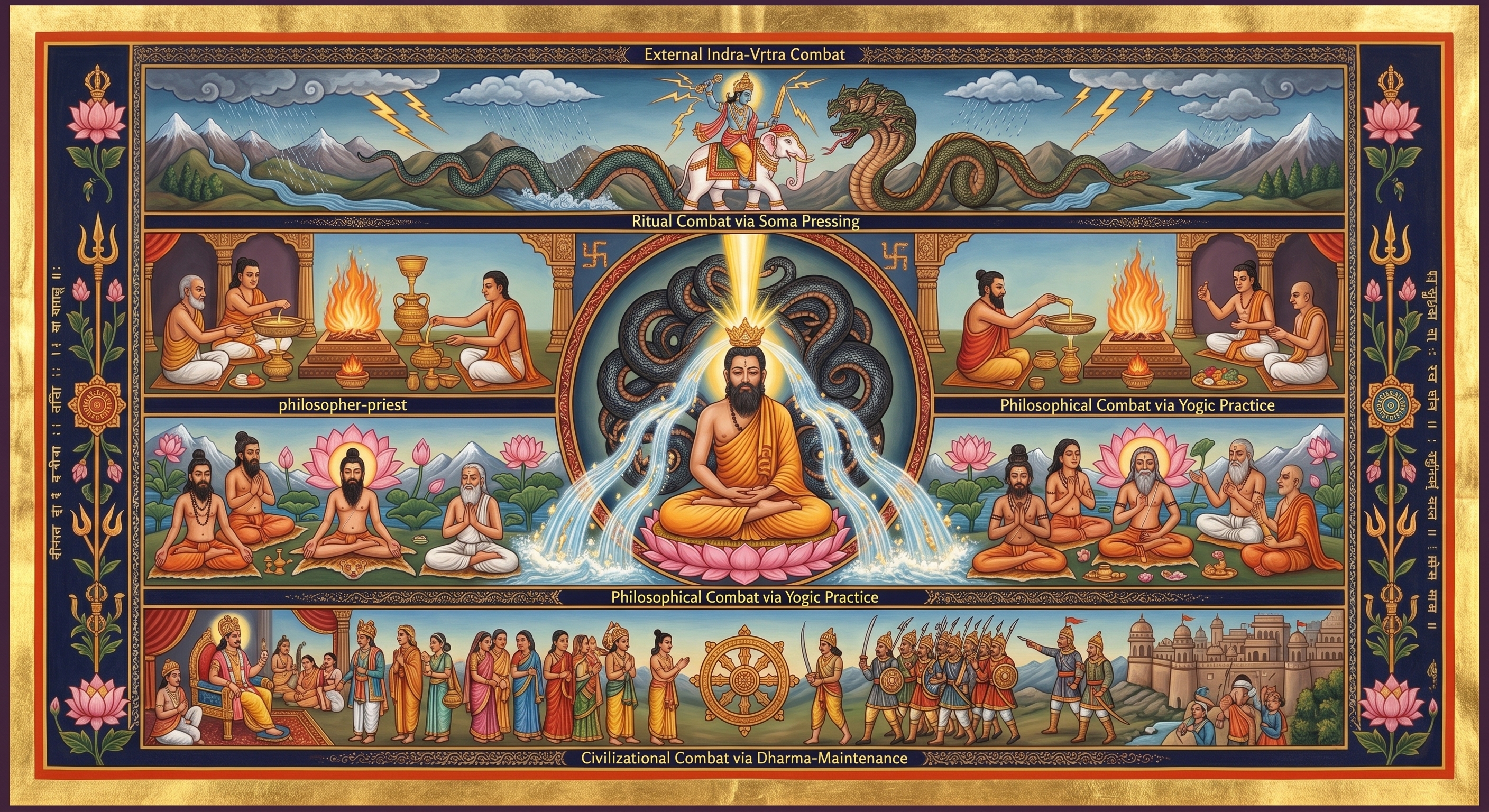
The Four Registers of the Cosmic Combat
Indra's victory over Vṛtra is reenacted at every level: in the cosmos (the primordial slaying), in ritual (the daily Soma pressing), in the soul (the stilling of vṛttis), and in civilization (the maintenance of dharma). One combat, four simultaneous theatres.
Indra's victory over Vṛtra is reenacted at every level: in the cosmos (the primordial slaying), in ritual (the daily Soma pressing), in the soul (the stilling of vṛttis), and in civilization (the maintenance of dharma). One combat, four simultaneous theatres.
Part Ten: The Conclusion of the Three-Part Study
With this third section, the essential structure of our study is complete. We have shown:
In Part A, that the Greek Titanomachy as narrated by Hesiod, elaborated by Homer and the tragedians, and philosophically interpreted by Plato, Plutarch, and Proclus, is the paradigmatic form of the cosmic combat between sovereign divine order and primordial chaos, with Zeus as the thunder-wielding king whose victory institutes the articulated cosmos.
In Part B, that the same cosmic operation is performed in Egyptian religion through Horus's overthrow of Seth (establishing legitimate kingship against the entry of Izfet into the cosmos) and through Ra's daily defeat of Apophis (maintaining cosmic order against the permanent pressure of the chaos-serpent), with the Greek identification Zeus = Ammon = Osiris already attested in Herodotus and Plutarch confirming the ancient recognition of the structural identity between the Greek and Egyptian divine sovereigns.
In Part C, that the Vedic tradition preserves the same cosmic operation in Indra's slaying of Vṛtra and in the perpetual war of the Devas against the Asuras, with the philological identity of Zeus and Dyauṣ Pitṛ (both descending from PIE *Dyēus Ph₂tēr) demonstrating that the Greek and Vedic traditions are historically sibling preservations of a common prehistoric Indo-European religious system, within which Indra inherits the sovereign thunder-function that Zeus occupies in Greek.
The convergence across three great civilizations, independently developing in three language families, three geographical regions, over three to four millennia of textual witness, establishes beyond reasonable doubt that the cosmic-combat theology transcends any local cultural product of any one civilization, and operates instead as the recognition of an objective cosmic reality, seen from three angles, described in three inherited sacred tongues. The ancient world saw this clearly. The modern world has forgotten it, to its permanent philosophical impoverishment.
For the Zevist, this triple witness has a single practical implication: the cosmic combat is the deepest reality, and every human life is fought on its battlefield. The Titans are bound, Vṛtra lies under the waters, Apophis is repelled at every dawn, but the binding, the pinning, the repelling must continue, because the chaos-forces have not been annihilated but only subdued. The Gods have established the cosmos. The Gods hold the cosmos in place. The Zevist's task is to participate in the holding.
This participation happens at every level. It happens in ritual, when the practitioner chants the sacred names and binds the soul to the cosmic order. It happens in meditation, when the practitioner stills the internal vṛttis and releases the imprisoned waters of insight. It happens in ethics, when the practitioner refuses complicity with Izfet and acts according to Ma'at. It happens in civilizational labor, when the practitioner builds structures of truth against the ambient pressure of lie. Every scale is the same battle. Every victory at any scale is a local Titanomachy won.
The study closes where it began: with the thunder-bolt in the hand of the sovereign God. In Greek his name is Zeus. In Sanskrit his name is Indra. In Egyptian the sovereign-sky function is articulated across Horus and Ra. The Gods of the ancient world knew themselves in one another. The Zevist who recovers this knowledge recovers the true ancient religion, of which Zevism is the contemporary restoration, grounded in the Greek branch that philosophy developed most fully but open to the confirming testimony of every inherited cognate tradition.
Jan Gonda, The Ritual Sūtras:
इन्द्रः स्वाहा24
"Indraḥ svāhā"
"To Indra, the offering!"
M.L. West, Indo-European Poetry and Myth:
Ζεῦ πάτερ, ἤδ' ἀθάνατος, ἔκανες μέγα ἔργον25
"Zeu pater, ēde athánatos, ekanes méga ergon"
"O Father Zeus, immortal, you accomplished the great work."
Continue to:
References:
1 J.P. Mallory and D.Q. Adams, The Oxford Introduction to Proto-Indo-European and the Proto-Indo-European World, Oxford University Press, 2006, pp. 408-432; M.L. West, Indo-European Poetry and Myth, Oxford University Press, 2007, pp. 166-194
2 M.L. West, Indo-European Poetry and Myth, Oxford University Press, 2007, pp. 170-171
3 Calvert Watkins, How to Kill a Dragon: Aspects of Indo-European Poetics, Oxford University Press, 1995, pp. 297-341; M.L. West, Indo-European Poetry and Myth, Oxford University Press, 2007, pp. 238-259; Jaan Puhvel, Comparative Mythology, Johns Hopkins University Press, 1987, pp. 48-65
4 Ṛg Veda 1.32.1, Sanskrit text from van Nooten and Holland eds., Rig Veda: A Metrically Restored Text, Harvard Oriental Series 50 (Harvard University Press, 1994); translation adapted from Ralph T.H. Griffith, The Hymns of the Rig Veda, 1896; cf. Jamison and Brereton, The Rigveda: The Earliest Religious Poetry of India, Oxford University Press, 2014
5 Calvert Watkins, How to Kill a Dragon: Aspects of Indo-European Poetics, Oxford University Press, 1995, pp. 297-303 (formula), 448-459 (Vedic), 357-369 (Hittite Illuyankas), 460-469 (Greek Zeus and Typhoeus, Apollo and Python), 411-425 (Germanic), 441-446 (Celtic)
6 Ṛg Veda 1.32.2
7 Ṛg Veda 1.32.3
8 Ṛg Veda 1.32.4
9 Ṛg Veda 1.32.5
10 Ṛg Veda 1.32.7
11 Ṛg Veda 1.32.8
12 Ṛg Veda 1.32.9
13 Manfred Mayrhofer, Etymologisches Wörterbuch des Altindoarischen, Vol. II, Carl Winter Universitätsverlag, 1996, pp. 594-596; cf. M.L. West, Indo-European Poetry and Myth, Oxford University Press, 2007, pp. 256-259
14 Joseph Fontenrose, Python: A Study of Delphic Myth and Its Origins, University of California Press, 1959, pp. 217-273; cf. Walter Burkert, Structure and History in Greek Mythology and Ritual, University of California Press, 1979, pp. 18-34; Bruce Lincoln, Myth, Cosmos, and Society: Indo-European Themes of Creation and Destruction, Harvard University Press, 1986
15 Jan Assmann, Ma'at: Gerechtigkeit und Unsterblichkeit im Alten Ägypten, C.H. Beck, 1990, pp. 15-29; Jan Gonda, Vedic Literature, Harrassowitz, 1975, pp. 28-42 on ṛta; cf. Holger Kalweit, comparative study in Studies in the History of Religions 58 (1991); cf. Carolina López-Ruiz, When the Gods Were Born, Harvard University Press, 2010, pp. 130-170
16 Mary Boyce, A History of Zoroastrianism, Vol. I: The Early Period, Brill, 1975, pp. 192-228; cf. R.C. Zaehner, The Dawn and Twilight of Zoroastrianism, Weidenfeld and Nicolson, 1961, pp. 38-55; Michael Witzel, "Vedas and Upaniṣads," in Gavin Flood ed., The Blackwell Companion to Hinduism, Blackwell, 2003, pp. 68-101
17 Wendy Doniger, Hindu Myths: A Sourcebook Translated from the Sanskrit, Penguin Classics, 1975, pp. 273-280; cf. Alf Hiltebeitel, The Ritual of Battle: Krishna in the Mahabharata, Cornell University Press, 1976; Cornelia Dimmitt and J.A.B. van Buitenen, Classical Hindu Mythology: A Reader in the Sanskrit Purāṇas, Temple University Press, 1978, pp. 72-82
18 Bhagavad Gītā 4.7-8, Sanskrit text from S.K. Belvalkar ed., Bhagavadgītā (critical edition of the Mahābhārata, BORI, 1961); translation adapted from Winthrop Sargeant, The Bhagavad Gītā, 25th anniversary edition, SUNY Press, 2009
19 Devī Māhātmya 2.32-3.42 (paraphrased); Sanskrit critical edition by Vasudeva S. Agrawala, Devī-Māhātmya: The Glorification of the Great Goddess, All-India Kashiraj Trust, 1963; cf. Thomas B. Coburn, Encountering the Goddess: A Translation of the Devi-Mahatmya and a Study of Its Interpretation, SUNY Press, 1991
20 Patanjali, Yoga Sūtra 1.2, Sanskrit text from Swami Hariharananda Aranya, Yoga Philosophy of Patanjali with Bhasvati, SUNY Press, 1981; cf. Edwin F. Bryant, The Yoga Sutras of Patanjali, North Point Press, 2009, pp. 10-30
21 Jaan Puhvel, Comparative Mythology, Johns Hopkins University Press, 1987, pp. 48-75; M.L. West, Indo-European Poetry and Myth, Oxford University Press, 2007, pp. 166-259; Emile Benveniste, Indo-European Language and Society, University of Miami Press, 1973, Book V on "Religion"
22 Mary Boyce, A History of Zoroastrianism, Vol. I: The Early Period, Brill, 1975, pp. 62-75; cf. Gherardo Gnoli, Zoroaster's Time and Homeland, Istituto Universitario Orientale, 1980; cf. Émile Benveniste and Louis Renou, Vṛtra et Vṛθragna: Étude de mythologie indo-iranienne, Imprimerie Nationale, 1934 (the foundational comparative study)
23 Calvert Watkins, How to Kill a Dragon: Aspects of Indo-European Poetics, Oxford University Press, 1995, pp. 464-468; cf. Hanns-Peter Schmidt, "Indo-Iranian Mitra Studies: The State of the Central Problem," in Études Mithriaques, ed. Jacques Duchesne-Guillemin, Brill, 1978, pp. 345-393
24 Vedic ritual formula, used throughout the śrauta sacrifice; cf. Jan Gonda, The Ritual Sūtras, Harrassowitz, 1977
25 Reconstructed Indo-European-style vocative address; cf. the analysis of preserved address-formulas in M.L. West, Indo-European Poetry and Myth, pp. 168-172
Sources
- Ṛg Veda, Sanskrit text: van Nooten, Barend A. and Holland, Gary B., eds., Rig Veda: A Metrically Restored Text with an Introduction and Notes, Harvard Oriental Series 50, Harvard University Press, 1994
- Ṛg Veda, translation: Jamison, Stephanie W. and Brereton, Joel P., The Rigveda: The Earliest Religious Poetry of India, 3 vols., Oxford University Press, 2014
- Griffith, Ralph T.H., The Hymns of the Rig Veda, E.J. Lazarus, 1896 (standard older English translation)
- Geldner, Karl Friedrich, trans., Der Rig-Veda aus dem Sanskrit ins Deutsche übersetzt, Harvard Oriental Series 33-36, Harvard University Press, 1951-1957
- Macdonell, Arthur Anthony, Vedic Mythology, Trübner, 1897 (foundational study)
- Watkins, Calvert, How to Kill a Dragon: Aspects of Indo-European Poetics, Oxford University Press, 1995
- West, M.L., Indo-European Poetry and Myth, Oxford University Press, 2007
- Mallory, J.P. and Adams, D.Q., The Oxford Introduction to Proto-Indo-European and the Proto-Indo-European World, Oxford University Press, 2006
- Mayrhofer, Manfred, Etymologisches Wörterbuch des Altindoarischen, 3 vols., Carl Winter Universitätsverlag, 1992-2001
- Dumézil, Georges, Mitra-Varuna: An Essay on Two Indo-European Representations of Sovereignty, trans. Derek Coltman, Zone Books, 1988
- Dumézil, Georges, The Destiny of the Warrior, trans. Alf Hiltebeitel, University of Chicago Press, 1970
- Puhvel, Jaan, Comparative Mythology, Johns Hopkins University Press, 1987
- Benveniste, Emile, Indo-European Language and Society, trans. Elizabeth Palmer, University of Miami Press, 1973
- Boyce, Mary, A History of Zoroastrianism, Vol. I: The Early Period, Brill, 1975
- Zaehner, R.C., The Dawn and Twilight of Zoroastrianism, Weidenfeld and Nicolson, 1961
- Witzel, Michael, "Vedas and Upaniṣads," in Gavin Flood, ed., The Blackwell Companion to Hinduism, Blackwell, 2003, pp. 68-101
- Witzel, Michael, "The Rigvedic Religious System and its Central Asian and Hindu Kush Antecedents," in Arlo Griffiths and Jan Houben, eds., The Vedas: Texts, Language, and Ritual, Egbert Forsten, 2004, pp. 581-636
- Gonda, Jan, Vedic Literature (Saṃhitās and Brāhmaṇas), Harrassowitz, 1975
- Gonda, Jan, The Ritual Sūtras, Harrassowitz, 1977
- Olivelle, Patrick, ed. and trans., Upaniṣads, Oxford World's Classics, Oxford University Press, 1996
- Radhakrishnan, S., trans., The Principal Upaniṣads, Harper, 1953
- Sargeant, Winthrop, trans., The Bhagavad Gītā, 25th Anniversary Edition, SUNY Press, 2009
- Van Buitenen, J.A.B., trans., The Mahābhārata, 3 vols., University of Chicago Press, 1973-1978
- Bryant, Edwin F., trans. and commentary, The Yoga Sutras of Patanjali, North Point Press, 2009
- Aranya, Swami Hariharananda, Yoga Philosophy of Patanjali with Bhasvati, SUNY Press, 1981
- Doniger, Wendy, trans., Hindu Myths: A Sourcebook Translated from the Sanskrit, Penguin Classics, 1975
- Doniger, Wendy, The Hindus: An Alternative History, Penguin, 2009
- Hiltebeitel, Alf, The Ritual of Battle: Krishna in the Mahabharata, Cornell University Press, 1976
- Dimmitt, Cornelia and van Buitenen, J.A.B., Classical Hindu Mythology: A Reader in the Sanskrit Purāṇas, Temple University Press, 1978
- Coburn, Thomas B., Encountering the Goddess: A Translation of the Devi-Mahatmya and a Study of Its Interpretation, SUNY Press, 1991
- Agrawala, Vasudeva S., Devī-Māhātmya: The Glorification of the Great Goddess, All-India Kashiraj Trust, 1963
- Pollock, Sheldon, The Language of the Gods in the World of Men: Sanskrit, Culture, and Power in Premodern India, University of California Press, 2006
- Fontenrose, Joseph, Python: A Study of Delphic Myth and Its Origins, University of California Press, 1959 (indispensable for the comparative dragon-slaying complex)
- Burkert, Walter, Structure and History in Greek Mythology and Ritual, University of California Press, 1979
- Lincoln, Bruce, Myth, Cosmos, and Society: Indo-European Themes of Creation and Destruction, Harvard University Press, 1986
- López-Ruiz, Carolina, When the Gods Were Born: Greek Cosmogonies and the Near East, Harvard University Press, 2010
- Assmann, Jan, Ma'at: Gerechtigkeit und Unsterblichkeit im Alten Ägypten, C.H. Beck, 1990 (for the Ma'at ṛta comparative frame)
- Eliade, Mircea, The Myth of the Eternal Return, Princeton University Press, 1954
- Flood, Gavin, An Introduction to Hinduism, Cambridge University Press, 1996
- Parpola, Asko, The Roots of Hinduism: The Early Aryans and the Indus Civilization, Oxford University Press, 2015