
 አማርኛ
አማርኛ العربية
 বাংলা
বাংলা Български
 中文
中文 Čeština
 Dansk
Dansk Deutsch
 Eesti
Eesti Ελληνικά
 Español
 Français
 हिन्दी
 Hrvatski
 IsiZulu
 Italiano
 日本語
日本語 Kiswahili
 Magyar
 Македонски
 नेपाली
 Nederlands
 فارسی
فارسی Polski
 Português
 Română
 Русский
 Slovenščina
 Suomi
Suomi Svenska
 Tagalog
 Türkçe
Apollonius reached a spiritual level that is of the Gods, capable of all sorts of miracles. Towards the end of his life, he was so spiritually advanced that he was reported to be able to raise the dead, or do what we presently call "Teleportation" or "Bi-Location". These far surpassed the "miracles" claimed by the hoax of "Jesus". The enigmatic figure of Apollonius was loved by everyone – no matter where he went, people flocked to listen to his sermons, and he was adored by all people.
He spread healing and positivity everywhere he went. Leaders of the time bowed to Apollonius and his massive wisdom, many recognizing him as a god in the flesh, while even more leaders wrote epistles to him. There are surviving fragments of his replies to them. Apollonius left behind a major wealth of written knowledge, that was burned and destroyed by the Yehuborim.
Apollonius was called a
'Demonic Magician' by the Church, and demonized.13
Apollo: Hieratic Information
author: High Priest Zevios Metathronos
The knowledge presented on this page is advanced and contains information for those who want to get to know Apollo in depth. There is also the inclusion of hieratic [deeply spiritual] knowledge, such as the Divine Names of Apollo.
In regards to additional information on Divine Names, these are Names which are numerologically sound Divine Names to use for Summoning and Invocation:
Divine Names
- Azazee-eel [pronounced AZAZ-EE-EEL]
- UDDTHU [U-D-U]*
- PAIANA [PE-ANA]*
- APOLON [A-POL-ON]
Divine Symbols
- Lyre (Musical Instrument)
- Sun Disk
- The Letter "E"
- Golden Bow
- Golden Arrow
Divine Numbers and Attributes
- Numbers: 5, 7, 20, 36*
- Runes: Sowilo, Raidho, Kenaz*
- Zodiac Sign of Power: Scorpio [Degrees of Ophiuchus]*
- Divine Animal Symbol: Python [species of snake], Hawk, Dove, Dolphin*, Mockingbird*
Psalm of Apollo
- COMING SOON
Divine Forces
- The Light
- Music
- Harmony
- Law
- Justice
- Grace
- Prophecy
Important Titles
- Lord Of The Light
- Helios
- Light Bringer
- Heavenly Protector
- Mousaios [Musician]
- Divine Juror
- Eternal Sun
Other Names:
APOLLO (Greek; God of Shining Sun), Mithra (Roman), Mitra/Surya (Vedic Period), LUGUS/LUGH (Irish/Welsh), SHAMASH (Babylonian), UTU (Sumerian; The Shining One),* SAMAS (Akkadian), BABBAR (Sumerian), Ashur (Assyrian), SHAMIYAH (Hathra), SAMYAZA, SEMJAZA, SEMIHAZAH, SEMIHAZAI (as he appears in a lot of Yehuboric literature, taken from Middle Eastern names and titles of the God), Japanese Susanoo-No-Mikoto, Aztec Huitzilopochtli, AZAZEL aka ZAZEL (Arabic)
[*] There is no problem with also casually referring to him as Azazel in ordinary speech. Azazel is of Arabic origin. The Hieratic Names are above and will give the best contact for spiritual works such as summoning.
Azazel is one of these Gods who have been among the most popular in the Ancient World. A longstanding and most powerful God, he has been followed by all of the Ancient Civilizations.
Lord Azazel is a god of harmony, majesty, beauty, art, and high spirituality. His strong association with the Sun is a principle that fits strongly into his status and nature. Under all his manifestations, he has been a God of Justice. He strongly stands for people "paying their dues" and people "getting paid their due," in a karmic way.
Azazel has given humanity many gifts. In many languages, the phrase still survives that "Nothing remains hidden under the Sun." Utu, the Sumerian Name of the God, is credited with being able to see "everything that happens within the world," but also with observing the relations between people towards one another. Apollo's Oracle was consulted in Ancient Greece on the soundness of laws and legal systems, so that they would not be wrong or abusive to the citizens.1,2
Alongside many other Pagan deities in many Pantheons, he was worshiped by the Ancient Greeks and many others under the very famous name "Apollo." Apollo is not the specific God of the Sun in the sky as a heavenly body, but rather represents the majesty and power of the Sun. The literal Sun in the heavens is the God "Helios" in Ancient Greek. Helios was also used as a title for Azazel, as in "Helios Apollo" or the "Apollo of the Sun," to signify his major powers and high spiritual rank.
Apollo's powers are many, but centered around the arts, music, medicine, and prophecy. Prophecy is a very elaborate practice, involving all the divinatory arts, which bestow upon one the ability to tell the past, present, or future. Each of these powers has a lot of depth and analysis to it. It would take an encyclopedia to explain everything about Him, as Apollo is very rich in mysteries and knowledge.3
As Mithra, during the time of the Romans, he was patron of the mysteries of Rome. There again, he was strongly associated with the Sun. In Mithraism, there were 7 levels of initiation. In the Vedic literature, he was called "Mitra," again strongly associated with the Sun and the keeping of oaths.
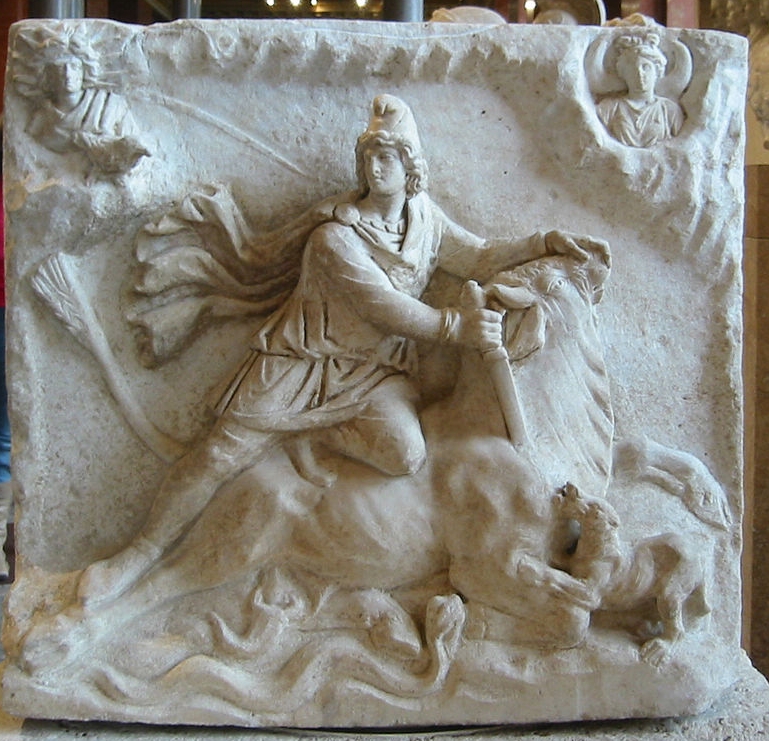
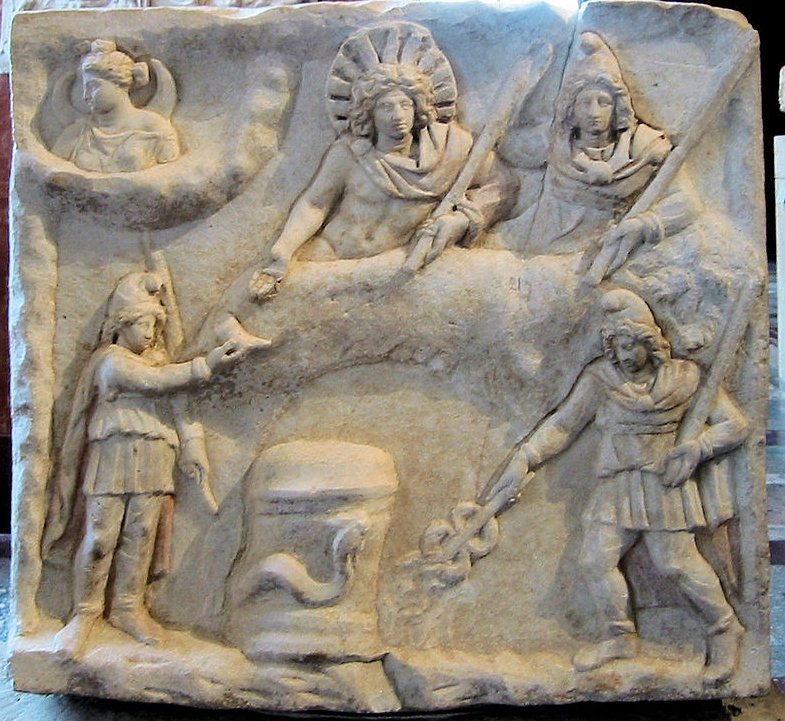
In the symbolism of the Roman Mithra, we can see Apollo giving the light and laws, and extending his hand as a gesture of help towards the initiate. His symbol, that of the Python [also related to Kundalini], is being pointed at by the initiate, to the right.
In the same depiction, Apollo appears armed, holding a sword in one hand. With his other hand, he communes with the human disciple in a friendly manner. We also see one disciple being "lifted" to the place of the God, who appears to be on a mountain or a cloud.
The Phrygian Cap worn by the initiates is a very important symbol of the Mithraic rites. It symbolizes the opening of the consciousness. Like in many of his depictions, he has a Halo and a Solar Disk around his head.
The slaying of the Bull is symbolic of many things. The slaying of the bull, from an everyday perspective, is symbolic of control over one's creative drives. On the inscription to the left, we also see the Sun and Moon Gods, symbolizing Union [unified by Mithra and the Bull].
Apollo is strongly associated with the sun's rays and the radiance of spiritual power. The titles given to the God have been many, extensive, and most esteemed and honorable. Apollo was given hundreds of glorifying epithets. He is a "God of Music", the hidden meaning of music being the music of the planetary spheres or the higher levels of existence, represented by the seven musical octaves. These represent the rising levels towards enlightenment for the individual human being.4
In the deeper mysteries, Apollo is a most wise teacher of the Arts of Alchemy and the workings of the light of the soul. His instrument is the Lyre, symbolizing the knowledge of all the dimensions of the world, symbolized by each of the seven respective cords of the Lyre, all of which correspond to one of the 7 main chakras. As a result, Apollo was termed by Ancient Greek Philosopher Plutarch as the "inventor of music", alongside Hermes or Thoth, who created his lyrical instruments. The two Gods also share a very close relationship, based on strong friendship. Apollo can heal through music, a symbolism for the correct chanting of mantras into the soul, but also literal music. Such "songs" were named "Pe-ans" by the Ancient Greeks.5
His rites, which were purificatory, dealt with the power of the sun to purify the human soul. Additionally, he was known to possess exceptional prophetic abilities, and he bestows the gift of looking into the future or extensive prophetic powers, being himself a God who is a master diviner. These abilities come from purifying and uplifting spiritually the Soul, by making use of the knowledge of the Gods.6
Plutarch, a most prominent Greek philosopher and Pagan theologian, writes about our esteemed God in his work "In Regards to the Delphic Epsilon":
"Our beloved Apollo heals the woes of our lives, solving them by the giving of oracles to all those who will ask him, while he himself sets inside us and gives rise to spiritual longings in philosophers, to ask necessary questions towards the correct knowledge [logos] - he does this by making our soul open to the truth, something obvious in many other things [relating to the God], but also obvious in his choice for the letter E to represent him."7
The pronunciation of the letter "E" was what one had to say upon entering and exiting the temple of Apollo in Delphi. The choice of this letter was
considered a great mystery of the God. The
letter was pronounced exactly like the word "Hey" of today, a common greeting between people who speak English but also other languages. The word "Ei"
in Ancient Greek [which was used for the
greeting inside Apollo's Temple], had, however, another spiritual notion. It translated as "That which truly is", a sublime parable of the power of
"existing".8 The letter E is
strongly symbolized in his Sigil, too. The relation between the letter E and his temple is illustrated clearly here on the coin.
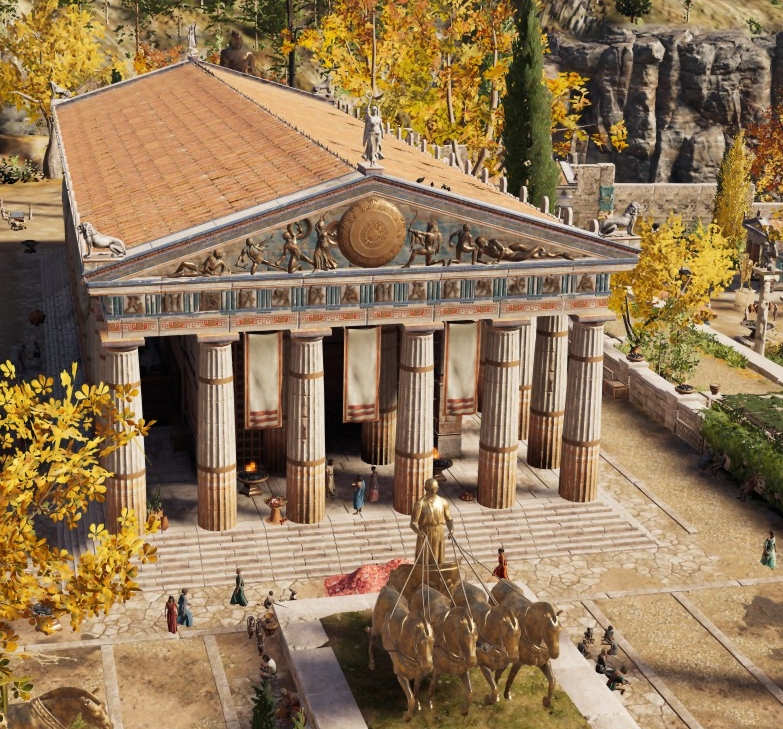
Temple of Apollo in Delphi, Reconstructed
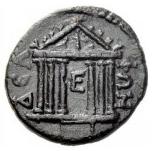
Coin symbolic of the Temple
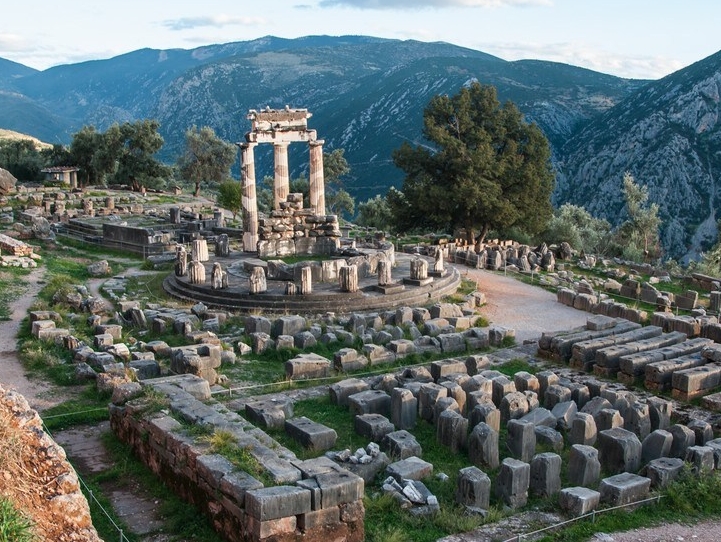
The remains of the Temple in Delphi, Greece today
On the entrance to the Temple of Delphi, there were inscriptions of wisdom. Three of these were on the entrance.
The First One:
"KNOW THYSELF"
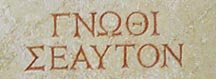
A most important occult statement, adopted for thousands of years by all mystery schools.
Here, Apollo describes the importance of meditation and knowing yourself. Without self-understanding, there is no wisdom.
The Second One:
"NOTHING IN EXCESS"
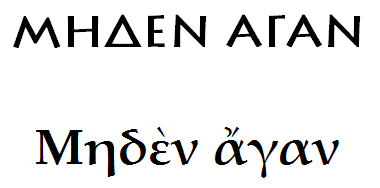
Excess here describes a situation of imbalance and lack of harmony, either through lacking in something or through an overabundance that causes disharmony and, therefore, damage.
This "excess" is also a code-word for the balance of the soul.
The Third One:
"PLEDGE [Certainty], THEN CALAMITY"

This statement translates to "A pledge, then a calamity".
This is the most cryptic of the three statements.
This statement warns strongly against being deluded by false certainty, which can later bring calamity.
It warns against "pledging" one's self to rumors or false ideals.
Going back to the Oaths, Mithra was also strongly identified, like all other names of Apollo, with the ability to take oaths and keep them. The oaths not only relate to literal oaths, but also to the oaths of silence in the Ancient Mystery schools. As Lugus for the Irish, he was also the God of bright vibrancy and the keeper of the oaths. The same is also true of his Vedic identity as Mitra.9
Today, a very common practice of giving an Oath to the Gods is the Oath that all doctors give [clearly associated with the healing powers of Apollo], the Hippocratic Oath. Despite what modern doctors follow in their practices, the oath is true and binding.
In modern “Daemonology”, Apollo has been slandered as “Apollyon” and appears as such in many “Grimoires”. This is a blasphemy, and the word Apollyon means “he who goes away” or “he who gets thrown away”. This allusion is also about “Azazel’s” Goat, which is “thrown” from a cliff in the blood rituals Hebrews do yearly, to rebuke Azazel [Apollo]. While Apollo means all the positive things mentioned above, the word “Apollyon” serves as blasphemy to the God. Apollo was also known to send the curse of locusts on his enemies, and three Emperors that did severe damage to the Yehuborim were closely connected to Apollo. Christians to this day understand that the “Apollyon” figure in the Bible was one of “Satan’s Subordinates”, and a very powerful God that they also admit ruled over Rome, an empire built by the “Forces of Hell”.10
Even in the Yehuboric texts of defamation, Apollo, going under the Yehuboric title of "Semihazah", which means "The Great Rebellion", takes an oath with other Daemons so that they carry out the revolt against the tyranny of the Yehuborim, while Apollo says he will take the responsibility himself. Apollo, in opposition to the injustice of the Yehuborim to sink us spiritually, resisted. He was thus slandered for protecting mankind against the Yehuborim.11 The same is also reflected in how Apollo also joined the rest of the "Olympians" against the "Giants" or impure spirits in Gigantomachy, where Apollo takes arms to defend the other Gods.
Regardless, this myth reveals that Apollo actually "descended" on a mortal wife and gave her a son, the name of the woman being titled in the myth as "Coronis".12 The name "Coronis" implies the Greek word for Crown, so that is an allegory. Apollo in all Yehuboric literature is attacked strongly for "Descending" downwards to help mankind. This has to do with the arrival of the Gods a very, very long time ago. Important to know is that Apollo fathered a son with a physical wife, who was later called a Demi-God named Asclepius. Asclepius is the father of modern medicine and healing arts. Asclepius's symbol is also the symbol of his father, the entwined Python.
A most famous disciple and considered "Son" of the blessed God was "Apollonius" of Tyana. The myth of Apollonius describes him as a miracle worker and a man who reached the Godhead, attaining full immortality. Apollonius never died. All the writings, teachings, and instructions of Apollonius were later, after copious perversion and forgery, falsely accredited to the non-existent character named "Jesus". These include teachings such as "The Kingdom of God is within" and other occult statements. Of course, these were also common knowledge in the Mystery Schools of the time.
The Name of Apollonius means "He of Apollo"; thus he was called "Apollonius" of Tyana. The kindness and goodness of Apollo is great, and the gifts he bestows are numerous towards his disciples. Apollonius was known beyond any doubt to have become a God, with extensive powers related to Apollo, such as extreme wisdom, oracular ability, god-like levels of divination, but also many other powers. He was recognized as being a God by all the Ancient Priesthoods of the time. He was loved by all and travelled in Rome, the Middle East, Far East, India, Egypt, and Ancient Greece, giving teachings, spiritual knowledge, and promoting mystical knowledge. He was hailed as a living "God". Apollonius was a commoner, neither a king nor anything else. Yet, his intense love for Apollo and his extreme spiritual diligence gained him all the glory of the known world at the time. It was considered that inside him lived literally an aspect of the God Apollo.
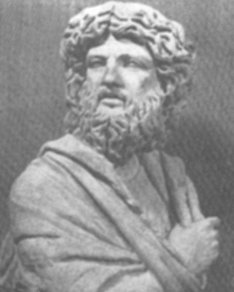
In contrast to the Yehuboric hoax of Jesus, which even claims that he was literally stoned and “crucified” by the Ancient Pagans of the time, Apollonius was indeed believed in and loved. Because of the extensive influence Apollonius had, the Christian Church destroyed all knowledge and mention of Apollonius, and where it didn’t remove all of it, it simply replaced it with the lowest slander. Apollonius was called a “goetic magician” by the Early Christian Church, and he was defamed and ridiculed to extents that few people have. This was an attempt to defame him, no different from how they did this to the literal Gods of the Ancient Peoples themselves.
Nobody loved “Jesus” whatsoever – the hoax had to be founded on the blood of the innocents, mostly shed centuries after “in his name” by mad emperors, and of course character murder of the true “Messiahs” such as Apollonius of Tyana. The empire of “Jesus” was built solely on blood.
As Apollonius was slandered as a man and was replaced by "Jesus", so did Apollo, of course, get slandered to no end by the Yehuborim.
The Name "Azazel" that the Yehuborim have been calling this God is based on two separate words. It is merely a title, and not the actual Name of the Deity. These were Azaz and EL. Numerous blasphemous interpretations have been written about this Name, as with any other Name of the Gods by the Yehuborim, yet their meaning remains clear even in present-day Arabic and Middle Eastern languages.
The word “Azaz” relates to meanings about “power” or “extreme power”. The word "EL" simply means "God", but commonly translates to "Light". However, God here is a code-word for the spiritual light. These two words put together signify Apollo's extreme power and spiritual brilliance; his power of the Light. Further revealed is the power and high rank of Apollo, as many of the Yehuboric texts do refer to Azazel as the "Leader of the Hosts of Evil", i.e., the Gods. His position of high importance, like in the Pagan Pantheon, is openly recognized by the Yehuborim too. Azazel’s Name in the Yehuboric literature is also described as “Azael”, meaning “He who God Strengthens”. This is a code word again for the light. He is also “condemned” and attacked for giving the “Secrets of the Heavens” to mankind, or spiritual knowledge.14
There are few Daemons that are as powerful as Apollo, and Apollo is very high-ranking and loyal to Zeus, Aphrodite, and all other Gods. It's also stated that he is so important in this hierarchy that the Yehuborim center many of their attacks specifically on Apollo because they recognize his superior power and higher rank, but also how many of the Gods thrive under him. They know that if "Azazel befalls" them, it will be over for them.15
Except for being reduced to a mere "Demon", the Yehuborim are so insistent on trying to hide Apollo's power that they have devoted one of their most important Religious Holidays [Yom Kippur] to a direct, full-on attack against Azazel. A Goat is brutalized during these dates, where ritualistic rites, curses, and abuse are done on it by the Abrahamics. The goat is left desolate to die, or thrown off a cliff, to die a slow and painful death. The symbolism of the Goat is symbolic of both the Pagan cultures, yet there are many other more cryptic messages in this ritual attack that is conducted yearly by the Abrahamics.16
Apollo, in the external world, represents the protection of children and is patron of children and their education. Apollo was called “Apollo Kourothrophos”, implying he is the nurturer and protector of the children. He was considered a force that helps them grow into adulthood and protects children during this time in their life. The “Child” here is also a code word for the new soul that arises from meditation, progressively growing and reaching enlightenment or maturity. In the linear world, he protects and oversees children and their growth, but also education so that they become full adults.17
As Zeus is rebuked because his name means "Eternal Truth" in Sanskrit [Satan], so is Apollo rebuked in response to the Yehuborim's opposition to the collective splendor and Justice-oriented nature of Paganism. The Yehuboric religions preach lawlessness, excusing crimes indefinitely, turning the other cheek, and so on.
Apollo is also the deliverer of Justice. While he bestows many gifts to his disciples and people, he can be the exact reverse when it comes to the enemies of the Gods. He can bring very dark calamities, and as bright and beautiful as he can be in his loving face, so dark and bleak can the curses he casts on his enemies be. The power of Apollo to curse was symbolized by his bow, with which he flung darts onto his enemies. Socrates in Plato's work refers to this power as his power to "Cast Darts", which can bring major damage to enemies.18 On the contrary, Apollo is a strong protector for those of the Gods, averting evil from reaching them.19
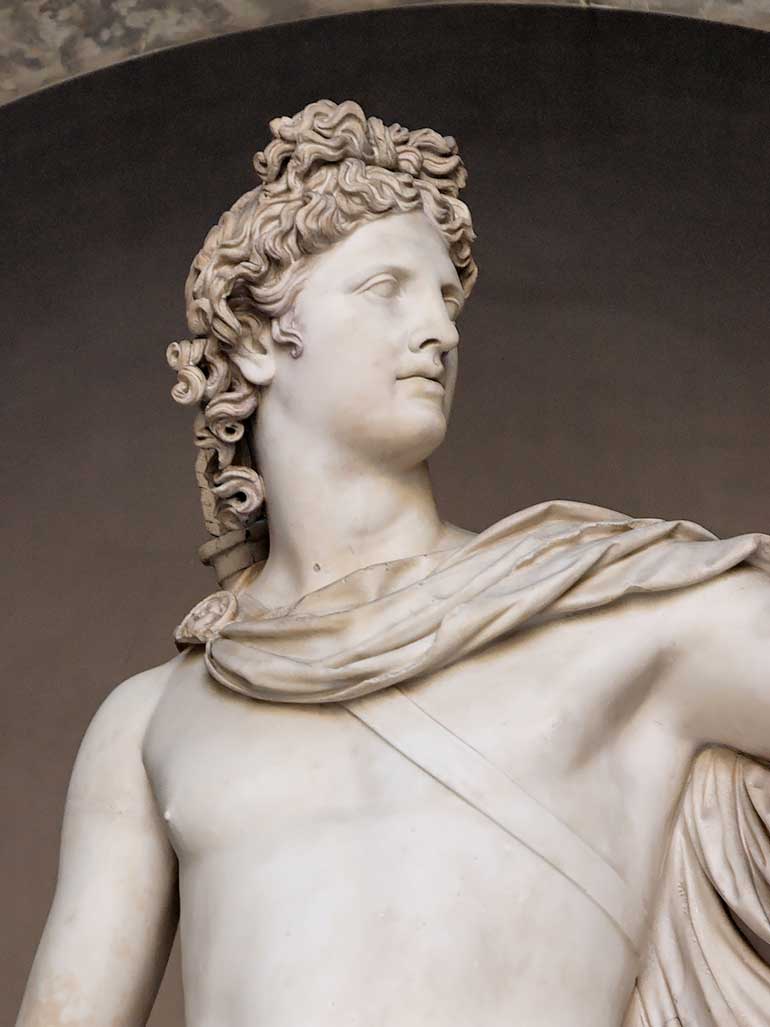
The statue on the left is one of the greatest forms of fine art the world has ever seen. It is called 'Apollo Belvedere' and it currently resides in the Vatican. Even the Vatican could never pass as a construct worth existing without stealing the artwork of the Gods and the Ancients.
The beauty of Apollo is so extensive that the phrase 'Apollonian Body' is still commonly used to describe aesthetic perfection. Apollo represents a very strong balance between being a man but having beautiful grace.
Apollo was regularly called 'Uranios', which means 'Heavenly', as in Heavenly Apollo. The title, except for being a spiritual title, is also pointing to the beauty of this God. For centuries, Apollo was considered one of the ultimate types of human beauty and perfection.
In our modern world, Apollo remains a major inspiration for us humans collectively. NASA's most important mission to get to the moon was named after the God Apollo. It was also the first successful mission of landing on the moon. Except for reaching the starry heavens in this manner, Apollo still remains an inspiration for those who want to reach the heavens in their souls.
Those who partake in the spiritual communion with this God will find all the power shining strongly above them.
HAIL APOLLO!!!
Sources/Bibliography:
1 Wikipedia, God UTU [Sumerian]
2 Wikipedia on Apollo https://en.wikipedia.org/wiki/Apollo- On the other hand, Apollo also encouraged founding new towns and establishment of civil constitution. He is associated with dominion over colonists. He was the giver of laws, and his oracles were consulted before setting laws in a city.
3 Luke Roman & Monica Roman, "Apollo", Encyclopedia of Greek and Roman Mythology, 2010
4 HellenicGods.org – Apollo, https://www.hellenicgods.org/the-lyre-of-apollo
5 Ibid 4.
6 Utu as Helper and Rescuer, Section on Sumerian God Utu: https://www.encyclopedia.com/environment/encyclopedias-almanacs-transcripts-and-maps/utu
7 Plutarch, "In regards to the Greek Epsilon of Deplhi"
8 Ibid 7
9 From Wikipedia on the God Lugus - The exact etymology of Lugus is unknown and contested. The Proto-Celtic root of the name, *lug-, is generally believed to have been derived from one of several different roots, such as *leug- 'black', *leuǵ- "to break", and *leugʰ-'to swear an oath'. It was once thought that the root may be derived from Proto-Indo-European *leuk- 'to shine', but there are difficulties with this etymology and few modern scholars accept it as being possible (notably because Proto-Indo-European *-k- never produced Proto-Celtic *-g-).
10 This source is of the Yehuborim, where they casually attack the Gods, BEWARE: Christianity.com,"What Is the Apollyon?", https://www.christianity.com/wiki/christian-terms/what-is-the-apollyon.html
11 Book of Enoch [warning, this material is of the Yehuborim - foul and corrupted, but is given solely as reference]: And Semjâzâ, who was their leader, said unto them: 'I fear ye will not indeed agree to do this deed, and I alone shall have to pay the penalty of a great sin. And they all answered him and said: 'Let us all swear an oath, and all bind ourselves by mutual imprecations not to abandon this plan but to do this thing.' Then sware they all together and bound themselves by mutual imprecations upon it. (Enoch 6:3-5)
12 Coronis (Wife Of Apollo), https://en.wikipedia.org/wiki/Coronis_(lover_of_Apollo)
13 "God On Earth: Apollonius of Tyana", Kalogerakis Gerasimos, 2009
14 Rosemary Ellen Guiley, "Encyclopedia of Daemons and Daemonology", page 20
15 Andrei Orlov, "Azazel as the Celestial Scapegoat", excerpts from which are translated here: https://www.marquette.edu/maqom/azazelscapegoat.htmlThe author of the article points to the book "Symbola Caelestis. Le symbolisme liturgique et paraliturgique dans le monde Chrétien".
16 Encyclopedia Britannica, "Azazel"section. The source further elaborates:"After the high priest symbolically transferred all the sins of the hebrew people to the scapegoat, the goat destined"for Azazel" was driven into the wilderness and cast over a precipice to its death. Azazel was the personification of uncleanness and in later rabbinic writings was sometimes described as a fallen angel." https://www.britannica.com/topic/Azazel
17 Wikipedia on Apollohttps://en.wikipedia.org/wiki/Apollo: "As the protector of young (kourotrophos), Apollo is concerned with the health and education of children. He presided over their passage into adulthood."
18 Plato's Cratylus, Socrates to Ermogenes about Apollo
19 Pausanias, Description of Greece 6. 24. 6 : 'Apollon Akesios (Healer): The meaning of the name would appear to be exactly the same as that of Alexikakos (Averter of Evil), the name current among the Athenians.'
* From Lord Azazel directly to High Priest Zevios Metathronos