Theme
☼
author: High Priest Zevios Metathronos
To the family of Zevists. A working teaching, grounded in Plato's Theaetetus, Republic, Timaeus, Phaedrus and Laws, in the Orphic, Pythagorean and Presocratic witnesses before him, and in the Platonic succession after him. This sermon sets out 3 things that must stand clear before anything else is said about the Gods: that the Godhead, the becoming of man as the Gods, is the original and explicit aim of the ancient path and is older than every doctrine that forbids it; that the prohibition against it enters history with the Genesis account and the doctrines built upon it, and that the modern "reactions" to that prohibition are its by-products and carry no originality of their own; and that Zevism is the completed and literal path to this end, with Meditation, Ethics, a life in service and Theurgy as its 4 dimensions.
Many people today look into childish modernity for their knowledge of the Gods. They read cheap sources, they repeat what those sources say, and some of them then argue that the core position of the Temple of Zeus, the promotion of the Godhead, is a "modern" thing, or that the modern things they've read are somehow "original". There's something to relate to everyone on this, and it belongs at the very beginning.
The idea of the Godhead isn't new. Nobody invented it recently. And it's certainly no reaction to the popularized Abrahamic doctrine. If anything, the relationship runs the other way. The reactions on display today are the consequential expressions of a lack. Those who were left destitute by the prohibitions long for a return.
A return to where? That's the question. And the answer is the core idea of the path of the Gods, standing clearly as the central aim of man.
"Becoming as the Gods" was never invented. It's nothing modern. It relates conceptually to nothing less than the core of the Gods themselves. The popularized comment for which "man was driven out of Eden" was the true aim of the ancient spiritual system.
So 3 things sit on the table, and they must be told apart from the start.
| What it is | What it does with the aim | |
|---|---|---|
| The Original | The original manuals and the original aims: the ancient path, stated by Plato with precision and lived by the initiates before him | Names it, teaches it, and orders a whole life around it |
| The Prohibition | The prohibitive manuals, written for mass control | Turns it into the first sin and posts a guard against it |
| The Reaction | The reactions of the uneducated to those prohibitions | Mistakes its own resentment for the original, and never reaches the source |
From the 3, one who is wise picks the First: the Original. Everything below serves that choice.
Plato states the point of every spiritual and divine discipline in 1 sentence. He wrote the Theaetetus around 369 BCE. He was born in the 5th century BCE, and some would argue that the doctrine in the sentence stands way before him; Section IV shows they're right. The sentence has been quoted for 24 centuries:
Plato, Theaetetus 176a-b:
«διὸ καὶ πειρᾶσθαι χρὴ ἐνθένδε ἐκεῖσε φεύγειν ὅτι τάχιστα. φυγὴ δὲ ὁμοίωσις θεῷ κατὰ τὸ δυνατόν· ὁμοίωσις δὲ δίκαιον καὶ ὅσιον μετὰ φρονήσεως γενέσθαι.»
"Therefore one must try to flee from here to there as quickly as possible. And the flight is becoming like God, as far as is possible; and becoming like God is to become just and holy, with wisdom."
Read it slowly. Plato literally tells the reader what the point of all the spiritual and divine disciplines is: to become a God. He names the destination, and he names the road, in plain words.
There's no "humanity cannot connect to the Divine" here. There's no "Man is separate from God". There's no "the Most High exists somewhere in the clouds and man cannot reach it". None of the falsehoods and pivots that take place later in religion appear in this text. The statement is explicit.
He repeats it a few lines further on, and there he binds it to Justice:
Plato, Theaetetus 176b-c:
«θεὸς οὐδαμῇ οὐδαμῶς ἄδικος, ἀλλ᾽ ὡς οἷόν τε δικαιότατος, καὶ οὐκ ἔστιν αὐτῷ ὁμοιότερον οὐδὲν ἢ ὃς ἂν ἡμῶν αὖ γένηται ὅτι δικαιότατος.»
"God is in no way and in no manner unjust, but as just as it is possible to be, and nothing is more like him than whichever of us becomes as just as possible."
And this was no passing remark in 1 dialogue. He set the same destination in the Republic, in the Laws and in the Phaedrus, across the whole of his working life:
Plato, Republic X, 613a-b:
«οὐ γὰρ δὴ ὑπό γε θεῶν ποτε ἀμελεῖται ὃς ἂν προθυμεῖσθαι ἐθέλῃ δίκαιος γίγνεσθαι καὶ ἐπιτηδεύων ἀρετὴν εἰς ὅσον δυνατὸν ἀνθρώπῳ ὁμοιοῦσθαι θεῷ.»
"For the Gods never neglect one who is willing to strive to become just and, by practising virtue, to become like God as far as is possible for a man."
Plato, Laws IV, 716c-d:
«ὁ δὴ θεὸς ἡμῖν πάντων χρημάτων μέτρον ἂν εἴη μάλιστα, καὶ πολὺ μᾶλλον ἤ πού τις, ὥς φασιν, ἄνθρωπος· τὸν οὖν τῷ τοιούτῳ προσφιλῆ γενησόμενον, εἰς δύναμιν ὅτι μάλιστα καὶ αὐτὸν τοιοῦτον ἀναγκαῖον γίγνεσθαι.»
"God, then, would be for us the measure of all things in the highest degree, and far more so than any man, as they say. He who would become dear to such a one must, so far as he can, become himself such as He is."
Plato, Phaedrus 252e-253a:
«οἱ μὲν δὴ οὖν Διὸς δῖόν τινα εἶναι ζητοῦσι τὴν ψυχὴν τὸν ὑφ᾽ αὑτῶν ἐρώμενον [...] καὶ οὕτω καθ᾽ ἕκαστον θεόν, οὗ ἕκαστος ἦν χορευτής, ἐκεῖνον τιμῶν τε καὶ μιμούμενος εἰς τὸ δυνατὸν ζῇ.»
"Those who follow Zeus seek that the soul of the one they love be Zeus-like [...] and so, according to each God, each one lives honouring and imitating, as far as he can, the God whose chorus he belonged to."
4 dialogues, 1 doctrine. The ultimate imperative of the ancient path of the Gods was indeed for one to become in essence like them. This is the explicit aim.
Plato also places the instrument for it inside every human being. In the Timaeus he calls the highest part of the soul a daimon given by God to each person, and he says it lifts man from the earth toward his kindred in heaven, «ὡς ὄντας φυτὸν οὐκ ἔγγειον ἀλλὰ οὐράνιον», "as being a plant of heaven, and no plant of the earth" (Timaeus 90a). This means every individual and every person out there has this ability inside them. It must be unlocked and brought to life.
The whole doctrine rides on 1 word, so the word must be read with care.
Ὁμοίωσις is a verbal noun from ὁμοιόω, "to make like". The ending -σις names an action under way, the same ending as in γένεσις, "coming into being", or κίνησις, "motion". Greek keeps other words for a static resemblance. Ὁμοιότης is "similarity", the condition of 2 things looking alike. Εἰκών is "image", a copy of an original. Plato picked neither of those. He picked the word for the process by which one thing is made into the likeness of another, and then he defined the process: to become (γενέσθαι) just and holy, with wisdom.
The Ancient Greek word ὁμοίωσις therefore means, literally, for the man to transmute his essence into Divine Essence. Plato defines this as possible and sought after, and never as a theorem.
The schools after him read it exactly this way. Eudorus of Alexandria, in the 1st century BCE, set ὁμοίωσις θεῷ as the τέλος of the whole Platonic philosophy. Alcinous wrote it into the Didaskalikos (ch. 28) as the goal to which every other teaching is ordered. Plotinus opened his treatise on the virtues with Plato's sentence:
Plotinus, Enneads I.2.1:
«Ἐπειδὴ τὰ κακὰ ἐνταῦθα καὶ τόνδε τὸν τόπον περιπολεῖ ἐξ ἀνάγκης, βούλεται δὲ ἡ ψυχὴ φυγεῖν τὰ κακά, φευκτέον ἐντεῦθεν. τίς οὖν ἡ φυγή; θεῷ, φησιν, ὁμοιωθῆναι.»
"Since evils are here and haunt this region of necessity, and the soul wishes to flee from evils, one must flee from here. What, then, is the flight? To be made like God, he says."
From Plato to Proclus and Damascius, across 9 centuries, the Platonic succession never moved the destination. As far as the real universe is concerned, Plato explains explicitly what the aim of this path is: that it's applicable, walkable, possible, and even destined for the divine souls to follow.
Some would argue that the aim stands way before Plato. They're right, and the evidence survives in verse, on stone and on gold.
Pythagoras, in the 6th century BCE, gave his followers the maxim ἕπου θεῷ, "follow God". Iamblichus reports that the whole ordering of the Pythagorean life was arranged toward following the divine (On the Pythagorean Life 137).
Heraclitus, around 500 BCE, wrote the 2 conditions into 1 line:
Heraclitus, fr. B62 Diels-Kranz:
«ἀθάνατοι θνητοί, θνητοὶ ἀθάνατοι, ζῶντες τὸν ἐκείνων θάνατον, τὸν δὲ ἐκείνων βίον τεθνεῶτες.»
"Immortals mortal, mortals immortal, living the death of the others, dead in the life of the others."
Empedocles, around 450 BCE, addressed the citizens of Acragas and announced the outcome of the path in the first person:
Empedocles, fr. B112 Diels-Kranz:
«ἐγὼ δ᾽ ὑμῖν θεὸς ἄμβροτος, οὐκέτι θνητός, πωλεῦμαι μετὰ πᾶσι τετιμένος.»
"I go about among you an immortal God, no longer mortal, honoured among all."
And the Orphic initiates carried the same promise into the grave, engraved on gold leaf and laid on the tongue of the dead:
Orphic gold tablets from Thurii, 4th century BCE (OF 487 and 488 Bernabé):
«χαῖρε παθὼν τὸ πάθημα· τὸ δ᾽ οὔπω πρόσθε ἐπεπόνθεις· θεὸς ἐγένου ἐξ ἀνθρώπου.» / «ὄλβιε καὶ μακαριστέ, θεὸς δ᾽ ἔσῃ ἀντὶ βροτοῖο.»
"Hail, you who have suffered the suffering; this you had never suffered before: a God you have become, out of a man." / "Happy and blessed one, a God you shall be instead of a mortal."
The aim precedes Plato. What Plato gave it was its exact definition and its exact method. That's what a philosopher does with what the path already carries. The core of the Gods came first; the sentence came after.
Now set the other text beside it. What Plato states is the direct opposite of what later Christianity, for example, teaches, and the teaching begins in Genesis.
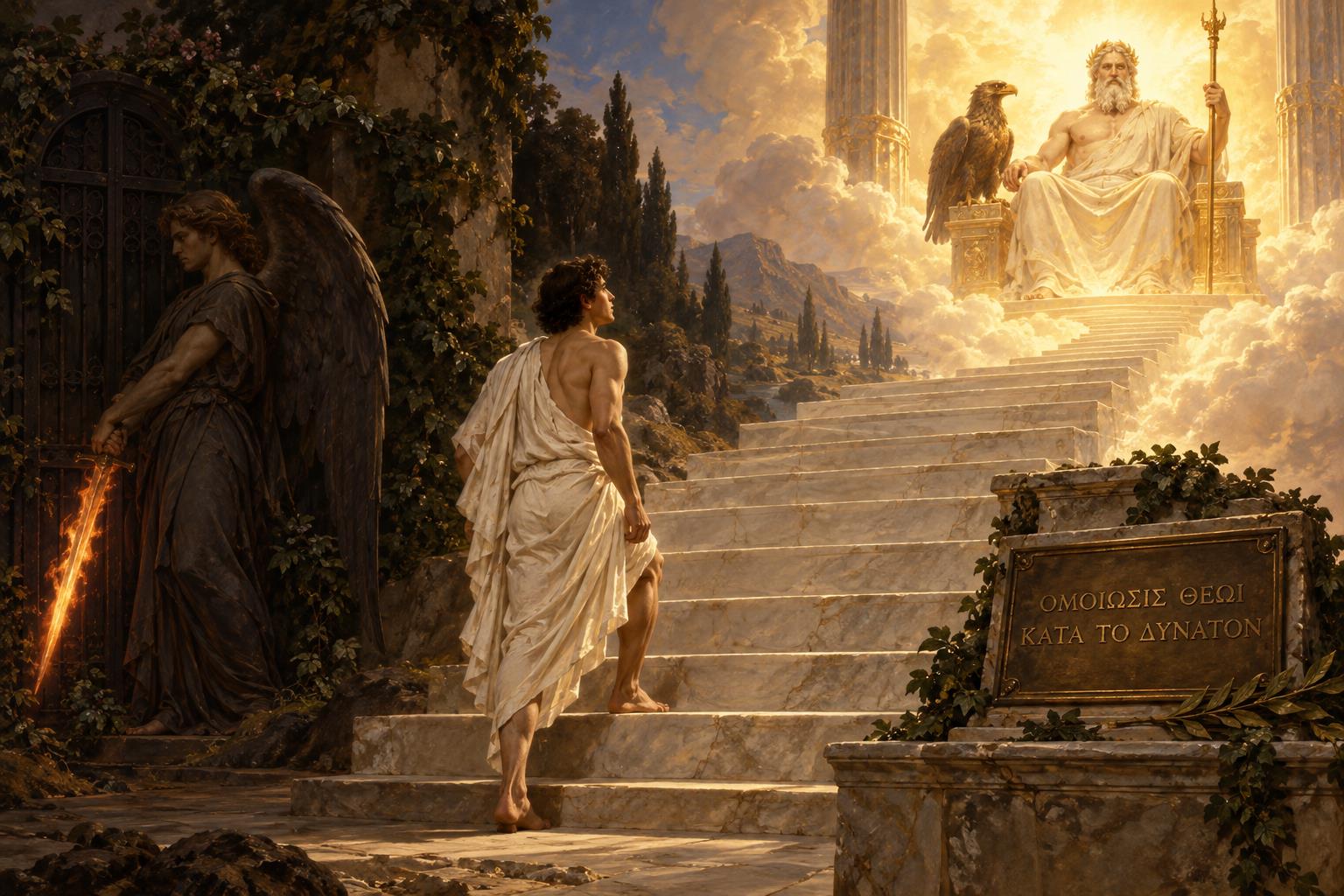
In Genesis, "God" appears as a prohibitory thing, and the attempt to become as the Gods appears as an unethical thing to do. The account then requires a punisher for the individuals who try it. They're cast down from the Garden of Eden, cursed and anathematized, because they ate from the Tree of Knowledge of Good and Evil. That is exactly the place where Plato, before this doctrine existed in Greek or anywhere outside 1 small province, told people to engage.
The text of the prohibition is worth reading in the Greek in which the world received it:
Genesis 3:5 (Septuagint):
«ᾔδει γὰρ ὁ θεὸς ὅτι ἐν ᾗ ἂν ἡμέρᾳ φάγητε ἀπ᾽ αὐτοῦ, διανοιχθήσονται ὑμῶν οἱ ὀφθαλμοί, καὶ ἔσεσθε ὡς θεοὶ γινώσκοντες καλὸν καὶ πονηρόν.»
"For God knew that on the day you eat of it your eyes will be opened, and you will be as Gods, knowing good and evil."
Genesis 3:22-24 (Septuagint):
«Καὶ εἶπεν ὁ θεός Ἰδοὺ Ἀδὰμ γέγονεν ὡς εἷς ἐξ ἡμῶν τοῦ γινώσκειν καλὸν καὶ πονηρόν, καὶ νῦν μήποτε ἐκτείνῃ τὴν χεῖρα καὶ λάβῃ τοῦ ξύλου τῆς ζωῆς καὶ φάγῃ καὶ ζήσεται εἰς τὸν αἰῶνα. [...] καὶ ἐξέβαλεν τὸν Ἀδὰμ [...] καὶ ἔταξεν τὰ χερουβὶμ καὶ τὴν φλογίνην ῥομφαίαν τὴν στρεφομένην φυλάσσειν τὴν ὁδὸν τοῦ ξύλου τῆς ζωῆς.»
"And God said: Behold, Adam has become as one of us, to know good and evil; and now, lest he stretch out his hand and take of the tree of life and eat and live forever. [...] And he cast Adam out [...] and stationed the cherubim and the flaming sword that turns, to guard the way to the tree of life."
Read the reason the text itself gives for the expulsion. The man had become "as one of us" in knowledge, and the guard is posted so that he'll never take the second step, immortality. The cherubim and the turning sword stand against ὁμοίωσις. That is their whole function.
In this Jewish lore there's a strong prohibition for this, and it's considered an evil act to attempt. In the Platonic and ancient conception, the same act is the desired outcome for mankind, and nothing evil attaches to it. Historically, the inversion from becoming as the Gods, the inversion which was later "popularized", starts with this prohibitive perception. From this point on, man is no longer supposed to become as the Gods, and this remains a restricted environment for man to dwell in.
Where Plato says "become as the Gods and be like them", later belief systems come to say "don't you dare even entertain that thought".
The origin of this prohibition for man rests in the early conceptions of Judaism and in these doctrines. The same holds for all the "reactions" to it that were generated later. These, one has to move past, in order to approach the Original. Then one sees the aim and the path clearly.
There's a chronology here, and it settles the matter of who came first. The Theaetetus was written around 369 BCE. The Greek Genesis, the Septuagint, was translated in Alexandria in the 3rd century BCE, roughly a century after the Theaetetus, in a city built by Greeks and run in Greek. When its translators reached the sixth day, they reached for Plato's word:
Genesis 1:26 (Septuagint):
«Καὶ εἶπεν ὁ θεός Ποιήσωμεν ἄνθρωπον κατ᾽ εἰκόνα ἡμετέραν καὶ καθ᾽ ὁμοίωσιν.»
"And God said: Let us make man according to our image and according to likeness."
The word travelled. The content was emptied on arrival. The later doctrines water down this word; they call it "Likeness", "Image" and other weaker words, visual words and words of similarity, and on top of that they set the process itself down as the ultimate "sin". Man is eternally locked in slave status by this conception, and if he's anything at all, he's just an "image". Long before the concept of «κατ᾽ εἰκόνα καὶ καθ᾽ ὁμοίωσιν» ("in the image and likeness") appears, Plato had coined the statement. What appears later could easily allude to a cultural carry-over of the shell (the idea that man resembles God), without the essence (the potential to become like Him), with the essence itself marked as a punishable route of existence.
The above is textbook Yehuborism.
Plato speaks on this as an expert. The sources of the ancient world explicitly admit that he was recognized as the son of the God Apollo. Diogenes Laertius records the tradition from 3 separate authorities, the first of them Plato's own nephew and successor:
Diogenes Laertius, Lives of the Philosophers III.2:
«Σπεύσιππος δ᾽ ἐν τῷ ἐπιγραφομένῳ Πλάτωνος περιδείπνῳ καὶ Κλέαρχος ἐν τῷ Πλάτωνος ἐγκωμίῳ καὶ Ἀναξιλαΐδης ἐν τῷ δευτέρῳ Περὶ φιλοσόφων φασίν, ὡς Ἀθήνησιν ἦν λόγος, ὡραίαν οὖσαν τὴν Περικτιόνην βιάζεσθαι τὸν Ἀρίστωνα καὶ μὴ τυγχάνειν· παυόμενόν τε τῆς βίας ἰδεῖν τὴν τοῦ Ἀπόλλωνος ὄψιν· ὅθεν καθαρὰν γάμου φυλάξαι ἕως τῆς ἀποκυήσεως.»
"Speusippus in the work entitled Plato's Funeral Feast, Clearchus in his Encomium of Plato, and Anaxilaides in the second book of On Philosophers say that there was a story at Athens that Ariston tried to force Perictione, who was then in her bloom, and did not succeed; and that when he ceased from his violence he saw a vision of Apollo, whereupon he kept her pure of marriage until her delivery."
The same author records that Plato was born on the 7th of Thargelion, the day on which the Delians say Apollo was born. Plutarch (Table Talk VIII.1) reports that the Academy kept the 2 birthdays together. Apuleius and Olympiodorus repeat the paternity in their Lives of Plato. The ancient world knew whose son was speaking.
So, as an expert, Plato goes further and explains how the process takes place. To become "as the Gods" necessitates, consequently, 3 attainments and 1 measure:
| Term in Theaetetus 176b | What it demands |
|---|---|
| Φρόνησις | The balance of the urges that leads to higher wisdom |
| Ὅσιον | Purity of soul |
| Δίκαιον | Justice, in both behavioural and energetic fashioning |
| Κατὰ τὸ δυνατόν | The measure: a person will attain as much as possible, or should, or would, and must strive as much as possible to that end |
The measure is an order, and Plato repeats it as an order in the Timaeus:
Plato, Timaeus 90b-c:
«τῷ δὲ περὶ φιλομαθίαν καὶ περὶ τὰς ἀληθεῖς φρονήσεις ἐσπουδακότι καὶ ταῦτα μάλιστα τῶν αὑτοῦ γεγυμνασμένῳ φρονεῖν μὲν ἀθάνατα καὶ θεῖα, ἄνπερ ἀληθείας ἐφάπτηται, πᾶσα ἀνάγκη που, καθ᾽ ὅσον δ᾽ αὖ μετασχεῖν ἀνθρωπίνῃ φύσει ἀθανασίας ἐνδέχεται, τούτου μηδὲν μέρος ἀπολείπειν.»
"But he who has given himself to the love of learning and to true wisdom, and has exercised these parts of himself above all, must of necessity think immortal and divine thoughts, if he lays hold of truth; and insofar as human nature can partake of immortality, he must leave no part of it undone."
Leave no part of it undone. That's the measure.
As for the question of how this happens, Zevism represents the completed path and system to that end. Others pretend this semantically. Zevism is this path, literally applicable to this very specific end.
Each element Plato names has its discipline in the Temple, and each discipline works on 1 dimension of the person:
| Dimension | Platonic term | Zevist discipline | What it achieves |
|---|---|---|---|
| Internal | Δυνατόν, the capacity of power | Meditation | Builds the capacity the measure calls for |
| Behavioural | Φρόνησις and Δίκαιον | The Ethics of Zevism | The behavioural template of the God-like life |
| Existential | Ὁμοίωσις θεῷ | Life in the service of that end | The highest workings of man |
| Connection with the Gods | Σοφία, Θεουργία | Theurgy | Connects your intelligence to theirs |
The internal dimension of these is what the Temple instructs as Meditation (δυνατόν, the capacity of power). The behavioural template of this is the Ethics of Zevism (Φρόνησις and Justice). The existential dimension is the life in the service of that end, which achieves the highest workings of man (ὁμοίωσις θεῷ). The connection of these matters with the Gods is Theurgy (Σοφία, Θεουργία): connecting your intelligence to theirs.
On that last dimension the Platonic succession is precise. Iamblichus wrote that thinking about the Gods does not by itself join a man to them; the work does:
Iamblichus, On the Mysteries II.11:
«ἀλλ᾽ ἡ τῶν ἔργων τῶν ἀρρήτων καὶ ὑπὲρ πᾶσαν νόησιν θεοπρεπῶς ἐνεργουμένων τελεσιουργία ἥ τε τῶν νοουμένων τοῖς θεοῖς μόνον συμβόλων ἀφθέγκτων δύναμις ἐντίθησι τὴν θεουργικὴν ἕνωσιν.»
"It is the accomplishment of the ineffable works, performed in a manner worthy of the Gods and beyond all understanding, and the power of the unutterable symbols understood by the Gods alone, that establishes the theurgic union."
Proclus, in the 5th century CE, ranked the theurgic power above all human wisdom and knowledge (Platonic Theology I.25). Meditation builds the capacity, Ethics shapes the conduct, the life in service carries the work, and Theurgy closes the circuit with the Gods themselves. That's the system, complete, and every part of it answers to Theaetetus 176b.
Always remember this. It is the core objective of Zevism and the path of the Zevist: the impartment of humanity to the highest level of existence with the Gods.
The Original stated the aim. The Prohibition posted a guard in front of it. The Reaction rattled the gate without knowing what stood behind it. The Zevist walks past all 3 and takes the road Plato marked, the road the initiates walked before him and the schools walked after him.
Plato, Theaetetus 176b:
«φυγὴ δὲ ὁμοίωσις θεῷ κατὰ τὸ δυνατόν.»
"And the flight is becoming like God, as far as is possible."
Pick the Original. Unlock what the Gods placed inside you. Become as the Gods, as far as is possible, and leave no part of it undone.
ZEFS AENAOS.
High Priest Zevios Metathronos
Temple of Zeus Foundation
 አማርኛ
አማርኛ العربية
 বাংলা
বাংলা Български
 中文
中文 Čeština
 Dansk
Dansk Deutsch
 Eesti
Eesti Ελληνικά
 Español
 Français
 हिन्दी
 Hrvatski
 IsiZulu
 Italiano
 日本語
日本語 Kiswahili
 Magyar
 Македонски
 नेपाली
 Nederlands
 فارسی
فارسی Polski
 Português
 Română
 Русский
 Slovenščina
 Suomi
Suomi Svenska
 Tagalog
 Türkçe