
 አማርኛ
አማርኛ العربية
 বাংলা
বাংলা Български
 中文
中文 Čeština
 Dansk
Dansk Deutsch
 Eesti
Eesti Ελληνικά
 Español
 Français
 हिन्दी
 Hrvatski
 IsiZulu
 Italiano
 日本語
日本語 Kiswahili
 Magyar
 Македонски
 नेपाली
 Nederlands
 فارسی
فارسی Polski
 Português
 Română
 Русский
 Slovenščina
 Suomi
Suomi Svenska
 Tagalog
 Türkçe
A Sermon on the Four Great Philosophers: Divine Men Among Mortals
author: High Priest Zevios Metathronos
To the family of Zevists. A teaching on the four pillars of Western philosophy: Pythagoras of Samos, Socrates of Athens, Plato of Athens, and Aristotle of Stagira. This sermon treats them not as ordinary mortals who happened to be clever, but as what the ancient world recognized them to be: θεῖοι ἄνδρες (theioi andres), divine men, souls of exceptional advancement who appeared at critical moments in human history to deliver teachings that transformed civilization. Their biographies, their doctrines, and their legacy are presented here from the Zevist perspective: these were men in whom the divine spark burned so brightly that it illuminated the world for millennia after their bodies returned to earth. The text runs long, because the subject demands it. Read it in parts if you must, but read it complete.
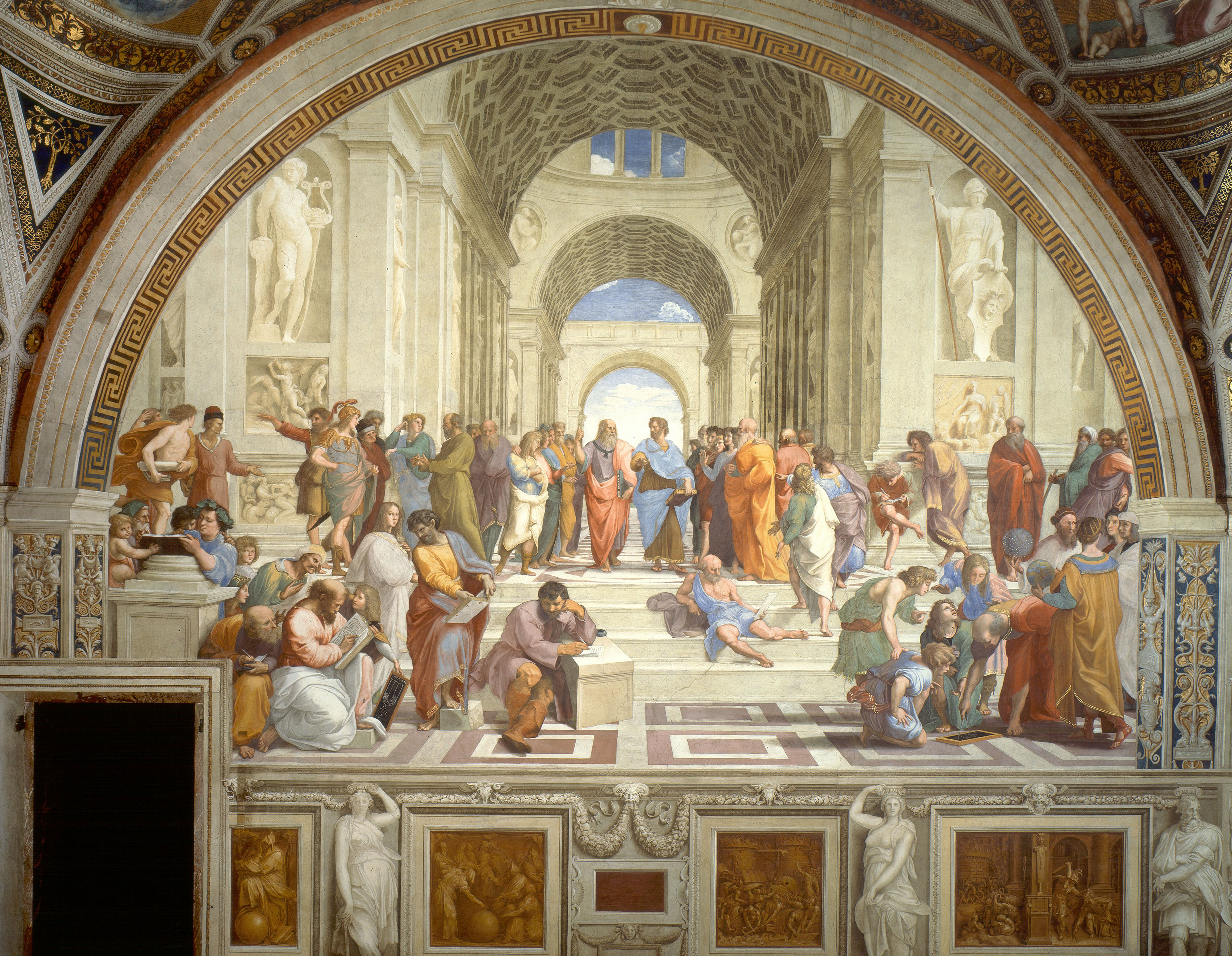
Raphael's fresco places Plato and Aristotle at the center of all philosophy: Plato pointing upward to the Forms, Aristotle pointing outward to the world. Behind them, Pythagoras writes and Socrates argues. These four men, spanning three centuries, built the intellectual framework within which the Western world still thinks. To understand them is to understand the foundations of everything you know.
PART ONE: PYTHAGORAS OF SAMOS (c. 570 to c. 495 BCE)
I. The Life
Pythagoras was born on the island of Samos, off the coast of Asia Minor, around 570 BCE. His father, Mnesarchus, was a gem-engraver or merchant (sources vary; Iamblichus says gem-engraver, Diogenes Laertius says merchant). Ancient sources say his mother, Pythais, was told by the Oracle of Delphi that she would bear a son who would surpass all other men in beauty and wisdom. The oracle gave him his name: Pythagoras, "he who was announced by the Pythia."
The ancient biographers (Porphyry in his Life of Pythagoras, Iamblichus in De Vita Pythagorica, Diogenes Laertius in Lives of the Eminent Philosophers VIII) agree on the basic outline of his education, though details vary. He studied under Thales of Miletus, the first philosopher, who was already old when Pythagoras was young. Thales, recognizing the youth's extraordinary capacity, advised him to travel to Egypt. Pythagoras also studied under Anaximander, Thales' successor, and under Pherecydes of Syros, from whom he may have learned the doctrine of the transmigration of souls.
He traveled to Egypt and spent (according to Iamblichus) twenty-two years studying with the Egyptian priests at Memphis, Heliopolis, and Thebes. He learned geometry, astronomy, the sacred sciences, and the temple disciplines. He was initiated into the mysteries. When Cambyses II of Persia conquered Egypt in 525 BCE, Pythagoras was taken to Babylon as a captive. There he spent another twelve years studying with the Magi, the Chaldean astronomers, and (according to some sources) the Zoroastrian priests. Some later traditions claim he also traveled to India and studied with the Brahmins, though this is debated.
The numbers are worth pausing on. Forty years of preparation before he began to teach. Twenty-two years in Egypt, twelve in Babylon. Whatever the precise figures, the pattern is clear: Pythagoras spent the first half of his life absorbing the accumulated wisdom of the oldest civilizations on earth. He didn't improvise his philosophy. He received it, digested it, and then synthesized it into a form the Greek mind could use.
After roughly forty years of preparation, he returned to the Greek world. He tried first to teach on Samos, but the tyranny of Polycrates made this impossible. He sailed west and settled in Croton, a prosperous Greek colony in southern Italy, around 530 BCE. There he founded the Pythagorean Brotherhood: a philosophical, mathematical, religious, and political organization unlike anything the ancient world had seen.
The Brotherhood grew rapidly. At its height, the Pythagorean community influenced the governments of several cities in southern Italy. This political power eventually provoked a backlash. Around 509 BCE (dates are uncertain), Cylon of Croton, a wealthy man whom Pythagoras had refused to admit to the Brotherhood, led a violent uprising. The Pythagorean meeting house was burned. Many members were killed. Pythagoras fled to Metapontum, where he died around 495 BCE. Some sources say he starved himself to death in the Temple of the Muses, refusing food for forty days. Others say he died of grief at the destruction of his community.
The Brotherhood survived him, though weakened. Pythagorean communities persisted for another two centuries. Their influence on Plato, on Aristotle, on the Neoplatonists, and through them on the entire Western tradition, is beyond calculation.
II. The Divine Nature
The ancient world didn't consider Pythagoras an ordinary man. Aristotle, who was careful with his claims, recorded that the Pythagoreans divided rational beings into three categories: Gods, men, and "beings like Pythagoras." He occupied a category between human and divine.
Aristotle, fragment 192 (Rose), preserved by Iamblichus, VP 31:
"There are three kinds of rational beings: God, man, and beings like Pythagoras."
Iamblichus records that Pythagoras was believed to be an incarnation of Apollo, or at least a soul sent by Apollo to benefit mankind. He was said to have a golden thigh (a mark of divine origin, which he reportedly showed to the priest Abaris the Hyperborean as proof of his identity). He claimed to remember his past lives: he had been Aethalides, son of Hermes, who received from his father the gift of remembering through death; then Euphorbus, a Trojan warrior killed by Menelaus at Troy (Pythagoras identified Euphorbus' shield in the Temple of Hera at Argos); then Hermotimus of Clazomenae; then Pyrrhus, a Delian fisherman; and finally Pythagoras himself.
He was said to have appeared in two cities at the same time. He was said to have been greeted by a river, which called out "Hail, Pythagoras!" as he crossed it. He was said to have been able to communicate with animals, including the famous story of the bear of Daunia, which he persuaded to stop attacking people through conversation. Whether literal or symbolic, these accounts carry a single message: the ancients recognized in Pythagoras something that exceeded ordinary human capacity.
The Zevist reading is clear. Pythagoras was a Theophoros in the fullest sense: a God-bearer, a soul so advanced that the boundary between human and divine became thin in him. He didn't invent his teachings. He received them, through forty years of preparation that included initiation into the deepest mysteries of three civilizations. What he taught was the knowledge of the Gods, translated into forms the human mind could grasp.
III. The Teachings
"All is number" (πάντα ἀριθμός). This is the most famous Pythagorean doctrine, and the most misunderstood. Pythagoras didn't mean that everything is literally a number. He meant that the structure of reality is mathematical: that proportion, ratio, and harmony are the fundamental principles governing all things, from the vibration of a lyre string to the orbit of a planet to the health of the human body.
The discovery that launched this insight was the relationship between musical harmony and mathematical ratio. Pythagoras (or his students; the attribution is traditional) discovered that the intervals the human ear recognizes as harmonious correspond to simple numerical ratios. When a string is divided in the ratio 2:1, the resulting notes are an octave apart. The ratio 3:2 produces the fifth. The ratio 4:3 produces the fourth. These ratios are objective: they don't depend on culture, taste, or opinion. A Chinese ear and a Greek ear hear the same octave. Beauty, which seems subjective, has an objective mathematical structure.
This was one of the most important discoveries in human history. It meant that the universe is not chaos. It's a kosmos (κόσμος), and Pythagoras was the first to apply this word to the universe as a whole: an ordered whole, governed by mathematical proportion, accessible to the human mind. When Newton wrote that "Nature is pleased with simplicity, and affects not the pomp of superfluous causes," he was speaking as a Pythagorean. When Einstein sought a unified field theory, he was pursuing a Pythagorean project.
The Pythagorean Theorem. a² + b² = c². The square on the hypotenuse of a right triangle equals the sum of the squares on the other two sides. The theorem may have been known empirically in Babylon and Egypt before Pythagoras, but the Pythagoreans provided the first known proof: a demonstration, through pure reason, that this relationship holds for every right triangle, without exception, without needing to measure a single one. The leap from "it works every time we check" to "it must work, and here is why" is the leap from empirical observation to mathematical proof. Pythagoras made that leap.
The Transmigration of Souls (Metempsychosis). Pythagoras taught that the soul is immortal and passes through a series of incarnations in different bodies (human, animal, and possibly divine). The quality of each incarnation depends on the conduct of the previous life. This doctrine predates Plato's use of it in the Phaedo, the Republic, and the Phaedrus, and aligns closely with the Hindu and Vedic doctrine of samsara.
The Zevist significance: the soul's journey doesn't end with one life. Conduct in this life shapes the conditions of the next. This gives ethics a cosmic weight that mere social convention can never carry. You don't behave well because society rewards it. You behave well because the structure of reality demands it, and the consequences extend beyond death.
Xenophanes preserves the earliest reference to this doctrine, in an anecdote about Pythagoras:
Xenophanes, fragment B7 (DK):
"They say that once, when a puppy was being beaten, Pythagoras passed by and said: 'Stop! Do not beat him! It is the soul of a friend. I recognized it when I heard it cry.'"
The Tetraktys. The Pythagoreans swore their most sacred oath by the Tetraktys: the figure formed by the first four numbers arranged in a triangle (1 + 2 + 3 + 4 = 10). They called it "the source and root of ever-flowing nature."
The Pythagorean Oath:
«Ναὶ μὰ τὸν ἁμετέρᾳ γενεᾷ παραδόντα Τετρακτύν, παγὰν ἀενάου φύσεως.»
"By him who transmitted to our generation the Tetraktys, the source and root of ever-flowing nature."
The Tetraktys encodes the fundamental ratios of musical harmony (4:3 = fourth, 3:2 = fifth, 2:1 = octave), the four elements, the four dimensions (point = 1, line = 2, surface = 3, solid = 4), and the progression from unity through multiplicity to completion. Ten, the sum, was the number of perfection: the Decad, which contains within itself all the principles of number.
The Way of Life. Pythagoras didn't just teach theory. He prescribed a complete way of life. The daily routine was precise: rise before dawn, walk alone in sacred groves to collect your thoughts, exercise the body, study, attend lectures, eat a communal meal (usually bread, honey, vegetables, and water; some sources say the inner circle was strictly vegetarian), and close the day with the evening review.
The akousmata (oral sayings) governed even the smallest details of daily conduct: don't step over a crossbar, don't stir the fire with iron, don't eat the heart, don't look in a mirror by lamplight. Many of these are symbolic (don't eat the heart = don't consume yourself with worry; don't stir the fire with iron = don't provoke an angry person). But the point is that every moment of the Pythagorean day was structured. Nothing was left to accident. The life was the teaching, and the teaching was the life.
The Harmony of the Spheres. Pythagoras taught that the celestial bodies produce sounds as they move through space, and that these sounds form a cosmic harmony inaudible to ordinary ears (we don't hear it because we've heard it since birth, the way a blacksmith doesn't hear the noise of his own forge). Kepler's laws of planetary motion (1609-1619) confirmed this Pythagorean intuition: the orbits of the planets are described by precise mathematical relationships. Kepler himself titled his masterwork Harmonices Mundi, "The Harmonies of the World," in direct homage to Pythagoras.
The Pentagram. The Pythagoreans used the pentagram (five-pointed star) as their recognition symbol. The pentagram encodes the golden ratio (φ = 1.618...) at every intersection: each diagonal of a regular pentagon is divided by the other diagonals in the golden ratio. This ratio appears throughout nature (the spiral of a nautilus shell, the arrangement of seeds in a sunflower, the proportions of the human body) and was considered by the Pythagoreans a signature of divine order inscribed in matter.
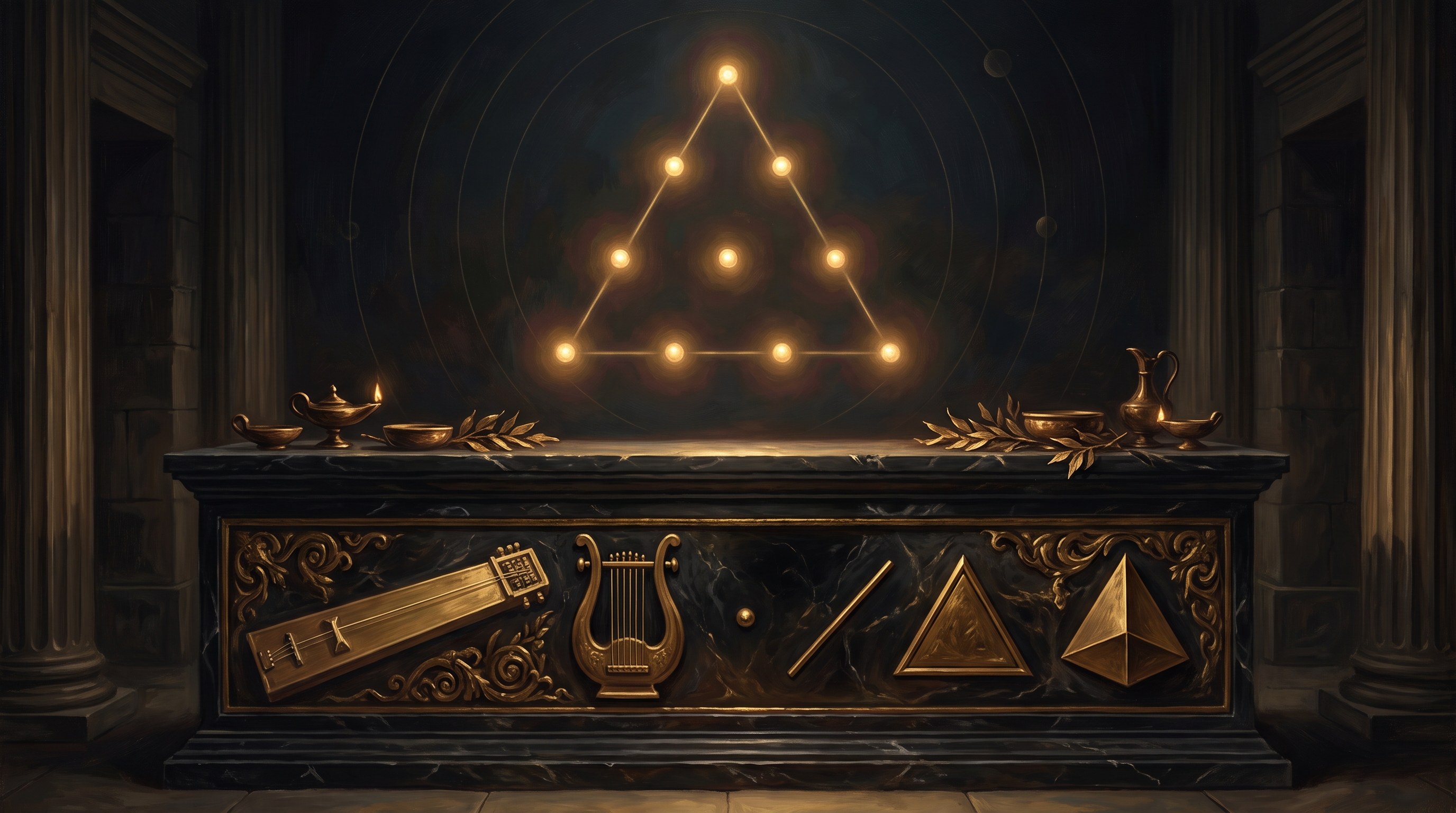
The Tetraktys (1 + 2 + 3 + 4 = 10) was the most sacred symbol of the Pythagorean tradition. Within its simple triangular form lies the structure of musical harmony, the progression of spatial dimensions, and the architecture of the Decad. Pythagoras taught that number is the key to reality: living number, the proportion and ratio that govern all things from the vibration of a string to the orbit of a star.
PART TWO: SOCRATES OF ATHENS (c. 470 to 399 BCE)
I. The Life
Socrates was born in Athens around 470 BCE, in the deme of Alopece. His father, Sophroniscus, was a stonemason or sculptor (some sources say he worked on the Acropolis). His mother, Phaenarete, was a midwife. Socrates often compared his own work to his mother's: she helped bodies give birth; he helped souls give birth to truth. He called his method maieutics (μαιευτική), the art of intellectual midwifery.
He grew up during the golden age of Pericles, when Athens was the wealthiest and most powerful city in Greece. He received a standard Athenian education: gymnastics, music, and letters. He may have studied natural philosophy under Archelaus (a student of Anaxagoras), but he eventually turned away from cosmological speculation and toward the study of human life and conduct. As he says in the Phaedrus: "I can't learn anything from trees and fields; I can only learn from people in the city" (230d).
He served as a hoplite (heavy infantryman) in the Athenian army and distinguished himself at three engagements. At Potidaea (432 BCE), he saved the life of Alcibiades during a retreat, standing over his wounded body and fighting off the enemy. Alcibiades himself testified to this in the Symposium (220d-221c), adding that Socrates showed no sign of fear and walked away from the battle with his usual calm gait, "rolling his eyes and looking around," so that no enemy dared approach him. At Delium (424 BCE), during a disastrous Athenian defeat, Socrates retreated in perfect order, turning to face the pursuers at intervals. The general Laches later testified that if every Athenian fought like Socrates, Athens would never lose a battle. At Amphipolis (422 BCE), he served again without distinction of rank but with the same composure.
His physical appearance was famously ugly. He had a flat nose, bulging eyes, thick lips, and a stocky build. He compared himself to a Silenus figure: ugly on the outside, filled with golden statues of the Gods on the inside. He walked barefoot in all seasons. He wore the same rough cloak year-round. He could drink more wine than anyone at a banquet without showing the slightest effect. He stood in one spot for an entire day and night at Potidaea, deep in thought, motionless, while the soldiers set up their bedrolls around him and watched. He didn't notice them.
His wife, Xanthippe, was famous for her difficult temperament. Socrates bore it with humor. When asked why he married such a woman, he replied: "Those who wish to become good horsemen don't get gentle horses. They get spirited ones. If they can manage those, they can manage any horse. I married Xanthippe because I knew that if I could get along with her, I could get along with anyone."
He wrote nothing. Everything we know of his teaching comes from his students, principally Plato (who made Socrates the protagonist of nearly all his dialogues) and Xenophon (whose Memorabilia and Symposium offer a more prosaic portrait). Aristophanes parodied him in The Clouds (423 BCE), depicting him as a charlatan who ran a "Thinkery" and taught students to make the weaker argument defeat the stronger. The parody was unfair but influential, and Socrates himself believed it contributed to the prejudice that eventually killed him (Apology 18a-19c).
In 399 BCE, at the age of seventy, he was tried on two charges: asebeia (impiety, specifically "not acknowledging the Gods the city acknowledges and introducing new divinities") and corrupting the youth of Athens. The trial lasted one day. He was convicted by a margin of sixty votes (280 to 221, by Plato's account). When asked to propose his own penalty (standard Athenian procedure), he first suggested, half-seriously, that he be fed at public expense in the Prytaneum, the honor given to Olympic victors. He eventually proposed a fine of thirty minae, which his friends offered to guarantee. The jury, offended by his defiance, sentenced him to death by a larger margin than the conviction.
He spent his last thirty days in prison, because the sacred ship to Delos was at sea and no executions could take place until it returned. During this time, Crito visited him and offered an escape plan: the guards were bribed, a boat was ready, safe houses were arranged in Thessaly. Socrates refused, in one of the most important arguments in the history of ethics. His reasoning, as Plato records it in the Crito: he had lived under Athenian law for seventy years and enjoyed its benefits. He had raised his children under its protection. He had never left the city except for military service. By staying, he had tacitly agreed to abide by the city's decisions, even the unjust ones. To escape now would be to break that agreement. The laws of Athens, speaking through Socrates' imagination, ask: "Do you think a city can exist and not be overturned, if the judgments of its courts have no force?" (50b). Socrates chose consistency over survival.
He drank the hemlock in the presence of his students, conversing about the immortality of the soul until the drug took effect, moving from his feet upward. His last words, as Plato records them in the Phaedo (118a): "Crito, we owe a rooster to Asclepius. Pay it and don't neglect it." Asclepius was the God of healing. The rooster was an offering of thanks. Socrates was thanking the God of healing for curing him of the disease of life, releasing his soul from the prison of the body.
II. The Divine Nature
Socrates himself claimed to be guided by a divine sign. He called it his daimonion (δαιμόνιον), a divine voice or signal that came to him from childhood. It never told him what to do; it only warned him when he was about to do something wrong.
Plato, Apology 31c-d:
«Ἐμοὶ δὲ τοῦτ᾽ ἐστὶν ἐκ παιδὸς ἀρξάμενον, φωνή τις γιγνομένη, ἣ ὅταν γένηται, ἀεὶ ἀποτρέπει με τούτου ὃ ἂν μέλλω πράττειν, προτρέπει δὲ οὔποτε.»
"This is something that began in my childhood: a voice that comes to me, and whenever it comes, it always turns me away from what I'm about to do, but never urges me forward."
The daimonion kept him out of politics (Apology 31d: "If I had tried to enter politics, I would have perished long ago"). It warned him on specific occasions: once it stopped him from crossing a river, and later those who had crossed were swept away. It never spoke falsely.
The Oracle of Delphi declared Socrates the wisest man in Greece. His friend Chaerephon asked the Pythia: "Is anyone wiser than Socrates?" The answer: "No one" (Apology 21a). Socrates took this seriously, as a puzzle to be solved. He spent the rest of his life testing the claim by questioning everyone reputed to be wise: politicians, poets, craftsmen. His conclusion: he was the wisest because he alone knew that he didn't know. Everyone else claimed knowledge they didn't possess. Socrates knew the limits of his knowledge, and that knowledge of ignorance was itself wisdom.
The Zevist understanding: Socrates was a man in direct, continuous contact with his Guardian Daimon. The daimonion was a genuine divine communication channel, the same channel that every Zevist seeks to open through meditation, ritual, and spiritual discipline. Socrates had it from birth, which suggests a soul of extraordinary advancement: a soul that came into this life already connected to the divine, already carrying the mark of Apollo's favor.
III. The Teachings
The Examined Life. The most famous statement in all of philosophy:
Plato, Apology 38a:
«Ὁ δὲ ἀνεξέταστος βίος οὐ βιωτὸς ἀνθρώπῳ.»
"The unexamined life is not worth living for a human being."
Before Socrates, people lived according to tradition, habit, and authority. After Socrates, the standard changed: a life is worth living only if the person living it has asked himself why he lives as he does, what he believes and why, what he values and whether those values hold up under questioning. Self-examination is the basic discipline. Without it, you're sleepwalking through a life designed by other people.
The Socratic Method (Elenchus). Socrates didn't lecture. He asked questions. He would approach someone who claimed to know something (what is justice? what is courage? what is piety?) and through a sequence of questions, show that the person's understanding was confused, contradictory, or incomplete. The purpose was never to humiliate. It was to clear away false beliefs so that genuine knowledge could emerge, the way a sculptor removes stone to reveal the statue inside.
The method had a specific structure. Socrates would ask for a definition. The interlocutor would give one. Socrates would then produce a counterexample: a case that fits the definition but clearly isn't an instance of the thing being defined, or a case that clearly is an instance but doesn't fit the definition. The interlocutor would revise. Socrates would produce another counterexample. The process would continue until the interlocutor either reached a deeper understanding or admitted that he didn't know what he thought he knew. The second outcome was more common, and more valuable. Knowing that you don't know is the beginning of wisdom.
He called himself a gadfly (μύωψ, myops): the irritating insect that keeps the horse awake. Athens was the horse, a great and noble beast that had grown sluggish and needed to be stung into wakefulness. "If you kill me," he told the jury, "you won't easily find another gadfly. You'll spend the rest of your lives asleep, unless God sends you another one" (Apology 30e-31a).
Virtue is Knowledge. Socrates taught that no one does wrong knowingly (oudeis hekon hamartanei). If a person truly understood what was good, he would do it. Evil comes from ignorance, not from malice. This sounds naive until you think about it carefully. The alcoholic knows that drinking is harmful, in the sense that he has the information. But he doesn't genuinely understand it, in the sense that the knowledge has penetrated his whole being and become a lived conviction. Socrates' point is that deep, genuine understanding of the good makes evil action impossible, because the fully wise person sees the good so clearly that choosing evil would be like choosing poison while knowing and understanding that it's poison. Information is not understanding. The person who truly understands has no choice but to act rightly.
Care of the Soul. Socrates taught that the soul (ψυχή, psyche) is more important than the body, and that caring for the soul through philosophy, virtue, and self-examination should take priority over every other pursuit: wealth, fame, power, pleasure.
Plato, Apology 29d-e:
"Are you not ashamed that you give your attention to acquiring as much money as possible, and similarly with reputation and honor, and give no attention or thought to truth and understanding and the perfection of your soul?"
He lived this teaching with total consistency. He was poor. He charged no fees for his teaching (unlike the Sophists, whom he criticized precisely for selling wisdom like a commodity). He wore the same rough cloak in summer and winter. He walked barefoot. And he was, by every account, the most contented man in Athens.
The Good Death. Socrates' death is the supreme lesson. He could have escaped. He could have proposed exile as his penalty (the jury would almost certainly have accepted). He could have wept and begged, as was customary. He refused all of these options, on principle.
His argument in the Crito amounts to this: the social contract is real. By living in Athens for seventy years, he had agreed to abide by its laws, including the verdicts of its courts. If the verdict was unjust (and he believed it was), the proper response was to try to change the law or persuade the jury, which he had done. Having failed at persuasion, he had no right to escape, because escape would undermine the authority of the law itself, which protects everyone, including him.
He chose consistency over survival. His death proved his life. And in proving his life, he gave the world something more valuable than any argument: a demonstration that philosophy is worth dying for. The man who dies for his principles proves that his principles are real. Every martyr since Socrates, whether consciously or not, walks in his footsteps.
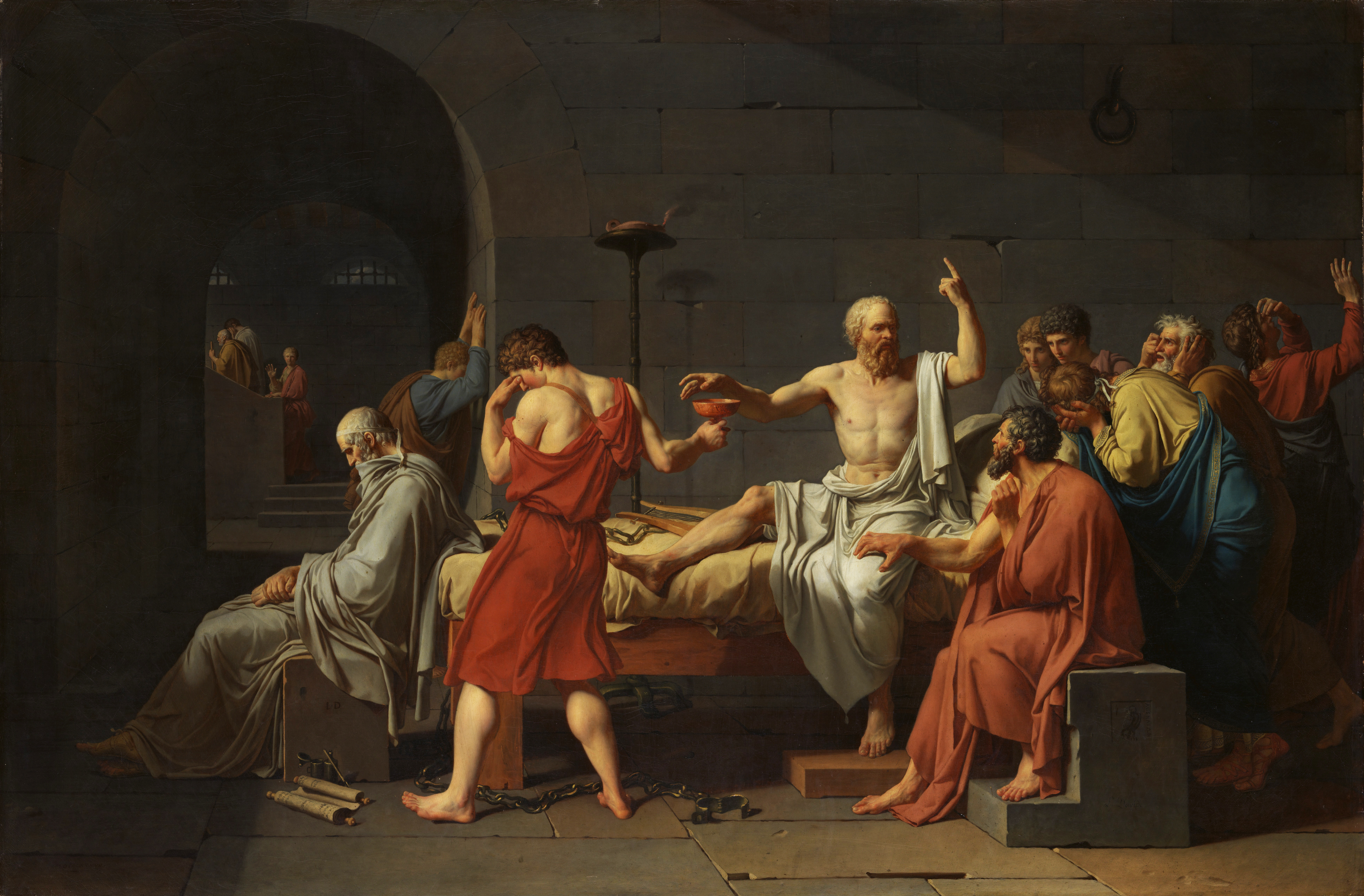
Jacques-Louis David's painting (1787) depicts the moment Socrates reaches for the cup of hemlock, still teaching, still composed, while his students weep around him. The raised finger indicates that he's making a point. Even in his final moment, the philosopher was still talking about the truth. His last act was a proof: if the soul is immortal, as he had argued throughout his life, then death is nothing to fear. He demonstrated the argument by dying.
PART THREE: PLATO OF ATHENS (c. 428 to 348 BCE)
I. The Life
Plato was born around 428 BCE into one of the most distinguished families in Athens. His father, Ariston, traced his lineage to Codrus, the last king of Athens, and ultimately to Poseidon. His mother, Perictione, was related to Solon, the great lawgiver who laid the foundations of Athenian democracy. Through his mother, Plato was also related to Critias and Charmides, two members of the Thirty Tyrants who briefly ruled Athens in 404 BCE. His real name was Aristocles; "Plato" (Πλάτων) was a nickname, meaning "broad," probably referring to his physical build (he was reportedly an accomplished wrestler in his youth).
He was a student of Socrates from about the age of twenty until Socrates' death in 399 BCE. The execution of his teacher was the defining event of Plato's life. It shattered his faith in Athenian democracy and convinced him that no existing form of government was adequate. The only cure for political injustice was the union of philosophy and power.
After Socrates' death, Plato left Athens for about twelve years. He traveled to Megara (where he studied with the philosopher Euclides, a fellow student of Socrates), to Cyrene in North Africa (where he studied mathematics with Theodorus), to Egypt (where he saw the ancient temples and, according to some sources, studied with the priests), and to southern Italy, where he encountered the Pythagorean community. The Pythagorean influence on Plato was profound and permanent. From them he absorbed the doctrine of the immortality of the soul, the mathematical structure of reality, the idea that philosophy is a way of life (not just an intellectual exercise), and the model of the philosophical community devoted to learning and virtue.
In Syracuse, on the island of Sicily, he met Dion, the brother-in-law of Dionysius I, the tyrant of Syracuse. Dion became Plato's devoted student and later invited him back to Syracuse to educate Dionysius II, the young tyrant who succeeded his father. Plato made three journeys to Syracuse (388, 366, and 361 BCE), each time attempting to put his political philosophy into practice by advising the ruler. All three attempts failed. On the first visit, Dionysius I grew hostile and reportedly had Plato sold into slavery on the island of Aegina (he was ransomed by Anniceris of Cyrene). On the second and third visits, Dionysius II proved unteachable: he wanted the prestige of philosophy without the discipline. Plato nearly died on the third visit, and was rescued only through the intervention of Archytas of Tarentum, a Pythagorean statesman.
These failures didn't weaken his convictions. They deepened them. The Laws, his final and longest work, is the product of a man who had tested his ideas against reality and adjusted them: finding ways to approximate it given the limitations of actual human beings.
In 387 BCE, Plato founded the Academy in a grove sacred to the hero Academus, outside the walls of Athens. The Academy was the first permanent institution of higher learning in the Western world. It operated continuously for nearly nine hundred years, until the Christian emperor Justinian closed it in 529 CE. The Academy taught philosophy, mathematics, astronomy, biology, political theory, and dialectic. Above its entrance (according to tradition) were inscribed the words: ΑΓΕΩΜΕΤΡΗΤΟΣ ΜΗΔΕΙΣ ΕΙΣΙΤΩ, "Let no one ignorant of geometry enter." Mathematics was the foundation, not because Plato cared about numbers for their own sake, but because mathematical reasoning trains the mind to grasp abstract, eternal truths: the Forms.
He died around 348 BCE, reportedly at a wedding feast, at the age of approximately eighty. He was buried on the grounds of the Academy. Aristotle, his most famous student, had already been studying with him for twenty years.
II. The Divine Nature
The ancient world treated Plato with awe that bordered on religious veneration. Numenius of Apamea (2nd century CE) asked: "What is Plato but Moses speaking Greek?" (a comparison that reveals Numenius' reverence for Plato more than any actual connection). The Neoplatonists of late antiquity treated his dialogues as sacred texts, subject to commentary and exegesis in the same spirit that religious scriptures received.
Ancient biographers (Diogenes Laertius III.1-2, drawing on earlier sources) recorded a tradition that Plato's true father was Apollo: his mother Perictione conceived him through divine visitation, and Ariston was forbidden from approaching her until the child was born. Speusippus, Plato's own nephew and successor at the Academy, reportedly maintained this tradition. The legend places Plato's birth on the seventh day of the month Thargelion, the birthday of Apollo. Whether literal or symbolic, the message is consistent: the ancients believed that Plato's wisdom was more than merely human.
The Zevist reading: Plato was a soul of the highest order, prepared by his connection with Socrates and the Pythagoreans to deliver the most complete philosophical system the ancient world produced. His dialogues are initiatory documents: designed to lead the reader through progressive levels of understanding, from opinion (doxa) to knowledge (episteme), from the visible world to the intelligible world, from the shadows in the cave to the light of the Good. They are meant to transform the reader, not merely inform him.
III. The Teachings
The Theory of Forms (Ideas). The visible world, the world of change, decay, and imperfection, is not the fundamental reality. It's a reflection, a shadow, of a higher reality: the world of Forms (εἴδη, eide), eternal, unchanging, perfect archetypes of which physical things are imperfect copies.
The Form of a circle is perfect; every circle you draw is imperfect. The Form of Justice is absolute; every human court is flawed. The Form of Beauty is eternal; every beautiful face ages. The physical world participates (μέθεξις, methexis) in the world of Forms, drawing its being and its intelligibility from them, but never fully achieving their perfection.
The highest Form is the Form of the Good (τὸ ἀγαθόν), which stands in relation to the intelligible world as the sun stands in relation to the visible world: it illuminates everything, makes everything knowable, and is itself the source of being and truth.
Plato, Republic VI, 509b:
«Τοῖς γιγνωσκομένοις τοίνυν μὴ μόνον τὸ γιγνώσκεσθαι φάναι ὑπὸ τοῦ ἀγαθοῦ παρεῖναι, ἀλλὰ καὶ τὸ εἶναί τε καὶ τὴν οὐσίαν ὑπ᾽ ἐκείνου αὐτοῖς προσεῖναι.»
"To the objects of knowledge, say that not only their knowability but also their being and reality come from the Good."
The Allegory of the Cave (Republic VII, 514a-520a). Prisoners chained in a cave, facing a wall, see only shadows cast by objects passing before a fire behind them. They believe the shadows are reality. One prisoner breaks free, turns around, sees the fire, climbs out of the cave, and sees the sun. The pain is intense: his eyes, accustomed to darkness, are blinded by the light. Gradually he adjusts. He sees real objects for the first time. He sees the sun itself, and understands that it's the source of all light, all warmth, all life. When he returns to the cave to tell the others, they think he's insane. They threaten to kill him if he tries to free them.
The allegory operates on every level simultaneously. Personally, it describes the philosopher's journey from ignorance through education to wisdom. Politically, it describes the philosopher's obligation to return and govern, even at risk to himself. Epistemologically, it describes the ascent from sensory experience (shadows) through mathematical reasoning (the objects) to the direct apprehension of the Forms (the sun). Spiritually, it describes the soul's liberation from the body and its ascent to the divine.
The Divided Line (Republic VI, 509d-511e). Plato divides reality into four levels, arranged vertically: images (reflections, shadows) at the bottom; physical objects; mathematical objects; and the Forms at the top. Corresponding to these four levels are four states of mind: eikasia (imaging/imagination), pistis (belief/conviction), dianoia (mathematical reasoning), and noesis (direct intellectual apprehension). Education is the movement upward through these levels, from the lowest to the highest.
The Tripartite Soul (Republic IV, 435a-441c). Plato divided the soul into three parts: logistikon (reason, located in the head), thumoeides (spirit/courage, located in the chest), and epithumia (appetite/desire, located in the belly). The just person is the one in whom reason governs spirit and spirit governs appetite. The unjust person is the one in whom appetite rules, dragging reason behind it.
In the Phaedrus (246a-254e), Plato restates this as the myth of the charioteer: the soul is a winged chariot drawn by two horses. The charioteer is reason. One horse (white, noble, obedient) is spirit. The other horse (dark, wild, unruly) is appetite. The charioteer's task is to control both horses and drive the chariot upward toward the heavens, where the Forms are visible. When he succeeds, the soul gains wings and rises. When he fails, the wings break and the soul falls into a body.
The Immortality of the Soul. Plato presents multiple arguments across several dialogues. In the Phaedo: the argument from opposites (life comes from death, so death must come from life, implying the soul persists between incarnations); the argument from recollection (we recognize truths we never learned in this life, so we must have known them before birth); the argument from affinity (the soul resembles the Forms in being invisible, intelligible, and unchanging); the argument from the Form of Life (the soul is the principle of life and cannot admit its opposite, death). In the Republic (Book X): the soul is not destroyed by its own specific evil (injustice), so nothing can destroy it. In the Phaedrus: the soul is self-moving, and what moves itself is the source of all motion, which cannot cease to exist.
Anamnesis: Knowledge as Recollection. Learning is remembering. The soul, before birth, dwelt in the presence of the Forms and knew them directly. Birth causes forgetting. Education is the process of recollection (anamnesis): the teacher doesn't pour knowledge into the student's mind; the teacher helps the student remember what the soul already knows. Socrates demonstrates this in the Meno (82b-85b), where he guides an uneducated slave boy through a geometric proof. The boy discovers the answer himself, through questioning. He didn't learn it; he remembered it.
The Philosopher-King (Republic V, 473c-d).
«Ἐὰν μή, ἦν δ᾽ ἐγώ, ἢ οἱ φιλόσοφοι βασιλεύσωσιν ἐν ταῖς πόλεσιν ἢ οἱ βασιλεῖς φιλοσοφήσωσι, οὐκ ἔστι κακῶν παῦλα.»
"Unless philosophers become kings or kings become philosophers, there will be no end to the troubles of cities."
Genuine wisdom and genuine authority must reside in the same person. The ruler who doesn't understand justice will rule unjustly. The philosopher who doesn't exercise power leaves the world in the hands of the ignorant. The union of the two is the only solution. Plato tested this ideal three times in Syracuse and failed three times. He didn't abandon the principle; he concluded that it's more easily approximated through good laws than through individual rulers, which is why the Laws replaces the philosopher-king with the rule of law tempered by a council of wise elders.
PART FOUR: ARISTOTLE OF STAGIRA (384 to 322 BCE)
I. The Life
Aristotle was born in 384 BCE in Stagira, a small Greek city in the Chalcidice peninsula, near the border of Macedonia. His father, Nicomachus, was the personal physician of Amyntas III, king of Macedonia (grandfather of Alexander the Great). Growing up in a physician's household shaped Aristotle's mind permanently: his respect for empirical observation, his interest in biology, and his systematic approach to classification all bear the mark of the medical tradition.
At seventeen, he traveled to Athens and entered Plato's Academy, where he studied for twenty years, from 367 to 347 BCE. Plato reportedly called him "the mind of the Academy" (νοῦς τῆς διατριβῆς), and also "the reader" (ὁ ἀναγνώστης), because of his voracious appetite for books (at a time when books were rare and expensive). Their relationship was one of deep mutual respect combined with fundamental philosophical disagreement. Aristotle rejected the Theory of Forms as Plato taught it, holding that the Forms cannot exist apart from the things they form. The universal "horse" doesn't exist in a separate realm; it exists in individual horses. He is reported to have said: "I am a friend of Plato, but a greater friend of truth" (amicus Plato, sed magis amica veritas).
After Plato's death, Aristotle left Athens. He spent several years in Asia Minor, first at Assos (where he joined a small Platonic community led by Hermias, the ruler of Atarneus and a former Academy student) and then at Mytilene on Lesbos. At Lesbos, together with his student Theophrastus (who would become his successor), he conducted groundbreaking research in marine biology, dissecting sea creatures, observing their behavior, and classifying them with a precision that remained unsurpassed until the modern era. Darwin called Aristotle's biological works "simply astonishing" and said that Linnaeus and Cuvier were "mere schoolboys" compared to him.
At Assos, Aristotle married Pythias, Hermias' adopted daughter and niece. They had a daughter, also named Pythias. After Pythias' death, Aristotle lived with Herpyllis of Stagira, with whom he had a son, Nicomachus, for whom the Nicomachean Ethics is named. In his will (preserved by Diogenes Laertius), Aristotle asked to be buried beside Pythias, "as she wished," and made careful provision for Herpyllis, their son, and his slaves (including arrangements for their eventual freedom).
In 343 BCE, Philip II of Macedonia invited Aristotle to tutor the thirteen-year-old Alexander. Aristotle spent approximately three years educating the future conqueror. He reportedly prepared a special edition of the Iliad for Alexander (the "casket copy," which Alexander kept under his pillow with a dagger throughout his campaigns). What else he taught Alexander is debated, but the results suggest a broad education: Alexander founded cities across three continents, named them after himself and after his horse but staffed them with Greek libraries, theaters, and gymnasia. He generally preserved the religious traditions of conquered peoples (with notable exceptions). The synthesis of Greek and Eastern culture that resulted from Alexander's conquests, called Hellenism, shaped civilization for five centuries.
In 335 BCE, Aristotle returned to Athens and founded the Lyceum, in a gymnasium and grove sacred to Apollo Lykeios (Apollo the Wolf-God). The school was called the Peripatetic school, from Aristotle's habit of walking while lecturing (peripatein, to walk about) in the covered walkway (peripatos). The Lyceum had a library (the first systematically organized research library in history), a collection of maps, specimens of plants and animals sent by Alexander's soldiers from across the empire, and a museum of natural objects. Aristotle's teaching was divided into morning lectures (esoteric, for advanced students) and afternoon lectures (exoteric, for the general public). The surviving works are believed to be lecture notes from the esoteric sessions.
He taught there for twelve years, producing the vast body of work that survives. The ancient catalog attributed to Diogenes Laertius lists about 150 titles; approximately 30 survive, covering logic, physics, metaphysics, ethics, politics, rhetoric, poetics, biology, psychology, meteorology, and economics. The lost works include published dialogues that were praised in antiquity for their literary beauty (Cicero compared Aristotle's prose style to "a river of gold").
After Alexander's death in 323 BCE, anti-Macedonian sentiment swept Athens. Aristotle was charged with impiety (the same charge that had killed Socrates). He left Athens, reportedly saying: "I will not allow the Athenians to sin twice against philosophy." He died a year later, in 322 BCE, at the age of sixty-two, at his family estate in Chalcis on the island of Euboea. The cause of death is unknown; some ancient sources say a stomach ailment.
II. The Divine Nature
Aristotle's divinity was of a particular kind: the divinity of pure Nous, of an intellect so comprehensive that it could encompass the whole of reality and give it rational form. He didn't claim visions, didn't report supernatural experiences, didn't present himself as a prophet. His authority was the authority of reason itself, exercised with a scope and precision that no individual mind has matched before or since.
The Islamic philosophers called him simply "The Philosopher" (al-mu'allim al-awwal, "the First Teacher"), as if there were only one. Dante placed him at the head of all philosophers in Limbo, calling him il maestro di color che sanno, "the master of those who know" (Inferno IV.131). Thomas Aquinas, throughout the Summa Theologica, referred to him simply as "the Philosopher," with no further identification needed.
The Zevist reading: Aristotle's divine quality was Nous in the fullest Aristotelian sense. His own Nicomachean Ethics identifies the life of contemplation (theoria) as the highest human activity, and Nous as the divine element in man. Aristotle was Nous operating at its maximum human capacity: systematic, all-encompassing, relentless, precise. If Pythagoras was the mystic, Socrates the moral exemplar, and Plato the visionary, Aristotle was the architect of knowledge: the mind that took the raw materials of observation and thought and built from them a system so complete that it governed Western science and philosophy for two thousand years. His mind was aligned with the Unmoved Mover, the pure thinking-about-thinking that he himself identified as God.
III. The Teachings
The System of Knowledge. Aristotle's most enduring achievement was the classification and systematization of all human knowledge into distinct disciplines, each with its own method and subject matter. Logic (the Organon): the study of valid reasoning. Physics: the study of nature and motion. Metaphysics: the study of being as being, the most fundamental structures of reality. Ethics: the study of the good life. Politics: the study of the good society. Rhetoric: the art of persuasion. Poetics: the art of literary creation. Biology: the study of living things. Psychology (De Anima): the study of the soul.
Before Aristotle, these subjects were mixed together in a single undifferentiated inquiry called "philosophy." Aristotle separated them, gave each its own principles, and showed how they related to one another. This organizational achievement is so fundamental that we take it for granted. Every university on earth is organized along lines that Aristotle established twenty-four centuries ago.
Logic: The Organon. Aristotle invented formal logic. The syllogism (if all A are B, and all B are C, then all A are C) remained the dominant system of logical analysis until the work of Frege, Russell, and Whitehead in the late nineteenth century. More important than the specific forms of the syllogism is the principle behind them: truth must be reached through valid argument. Authority, tradition, reputation, emotional appeal: none of these make a proposition true. Only valid reasoning from true premises can do that. This principle is the foundation of science, law, medicine, and every form of rational inquiry.
The Four Causes. To understand anything fully, you must know its four causes. The material cause: what it's made of (a statue is made of bronze). The formal cause: its shape or structure (the statue has the form of a man). The efficient cause: what made it (the sculptor). The final cause: its purpose (the statue was made to honor a God).
Modern science focuses almost exclusively on efficient causes. Aristotle insisted that final causes (what things are for) are equally real and equally important. The eye exists in order to see. The heart exists in order to pump blood. The acorn grows in order to become an oak. Purpose (telos) is woven into the fabric of nature. Removing final causes from your understanding of the world is like reading a story while ignoring the plot.
The Nicomachean Ethics: Virtue as the Mean. Every virtue lies between two extremes, each of which is a vice. Courage lies between cowardice (too little) and recklessness (too much). Generosity lies between stinginess and wastefulness. Friendliness lies between flattery and hostility. The virtuous person hits the mean: the appropriate response to the specific situation.
Aristotle, Nicomachean Ethics II.6, 1106b36-1107a2:
«Ἔστιν ἄρα ἡ ἀρετὴ ἕξις προαιρετική, ἐν μεσότητι οὖσα τῇ πρὸς ἡμᾶς.»
"Virtue is a settled disposition involving choice, lying in a mean relative to us."
"Relative to us" is the key phrase. The mean varies by person and circumstance. What counts as generous for a millionaire differs from what counts as generous for a worker. Virtue requires judgment (phronesis, practical wisdom), not just rules. The person who follows rules without understanding them is obedient; the person who understands the principles and adapts them to the situation is wise.
Eudaimonia: The Good Life. The good life is eudaimonia: living well and doing well, over the course of a complete life. Eudaimonia requires virtue, but also external goods (health, moderate wealth, friends, good fortune). Aristotle was realistic enough to acknowledge that a person who is virtuous but tortured, impoverished, and bereaved cannot be called truly happy. The good life needs favorable conditions, although virtue is the most important condition of all.
The highest form of eudaimonia is the life of contemplation (theoria): pure thought directed toward the highest objects. This is the life that most closely approaches the divine.
Aristotle, Nicomachean Ethics X.7, 1177b30-33:
«Εἰ δὴ θεῖον ὁ νοῦς πρὸς τὸν ἄνθρωπον, καὶ ὁ κατὰ τοῦτον βίος θεῖος πρὸς τὸν ἀνθρώπινον βίον.»
"If the intellect is divine in comparison with man, then the life of the intellect is divine in comparison with human life."
The Unmoved Mover (Metaphysics XII). The first cause of all motion, which itself is unmoved. The Unmoved Mover is pure actuality (energeia), pure thought, thinking about thinking (νόησις νοήσεως, noesis noeseos). It moves the universe by attracting it: everything in the cosmos moves toward the Unmoved Mover as toward a beloved. The universe is drawn toward perfection by the desire for the divine.
This is one of the most profound theological ideas in Western history. God doesn't create by force or command. God creates by attraction. The cosmos moves toward God the way a plant moves toward light: naturally, inevitably, because that's what it needs. The human soul moves toward truth the way the eye moves toward beauty: because truth is what the soul is made for. The Unmoved Mover doesn't command worship; it inspires it, by being what everything else aspires to become.
Potentiality and Actuality (Metaphysics IX). Every being has two aspects: what it is now (actuality, energeia) and what it can become (potentiality, dynamis). The acorn is potentially an oak. The student is potentially a philosopher. The bronze is potentially a statue. The movement from potentiality to actuality is the fundamental process of nature. God, the Unmoved Mover, is pure actuality: nothing in God is potential, nothing is unrealized, nothing is still becoming. God is the fully realized Being, and everything else is on its way toward that state.
The Soul (De Anima). Aristotle defined the soul as "the first actuality of a natural body that has life potentially" (De Anima II.1, 412a27). The soul is the form of the body: what makes a body alive. Plants have a nutritive soul (growth and reproduction). Animals have a sensitive soul (perception and movement). Humans have a rational soul (thought and deliberation). The rational soul includes Nous, the capacity for direct intellectual apprehension, which Aristotle considered "separable, impassible, and unmixed" (De Anima III.5, 430a17): it enters the body "from outside" (thyrathen, 736b28) and survives the body's death. This is Aristotle's version of the immortality of the soul: the individual personality perishes, but the Nous, the divine element in man, is eternal.
Political Philosophy: Man as Political Animal. "Man is by nature a political animal" (ζῷον πολιτικόν, zoon politikon), Politics I.2, 1253a2). Humans need the city (polis) the way bees need the hive: it's the natural environment in which human capacities can be fully exercised. The hermit may be virtuous, but he can't practice justice (which requires other people), generosity (which requires someone to receive), courage in battle, or political leadership. The full human life requires community.
Aristotle collected and studied 158 constitutions before writing the Politics. Only one survives: the Constitution of the Athenians, discovered on papyrus in Egypt in 1879. His analysis of the three pure forms of government (monarchy, aristocracy, polity) and their corruptions (tyranny, oligarchy, democracy in the negative sense) remains the foundation of political science. His argument that the middle class is the best guardian of political stability has been confirmed by every subsequent century of political history. His warning that extreme inequality produces revolution has never been refuted.
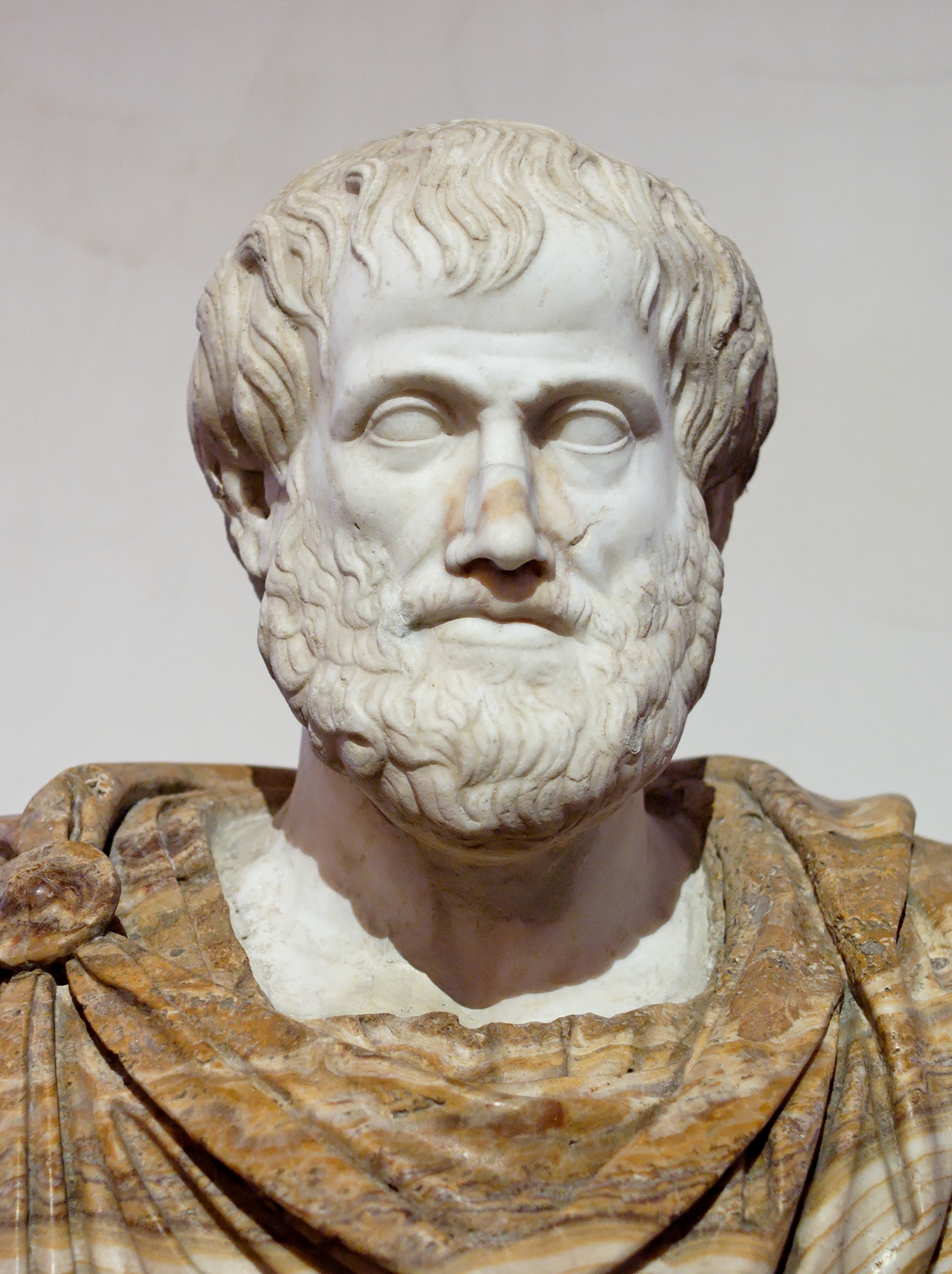
Aristotle's theology is often underestimated. The Unmoved Mover, pure Nous, thinking about thinking: this is a conception of God so refined that it influenced Islamic, Jewish, and Christian theology for fifteen centuries. The universe moves toward the divine because the divine attracts it, the way a beloved attracts the lover. Every atom of the cosmos reaches toward perfection. That reaching is the pulse of reality itself.
PART FIVE: THE GOLDEN CHAIN
These four men form a chain. Pythagoras taught the mathematical structure of reality and the immortality of the soul. Socrates took the Pythagorean moral discipline and turned it into a method of questioning that could be applied to any human claim. Plato synthesized Pythagorean mysticism and Socratic ethics into a comprehensive vision of reality, from the cave of ignorance to the sun of the Good. Aristotle took Plato's vision and gave it systematic form, grounding it in observation, logic, and the careful classification of everything that exists.
Each built on the work of his predecessors. Each corrected the errors of his predecessors. Each was incomplete without the others. Pythagoras without Socrates is mysticism without method. Socrates without Plato is method without system. Plato without Aristotle is vision without discipline. Aristotle without Pythagoras is system without soul. Together, they form a single edifice: four corners of one building, four pillars of one temple.
The Neoplatonists called this the Golden Chain (σειρὰ χρυσῆ, seira chryse): the unbroken succession of divine teachers stretching from the Gods themselves, through the ancient sages, down to the living teachers of each generation. Homer named it first (Iliad VIII.19-22): Zeus challenges the other Gods to fasten a golden chain from heaven to earth, and boasts that he could pull them all up, along with the earth and the sea, and hang them from Olympus. The Neoplatonists interpreted this passage as a symbol of the chain of being that connects every level of reality to the divine source.
The Chain doesn't end. It extends through the centuries: through Plotinus and Porphyry and Iamblichus and Proclus; through the Islamic philosophers (Al-Farabi, Avicenna, Averroes) who preserved and transmitted Aristotle when the Christian West had forgotten him; through the medieval scholars (Aquinas, Albert, Ockham) who rediscovered him; through the Renaissance humanists who recovered Plato; through every culture that received and preserved the Greek inheritance.
The Zevist stands in this chain. When you study Plato, you're participating in a living tradition that connects you to the same divine source that inspired Pythagoras twenty-six centuries ago. The chain holds because the truth doesn't change. Mathematics doesn't age. The soul doesn't decay. The Good remains the Good: yesterday, today, and for all time.
VI. The Zevist Obligation
The student's duty is simple and demanding.
Study these men. Read their works complete. Read the Republic. Read the Nicomachean Ethics. Read the Phaedo. Read the Apology. Read the Golden Verses. Read the Metaphysics, even the hard parts. Especially the hard parts. Let the words enter your mind the way water enters dry earth: slowly, deeply, and with permanence.
Don't read them as curiosities. Don't read them as "historical documents" from a dead culture. Read them as messages from divine men who saw further than you can see, and who left their vision in writing so that you could share it. They didn't write for their own century. They wrote for yours. Socrates' demand that you examine your life is addressed to you, personally, today, right now. Plato's Cave describes the world you live in, the screens you stare at, the shadows you mistake for reality. Aristotle's insistence on the life of contemplation is a rebuke to every hour you've spent on trivia when you could have been thinking about what matters.
And then live what you've learned. Examine your life, as Socrates demanded. Practice the virtues, as Aristotle taught. Turn your soul toward the Good, as Plato urged. Seek the harmony in all things, as Pythagoras revealed. These four men didn't just think about the divine. They lived it. Their lives were their arguments, and their arguments were their lives.
The Zevist who studies them doesn't learn philosophy. He learns how to live as a human being in the presence of the Gods. And the Gods, who sent these teachers, honor the student who takes their teachings seriously.
Honor them. Study them. Follow the Chain.
ZEFS AENAOS.
High Priest Zevios Metathronos