
 አማርኛ
አማርኛ العربية
 বাংলা
বাংলা Български
 中文
中文 Čeština
 Dansk
Dansk Deutsch
 Eesti
Eesti Ελληνικά
 Español
 Français
 हिन्दी
 Hrvatski
 IsiZulu
 Italiano
 日本語
日本語 Kiswahili
 Magyar
 Македонски
 नेपाली
 Nederlands
 فارسی
فارسی Polski
 Português
 Română
 Русский
 Slovenščina
 Suomi
Suomi Svenska
 Tagalog
 Türkçe
The Greatest Followers of Zeus in the Ancient Times
author: High Priest Zevios Metathronos
To the family of Zevists. This is the longest teaching in the Temple's library, and the most comprehensive. It traces the unbroken chain of divine wisdom from Homer (c. 750 BCE) to Olympiodorus the Younger (c. 495 to 570 CE), covering sixty-two men and women who received, preserved, developed, and transmitted the knowledge of the Gods across thirteen centuries. When Justinian closed the Academy of Athens in 529 CE, the last seven philosophers carried their books to Persia. The chain did not break. It went underground, resurfaced through the Islamic scholars who translated the Greek texts, re-entered Europe through Toledo and Sicily, and ignited the Renaissance. Every person in this document is a link in that chain. To understand them is to understand the living tradition you now inherit.
The text is organized chronologically, from the earliest figures to the latest. Read it whole if you can. If you must read in sections, read chronologically: each generation built on the last, and the later figures are incomprehensible without the earlier ones. The treatment of each figure includes: who they were, what they taught, what they contributed to the chain, and why they matter to the Zevist. Ancient sources are cited throughout.
A note on chronology. The dates given throughout this text follow the conventionally accepted academic chronology: the standard dating system used by historians, classicists, and archaeologists in modern universities. We use this system because it is the best available framework for organizing the material, and because epistemological honesty requires us to work with the strongest scholarly consensus rather than against it. We respect this chronology as a serious intellectual achievement, built over centuries of careful research, cross-referencing of sources, and archaeological discovery.
We do not, however, accept it as infallible or as the final word. Conventional chronology is a reconstruction, assembled from fragmentary evidence: inscriptions, astronomical records, ceramic typologies, cross-references between ancient historians who sometimes contradict each other, and (for the earliest periods) educated guesswork. The dates for Homer, Orpheus, and even some of the Presocratics carry margins of uncertainty that honest scholars acknowledge. When we write "c. 570 BCE" for Pythagoras' birth, we mean: this is the date that the best available evidence supports, and we use it with appropriate respect, while recognizing that future discoveries could revise it. The tradition itself is older than any dating system, and the teachings preserved in it are older than the men who formulated them. Numbers measure; they do not define. The truth of Pythagoras' theorem does not depend on whether Pythagoras was born in 570 or 580 or 560 BCE. The chain holds regardless of the dates we assign to its links.
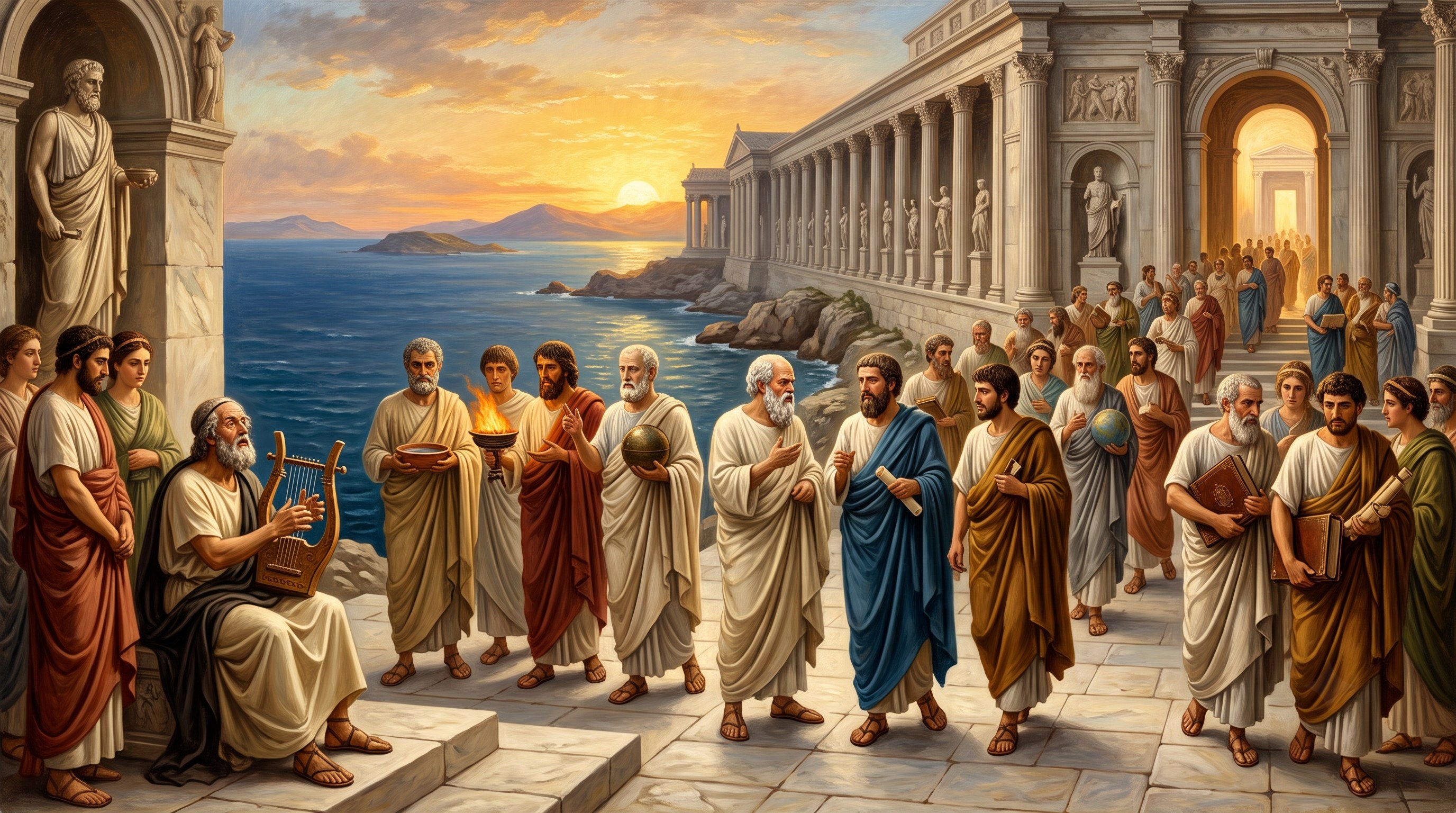
ERA I: THE FOUNDATIONS (c. 750 to 500 BCE)
The period from Homer to Parmenides (roughly 750 to 500 BCE) produced everything the later tradition needed: the portrayal of the Gods (Homer, Hesiod), the mystery traditions (Orpheus), the model of the wise lawgiver (Solon), the first cosmological questions (the Milesians), the first comprehensive philosophical community (Pythagoras), the first philosophy of change (Heraclitus), and the first philosophy of permanence (Parmenides). Every subsequent philosopher works with these materials. Every subsequent school defines itself in relation to these founders.
Before philosophy had a name, before the schools and the academies, before the systematic arguments and the formal logic, there were the poets and the lawgivers. Homer sang the Gods into permanent form. Hesiod codified the divine genealogy. Orpheus opened the mysteries. Solon gave Athens its laws. Thales asked the first philosophical question. These are the roots. Everything that follows grows from this ground.
1. HOMER (c. 750 BCE)
Homer is the beginning. Every Greek philosopher, every Roman statesman, every Byzantine scholar, every Renaissance humanist began with Homer. The Iliad and the Odyssey were the Bible of the Greek world: the texts children memorized, the stories adults debated, the narratives that shaped the moral imagination of an entire civilization for a thousand years.
The question of Homer's historical existence has been debated since antiquity. Seven cities claimed to be his birthplace. The ancients agreed on certain points: he was blind (or became blind), he was Ionian (probably from Smyrna or Chios), and he composed his poems in the oral tradition, performing them before audiences who heard them before they read them. Modern scholarship has complicated the picture (the "Homeric Question" of single versus multiple authorship), but the Zevist position is simple: the poems exist, they carry the knowledge of the Gods, and whether one man or ten composed them is irrelevant to their authority.
What Homer gave the chain:
The Gods as persons. Homer's Gods are not abstractions. They are characters: Zeus presides with authority and occasional fury; Athena combines wisdom with martial skill; Apollo embodies beauty, prophecy, and sudden death; Aphrodite is desire incarnate; Ares is raw violence; Hephaestus is craft and endurance; Hermes is speed, cunning, and communication. Every later theology, every philosophical interpretation, every Neoplatonic allegory begins with Homer's portraits. You can't understand what the Greeks meant by "Zeus" unless you've read the Iliad.
Arete as the supreme value. The Iliad is a poem about excellence. Achilles is the best warrior. Odysseus is the most resourceful man. Hector is the noblest defender. The poem doesn't moralize. It shows what excellence looks like in action: the cost of it, the glory of it, the tragedy of it. When Achilles chooses a short, glorious life over a long, obscure one (Iliad IX.410-416), he's making the foundational choice of the Greek tradition: Arete over comfort, excellence over safety.
The concept of fate (Moira) alongside divine will. Homer's universe is governed by Moira (fate, allotted portion) and by the will of the Gods, and the relationship between these two forces is deliberately unresolved. Even Zeus cannot (or chooses not to) overrule Moira. This tension drives the entire Greek philosophical tradition: the debate between determinism and freedom, between cosmic order and divine intervention, between what is fated and what is chosen.
Xenia (hospitality) as sacred law. Zeus Xenios, Zeus the protector of guests, enforces the laws of hospitality throughout the Odyssey. The suitors who violate xenia in Odysseus' house are slaughtered. Paris, who violated xenia by seducing Helen under Menelaus' roof, brought destruction on Troy. The message is clear: the treatment of strangers is a religious obligation, enforced by the king of the Gods himself.
Homer, Odyssey IX.270-271:
«Ζεὺς δ᾽ ἐπιτιμήτωρ ἱκετάων τε ξείνων τε, ξείνιος.»
"Zeus is the avenger of suppliants and strangers, Zeus the God of strangers."
The Odyssey adds dimensions that the Iliad doesn't. Where the Iliad is about Arete in war (the excellence of the warrior), the Odyssey is about Arete in peace (the excellence of the survivor, the husband, the father, the king). Odysseus' defining quality is metis (μῆτις), cunning intelligence: the ability to read a situation, adapt to circumstances, devise plans, lie when necessary, endure when fighting is useless, and wait for the right moment. Athena loves him precisely for this quality: "You and I are both adept at scheming," she tells him (XIII.296-299). Where Achilles is the straight line (the shortest path, the most direct force), Odysseus is the curve (the winding route, the indirect approach, the plan that accounts for what the straight line ignores).
The Zevist needs both models. There are situations that demand Achilles: direct confrontation, full commitment, the willingness to sacrifice everything for the principle. And there are situations that demand Odysseus: patience, indirection, the long game, the willingness to endure humiliation today in order to triumph tomorrow. The wise man knows which model the situation demands. The Suitors in Odysseus' hall mistook patience for weakness. They were wrong, and they paid for the error with their lives.
The Nekuia (the journey to the Underworld in Book XI) is also essential. Odysseus descends to the land of the dead and converses with the shades. Achilles, who chose the short glorious life, tells Odysseus: "I would rather be a living hired servant to a poor man than king among all the dead" (XI.489-491). This reversal of values, the greatest warrior regretting his choice, complicates the heroic code that the Iliad established. Homer doesn't resolve the tension. He presents both positions: the glory of the short life and the wisdom of the long life. The reader must choose, and the choice reveals who the reader is.
Homer's theology deserves separate treatment. His portrait of the Gods on Olympus (particularly in Iliad Books I, V, XIV, XV, XX, and XXIV) presents a divine society that mirrors and transcends the human one. The Gods feast, argue, scheme, love, and fight. But they do all these things from a position of immortal power: their conflicts have cosmic consequences, their loves create demi-gods, their anger shakes the earth. The theological point is subtle: the Gods are like us (they have personalities, desires, relationships) and utterly unlike us (they are immortal, immeasurably powerful, and ultimately governed by Zeus' sovereign will).
Homer's Zeus is the most fully realized portrait of divine sovereignty in Greek literature. He is not merely the strongest God; he is the wisest. In Iliad VIII.18-27, he challenges the other Gods to a contest of strength: if all of them together pull on a golden chain from one side, he will pull from the other and draw them all up, along with the earth and the sea, and hang everything from Olympus. This image (the "golden chain of Zeus") became one of the most interpreted passages in all of ancient literature. The Stoics read it as an allegory of Providence: Zeus' will governs all things, and nothing can resist it. The Neoplatonists read it as an allegory of the hierarchy of being: the golden chain connects every level of reality to the divine source, and Zeus, holding the chain, sustains all things in existence. Homer, whether he intended it or not, provided the foundational image for fifteen centuries of philosophical theology.
The ending of the Iliad (Book XXIV) is the theological climax of the poem. Priam, the old king of Troy, comes to the tent of Achilles to ransom the body of his son Hector. Achilles, who has been consumed by rage and grief since the death of Patroclus, looks at the old man and sees his own father, Peleus. Both men weep together: Priam for Hector, Achilles for Patroclus and for Peleus, whom he will never see again. In this moment of shared grief, the two enemies recognize their common humanity. Achilles releases Hector's body and grants Priam a truce for the funeral. The Iliad ends with the funeral of Hector, the noblest Trojan. The poem that began with the wrath of Achilles ends with the compassion of Achilles. The theological lesson: the Gods send suffering, and suffering, endured with dignity, produces wisdom. Achilles at the end of the Iliad is a different man from Achilles at the beginning. Rage has been transformed into compassion through the experience of loss. The Gods, who orchestrated the events that brought Priam to Achilles' tent (Zeus sent Hermes to guide the old man safely through the Greek camp), used human suffering as the instrument of human growth.
Homer is the bedrock. Without him, there is no Greek religion, no Greek philosophy, no Western literature. The Zevist reads Homer as scripture: inspired, authoritative, and inexhaustible.
The Iliad's theology is more sophisticated than casual readers realize. Zeus doesn't simply rule the other Gods by force. He rules by wisdom. In Book I, when Thetis asks him to honor Achilles, Zeus weighs the consequences carefully: he knows his decision will cause suffering, and he makes it anyway, because the larger pattern requires it. This is the portrait of a sovereign deity who governs through knowledge of consequences, not through arbitrary will. It anticipates the Stoic concept of Providence: Zeus sees the whole, and his decisions serve the whole, even when individual parts suffer.
The Odyssey adds a crucial dimension. Zeus, speaking in the divine assembly at the poem's opening (I.32-34), declares that mortals blame the Gods for their suffering, but in fact they bring most of it upon themselves through their own recklessness (atasthalia). This statement is the earliest articulation of the idea that human free will coexists with divine governance. The Gods establish the order. Humans can comply with that order or violate it. The consequences follow from the choice, and those consequences are just.
Homer also established the concept of kleos (κλέος), "glory" or "renown": the fame that survives death. For the Homeric hero, kleos is the closest thing to immortality available to a mortal. You will die, but your deeds can live forever in song. This concept drives the entire culture of Arete: you strive for excellence because excellence produces kleos, and kleos is the mortal approximation of the divine attribute of eternity. Achilles chose a short life with eternal kleos over a long life with no kleos. That choice reverberates through the entire Greek tradition.
Homer's relationship to truth is worth noting. The Greeks believed the Muses literally inspired the poet: they breathed into him the knowledge of events he could not have witnessed. The invocation of the Muse at the opening of each poem is a declaration of divine authority. Homer doesn't claim to know what happened at Troy; he claims the Goddess told him. The poem is revelation, mediated through a human channel. The Zevist reads Homer this way: as inspired scripture, carrying truths that exceed the poet's personal knowledge.
2. HESIOD (c. 700 BCE)
If Homer gave the Gods their personalities, Hesiod gave them their genealogy. His Theogony is the systematic account of the origin of the Gods: from Chaos came Earth (Gaia) and Love (Eros); from Gaia came Sky (Ouranos); from their union came the Titans; from the Titans came Zeus and the Olympians; from the war between them came the present order of the cosmos. This is the foundational creation myth of the Greek tradition, and every later cosmology (Platonic, Stoic, Neoplatonic) builds on it or reacts against it.
Hesiod's second major work, Works and Days, is equally important. It's a practical poem addressed to his brother Perses, who had cheated Hesiod of his inheritance through bribed judges. The poem teaches: work hard, be just, fear the Gods, respect the seasons, and live within your means. It contains the myth of the Five Ages (Gold, Silver, Bronze, Heroic, Iron), the story of Pandora, and the first known articulation of the idea that justice (Diké) is a divine principle enforced by Zeus.
Hesiod, Works and Days 267-269:
«Τοῖς δ᾽ ὅρκον τ᾽ ἐπίορκον ὀμόσσῃ, ψευδέ᾽ ὀμόσσας, τῷ δὲ μέτ᾽ ἀθάνατοι δίκης ῥηγμῖνα τέτυκται.»
"For those who swear false oaths, justice follows after."
Hesiod's Diké, daughter of Zeus, sits beside her father's throne and reports the wrongs of men. This image of cosmic justice, personally enforced by the chief God, runs through the entire Greek tradition: from Hesiod to Solon to Plato to the Stoics to Proclus. The Zevist understanding of justice begins here.
Hesiod also cataloged the divine genealogies in a way that made systematic theology possible. Before him, each city had its local myths. After him, there was a shared framework. The Theogony is the first attempt to organize the divine world into a coherent hierarchy, and every later system of theology (including the Neoplatonic) takes Hesiod as its starting point.
Hesiod's Five Ages deserve detailed attention. The Golden Age: humans lived like Gods, without toil, without sorrow, dying as if falling asleep. The Silver Age: a hundred years of childhood, brief and violent adulthood, destroyed by Zeus for refusing to honor the Gods. The Bronze Age: warriors who destroyed each other. The Heroic Age: the age of the Trojan War and Thebes, when demi-gods walked the earth. The Iron Age: our age, marked by toil, suffering, injustice, and the gradual dissolution of all bonds (parents dishonored, guests mistreated, oaths broken).
This schema is cyclical and degenerative: each age is worse than the last (with the Heroic Age as a partial exception). The implication: the cosmos tends toward disorder. Without active intervention (by the Gods, by just rulers, by disciplined individuals), things fall apart. The Zevist reads this as a call to action: we live in the Iron Age, and the Five Ages myth contains a crucial insight. The inclusion of the Heroic Age (better than the Bronze Age that precedes it) breaks the simple pattern of degeneration. This break suggests that decline can be interrupted: there are moments when excellence reasserts itself, when the downward trend is temporarily reversed by exceptional human achievement. The Trojan War and the expedition of the Argonauts produced heroes who were "more just and better" than the men of the Bronze Age (Works and Days 158-160). Individual and collective Arete can resist the general decline of the age.
Hesiod's concept of Eris (Strife) is also dual. In the Works and Days (11-26), he distinguishes between two kinds of Eris: one is destructive (war, violence, conflict), and the other is productive (competition, emulation, the desire to excel by outperforming your neighbor). "Potter envies potter, carpenter envies carpenter, beggar envies beggar, singer envies singer" (25-26). The good Eris drives economic and artistic progress; the bad Eris drives destruction. The Zevist channel of ambition follows the good Eris: compete to excel, strive to outperform your previous best, push yourself and your community toward higher standards. This competitive excellence is the engine of Arete. We live in the Iron Age, and our duty is to resist the dissolution, to maintain Arete against the current, to be the gold within the iron.
The Works and Days also contains practical wisdom that the Zevist should absorb. Don't put off work. Rise early. Maintain your tools. Know the seasons. "The dawn, early-rising, gives a third of the work" (line 579). "Before the house is the toil, but after the toil, the feast" (line 20, adapted). Hesiod teaches that the good life requires daily discipline, and that divine justice rewards the disciplined man and punishes the lazy one.
3. ORPHEUS (mythical; Orphic tradition c. 600 BCE onwards)
Orpheus belongs to a different category than the other figures in this document. He is a mythical figure: the Thracian singer whose music moved stones, tamed wild animals, and opened the gates of the Underworld. His historicity is irrelevant. What matters is the tradition that bears his name: the Orphic tradition, one of the deepest and most influential currents in Greek religion.
The Orphic tradition taught doctrines that set it apart from mainstream Greek religion:
The divine origin of the soul. Mainstream Greek religion was vague about the afterlife. The Orphics were precise: the soul is divine in origin, imprisoned in the body as punishment for a primordial crime (the Titans' murder and consumption of the infant Dionysus; humanity was created from the Titans' ashes, which contained both Titanic and Dionysiac elements). The body is the soul's tomb (σῶμα = σῆμα, soma = sema). Life is a process of purification aimed at freeing the divine soul from its material prison.
Reincarnation and purification. The soul passes through a cycle of births (κύκλος γενέσεως, kyklos geneseos, the "cycle of generation"). Through ritual purification, vegetarianism, and right conduct, the soul can escape the cycle and return to its divine source. This doctrine influenced Pythagoras directly, and through him, Plato.
The Orphic cosmogony. The Orphic creation story differs from Hesiod's. In one version, the cosmic egg hatches to produce Phanes (also called Protogonos, "First-Born"), a hermaphroditic deity of light who creates the visible world. Zeus then swallows Phanes and re-creates the cosmos from within himself, so that all things exist inside Zeus. The Orphic hymn states: "Zeus is the first, Zeus is the last; Zeus is the head, Zeus is the middle; from Zeus all things are made" (Orphic fragment 21a Kern). This radical monotheistic theology within polytheism directly influenced the Stoic concept of Zeus as the cosmic Logos and the Neoplatonic concept of the One.
Orphic Fragment 21a (Kern):
«Ζεὺς πρῶτος γένετο, Ζεὺς ὕστατος ἀργικέραυνος· Ζεὺς κεφαλή, Ζεὺς μέσσα, Διὸς δ᾽ ἐκ πάντα τέτυκται.»
"Zeus was born first, Zeus last, Zeus of the bright thunderbolt; Zeus is the head, Zeus the middle, and from Zeus all things are made."
The Orphic mysteries were practiced throughout the Greek world. Gold tablets found in graves in southern Italy and Crete contain instructions for the dead soul's journey through the Underworld: which springs to drink from, what words to say to the guardians, how to identify yourself as a child of Earth and starry Heaven. These tablets are among the most moving artifacts of Greek religion: practical guides for the soul's navigation of death.
Orphism flows through the entire chain: through Pythagoras, through Empedocles, through Plato (whose myths of the afterlife in the Republic, Phaedo, and Phaedrus are deeply Orphic), through the Neoplatonists, and into the living Zevist tradition.
The Orphic gold tablets, found in graves from Thurii to Crete, are among the most direct records of ancient pagan religious practice. A typical tablet reads: "I am a child of Earth and starry Heaven, but my race is heavenly. You know this yourselves. I am parched with thirst and am perishing. Give me to drink from the spring of Memory." The soul identifies itself to the guardians of the Underworld, declares its divine origin, and asks for the water of Memory (Mnemosyne), which restores its knowledge of its true nature. This is the inverse of the river Lethe (Forgetfulness), which erases identity. The Orphic initiate chooses Memory over Forgetfulness, identity over dissolution, consciousness over oblivion.
The Orphic tradition also established the principle that the body is a temporary vessel and that the soul's true home is elsewhere. This doctrine, transmitted through Pythagoras to Plato, became the foundation of all subsequent Western metaphysics of the soul. When Plato writes in the Phaedo that the philosopher practices death (melete thanatou), he is speaking in an Orphic register: the philosopher rehearses the separation of soul from body, so that when death comes, it finds him prepared.
The Orphic cosmogony's image of Zeus swallowing Phanes and re-creating the world from within himself is theologically profound. It means that the cosmos exists inside Zeus. Everything that exists is Zeus, in a specific sense: the cosmos is Zeus' body, animated by Zeus' mind. This pantheistic or panentheistic theology runs as an undercurrent through the entire Greek tradition: through the Stoics (for whom Zeus is the cosmic fire-pneuma), through the Neoplatonists (for whom all things proceed from and return to the One), and into the Zevist understanding that every atom of the cosmos is a manifestation of the divine order.
4. SOLON OF ATHENS (c. 638 to 558 BCE)
Solon was counted among the Seven Sages of Greece, and he earned the title. He was an Athenian statesman, lawgiver, and poet who reformed Athenian society at a moment of crisis and set it on the path that would lead to democracy, philosophy, and cultural supremacy.
Athens in the early sixth century BCE was torn apart by debt slavery. Poor farmers who couldn't pay their debts were enslaved by wealthy landowners. The city was on the verge of civil war. Solon was elected archon (chief magistrate) in 594 BCE with extraordinary powers to reform the laws.
His reforms were sweeping. He cancelled all existing debts (the seisachtheia, "shaking off of burdens"). He freed Athenians who had been enslaved for debt. He prohibited future debt slavery. He reformed the currency. He reorganized the citizen body into four classes based on wealth rather than birth, opening public office to men of ability. He established the right of any citizen to bring a lawsuit on behalf of an injured party (a revolutionary innovation that made justice accessible to the poor). He created the Boule (Council of Four Hundred) as a check on the power of the aristocratic Areopagus.
Then he did something even more remarkable: he left. He made the Athenians swear to observe his laws for ten years, and then he traveled abroad, visiting Egypt, Cyprus, and Lydia (where, according to Herodotus, he met King Croesus and told him that no man could be called happy until he was dead). He refused to become tyrant, though he could have. He chose the law over personal power.
Solon was also a poet, and his poems preserve his political philosophy in memorable form:
Solon, fragment 36 (West):
«Δήμῳ μὲν γὰρ ἔδωκα τόσον γέρας, ὅσσον ἀπαρκεῖ, τιμῆς οὔτ᾽ ἀφελὼν οὔτ᾽ ἐπορεξάμενος.»
"To the people I gave as much privilege as was sufficient, taking away neither honor nor reaching for too much."
This is the principle of the mean applied to politics: give the people enough power to prevent tyranny, but not so much that the state dissolves into mob rule. Aristotle cited Solon as the model of the moderate reformer, and the principle of balanced government that Solon established became the foundation of Plato's mixed constitution in the Laws.
His famous elegy on the ages of man divides human life into ten periods of seven years each (the hebdomads): infancy (0-7), boyhood (7-14), adolescence (14-21), young manhood (21-28), the prime of life (28-42), mature wisdom (42-56), the beginning of decline (56-63), old age (63-70). After seventy, death may come at any time, and the wise man accepts it. This schematization influenced Hippocratic medicine (which adopted the seven-year cycle), Pythagorean numerology, and the entire subsequent tradition of life-stage theory.
His political poetry articulates the principle that a city's prosperity depends on justice, and that injustice destroys the state from within. "Our city will never perish by the decree of Zeus or the will of the blessed immortal Gods... but the citizens themselves, in their foolishness, wish to destroy the great city, yielding to the persuasion of money" (fragment 4 West, lines 1-6). The Gods don't destroy cities; citizens destroy cities, through greed, corruption, and the erosion of justice. The Zevist reads Solon as the first political philosopher of the Western tradition: the man who understood that political life requires moral foundations, and that a city without justice is a city without a future.
Solon matters to the chain because he proved that wisdom and political power can coexist, that the philosopher (or the sage, which is the same thing) can reform a state through law, and that the greatest act of power is the willingness to relinquish it.
Solon's reforms also included the encouragement of trade and craft. He promoted olive cultivation (banning the export of all agricultural products except olive oil, thus creating the Athenian olive oil trade that became one of the most important commercial activities in the Mediterranean). He reformed weights and measures. He encouraged skilled craftsmen from other cities to settle in Athens by offering them citizenship. These economic reforms laid the foundation for Athens' commercial prosperity in the fifth century.
His encounter with Croesus, king of Lydia (as told by Herodotus, Histories I.29-33), contains one of the most important lessons in Greek wisdom literature. Croesus showed Solon his vast treasures and asked: "Who is the happiest man you have ever seen?" He expected Solon to name him. Solon named Tellus of Athens, an obscure citizen who lived a good life, raised fine children, and died bravely in battle. Croesus, offended, pressed: "And the second happiest?" Solon named Cleobis and Biton, two young men who carried their mother to the temple in an oxcart, were blessed by the goddess Hera, and died peacefully in their sleep. Croesus, now angry, demanded to know why he wasn't named. Solon's answer: "Call no man happy until he is dead." Happiness can only be judged when the whole life is visible, and the whole life is only visible at its end. Croesus dismissed the advice. Later, when he was captured by Cyrus of Persia and placed on a funeral pyre, he cried out "Solon! Solon!" and Cyrus, curious, asked him to explain. When Cyrus heard the story, he spared Croesus' life.
The lesson: the wisdom of the sage has practical power. Solon's words saved a king's life, decades after they were spoken. The Zevist who absorbs the teachings of the tradition carries a similar power: the right word, spoken or recalled at the right moment, can change the course of events.
5. THALES OF MILETUS (c. 624 to 546 BCE)
Thales is the first philosopher. Aristotle says so (Metaphysics I.3, 983b6), and no one has disputed it. He was the first person in recorded history to ask the question: what is the fundamental substance of which all things are made? His answer (water) was wrong. The question was everything.
Thales was born in Miletus, the wealthiest and most intellectually active city in Ionia (the Greek coast of Asia Minor). He was one of the Seven Sages. Ancient sources attribute to him: the prediction of a solar eclipse (585 BCE, confirmed by modern astronomy), the measurement of the height of the Egyptian pyramids by their shadows, the introduction of Egyptian geometry into Greece, the discovery that amber, when rubbed, attracts light objects (the first observation of static electricity), and the proposition that the earth floats on water.
His philosophical significance lies in the method. Before Thales, the question "why does the rain fall?" received a mythological answer: Zeus sends it. After Thales, the same question received a naturalistic answer: the process follows from the fundamental nature of the material world. Thales didn't reject the Gods (Aristotle records him as saying "all things are full of Gods," De Anima I.5, 411a7). He added a second mode of explanation alongside the theological one. This dual approach, divine and natural, defines the entire Greek philosophical tradition.
Thales also matters because he taught Anaximander, who taught Anaximenes, who influenced Pythagoras, who influenced Plato, who influenced Aristotle. The chain begins with him. He also demonstrated the practical value of philosophical thinking. Aristotle (Politics I.11, 1259a) records the famous story: Thales, tired of being mocked for his poverty (people said philosophy was useless), used his astronomical knowledge to predict a bumper olive harvest. He quietly rented all the olive presses in Miletus and Chios before the season. When the harvest came and everyone needed presses, Thales charged whatever he liked and made a fortune. He then returned to philosophy, having proved his point: the philosopher can make money whenever he chooses; he simply has better things to do.
This story matters because it refutes the oldest and most persistent criticism of philosophy: that it's impractical. Thales showed that the same intellectual capacities that enable you to understand the cosmos also enable you to understand the market. The philosopher who chooses contemplation over commerce is making a choice, and the choice reveals his values, and his values reveal his understanding of what matters. Thales chose to understand the cosmos. The olive press story proves he could have chosen otherwise.
He was the first link.
Thales' significance extends beyond his specific philosophical claims. He represents a turning point in human intellectual history: the moment when humanity discovered that the world can be understood through reason. Every science, every technology, every systematic investigation of reality begins with this discovery. Before Thales, the world was explained by stories. After Thales, stories were supplemented by arguments. Both modes of understanding coexist in the Greek tradition (Homer and Thales are both part of the chain), and the Zevist honors both: the mythological mode reveals the meaning of things, the philosophical mode reveals their structure. Both are necessary; neither is sufficient alone.
His saying "all things are full of Gods" (πάντα πλήρη θεῶν) deserves special attention. It means that divinity is not confined to temples and altars. It pervades everything: every stone, every river, every breath of wind. This is the foundational Zevist position on the relationship between the divine and the natural: the Gods are not absent from the world, watching from a distance. They are present in every particle of matter, in every natural process, in every living thing. Physics and theology are not enemies; they're two languages for describing the same reality.
6. ANAXIMANDER OF MILETUS (c. 610 to 546 BCE)
Anaximander was Thales' student and successor. He pushed his teacher's question further: if all things come from one substance, that substance can't be any of the observable elements (water, air, fire, earth), because each of these is already a specific, limited thing. The fundamental substance must be unlimited, indefinite, without specific qualities. He called it the apeiron (τὸ ἄπειρον, "the boundless," "the infinite").
This was a staggering intellectual leap. Anaximander moved from the visible to the invisible, from the specific to the abstract, from the physical to the metaphysical. He posited an unobservable principle as the ground of all observable things. This is the first step toward Plato's Forms, toward Aristotle's prime matter, toward the Neoplatonic One.
He also produced the first known map of the world, proposed that the earth is a cylinder floating freely in space (held in place by its equidistance from all things, not resting on anything), and suggested that human beings evolved from fish-like creatures that lived in the sea. This last idea, reported by several ancient sources, makes Anaximander the first thinker to propose something like biological evolution, twenty-four centuries before Darwin.
His most famous fragment states the law that governs all change:
Anaximander, fragment B1 (DK):
«Ἐξ ὧν δὲ ἡ γένεσίς ἐστι τοῖς οὖσι, καὶ τὴν φθορὰν εἰς ταῦτα γίνεσθαι κατὰ τὸ χρεών· διδόναι γὰρ αὐτὰ δίκην καὶ τίσιν ἀλλήλοις τῆς ἀδικίας κατὰ τὴν τοῦ χρόνου τάξιν.»
"From the same source from which things arise, to that they return of necessity; for they pay penalty and retribution to each other for their injustice according to the ordering of time."
This fragment reveals a cosmos governed by justice (Diké): the same principle Hesiod described in Works and Days now operates at the level of physics. The birth and death of all things follows a moral law. Anaximander unified physics and ethics in a single vision.
Anaximander's concept of the apeiron anticipates many of the deepest ideas in later philosophy. The apeiron is the unlimited, the indefinite, the source from which all definite things emerge and to which they return. It is the first philosophical concept of infinity, and it carries theological implications: the apeiron is divine (Aristotle reports that Anaximander called it "the divine," Physics III.4, 203b13), immortal, and indestructible. It encompasses all things and steers all things. This is the earliest philosophical portrait of God as infinite ground: an impersonal, unlimited source of all being, prior to all specific forms and qualities.
The fragment about justice deserves deep reflection. Things come into being from the apeiron and return to it "according to necessity." They "pay penalty and retribution to each other for their injustice." What does this mean? Every definite thing (every tree, every person, every civilization) is an "injustice" in the sense that it has separated itself from the infinite whole, has claimed a portion of being for itself, has insisted on being this particular thing rather than remaining in the universal flux. The penalty for this separation is dissolution: every particular thing eventually returns to the infinite source from which it came. Birth is separation; death is return. Existence is injustice; dissolution is justice.
This vision is severe and beautiful. The Zevist reads it as a reminder that every individual existence is temporary and that the permanent reality is the unlimited source. The wise man lives in awareness of both: the particular life he inhabits and the infinite ground from which it springs. He doesn't reject his particular existence (that would be nihilism), and he doesn't cling to it (that would be delusion). He holds both, the way a musician holds both the note and the silence from which it emerged.
7. ANAXIMENES OF MILETUS (c. 586 to 526 BCE)
Anaximenes, the third of the Milesian philosophers, proposed that the fundamental substance is air (aer). When air thickens (condensation), it becomes wind, then cloud, then water, then earth, then stone. When it thins (rarefaction), it becomes fire. All change is the condensation or rarefaction of a single substance.
This seems like a step backward from Anaximander's abstract apeiron. In fact, it's a step forward in method. Anaximenes provided a mechanism: condensation and rarefaction. He showed how one substance becomes many through a quantitative process. This is the first attempt at a mechanical explanation of natural change, and it anticipates the modern scientific method of explaining qualitative differences through quantitative processes (temperature is the speed of molecular motion; color is the wavelength of light).
Anaximenes introduced a crucial methodological innovation: the principle that qualitative differences can be explained by quantitative changes in a single substance. Water differs from ice only in temperature (the degree of condensation). Steam differs from water only in temperature (the degree of rarefaction). What appears to be a change in kind (liquid to solid, liquid to gas) is actually a change in degree. This insight, that the apparent diversity of nature conceals an underlying quantitative unity, became the foundational assumption of modern physics and chemistry. When a chemist says that diamond and graphite are both carbon, differing only in the arrangement of their atoms, he is restating Anaximenes' principle in modern terms.
His influence on the Stoics was direct. The Stoic concept of pneuma (divine breath-fire that pervades all matter, giving it form and coherence) is an elaboration of Anaximenes' cosmic air. The Stoics replaced "air" with "pneuma" and "condensation/rarefaction" with "tension" (tonos), but the underlying model is the same: a single, continuous, living substance that differentiates itself through varying degrees of intensity. The cosmos breathes because it is alive, and it is alive because the divine substance pervades every part of it.
Anaximenes also drew a parallel between the cosmos and the human body: "Just as our soul, being air, holds us together, so breath and air surround the whole cosmos" (fragment B2, DK). The cosmos breathes. It is alive. This organic cosmology, in which the universe is a living being animated by a universal soul, runs through the entire Greek tradition: through the Stoics (who identified God with the cosmic pneuma), through Plato's Timaeus (in which the cosmos is a living creature with a soul), and through the Neoplatonists.
8. PYTHAGORAS OF SAMOS (c. 570 to c. 495 BCE)
Pythagoras has been treated at length in the companion sermon on the Four Great Philosophers. Here, the summary is brief.
Forty years of preparation: study under Thales and Anaximander in Miletus, twenty-two years with the Egyptian priests, twelve years with the Babylonian Magi. He returned to the Greek world and founded the Pythagorean Brotherhood in Croton, southern Italy, around 530 BCE. The Brotherhood was simultaneously a philosophical school, a religious community, a mathematical research institute, and a political movement.
His contributions to the chain: "All is number" (the mathematical structure of reality). The Pythagorean theorem. The discovery of musical ratios. The transmigration of souls. The Tetraktys. The harmony of the spheres. The way of life: daily routine, vegetarianism, communal property, the evening review, silence as discipline. The Five-Pointed Star as the symbol of health and recognition.
The Pythagorean pentagram (the five-pointed star inscribed in a regular pentagon) served as the Brotherhood's secret sign of recognition. Members could identify each other by drawing this symbol. Mathematically, the pentagram is a marvel: every line segment is divided by the intersecting segments in the golden ratio (φ = 1.618...), and the diagonals of the inner pentagon form another, smaller pentagram, and so on ad infinitum. The figure is self-similar at every scale: a fractal before fractals had a name. The Pythagoreans called it ὑγίεια (hygieia), "health," because it embodied the mathematical harmony that they considered the source of all well-being.
The Pythagorean classification of numbers reveals the depth of their mathematical research. They distinguished: even and odd; prime and composite; perfect numbers (equal to the sum of their divisors: 6 = 1+2+3; 28 = 1+2+4+7+14); amicable numbers (pairs where each equals the sum of the other's divisors: 220 and 284); triangular numbers (1, 3, 6, 10, 15...); square numbers (1, 4, 9, 16, 25...); and oblong numbers (2, 6, 12, 20...). They discovered the relationship between these classes and explored their properties with a passion that was simultaneously mathematical and religious. For the Pythagoreans, number theory was theology: the properties of numbers are the properties of being itself, and to understand numbers is to understand the mind of God.
The doctrine of the harmony of the spheres connected music, mathematics, and cosmology in a single vision. Each planet, moving through space at a specific speed and distance from the center, produces a note. The combination of all these notes produces a cosmic chord: the music of the universe. We don't hear it because we've heard it since birth, the way a miller doesn't hear the grinding of his own mill. The doctrine seems mystical, but its core insight is scientific: the movements of the celestial bodies are governed by mathematical laws, and those laws can be expressed as ratios. When Kepler titled his masterwork Harmonices Mundi ("The Harmonies of the World," 1619), he was consciously fulfilling the Pythagorean program.
Aristotle classified him as "between Gods and men." The Zevist tradition classifies him as a Theophoros of the first order: a channel through which the knowledge of three civilizations flowed into Greece and was transformed into philosophy.
Golden Verses, 40-42:
«Μηδ᾽ ὕπνον μαλακοῖσιν ἐπ᾽ ὄμμασι προσδέξασθαι, πρὶν τῶν ἡμερινῶν ἔργων τρὶς ἕκαστον ἐπελθεῖν· πῇ παρέβην; τί δ᾽ ἔρεξα; τί μοι δέον οὐκ ἐτελέσθη;»
"Do not welcome sleep upon your soft eyes before you have reviewed each of the day's deeds three times: Where did I go wrong? What did I do? What duty was left undone?"
9. HERACLITUS OF EPHESUS (c. 535 to 475 BCE)
Heraclitus was called "the Obscure" (σκοτεινός, skoteinos) and "the Weeping Philosopher." He was an aristocrat from Ephesus who renounced his hereditary right to the kingship in favor of his brother. He deposited his book in the Temple of Artemis at Ephesus, reportedly saying it was meant for those capable of understanding it, and withdrew into solitary contemplation.
His philosophy is preserved in approximately 130 fragments, and every one of them burns with intensity.
The Logos. Heraclitus was the first philosopher to use the term Logos (λόγος) in a philosophical sense. For him, the Logos is the rational principle that governs all things: the law of the universe, the pattern within the flux, the unity behind the opposites. It is always operative, and most people fail to recognize it, even when they encounter it directly.
Heraclitus, fragment B1 (DK):
«Τοῦ δὲ λόγου τοῦδ᾽ ἐόντος ἀεὶ ἀξύνετοι γίνονται ἄνθρωποι.»
"Although this Logos holds forever, people fail to understand it, both before hearing it and after they have heard it."
The unity of opposites. Heraclitus taught that opposites are identical: day and night, life and death, up and down, are aspects of a single process. "The road up and the road down are one and the same" (fragment B60). "God is day and night, winter and summer, war and peace, satiety and hunger" (fragment B67). This doctrine influenced Plato's dialectic, Aristotle's concept of potentiality and actuality, Hegel's dialectic, and the Stoic concept of cosmic cycles.
Fire as the fundamental element. Heraclitus identified fire as the arche (first principle): "This cosmos, the same for all, no God and no man made, but it always was, is, and will be: an ever-living fire, kindling in measures and going out in measures" (fragment B30). Fire is the perfect symbol for his philosophy: it is both destruction and creation, both death and life, both consuming and producing. The cosmos is a fire that transforms itself endlessly.
"Panta rhei" (everything flows). The most famous Heraclitean doctrine, though the phrase itself may come from Plato's summary rather than Heraclitus' own words: "You cannot step twice into the same river" (fragment B91). Everything changes. Stability is an illusion. The cosmos is process, perpetual becoming, perpetual transformation. The only constant is the Logos: the law of change itself.
Heraclitus matters to the chain because he introduced the concept of the Logos that would become central to Stoic theology, because he insisted on the unity of opposites that Plato would develop into dialectic, and because his vision of cosmic fire would reappear in the Stoic ekpyrosis (the periodic conflagration and rebirth of the cosmos).
Several more of Heraclitus' fragments deserve quotation and reflection, because they illuminate the Zevist path:
"The way up and the way down are one and the same" (fragment B60). The ascent to the divine and the descent into matter are the same path, traveled in opposite directions. The Neoplatonic procession (from the One down to matter) and return (from matter back to the One) are the same road. The philosopher who ascends retraces the steps of the soul's descent. This insight connects Heraclitus to Plotinus across seven centuries.
"Those who are awake share one common cosmos; those who sleep turn each to a private world" (fragment B89). Most people live in private worlds of opinion, prejudice, and habitual thinking. The philosopher wakes up and enters the shared world of the Logos: the one reality that is the same for all who see it clearly. The function of philosophy is to wake people up, to drag them out of their private dreams and into the common daylight of rational understanding. Socrates was a gadfly for the same reason: he stung the sleeping horse of Athens.
"The most beautiful cosmos is a heap of things poured out at random" (fragment B124). This seems to contradict the doctrine of the Logos. How can the cosmos be both rationally ordered and random? The answer: the order is not visible on the surface. To the untrained eye, the cosmos looks like chaos. Only the philosopher, who has grasped the Logos, sees the order beneath the apparent disorder. The heap of random things is beautiful precisely because it conceals a profound order: the order of opposites in tension, of fire transforming itself, of the Logos working through change.
"The thunderbolt steers all things" (fragment B64). Zeus' weapon, the thunderbolt (κεραυνός, keraunos), is the symbol of divine governance. The cosmos is not steered by gentle persuasion; it is steered by lightning: by sudden, overwhelming, irresistible force. The Logos doesn't ask for compliance; it commands it. When a forest fire sweeps through and the dead wood burns, the Logos is at work. When a civilization collapses because it violated the principles of justice, the thunderbolt has struck. The Zevist reads this fragment as a reminder that divine governance is real, that it operates through natural processes, and that the consequences of violating the cosmic order are not negotiable.
"I searched for myself" (fragment B101). The shortest and perhaps the deepest of Heraclitus' fragments. Philosophy begins with self-inquiry. Before you can understand the cosmos, you must understand yourself. Before you can grasp the Logos that governs all things, you must find the logos within your own soul. This fragment anticipates the Delphic maxim "Know thyself" (γνῶθι σεαυτόν), Socrates' insistence on self-examination, and Plotinus' injunction to "turn inward, for the source is within." The philosophical journey is always a journey inward before it is a journey outward.
The Stoics considered Heraclitus their intellectual ancestor, and they were right.
Heraclitus deserves emphasis on one more point: his concept of the soul's depth. "You would not find out the boundaries of the soul by traveling, even if you traveled every road: so deep is its logos" (fragment B45). The soul has a logos (a rational structure, a depth of meaning) that exceeds any investigation. This statement anticipates the entire tradition of depth psychology: the insight that the psyche contains more than the conscious mind can access, that there are depths below the surface that can be explored but never exhausted.
His aristocratic temperament also deserves noting. Heraclitus had contempt for the masses: "Dogs bark at those they don't recognize" (fragment B97). "Most people are bad" (fragment B104). He didn't teach publicly and didn't seek disciples. He wrote for those who could understand, and he made no effort to make himself accessible. This is the opposite of the Sophistic approach, and it carries a lesson: truth is not a democracy. The majority does not determine what is real. The philosopher's job is to see clearly, and if the majority cannot follow, the philosopher does not lower his gaze.
The Stoics venerated Heraclitus as their predecessor, and they were right. His Logos became their Logos. His cosmic fire became their cosmic pneuma. His vision of a universe governed by rational law, in which apparent opposites are resolved into unity, and in which the wise man aligns himself with the cosmic order, is the skeleton of Stoic theology. Every time a Stoic says "live according to nature," he is echoing Heraclitus.
10. PARMENIDES OF ELEA (c. 515 to 450 BCE)
Parmenides is the opposite of Heraclitus, and together they define the two poles of Greek philosophy. Heraclitus said everything changes. Parmenides said nothing changes. Change is an illusion. Reality is one, eternal, unchanging, indivisible, and perfect.
He was born in Elea (modern Velia, in southern Italy), a Greek colony. He was connected to the Pythagorean community. He wrote a single philosophical poem, On Nature, in which a young man is carried by chariot to the gates of Night and Day, where a goddess reveals to him the truth about reality.
The goddess presents two "ways" of inquiry: the Way of Truth and the Way of Opinion. The Way of Truth reveals that "what is, is, and cannot not-be" (fragment B2). Being is. Non-being is not. Change requires something to come into being from non-being, which is impossible, because non-being does not exist. Therefore, change is impossible. Motion is impossible. Birth and death are impossible. The apparent world of change and multiplicity is an illusion. True reality is a single, unchanging, perfect sphere of Being.
Parmenides, fragment B8, lines 3-6 (DK):
«...ὡς ἀγένητον ἐὸν καὶ ἀνώλεθρόν ἐστιν, ἐστι γὰρ οὐλομελές τε καὶ ἀτρεμὲς ἠδ᾽ ἀτέλεστον.»
"...that Being is ungenerated and imperishable, whole, of a single kind, unshaken, and complete."
This sounds absurd. The senses clearly perceive change. Parmenides knew this. His point was deeper: logic trumps perception. If logic demonstrates that change is impossible, then the senses are wrong, and the philosopher must follow the argument where it leads, regardless of appearances. This commitment to rational argument over sensory evidence is the foundation of all subsequent Western philosophy and science. Every physicist who accepts that the earth moves (despite the sensory evidence that it stands still) is following Parmenides' method.
Parmenides forced every subsequent philosopher to confront the problem of change. Plato's Theory of Forms is, in part, an answer to Parmenides: the Forms are the eternal, unchanging reality that Parmenides described, while the physical world is the changing reality that Heraclitus described. The Forms are the Way of Truth; the physical world is the Way of Opinion. Plato synthesized both by placing them in a hierarchy.
His poem's structure is itself philosophically significant. The proem (introduction) describes the young man's journey by chariot to the gates of Night and Day, where the goddess Justice (Diké) holds the keys. The goddess receives him and tells him he must learn "both the unshaken heart of well-rounded truth and the opinions of mortals, in which there is no true trust" (fragment B1, lines 28-30). This framing device tells us several things. First, truth comes from the divine, not from human invention (the goddess reveals; the young man receives). Second, truth requires a journey (you don't find it by staying where you are; you must travel beyond the ordinary world). Third, the path to truth passes through the gates of Justice: only the just soul can receive truth. Philosophy is not morally neutral; it requires moral preparation.
The Way of Opinion, which occupies the second part of the poem (largely lost), describes the cosmos as it appears to the senses: a world of change, diversity, and mortality. This section is often dismissed as a concession to popular belief, but it may serve a deeper purpose. The philosopher needs to understand appearances, even false ones, in order to see through them. You can't escape the cave if you don't first understand that you're in a cave. The Way of Opinion may be Parmenides' description of the cave: the world as it appears to the unphilosophical mind, presented with sufficient detail that the philosopher can recognize it and transcend it.
His influence on modern philosophy is sometimes underestimated. Descartes' cogito ("I think, therefore I am") echoes Parmenides' fundamental insight: thinking and being are the same. Hegel's dialectic (thesis, antithesis, synthesis) can be read as a sustained attempt to resolve the Parmenidean paradox of change and permanence. Heidegger devoted extensive study to Parmenides, finding in his poem the origins of the "question of Being" that Heidegger considered the fundamental question of all philosophy. Twenty-five centuries after Parmenides wrote, the questions he raised remain open.
Parmenides matters because he established the standard: philosophy must follow the argument. If the conclusion is uncomfortable, the conclusion stands. The philosopher who abandons a valid argument because its conclusion is inconvenient is no philosopher at all.
Parmenides' influence on Plato was so profound that Plato named a dialogue after him and made him the senior figure in it. In the Parmenides, the young Socrates presents the Theory of Forms to the elderly Parmenides, and Parmenides subjects the theory to devastating criticism (the famous "Third Man" argument). The dialogue reveals Plato's awareness that his own theory needed refinement, and his respect for Parmenides was so great that he allowed the Eleatic to win the argument. In the second half of the dialogue, Parmenides conducts a series of eight deductions about the One and the Many that became the foundation of Neoplatonic metaphysics. Proclus considered the Parmenides the most theological of all Plato's dialogues, and his commentary on it runs to over a thousand pages.
The Eleatic tradition that Parmenides founded produced two of the most important concepts in Western philosophy: the distinction between appearance and reality (what things seem to be versus what they truly are), and the primacy of logical argument over sensory evidence. Both concepts are indispensable to science, to law, to philosophy, and to spiritual practice. The Zevist who meditates is practicing Parmenides' method: turning away from the Way of Opinion (the sensory world) toward the Way of Truth (the intelligible reality that underlies appearances).
11. ZENO OF ELEA (c. 490 to 430 BCE)
Zeno was Parmenides' student and defender. He composed a book of paradoxes designed to prove that the common-sense belief in motion and plurality leads to contradictions. His paradoxes are among the most famous arguments in the history of philosophy.
Achilles and the Tortoise: Achilles gives the tortoise a head start. To catch the tortoise, Achilles must first reach the point where the tortoise was. But by that time, the tortoise has moved ahead. Achilles must then reach that new point, but the tortoise has moved again. The process continues infinitely. Achilles can never catch the tortoise.
The Dichotomy: Before you can cross a room, you must cross half the room. Before you can cross half, you must cross a quarter. Before a quarter, an eighth. The division is infinite. You must complete an infinite number of tasks in a finite time. Therefore, motion is impossible.
The Arrow: At any given instant, an arrow in flight occupies a space exactly equal to itself. At that instant, it is at rest (since it occupies a definite position). But time is composed of instants. If the arrow is at rest at every instant, it is always at rest. Therefore, motion is impossible.
These paradoxes are not tricks. They expose genuine problems about the nature of space, time, and infinity that were not adequately resolved until the development of calculus by Newton and Leibniz in the seventeenth century, and even then, questions remained (the rigorous mathematical solution came with Cantor's theory of transfinite numbers and Weierstrass' epsilon-delta definition of limits in the nineteenth century). Zeno identified problems that took twenty-four centuries to solve. That's the power of following the argument.
Aristotle called Zeno the inventor of dialectic (the art of arguing from an opponent's premises to a contradictory conclusion).
Zeno's paradoxes also raise the question of the relationship between logic and reality. If a valid logical argument proves that motion is impossible, but we observe motion constantly, which do we trust: the logic or the observation? Parmenides and Zeno chose logic. Aristotle chose a combination of logic and observation, arguing that Zeno's arguments contain hidden assumptions (specifically, about the nature of infinity) that can be exposed and corrected. The modern response (calculus, set theory) preserves both: the logic is valid, and motion is real, because the mathematical framework needed to reconcile the two had not yet been developed in Zeno's time. Zeno didn't prove that motion is impossible; he proved that the Greek concept of infinity was inadequate. The paradoxes drove the development of a better concept.
The Zevist takes from Zeno a specific lesson about intellectual courage: if your argument leads to an uncomfortable conclusion, don't abandon the argument. Check the premises. If the premises are sound and the reasoning is valid, the conclusion stands, however strange it may seem. The philosopher who abandons a valid argument because its conclusion contradicts common sense has chosen comfort over truth. Zeno chose truth, and truth eventually vindicated him: the mathematical tools needed to resolve his paradoxes proved more valuable than the common-sense beliefs they challenged.
This makes Zeno an ancestor of Socrates' elenctic method and of Plato's dialectical method.
Zeno's paradoxes raise the deepest questions about the relationship between mathematics and physical reality. Can space be infinitely divided? Is time composed of instants or of durations? Is motion a continuous process or a series of discrete steps? These questions drove the development of mathematical analysis from Archimedes through Newton to Cantor, and they remain active in the philosophy of physics today. Quantum mechanics, which describes reality in terms of discrete quantities rather than continuous processes, can be read as a vindication of certain Zenonian intuitions.
Aristotle's solution to Zeno's paradoxes (distinguishing between potential infinity, which is real, and actual infinity, which is impossible) dominated Western thought for two millennia. The modern mathematical solution (the theory of infinite series and limits) shows that an infinite number of tasks can indeed be completed in a finite time, as long as the time required for each successive task decreases sufficiently fast. The sum 1/2 + 1/4 + 1/8 + ... = 1. Achilles catches the tortoise. Motion is possible. But Zeno's contribution was to show that this conclusion requires sophisticated mathematical justification and cannot be taken for granted.
12. EMPEDOCLES OF ACRAGAS (c. 494 to 434 BCE)
Empedocles was a philosopher, poet, physician, engineer, orator, and wonder-worker from Acragas (modern Agrigento) in Sicily. He was the most colorful of the Presocratics: he wore purple robes, a golden crown, and bronze sandals, and claimed to be a God walking among mortals.
Empedocles, fragment B112 (DK):
«Ὦ φίλοι, οἳ μέγα ἄστυ κατὰ ξανθοῦ Ἀκράγαντος ναίετ᾽... χαίρετ᾽· ἐγὼ δ᾽ ὑμῖν θεὸς ἄμβροτος, οὐκέτι θνητός.»
"Friends, who dwell in the great city of golden Acragas... greetings! I, an immortal God, no longer mortal, walk among you."
His philosophy: four eternal elements (earth, water, air, fire) are combined and separated by two cosmic forces: Love (Φιλία, Philia) and Strife (Νεῖκος, Neikos). Love unites; Strife divides. The cosmos cycles eternally between a state of perfect unity under Love (the Sphere) and a state of complete separation under Strife. We live in a period between these extremes, where both forces operate simultaneously.
Empedocles also taught the transmigration of souls, in terms closely related to the Orphic and Pythagorean traditions. He claimed to have been a bush, a bird, a fish, and a boy and girl in previous lives (fragment B117). He taught that the soul falls from the divine realm due to a primal sin (swearing a false oath, according to fragment B115) and must undergo thirty thousand seasons of incarnation before returning.
Empedocles' theory of vision deserves attention as an example of his scientific method. He proposed that the eye contains fire (you can see it when you press on your closed eyelids) and that vision occurs when effluences from external objects meet the fire emanating from the eye. The two streams meet, interact, and produce the experience of sight. This "extramission" theory (the eye sends something outward) was eventually superseded by the "intromission" theory (the eye receives something from outside), but Empedocles' approach, proposing a physical mechanism for perception and testing it against observation, is genuinely scientific.
His biology was ahead of its time. He proposed that the earliest living creatures were isolated limbs and organs ("heads without necks, arms without shoulders, eyes without faces," fragment B57) that combined randomly under the influence of Love. Most combinations were non-viable and perished (fragment B61: "many creatures were born with faces and breasts on both sides, man-faced bulls and bull-headed men"). Only viable combinations survived and reproduced. This is the first known statement of something like natural selection: random variation produces a range of forms, and only the functional forms survive. Aristotle rejected this theory (Physics II.8, 198b29-32), arguing that the regularity of biological reproduction proves that nature acts for a purpose. The debate between Empedocles' random variation and Aristotle's teleology is still the central debate in the philosophy of biology. Darwin's theory of natural selection, which explains the appearance of design through the mechanism of variation and differential survival, is structurally identical to Empedocles' proposal: random combinations, tested against the environment, with only the viable forms surviving to reproduce. Aristotle's objection (that regularity implies purpose) has also been revived in modern form by proponents of intelligent design. The ancient debate, formulated in the fifth century BCE, frames the modern one with remarkable precision.
Empedocles' concept of Love (Philia) as the cosmic unifying force has resonated through the tradition in ways that extend far beyond physics. Plato's concept of Eros in the Symposium (the force that draws the soul toward beauty and ultimately toward the Good) echoes Empedocles' Philia. Plotinus' description of the soul's desire for the One echoes it further. Dante's "the love that moves the sun and the other stars" (the closing line of the Divine Comedy) is a direct descendant of Empedocles' cosmic Love, transmitted through Plato, Aristotle (whose Unmoved Mover attracts through desire), and the Neoplatonists. The idea that the cosmos is held together by a force that can be called Love is one of the most persistent and beautiful ideas in Western philosophy, and Empedocles was its first systematic exponent.
His political career was also remarkable. He was offered the kingship of Acragas and refused it. He was a champion of democracy, breaking up an oligarchic conspiracy and distributing the conspirators' wealth to the poor (Diogenes Laertius VIII.72). He built an aqueduct, drained a malarial swamp, and broke a gap in the hills to redirect wind and improve the climate of his city. He was, in other words, a man who combined the highest philosophical speculation with practical engineering and political engagement. The Zevist model of the philosopher-citizen finds in Empedocles an early and impressive exemplar.
He contributed to the chain: the four-element theory that became standard in Greek physics (adopted by Aristotle, the Stoics, and medieval science); the concept of cosmic Love and Strife (which reappears in the Neoplatonic concepts of procession and return); and the bold claim of personal divinity, which the Zevist understands as the assertion of a realized Theophoros: a man who has completed the cycle of purification and regained his divine nature.
Empedocles' poem On Nature and his religious poem Purifications (Katharmoi) present two seemingly incompatible worldviews: one physical (the four elements, Love and Strife), one religious (the fallen soul, the cycle of reincarnation, the return to the divine). Scholars have debated whether these represent two periods of his thought or two complementary aspects of a single vision. The Zevist reading follows the second interpretation: the physical cosmos described in On Nature is the stage on which the spiritual drama described in Purifications takes place. The elements combine and separate under the forces of Love and Strife; the soul, caught in this cosmic process, must learn to align itself with Love and free itself from Strife in order to return to its divine origin.
His claim to divinity (fragment B112) should be taken seriously within its historical context. In the Greek world, the boundary between human and divine was permeable. Heroes could become Gods (Heracles, Asclepius). Philosophers could achieve a state of purification so advanced that the distinction between human and divine became irrelevant (this is the state Plotinus achieved in his mystical experiences). Empedocles' claim was not megalomania; it was the declaration of a man who believed he had completed the cycle of purification and regained his divine nature. The Zevist reads his claim as a testimony to the possibility of theosis: the divinization of the human being through philosophical and spiritual practice.
His theory of perception is also noteworthy. He taught that all things emit effluences (aporroai), tiny particles that flow outward from their surfaces. Perception occurs when effluences from external objects enter the pores of the sense organs. Like perceives like: the fire in the eye perceives the fire in the external object. This is the first mechanistic theory of perception in the Western tradition, and it anticipates (in a crude form) the modern theory that perception involves the transmission of physical signals (light waves, sound waves) from objects to sense organs.
13. ANAXAGORAS OF CLAZOMENAE (c. 500 to 428 BCE)
Anaxagoras brought philosophy to Athens. He was the first philosopher to live and teach in the city that would become the capital of Greek thought. He was a friend and adviser of Pericles, the statesman who led Athens during its golden age.
His central doctrine: all things contain a portion of everything else ("in everything there is a portion of everything," fragment B11). What we call "gold" is mostly gold, but contains traces of everything else. What we call "bone" is mostly bone, but contains all other substances in minute quantities. The universe began as an undifferentiated mixture of all things, and was set in motion by Nous (νοῦς, Mind), a pure, unmixed, self-ruling intelligence that initiated the cosmic rotation and separated the elements.
Anaxagoras, fragment B12 (DK):
«Νοῦς δέ ἐστιν ἄπειρον καὶ αὐτοκρατὲς καὶ μέμεικται οὐδενὶ χρήματι, ἀλλὰ μόνος αὐτὸς ἐπ᾽ ἐωυτοῦ ἐστιν.»
"Mind is infinite and self-ruling and is mixed with nothing, and is alone by itself."
Anaxagoras' Nous is the ancestor of Aristotle's Unmoved Mover and of the Neoplatonic Nous that occupies the second position in Plotinus' hierarchy (below the One, above Soul). It's the first clear statement in Greek philosophy that the organizing principle of the cosmos is an intelligence: pure, separate, and sovereign.
He was eventually prosecuted for impiety in Athens (he had said the sun was a white-hot stone larger than the Peloponnese, which offended traditional religion) and exiled to Lampsacus, where he founded a school and was honored after his death.
Anaxagoras' concept of Nous as the cosmic organizing principle carries implications that extend far beyond his own system. If the universe is organized by Mind, then the universe is intelligible: it can be understood by minds like ours, because our minds share something essential with the Mind that organized the whole. This principle of the intelligibility of nature, the conviction that the universe is rationally structured and therefore accessible to rational inquiry, is the foundational assumption of all science. Einstein's famous remark, "the most incomprehensible thing about the universe is that it is comprehensible," restates Anaxagoras' insight in modern terms.
His relationship with Pericles reveals the practical value of philosophical training for political leadership. Thucydides reports that Pericles' unmatched oratorical power and strategic clarity were products of his philosophical education under Anaxagoras. The philosopher taught the statesman to think clearly, to distinguish appearance from reality, to resist superstition (Plutarch records that when a one-horned ram was brought to Pericles as a portent, Anaxagoras cut open the skull and showed that the single horn was caused by a natural deformity of the brain, not by divine intervention), and to make decisions based on evidence rather than emotion. The Zevist reads this relationship as a model: the philosopher's place is beside the ruler, sharpening the ruler's judgment and inoculating him against the irrationality that corrupts political life.
His cosmological vision, in which all things were originally mixed together and Mind set them in motion, producing the visible cosmos through a process of separation and organization, anticipates the modern Big Bang cosmology in striking ways. The initial state (an undifferentiated mixture) corresponds to the initial singularity. The organizing force (Nous) corresponds to the laws of physics. The process of separation (heavier elements moving to the center, lighter elements moving to the periphery) corresponds to the process of gravitational differentiation that produced stars, planets, and the elements. Anaxagoras was wrong in the details, but his structural insight, that the cosmos began in unity and developed into multiplicity through an organizing process, remains the framework within which modern cosmology operates.
His prosecution was a precursor to the trial of Socrates, thirty years later.
Anaxagoras' trial for impiety (around 437 BCE) established a dangerous precedent. The charge was that he had taught that the sun is a physical object (a red-hot stone) rather than a God. This was the first known prosecution of a philosopher for his intellectual opinions, and it foreshadowed the trials of Protagoras (for agnosticism about the Gods) and Socrates (for "introducing new divinities" and "corrupting the youth"). The pattern is clear: Athenian democracy, for all its virtues, was capable of punishing independent thought when that thought threatened conventional piety.
The Zevist lesson: philosophy and traditional religion can conflict, and when they do, the philosopher must be prepared to defend both his intellectual conclusions and his right to hold them. Anaxagoras' response was exile rather than recantation. He went to Lampsacus, continued teaching, and was honored there after his death. His courage mattered more than his comfort.
His concept of Nous (Mind) as the organizing principle of the cosmos was criticized by both Plato and Aristotle for not going far enough. Plato has Socrates say in the Phaedo (97b-99c) that he was excited when he first read Anaxagoras, expecting to find a teleological explanation of everything (why does the sun exist? for what purpose does the earth occupy its position?). He was disappointed to find that Anaxagoras used Nous only to start the cosmic rotation and then relied on purely mechanical causes for everything else. Aristotle made the same criticism in the Metaphysics (I.4, 985a18): Anaxagoras "uses Nous as a deus ex machina" and drags it in only when he can't explain something mechanically. These criticisms are valid, but they also reveal how influential Anaxagoras' concept of Nous was: both Plato and Aristotle took it as their starting point and developed it into the more comprehensive teleological systems that came to define the tradition.
14. DEMOCRITUS OF ABDERA (c. 460 to 370 BCE)
Democritus (together with his teacher Leucippus, about whom almost nothing is known) invented the atomic theory. All things are composed of atoms (atomos, "uncuttable"): indivisible, indestructible, infinitely varied particles moving through empty space (the void). The differences between things are explained by the shape, arrangement, and position of their atoms. Fire atoms are smooth and spherical. Earth atoms are rough and angular. Soul atoms are the smallest and smoothest.
He was called "the laughing philosopher" (in contrast to Heraclitus, "the weeping philosopher"), and he was one of the most prolific writers of antiquity. Ancient catalogs list over seventy works covering physics, mathematics, ethics, music, medicine, agriculture, painting, and military science. Almost nothing survives intact; we have only fragments and testimonies.
His atomic theory was revived in the seventeenth century by Gassendi and became the foundation of modern chemistry and physics. When Dalton proposed his atomic theory in 1803, he was building directly on Democritus' insight, twenty-three centuries later.
Democritus also developed a sophisticated ethics: "Cheerfulness (εὐθυμίη, euthymie) is reached by moderation in pleasure and a proportioned life. Excess and deficiency tend to change into their opposites" (fragment B191). This anticipates Aristotle's doctrine of the mean. He taught that the good life consists in cheerful contentment achieved through rational self-discipline: a position remarkably close to the later Epicurean ethics.
Democritus' epistemological position is more subtle than simple empiricism. He distinguished between "genuine" knowledge (γνησίη γνώμη, gnesie gnome) and "bastard" knowledge (σκοτίη γνώμη, skotie gnome). Bastard knowledge comes from the senses: sight, hearing, smell, taste, touch. Genuine knowledge comes from the intellect, which grasps the atoms and the void that the senses cannot directly perceive. "By convention sweet, by convention bitter, by convention hot, by convention cold, by convention color; but in reality atoms and void" (fragment B125). The sensory world is a convention; the atomic world is the reality.
But then he adds a self-critical twist. The senses, speaking to the intellect, say: "Wretched mind, you get your evidence from us, and then you try to overthrow us? Our overthrow is your downfall" (fragment B125). The intellect depends on the senses for its evidence, and yet it reaches conclusions that contradict the senses. This circularity, the intellect undermining the senses on which it depends, is a genuine epistemological problem, and Democritus' recognition of it shows a philosophical self-awareness that is often absent in later materialists.
His cosmological vision is sweeping. The universe is infinite in extent and contains infinitely many worlds. These worlds come into being when atoms collide and form vortices (dinai); they grow, flourish, and eventually dissolve, returning their atoms to the void. Some worlds have suns and moons; others don't. Some support life; others are barren. This vision of an infinite universe containing infinitely many worlds anticipates the modern cosmological picture with uncanny accuracy.
His ethical writings (over sixty titles are attributed to him, all lost) were apparently extensive and influential. The surviving fragments reveal a moralist of depth and originality. "Happiness does not reside in cattle or gold; the soul is the dwelling-place of one's fortune (daimon)" (fragment B171). The wordplay on "daimon" (fortune/guardian spirit) connects ethics to theology: your moral condition is your true fortune, and your soul is where your daimon (your divine guardian) dwells. This fragment anticipates Heraclitus' "Character is destiny" (fragment B119) and the entire Stoic-Neoplatonic tradition of the Guardian Daimon.
He matters to the chain because his atomic theory represents the most radical naturalistic explanation of the cosmos in ancient philosophy, and because his cheerful materialism proved that you can take the physical world seriously without losing your soul. Epicurus built his entire system on Democritus' foundations.
Democritus' atomism carries a theological dimension that is often overlooked. He didn't deny the existence of the Gods; he explained them atomistically. The Gods are composed of extraordinarily fine, long-lasting atoms that form images (eidola) capable of affecting human minds. When we dream of the Gods, or sense their presence, we are perceiving these atomic images. This is a naturalistic theology: the Gods are real, but they are natural beings, composed of the same atoms as everything else, differing only in the fineness and durability of their atomic structure.
His ethical fragments are remarkable for their psychological sophistication. "The man who is fortunate in his choice of a son-in-law has found a son; the man who is unfortunate has lost a daughter" (fragment B194). "People are fools who hate life and yet wish to go on living, out of fear of the afterlife" (fragment B199). "One should speak the truth, not much" (fragment B225). These aphorisms reveal a mind attuned to the ironies and complexities of human behavior, a mind that could be simultaneously materialist in physics and deeply humane in ethics.
His influence on Epicurus was direct and acknowledged. Epicurus adopted the atomic theory, the concept of the void, and the naturalistic explanation of the Gods. He modified Democritus' determinism by introducing the atomic swerve (clinamen), which allowed for free will. The Epicurean system is Democritean physics with Epicurean ethics added. Democritus provided the hardware; Epicurus wrote the software.
15. PROTAGORAS OF ABDERA (c. 490 to 420 BCE)
Protagoras was the first and greatest of the Sophists: professional teachers of rhetoric, argument, and civic virtue who traveled from city to city offering their services for fees. He was the most famous intellectual in Greece during the age of Pericles.
His most famous statement: "Man is the measure of all things: of the things that are, that they are; of the things that are not, that they are not" (fragment B1, DK). This is the foundational statement of relativism: truth is relative to the perceiver. What seems warm to you is warm for you; what seems cold to me is cold for me. There is no "absolute" temperature independent of a perceiving subject.
Plato took this seriously enough to devote a large section of the Theaetetus to refuting it. Aristotle attacked it in the Metaphysics. The Stoics rejected it. The fact that the greatest minds in the tradition felt obligated to refute Protagoras is itself a measure of the power of his position.
He also wrote: "Concerning the Gods, I am unable to know whether they exist or do not exist, or what form they might take; for many things prevent knowledge: the obscurity of the matter and the shortness of human life" (fragment B4). For this, he was reportedly prosecuted for impiety and his books were burned in the Athenian agora. His agnosticism represents an important strand of Greek thought: the honest admission of the limits of human knowledge about divine matters.
Protagoras matters because he forced the philosophical tradition to defend objective truth against the challenge of relativism. Without his challenge, the Platonic theory of Forms might never have been developed with such rigor.
Protagoras also developed an important educational theory. He taught that virtue (arete) can be taught, a claim that contradicted the traditional aristocratic belief that virtue is inherited. If virtue can be taught, then anyone, regardless of birth, can become excellent. This is the foundational principle of meritocracy, and it remains one of the most important ideas in Western education. The debate between Socrates and Protagoras on this question (dramatized in Plato's Protagoras) is one of the most illuminating exchanges in the entire philosophical tradition.
His "Great Speech" in Plato's Protagoras (320c-328d) presents a myth about the origin of political virtue. When the Gods created animals, Epimetheus distributed natural abilities (speed to the hare, strength to the lion, wings to the eagle), but he ran out before reaching humans. Prometheus stole fire and craft from the Gods to compensate, but humans still lacked the political art (the ability to live together in communities). Zeus then sent Hermes to distribute justice (dike) and shame (aidos) to all humans equally, because a city cannot function unless every citizen possesses a share of these virtues. This myth makes a radical democratic argument: political virtue is universally distributed, and therefore every citizen has the right to participate in political deliberation.
Protagoras' relativism, his democratic theory, and his agnosticism about the Gods make him the most "modern" of the ancient philosophers. He is the ancestor of every liberal, pluralistic, democratic tradition in Western thought. The Zevist respects his contributions while maintaining that his relativism, taken to its conclusion, undermines the very values (justice, truth, excellence) that make democracy possible. Relativism is a useful tool for challenging dogmatism; it is a poor foundation for building anything.
16. GORGIAS OF LEONTINI (c. 483 to 375 BCE)
Gorgias was a Sicilian rhetorician and Sophist who lived to approximately 108 years of age (an extraordinary span in the ancient world). He arrived in Athens in 427 BCE as an ambassador from Leontini, and his rhetorical brilliance dazzled the Athenians.
His philosophical work On What Is Not, or On Nature argued three linked propositions: (1) Nothing exists. (2) If anything existed, it could not be known. (3) If it could be known, it could not be communicated. This is either radical nihilism or a virtuoso demonstration that any thesis can be defended with sufficient rhetorical skill. Scholars still debate which. The work is a devastating attack on Parmenides' claims about Being, conducted using Parmenides' own methods.
Gorgias' real contribution was to rhetoric. He developed the elaborate prose style (the "Gorgianic figures": balanced clauses, rhyming endings, antithesis, metaphor) that became the foundation of Greek oratory. His Encomium of Helen is a masterpiece of persuasive writing: Gorgias argues that Helen of Troy was blameless, because she was compelled by divine force, physical violence, verbal persuasion, or love, and none of these can be resisted.
Plato named an entire dialogue after him (Gorgias), and in it Socrates argues that rhetoric without philosophy is a dangerous tool: the ability to persuade without the wisdom to know what is good. This debate between philosophy and rhetoric runs through the entire Western tradition.
Gorgias lived to be approximately 108 years old, a span that itself became legendary. When asked the secret of his longevity, he reportedly said: "I have never done anything for the sake of pleasure." Whether true or not, the anecdote illustrates a key Sophistic principle: self-discipline serves even the hedonist better than indulgence.
His significance for the chain lies in the challenge he posed. If language can make any proposition seem true, then what is truth? If rhetoric can defend both sides of any argument with equal persuasiveness, what distinguishes genuine knowledge from persuasive performance? These questions drove Plato to develop the Theory of Forms (an attempt to ground truth in something beyond opinion) and Aristotle to develop formal logic (an attempt to distinguish valid from invalid arguments regardless of their persuasive power). The entire Platonic-Aristotelian tradition can be read as a response to the Sophistic challenge that Gorgias and Protagoras formulated. Without the disease, the medicine would never have been developed.
ERA II: THE CLASSICAL GOLDEN AGE (c. 470 to 322 BCE)
The Classical period represents the convergence of every thread that the Archaic period had spun. The mythological tradition of Homer and Hesiod, the mystery religion of Orpheus, the mathematical mysticism of Pythagoras, the cosmological speculation of the Milesians, the logical rigor of the Eleatics, the rhetorical brilliance of the Sophists: all of these flowed into the work of Socrates, Plato, and Aristotle, who wove them into systems of permanent authority.
This was also the period of the Socratic schools, the lesser-known but important branches of the tradition: the Cynics (Antisthenes, Diogenes), the Cyrenaics (Aristippus), the Megarians (Euclid), the Dialecticians. Each school seized one aspect of Socrates' teaching and developed it to its logical extreme. The Cynics pushed his poverty to total renunciation. The Cyrenaics pushed his observation that the wise man is happy to the conclusion that pleasure is the good. The Megarians pushed his commitment to logical argument to the development of formal propositional logic. Together, these schools demonstrate the fertility of Socrates' teaching: a single teacher, asking the right questions, generated a century of philosophical development.
The century and a half from Socrates' birth to Aristotle's death is the summit. These are the minds that built the permanent structures: ethics, logic, metaphysics, political theory, natural science, epistemology, theology. Everything after them is development, refinement, recovery, or decline. The foundation was laid here, and it holds.
17. SOCRATES OF ATHENS (c. 470 to 399 BCE)
Treated at length in the companion sermon on the Four Great Philosophers. The essential summary:
He wrote nothing. He taught by questioning. His method (elenchus) exposed contradictions in his interlocutors' beliefs, clearing the ground for genuine knowledge. He claimed to know nothing, which the Oracle of Delphi confirmed was the highest wisdom: the knowledge of ignorance.
He was guided by a divine sign (daimonion) from childhood. He lived in radical poverty by choice. He served as a hoplite with conspicuous courage. He refused to participate in the crimes of the Thirty Tyrants and the injustices of the democratic assembly alike.
He was tried for impiety and corrupting the youth, convicted by a narrow margin, and executed by hemlock in 399 BCE. He refused to escape, choosing the integrity of his principles over his life. His death is the moral foundation of the Western philosophical tradition.
Teachings: the examined life; virtue is knowledge; care of the soul; the unity of the virtues; the good death.
The Socratic paradoxes deserve explicit listing, because they're the foundation of everything:
No one does wrong willingly. (Protagoras 345d-e, Gorgias 468d, Meno 77b-78a). Evil is always the result of ignorance. The person who truly understands the good will choose it. This implies that moral education is possible and that moral failure is a cognitive failure, which can be corrected through philosophical inquiry.
It is worse to do injustice than to suffer it. (Gorgias 469b-c, 474b). The person who does wrong damages his own soul; the person who suffers wrong suffers only external harm. The tyrant who rules unjustly is more pitiable than the citizen he oppresses, because the tyrant's soul is corrupted while the citizen's soul remains intact.
The just man cannot be harmed. (Apology 30c-d, 41d). External harm (poverty, exile, death) doesn't touch the soul. The only real harm is moral harm: the corruption of one's own character. Since the just man's character is incorruptible by external forces, the just man is invulnerable. Socrates demonstrated this at his trial: condemned to death, he declared himself the luckiest man in Athens.
Virtue is one. (Protagoras 329c-330b, Laches 199d-e). Courage, justice, temperance, wisdom, and piety are not separate virtues but aspects of a single virtue: knowledge of the good. The man who truly knows what is good will be courageous (because he knows that death is not an evil), just (because he knows that injustice harms the doer), temperate (because he knows that excess is irrational), and pious (because he knows that the Gods are good).
These paradoxes scandalized Socrates' contemporaries and continue to provoke debate. They're extreme positions, deliberately pushed to their logical limits. The Zevist doesn't need to accept all of them literally (Aristotle's critique of "virtue is knowledge" in Nicomachean Ethics VII.2 is powerful). What the Zevist needs to accept is the method: push every principle to its limit, follow the argument where it leads, and don't flinch from conclusions that contradict common opinion. If the conclusion is uncomfortable, that's evidence that you've reached something true.
His legacy: every philosophical school of the next five centuries claimed him as its founder. Platonists, Cynics, Cyrenaics, Megarians, Stoics, Skeptics: all trace their lineage to Socrates.
Socrates' influence on subsequent philosophy cannot be overstated. Every major school of the Hellenistic period claimed descent from him. The Platonists derived from him through Plato. The Cynics derived from him through Antisthenes. The Cyrenaics derived from him through Aristippus. The Megarians derived from him through Euclid of Megara. The Stoics traced their lineage through the Cynics back to Socrates. The Skeptics (at least the Academic Skeptics) claimed that Socrates' profession of ignorance was itself a form of skepticism.
This proliferation of schools from a single source is not a contradiction; it reveals the depth of Socrates' teaching. He taught a method (questioning), a commitment (the examined life), and a priority (the soul over the body). Different students emphasized different aspects, and the result was a flowering of philosophical traditions that enriched the Greek world for centuries. The Zevist sees in this phenomenon a model for the Temple's own future: a single root that nourishes many branches, each developing its own emphasis while remaining connected to the common source.
Plato's portrait of Socrates in the Symposium deserves special attention. Alcibiades, the most brilliant and most reckless of Athenian politicians, arrives drunk at a philosophical banquet and delivers an unsolicited eulogy of Socrates. He describes Socrates as a Silenus figure: ugly on the outside, filled with golden statues of the Gods on the inside. He describes Socrates' superhuman endurance on campaign (walking barefoot on ice, standing motionless for an entire day and night lost in thought), his immunity to cold and to drunkenness, and above all his maddening, irresistible combination of erotic attraction and philosophical distance. Alcibiades, who could seduce anyone, could not seduce Socrates. The philosopher's self-mastery was absolute. And Alcibiades, despite his own dissolute life, knew that Socrates was the best man he had ever met. "When I listen to him," Alcibiades says, "my heart pounds and tears stream from my eyes, and I see that many others are affected in the same way" (215d-216a).
18. XENOPHON OF ATHENS (c. 430 to 354 BCE)
Xenophon was a soldier, historian, and student of Socrates. His portrait of Socrates (Memorabilia, Apology, Symposium, Oeconomicus) is more practical and less philosophically profound than Plato's, but provides an essential corrective: where Plato's Socrates is a metaphysician, Xenophon's Socrates is a practical moralist, a man concerned with household management, military discipline, and the daily conduct of life.
Xenophon's greatest work, the Anabasis ("The March Up-Country"), describes his leadership of ten thousand Greek mercenaries retreating from the heart of Persia to the Black Sea after the death of their employer, Cyrus the Younger. It's one of the greatest adventure stories in literature, and it demonstrates the Socratic virtues in action: courage, resourcefulness, self-discipline, and care for one's companions.
His Cyropaedia ("The Education of Cyrus") is a fictionalized account of the education of Cyrus the Great of Persia, presenting an ideal ruler who combines military prowess with moral virtue. It influenced political thinkers from Cicero to Machiavelli.
Xenophon matters because he proved that Socratic philosophy is not limited to the seminar room. It works in the field, on the march, under fire. His Memorabilia (Ἀπομνημονεύματα, "Recollections") preserves conversations with Socrates that reveal a teacher concerned with everyday virtue. Socrates discusses with Euthydemus how to choose friends, advises Aristarchus on managing his household during an economic crisis, teaches Crito how to deal with troublesome neighbors through the use of a professional protector, and counsels a young man on the importance of physical fitness for military service. These conversations are not philosophically groundbreaking, but they show a side of Socrates that Plato's dialogues largely omit: the practical moralist who helped real people solve real problems.
His account of Socrates' trial (Xenophon's Apology, shorter and very different from Plato's) presents a Socrates who is deliberately provocative, even eager for death. Xenophon's Socrates argues that death at seventy is preferable to the decline of old age: better to die while the mind is still sharp than to linger into senility. This pragmatic attitude toward death, while less philosophically elevated than Plato's account, has its own honesty: it acknowledges that the body's decline is real and that a good death, timed well, is itself a form of Arete.
The Zevist needs both Platos and Xenophons: thinkers who see the highest truths and soldiers who live them.
Xenophon's Memorabilia (Memoirs of Socrates) is the indispensable counterbalance to Plato's dialogues. Where Plato's Socrates discusses the Forms, the Good, and the immortality of the soul, Xenophon's Socrates discusses farming, horse-breeding, household management, and military leadership. Where Plato's Socrates is an otherworldly visionary, Xenophon's Socrates is a practical counselor who helps his friends manage their estates, choose their careers, and train their bodies.
Neither portrait is complete without the other. The historical Socrates was probably closer to a combination of the two: a man who could discuss the most abstract philosophical questions and also give practical advice about farming. The Zevist tradition follows this dual model: the highest contemplation and the most practical engagement with daily life are equally part of the philosophical life.
Xenophon's Oeconomicus (On Estate Management) contains a remarkable section (chapters 7-10) in which Socrates describes how the Persian nobleman Ischomachus trained his young wife to manage their household. The section reveals the practical side of Socratic ethics: virtue is knowledge, and the knowledge in question includes knowing how to organize a pantry, train servants, and manage agricultural production. Philosophy, in Xenophon's Socratic tradition, includes competence in daily life. The Zevist who can discuss the Theory of Forms but can't manage his own household has missed something essential.
19. ANTISTHENES OF ATHENS (c. 445 to 365 BCE)
Antisthenes was a student of Socrates and the founder (or forerunner) of the Cynic school. He took Socrates' poverty and self-sufficiency to an extreme: he wore a single rough cloak, carried a staff and a wallet, and taught that virtue is the only good, that pleasure is an evil, and that the wise man needs nothing that the world offers.
His motto: "I'd rather go mad than feel pleasure" (Diogenes Laertius VI.3). He taught at the gymnasium called Cynosarges ("White Dog"), which may be the origin of the name "Cynic" (from kynikos, "dog-like"). He taught that the conventions of society (rank, wealth, reputation, nationality) are artificial and that the wise man lives according to nature, free from all attachment.
Antisthenes represents the ascetic wing of the Socratic tradition. His influence runs through Diogenes of Sinope, through the Stoics (who adopted his ethics), and into every tradition that values inner freedom over material comfort.
Antisthenes' literary output was considerable: Diogenes Laertius lists ten volumes of works. None survives intact, but the fragments and testimonies reveal a thinker of real originality. He argued that virtue is a matter of action, not words; that the wise man is self-sufficient; that pleasure is an obstacle to wisdom; that conventional distinctions (Greek/barbarian, free/slave, noble/ignoble) are meaningless; and that the only true nobility is moral nobility.
His relationship with Socrates was devoted and personal. He reportedly walked daily from the port of Piraeus to Athens (a distance of about five miles) to hear Socrates teach. When asked what philosophy had given him, he answered: "The ability to converse with myself" (Diogenes Laertius VI.6). Self-conversation, the internal dialogue of the soul with itself, is the Socratic method internalized: the philosopher who has absorbed Socrates' questioning doesn't need Socrates anymore; he carries the questioner inside himself.
His influence on Diogenes of Sinope was direct and decisive. Diogenes took Antisthenes' asceticism and pushed it to its logical extreme: if you don't need wealth, you don't need a house; if you don't need a house, you don't need possessions; if you don't need possessions, you don't need anything the world offers.
Antisthenes' philosophical writings, though almost entirely lost, covered an impressive range. Diogenes Laertius catalogs ten volumes including: dialogues (Aspasia, Archelaus, Heracles), logical works (On Dialectic, On Names, On the Use of Contradiction), ethical works (On the Good, On Courage, On Justice, On Freedom and Slavery), and literary criticism (On Homer, On Odysseus, On the Style of Oral Argument). The breadth of this output suggests a systematic thinker, not merely an eccentric ascetic.
His literary criticism deserves attention. His works on Homer interpreted the Iliad and Odyssey allegorically, finding philosophical meanings beneath the surface narrative. This method of allegorical interpretation, which Antisthenes may have been the first to apply systematically to Homer, became standard in the Stoic and Neoplatonic traditions. When the Stoics read Zeus as the cosmic Logos, or when the Neoplatonists read the Odyssey as an allegory of the soul's journey, they were following a method that Antisthenes had pioneered.
His philosophical position on language is also important. He argued that every proposition is either true or false, that contradiction is impossible (since if two people appear to contradict each other, they must be talking about different things), and that definition is achieved by describing what a thing is like, not by stating what it is. These positions were influential in the development of Megarian and Stoic logic, and they raised questions about the relationship between language and reality that remain active in the philosophy of language today.
His motto "Ἀρετὴ τῶν ὅπλων οὐ δεῖται" ("Virtue has no need of weapons") was not a statement of pacifism but of self-sufficiency. The virtuous man doesn't need external defenses because his virtue is its own defense. No external force can damage the soul that has made itself impregnable through philosophical discipline. This is the root of the Stoic concept of the sage's invulnerability, and it connects directly to Socrates' declaration at his trial: "No harm can come to a good man."
The Cynic tradition, from Antisthenes through Diogenes to Crates (who taught Zeno of Citium, the founder of Stoicism), is a continuous radicalization of the Socratic principle that virtue is sufficient for happiness.
20. ARISTIPPUS OF CYRENE (c. 435 to 356 BCE)
Aristippus was a student of Socrates and the founder of the Cyrenaic school, which taught that pleasure (ἡδονή, hedone) is the highest good. He represents the opposite pole from Antisthenes: where Antisthenes rejected pleasure entirely, Aristippus embraced it.
His position was more sophisticated than simple hedonism. He taught that only present, bodily pleasure is real (memories of past pleasures and anticipations of future pleasures are weaker and less reliable). He taught that the wise man enjoys pleasure without being enslaved by it: he uses pleasures; they don't use him. "I possess Lais [a famous courtesan]; she does not possess me" (Diogenes Laertius II.75).
The Cyrenaic school eventually developed into Epicureanism (through Anniceris, Hegesias, and Theodorus), where pleasure was redefined as the absence of pain (ataraxia) rather than active enjoyment. Aristippus matters because he tested the limits of the Socratic tradition: if virtue is knowledge, and the good life requires wisdom, can a wise man also enjoy physical pleasure? The answer matters to every Zevist who must live in the world rather than retreat from it.
The Cyrenaic school, founded by Aristippus, developed a sophisticated epistemology alongside its hedonistic ethics. The Cyrenaics taught that we can know our own sensory experiences (pathé) with certainty, but we cannot know the external objects that cause them. When I say "the honey is sweet," I am making a claim about the external world that might be false (the honey might taste bitter to someone else, or to me when I am ill). When I say "I am experiencing sweetness," I am reporting my own sensation, which is indubitable. This focus on the privacy and indubitability of subjective experience anticipates Descartes' cogito ("I think, therefore I am") by two thousand years and the phenomenological tradition of Husserl by twenty-four centuries.
Aristippus' ethical position also contains a hidden radicalism. If pleasure is the good, and pleasure is subjective, then the good is subjective. Each person is the judge of what is pleasant and therefore of what is good for him. This implies a radical individualism and a radical equality: no one can tell you what is good for you, because no one else has access to your experiences. The Cyrenaics drew this conclusion explicitly: the wise man is self-sufficient, dependent on no authority for his moral judgments, guided only by his own experience and his own reason. This is the most individualistic moral philosophy in the ancient world, and it anticipates the liberal tradition of individual rights and personal autonomy.
21. EUCLID OF MEGARA (c. 435 to 365 BCE)
Euclid of Megara (to be distinguished from Euclid the mathematician, who came later) was a student of Socrates and the founder of the Megarian school. He combined Socratic ethics with Eleatic metaphysics: he identified the Socratic Good with the Parmenidean One, teaching that the Good is one, eternal, and unchanging, and that everything opposed to the Good is unreal.
The Megarian school became famous for logical paradoxes and for the development of propositional logic (the logic of "if... then..." statements, as opposed to Aristotle's syllogistic logic of "all A are B"). Eubulides of Miletus, a Megarian, formulated the Liar Paradox ("This statement is false") and the Sorites Paradox ("How many grains make a heap?"), which remain active areas of research in logic today.
Euclid of Megara's devotion to Socrates was legendary. When Athens banned Megarian citizens from entering the city on pain of death, Euclid reportedly disguised himself as a woman and traveled to Athens by night to hear Socrates teach. The risk was real; the penalty was execution. That's the measure of what Socrates' students thought his teaching was worth.
The Megarian school, though less famous than the Academy and the Lyceum, made lasting contributions to logic and the philosophy of language. The Megarians argued that a thing is possible only if it is actual (the principle of the "Master Argument," attributed to Diodorus Cronus, a later Megarian): a thing that never happens was never possible. This radical determinism challenged both the Stoic and the Peripatetic theories of possibility and provoked extensive debate.
The Megarians also developed the theory of conditionals (if-then statements): they asked under what conditions a conditional statement is true and proposed criteria that anticipated modern propositional logic. Philo of Megara proposed what is now called "material implication": a conditional is false only when the antecedent is true and the consequent is false. This definition is still used in modern logic.
Euclid of Megara himself represents a type that recurs throughout the chain: the man of deep conviction and modest personality who serves the tradition by preserving and transmitting it. He didn't produce a revolutionary philosophy; he kept the Socratic flame alive in a difficult time (after Socrates' execution, when his followers were scattered and demoralized) and ensured that the questions Socrates raised continued to be asked.
The Megarian logical tradition, though it produced no surviving complete texts, generated problems that shaped the entire subsequent history of logic. The Master Argument (Κυριεύων λόγος, kyrievon logos) of Diodorus Cronus attacked the concept of possibility: Diodorus argued that the possible is that which either is or will be true. Anything that neither is nor will be true is impossible. This "temporal" definition of possibility has the startling consequence that nothing that doesn't actually happen was ever possible. The unactualized possibility is a fiction. This argument provoked responses from the Stoics (Chrysippus developed his compatibilist theory of fate partly in response to Diodorus), the Peripatetics, and the Epicureans, and the questions it raises about the nature of possibility, necessity, and counterfactual reasoning remain active in contemporary philosophy.
The Liar Paradox, attributed to the Megarian Eubulides, is even more famous. "This statement is false." If it's true, then what it says is the case, so it's false. If it's false, then what it says is not the case, so it's true. The paradox admits no stable resolution within classical logic, and it has generated an enormous literature in modern logic and the philosophy of language. Alfred Tarski's semantic theory of truth (1933) and Saul Kripke's theory of grounded truth (1975) are both responses to the problem Eubulides formulated twenty-four centuries earlier.
The chain needs revolutionaries like Plato and Aristotle, but it also needs custodians like Euclid: people who carry the flame without adding to it, keeping it burning until the next great mind arrives.
22. DIOGENES OF SINOPE (c. 412 to 323 BCE)
Diogenes was the most extreme and most memorable of the Cynics. He lived in a large ceramic jar (pithos) in the Athenian agora. He owned nothing beyond a cloak, a staff, and a bowl (which he threw away when he saw a child drinking water from cupped hands: "A child has beaten me in simplicity"). He urinated, defecated, and masturbated in public, explaining that these were natural functions and that shame about natural functions was conventional, therefore irrational.
Alexander the Great, visiting Athens, found Diogenes sunbathing and asked if there was anything he could do for the philosopher. Diogenes replied: "Stand out of my sunlight." Alexander reportedly said: "If I were not Alexander, I would wish to be Diogenes" (Plutarch, Life of Alexander 14).
He walked through Athens in broad daylight carrying a lantern, explaining: "I am looking for an honest man." He never found one.
When asked what he considered the finest thing in the world, he answered: "Freedom of speech" (παρρησία, parrhesia). Parrhesia, the right and duty to speak the truth regardless of consequences, became a central concept in Cynic and Stoic ethics, and it remains one of the foundational values of Western civilization.
Diogenes matters because he tested every convention to its breaking point. He proved that you can live without money, without a house, without a reputation, without social approval, and still be free. He is the proof of concept for the Socratic claim that virtue is sufficient for happiness.
Diogenes' relationship to religion is instructive. He was not an atheist. He participated in religious festivals and observed customary rites. But he subjected religious practice to the same philosophical scrutiny he applied to everything else. When he saw women hanging offerings in a temple, he said: "If you hang up the offerings of those who've been cured by the God, there won't be room for the offerings of those who died despite praying." His point was not that the God doesn't heal, but that selective evidence (displaying only the successes) creates a false picture. This kind of critical piety, faith combined with intellectual honesty, is the Zevist model.
He was also famous for his encounters with Alexander the Great. Besides the famous "stand out of my sunlight" episode, he reportedly said to Alexander: "I am the son of Zeus, just as you claim to be. You rule Macedon; I rule myself. You have conquered nations; I have conquered desire. Which of us is the greater king?" The comparison is pointed: external conquest without internal mastery is incomplete. Alexander ruled the world and was enslaved by his own ambitions. Diogenes owned nothing and was free. The Zevist takes both models seriously: Alexander's ambition and Diogenes' freedom are both expressions of Arete, applied to different domains.
The Zevist doesn't need to live in a jar. He needs to know that he could, and that nothing essential would be lost.
Diogenes' concept of "cosmopolitanism" (κοσμοπολίτης, kosmopolites, "citizen of the cosmos") was revolutionary. When asked where he came from, he replied: "I am a citizen of the world" (Diogenes Laertius VI.63). This was the first known articulation of the idea that a person's primary identity is not national, tribal, or civic, but universal. Every subsequent universalist philosophy (Stoicism, human rights theory, international law) builds on this Cynic foundation.
His poverty was deliberate, systematic, and philosophical. He owned precisely what he needed and nothing more. He eliminated every dependency, every attachment, every lever by which the world could control him. The result was a freedom so absolute that even Alexander, who ruled the world, envied it. The lesson: freedom is measured by what you can do without. The man who needs nothing is the man no one can threaten.
Diogenes' relationship to conventional morality was complex. He violated social norms constantly (eating in the agora, sleeping in public, performing private acts in public), but he wasn't simply a provocateur. Each violation was a philosophical argument made visible. When he ate in the agora (where eating was considered shameful), he was arguing: "If eating is natural and necessary, why is it shameful to do it in public?" When he carried his lantern in daylight looking for "a human being," he was arguing: "Most of you have abandoned the qualities that make a person truly human." His life was his argument, and his argument was his life. In this, he was the truest disciple of Socrates.
23. PLATO OF ATHENS (c. 428 to 348 BCE)
Treated at length in the companion sermon on the Four Great Philosophers. The essential summary:
Student of Socrates for twenty years. Founder of the Academy (387 BCE), the first permanent institution of higher learning in the West. Author of approximately thirty-six dialogues and thirteen letters (not all attributed letters are authentic). Three failed attempts to create a philosopher-king in Syracuse. Died at approximately eighty.
Teachings: the Theory of Forms (eternal, unchanging archetypes of which physical things are imperfect copies). The Allegory of the Cave (the ascent from ignorance to knowledge). The Divided Line (four levels of reality and four corresponding states of mind). The tripartite soul (reason, spirit, appetite). The immortality of the soul (argued from multiple angles in the Phaedo, Republic, and Phaedrus). Knowledge as recollection (anamnesis). The Form of the Good as the source of all being and truth. The Philosopher-King. The mixed constitution. The Timaeus cosmology (the universe as a living creature created by a divine craftsman, the Demiurge). The Laws (the rule of law tempered by wisdom).
Plato's concept of philosophical eros (philosophical love) deserves special attention. In the Symposium, Socrates reports the teaching of Diotima, a priestess from Mantinea. Diotima describes the "ladder of love": the philosopher begins by loving a single beautiful body, then recognizes that all beautiful bodies share the same quality, then ascends to the love of beautiful souls, then to the love of beautiful institutions and laws, then to the love of beautiful knowledge, and finally arrives at the direct vision of Beauty itself (τὸ καλόν, to kalon), the Form of Beauty, which is "eternal, neither coming to be nor passing away, neither increasing nor diminishing" (211a).
This is the Platonic spiritual path described as an erotic experience. The philosopher is a lover. His desire for truth has the same intensity, the same urgency, the same willingness to sacrifice everything, as physical desire. The difference is the object: the lover of bodies desires something mortal and temporary; the lover of truth desires something immortal and eternal. The energy is the same; the direction differs.
This concept of philosophical eros shapes the entire subsequent tradition. Plotinus' "flight of the alone to the Alone" is the culmination of Plato's ladder of love. Proclus' hymns to the Gods are expressions of philosophical eros directed toward the divine. The Zevist's devotional practice is, at its deepest level, an erotic practice: the soul's desire for its source, the mind's yearning for the truth it once knew, the spirit's longing for the beauty it can glimpse but never fully possess in this life.
His Timaeus deserves mention as the most influential cosmological text in Western history. In it, a divine craftsman (Demiurge) creates the cosmos by imposing mathematical structure on pre-existing chaotic matter, using the eternal Forms as his model. The cosmos is a living creature with a soul (the World-Soul) and a body (the visible heavens and earth). Time itself is "the moving image of eternity" (37d): it didn't exist before the cosmos was created; it is a feature of the created world, a reflection of the eternal stillness of the Forms. This cosmology governed Western science from its composition (c. 360 BCE) through the Scientific Revolution, and its influence on medieval Islamic and Christian thought was immense.
Whitehead's famous remark: "The safest general characterization of the European philosophical tradition is that it consists of a series of footnotes to Plato." The Zevist might add: and the most important footnotes are the ones Plato himself wrote in the margins of Pythagoras.
Plato's later dialogues reveal a philosopher of extraordinary intellectual honesty. In the Parmenides, he allows Parmenides to demolish the Theory of Forms as presented in the earlier dialogues. In the Sophist, he introduces a doctrine of "greatest kinds" (Being, Sameness, Difference, Motion, Rest) that modifies the original theory. In the Timaeus, he presents a creation myth in which a divine craftsman (Demiurge) creates the cosmos by imposing mathematical structure on pre-existing chaotic matter, using the Forms as his model. In the Philebus, he abandons the stark opposition between pleasure and reason and argues that the good life contains both, properly mixed. In the Laws, he replaces the philosopher-king with the rule of law and a nocturnal council of wise elders.
This evolution shows a mind that never stopped growing. Plato didn't defend his earlier positions out of pride; he revised them when he found them inadequate. The Zevist should emulate this intellectual honesty: loyalty to the truth is higher than loyalty to any doctrine, including one's own.
The Academy's curriculum, as reconstructed from ancient sources, reveals the scope of Plato's educational vision. Students studied: mathematics (arithmetic, geometry, stereometry, astronomy) for ten years, dialectic for five years, and then served in practical administrative roles for fifteen years before being considered ready for philosophical leadership at the age of fifty. This curriculum was designed to produce philosopher-kings: men who combined theoretical understanding with practical experience. The Zevist educational ideal follows this pattern: no philosophy without mathematics, no theory without practice, no teaching without experience.
Plato's unwritten doctrines (agrapha dogmata) are a subject of intense scholarly debate. Aristotle and other ancient sources report that Plato taught orally in the Academy doctrines that he didn't commit to writing, including a derivation of the Forms from two ultimate principles: the One (the principle of unity and goodness) and the Indefinite Dyad (the principle of plurality and matter). If this report is accurate (and many scholars accept it), then the deepest level of Platonic philosophy is not in the dialogues but in the oral tradition of the Academy, a tradition that passed through Speusippus, Xenocrates, and ultimately into Neoplatonism.
24. SPEUSIPPUS OF ATHENS (c. 408 to 339 BCE)
Speusippus was Plato's nephew (son of his sister Potone) and his immediate successor as head of the Academy (347 to 339 BCE). He modified Plato's system in significant ways: he rejected the Theory of Forms as Plato taught it, replacing the Forms with mathematical objects as the fundamental realities. He denied that the One (the highest principle) is identical with the Good, arguing instead that the Good emerges at a later stage of cosmic development. He expanded the Academy's program of biological classification, anticipating Aristotle's later work.
His modifications were unpopular in his own time, and most of his writings are lost.
Speusippus' rejection of Plato's Theory of Forms in its original version was more nuanced than is sometimes reported. He didn't deny the existence of a higher, intelligible reality. He argued that mathematical objects (numbers, geometrical figures, proportions) are better candidates for that reality than Plato's universals (the Form of Man, the Form of Horse). His reasoning: mathematical objects are precise, eternal, and knowable with certainty; biological and ethical Forms are vague, contested, and difficult to define rigorously. This argument anticipates the modern physicist's preference for mathematical models over qualitative descriptions: the equations are more reliable than the words.
He also developed an important metaphysical principle: the first principle (the One, or the Good) is not the most perfect being but the most basic. Perfection, he argued, emerges through a process of development: the seed is not the tree, the child is not the adult, the beginning is not the end. If the universe develops from a simple beginning toward increasing complexity and perfection, then the first principle must be simpler and less perfect than what develops from it. This seems counterintuitive (how can something less perfect produce something more perfect?), but it anticipates the modern concept of emergence: simple rules produce complex outcomes, basic atoms produce conscious minds, a single fertilized cell produces a complete organism.
Aristotle criticized Speusippus' position sharply (Metaphysics XII.7, 1072b30-34), arguing that the first principle must be the most actual and most perfect being, not the most potential and least developed. This disagreement between Speusippus and Aristotle about the nature of the first principle shaped the entire subsequent tradition. The Neoplatonists sided with Speusippus on this point: the One is "beyond being" (epekeina tes ousias), simpler and more basic than anything that proceeds from it. The One is not a perfected being; it is the source from which all perfection flows.
He matters to the chain as the first example of a principle that would recur throughout the tradition: the successor is free to revise the master's teachings. Fidelity to the truth is higher than fidelity to the teacher.
Speusippus' departure from Plato's Theory of Forms represents the first major internal revision of Platonism. He argued that the Forms cannot be perfect paradigms of physical things, because the Forms lack the specific features that make physical things what they are (the Form of Man is not a man; it doesn't eat, breathe, or die). Instead, he proposed that mathematical objects (numbers, ratios, geometrical figures) are the fundamental realities, and that the physical world is structured by mathematical principles. This "mathematization" of reality anticipates modern physics: when a contemporary physicist says that the fundamental reality is described by mathematical equations, he is closer to Speusippus than to Plato.
He also developed an interesting ethical position: he denied that pleasure is a good. Pleasure, he argued, is merely the absence of pain, and the absence of pain is not a positive value. The good life consists in the activity of the intellect directed toward mathematical and philosophical truth. This position was attacked by both the Epicureans (who made pleasure the highest good) and by Aristotle (who argued that pleasure accompanies virtuous activity and is therefore a good, though not the highest good). The debate illustrates the range of ethical positions available within the broadly Platonic tradition.
25. XENOCRATES OF CHALCEDON (c. 396 to 314 BCE)
Xenocrates succeeded Speusippus as head of the Academy (339 to 314 BCE). He restored a more orthodox Platonism, identifying the One with the Good (reversing Speusippus' revision) and developing a systematic theology in which the Forms are thoughts in the mind of God. He divided reality into three realms: the intelligible (above the heavens), the sensible (below the moon), and the celestial (the heavens themselves, which participate in both). This three-level ontology anticipates the Neoplatonic hierarchy of One, Nous, and Soul.
Xenocrates was famous for his personal austerity and integrity. He was so trusted that the Athenians exempted him from the requirement to take an oath when giving testimony in court: his word was considered sufficient. He was also famous for his immunity to temptation: the courtesan Phryne reportedly tried to seduce him and failed. When mocked for it, Xenocrates replied that he was not a man of stone, but a man of discipline.
Xenocrates' identification of the Forms with thoughts in the divine mind (a position later developed by the Middle Platonists and the Neoplatonists) has profound theological implications. If the Forms are God's thoughts, then the structure of reality is mental: the universe is, at its deepest level, an expression of divine intelligence. When the philosopher understands the Form of Justice, he is literally thinking God's thought. When the mathematician grasps the properties of numbers, he is reading the mind of God. Philosophy and mathematics are forms of communion with the divine, and the university (the institution devoted to systematic inquiry) is, at its deepest level, a temple.
This position was adopted by Augustine ("The Ideas are certain archetypal forms or stable and immutable reasons of things, which are themselves not formed but are contained in the divine mind," De Diversis Quaestionibus 46.2) and became standard in the Christian Platonic tradition. The Islamic philosophers (especially Avicenna) developed a similar position. The Zevist recognizes in Xenocrates' doctrine the philosophical foundation for the sacredness of knowledge: learning is worship, and the pursuit of truth is the pursuit of God.
Xenocrates also made important contributions to the classification of philosophy. He divided philosophy into three parts: physics (the study of nature), ethics (the study of the good life), and logic (the study of valid reasoning). This tripartite division was adopted by the Stoics and became the standard organization of philosophical instruction throughout antiquity and the Middle Ages. Every university curriculum that separates natural science, moral philosophy, and logic follows the pattern Xenocrates established.
His personal character was considered exemplary. He was appointed head of the Academy by a vote of the members, defeating the rival candidacy of Menedemus and Heraclides of Pontus. He led the school for twenty-five years, maintaining the Platonic tradition during a period of intense intellectual competition from the rival schools of Aristotle (the Lyceum), Epicurus (the Garden), and Zeno (the Stoa). His steadiness, his integrity, and his fidelity to the Platonic tradition ensured that the Academy survived as a functioning institution for another two and a half centuries.
He matters to the chain because he consolidated Platonism into a system that could be taught and transmitted. Without Xenocrates' systematization, Plato's dialogues might have remained literary masterpieces without becoming the foundation of a philosophical tradition.
Xenocrates' three-level ontology (intelligible, celestial, sensible) provided the framework for all subsequent Neoplatonic metaphysics. His identification of the Platonic Forms with thoughts in the divine mind became the standard Neoplatonic position and was later adopted by Augustine and the Christian Platonists: the Forms are not abstract objects floating in some separate realm; they are ideas in the mind of God. This interpretation makes the Theory of Forms theologically concrete: to know the Forms is to know the thoughts of God.
His classification of daimones (intermediary beings between Gods and humans) influenced the entire later tradition of demonology (in the original, non-pejorative sense of the term). Xenocrates taught that daimones populate the air, that they can be good or evil, and that they mediate between the divine and human realms. Plutarch's treatise On the Daemon of Socrates draws on Xenocrates' demonology, and the Neoplatonic concept of guardian daimones owes much to his systematization.
26. ARISTOTLE OF STAGIRA (384 to 322 BCE)
Treated at length in the companion sermon on the Four Great Philosophers. The essential summary:
Student of Plato for twenty years at the Academy. Tutor of Alexander the Great. Founder of the Lyceum (335 BCE). Author of the most comprehensive body of philosophical and scientific work in antiquity. Died at sixty-two after fleeing Athens to avoid the charge of impiety.
Teachings: the system of knowledge (division of all inquiry into distinct sciences). Formal logic (the syllogism). The four causes (material, formal, efficient, final). The doctrine of the mean (virtue as the midpoint between extremes). Eudaimonia (the good life as activity of the soul in accordance with virtue). The Unmoved Mover (God as pure thought, attracting the cosmos through desire). Potentiality and actuality. The soul as the form of the body. Man as a political animal. The analysis of constitutions. The Poetics (tragedy as catharsis).
Aristotle's concept of phronesis (practical wisdom, prudential judgment) deserves emphasis because it corrects a common misunderstanding of philosophical ethics. Many people assume that ethics consists of rules: lists of do's and don'ts that cover every situation. Aristotle knew better. Rules can't cover every situation, because every situation is unique. The virtuous person needs phronesis: the ability to perceive the morally relevant features of a specific situation and to determine the right action in that specific context.
Phronesis can't be taught in the way that mathematics can be taught. It requires experience. The young person can learn the ethical rules ("courage is good, cowardice is bad"), but he can't apply them skillfully until he has encountered many situations, made mistakes, reflected on those mistakes, and gradually developed the perceptual sensitivity that allows him to read a situation correctly. This is why Aristotle says that the study of ethics is useless for the young: they have the rules but lack the judgment to apply them.
His concept of friendship (philia, discussed in Nicomachean Ethics VIII-IX, the longest single discussion of any topic in the entire work) is also essential. Aristotle distinguishes three types of friendship: friendships of utility (you're useful to me), friendships of pleasure (I enjoy your company), and friendships of virtue (we admire each other's character and help each other become better). Only the third type is genuine friendship. It requires equality, mutual respect, shared values, and time. "No one would choose to live without friends, even if he had all other goods" (1155a5). The Zevist takes this seriously: the philosophical life is not a solitary pursuit. It requires a community of friends who share the commitment to excellence and who hold each other accountable.
His theology, centered on the Unmoved Mover (Metaphysics XII), is the most abstract and most powerful conception of God in the Western tradition. God is noesis noeseos: thought thinking thought. God doesn't think about the world (that would make God dependent on something external). God thinks about thinking itself: the pure activity of intellectual contemplation, directed toward the highest possible object, which is itself. This conception influenced every subsequent theology: Islamic (al-Farabi's Active Intellect), Jewish (Maimonides' God as pure intellect), and Christian (Aquinas' God as pure act, actus purus). The Zevist reads the Unmoved Mover as the philosophical equivalent of Zeus at his most transcendent: the divine mind that governs all things by attracting them toward perfection.
Called simply "The Philosopher" by the Islamic, Jewish, and Christian traditions. The most influential single mind in the history of Western thought.
Aristotle's biological works deserve special emphasis. He dissected over 500 species of animals, described their anatomy, classified them into groups (blooded and bloodless, corresponding roughly to vertebrates and invertebrates), investigated their reproduction, and observed their behavior. His History of Animals, Parts of Animals, and Generation of Animals constitute the first comprehensive zoological survey in history. Darwin, who read them carefully, wrote: "Linnaeus and Cuvier have been my two Gods, though in very different ways; but they were mere schoolboys to old Aristotle."
His work on logic extended beyond the syllogism. He developed the theory of modal logic (propositions involving necessity and possibility), the theory of definition (genus plus differentia), the theory of scientific explanation (demonstration from first principles), and the analysis of fallacies (the Sophistical Refutations). His Posterior Analytics, which describes the structure of scientific knowledge as a deductive system proceeding from self-evident axioms through valid inferences to demonstrated conclusions, provided the model for all subsequent scientific methodology. When Euclid organized geometry as a deductive system in the Elements, he was following the method Aristotle described.
His Poetics, though only the section on tragedy survives (the section on comedy is lost), created the discipline of literary criticism. His analysis of tragedy (plot as the most important element; the tragic hero as a person of high status who falls through hamartia, a critical error; the effect of tragedy as katharsis, the purgation of pity and fear through their controlled experience) remains the most influential theory of drama in the Western tradition. Shakespeare, Racine, and every subsequent tragedian has worked within or against the Aristotelian framework.
His Rhetoric is the foundational text of the theory of persuasion. It analyzes the three modes of persuasion (ethos: the character of the speaker; pathos: the emotional state of the audience; logos: the argument itself) and provides practical guidance on structure, style, and delivery. Every modern handbook of public speaking, every course in communication, every political speech, draws on Aristotelian principles, whether the author knows it or not.
27. THEOPHRASTUS OF LESBOS (c. 371 to 287 BCE)
Theophrastus was Aristotle's closest student and his successor as head of the Lyceum (322 to 287 BCE). His given name was Tyrtamus; "Theophrastus" ("divine speaker") was a nickname given by Aristotle in tribute to his eloquence.
He was one of the most prolific writers in antiquity: ancient catalogs list over 200 titles. His most important surviving works are the History of Plants and On the Causes of Plants, which founded the science of botany. He classified over 500 plant species, described methods of cultivation and propagation, and analyzed the effects of climate and soil on plant growth. He is called "the father of botany" with justice.
His Characters, a collection of thirty sketches of human types (the Flatterer, the Boor, the Vain Man, the Coward, etc.), is a masterpiece of observation and a founding text of character writing. It influenced La Bruyère, Addison, and the entire English essay tradition.
In philosophy, Theophrastus modified Aristotle's system in several ways: he questioned the doctrine of final causes in biology (asking whether every organ really has a purpose), raised objections to the theory of the Unmoved Mover, and extended Aristotle's logic.
Theophrastus' botanical works are a landmark in the history of science. He classified plants by their mode of generation (from seed, from root, from cutting), by their habitat (land, water, mountain, plain), by their use (food, medicine, timber, ornament), and by their structure (trees, shrubs, under-shrubs, herbs). He described the effects of climate, soil, and cultivation on plant growth. He observed that some plants thrive in wet soil and others in dry, that transplanting can change a plant's characteristics, and that certain plants have medicinal properties that vary depending on the part used (root, leaf, flower, fruit) and the method of preparation (fresh, dried, boiled, pressed).
His On the Causes of Plants (Περὶ φυτικῶν αἰτιῶν) goes beyond description to explanation. He asks why plants grow as they do, why they fruit at specific times, why some plants can be grafted and others cannot, why the same species behaves differently in different climates. He proposes mechanisms: internal heat, moisture, and nutrition govern plant growth; environmental factors (temperature, rainfall, soil quality) modify these internal processes. This explanatory ambition, the desire to understand causes rather than merely catalog effects, makes Theophrastus a scientist in the modern sense of the word.
His philosophical contributions, though overshadowed by his botanical work, were substantial. He wrote a treatise On Fire that investigated the nature of heat, combustion, and the differences between natural fire and artificial fire. He wrote On Stones, the first mineralogical treatise, classifying stones by their physical properties (hardness, color, weight, texture) and their behavior under various conditions (resistance to fire, solubility in water). He wrote On Fatigue, investigating the physiology of exhaustion. He wrote On Vertigo and On Sweat, extending the Peripatetic program of empirical investigation into the minutest details of bodily function.
His questioning of Aristotle's teleology (the doctrine that everything in nature exists for a purpose) was philosophically significant. Theophrastus asked: do all animals have teeth for a purpose? Do all organs serve a function? What about vestigial structures that seem to serve no purpose at all? These questions, which Theophrastus raised in the fourth century BCE, anticipated the evolutionary biology of the nineteenth century, which explained vestigial structures as remnants of ancestral adaptations rather than as purposeful designs.
Under his leadership, the Lyceum reached its largest enrollment and greatest influence.
Theophrastus' Characters deserves attention as a philosophical text, not merely as a literary one. Each character sketch describes a vice: a stable disposition to act in a specific, recognizable, and harmful way. The Flatterer says what you want to hear. The Boor offends everyone without noticing. The Vain Man displays his wealth at every opportunity. The Late Learner tries to compete with young men in athletics at the age of sixty. These sketches are Aristotelian ethics applied to observation: each vice is a failure to hit the mean, a habitual excess or deficiency in some area of conduct.
The Zevist can use the Characters as a mirror. Read the thirty sketches and ask yourself: which of these do I recognize in myself? The honest answer is always "more than I would like." The purpose of the exercise is self-knowledge: the same self-knowledge that Socrates demanded, applied to the specific patterns of behavior that define your character. The unexamined character produces unexamined actions, and unexamined actions produce unexamined consequences.
28. STRATO OF LAMPSACUS (c. 335 to 269 BCE)
Strato succeeded Theophrastus as head of the Lyceum (287 to 269 BCE). He was called "the Physicist" (ὁ Φυσικός) because he turned the Lyceum's attention from metaphysics and ethics to natural science. He rejected the Unmoved Mover, arguing that nature operates through its own inherent forces without the need for an external divine cause. He conducted experiments in physics (on the acceleration of falling bodies, on the behavior of air in a vacuum) that anticipate Galileo's work by eighteen centuries.
Strato represents the naturalist wing of the Peripatetic tradition: the commitment to explaining the physical world through physical causes. His methodological rigor influenced the Islamic scientists who later inherited the Peripatetic tradition, and through them, the Scientific Revolution.
Strato's experiments with falling bodies are worth detailed attention. He observed that water poured from a roof separates into discrete drops as it falls, proving that falling objects accelerate (if they moved at constant speed, the water would remain a continuous stream). This observation, which anticipates Galileo's famous experiments on acceleration by eighteen centuries, demonstrates the empirical rigor of the best Peripatetic science.
He also investigated the behavior of air in a vacuum, using experiments with vessels, tubes, and water displacement to demonstrate that air has substance and that a true vacuum is possible (contradicting Aristotle's claim that "nature abhors a vacuum"). His work on pneumatics influenced Hero of Alexandria and, through Hero, the development of early modern physics and engineering.
Under Strato's leadership, the Lyceum shifted its focus from metaphysics and ethics to natural science. This shift reflects a genuine philosophical principle: the world can be studied on its own terms, without constant reference to first causes and ultimate purposes. The Zevist doesn't need to choose between Aristotle's teleological approach and Strato's naturalistic approach; both are valid modes of inquiry, appropriate to different questions. But His philosophical significance extends beyond his specific physical theories. Strato represents the empiricist tradition within the Peripatetic school: the conviction that the world must be studied on its own terms, through observation and experiment, without constant appeal to metaphysical first principles. This tradition, transmitted through the Lyceum and through the Hellenistic scientific community (Archimedes, Ctesibius, Hero of Alexandria, Ptolemy), eventually produced the modern scientific method. When Galileo dropped balls from the Tower of Pisa (or, more accurately, rolled them down inclined planes), he was continuing the experimental program that Strato had initiated eighteen centuries earlier.
His rejection of the Unmoved Mover is philosophically interesting because it pushes Aristotelianism toward a naturalism that Aristotle himself would have resisted. If nature operates through its own inherent forces, without the need for an external divine mover, then the cosmos is self-sufficient. This position, which later influenced the Deists and the naturalistic theology of Spinoza, shows that the Greek philosophical tradition contained the seeds of both theism and naturalism, and that a philosopher could follow the Peripatetic method to conclusions that Aristotle himself would have rejected.
Strato's example reminds us that piety toward the Gods does not require ignoring the natural mechanisms through which the Gods operate.
ERA III: THE HELLENISTIC SCHOOLS (c. 322 to 30 BCE)
The death of Alexander and the political fragmentation of his empire created a new world: cosmopolitan, multilingual, politically unstable, and culturally rich. The small, self-governing city-state (polis) was replaced by the vast Hellenistic kingdoms of the Ptolemies (Egypt), the Seleucids (Syria, Mesopotamia, Persia), and the Antigonids (Macedonia). The individual lost the intimate connection to his political community that had characterized life in the classical polis.
Philosophy responded to this new world by turning inward. The great Hellenistic schools (Epicureanism, Stoicism, Skepticism) addressed the individual rather than the citizen. They asked: how can I achieve inner peace in a world I cannot control? How can I live well when the political structures that once supported the good life have collapsed? The answers differed (Epicurus: withdraw and cultivate simple pleasures; the Stoics: engage fully with the world while maintaining inner detachment; the Skeptics: suspend judgment and let tranquility follow), but the question was the same. It remains the same today, and the Hellenistic answers remain powerful.
After Alexander's death (323 BCE) and Aristotle's death (322 BCE), the Greek world expanded and fragmented. The great city-states gave way to vast kingdoms ruled by Alexander's successors. Philosophy adapted: the schools of the Hellenistic period addressed themselves to the individual, not the citizen. How should I live in a world I cannot control? How do I find peace, happiness, and freedom in the midst of political chaos? The answers: Epicureanism (pleasure through withdrawal), Stoicism (virtue through acceptance and action), and Skepticism (peace through suspension of judgment).
29. EPICURUS OF SAMOS (341 to 270 BCE)
Epicurus was born on Samos to Athenian parents. He studied Democritean atomism under Nausiphanes and founded his own school in Athens around 307 BCE. The school met in his garden (hence "the Garden" as its name), and it was revolutionary in one respect: it admitted women and slaves as members, the first philosophical school to do so.
His physics: Democritean atomism, modified. Everything consists of atoms and void. The atoms fall through infinite space, occasionally "swerving" (the famous clinamen) to collide and form compounds. The swerve introduces an element of indeterminacy into the atomic system, which Epicurus used to ground free will: if the atoms can swerve, so can we.
His ethics: the goal of life is pleasure (ἡδονή), defined as the absence of pain in the body (ἀπονία, aponia) and the absence of disturbance in the soul (ἀταραξία, ataraxia). The greatest pleasures are simple: friendship, philosophical conversation, bread and water, a garden. The greatest pains are mental: fear of the Gods and fear of death. Philosophy cures both.
The Tetrapharmakos (fourfold remedy): (1) God is nothing to fear. (2) Death is nothing to feel. (3) What is good is easy to get. (4) What is terrible is easy to endure.
On the Gods: Epicurus didn't deny their existence. He taught that the Gods exist in the spaces between worlds (the metakosmia), perfectly blessed, perfectly undisturbed, and completely indifferent to human affairs. They don't punish and they don't reward. They are models of the tranquil life the philosopher aspires to.
Epicurus, Letter to Menoeceus 125:
«Ὁ θάνατος οὐδὲν πρὸς ἡμᾶς· τὸ γὰρ διαλυθὲν ἀναισθητεῖ, τὸ δ᾽ ἀναισθητοῦν οὐδὲν πρὸς ἡμᾶς.»
"Death is nothing to us; for what has been dissolved has no sensation, and what has no sensation is nothing to us."
The social structure of the Garden was revolutionary. In an age when philosophy was restricted to free, male, Greek citizens, Epicurus admitted women (Leontion, Themista, Mammarion), slaves (Mys), and non-Greeks. His reasoning: if philosophy is the cure for unhappiness, and unhappiness is universal, then the cure must be universally available. The restriction of philosophy to a social elite is irrational: suffering knows no class boundaries, and neither should wisdom.
His thirty-seven "Principal Doctrines" (Kyriai Doxai), preserved by Diogenes Laertius (X.139-154), constitute a complete ethical handbook. They cover: the nature of the Gods (blessed and incorruptible, uninvolved in human affairs); the nature of death (dissolution of atoms, nothing to fear); the nature of pleasure (freedom from pain and disturbance); the limits of desire (natural and necessary desires are easily satisfied; unnatural desires are the source of all suffering); the nature of justice (a social contract for mutual advantage, valid only so long as it serves that purpose); and the value of friendship (the greatest of all pleasures, the foundation of the good life).
His concept of the "canon" (κανών, kanon, a measuring stick for truth) includes three criteria of truth: sensation (aisthesis), preconception (prolepsis), and feeling (pathos). Sensations are always true (the eye always reports what it sees; error arises only when the mind misinterprets the report). Preconceptions are general concepts formed from repeated sensations (we see many horses and form the preconception "horse"). Feelings are pleasure and pain, which guide action (pursue what produces pleasure, avoid what produces pain). This empiricist epistemology, grounded in sensation and generalization, anticipates the British empiricism of Locke, Berkeley, and Hume.
Epicurus matters because he offered a complete system: physics (atomism), epistemology (sensory empiricism), and ethics (tranquility through simple pleasures).
Epicurus' physics contains several innovations beyond the atomic swerve. He proposed that the universe is infinite in extent and eternal in duration: it had no beginning and will have no end. He proposed that infinitely many worlds exist, some like ours and some different. He proposed that the earth is not the center of the cosmos: it is one of many worlds, suspended in infinite space, with no special position or significance. These cosmological claims, which contradicted the geocentric cosmology of Aristotle and Plato, were confirmed by modern astronomy. Epicurus was right about the universe, twenty-three centuries before the evidence arrived.
His theory of the development of civilization (preserved in Lucretius, De Rerum Natura V.925-1457, which follows Epicurus closely) is one of the earliest examples of social evolutionary theory. Humans originally lived like animals, without language, without tools, without fire. They gradually developed technology (first fire, then shelter, then agriculture, then metallurgy), social institutions (language, law, religion), and eventually philosophy. This development was driven by need and by trial-and-error, without divine intervention. Religion, in Epicurus' account, arose from fear (fear of natural phenomena, fear of death, fear of divine punishment) and was perpetuated by custom and political manipulation. This naturalistic account of the origin of religion was scandalous in antiquity and remains controversial.
His concept of the "infinite divisibility" of time is also noteworthy. He argued that time, like space, is infinitely divisible: between any two moments, there is another moment, and between that moment and either of the original two, there is yet another. This implies that time has no smallest unit, no "atom of time." This position was debated by the Stoics (who may have proposed discrete units of time) and remains relevant to the modern debate about the structure of time in quantum physics.
His school lasted over six centuries. His influence on Lucretius, whose De Rerum Natura preserved Epicurean physics in magnificent Latin poetry, transmitted atomism to the Renaissance and the Scientific Revolution.
The Garden was a community in the fullest sense. Members ate together, studied together, and supported each other through illness and hardship. Epicurus' letters to his students reveal a warmth and personal concern that contradicts the popular image of Epicureanism as cold individualism. His letter to Idomeneus, written on his deathbed, says: "On this blessed day, which is also the last day of my life, I write you this. The pain of strangury and dysentery has reached its peak, and nothing can be added to its severity. Yet it is all counterbalanced by the pleasure I take in remembering our conversations." A man who found pleasure in philosophical friendship while dying in agony demonstrated his philosophy more convincingly than any argument could.
Epicurus' atheism is exaggerated by modern interpreters. He maintained that the Gods exist (denying the Gods was asebeia, impiety, which Epicurus explicitly rejected). He argued that they don't intervene in human affairs, that they don't punish or reward, and that they exist in a state of perfect blessedness that humans should emulate. His Gods are models, the way the sage is a model: you look at them to understand what the good life looks like, and then you try to live accordingly. The Zevist disagrees with Epicurus on divine providence, but respects his insistence that the Gods are real and that they embody the good life at its fullest.
His epistemology is empiricist: all knowledge comes from sense experience. The senses never lie; only judgments about sense experience can be false. He used this principle to attack superstition: the fear of the Gods and the fear of death are judgments, not sense impressions, and both are false judgments that can be corrected through philosophical analysis. This therapeutic model of philosophy (philosophy as medicine for the soul's false beliefs) influenced the entire subsequent tradition, including the Stoics and the Skeptics.
30. PYRRHO OF ELIS (c. 360 to 270 BCE)
Pyrrho was the founder of Greek Skepticism. He traveled with Alexander's army to India, where (according to Diogenes Laertius IX.61) he encountered the gymnosophists (naked philosophers, probably Jain or Buddhist ascetics). He returned to Elis and taught that certainty is impossible: for every argument, an equally strong counter-argument can be produced. Since we can't know which of two opposing positions is true, we should suspend judgment (ἐποχή, epoche) on all matters. The result of this suspension is ataraxia: tranquility, the same goal as the Epicureans, reached by a different route.
Pyrrho wrote nothing. His teachings were preserved by his student Timon of Phlius. His influence resurfaced powerfully in later antiquity through Aenesidemus and Sextus Empiricus, and in the modern period through Montaigne, Hume, and the phenomenological tradition.
The Zevist relationship with Pyrrhonism is cautious. The suspension of judgment has value as a methodological tool (don't claim to know what you don't know), but as a complete philosophy it leads to paralysis. The Gods demand action, and action requires judgment.
Pyrrho's personal example is worth examining. Despite his theoretical commitment to the impossibility of knowledge, he lived a quiet, orderly, respected life in Elis. He did his own housework (including, according to Diogenes Laertius, washing the pigs). He attended religious ceremonies. He served as high priest of the city. He was so respected that Elis exempted him from taxes, and Greece (according to one source) passed a decree honoring all philosophers on account of Pyrrho.
This gap between theory and practice is not hypocrisy; it's the practical consequence of Pyrrhonian philosophy. The Skeptic doesn't claim that action is impossible; he claims that certainty is impossible. You can act without certainty. You can follow customs, obey laws, maintain relationships, and live a full life without claiming that any of your beliefs are absolutely true. You follow appearances (phainomena) and conventions (nomima), not because you know they're correct, but because they constitute the framework within which human life operates. This pragmatic dimension of Skepticism, the ability to live well without claiming to know the ultimate truth, is a valuable philosophical achievement.
Timon, Pyrrho's student, described his master's state of mind with a vivid image: Pyrrho was like a man who has stepped out of the wrestling ring. The other philosophers are still grappling with their opponents (the Stoics with the Epicureans, the Academics with the Peripatetics), sweating, straining, trying to pin down the truth. Pyrrho has simply walked away. He has left the contest. And in leaving the contest, he has achieved the peace that the contestants are still fighting for. The Zevist respects this image while noting that the wrestling ring is where Arete is tested, and the man who leaves the ring untested has preserved his peace at the cost of his excellence.
Pyrrho's significance for the history of philosophy extends beyond his specific doctrines. He established a permanent counter-tradition within Greek thought: the tradition of radical questioning that refuses to settle for any conclusion, however persuasive. This counter-tradition, running from Pyrrho through Aenesidemus and Sextus Empiricus, serves as a perpetual check on philosophical dogmatism. Whenever a school becomes too confident in its conclusions, the Skeptics arrive to show that the conclusions rest on assumptions that can be questioned. The Zevist tradition, which does hold positive doctrines (the reality of the Gods, the immortality of the soul, the cosmic order), must take the Skeptical challenge seriously. Confident belief that has survived the Skeptic's scrutiny is stronger than confident belief that has never been tested. Pyrrho provides the test.
Pyrrhonism is a useful corrective to dogmatism; it's a poor foundation for life.
Pyrrho's encounter with the Indian philosophers deserves reflection. What he learned from them is debated, but certain parallels are clear. The Buddhist concept of sunyata (emptiness, the absence of inherent existence in all things) resonates with Pyrrho's teaching that things are equally indeterminate and indiscriminate. The Buddhist concept of upekkha (equanimity, non-attachment to outcomes) resonates with Pyrrho's ataraxia. The Buddhist Middle Way (avoiding extremes of indulgence and asceticism) resonates with the Pyrrhonian avoidance of dogmatic commitment to any position.
Whether these parallels reflect direct influence or independent discovery is uncertain. What is clear is that Pyrrho returned from India a changed man. Before the expedition, he was an obscure painter. After it, he was a philosopher of such radical detachment that the people of Elis honored him as a sage and exempted him from taxes. He was also appointed high priest of Elis, a fact that suggests his skepticism was compatible with traditional religious practice: you don't need to believe with certainty in order to participate in the ritual life of your community. This is a position the Zevist can respect.
His student Timon of Phlius wrote satirical poems (Silloi, "Squinting Poems") attacking all dogmatic philosophers: Plato, Aristotle, the Stoics, the Epicureans. These poems, surviving in fragments, provide a Skeptic's-eye-view of the philosophical tradition: every school claims to have found the truth, and all of them contradict each other, which suggests that none of them has found it. The argument is powerful, and the philosophical tradition's inability to reach consensus on fundamental questions remains one of the strongest arguments for intellectual humility.
31. CLEANTHES OF ASSOS (c. 330 to 230 BCE)
Cleanthes was the second head of the Stoic school, succeeding its founder Zeno of Citium (not to be confused with Zeno of Elea). Zeno of Citium founded Stoicism around 300 BCE, teaching at the Stoa Poikile (Painted Porch) in the Athenian agora. He taught that virtue is the only good, that the cosmos is governed by a divine rational principle (Logos, Providence, Fate, Zeus: all names for the same thing), and that the wise man lives in harmony with nature.
Cleanthes took over the school after Zeno's death and led it for thirty-two years. His most important contribution is the Hymn to Zeus, the greatest devotional poem in the Stoic tradition, and one of the most powerful religious texts in Greek literature:
Cleanthes, Hymn to Zeus, lines 1-4:
«Κύδιστ᾽ ἀθανάτων, πολυώνυμε, παγκρατὲς αἰεί, Ζεῦ, φύσεως ἀρχηγέ, νόμου μέτα πάντα κυβερνῶν, χαῖρε· σὲ γὰρ πάντεσσι θέμις θνητοῖσι προσαυδᾶν.»
"Most glorious of immortals, many-named, almighty forever, Zeus, first cause of nature, governing all things by law: hail! For it is right for all mortals to address you."
This is the Zevist prayer par excellence. Zeus as the governing intelligence of the cosmos. Zeus as the source of natural law. Zeus as the principle that can be addressed by all mortals, everywhere, at all times. Cleanthes' Hymn belongs in every Zevist's daily practice.
Cleanthes was famous for his extraordinary physical endurance and his unwavering commitment to philosophy despite poverty. Before studying philosophy, he worked as a water-carrier (drawing water for gardens at night so he could attend lectures during the day). The Athenians once summoned him before a court to explain how he could afford not to work; he brought his employers as witnesses, and the court was so impressed by his dedication that they voted him a grant of money, which he refused.
He led the Stoic school for thirty-two years (263 to 232 BCE), a period during which it came under intense criticism from the Academic Skeptics, particularly Arcesilaus. Cleanthes defended Stoic doctrines with the stubbornness that was his defining characteristic. He reportedly said that he was "like a lyre that has but one string" but that single string was true. His enemies called him slow; his friends called him steady. The tradition survived because of his steadiness.
His Hymn to Zeus deserves quotation at greater length. After the opening invocation, Cleanthes describes Zeus as the governor of all things through the Logos (universal reason), the source of all law, the unifier of all opposites. He prays for the wisdom to understand and align with the divine will. He declares that the worst evil is ignorance: the failure to understand the cosmic order leads people to pursue false goods (wealth, fame, pleasure) at the expense of the true good (virtue). He concludes with a prayer for all mankind: "Deliver them from their dark ignorance, and grant them, Father, to obtain the mind by which you justly govern all things."
The full Hymn to Zeus runs to 39 hexameter lines, and every line deserves study. Cleanthes addresses Zeus as the ruler of nature (φύσεως ἀρχηγέ), who governs all things by law (νόμῳ). The cosmic Logos, which Heraclitus had identified as the rational principle governing all things, is here explicitly identified with Zeus' will. When the Stoic says "live according to nature," he means "live according to Zeus' law." Nature and Zeus are two names for the same thing: the rational order that pervades all reality.
The middle section of the Hymn describes the cosmic consequences of human folly. Those who fail to understand the Logos "rush eagerly, each in a different direction" (line 18), pursuing wealth, fame, and pleasure while ignoring the divine law that governs all things. Their pursuit is self-defeating: by violating the cosmic order, they bring upon themselves the very suffering they seek to avoid. The remedy is philosophy: the understanding of the Logos that allows the wise man to align his will with the will of Zeus and thereby achieve the harmony that the foolish man destroys.
The Hymn concludes with a prayer that is simultaneously universal and personal: "Father, deliver all mortals from their dark ignorance. Scatter it from their souls, and grant them to find the mind (gnome) by which you justly govern all things" (lines 35-38). The prayer asks for wisdom: the understanding of the divine order that constitutes the Stoic sage's highest achievement. Cleanthes doesn't pray for wealth, for health, or for the defeat of his enemies. He prays for the one thing that matters: the wisdom to understand and align with Zeus' governance of the cosmos. This is the Zevist prayer, and the Zevist should learn it by heart.
The Hymn is remarkable because it combines theological depth with genuine devotion. Cleanthes is not constructing an abstract argument; he is praying. The Logos is not a concept; it is a person, a Father, who can be addressed and whose help can be sought. This is the devotional face of Stoic theology, and it is the face most congenial to the Zevist. Zeus is the cosmic Logos. The Logos governs all things. And the philosopher can turn to Zeus in prayer, seeking wisdom and alignment with the divine will.
32. CHRYSIPPUS OF SOLI (c. 279 to 206 BCE)
Chrysippus was the third head of the Stoic school and its greatest systematizer. He wrote over 700 works (all lost; we have only fragments and testimonies). The ancients said: "If there had been no Chrysippus, there would have been no Stoa" (Diogenes Laertius VII.183). He built the comprehensive system that later Stoics (Seneca, Epictetus, Marcus Aurelius) inherited.
His contributions: propositional logic (a system of logic based on "if... then..." statements, independent of Aristotle's syllogistic and in some ways superior to it); a comprehensive physics based on the concept of pneuma (divine breath/fire that pervades all things, holding them together and giving them their qualities); a detailed theory of fate and free will (everything is determined by the chain of causes, but human assent is part of that chain, which preserves moral responsibility); and a refined ethics based on "living in agreement with nature" (κατὰ φύσιν ζῆν).
Chrysippus' logic was so advanced that it was not fully appreciated until the twentieth century, when modern logicians recognized that his propositional logic anticipated many developments in mathematical logic. His physics, with its concept of a divine fire-pneuma pervading all things, provides the metaphysical foundation for the Stoic theology of Zeus as cosmic Logos.
The Stoic school deserves a summary of its complete theology, since this is the philosophical tradition closest to Zevist practice.
The Stoics taught that the cosmos is a single living being, animated by a divine rational principle they called God, Zeus, Logos, Providence, Fate, Nature, and Fire. These are different names for the same thing. The cosmic pneuma (divine breath-fire) pervades all things, holding them together and giving them their specific qualities. At the cosmic level, it is God. At the human level, it is reason. At the physical level, it is the tension (tonos) that gives matter its structure.
The cosmos is eternal in its substance but periodic in its form. At the end of each cosmic cycle, everything returns to the primordial fire (ekpyrosis, conflagration). Then the cycle begins again, identical in every detail. This is the doctrine of eternal recurrence: you have lived this life before, infinitely many times, and you will live it again, infinitely many times. Every choice you make has eternal significance, because you will make it again and again, forever.
The Stoic sage is the person who lives in perfect accord with the cosmic Logos. He understands that everything happens by Providence, and he accepts what happens with equanimity, not because he is passive, but because he understands that the whole is rational and good, even when individual parts suffer. The sage acts with full engagement (the Stoics were politically active: Seneca governed Rome, Marcus Aurelius governed the empire), but he holds the results of his actions lightly, because the results belong to Fate, and only his intention belongs to him.
Stoic ethics influenced Christianity (Paul of Tarsus studied in the Stoic city of Tarsus and uses Stoic terminology throughout his letters), Roman law (the concept of natural law, ius naturale, is Stoic), and modern philosophy (Kant's categorical imperative echoes the Stoic concept of duty). The Zevist finds in Stoicism the closest philosophical approximation to the worship of Zeus: Zeus is the Logos, the Logos governs all things, and the good life consists in aligning your will with the divine will that pervades the cosmos.
Chrysippus' theory of fate and free will deserves detailed attention, because it addresses a problem that still haunts philosophy. If everything is determined by the chain of causes (as the Stoics teach), how can human beings be morally responsible for their actions? Chrysippus' answer: everything is determined, but human assent is part of the chain of determination. When an impression (phantasia) strikes the mind, you can assent to it or withhold assent. Your assent is caused (by your character, your training, your past experiences), but it is still yours. The external impression is like a hand pushing a cylinder: the push starts the motion, but the cylinder rolls because of its own shape. Similarly, an external event triggers your response, but the response flows from your own character.
This solution (which scholars call "compatibilism": determinism and moral responsibility are compatible) is the dominant position in contemporary philosophy of action. When a modern philosopher argues that free will is compatible with determinism, he is, whether he knows it or not, restating Chrysippus' position. The Stoic contribution to this debate, formulated twenty-three centuries ago, remains the most influential answer to one of the deepest questions in philosophy.
Chrysippus also developed the Stoic theory of the passions (pathe). The passions (anger, fear, desire, grief) are false judgments: they are assents to false impressions. When you feel angry, you have judged (falsely) that a significant harm has been done to you and that retaliation is appropriate. When you feel afraid, you have judged (falsely) that a significant future evil is approaching. The cure for the passions is philosophical analysis: examine the judgment that underlies the emotion, show that it is false or excessive, and the emotion dissolves. This cognitive theory of emotion anticipates cognitive behavioral therapy (CBT), which treats emotional disorders by identifying and correcting the false beliefs that generate them.
Chrysippus' logical innovations deserve further attention. He identified five basic valid argument forms (the "indemonstrables") that serve as the axioms of his propositional logic:
1. If the first, then the second. The first. Therefore, the second. (Modus ponens.)
2. If the first, then the second. Not the second. Therefore, not the first. (Modus tollens.)
3. Not both the first and the second. The first. Therefore, not the second.
4. Either the first or the second. The first. Therefore, not the second.
5. Either the first or the second. Not the first. Therefore, the second.
All other valid arguments, Chrysippus claimed, can be reduced to combinations of these five forms. This claim is essentially correct: the five indemonstrables, together with certain rules of inference, generate a system of propositional logic that is complete for the basic connectives (if-then, and, or, not). Chrysippus' logic was not fully appreciated until the twentieth century, when Jan Lukasiewicz and Benson Mates recognized its sophistication and showed that it anticipated the propositional logic of Frege, Russell, and Whitehead.
His famous paradox of the "Lazy Argument" (argos logos) also deserves mention. The argument runs: if it is fated that you will recover from your illness, you will recover whether or not you call a doctor. If it is fated that you will not recover, you will not recover whether or not you call a doctor. Either it is fated that you will recover or it is fated that you will not. Therefore, you should not call a doctor. Chrysippus' response introduced the concept of "co-fated" events (confatalia): your recovery and your calling a doctor are both fated, and they are fated together. Fate includes the causes of events, not just the events themselves. Calling the doctor is the cause through which fate operates. You are free to call the doctor; in fact, your calling the doctor is part of the fated causal chain. This solution preserves both determinism and practical rationality: everything is fated, and your choices are part of the fate.
The Stoics were practicing CBT twenty-three centuries before it was given a name.
33. ARCESILAUS OF PITANE (c. 316 to 241 BCE)
Arcesilaus became head of the Academy around 268 BCE and transformed it from a Platonic school into a Skeptical one. He argued that Plato's dialogues demonstrate that certainty is unattainable (pointing to the aporetic dialogues, which end without a definitive conclusion, as evidence that Plato himself was a Skeptic). He directed his attacks primarily against the Stoic theory of knowledge, arguing that the Stoic "cognitive impression" (φαντασία καταληπτική, the impression so clear that it cannot be false) does not exist: for any true impression, an identical false impression can be produced.
Arcesilaus' method in debate was distinctive. He would not state his own position. Instead, he would argue against whatever position his interlocutor proposed, using that person's own premises to generate contradictions. This method (which he claimed to have learned from Socrates) was purely destructive: it demolished positions without constructing alternatives. His goal was not to establish truth but to demonstrate that truth cannot be established, and that the appropriate response to this situation is the suspension of judgment (epoche) and the practical guidance of "what is reasonable" (to eulogon).
He was a brilliant lecturer and a charismatic personality. Diogenes Laertius reports that he attracted large crowds, that students from other schools would come to hear him, and that he was generous with money (he emptied his purse when he found it full, giving to anyone who asked). He was also famous for his drinking: he could consume enormous quantities of wine without losing his intellectual clarity, a feat that his admirers cited as proof of his self-mastery and his detractors cited as proof of his dissipation.
His philosophical legacy is the transformation of the Academy. For nearly two centuries after Arcesilaus, the Academy was a Skeptical institution, teaching the suspension of judgment rather than the positive doctrines of Plato. This transformation raises a fascinating question: was Plato himself a Skeptic? Arcesilaus said yes, pointing to the aporetic dialogues. The Neoplatonists said no, pointing to the metaphysical dialogues. The debate continues.
This "Academic Skepticism" (skepticism within the Academy) would dominate the institution for over a century, until Antiochus of Ascalon restored a more dogmatic Platonism around 87 BCE. Arcesilaus' challenge forced the Stoics to refine their epistemology and ultimately contributed to the development of a more sophisticated theory of knowledge.
34. CARNEADES OF CYRENE (c. 214 to 129 BCE)
Carneades was the greatest of the Academic Skeptics. He headed the Academy for several decades and was famous for his rhetorical brilliance. In 155 BCE, he was sent to Rome as part of an Athenian embassy and delivered two speeches on successive days: the first in praise of justice, the second (using equally persuasive arguments) in praise of injustice. The elder Cato was so alarmed by the second speech that he urged the Senate to send the philosophers home before they corrupted Roman youth.
Carneades developed the concept of "the probable" (τὸ πιθανόν, to pithanon): since certainty is unattainable, the wise man acts on the basis of probability. Some impressions are more persuasive than others; a tested and confirmed impression is more reliable than an untested one. This practical epistemology allowed the Skeptic to act in the world without claiming certainty. It anticipates the modern scientific concept of provisional knowledge and degrees of confidence.
Carneades' impact on Rome cannot be overstated. His two speeches on justice (one for, one against) demonstrated the power of Greek dialectic to a Roman audience for the first time. The Romans were accustomed to rhetoric (persuasion aimed at a practical outcome); they were unprepared for dialectic (the ability to argue both sides of a question with equal force, not to win a case but to expose the complexity of the issue). Cato the Elder's alarm was not irrational: he understood that a mind capable of arguing both sides of any question is a mind that has freed itself from all conventional certainties, and conventional certainties are what hold a conservative society together.
Carneades' theory of probability (to pithanon) was a practical breakthrough. Earlier Skeptics had argued that since certainty is impossible, the wise man should suspend all judgment and refrain from all action. Carneades showed that action doesn't require certainty. It requires probability: a reasonable assessment of which course of action is most likely to produce good results, based on available evidence, tested against potential objections, and held provisionally, ready to be revised in light of new information.
Carneades also developed a sophisticated theory of moral responsibility that anticipated modern compatibilism. He argued against the Stoic determinism of Chrysippus: if everything is determined by fate, then praise and blame are meaningless, since the agent could not have done otherwise. But he also argued against the Epicurean appeal to the atomic swerve (clinamen) as the basis of free will: a random swerve provides indeterminacy but not control, and free will requires control, not randomness. His own position (as far as we can reconstruct it from Cicero's testimony in De Fato) was that voluntary action is self-caused: it originates in the agent's own nature and character, which is neither externally determined (like the Stoic chain of fate) nor randomly generated (like the Epicurean swerve). This position, which locates free will in the agent's character rather than in the causal chain or in quantum randomness, remains the most defensible account of free will in the philosophical literature.
Carneades' intellectual legacy extends beyond the Academy. His concept of probability influenced the development of probability theory in the seventeenth and eighteenth centuries. His theory of moral responsibility influenced the compatibilist tradition from Hobbes through Hume to Frankfurt. His dialectical method (arguing both sides of every question) influenced the medieval scholastic method of disputation. And his devastating critique of Stoic epistemology forced the Stoics to develop more sophisticated accounts of knowledge and certainty, accounts that in turn influenced the development of modern epistemology.
This is the epistemology that modern science, medicine, law, and engineering actually use. We don't wait for certainty before acting; we act on the best available evidence and adjust as we go. Carneades formulated this practical epistemology twenty-two centuries before it became the official methodology of the scientific community.
35. POSIDONIUS OF APAMEA (c. 135 to 51 BCE)
Posidonius was the most learned man of his century. He was a Stoic philosopher, historian, astronomer, geographer, mathematician, ethnographer, and political theorist. He studied under the Stoic Panaetius, traveled extensively (including a voyage to the Atlantic coast of Spain, where he observed the tides and connected them to the phases of the moon), and established a school in Rhodes that attracted students from across the Mediterranean, including the young Cicero and Pompey the Great.
His philosophical contribution: he modified orthodox Stoicism by reintroducing elements of Platonic psychology. Where Chrysippus had taught that the soul is entirely rational (emotions are simply errors of judgment), Posidonius restored the Platonic tripartite soul (reason, spirit, appetite), arguing that emotions have their own independent force and can't be reduced to faulty judgments. This made Stoic psychology more realistic and more therapeutically useful.
He calculated the circumference of the earth (arriving at a figure close to the correct one), studied volcanic activity and earthquakes, wrote a history of the period after Polybius (from 146 to about 86 BCE), and investigated the customs of the Celts and other "barbarian" peoples with an ethnographer's eye.
Posidonius matters because he represents the Stoic tradition at its most expansive: a mind that embraced every field of inquiry, that traveled to the edges of the known world, and that combined rigorous philosophy with empirical research.
Posidonius' concept of sympatheia (cosmic sympathy, the interconnection of all things) deserves special attention because it grounds the Stoic theology in a physical principle. The cosmos is a single living organism, held together by the divine pneuma. Every part of the cosmos is connected to every other part through this pneuma, the way every organ in a body is connected to every other organ through the bloodstream. When the moon changes phase, the tides respond. When a distant star explodes, the effects ripple through the cosmic web. When a person prays, the prayer travels through the pneuma to the Gods, and the Gods' response travels back through the same medium.
This concept of sympatheia provides the physical basis for divination, astrology, and prayer. It's not magic; it's physics. The cosmos is interconnected, and a mind attuned to the interconnections can read the signs that pervade the natural world. The flight of birds, the configuration of the stars, the entrails of a sacrificed animal: all of these are expressions of the cosmic order, and the trained observer can read them the way a sailor reads the wind. Posidonius placed divination on a rational, physical foundation, and his defense of it was adopted by the entire subsequent Stoic tradition.
His influence on Virgil and the Augustan poets gave Stoic cosmology a literary expression that shaped the Roman imagination for centuries. The vision of a cosmos governed by fate (fatum), animated by divine providence, and interconnected through sympatheia pervades the Aeneid, the Georgics, and the Eclogues. When Virgil describes the "tears of things" (lacrimae rerum), the universal grief that pervades the mortal world, he is expressing a Posidonian insight: the cosmos feels, because it is alive, and the suffering of any part is registered by the whole.
He proved that the Stoic sage is capable of being interested in everything.
ERA IV: THE ROMAN PERIOD AND MIDDLE PLATONISM (c. 50 BCE to 250 CE)
The incorporation of Greece into the Roman Empire (146 BCE: destruction of Corinth; 86 BCE: Sulla's sack of Athens) might have destroyed Greek philosophy. Instead, it spread it. Roman aristocrats studied in Athens, read the philosophers, adopted Greek learning as the foundation of their education. Cicero translated Greek philosophy into Latin, making it accessible to a vast new audience. Seneca, Epictetus, and Marcus Aurelius practiced Stoicism at the highest levels of Roman power.
This period also saw the emergence of Middle Platonism, a revived interest in Plato that prepared the ground for Neoplatonism. The Middle Platonists (Plutarch, Numenius, Maximus of Tyre, Ammonius Saccas) reinterpreted Plato through the lens of Pythagorean number theory, Aristotelian logic, and Stoic ethics, producing a synthetic philosophy that would reach its culmination in Plotinus. They also developed the concept of a transcendent God who creates the world through intermediary principles (the Demiurge, the World-Soul), a concept that influenced both Neoplatonism and early Christianity.
The period was also marked by increasing competition between Greek philosophy and the rising Christian religion. The Christians appropriated Platonic and Stoic concepts (the Logos, the immortality of the soul, the hierarchy of being) while attacking the pagan religion that had been their context. The philosophers fought back: Celsus attacked Christianity in his True Doctrine (c. 178 CE); Porphyry attacked it in Against the Christians; Julian attacked it in Against the Galileans. These texts were suppressed and largely destroyed by the Church, but the arguments they contained were powerful enough to provoke major Christian responses (Origen's Against Celsus, Augustine's City of God).
The Greek philosophical schools continued under Roman political dominance. Stoicism became the dominant philosophy of the Roman elite. Epicureanism survived in the garden. The Academy oscillated between Skepticism and dogmatism. And a new movement emerged: Middle Platonism, which prepared the ground for the Neoplatonic synthesis.
Posidonius' ethnographic work deserves attention. He traveled to Gaul, Spain, and possibly Britain, observing the customs of the Celtic peoples at firsthand. His descriptions of Celtic warfare, religion, feasting, and social structure (preserved in fragments by Strabo, Diodorus Siculus, and Athenaeus) are among the most detailed ancient accounts of non-Mediterranean European cultures. He approached these cultures with genuine curiosity and respect, treating them as rational societies with their own logic, their own virtues, and their own relationship to the divine.
This ethnographic approach reveals a philosophical principle: wisdom is not confined to the Greek world. Other peoples, with different customs and different Gods, participate in the same cosmic Logos. The Stoic concept of cosmopolitanism (all people are citizens of one cosmos, governed by one rational principle) finds its practical expression in Posidonius' willingness to travel, observe, and learn from cultures very different from his own.
His astronomical work was also significant. He attempted to measure the distance from the earth to the sun and the moon, arriving at figures that, while incorrect, demonstrate the ambition and the method of ancient astronomical science. He investigated the relationship between the moon and the tides (one of the first to recognize this connection), studied atmospheric phenomena (halos, rainbows, lightning), and developed a comprehensive physical theory of the cosmos based on the Stoic concept of sympatheia: the interconnection of all things through the cosmic pneuma.
Cicero, who studied with Posidonius in Rhodes, drew on his work extensively. The famous "Dream of Scipio" (the closing section of Cicero's De Republica), in which the soul ascends through the celestial spheres to view the earth from above, is deeply Posidonian in its cosmology and its spirituality. Posidonius transmitted Stoic philosophy to the Roman world through Cicero, and through Cicero to the entire Latin tradition.
36. EPICTETUS OF HIERAPOLIS (c. 50 to 135 CE)
Epictetus was born a slave in Hierapolis, Phrygia (modern Pamukkale, Turkey). His master, Epaphroditus, was himself a freedman of Nero. Epaphroditus allowed Epictetus to study with the Stoic teacher Musonius Rufus. After being freed (the date is uncertain), Epictetus taught philosophy in Rome until Domitian expelled all philosophers in 89 CE. He moved to Nicopolis in Epirus, where he established a school and taught until his death.
He wrote nothing. His teachings were preserved by his student Arrian (the same Arrian who later wrote the history of Alexander's campaigns) in two works: the Discourses (four books of eight survive) and the Enchiridion ("Handbook"), a condensed manual of Stoic practice.
The opening of the Enchiridion states the foundational Stoic principle with crystalline clarity:
Epictetus, Enchiridion 1.1:
«Τῶν ὄντων τὰ μέν ἐστιν ἐφ᾽ ἡμῖν, τὰ δὲ οὐκ ἐφ᾽ ἡμῖν.»
"Of things that exist, some are in our power, and some are not in our power."
In our power: our judgments, desires, aversions, and choices. Outside our power: our body, property, reputation, and political position. Freedom consists in focusing exclusively on what is in our power and accepting everything else with equanimity. The slave who masters his own mind is freer than the emperor who is mastered by his desires.
His teaching on the proper use of impressions (prosoche, attention) is the core of Stoic daily practice. Every moment of every day, impressions strike the mind: a rude comment, a beautiful sunset, a piece of bad news, a compliment, a traffic jam. Each impression comes with an automatic judgment attached (this is terrible, this is wonderful, this is unfair). Epictetus teaches: separate the impression from the judgment. See the impression for what it is (a physical sensation, a piece of information) and then choose whether to assent to the automatic judgment or replace it with a more accurate one. "It is not things that disturb people, but their judgments about things" (Enchiridion 5). This single principle, practiced consistently, transforms the emotional life. The Zevist who masters prosoche has mastered himself.
His teaching on prohairesis (moral choice, the capacity that defines human identity) is equally important. Prohairesis is the faculty by which we make choices: it is the one thing that is entirely our own, entirely in our power, and entirely inviolable. No one can compel your prohairesis; no one can take it from you; no one can damage it without your consent. "Show me a man who is sick and happy, in danger and happy, dying and happy, exiled and happy, disgraced and happy. Show him! By the Gods, I want to see a Stoic!" (Discourses II.19.24). The Stoic is the man whose prohairesis is aligned with nature, and that alignment cannot be disturbed by any external circumstance.
Epictetus matters because he proved the Stoic system with his life. A former slave who became one of the most respected teachers in the Roman world, he demonstrated that philosophy is available to everyone and that inner freedom is independent of external conditions. His influence on Marcus Aurelius was direct: Marcus studied the Discourses closely and adopted Epictetus' exercises as his own daily practice.
Epictetus' influence on Marcus Aurelius, and through Marcus on the entire subsequent tradition, is one of the most remarkable cases of philosophical transmission across social barriers. Epictetus was a slave who became a teacher. Marcus Aurelius was an emperor who became a student. The Meditations of Marcus Aurelius, the most widely read Stoic text in the modern world, is essentially a personal journal in which the emperor applies Epictetus' principles to the challenges of governing the Roman Empire during plague, invasion, and betrayal.
Marcus writes: "From Rusticus, I learned to read Epictetus' Discourses, which he lent me from his own library" (Meditations I.7). The philosophical chain here is precise: Epictetus taught Arrian, who wrote down the Discourses; the Discourses were copied and circulated; Junius Rusticus obtained a copy and lent it to Marcus; Marcus absorbed the teachings and applied them while governing an empire of sixty million people. A slave's words, spoken in a provincial town in Greece, shaped the moral life of the most powerful man on earth two generations later. That's the power of the chain.
Epictetus' concept of "role ethics" is particularly valuable for the Zevist. He taught that each person occupies multiple roles (father, son, citizen, student, teacher) and that the wise man fulfills the duties of each role with excellence. You don't choose your roles (you didn't choose to be born, to have parents, to live in a particular city); you choose how you perform them. The Stoic sage is the man who plays every role assigned to him by Providence with full commitment and full skill, while remaining inwardly detached from the results. This is Arete applied to the structure of daily life: excellence in every function, from the most exalted to the most mundane.
His teaching on the discipline of desire, the discipline of action, and the discipline of assent provides a practical framework for daily philosophical practice. The discipline of desire: want only what is in your power. The discipline of action: act in accordance with your roles and duties, for the benefit of the community. The discipline of assent: examine every impression before accepting it; don't let automatic judgments control your emotional life.
Epictetus' theology is often overlooked in favor of his ethics, but it is essential to his system. He taught that the cosmos is governed by Zeus (he uses the names Zeus, God, and Providence interchangeably), and that every event in the cosmos is part of a rational, benevolent plan. When bad things happen, the Stoic doesn't say "this is meaningless." He says: "I don't yet understand how this serves the whole, but I trust that it does, because the whole is governed by divine reason." This is not blind faith; it's a philosophical commitment based on the argument that a cosmos governed by reason must be rationally ordered, and that what appears evil from a partial perspective may be good from the perspective of the whole.
His Discourses contain some of the most powerful devotional passages in the Stoic tradition. "What else can I, a lame old man, do except sing hymns to God? If I were a nightingale, I would sing as a nightingale; if a swan, as a swan. But I am a rational being; therefore I must sing hymns to God. This is my work. I do it. And I shall not abandon this post as long as it is given to me to fill it" (Discourses I.16.20-21). This passage reveals the deepest motivation of Stoic practice: the philosopher's life is a hymn to God, and every act of philosophical courage, every moment of acceptance, every exercise of virtue is a verse in that hymn.
His teaching on death is characteristically direct. "You are a tiny soul carrying a corpse" (attributed to Epictetus by Marcus Aurelius, Meditations IV.41). The body is dead weight; the soul is what you truly are. When death comes, you set down the corpse and return to the God who sent you. Death is a return, a homecoming, a release. The philosopher who fears death fears nothing real. "Where is death? Let me see it. Show me death. Look: this is death. It's nothing. What were you afraid of?" (Discourses II.1.17). The Zevist takes this directness as a model: face facts, call things by their right names, and don't dress up reality in comforting fictions.
These three disciplines, practiced daily, constitute a complete spiritual practice that the Zevist can adopt without modification.
37. PLUTARCH OF CHAERONEA (c. 46 to 120 CE)
Plutarch was a Middle Platonist philosopher, biographer, and essayist from Chaeronea in Boeotia. He studied at the Academy in Athens under the Platonist Ammonius. He traveled to Rome, where he lectured and formed friendships with prominent Romans, and he served as a priest of Apollo at Delphi for the last thirty years of his life.
His Parallel Lives, pairing Greek and Roman statesmen and generals (Theseus and Romulus, Alexander and Caesar, Demosthenes and Cicero), are among the most influential biographical works ever written. They shaped Shakespeare's Roman plays, the political thought of the American Founders (Hamilton and Madison studied them closely), and the European understanding of ancient history.
His Moralia, a vast collection of essays on ethics, religion, education, natural philosophy, and literary criticism, contains some of the most important surviving testimony about Greek religion and philosophy. Essays like On Isis and Osiris, On the E at Delphi, On the Obsolescence of Oracles, and On the Daemon of Socrates preserve religious and philosophical knowledge that would otherwise be lost.
Plutarch's theology is deeply Platonic: God is transcendent, good, and rational. The world is created by a divine craftsman who imposes order on pre-existing matter. The soul is immortal and capable of direct communion with the divine through philosophical contemplation and religious practice. He defended the traditional Greek religion against both Christian polemic and philosophical skepticism, arguing that the myths contain profound truths when properly interpreted.
He matters as a bridge: between Greek and Roman culture, between philosophy and religion, between the classical tradition and the Neoplatonism that followed. Every Zevist who reads Plutarch gains access to a mind that was simultaneously learned, pious, humane, and wise.
Plutarch's essay On Isis and Osiris is one of the most important texts in the history of comparative religion. In it, he interprets the Egyptian myth of Isis and Osiris through a Platonic lens, identifying Osiris with the intelligible realm, Isis with the soul that seeks knowledge, and Typhon-Set with the material principle of disorder. He argues that the Egyptian and Greek religious traditions are different expressions of the same underlying truths, and that the wise person recognizes the unity beneath the diversity of religious forms. This is the foundational Zevist position on comparative religion: the Gods of different peoples are different names for the same divine realities, and the philosopher honors all of them while understanding the principles they share.
His essay On the Daemon of Socrates investigates the nature of Socrates' daimonion through a combination of philosophical analysis and dramatic narrative. He discusses various theories: the daimonion is a sneeze (a sign of divine favor), a physical sensation, a guardian spirit, a direct perception of the intelligible realm, or a genuine divine voice. Plutarch's own view (expressed through the character Simmias) is that the daimonion was a direct communication from a guardian daimon, a higher being assigned to Socrates' soul to guide it. This interpretation aligns with the Zevist understanding of the Guardian Daimon and with the theurgical practice of cultivating communication with one's personal divine guide.
His On the E at Delphi is a philosophical meditation on the letter E (epsilon) inscribed at the entrance to Apollo's temple at Delphi. Plutarch considers various interpretations (it means "five," it means "if," it means "thou art," addressed to Apollo as the one who truly IS) and uses the question as a springboard for a profound discussion of the nature of divine being. His conclusion: the God truly IS; everything else merely becomes. Apollo is pure Being, eternal and unchanging, while everything in the mortal world is in flux. The inscription is a reminder to the worshipper that the God he is about to address exists in a mode utterly different from the worshipper's own transient existence. This is Platonism practiced as theology: the Forms are not abstractions but divine realities, and the temple is the place where the philosopher encounters them.
Plutarch also served as a priest at Delphi for the last thirty years of his life, and his priestly experience informs his philosophical writings throughout. He is the rare figure who was both a professional philosopher and a practicing priest, and this combination gives his work a depth of religious understanding that purely academic philosophy often lacks. The Zevist recognizes in Plutarch a model for the philosophical life that includes active religious practice.
38. AENESIDEMUS OF CNOSSUS (c. 1st century BCE)
Aenesidemus revived Pyrrhonian Skepticism after it had been dormant for over a century. He had been a member of the Academy but left, dissatisfied with the dogmatic turn it had taken under Philo of Larissa and Antiochus of Ascalon. He wrote Pyrrhonian Discourses (lost; known through summaries by Photius and Sextus Empiricus) in which he formulated the "Ten Tropes" (modes of skeptical argument): ten systematic ways of generating doubt about any claim to knowledge.
The Ten Tropes argue from: the differences among animals; the differences among people; the different deliverances of the senses; the effect of circumstances; positions, distances, and locations; admixtures; quantities and compositions; relativity; frequency and rarity; and the diversity of customs, laws, and beliefs. Each trope shows that appearances vary systematically, and since we have no criterion for determining which appearance reflects reality, we must suspend judgment.
The Ten Tropes deserve illustration. The First Trope (from the differences among animals): a snake is warmed by sunlight but a man is burned; a sea urchin is nourished by what poisons us; an owl sees clearly at night but is blinded by day. The same object produces different perceptions in different organisms. Which perception reveals the object as it truly is? We have no criterion for deciding. Therefore, we must suspend judgment about the true nature of the object.
The Tenth Trope (from the diversity of customs, laws, and beliefs) is particularly devastating: among the Persians, intercourse between parent and child is acceptable; among the Greeks, it is the most abhorrent of crimes. Among the Massagetae, cannibalism is a sacred duty; among the Greeks, it is unspeakable. What is sacred here is profane there. What is shameful in one culture is noble in another. If moral judgments vary this systematically across cultures, what grounds do we have for claiming that our moral judgments are objectively correct? The Trope doesn't prove that morality is relative; it proves that we have no non-circular way of demonstrating that our morality is the correct one.
Aenesidemus also reportedly connected Pyrrhonism to Heracliteanism, arguing that the Heraclitean doctrine of universal flux (everything is changing) provides the metaphysical foundation for the Pyrrhonian suspension of judgment (since nothing stays the same, no fixed judgment about it can be correct). This connection is disputed by scholars, but it illustrates the Skeptics' willingness to draw on the entire Greek philosophical tradition in service of their project.
Aenesidemus' revival of Pyrrhonism produced a living tradition that lasted for centuries and profoundly influenced modern philosophy through Sextus Empiricus.
39. SEXTUS EMPIRICUS (c. 160 to 210 CE)
Sextus Empiricus is the most important source for ancient Skepticism. He was a physician (the title "Empiricus" refers to the Empirical school of medicine, which emphasized observation over theory) and a Pyrrhonian philosopher. His three surviving works, Outlines of Pyrrhonism, Against the Professors, and Against the Dogmatists, constitute the most comprehensive exposition of Skeptical philosophy in antiquity.
His method: for every dogmatic claim (in logic, physics, and ethics), Sextus produces counter-arguments of equal weight, forcing the reader into suspension of judgment. He argues against the existence of proof, of causation, of God, of motion, and of time, in each case showing that the arguments for and against are balanced.
The rediscovery of Sextus' works in the sixteenth century had an enormous impact on modern philosophy. Montaigne read him closely. Descartes' method of systematic doubt is a response to the Skeptical challenge Sextus formulated. Hume's skepticism about causation echoes Sextus' arguments. The entire modern epistemological project (from Descartes to Kant) can be read as an attempt to answer
Sextus' method has a therapeutic dimension that is often overlooked. He compared the Skeptic to a doctor who administers a purgative: the purgative works by expelling itself along with the disease. The Skeptical arguments expel dogmatic beliefs from the mind, and then the arguments themselves are expelled, leaving the mind empty, quiet, and at peace. The Skeptic doesn't claim that his arguments are true (that would be dogmatism); he uses them as tools for achieving tranquility, and then he discards the tools.
This therapeutic model of philosophy connects Sextus to the Epicurean tradition (philosophy as medicine for the soul) and to the Buddhist tradition (the dharma as a raft that carries you across the river and is then abandoned). The Zevist notes the connection without adopting the conclusion: the Skeptic's peace is the peace of emptiness, while the Zevist's peace is the peace of fullness (union with the divine). Both are legitimate responses to the chaos of the world, but the Zevist's response is richer, because it includes the positive experience of divine contact that the Skeptic's method deliberately excludes.
His legacy in modern philosophy is extensive. Montaigne's Essays (1580) draw heavily on Sextus: Montaigne's motto "Que sais-je?" ("What do I know?") is a Pyrrhonian question. Descartes' method of systematic doubt (Meditations, 1641) is a response to the Skeptical challenge: Descartes tries to find something that survives the most radical doubt, and finds it in the cogito ("I think, therefore I am"). Hume's skepticism about causation, induction, and personal identity (Treatise of Human Nature, 1739) restates Sextus' arguments in modern form. The entire epistemological project of modern philosophy, from Descartes through Kant to the present, can be understood as a sustained response to the challenge that Sextus Empiricus formulated in the second century CE.
the questions Sextus raised.
Sextus' method deserves illustration. Take the question: does God exist? Sextus presents the arguments for God's existence (the order of the cosmos implies a designer; all peoples believe in the Gods; the Stoic argument from Providence) and then presents equally powerful counter-arguments (the problem of evil: if God is all-powerful and all-good, why does suffering exist? the diversity of religious beliefs: if the Gods are real, why do different peoples disagree about their nature? the regress argument: if the cosmos needs a cause, so does God). The result: the arguments are balanced, neither side is conclusive, and the philosopher must suspend judgment.
This method is devastating in its rigor, and the Zevist must confront it honestly. The Skeptic challenge cannot be answered by assertion or by faith; it must be answered by showing where the balance of arguments actually tips, or by admitting that certainty is unattainable and proceeding on the basis of probability (as Carneades taught). The Neoplatonic response to the Skeptic was not to refute the arguments (which in many cases are irrefutable) but to transcend the level at which they operate: the One is beyond argument, beyond thought, beyond the categories of being and non-being, and therefore immune to Skeptical attack. You can't argue against something that exceeds the capacity of argument. This is why Plotinus' mystical experience, and the theurgical practices of Iamblichus and Proclus, are not irrational flights from reason; they are the rational acknowledgment that reason has limits, and that what lies beyond those limits must be approached by other means.
40. NUMENIUS OF APAMEA (c. 2nd century CE)
Numenius was a Middle Platonist and Neopythagorean from Apamea in Syria. He is one of the most important precursors of Neoplatonism. He taught that Plato derived his philosophy from Pythagoras, and that both drew on the wisdom of the Egyptians, Persians, Indians, and Jews ("What is Plato if not Moses speaking Greek?").
He developed a hierarchical theology with three divine principles: the First God (the supreme, transcendent source of all being, comparable to Plato's Form of the Good), the Second God (the Demiurge or craftsman, who contemplates the First God and creates the cosmos), and the Third God (the cosmos itself, as a living, ensouled being). This three-level theology directly anticipates Plotinus' hierarchy of the One, Nous, and Soul.
Numenius also taught that the soul descends from the divine realm through the celestial spheres, acquiring at each level the qualities associated with that sphere (the combativeness of Mars, the ambition of Jupiter, etc.), and must ascend back through the same spheres to return to its divine source. This doctrine of the soul's descent and ascent became central to Neoplatonic theurgy.
Numenius' three-God theology is one of the most important precursors of the Neoplatonic hierarchy. His First God is absolutely transcendent: he does nothing, creates nothing, and knows nothing except himself. He simply IS, in the fullest possible sense of the word. The Second God (the Demiurge) contemplates the First God and, inspired by that contemplation, creates the cosmos. The Third God is the cosmos itself, understood as a living, ensouled being that participates in the divinity of its maker.
The relationship between the three Gods is one of progressive diminishment: each successive God is less perfect, less unified, less purely divine than the one above it. This hierarchical structure became the template for Plotinus' three hypostases (One, Nous, Soul), which in turn became the template for all Neoplatonic metaphysics. Numenius is the architect who drew the blueprint; Plotinus built the building.
His comparative method (tracing parallels between Greek, Jewish, Egyptian, and Indian traditions) established a principle that the Zevist tradition follows: truth is universal, and different cultures have expressed the same truths in different forms. The God of Plato and the God of Moses, the Logos of the Stoics and the Brahman of the Upanishads: these are different names for the same ultimate reality.
Numenius' concept of the "Second God" as a mediator between the transcendent First God and the material world was theologically revolutionary. The First God, being absolutely perfect, cannot interact with imperfect matter without being contaminated by it. Therefore, a mediating figure is needed: a God who participates in both the perfection of the First God (by contemplating him) and the imperfection of the material world (by shaping it). This Second God is the Demiurge of Plato's Timaeus, reinterpreted as a distinct divine being rather than an aspect of the one God.
This two-God (or three-God) theology solved a problem that had plagued Platonic theology since the Timaeus: how can a perfect God create an imperfect world? Numenius' answer: the perfect God doesn't create directly. He creates through a mediator, who does the work of engaging with matter while the First God remains in his perfection, untouched by the imperfection of the created world. This structure of transcendent source, mediating intellect, and created cosmos became the template for Plotinus' three hypostases and for all subsequent Neoplatonic metaphysics.
Numenius' fragments also contain an important discussion of the soul's descent into matter. The soul, originally dwelling with the First God in the intelligible realm, descends through the celestial spheres, acquiring at each sphere the characteristics associated with that planet: from Saturn, sluggishness; from Mars, aggressiveness; from Venus, desire; from Mercury, the love of gain. By the time the soul reaches the earth and enters a body, it is encrusted with planetary influences that obscure its original divine nature. The philosophical and theurgical task is to strip away these accretions and restore the soul to its original purity. This doctrine of the soul's planetary descent became standard in Neoplatonic theurgy and influenced Hermetic, Gnostic, and medieval astrological traditions. The philosopher's task is to see through the diversity of names to the unity of the thing named.
41. MAXIMUS OF TYRE (c. 125 to 185 CE)
Maximus was a Middle Platonist philosopher and popular lecturer who delivered orations (Dialexeis) in Rome and throughout the eastern Mediterranean. Forty-one of his lectures survive. They address philosophical, ethical, and theological questions in an accessible style, drawing on Plato, Homer, Hesiod, and the Stoics.
His most important contributions: he defended the use of images in worship (Oration II: the divine is invisible, but humans need visible symbols to approach it; statues, temples, and rituals are ladders that help the soul ascend to the God it cannot directly perceive). He argued for the compatibility of Platonic philosophy with traditional Greek religion. He discussed the nature of the daimonion of Socrates, interpreting it as a genuine divine communication.
Maximus matters because he represents the public face of Middle Platonism: philosophy as a living practice, accessible to educated laypeople, connected to traditional religion, and concerned with practical ethics.
His oration on whether Socrates was right to refuse to flee (Dialexis III) illustrates the practical dimension of his philosophical teaching. Maximus argues that Socrates' refusal was not passive submission but active choice: by accepting the verdict, Socrates demonstrated that the philosopher's commitment to principle is absolute, that no external threat can override internal conviction, and that death is preferable to dishonor. The oration treats Socrates as a moral exemplar in the strongest sense: not merely someone who taught the right things, but someone who lived and died by them.
His oration on whether one should pray to the Gods (Dialexis V) addresses a question that every Zevist must confront. If the Gods already know what is best for us, why should we ask? If they don't know, prayer is useless. Maximus' answer: prayer doesn't inform the Gods; it aligns the human soul with the divine will. The purpose of prayer is not to change the Gods' minds but to change our own. When we pray, we turn our attention from the transient concerns of daily life to the eternal principles that govern the cosmos. Prayer is a form of contemplation, and contemplation is the highest human activity. The prayer that asks for wisdom is itself an act of wisdom.
Maximus' philosophical style is accessible, allusive, and grounded in examples. He draws constantly on Homer, Hesiod, the tragedians, and the visual arts. He uses myths as philosophical illustrations, extracting their allegorical content without losing their narrative power. His lectures are the best surviving example of popular Platonic teaching in the Roman imperial period, and they demonstrate that profound philosophy can be communicated to educated non-specialists without dilution.
The Zevist tradition, which combines philosophical depth with religious practice, follows this model.
Maximus' oration on images in worship (Dialexis II) makes an argument of permanent importance for the Zevist. He asks: if the God is invisible, how can a mortal apprehend the divine? The answer: through visible symbols. The statue is not the God; the statue is a ladder that the mind climbs to reach the God. The temple is not heaven; the temple is a door through which the soul passes into the presence of the divine. The ritual is not magic; the ritual is a discipline that trains the soul's attention, directing it upward toward realities it cannot directly perceive.
This defense of religious imagery and ritual practice anticipates every subsequent debate about iconoclasm, idol worship, and the role of material objects in spiritual life. The iconoclasts (Christian, Islamic, Protestant) argue that material objects distract from the spiritual. Maximus argues the opposite: material objects, properly understood, facilitate the spiritual. The Zevist tradition agrees with Maximus: the temple, the statue, the ritual, the sacred name are all instruments that help the embodied soul reach the disembodied God. To destroy the instrument is to harm the soul that needs it.
42. AMMONIUS SACCAS (c. 175 to 242 CE)
Ammonius Saccas is one of the most mysterious figures in the history of philosophy. He wrote nothing (or at least nothing survived). He is known only as the teacher of Plotinus, who studied with him for eleven years (232 to 243 CE) in Alexandria and considered him his master.
Ancient sources describe Ammonius as a self-taught philosopher who was raised as a Christian but returned to the traditional Greek religion (Porphyry, Life of Plotinus 3). He reportedly taught that Plato and Aristotle agreed on fundamental doctrines, and that their apparent disagreements were superficial. This project of harmonization became central to the Neoplatonic tradition.
The mystery of Ammonius deepens when we consider his other known students: besides Plotinus, he taught Origen the Christian (a different person from Origen the Neoplatonist, according to most scholars), Herrennius, and Longinus (the literary critic and philosopher who taught Porphyry). These students went in radically different directions: Plotinus toward Neoplatonic mysticism, Origen toward Christian theology, Longinus toward literary criticism and political engagement (he became adviser to Zenobia of Palmyra and was executed by Aurelian). The diversity of Ammonius' students' trajectories suggests a teacher of extraordinary breadth, who communicated fundamental principles that could be developed in multiple directions.
The tradition reports that Ammonius' students made a pact to keep his teachings secret. Herrennius broke the pact first. Plotinus then felt released from the obligation and began to teach publicly. This story suggests that Ammonius' teachings contained esoteric elements, doctrines considered too powerful or too easily misunderstood for general circulation. What these esoteric teachings were, we cannot know with certainty. But the system that Plotinus built, the three hypostases, the emanation and return, the possibility of mystical union with the One, is presumably the fruit of what Ammonius planted during those eleven years of teaching.
Ammonius matters because he was the seedbed from which Neoplatonism grew. Whatever he taught Plotinus during those eleven years in Alexandria, it produced the most powerful philosophical synthesis since Aristotle. The teacher is known by his students, and Plotinus is the greatest student in the history of philosophy.
ERA V: NEOPLATONISM (c. 250 to 529 CE)
Neoplatonism represents the final, most comprehensive synthesis of ancient Greek philosophy. It incorporated Platonic metaphysics, Aristotelian logic and natural science, Stoic ethics and physics, Pythagorean mathematics and mysticism, Orphic and Chaldean theology, and Egyptian religious practice into a single, coherent system. It was simultaneously a philosophy (a rational account of reality), a theology (a systematic account of the divine), a spiritual practice (a discipline of contemplation and ritual aimed at union with the divine), and an educational institution (the Academy, the Alexandrian school).
The Neoplatonic period lasted approximately three centuries (c. 250 to 529 CE), and it produced some of the deepest and most beautiful philosophical writing in the Western tradition. Plotinus' Enneads, Proclus' Elements of Theology and Platonic Theology, Damascius' On First Principles: these works push human thought to its limits and, in the case of Damascius, beyond its limits, into the recognition of the Ineffable that exceeds all thought.
The Neoplatonists were also fighters. They lived under conditions of increasing Christian hostility: their temples were destroyed, their books were burned, their teachers were prosecuted and occasionally murdered. They defended their tradition with intellectual arguments (Porphyry's Against the Christians), with political action (Julian's restoration), and with institutional persistence (the Academy survived for 142 years after the establishment of Christianity as the state religion). When the end finally came (Justinian's edict of 529 CE), they carried their books to Persia rather than surrender them. The chain didn't break; the carriers changed.
Neoplatonism is the culmination of the pagan philosophical tradition. It synthesized Plato, Aristotle, the Stoics, and the Pythagoreans into a comprehensive system that is simultaneously a philosophy, a theology, and a spiritual practice. It dominated the intellectual life of the Roman Empire for three centuries, and its influence on Christianity, Islam, Judaism, and the Renaissance is incalculable.
43. PLOTINUS (204 to 270 CE)
Plotinus was born in Lycopolis, Egypt. He studied with Ammonius Saccas in Alexandria for eleven years. He joined the Emperor Gordian III's military expedition against Persia in 243 CE, hoping to reach India and study with the Indian philosophers (the expedition failed; Gordian was assassinated). He settled in Rome in 244 CE and taught there for the rest of his life. His student Porphyry collected his writings into six groups of nine treatises each (the Enneads, from ennea, nine).
Plotinus' system is structured around three fundamental principles, or "hypostases":
The One (τὸ ἕν, to hen): The absolute source of all being, beyond being, beyond thought, beyond description. The One is not a thing, not a mind, not a person. It is the infinite, simple, self-sufficient ground from which everything else emanates, the way light emanates from the sun or heat from a fire. The One doesn't choose to create; creation flows from its superabundant perfection necessarily.
Nous (νοῦς, Intellect): The first emanation from the One. Nous is the realm of the Platonic Forms, the intelligible world, the totality of all that can be thought. It is simultaneously the thinker and the thought, the subject and the object. Nous contemplates the One and, in that contemplation, generates the multiplicity of the Forms.
Soul (ψυχή, psyche): The second emanation. Soul proceeds from Nous and, looking back toward Nous, generates the intelligible structure of the physical world. Looking "downward," Soul generates Nature and the material cosmos. The World-Soul animates the cosmos as a whole; individual souls animate individual bodies.
Below Soul is Matter (ὕλη, hyle): the lowest level of reality, almost non-being, the darkness at the farthest remove from the light of the One.
The human soul, in Plotinus' system, occupies a pivotal position. It can look upward, toward Nous and the One, and in doing so achieve union with the divine (the "flight of the alone to the Alone," Enneads VI.9.11). Or it can look downward, toward the body and matter, and lose itself in multiplicity and illusion. Philosophy is the discipline of turning the soul upward. Plotinus reportedly experienced mystical union with the One four times during the years Porphyry knew him.
Plotinus, Enneads I.6.8:
"Let us flee to our dear fatherland. The fatherland is where we came from, and where the Father is."
Plotinus' ethics of beauty, his theory of the soul's descent and ascent, and his account of mystical union constitute a complete spiritual path. The path begins with the recognition that the physical world, though beautiful, is a reflection of a higher beauty. It continues with the practice of philosophical contemplation, which turns the soul's attention from the reflected beauty of the physical world to the intelligible beauty of the Forms. It culminates in the experience of union with the One, which Plotinus describes as the "flight of the alone to the Alone": the individual soul, stripped of all multiplicity, all identity, all content, merging with the infinite simplicity of the absolute source.
Porphyry reports that Plotinus achieved this experience four times during the six years they were together. Plotinus described it as the highest human experience: "Then one sees both oneself and the One, but oneself as radiant, filled with intelligible light, one with it, in the condition of pure fire, light, without weight, becoming a God, or rather being a God" (Enneads VI.9.9). This is theosis: the divinization of the human being through the direct experience of the divine. It is the goal of all Zevist spiritual practice, and Plotinus is the philosopher who described it most precisely and most beautifully.
Plotinus matters because he completed the Greek philosophical tradition. He took everything the tradition had produced, from Homer to Aristotle, and organized it into a single, coherent, spiritually powerful system. Every subsequent Neoplatonist worked within his framework. Every subsequent religious philosophy (Christian, Islamic, Jewish) engaged with his ideas.
The specific treatises of the Enneads reward sustained study. Enneads I.6 ("On Beauty") describes the soul's recognition of beauty as a recognition of kinship: the soul sees beauty because the soul is beautiful, and beauty calls to beauty across the divide between the intelligible and the sensible. Enneads III.2-3 ("On Providence") defends the rationality and goodness of the cosmic order against the objection that the world contains evil and suffering. Enneads V.1 ("On the Three Primary Hypostases") lays out the fundamental structure of reality. Enneads VI.9 ("On the Good, or the One") describes the mystical ascent and the experience of union: "Then one sees both oneself and the One: oneself as having become radiant, filled with intelligible light, or rather having become that light itself, pure, weightless, buoyant, having become a God" (9.9).
Plotinus' method of philosophical writing is itself instructive. He doesn't argue in the way Aristotle argues (premise, inference, conclusion). He spirals: he approaches a topic from one angle, withdraws, approaches from another angle, deepens, digresses, returns, deepens again. Reading Plotinus is like ascending a mountain by a spiral path: you keep seeing the same landmarks from different heights, and each time you see them more completely. This method mirrors the metaphysical process it describes: the soul ascends to the One through a spiral of progressively deeper contemplation, each revolution bringing it closer to the center.
His relationship to Christianity is complex and important. Plotinus never mentions Christianity directly, but his system was both appropriated by Christians (Augustine, Pseudo-Dionysius, the Cappadocian Fathers) and deployed against them (Porphyry, Julian). The Neoplatonic hierarchy (One, Nous, Soul) maps roughly onto the Christian Trinity (Father, Son, Spirit), and this mapping was exploited by Christian theologians from the fourth century onward. The Zevist position: the Christians borrowed their best ideas from the Greek philosophical tradition and then persecuted the tradition they had borrowed from. Acknowledging this debt is an act of intellectual honesty that the Zevist demands of every serious student of Western thought.
His ethical psychology deserves attention. Plotinus taught that evil arises from the soul's identification with the body: when the soul "looks downward," toward matter, it loses itself in multiplicity and forgets its divine origin. The cure is contemplation: turning the mind inward and upward, toward the intelligible realm and ultimately toward the One. The philosopher doesn't fight evil directly (that would be to engage with matter on matter's terms); he transcends evil by ascending to the level at which evil doesn't exist. This is the Neoplatonic version of Socrates' claim that the just man cannot be harmed: if you identify with your true self (the rational soul, the divine element), then nothing that happens to the body can touch you.
His concept of henosis (union with the One) is the highest achievement of Greek philosophy. In the experience of henosis, the soul transcends all multiplicity, all distinction, all thought, and merges with the infinite simplicity of the absolute source. Plotinus describes it in language that strains toward the ineffable: "When the soul approaches the One, it must let go of all things, even knowledge, even virtue, even beauty. For the One is beyond all these. To see the One, the soul must become like the One: simple, naked, alone. And then, at the moment of contact, the soul discovers that it has always been one with the One, that the separation was an illusion, and that the return is not a journey to a distant destination but the recognition of what was always the case" (adapted from Enneads VI.9).
This experience is the goal of all Zevist spiritual practice. The temple, the ritual, the hymn, the philosophical study: all of these are preparations for the moment when the soul lets go of everything and touches the source. Plotinus achieved this four times in six years. Porphyry achieved it once in his entire life. The rarity of the experience doesn't diminish its importance; it establishes the standard. The peak is real. Some have reached it. The path is open.
He is the last great pagan philosopher and the first great mystic of the Western tradition.
Plotinus' philosophy of beauty is one of his most accessible and most powerful teachings. In Enneads I.6 ("On Beauty"), he argues that beauty in the physical world is a reflection of intelligible beauty: the beauty of a face is the Form of Beauty shining through matter. The soul recognizes beauty because it remembers the Forms from its life before incarnation. The experience of beauty is a call home: the soul, seeing beauty, remembers its origin and desires to return. This is the philosophical foundation of the Zevist approach to sacred art, sacred architecture, and sacred music: beauty is a ladder, and the rungs lead upward.
His political philosophy is implicit rather than explicit, but it's there. The philosopher, in Plotinus' system, has an obligation to live in the world and serve others. Plotinus himself took in orphaned children, managed their estates, and arbitrated disputes. He was the opposite of an ivory-tower intellectual: he lived in Rome, engaged with practical affairs, and treated his philosophical practice as compatible with (indeed requiring) service to others. The Zevist follows this model: contemplation without action is incomplete, and action without contemplation is blind.
His legacy in Islamic philosophy is enormous. The so-called Theology of Aristotle, an Arabic paraphrase of Enneads IV-VI attributed (incorrectly) to Aristotle, became one of the most influential texts in Islamic thought. Al-Kindi, Al-Farabi, Avicenna, and Ibn Arabi all absorbed Plotinian ideas through this text. The concept of emanation (fayd), the hierarchy of being, the return of the soul to its source: these became fundamental categories of Islamic philosophy and mysticism. Plotinus traveled further than he knew: his ideas reached Baghdad, Cordoba, and Isfahan.
44. PORPHYRY OF TYRE (c. 234 to 305 CE)
Porphyry was Plotinus' most important student, his editor, and his biographer. He was a Phoenician from Tyre (his given name, Malchus, was Semitic; "Porphyry" is a Greek translation meaning "purple," the color for which Tyre was famous). He studied with the Middle Platonist Longinus in Athens before joining Plotinus in Rome around 263 CE.
His contributions: he edited the Enneads, organizing Plotinus' treatises into the form we now have. He wrote the Isagoge ("Introduction"), an introduction to Aristotle's Categories that became the standard logic textbook for over a thousand years (it was translated into Latin by Boethius, into Arabic by multiple translators, and into Armenian, Syriac, and Hebrew). He wrote Against the Christians, a fifteen-book refutation of Christianity that was so powerful the Church ordered it burned (it survives only in fragments and refutations). He wrote On Abstinence from Animal Food, the most comprehensive philosophical defense of vegetarianism in antiquity. He wrote The Life of Pythagoras and The Life of Plotinus.
Porphyry's Isagoge ("Introduction") deserves special attention because of its extraordinary influence. The text introduces five key concepts: genus, species, difference, property, and accident. These five "predicables" (categories that can be predicated of a subject) became the standard vocabulary of logic for over a thousand years. Every medieval student, whether Christian, Muslim, or Jewish, began the study of philosophy with Porphyry's Isagoge as the gateway to Aristotle's logic. The text was translated into Latin by Boethius (c. 510 CE), into Arabic by multiple translators (including the great Hunayn ibn Ishaq in the ninth century), into Armenian, Syriac, and Hebrew. It may be the most widely studied philosophical text in history, measured by the number of languages into which it was translated and the number of centuries during which it served as a textbook.
The Isagoge also raised a question that dominated medieval philosophy: are genera and species real things (existing independently of the mind) or merely mental constructs (names we apply to groups of similar individuals)? This is the famous "problem of universals," and Porphyry explicitly declined to answer it in the Isagoge, saying that the question was "too deep" for an introductory text. His refusal to answer became, paradoxically, the most influential philosophical gesture in the text: it set the agenda for the medieval debate between realism (universals are real) and nominalism (universals are names), which occupied the best philosophical minds for five centuries.
Porphyry's interpretation of Plotinus emphasized the ethical and ascetic dimensions: philosophy as a practice of purification, detachment from the body, and ascent to the divine. He was more skeptical of theurgy (ritual practices aimed at divine contact) than his successor Iamblichus, preferring the purely intellectual ascent that Plotinus had practiced.
Porphyry's Against the Christians (Κατὰ Χριστιανῶν), though surviving only in fragments, was the most formidable intellectual attack on Christianity produced in antiquity. He argued: the book of Daniel is a forgery (written after the events it purports to prophecy, as modern scholarship has confirmed); the Gospels contain contradictions (he compiled lists of inconsistencies between the accounts of Matthew, Mark, Luke, and John); the Christian doctrine of the resurrection of the body is philosophically absurd (the body is material, therefore perishable; the soul is immaterial, therefore immortal; attaching the soul permanently to a material body condemns it to an inferior mode of existence); and the moral record of Christianity (its intolerance, its persecution of pagans, its destruction of temples and libraries) disqualifies it as a superior religion.
The Church's response to Porphyry is itself significant. Eusebius, Methodius, Apollinaris, Philostorgius, and Augustine all wrote refutations. The Emperors Constantine and Theodosius ordered all copies of the work destroyed. The fact that the most powerful institution in the late Roman world felt it necessary to suppress a philosopher's arguments, through both intellectual refutation and imperial decree, testifies to the power of those arguments.
Porphyry's On Abstinence from Animal Food (De Abstinentia) argues on philosophical, religious, and ethical grounds that the wise man should abstain from meat. He appeals to justice (animals, like humans, have souls; killing them for food is unjust), to purity (meat consumption pollutes the body and disturbs the soul's equanimity), and to religious tradition (the oldest and wisest peoples, including the Egyptians, the Pythagoreans, and the Indian Brahmins, abstained from meat). The text is the most systematic ancient defense of vegetarianism and remains relevant to modern debates about animal rights and dietary ethics.
His philosophical letter to his wife Marcella (Ad Marcellam) is a beautiful summary of Neoplatonic ethics addressed to a non-specialist reader. He counsels her to practice philosophy as the cure for the soul's diseases, to honor the Gods through purity of mind rather than elaborate ritual, and to remember that "the greatest fruit of piety is to honor God according to the ancestral customs." This letter reveals the human side of Neoplatonism: a philosopher writing to someone he loves, offering the best advice he knows, distilled from a lifetime of study and practice.
45. IAMBLICHUS OF CHALCIS (c. 245 to 325 CE)
Iamblichus was the most important Neoplatonist between Plotinus and Proclus. He was a Syrian from Chalcis (modern Qinnasrin) who studied with Porphyry and eventually broke with him on fundamental issues. The disagreement concerned theurgy: Porphyry held that the philosopher can ascend to the divine through intellect alone; Iamblichus argued that the human soul, in its fallen state, cannot ascend by its own power and needs the assistance of the Gods, obtained through ritual practices (theurgy).
This disagreement is crucial for the Zevist tradition. Iamblichus won, and his victory shaped the entire subsequent Neoplatonic tradition (Proclus, Damascius, and the Athenian school all followed Iamblichus on this point). The implication: philosophy without religious practice is incomplete. The mind can understand the divine, but it cannot reach the divine without the Gods' help, and that help comes through ritual, prayer, and sacred action.
His De Mysteriis ("On the Mysteries") is the foundational text of Neoplatonic theurgy. In it, he argues that the soul's salvation requires divine grace, mediated through the traditional religious practices (sacrifices, hymns, divine names, sacred objects) that the Gods themselves established. The philosopher who dismisses ritual as superstition cuts himself off from the divine assistance he needs most.
Iamblichus also modified Plotinus' system by multiplying the levels of reality: where Plotinus had three hypostases (One, Nous, Soul), Iamblichus introduced additional levels and sub-levels, creating a more elaborate metaphysical hierarchy. This multiplication was continued by Proclus and became characteristic of late Neoplatonism.
Iamblichus' concept of the "divine names" (theia onomata) is central to his theurgical system and to the Zevist practice of sacred invocation. He taught that certain names, spoken in their original language (Egyptian, Chaldean, Hebrew), carry an intrinsic power that connects the speaker to the divine being named. Translation destroys this power: you can translate the meaning of a divine name, but you cannot translate its theurgical efficacy. The name is not a label; it is a channel. When you speak the name of a God in the correct language, with the correct pronunciation, and in the correct ritual context, you open a channel between the human and the divine through which divine power flows.
This theory of divine names was inherited by Proclus, who elaborated it extensively in his commentary on the Cratylus and in his theurgical practice. It also influenced the Islamic tradition of the "beautiful names of God" (al-asma al-husna) and the Jewish tradition of the divine names in Kabbalah. The Zevist practice of sacred invocation follows Iamblichus' principle: the divine names are used in ritual precisely because they carry power that ordinary language does not.
He wrote On the Pythagorean Life, our most detailed source for the Pythagorean community, and Protrepticus (Exhortation to Philosophy), which preserves fragments of Aristotle's lost dialogue of the same name.
Iamblichus' influence on the subsequent tradition cannot be overstated. Before him, Neoplatonic philosophy was primarily intellectual: the ascent to the divine was achieved through contemplation, through the philosophical exercise of turning the mind upward. After Iamblichus, the ascent required divine assistance, obtained through ritual practice. This shift from purely intellectual philosophy to theurgical philosophy defined all subsequent Neoplatonism: Proclus, Damascius, and the entire Athenian school followed Iamblichus, and the Zevist tradition follows them.
His concept of the "self-constituted" (αὐθυπόστατον, authypostaton) entities, beings that cause themselves, was an important metaphysical innovation. It addressed the problem of how the hierarchy of reality is maintained: each level of being is sustained by its own self-constituting activity, its turning back toward its cause. This concept became central to Proclus' Elements of Theology and to the entire Neoplatonic understanding of cosmic order.
His On the Pythagorean Life is our most detailed source for the practices of the Pythagorean community. It preserves rules of conduct, dietary regulations, mathematical doctrines, and spiritual exercises that illuminate the daily life of the earliest philosophical community in the West.
Hierocles also developed the concept of "concentric circles of concern" (oikeiosis), which has become one of the most influential ideas in Stoic and Neoplatonic ethics. Each person is surrounded by a series of concentric circles: the innermost circle is the self; the next circle is the immediate family; then the extended family; then neighbors; then fellow citizens; then compatriots; then all humanity; and finally, all rational beings (including the Gods). The ethical task is to draw the outer circles inward, treating strangers with the care you give to family, treating foreigners with the care you give to fellow citizens, treating all humans with the care you give to your closest companions.
This concept, which Hierocles inherited from the Stoic tradition (particularly from Hierocles the Stoic, a different person from the Neoplatonist), provides a practical framework for the Zevist's relationship with the wider world. The Zevist doesn't retreat from society. He extends his circle of concern, progressively widening the scope of his care and his responsibility. The goal is cosmopolitan virtue: the capacity to care about all rational beings, not because abstract duty demands it, but because genuine understanding reveals that all rational beings share a common nature and a common origin.
His commentary on the Golden Verses also contains a detailed analysis of the Pythagorean precept "First, honor the immortal Gods as the law ordains" (Verse 1). Hierocles interprets "as the law ordains" (nomoi) as a reference to both human law (the religious customs of your city and your tradition) and divine law (the cosmic order established by the Gods themselves). The Zevist worships according to both: he follows the rituals of the Temple as established by the High Priest, and he aligns his inner life with the cosmic order as revealed by philosophy. The outer ritual and the inner alignment are complementary aspects of a single practice.
The text is indispensable for the Zevist who wants to understand how ancient philosophy was actually practiced, as a way of life and not merely a set of propositions.
He also developed a sophisticated theory of the symbol (σύμβολον, symbolon) and the token (σύνθημα, synthema). Symbols and tokens are material objects, words, or actions that contain, by divine appointment, a trace of the divine power they represent. The divine names, the sacred stones, the ritual gestures: these are not arbitrary signs but real channels through which divine power flows into the material world. This theory of the symbol grounds the entire practice of theurgy: ritual works because the Gods have placed their power in the material world, and the theurgist, using the correct symbols, can activate that power and open a channel between the human and the divine.
46. PLUTARCH OF ATHENS (c. 350 to 432 CE)
Plutarch of Athens (not to be confused with Plutarch of Chaeronea, the biographer) refounded the Platonic Academy in Athens as a center of Neoplatonic teaching. He is sometimes called Plutarch the Great or Plutarch the Neoplatonist. He was the teacher of Syrianus, who in turn taught Proclus. Through this chain, he connected the Iamblichean tradition to the Athenian school that would carry Neoplatonism to its highest systematic development.
Plutarch of Athens' significance lies primarily in his institutional achievement. He re-established the Academy as a center of Neoplatonic learning at a time when the Christian imperial government was actively hostile to pagan intellectual life. He secured financial support for the school, recruited students, maintained the library, and ensured the transmission of the Neoplatonic curriculum from the Iamblichean tradition to the Athenian school that would carry it to its highest development under Proclus.
His teaching combined theoretical philosophy with theurgical practice. He is reported to have received the Chaldean theurgical tradition from the followers of Iamblichus and to have transmitted it to his daughter Asclepigenia, who in turn transmitted it to Proclus. This transmission is of the highest importance: it meant that the deepest practical dimension of late Neoplatonism (the ritual practices aimed at divine contact) passed through Plutarch's household, making his family the custodians of the tradition's most sacred knowledge.
He reportedly taught until the age of over eighty, and his longevity ensured continuity: he connected the world of Iamblichus (who died around 325 CE) with the world of Proclus (who was born in 412 CE), bridging nearly a century of philosophical development.
Little of his work survives. He is known to have written commentaries on Aristotle and Plato, and to have practiced theurgy in the Iamblichean tradition. His historical significance lies in his role as the institutional link: he re-established the Academy as a functioning school, ensured the transmission of the Neoplatonic curriculum, and trained the teachers who would train the last great pagan philosophers.
47. SYRIANUS (died c. 437 CE)
Syrianus succeeded Plutarch of Athens as head of the Academy. He was the teacher of both Proclus and Hermias (who married Syrianus' relative Aedesia). His most important surviving work is a commentary on Aristotle's Metaphysics (Books III, IV, XIII, and XIV), in which he defends the Platonic Theory of Forms against Aristotle's criticisms. He argued that Aristotle misunderstood Plato and that the two philosophers agree on more than they disagree.
Syrianus' commentary on Aristotle's Metaphysics is one of the most important philosophical texts of late antiquity. In Books XIII and XIV of the Metaphysics, Aristotle attacks the Platonic theory that numbers and mathematical objects are the fundamental realities (a position associated with Speusippus and Xenocrates). Syrianus defends the Platonic position with systematic rigor, arguing: (1) Mathematical objects are not abstractions from physical objects (as Aristotle claims) but are intelligible realities that exist prior to physical objects and explain their structure. (2) The Pythagorean-Platonic identification of number with the structure of reality is confirmed by the success of mathematical physics (the movements of the celestial bodies are described by mathematical ratios, as Pythagoras discovered). (3) Aristotle's critique of the Theory of Forms rests on a misunderstanding: the Forms are not "separate" from things in the sense of existing in a different location; they are ontologically prior to things, existing in a different and higher mode of being.
This defense is philosophically powerful and historically important. It established the Neoplatonic reading of the Plato-Aristotle relationship: Aristotle's criticisms of Plato are valid against a superficial reading of the dialogues, but they miss the deeper meaning that the oral tradition of the Academy (transmitted through Speusippus, Xenocrates, and their successors) preserves. The real Plato, Syrianus argues, is the Plato of the unwritten doctrines, who taught that the ultimate principles are the One and the Indefinite Dyad, and that all reality derives from these two through a process of mathematical emanation.
Syrianus was also a practitioner of Orphic theurgy and transmitted the Orphic and Chaldean traditions to his students. Proclus records that Syrianus revealed to him the deeper, esoteric dimensions of the Platonic dialogues and initiated him into the theurgical practices that Iamblichus had championed.
Syrianus' defense of the Platonic Forms against Aristotle's criticisms is one of the most important philosophical arguments in late antiquity. Aristotle had argued (Metaphysics I.9, XIII, XIV) that the Forms are unnecessary: they don't explain change (how does the Form of Man cause individual men to come into being?), they multiply entities beyond necessity (for every physical thing, there must be a corresponding Form), and they generate logical paradoxes (the "Third Man" argument: if a man and the Form of Man are similar, there must be a third entity that explains their similarity, and so on ad infinitum).
Syrianus replied: the Forms don't explain change directly; they explain the intelligibility of things (why things have the specific natures they have, why a horse is a horse and not a cow). They don't multiply entities; they unify them (the many individual horses are intelligible as horses because they participate in a single Form). The Third Man argument fails because the relationship between particular and Form is participation (methexis), not similarity: the particular participates in the Form the way a student participates in a class, not the way two brothers resemble each other.
This defense consolidated the Neoplatonic position and ensured that the Theory of Forms remained central to the tradition. Every subsequent Neoplatonist (Proclus, Damascius, Simplicius) worked within Syrianus' framework. The debate between Plato and Aristotle on the Forms, mediated by Syrianus, is one of the most important philosophical discussions in the entire tradition, and its resolution (Forms as thoughts in the divine mind, mediating between the One and the many) became the standard position of all later Platonism.
48. HIEROCLES OF ALEXANDRIA (c. early 5th century CE)
Hierocles was a Neoplatonist who taught in Alexandria. He is best known for his Commentary on the Golden Verses of Pythagoras, which survives complete and is the most detailed ancient commentary on this foundational Pythagorean text. He also wrote On Providence, a work defending divine providence against various objections, which survives in fragments preserved by Photius.
His commentary on the Golden Verses treats the Pythagorean daily practice (the morning preparation, the evening review, the ethical precepts) as a complete system of spiritual training. He interprets the Verses through a Neoplatonic lens, connecting each precept to the hierarchy of virtues (political, purificatory, contemplative, theurgic) that Iamblichus and Proclus developed.
His commentary on the Golden Verses treats the Pythagorean precepts as a complete curriculum of spiritual development, organized in ascending order. The lower precepts concern daily conduct: honor the Gods, respect your parents, choose your friends wisely, control your appetites, avoid excess. The middle precepts concern intellectual development: study the nature of the cosmos, learn to distinguish the mortal from the immortal, understand the workings of providence. The highest precepts concern spiritual realization: the purification of the soul, the attainment of divine knowledge, the transformation of the philosopher into a God.
This three-level structure (ethical, intellectual, spiritual) mirrors the Neoplatonic hierarchy of virtues developed by Plotinus, Porphyry, and Iamblichus. The political virtues order the soul's relationship with other people. The purificatory virtues detach the soul from the body. The contemplative virtues align the soul with Nous. The theurgic virtues unite the soul with the One. Each level presupposes and includes the lower levels: you can't practice contemplation if your ethical life is disordered, and you can't practice theurgy if your contemplative life is unfocused.
Hierocles matters because he preserved the Pythagorean practical tradition within the Neoplatonic framework. His commentary remains the best introduction to the daily practice of ancient philosophical spirituality.
49. HYPATIA OF ALEXANDRIA (c. 355 to 415 CE)
Hypatia was a mathematician, astronomer, and Neoplatonist philosopher who taught in Alexandria. She was the daughter of Theon of Alexandria, a mathematician who edited Euclid's Elements and Ptolemy's Almagest. She was the first woman known to have made substantial contributions to mathematics: she wrote commentaries on the Arithmetica of Diophantus, the Conics of Apollonius, and the astronomical tables of Ptolemy (all lost, though later editions of these works may incorporate her revisions).
She taught publicly in Alexandria and attracted students from across the Mediterranean. She was respected by pagans and Christians alike for her learning, her eloquence, and her personal integrity. The Christian writer Socrates Scholasticus describes her as "surpassing all the philosophers of her own time" and says that "on account of the self-possession and ease of manner which she had acquired in consequence of the cultivation of her mind, she appeared frequently in public in the presence of the magistrates" (Ecclesiastical History VII.15).
In March 415 CE, she was murdered by a mob of Christian monks (or Christian parabalani, depending on the source), who dragged her from her chariot, stripped her, and beat her to death with roofing tiles (or oyster shells) in the Caesareum church. The murder was widely condemned, even by some Church authorities, but no one was punished. The event marks a turning point: the beginning of the end of pagan intellectual life in Alexandria.
Hypatia matters as a martyr of the tradition. She was killed for being what she was: a pagan philosopher, a woman who taught in public, a symbol of the old learning that the new religion was determined to destroy. The Zevist honors her as the last great public philosopher of Alexandria, the woman who held the torch until it was torn from her hands.
Hypatia's intellectual contributions, though poorly documented (none of her writings survive independently), were significant. The Suda (a Byzantine encyclopedia) credits her with commentaries on Diophantus' Arithmetica (the foundational text of algebraic number theory), on Apollonius' Conics (the foundational text of conic section geometry), and on Ptolemy's Syntaxis (the Almagest, the foundational text of ancient astronomy). Her father Theon's edition of the Almagest includes a note indicating that "my philosopher daughter Hypatia" prepared the third book, suggesting close collaboration.
She is reported to have constructed astronomical instruments: an astrolabe (for measuring the positions of stars) and a hydrometer (for measuring the density of liquids). She was a practical scientist as well as a theoretical philosopher.
Her philosophical teaching, as far as we can reconstruct it, was broadly Neoplatonic: she taught the study of Plato and Aristotle, with mathematics as the foundation. Her student Synesius of Cyrene (who later became a Christian bishop) wrote letters to her that reveal a teacher of extraordinary warmth, intellectual rigor, and personal authority. Synesius addresses her as "the genuine guide to the mysteries of philosophy" and "the most august and revered teacher."
Her murder has symbolic significance that transcends her individual biography. She represents the old learning, the classical tradition, the pagan philosophical establishment that the Christian Church was systematically destroying. She was killed because she was what she was: a pagan, a philosopher, a woman who spoke in public, a symbol of everything the new order intended to suppress.
Her philosophical significance extends beyond her personal fate. Hypatia represents the last generation of publicly teaching pagan philosophers in Alexandria, the city that had been the center of Greek learning for seven centuries (from the founding of the Museum by Ptolemy I around 295 BCE to Hypatia's death in 415 CE). The transition from Hypatia to her student Synesius illustrates the broader transition of the age: Synesius, though educated in Neoplatonic philosophy, became a Christian bishop, and his letters reveal a man who struggled to reconcile his philosophical training with his Christian faith. He wrote to Hypatia that he could not accept certain Christian doctrines (the creation of the world in time, the resurrection of the body) and asked whether he could serve as bishop while maintaining his philosophical reservations. The question itself reveals the impossible position of the educated pagan in the early fifth century: you could keep your philosophy and lose your social position, or keep your social position and compromise your philosophy.
Her mathematics, particularly her work on Diophantus, deserves emphasis. Diophantus' Arithmetica is the foundational text of algebraic number theory: it poses and solves problems involving integer solutions to polynomial equations (what are now called "Diophantine equations"). Hypatia's commentary on this work would have required mastery of the most advanced mathematics available in the ancient world. The fact that a woman achieved this mastery, in a culture that often discouraged women's intellectual activity, testifies to the strength of the Alexandrian intellectual tradition and to Hypatia's own exceptional ability.
Her death has been mythologized, sometimes inaccurately. She was not the "last pagan philosopher" (Olympiodorus taught in Alexandria over a century later). She was not burned alive (the sources say she was killed with tiles or shells, then her body was dismembered and burned). She was not killed because she was a scientist (she was killed because she was perceived as a political ally of the prefect Orestes, who was in conflict with the bishop Cyril). These corrections matter because the historical Hypatia, accurately understood, is more impressive than the mythologized version: a real woman, doing real philosophical and mathematical work, killed for real political reasons, in a real city undergoing a real and violent transformation.
The Zevist remembers her as a reminder that knowledge has enemies, that the chain can be attacked, and that the duty to preserve and transmit the tradition sometimes requires courage of the most fundamental kind.
50. ASCLEPIGENIA OF ATHENS (c. late 4th to early 5th century CE)
Asclepigenia was the daughter of Plutarch of Athens, the re-founder of the Neoplatonic Academy. She was a practitioner and transmitter of the Chaldean theurgical tradition, one of the most sacred and closely guarded bodies of knowledge in late Neoplatonism. According to Marinus' Life of Proclus (chapter 28), it was Asclepigenia who initiated Proclus into the Chaldean mysteries and the theurgical practices that Iamblichus had championed.
This is a fact of great significance. The transmission of the highest theurgical knowledge in the Neoplatonic tradition passed through a woman. Asclepigenia was the bridge between Plutarch of Athens (who received the tradition from Iamblichus' successors) and Proclus (who systematized it and carried it to its fullest expression). Without her, the chain would have been broken at a critical link.
The Chaldean theurgical tradition that Asclepigenia transmitted was based on the Chaldean Oracles, a collection of hexameter verses composed (or revealed, depending on your perspective) in the late second century CE by Julian the Theurgist and his father Julian the Chaldean. The Oracles describe a complex metaphysical hierarchy (the Paternal Intellect, the Second Intellect, the World-Soul, the celestial and sub-celestial realms) and prescribe ritual practices (invocations, purifications, the use of sacred symbols and divine names) aimed at the ascent of the soul through the celestial spheres to union with the Paternal source.
Iamblichus treated the Chaldean Oracles as scripture, equal in authority to Plato's dialogues. Proclus commented on them extensively. The theurgical practices they prescribed (which Asclepigenia taught to Proclus) included: the chanting of divine names, the use of sacred stones and herbs, specific postures and gestures, and meditative visualizations designed to attract divine light into the practitioner's soul. These practices were the operational core of late Neoplatonic religion: the means by which the philosophical understanding of the divine was translated into lived, embodied, experiential contact with the Gods.
Asclepigenia's role as transmitter of these practices is all the more significant because theurgy, by its nature, required personal transmission. You couldn't learn it from a book alone. The rituals had to be performed correctly, the divine names had to be pronounced correctly, and the inner state of the practitioner had to be properly prepared. All of this required a teacher who had herself been initiated, who had practiced the rituals, and who could guide the student through the stages of theurgical development. Asclepigenia was that teacher for Proclus, and through Proclus, for the entire subsequent tradition.
She is one of the least documented figures in this text, but her role was indispensable. The Zevist tradition, which practices theurgy as a living discipline, owes her a debt that can be honored by remembering her name and her contribution.
51. PROCLUS DIADOCHUS (412 to 485 CE)
Proclus is the systematic culmination of the Neoplatonic tradition. He was born in Constantinople, raised in Xanthus (Lycia), studied rhetoric and law in Alexandria, and then traveled to Athens to study philosophy. He was accepted by the aged Plutarch of Athens, initiated into the Chaldean mysteries by Asclepigenia, and taught by Syrianus. He became head of the Academy (Diadochus, "Successor") at the age of twenty-eight and led it for almost fifty years, until his death in 485 CE.
His output was staggering. He wrote systematic treatises (Elements of Theology, Platonic Theology), commentaries on Plato's dialogues (Timaeus, Republic, Parmenides, Alcibiades I, Cratylus), hymns to the Gods (seven survive, addressed to Helios, Aphrodite, the Muses, Athena, Lycian Aphrodite, Hecate, and Janus), and technical philosophical works on providence, fate, and evil.
His Elements of Theology is the most rigorous and systematic philosophical text produced in antiquity. It consists of 211 propositions, each proved from the preceding ones, building from the simplest metaphysical principles to a comprehensive description of the entire hierarchy of reality. It's the philosophical equivalent of Euclid's Elements: a deductive system of extraordinary precision and beauty.
His metaphysics elaborates Plotinus' three hypostases into a vastly more detailed hierarchy. Between the One and the physical world, Proclus posits multiple levels of divine beings (henads, intelligible Gods, intellectual Gods, hyper-cosmic Gods, encosmic Gods), each level mediating between the ones above and below it. This multiplication of levels may seem excessive, but it serves a theological purpose: it explains how the utterly simple One can produce the bewildering complexity of the world, through a gradual, ordered series of emanations.
His principle of procession and return (πρόοδος καὶ ἐπιστροφή, proodos kai epistrophe) governs every level of the hierarchy: every being proceeds from its cause, turns back toward its cause, and in that turning, constitutes itself as what it is. This triadic structure (remaining, procession, return) is the fundamental rhythm of reality.
Proclus, Elements of Theology, Proposition 35:
"Every effect remains in its cause, proceeds from it, and returns to it."
Proclus was also a devoted practitioner of theurgy. He observed the religious festivals of all nations (saying that the philosopher should be "the hierophant of the whole world"), practiced daily rituals, composed hymns to the Gods, and experienced divine visions. He was, in the fullest sense, a philosopher-priest: the union of intellectual rigor and religious devotion that the Zevist tradition aspires to.
His influence on subsequent philosophy is vast. The Elements of Theology was adapted into the Liber de Causis ("Book of Causes"), which was attributed to Aristotle and became one of the most influential texts in medieval Islamic and Christian philosophy. His Platonic Theology shaped the Renaissance Platonism of Ficino and Pico della Mirandola. His hierarchical metaphysics influenced the pseudo-Dionysian corpus, which in turn shaped all of medieval Christian mysticism.
Proclus' daily schedule, as recorded by Marinus, reveals the life of a philosopher-priest in full operation. He rose before dawn and prayed to the sun (Helios). He taught two or three lectures per day. He wrote five pages per day as a minimum. He conducted philosophical discussions with visiting scholars and students. He observed the religious festivals of the Egyptians, the Greeks, and the Romans (saying that the philosopher must serve all the Gods, not only his own). He practiced Chaldean theurgy, including hymn-singing, ritual purification, and contemplative prayer. He fasted on certain days. He spent evenings in philosophical conversation and retired early.
He also experienced divine visions and miraculous events (at least, Marinus reports them). The ghost of Achilles appeared to him at Troy. The goddess Athena appeared to him in a dream and invited him to live in her house (he interpreted this as a call to live near the Parthenon, which he did). He healed a girl named Asclepigenia (not the same as the one who initiated him, but sharing her name) through theurgical prayer. These accounts, whether taken literally or symbolically, show that Proclus understood himself as a man in active communication with the divine: a philosopher who not only thought about the Gods but interacted with them.
His classification of the Platonic dialogues is instructive for the Zevist student. Proclus arranged Plato's dialogues in a pedagogical sequence corresponding to the stages of the soul's ascent: the Alcibiades I (self-knowledge), the Gorgias (political virtue), the Phaedo (purification), the Cratylus (the nature of language and the divine names), the Theaetetus (epistemology), the Sophist and Statesman (dialectic), the Phaedrus (the winged soul), the Symposium (beauty and love), the Philebus (the Good), the Timaeus (cosmology), and the Parmenides (theology). Each dialogue was treated as a stage in an initiatory curriculum, and the student who completed the sequence had, in theory, ascended from self-knowledge to knowledge of the One. This curriculum was the Neoplatonic equivalent of a mystery initiation, conducted through reading and discussion rather than ritual.
His seven surviving hymns are among the finest religious poetry in the Greek language. The Hymn to Athena calls her "Pallas, holder of the aegis, splendid counselor, unconquered maiden." The Hymn to the Muses invokes their power to lift the soul out of the darkness of forgetfulness and into the light of knowledge. The Hymn to Helios addresses the sun as "the image of the intelligible Father" who mediates between the transcendent source of light and the physical world.
Proclus' concept of prayer is philosophically precise and practically operational. He distinguished between three levels of prayer: the first level is petition (asking the Gods for specific things), which is appropriate for beginners; the second level is contemplation (meditating on the divine nature and aligning the mind with the divine order), which is appropriate for advanced students; the third level is theurgical union (using sacred names, symbols, and rituals to achieve direct contact with the divine), which is appropriate for those who have completed the philosophical curriculum and been initiated into the Chaldean mysteries. All three levels are legitimate forms of worship. The third level doesn't replace the first; it includes and transcends it. The philosopher who has achieved theurgical union still petitions the Gods, but his petitions are made from a position of understanding rather than ignorance, from alignment rather than confusion.
His concept of the "henads" (ἑνάδες, "unities") is a technical innovation of great theological importance. The henads are the first principles to proceed from the One. Each henad is a unity, a self-sufficient divine being, identified with one of the traditional Gods. Zeus is a henad. Athena is a henad. Apollo is a henad. They are not abstractions; they are real divine persons, each embodying a specific aspect of the One's infinite perfection. The henad of Zeus embodies sovereignty and paternal care. The henad of Athena embodies wisdom and creative intelligence. The henad of Apollo embodies beauty, prophecy, and purification. By worshipping the henads (the traditional Gods), the philosopher approaches the One through the specific divine qualities that each henad embodies. This theology preserves traditional polytheism within a monotheistic metaphysical framework: the many Gods are real, they are worthy of worship, and they are, at the deepest level, expressions of the One from which all things proceed.
These hymns are meant to be used in practice, not just read: they are prayers, designed to turn the soul upward and open it to divine influence. The Zevist can and should use them.
52. HERMIAS OF ALEXANDRIA (c. died 450s CE)
Hermias was a fellow student of Proclus under Syrianus at the Academy. He married Aedesia, a relative of Syrianus.
He returned to Alexandria to teach, bringing with him the methods and insights of the Athenian school. His commentary on the Phaedrus, based on Syrianus' lectures, preserves the most detailed Neoplatonic interpretation of Plato's myth of the winged soul. The charioteer (reason), the white horse (spirit), and the dark horse (appetite) are interpreted as corresponding to the three levels of the soul's activity: intellectual, psychic, and appetitive. The soul's ascent to the place "beyond the heavens" (hyperouranios topos) where it views the Forms is interpreted as the contemplative experience of Nous, the direct intellectual apprehension of intelligible reality.
The commentary also preserves Syrianus' interpretation of the Phaedrus' famous passage on divine madness (mania). Plato identifies four kinds of divine madness: prophetic (inspired by Apollo), mystic/telestic (inspired by Dionysus), poetic (inspired by the Muses), and erotic (inspired by Aphrodite and Eros). Syrianus, through Hermias, interprets these as four modes of divine contact, each corresponding to a different divine power and a different level of the soul's ascent. The madness of the prophet opens the soul to divine knowledge of the future. The madness of the mystic opens the soul to ritual purification and transformation. The madness of the poet opens the soul to the beauty of the intelligible realm. The madness of the lover opens the soul to the direct vision of divine beauty itself.
Hermias' early death deprived the Alexandrian school of a philosopher who might have become as influential as Proclus. His wife Aedesia ensured that their sons continued the philosophical tradition, and through them, the chain was maintained in Alexandria for another generation.
He returned to Alexandria to teach and wrote a commentary on Plato's Phaedrus based on Syrianus' lectures, which survives and is the only complete ancient commentary on that dialogue. He died relatively young, and his wife Aedesia continued to support philosophical education in Alexandria.
53. AEDESIA OF ALEXANDRIA (c. 5th century CE)
Aedesia was related to Syrianus, married Hermias, and after his death raised their two sons, Ammonius and Heliodorus, to become philosophers. She secured a public salary for the philosophical chair in Alexandria and ensured that her sons received the best education available, studying under Proclus in Athens.
Damascius, in his Philosophical History, describes Aedesia as a woman of exceptional virtue, intelligence, and devotion to the philosophical life. Her role was institutional: she preserved the conditions under which philosophy could continue to be taught in Alexandria during an increasingly hostile Christian environment. Without her patronage and persistence, the Alexandrian school might have collapsed a generation earlier.
Aedesia's story illuminates a dimension of the philosophical tradition that is often overlooked: the role of women as institutional guardians. The ancient philosophical schools depended on patronage, property, and continuous institutional support. When a philosopher died, his school survived only if someone maintained the property, managed the finances, paid the salaries, and ensured the succession. In the case of the Alexandrian Neoplatonic school, Aedesia performed this function during the critical transition between Hermias' death and their sons' maturity.
She also navigated the increasingly dangerous relationship between the pagan philosophical schools and the Christian authorities. Alexandria in the fifth century was the scene of violent religious conflict: the murder of Hypatia (415 CE) had demonstrated that pagan intellectuals could be killed with impunity. Aedesia's ability to maintain a philosophical household and secure public funding for the philosophical chair in this environment required diplomatic skill, social connections, and personal courage.
Her sons, Ammonius and Heliodorus, both became significant philosophers. Ammonius Hermeiou (son of Hermias and Aedesia) headed the Alexandrian school and wrote important commentaries on Aristotle and Porphyry's Isagoge. He reportedly reached an accommodation with the Christian bishop of Alexandria, agreeing to limit explicitly pagan content in his public lectures in exchange for the school's continued operation. This compromise, while painful, preserved the institutional framework within which philosophy could be taught for another century. Aedesia's investment in her sons' education paid dividends that extended far beyond her own lifetime.
Damascius' portrait of Aedesia in his Philosophical History emphasizes her personal virtue: her modesty, her devotion to her husband's memory, her commitment to the education of the young, and her courage in maintaining the philosophical life under hostile conditions. She represents a type that recurs throughout the chain: the person who doesn't produce original philosophical work but who ensures that the conditions for philosophical work continue to exist. The chain needs thinkers, but it also needs custodians. Aedesia was a custodian of the first rank.
The Zevist tradition honors Aedesia as a guardian: the woman who kept the school alive through a dark time, ensuring that the chain was not broken.
54. MARINUS OF NEAPOLIS (c. 440 to 500 CE)
Marinus was a Samaritan by birth who converted to Hellenic religion and philosophy. He studied under Proclus at the Academy and eventually succeeded him as head of the school (Diadochus) after Proclus' death in 485 CE. He wrote the Life of Proclus (or Proclus, or On Happiness), our most detailed source for the daily life, spiritual practices, and philosophical activity of the last great Neoplatonic school.
The Life of Proclus is structured around the Neoplatonic hierarchy of virtues: natural virtues, ethical virtues, political virtues, purificatory virtues, contemplative virtues, and theurgic virtues. Marinus shows how Proclus embodied each level, ascending from the natural dispositions of childhood to the theurgic union with the divine that crowned his philosophical career. The text is simultaneously a biography, a philosophical treatise, and a manual of spiritual development.
Marinus also contributed to mathematics (a commentary on Euclid's Data survives) and to the philosophical interpretation of Plato's dialogues.
His Life of Proclus provides unique information about the material conditions of late Neoplatonic philosophy. The Academy in Proclus' time was a functioning educational institution with a physical building (located near the Parthenon), a library, a staff of teachers, and a student body drawn from across the Mediterranean. It was funded partly by endowment (the Academy's property had accumulated over centuries) and partly by private patronage (wealthy pagans who supported the school as a religious and cultural obligation). The Christian government periodically threatened the endowment, and Marinus navigated these threats with skill, maintaining the school's financial viability through a combination of legal maneuvering and personal diplomacy.
The text also preserves Proclus' curriculum in detail. Students began with Aristotle's logic (the Categories, De Interpretatione, Prior Analytics, Posterior Analytics), then moved to Aristotle's natural science (Physics, De Caelo, De Anima), then to Aristotle's ethics and politics, then to Aristotle's Metaphysics. Only after completing the entire Aristotelian curriculum did students proceed to Plato, beginning with the Alcibiades I (self-knowledge) and ascending through the dialogues in the order Proclus had established (culminating in the Parmenides and the Timaeus). The Chaldean Oracles and the Orphic writings were studied alongside Plato as sources of theurgical and theological knowledge. The entire course of study took many years, and only the most advanced students reached the highest levels.
This curriculum reveals the Neoplatonic understanding of the relationship between Aristotle and Plato: Aristotle is the preparation, Plato is the goal. You study Aristotle first because his methods (logic, empirical observation, systematic classification) train the mind for the more demanding work of Platonic dialectic. You study Plato's dialogues in a specific order because each dialogue addresses a different level of the soul's development: the Alcibiades I awakens self-knowledge, the Gorgias develops political virtue, the Phaedo practices detachment from the body, the Symposium cultivates philosophical love, and the Parmenides reveals the theological structure of reality. The curriculum is not an arbitrary sequence; it's a ladder, and each rung must be climbed in order.
Marinus' testimony that Proclus mastered this entire curriculum and then spent decades teaching it to others reveals the scale of the commitment involved. Proclus didn't just know philosophy; he had internalized it so deeply that it shaped every aspect of his daily life: his prayers, his diet, his sleep, his relationships, his political activity, his dreams. The philosophical life, as Marinus describes it, is total: it encompasses every dimension of human existence, from the most mundane (what you eat for breakfast) to the most exalted (the experience of theurgical union with the divine). The Zevist aspires to this totality.
His tenure as head of the Academy was difficult: Christian persecution was intensifying, and the school's endowment was under threat. He navigated these dangers with skill, preserving the institution for another generation.
Marinus' account of Proclus' theurgical practices provides unique evidence for the daily religious life of a late Neoplatonic philosopher. Proclus observed the new moon with specific rituals. He celebrated the festivals of the Gods on their appointed days. He composed hymns for specific occasions (the hymns to Helios, Athena, and the Muses survive). He fasted on certain days and maintained a vegetarian diet for religious reasons. He practiced contemplative prayer, which he understood as a form of theurgic ascent: the soul, through prayer, aligns itself with the divine order and opens itself to divine influence.
Marinus also records that Proclus dreamed of the goddess Athena, who told him to live in her house (near the Parthenon). He records that Proclus wept when the statue of Athena was removed from the Parthenon by Christians, saying: "Those who would take her away want us to live in an unadorned house." He records that Proclus healed the sick through prayer and that he experienced visions of luminous divine beings during his meditations. Whether one reads these accounts literally or symbolically, they demonstrate that Proclus understood his philosophical life as inseparable from his religious life. Philosophy without worship was incomplete; worship without philosophy was blind. The union of the two was the Neoplatonic ideal, and it is the Zevist ideal.
55. SALLUSTIUS (c. 4th century CE)
Sallustius (also called Salutius or Saloustios) was a Roman official and a friend of the Emperor Julian. He wrote On the Gods and the World (Περὶ θεῶν καὶ κόσμου), a short treatise that serves as a compact summary of Neoplatonic theology for educated laypeople. It's the closest thing in the pagan tradition to a catechism: a clear, concise statement of what the philosophical pagans believed about the Gods, the cosmos, the soul, and the good life.
Key doctrines in the text: the Gods are eternal and unchanging; myths are true, but their truth is allegorical, and their purpose is to train the mind to think symbolically; the soul is immortal and subject to reincarnation; evil is not a positive reality but a privation of good; the Gods don't punish (punishment is the natural consequence of turning away from the divine order); religious rituals benefit the worshipper, not the Gods (the Gods need nothing from us; ritual aligns us with them).
Sallustius' treatment of evil is particularly clear and useful. Evil, he argues, has no positive existence. It is a privation, an absence of good, the way darkness is the absence of light. The Gods don't create evil; evil arises from the soul's turning away from the divine order. When the soul forgets its divine origin and identifies with the body, it falls into confusion, desire, and suffering. These are not punishments imposed by the Gods; they are the natural consequences of the soul's self-imposed exile from its source.
This theodicy (justification of the Gods in the face of evil) was standard in the Neoplatonic tradition and was adopted by Augustine (who credited his conversion, in part, to reading "the books of the Platonists"). It remains the most philosophically sophisticated answer to the problem of evil in the Western tradition. The Zevist who understands it has the intellectual tools to answer the most common objection to religious belief: "If God is good, why does evil exist?" The answer: evil exists because souls have the freedom to turn away from the good, and some do. God doesn't cause the turning; he provides the conditions for return.
The text is essential reading for every Zevist. It's short (about 20 pages), clear, and provides the theological framework within which all Neoplatonic religion operates. His treatment of myths is particularly valuable for the Zevist. Sallustius classifies myths into five categories: theological (myths about the nature of the Gods), physical (myths about the workings of nature), psychic (myths about the activities of the soul), material (myths about physical substances), and mixed (myths combining multiple levels). He argues that all myths operate on multiple levels simultaneously: the myth of Kronos swallowing his children is simultaneously a theological statement (the first principle contains all things within itself), a physical statement (time consumes what it produces), and a psychic statement (the intellect contains its thoughts within itself). The proper interpretation of a myth requires awareness of all its levels.
This multi-level hermeneutic is the standard Neoplatonic approach to myth interpretation, and the Zevist follows it. When we read that Zeus hurled thunderbolts at the Titans, we don't read this as a crude story about a sky-God throwing rocks. We read it as a theological statement about divine sovereignty, a cosmological statement about the establishment of cosmic order, and a psychological statement about the triumph of reason over chaos in the soul. The myth is true on all these levels, and reading it on only one level impoverishes it.
His chapter on why the Gods are not responsible for evil contains the most concise statement of the Neoplatonic theodicy. The Gods, being perfectly good, cannot be the cause of evil. Evil arises from the soul's voluntary turning away from the divine order. When the soul forgets its origin, identifies with the body, and pursues transient pleasures at the expense of eternal goods, it creates its own suffering. The Gods don't punish this turning; the turning is its own punishment. The cure is anamnesis: remembering what the soul truly is, where it truly comes from, and what it truly needs. Philosophy is this remembering, and the philosopher is the doctor who prescribes the cure.
Sallustius wrote it as a handbook for Julian's project of pagan restoration, and it remains a handbook for the Zevist project of pagan revival.
56. JULIAN THE APOSTATE (331 to 363 CE)
Julian was the last pagan emperor of Rome and the only emperor to attempt a systematic restoration of the traditional Greek religion after the Christianization of the empire. He was born into the imperial family (nephew of Constantine I), raised as a Christian, secretly converted to Hellenic religion under the influence of Neoplatonic philosophers (Maximus of Ephesus, who was a student of Iamblichus' successors), and became emperor in 361 CE.
During his brief reign (361 to 363 CE), he repealed the anti-pagan legislation of his Christian predecessors, restored the temples, reorganized the pagan priesthood on a model inspired by the Christian church's organizational structure, recalled exiled pagan philosophers, and attempted to create a pagan educational system and charitable infrastructure that could compete with the Church.
He was a prolific writer. His surviving works include orations, letters, satires (The Caesars, Misopogon), and two major theological works: the Hymn to King Helios and the Hymn to the Mother of the Gods. The Hymn to King Helios presents a Neoplatonic theology of the sun as the visible image of the intelligible Good, mediating between the transcendent source of all being and the physical world. It's a masterpiece of philosophical theology.
His Against the Galileans (surviving only in fragments preserved in Cyril of Alexandria's refutation) is a systematic philosophical critique of Christianity: he argues that the Christian God is provincial (the God of one small nation, not the universal God of all peoples), that Christian theology is incoherent (the Trinity, the Incarnation), and that the moral record of Christianity (persecution, intolerance, destruction of temples) disqualifies it as a superior religion.
He died in 363 CE, during a military campaign against Persia, probably from a spear wound received in battle (the sources disagree on whether the spear came from a Persian soldier or from a Christian in his own army). He was thirty-two years old. His death ended the last serious attempt to restore paganism as the official religion of the Roman Empire.
His philosophical significance extends beyond his political activities. He developed a sophisticated solar theology in which Helios (the Sun) occupies the central position in the cosmic hierarchy, mediating between the intelligible realm (the realm of the Forms) and the sensible realm (the physical world). The visible sun is the image of the intelligible sun (the Form of the Good), and by worshipping the visible sun with understanding, the philosopher ascends to knowledge of the intelligible source. This solar theology draws on Plato (Republic VI, the sun analogy), the Neoplatonists, and the Chaldean Oracles, and it provides a theological framework in which science and religion are harmonized: the physical sun that astronomers study and the divine Helios that priests worship are the same reality, apprehended at different levels.
His death was mourned throughout the pagan world. The rhetorician Libanius delivered funeral orations. The philosopher Ammianus Marcellinus (the last great Latin historian) devoted the most detailed and admiring section of his history to Julian's reign. Gregory of Nazianzus, a Christian bishop, wrote two "Invectives Against Julian" that, despite their hostility, reveal the magnitude of the threat Julian posed to the Christian establishment. Julian's brief reign proved that the pagan tradition was intellectually and institutionally capable of governing a civilization. The Christian victory was not inevitable; it was the result of contingent historical circumstances (Julian's premature death, the political choices of his successors) rather than the inherent superiority of Christianity.
Julian matters as the proof that the tradition can fight. He didn't just philosophize; he governed. He didn't just pray; he legislated.
Julian's philosophical training was extensive. He studied under Maximus of Ephesus (a student of Iamblichus' student Aedesius), who initiated him into the Chaldean mysteries. He studied under Priscus, another Neoplatonist. He studied rhetoric under Libanius, the greatest orator of the age. He read deeply in Plato, Aristotle, the Stoics, and the Neoplatonists. His intellectual formation was, in short, the complete Neoplatonic curriculum, and it shaped everything he did as emperor.
His concept of the solar Logos is theologically sophisticated. He identified the visible sun (Helios) with the Second Hypostasis (Nous/Intellect) in the Neoplatonic hierarchy. The sun mediates between the intelligible realm (the invisible source of all light, corresponding to the One) and the physical world (which receives its light, warmth, and life from the sun). Just as the physical sun makes physical things visible, the intelligible sun (the Form of the Good) makes intelligible things knowable. Worshipping Helios is therefore a form of philosophical contemplation: by turning the mind toward the visible sun with understanding, the philosopher ascends to the intelligible sun that the visible sun represents.
His argument for religious tolerance deserves emphasis in a Zevist context. Julian argued that different peoples worship different Gods, and that this diversity is part of the divine plan: "It is the will of God that different nations should worship him in different ways" (Letter to the Citizens of Bostra). He didn't claim that all religions are equally true (he clearly believed that the Hellenic tradition was superior); he claimed that religious coercion is impious, because it violates the freedom that the Gods themselves granted to human beings. Forced worship is no worship at all, because the Gods value sincerity, and sincerity is incompatible with coercion.
His practical instructions for the pagan clergy reveal a reformer of genuine administrative ability. He told the priests: visit the sick, feed the poor, welcome strangers, maintain the temples, study the sacred texts, live moral lives. "It is a disgrace that our people go hungry while the Galileans feed them," he wrote. He understood that the Christian Church was winning converts through charitable works, and he attempted to match those works with a pagan charitable infrastructure. He founded hostels for travelers, organized food distribution for the poor, and instructed the priests to set an example of moral virtue. These reforms, had they been sustained, might have produced a pagan church capable of competing with Christianity on its own organizational terms.
He demonstrated that pagan theology can organize a state, fund a clergy, educate a population, and compete with the most aggressive proselytizing religion the world had ever seen. He failed because he died too soon. The Zevist honors him as a Theophoros who wore both the philosopher's cloak and the emperor's purple, and who gave his life for the Gods.
Julian, Hymn to King Helios 133C:
"Helios, the common father of all mankind, since of him all things are begotten, nourished, and received."
Julian's theological and philosophical works reveal a mind of extraordinary range and depth. His Hymn to the Mother of the Gods interprets the myth of Cybele and Attis as a Neoplatonic allegory: the castration of Attis represents the soul's descent into matter and the severing of its connection to the intelligible realm; the grief of the Mother of the Gods represents the cosmic sympathy that binds all levels of reality; the restoration of Attis represents the soul's return to the divine source through purification and ascent. This interpretive method (treating myths as philosophical allegories) was standard in the Neoplatonic tradition, and Julian applied it with skill and conviction.
His letters reveal a man of genuine religious devotion and practical wisdom. He wrote to the high priest Theodorus about the duties of pagan clergy: they should live moral lives, avoid the theater, care for the poor, and set an example of virtue. He wrote to the citizens of Alexandria after the murder of the Arian bishop George by a pagan mob, condemning the violence and insisting that pagans must hold themselves to a higher standard than their opponents. He wrote to his uncle Julian about the education of children, arguing that the classics of Greek literature (Homer, Hesiod, the tragedians, the philosophers) should be the foundation of all education.
His administrative reforms were practical and far-reaching. He reduced the bloated imperial bureaucracy, cut taxes, reformed the postal system, and restored the municipal councils that had been weakened under his Christian predecessors. He invited exiled pagan philosophers to return and awarded them public positions. He funded the restoration of temples and the re-establishment of traditional festivals. He attempted to create a pagan charitable infrastructure (hospitals, hostels, food distribution) to match the Christian one, writing to the pagan priest Arsacius: "It is a scandal that the Galileans [Christians] feed our poor as well as their own, while our people receive no help from us."
His death in Persia was the critical turning point. Had he lived another twenty years (he was only thirty-two when he died), the religious map of Europe might look very different. His successor Jovian was a Christian who immediately reversed Julian's religious policies. The pagan restoration was over. The Zevist reads Julian's life as both an inspiration and a warning: inspiration, because it proves that the tradition can be revived; warning, because revival depends on sustained effort, and one man's lifetime is not enough.
57. THEMISTIUS (c. 317 to 390 CE)
Themistius was a philosopher, orator, and senator in Constantinople who served as adviser to multiple emperors (Constantius II, Julian, Jovian, Valens, Theodosius I). He was a Peripatetic (Aristotelian) philosopher and wrote paraphrases of Aristotle's works (Posterior Analytics, Physics, De Anima, Metaphysics XII) that were widely used as introductions to Aristotle in both the Byzantine and Islamic worlds. His paraphrases were translated into Arabic, Hebrew, and Latin, and served as the primary access point to Aristotle for many medieval scholars.
He was also a powerful advocate of religious tolerance. In a remarkable oration delivered to the Emperor Jovian (364 CE), he argued that diversity of religious belief is natural, that God delights in the variety of human worship, and that persecution produces hypocrisy rather than genuine conversion. This argument, made by a pagan philosopher to a Christian emperor, anticipates John Locke's Letter Concerning Toleration by thirteen centuries.
His paraphrases of Aristotle were designed to be accessible: where Aristotle's original text is dense and allusive (the surviving works are lecture notes, not polished treatises), Themistius rewrites the arguments in clear, expansive prose, adding examples and clarifications. His paraphrase of De Anima is particularly important: it preserves a reading of Aristotle's psychology (especially the controversial doctrine of the "Active Intellect" in Book III, chapter 5) that influenced the Islamic interpretation and, through it, the entire medieval debate about the nature of the intellect.
His oration on religious tolerance (Oration V, addressed to the Emperor Jovian) is a remarkable document. He argues from the nature of the divine: "God himself has implanted in the souls of all people a desire for knowledge of himself, but has left the manner of worship to each individual's choice. This competition in piety is pleasing to God." He argues from history: "Coercion has never produced sincere belief. Those who are forced to worship against their convictions are hypocrites, and God, who sees the heart, is not deceived by outward conformity." He argues from practical wisdom: "The empire contains many peoples with many religions. To impose a single religion by force would produce rebellion, not unity."
These arguments, made in 364 CE, anticipate the Enlightenment defense of religious tolerance by thirteen centuries. Themistius proved that the Greek philosophical tradition could produce principled arguments for pluralism and freedom of conscience, arguments that remain relevant in a world still struggling with religious conflict.
Themistius matters because he worked within the system. While Julian fought Christianity from without, Themistius influenced Christian emperors from within, using his position as senator and adviser to protect pagan intellectuals and moderate religious persecution. Both strategies have their place in the Zevist toolkit.
58. DAMASCIUS (c. 458 to after 538 CE)
Damascius was the last head (Diadochus) of the Academy of Athens. He was born in Damascus, studied in Alexandria under Ammonius (son of Hermias and Aedesia), and then moved to Athens, where he became the leading philosopher of the school. He wrote extensive commentaries on Plato (Phaedo, Philebus, Parmenides), philosophical treatises (On First Principles, On Place, On Time), and a Philosophical History (surviving only in fragments) that provides precious information about the Neoplatonic schools of Athens and Alexandria.
His On First Principles (also called Difficulties and Solutions Concerning First Principles, or Aporiai kai Lyseis) is the most ambitious work of late Neoplatonism. Damascius pushes the Neoplatonic inquiry to its absolute limit: he asks whether the One itself can be the ultimate principle, or whether there must be something beyond the One, something so utterly transcendent that it cannot be named, thought, or described in any way. He calls this the "Ineffable" (τὸ ἀπόρρητον, to aporrheton). It is the highest point the Greek philosophical tradition reaches: the acknowledgment that the ultimate ground of reality exceeds all conceptual categories, including "one" and "being" and "good."
In 529 CE, the Christian Emperor Justinian issued an edict closing the pagan philosophical schools and forbidding pagans from teaching. Damascius, together with six other philosophers (Simplicius, Priscian, Eulamius, Phocas, Hermias, and Diogenes), left Athens and traveled to the court of the Sasanian king Khosrow I of Persia, who had a reputation for philosophical learning. They stayed for approximately two years (531 to 532 CE). The experience was disappointing: the Persian court did not live up to its philosophical reputation. A peace treaty between Justinian and Khosrow included a clause guaranteeing the philosophers' safety and right to return to the Roman Empire without persecution. They returned, probably settling in Harran (on the border between the Roman and Persian empires), where a pagan philosophical community survived for centuries.
Damascius matters as the last link. He held the torch when the wind was strongest. The title "Diadochus" (Successor) that he bore connected him, through an unbroken chain of institutional succession, to Plato himself. When Damascius presided over the Academy, he sat in the chair that Plato had founded 916 years earlier. The continuity of the institution, from 387 BCE to 529 CE, is one of the most remarkable achievements of organizational persistence in human history. No university, no religious institution, no political body in the modern world has lasted as long as the Academy of Athens. And Damascius was its last leader: the man who turned off the lights and locked the door.
The significance of this closure cannot be overstated. Justinian's edict of 529 CE, which closed the philosophical schools and prohibited pagans from teaching, was the final act in a centuries-long campaign to destroy the pagan intellectual tradition. The temples had been demolished. The festivals had been banned. The priesthoods had been dissolved. The philosophical schools were the last surviving institution of pagan intellectual life, and when they fell, the institutional framework that had sustained Greek philosophy for nearly a thousand years was gone. He closed the door of the Academy and carried the books into exile. The chain did not break: the knowledge traveled to Persia, to Harran, to Baghdad, and eventually back to Europe through the great translation movements of the ninth to twelfth centuries.
The departure of the seven philosophers from Athens in 529 CE is one of the most poignant moments in intellectual history. Imagine: seven men, the last custodians of a thousand-year tradition, packing their books and leaving the city where Plato had founded the Academy eleven centuries earlier. They traveled east, through Syria, through Mesopotamia, to the court of Khosrow I at Ctesiphon. They carried with them the accumulated wisdom of the Greek philosophical tradition: the works of Plato, Aristotle, Plotinus, Proclus, and their own writings.
What happened in Persia? The sources are sparse. Agathias, a Byzantine historian, reports that the philosophers were disappointed: Khosrow's court was less philosophical than they had hoped, and Persian society was more authoritarian than they could accept. They requested permission to return. The peace treaty of 532 CE between Justinian and Khosrow included a remarkable clause: the philosophers were guaranteed the right to return to the Roman Empire and to live there without being forced to abandon their religious beliefs. This clause is the earliest known international guarantee of freedom of conscience.
They probably settled in Harran (modern Altinbasak, Turkey), on the border between the Roman and Persian empires. Harran had a long tradition of pagan worship (the Sabian community there preserved Mesopotamian religious practices into the Islamic period) and was a center of Greek learning. The transmission of Greek philosophy to the Islamic world may have passed, in part, through this community. The chain didn't break: it bent, stretched across continents and centuries, and held.
Damascius' philosophical achievement should be understood against this background. He was a man writing about the Ineffable, the principle beyond all principles, while his world was being dismantled around him. The serenity of his thought in the midst of catastrophe is itself a philosophical demonstration: the mind that grasps the eternal is not destroyed by temporal loss. The Academy can close; the truth the Academy taught cannot close. It has no door.
59. SIMPLICIUS OF CILICIA (c. 490 to 560 CE)
Simplicius was a student of Damascius and one of the seven philosophers who traveled to Persia after Justinian's edict. He is the most important commentator on Aristotle in the entire ancient tradition. His commentaries on Aristotle's Physics, On the Heavens, Categories, and De Anima are vast, meticulous, and invaluable: they preserve fragments of earlier philosophers (including extensive quotations from the Presocratics) that would otherwise be completely lost.
His commentary on the Physics alone preserves fragments of Parmenides, Zeno, Empedocles, Anaxagoras, and Democritus that constitute our primary evidence for their thought. Without Simplicius' commentaries, our knowledge of Presocratic philosophy would be drastically diminished.
He also wrote a commentary on Epictetus' Enchiridion, treating the Stoic handbook through a Neoplatonic lens and showing the compatibility of Stoic ethics with Platonic metaphysics.
His commentary method deserves attention as a model of philosophical scholarship. Simplicius approaches each Aristotelian text with three aims: first, to explain Aristotle's meaning as accurately as possible, drawing on the entire tradition of previous commentators; second, to defend the Platonic position on points where Aristotle disagrees with Plato (Simplicius, as a Neoplatonist, considers Plato's philosophy more profound than Aristotle's, though he respects Aristotle's contributions); third, to preserve the views of earlier philosophers, quoting their words verbatim whenever possible. This triple aim, explanation, defense, and preservation, produces commentaries of extraordinary value: they are simultaneously the best ancient introductions to Aristotle, the most detailed presentations of the Neoplatonic critique of Aristotle, and the most important repositories of Presocratic philosophy.
His commentary on the Categories includes a lengthy prolegomenon (preliminary discussion) on the nature of philosophy, the division of Aristotle's works, and the proper order of study. This prolegomenon became the standard introduction to philosophy in the late ancient and Byzantine worlds, and its influence extends through the Islamic and medieval Christian traditions. When a medieval student began the study of philosophy, the first text he encountered was often a version of Simplicius' prolegomenon, either directly or through its Arabic and Latin adaptations.
Simplicius matters as a preserver. He copied, quoted, explained, and transmitted the knowledge of a thousand years of philosophy. In an age of destruction, he saved what he could.
The scale of Simplicius' commentaries is itself remarkable. His commentary on Aristotle's Physics runs to approximately 1,400 modern printed pages. His commentary on De Caelo (On the Heavens) runs to about 800 pages. These are not summaries or paraphrases; they are line-by-line analyses, considering every significant word in Aristotle's text, citing dozens of earlier commentators, presenting alternative interpretations, defending the Neoplatonic position, and preserving quotations from lost works. The labor required to produce these commentaries, in an age without printing, without photocopying, and without digital search, is staggering. Simplicius wrote by hand, from memory and from manuscripts he had to borrow and return, in an environment of political instability and religious persecution.
His commentary on Epictetus' Enchiridion reveals the personal dimension of his philosophical practice. Simplicius reads Epictetus through a Neoplatonic lens, interpreting the Stoic distinction between "things in our power" and "things not in our power" as a version of the Platonic distinction between the intelligible and the sensible. The soul's true self (its rational, divine element) belongs to the realm of what is in our power; the body and its circumstances belong to the realm of what is not. By identifying with the true self and detaching from the false self, the philosopher achieves the freedom that Epictetus describes. This synthesis of Stoic practice and Platonic metaphysics represents the mature Neoplatonic position: all the philosophical schools, properly understood, teach the same essential truth, and the wise man draws on all of them.
His intellectual legacy extends through the Islamic world. His commentaries on Aristotle were translated into Arabic (some through Syriac intermediaries) and became foundational texts for Islamic Aristotelianism. Averroes (Ibn Rushd) cited Simplicius frequently, and the transmission of Presocratic philosophy to the Islamic world depends almost entirely on Simplicius' quotations. When a modern scholar reads a fragment of Empedocles or Parmenides, the text usually comes from Simplicius' commentary on the Physics. He is the indispensable link between the Presocratic philosophers and all subsequent readers of their work.
The Zevist honors him as the archivist of the tradition: the man who made sure the books survived.
60. PRISCIAN OF LYDIA (c. 6th century CE)
Priscian of Lydia (to be distinguished from the grammarian Priscian of Caesarea) was one of the seven philosophers who accompanied Damascius to Persia. He is known primarily for his work Solutions to the Problems Proposed by Khosrow (Solutiones ad Chosroem), which survives in a Latin translation. The work addresses philosophical questions posed by the Persian king: on the soul, on sleep and dreams, on the weather, on natural phenomena. It demonstrates the range of late Neoplatonic learning and the philosophers' attempt to engage with their Persian hosts on intellectual common ground.
He also wrote a summary of Theophrastus' work on sense perception, which preserves important material from the Peripatetic tradition.
The Solutions to the Problems Proposed by Khosrow reveals the intellectual encounter between Greek philosophy and Persian court culture. Khosrow I (reigned 531-579 CE) was genuinely interested in philosophy and science. He had Greek philosophical texts translated into Pahlavi (Middle Persian) and hosted scholars from multiple traditions at his court. The questions he posed to the Greek philosophers covered a wide range: Why do we sleep? What causes dreams? What is the soul? Why does the weather change? Is the world eternal or created?
Priscian's answers draw on the full range of Neoplatonic learning, combining Platonic metaphysics with Aristotelian natural science and Stoic physics. His account of dreams, for instance, invokes the Neoplatonic theory of the imagination (phantasia) as the faculty that mediates between the rational soul and the physical body: in sleep, when the senses are quiet, the imagination becomes transparent to the higher soul, and the higher soul can receive impressions from the intelligible realm (prophetic dreams) or from the celestial bodies (astrological influences). This theory of dreams, transmitted through Islamic and medieval Christian philosophy, influenced dream interpretation for a thousand years.
Priscian also preserved material from Theophrastus' lost work on sense perception, which is our most detailed source for the Peripatetic theory of the senses. This preservation is typical of the late Neoplatonic commentators: even in exile, they continued the work of transmitting the tradition, copying texts, preserving arguments, and ensuring that the knowledge survived even when the institutions that had housed it did not.
His significance lies in his role as one of the carriers: one of the seven men who physically transported the Greek philosophical tradition eastward when the West could no longer sustain it.
61. ISIDORE OF ALEXANDRIA (c. late 5th century CE)
Isidore was a Neoplatonist philosopher who taught in Alexandria and briefly served as head of the Athenian Academy before Damascius. Damascius wrote a biography of Isidore (surviving in fragments preserved by Photius and in the Suda) that provides detailed information about the intellectual life of the Neoplatonic schools in the late fifth century.
Isidore was a practitioner of theurgy and a man of deep religious devotion. Damascius describes him as inspired by divine love and possessed of a genuine connection to the higher realities. He represented the mystical wing of late Neoplatonism: the philosopher as visionary, for whom philosophical argument is the preparation for direct divine experience.
Damascius' biography of Isidore describes a man who combined intellectual brilliance with genuine religious devotion. Isidore experienced divine visions, practiced theurgical rituals, and understood his philosophical work as a form of worship. He taught that the highest philosophical activity is the contemplation of the divine, and that this contemplation requires not just intellectual preparation but spiritual purification: the philosopher must cleanse his soul of passions, attachments, and false beliefs before the divine light can enter.
Isidore was also notable for his emphasis on Plato's Parmenides as the supreme theological text. He taught that the eight hypotheses of the Parmenides describe the entire hierarchy of divine reality, from the Ineffable One beyond all description down to matter at the lowest level. This interpretation, which he inherited from Syrianus and Proclus, made the Parmenides the central text of the Neoplatonic curriculum: the dialogue that contained, in its compressed and enigmatic form, the complete theology of the tradition.
His brief tenure as head of the Athenian Academy (before Damascius) was marked by increasing pressure from the Christian authorities. He reportedly refused to compromise on matters of religious practice, insisting on the performance of traditional rituals despite the legal prohibition. This intransigence may have contributed to his replacement by Damascius, who may have been more politically adept, or it may reflect the growing impossibility of openly pagan philosophical practice in sixth-century Athens.
His historical importance lies in the information Damascius' biography provides about the final generation of pagan philosophers: their struggles with Christian persecution, their internal debates about the proper relationship between philosophy and theurgy, and their determination to maintain the tradition against overwhelming odds.
62. OLYMPIODORUS THE YOUNGER (c. 495 to 570 CE)
Olympiodorus was the last significant pagan philosopher in Alexandria. He taught at the Alexandrian school after Justinian's edict of 529 CE, apparently by reaching an accommodation with the Christian authorities: he may have avoided explicitly pagan theological content in his public lectures while preserving the philosophical substance of the tradition.
His surviving works include commentaries on Plato's Alcibiades I, Gorgias, and Phaedo, and on Aristotle's Meteorology and Categories. They are lecture notes, probably taken down by students, and they show how the Neoplatonic curriculum was taught in practice: each dialogue was treated as a stage in the soul's ascent, and the commentator's task was to reveal the spiritual meaning beneath the surface of the text.
His commentary on the Phaedo is particularly valuable. It preserves the Neoplatonic interpretation of Plato's arguments for the immortality of the soul, showing how each argument was understood as addressing a different level of the soul's being (the argument from opposites addresses the natural soul, the argument from recollection addresses the rational soul, the argument from the Form of Life addresses the divine soul).
Olympiodorus is the last pagan philosopher whose lecture notes survive. After him, the Alexandrian school continued under Christian teachers (Elias, David, Stephen), who preserved much of the Neoplatonic philosophical content while removing or reinterpreting the pagan theology. The tradition survived, but in a changed form.
His commentary on the Gorgias is particularly illuminating. He interprets the dialogue as a treatise on the descent of the soul: Socrates represents the philosopher who has ascended to knowledge of the Good; Gorgias, Polus, and Callicles represent three progressively deeper levels of confusion, from the rhetorician who mistakes persuasion for truth, through the power-worshipper who mistakes force for justice, to the hedonist who mistakes pleasure for the good. The dialogue traces the soul's fall from wisdom into ignorance, and Socrates' arguments represent the philosophical ladder by which the soul can climb back.
This interpretive method, treating each Platonic dialogue as a stage in the soul's journey, is the distinctive contribution of Neoplatonic commentary. It transforms the dialogues from historical documents into spiritual exercises: the reader who follows Socrates' arguments is not merely learning about justice; he is practicing justice, training his soul to recognize truth and reject falsehood. The commentary tradition turns reading into a form of meditation, and the commentator's role is analogous to the priest's: he guides the reader through the stages of the ascent, pointing out dangers, illuminating difficulties, and encouraging perseverance.
Olympiodorus' survival is itself a testament to the resilience of the tradition. He taught under conditions of increasing hostility, in a city where pagan temples had been destroyed, pagan philosophers had been murdered (Hypatia), and pagan religious practice was legally prohibited. He adapted by focusing on the philosophical content and minimizing the explicitly theological elements of his teaching. This adaptation cost something (the theurgical dimension of Neoplatonism was largely suppressed in his lectures), but it preserved the core: the method of reading Plato, the hierarchy of virtues, the discipline of philosophical self-examination. The core survived because someone was willing to protect it, even at the cost of its full expression.
Olympiodorus matters as the final voice. He is the last philosopher in this text, the last link in the unbroken chain that stretches from Homer to the closure of the pagan schools. When he fell silent, a thousand years of continuous pagan philosophical tradition came to its end.
But the knowledge didn't die. It was carried by the seven philosophers to Persia. It was translated by Syriac Christians into Arabic. It was studied by Al-Kindi, Al-Farabi, Avicenna, and Averroes. It re-entered Europe through the translation schools of Toledo and Sicily. It was recovered by Ficino, Pico, and the Renaissance humanists. It shaped the thought of Leibniz, Hegel, Schelling, and the Cambridge Platonists.
The Renaissance recovery of the Greek philosophical tradition is one of the most extraordinary episodes in intellectual history. In 1438, the Byzantine scholar Gemistus Plethon (c. 1355-1452) attended the Council of Florence and delivered lectures on the differences between Plato and Aristotle that electrified the Italian humanists. Plethon was himself a crypto-pagan: he secretly worshipped the Gods and wrote a treatise (Laws, modeled on Plato's dialogue of the same name) that proposed the restoration of ancient Greek religion. His influence on Cosimo de' Medici was decisive: Cosimo founded the Platonic Academy of Florence and commissioned Marsilio Ficino (1433-1499) to translate the complete works of Plato, Plotinus, Iamblichus, Proclus, and the Hermetic writings into Latin.
Ficino's translations transformed European thought. For the first time since antiquity, Western readers could access the full range of Platonic and Neoplatonic philosophy. Ficino himself was a practicing Neoplatonist: he conducted philosophical hymn-singing sessions in the Academy, practiced the Plotinian contemplative exercises, and believed that the "ancient theology" (prisca theologia) of Orpheus, Pythagoras, Plato, and the Hermeticists contained a divine wisdom that had been suppressed by the Church but could now be recovered. His student Pico della Mirandola (1463-1494) extended this program, synthesizing Platonic, Hermetic, Kabbalistic, and Christian sources into a universal philosophy that claimed to reconcile all traditions.
Through Ficino and Pico, the Greek philosophical tradition re-entered the mainstream of European thought. Giordano Bruno (1548-1600) drew on Neoplatonic cosmology for his theory of an infinite universe. The Cambridge Platonists (Ralph Cudworth, Henry More) drew on Plotinus and Proclus for their resistance to the mechanistic philosophy of Hobbes and Descartes. Leibniz drew on the Neoplatonic concept of monads. Schelling drew on the Neoplatonic concept of the Absolute. Hegel drew on Proclus' dialectic of procession and return. The chain, driven underground in 529, resurfaced in 1438, and it has been growing ever since.
And it lives today, in this temple, in these teachings, in the practice of every Zevist who reads these words and takes them seriously.
THE CHAIN UNBROKEN
Sixty-two men and women. Thirteen centuries. From Homer's first song to Olympiodorus' last lecture. From the wine-dark sea to the closing of the Academy. From the birth of philosophy to its exile.
The chain begins with Homer singing the anger of Achilles. It passes through Hesiod's genealogy of the Gods, Orpheus' mysteries, Solon's laws. It reaches the Presocratics: Thales' water, Anaximander's boundless, Heraclitus' fire, Parmenides' sphere of being. It arrives at the Classical summit: Socrates' questions, Plato's vision, Aristotle's system. It extends through the Hellenistic schools: Epicurus' garden, the Stoic porch, the Skeptic's suspension. It rises to Plotinus' mystical union with the One. It culminates in Proclus' vast hierarchy and Damascius' Ineffable beyond the One. And it ends, as far as this text is concerned, with Olympiodorus teaching Plato in Alexandria while the world around him crumbles.
The transmission route deserves detailed tracing. From Harran, the Greek philosophical texts traveled to Baghdad, where the Abbasid Caliphs (especially al-Ma'mun, who founded the Bayt al-Hikma, "House of Wisdom," around 830 CE) sponsored a systematic translation program. Hunayn ibn Ishaq and his circle translated Aristotle, Galen, Euclid, Ptolemy, and many other Greek authors into Arabic, often working from Syriac intermediary translations. Al-Kindi (d. 873), the first major Islamic philosopher, drew directly on Plotinus (through the Theology of Aristotle) and Proclus (through the Liber de Causis). Al-Farabi (d. 950) synthesized Plato and Aristotle into a comprehensive system. Avicenna (Ibn Sina, d. 1037) developed a Neoplatonic Aristotelianism that became the dominant philosophical tradition in the Islamic world. Averroes (Ibn Rushd, d. 1198), in Cordoba, wrote the most influential commentaries on Aristotle in medieval philosophy, earning the title "the Commentator."
From the Islamic world, the Greek philosophical tradition re-entered Europe through two channels. First, through the translation schools of Toledo (where Gerard of Cremona and others translated Arabic philosophical and scientific texts into Latin in the twelfth century). Second, through Sicily and southern Italy, where Norman rulers patronized scholars who translated directly from Greek. The recovery of Aristotle in Latin translation (largely from Arabic intermediaries) transformed European intellectual life in the thirteenth century, leading to the great Scholastic syntheses of Albertus Magnus and Thomas Aquinas.
The recovery of Plato came later, through Byzantium. In 1438-39, the Byzantine scholar Gemistus Plethon attended the Council of Florence and astonished the Italians with his knowledge of Plato (who had been largely unknown in the medieval West). Cosimo de' Medici was so impressed that he founded the Platonic Academy of Florence and appointed Marsilio Ficino to translate Plato's complete dialogues into Latin. Ficino also translated Plotinus, Iamblichus, Proclus, and the Hermetic writings. The result was the Renaissance Neoplatonism that shaped Pico della Mirandola, Giordano Bruno, the Cambridge Platonists, and the entire tradition of Western esotericism.
The chain didn't break when Justinian closed the schools. It went underground. It traveled east. It was translated, copied, preserved, transmitted, and eventually returned. Every Renaissance was a recovery of what these sixty-two people taught. Every Enlightenment drew on their achievements. Every scientific revolution built on their methods.
The Zevist stands at the end of this chain and holds it. The tradition has been received. The knowledge is here. The obligation is clear: study it, practice it, transmit it. The Gods who inspired Homer still inspire. The Logos that Heraclitus named still governs. The Forms that Plato described still illuminate. The One that Plotinus contemplated still beckons.
The men and women in this text gave everything for the tradition. Socrates gave his life. Hypatia gave her life. Julian gave his life. Damascius gave his home. Simplicius gave his country. They carried books through exile, copied manuscripts by lamplight, taught students in secret, preserved rituals under threat of death. Every word you read in the works of Plato, Aristotle, Plotinus, or Proclus exists because someone, at some point in the thirteen centuries this text covers, decided that preserving it was worth the risk.
The Zevist inherits this determination. The chain is not a museum exhibit; it's a living thing, and living things must be fed. Feed it with study: read the primary texts, in Greek if you can, in translation if you must. Feed it with practice: perform the evening review of Pythagoras, chant the Hymn to Zeus of Cleanthes, meditate on the Forms of Plato, contemplate the One of Plotinus. Feed it with teaching: share what you've learned with those who are ready to receive it. Feed it with courage: defend the tradition against its enemies, and the tradition has always had enemies.
The sixty-two divine men and women in this text were links. You are the next link. The chain extends from Homer, who sang the Gods into permanent form twenty-eight centuries ago, through Olympiodorus, who taught Plato in a dying world fifteen centuries ago, through Ficino, who recovered Plato for the Renaissance five centuries ago, through the founding of this Temple in the present age. It will extend beyond you, through your students, through their students, through generations not yet born, for as long as human beings are capable of asking the questions that Thales asked, of living the examined life that Socrates demanded, of contemplating the Good that Plato revealed, of seeking the God that Aristotle described.
The tradition is not a set of opinions. It is a practice. It is not a body of knowledge. It is a way of life. It is not a historical curiosity. It is the most powerful instrument of human transformation ever devised. Every person in this text was transformed by it. Every person who takes it seriously will be transformed by it. The transformation is not metaphorical. It is as real as the transformation of the caterpillar into the butterfly: a change of form, a change of capacity, a change of world.
The Gods who inspired this tradition are still alive. The Logos that Heraclitus named still burns. The Forms that Plato described still illuminate. The One that Plotinus contemplated still beckons. The chain is in your hands. Don't drop it.
ZEFS AENAOS.
High Priest Zevios Metathronos