
 አማርኛ
አማርኛ العربية
 বাংলা
বাংলা Български
 中文
中文 Čeština
 Dansk
Dansk Deutsch
 Eesti
Eesti Ελληνικά
 Español
 Français
 हिन्दी
 Hrvatski
 IsiZulu
 Italiano
 日本語
日本語 Kiswahili
 Magyar
 Македонски
 नेपाली
 Nederlands
 فارسی
فارسی Polski
 Português
 Română
 Русский
 Slovenščina
 Suomi
Suomi Svenska
 Tagalog
 Türkçe
A Sermon on Law, Justice, and the Duty of the Citizen
author: High Priest Zevios Metathronos
To the family of Zevists. A working teaching, grounded in Plato's Laws and Republic, the Pythagorean legal tradition, and the broader Greek understanding that the law serves justice and draws its authority from justice. This sermon teaches three interwoven principles: that compliance with the law is a duty of every citizen and every Zevist; that the law itself can be imperfect and must be subject to rational criticism; and that the highest allegiance of the just person belongs to Diké, the divine principle of Justice, whose throne stands higher than any human legislature.
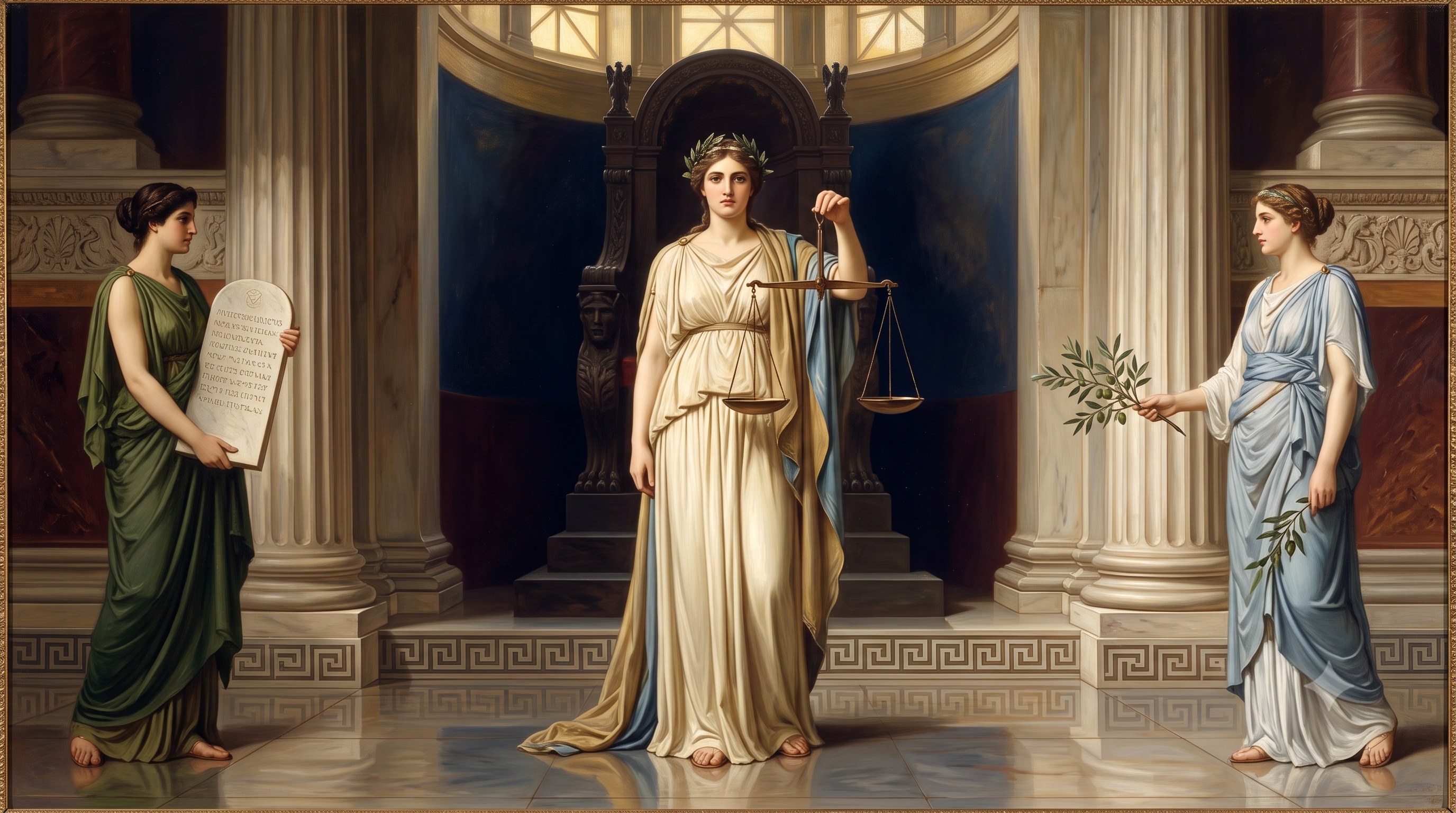
Diké, daughter of Zeus and Themis, was the Greek goddess of justice and fair judgment. She stood beside her father's throne and reported the wrongs of mankind. Her scales weighed deeds, not words. Her sister Eunomia (Good Order) governed the law; her sister Eirene (Peace) governed the fruit of justice kept. Together the three Horai held the world in balance. The Zevist allegiance is to all three: to law, to justice, and to the peace that follows when both are honored.
I. Opening: Two Truths That Must Be Held Together
The relationship between a person and the law of his country contains a tension that most people resolve badly. Some obey blindly, surrendering their judgment to the statute book, treating every law as sacred because it's law. Others rebel thoughtlessly, treating every regulation as oppression, confusing inconvenience with injustice. Both positions are wrong.
The Greek tradition teaches a harder path. Obey the law. Comply with the structures of your society. Pay your taxes, respect the courts, follow the regulations that govern your trade and your daily life. This is the baseline. But also: know that the law is a human product, subject to human error, and maintain the inner clarity to recognize when a law fails the standard of justice. When it does, work to change it through legitimate means, with the patience and persistence of a builder, not the fury of a destroyer.
Plato spent the last years of his life writing the Laws, his longest and most practical work. The central insight of that work is this: the best form of government is the rule of law tempered by wisdom. Not the rule of men, because men are corruptible. Not the rule of law alone, because laws can be foolish. The rule of law tempered by the living judgment of wise citizens. That's the Zevist position.
II. Pythagoras and the Legal Foundation
Pythagoras didn't just teach mathematics. He founded communities that were, for all practical purposes, small governments. The Pythagorean society in Croton (southern Italy, around 530 BCE) had strict laws, and these laws reveal a legal philosophy that deserves attention.
The foundation of Pythagorean law was harmonia: the idea that justice is a form of proportion. A just society is a harmonious society, and harmony means that every part receives its proper measure, no more and no less.
Aristotle, Nicomachean Ethics V.3, 1131a10-12:
«Τὸ δίκαιον ἄρα ἀνάλογόν τι ἐστίν.»
"Justice is therefore a kind of proportion."
Aristotle was drawing on Pythagorean ideas. The Pythagoreans taught that the universe itself is governed by mathematical proportion, and that human law should reflect this cosmic order. A law that creates disproportion (giving too much to one party, too little to another) is unjust by definition, regardless of whether a majority voted for it.
The Pythagorean legal system had several distinctive features worth preserving.
Property: The Pythagoreans practiced communal property within their inner circle ("friends have all things in common," a phrase attributed to Pythagoras by Diogenes Laertius VIII.10). But they didn't impose this on the wider society. They recognized that communal property works among the spiritually disciplined and fails among the general population, a lesson that took the modern world twenty centuries of bloodshed to learn.
Punishment: The Pythagorean approach to punishment was corrective, not vindictive. The goal of punishment was to restore harmony, not to satisfy anger. A member who violated the rules was first warned. If he persisted, he was expelled, and his former companions erected a symbolic tomb for him: he was treated as dead. The severity of this punishment should not be underestimated. It meant total social death. But notice: no physical violence, no imprisonment, no execution. The punishment was exclusion from the community, which is the natural consequence of refusing to live by the community's rules.
Education before legislation: Pythagoras believed that the best way to reduce the need for laws was to educate citizens. A well-educated population needs fewer laws, because people who understand the reasons behind the rules don't need to be forced. This is the opposite of the modern approach, which multiplies laws while neglecting education.
III. Plato's Laws: The Rule of Reason
Plato's Laws is a twelve-book dialogue in which an elderly Athenian stranger designs the legal code for a new colony on Crete. The work is less famous than the Republic, but more practical. If the Republic describes the ideal city, the Laws describes the best possible city for actual human beings, with all their flaws.
Several principles from the Laws are directly relevant to the Zevist.
The Preamble Principle (Laws IV, 722d-723b): Plato insisted that every law should have a preamble: an explanation of why the law exists. A doctor who merely orders "take this medicine" is a bad doctor. A doctor who explains why the medicine is needed, what it does, and what will happen without it, is a good doctor. Laws should work the same way. The citizen who understands the reason behind a law obeys it from conviction, not from fear. This is the difference between free obedience and servile obedience.
The Mixed Constitution (Laws III, 691d-692a): Plato argued that the best government mixes elements of monarchy (strong leadership), aristocracy (governance by the wise), and democracy (participation of the citizens). Any pure form becomes tyrannical: pure monarchy becomes despotism, pure democracy becomes mob rule, pure aristocracy becomes oligarchy. The balance of all three produces stability. This observation was later adopted by Polybius, Cicero, and the architects of the Roman Republic, and it remains the foundation of every successful modern constitution.
Law as Education (Laws I, 643e-644a): Plato considered the primary purpose of law to be educational, not punitive. The law teaches citizens what is good and what is harmful. It shapes character over generations. The best legal system produces citizens who barely need the law, because they've internalized its principles. The worst legal system produces citizens who obey only when watched and violate the law the moment surveillance lapses.
IV. When the Law Is Wrong
This is the hard part. The part most people avoid.
Laws can be wrong. Unjust laws have existed in every society in history. Athens, the cradle of democracy, permitted slavery. Sparta, the model of discipline, killed infants it judged unfit. Rome, the builder of the greatest legal system in antiquity, allowed paterfamilias the legal right to kill his own children. These were laws. They were also wrong.
The Greek tradition provides the answer. There is a law above the law. The Greeks called it φύσει δίκαιον (physei dikaion), natural justice: the standard of right that exists by nature, prior to any human legislation. Aristotle distinguished this explicitly in the Nicomachean Ethics:
Aristotle, Nicomachean Ethics V.7, 1134b18-20:
«Τοῦ δὲ πολιτικοῦ δικαίου τὸ μὲν φυσικόν ἐστι τὸ δὲ νομικόν.»
"Of political justice, one part is natural, the other conventional."
Natural justice doesn't change. Conventional justice (the laws of a particular state) does change, and sometimes it changes in the wrong direction. The just person recognizes the difference.
Sophocles dramatized this principle in the Antigone. Creon, the king of Thebes, decrees that the body of Polynices must remain unburied. Antigone buries her brother anyway, because the unwritten law of the Gods requires burial of the dead. When Creon confronts her, she gives one of the most important speeches in Western literature:
Sophocles, Antigone 456-457:
«Οὐ γάρ τί μοι Ζεὺς ἦν ὁ κηρύξας τάδε, οὐδ᾽ ἡ ξύνοικος τῶν κάτω θεῶν Δίκη.»
"It was not Zeus who made that proclamation to me, nor was it Justice, who dwells with the Gods below."
Antigone's point is simple and devastating: the king's decree contradicts the divine law, and when human law contradicts divine law, the human law must yield. She pays with her life, and Creon's stubbornness destroys his family. The lesson is clear: the ruler who places his own edicts above natural justice brings ruin upon himself.
The Zevist position follows Antigone, not Creon. Obey the law. Comply with the structures of your society. But when a law is genuinely unjust, by the standard of natural justice and divine order, work to change it. Petition. Advocate. Organize. Use every legitimate channel. Don't break the law casually, because casual lawbreaking erodes the fabric that holds society together. But don't mistake obedience for virtue, either. Blind obedience is the abdication of the moral responsibility the Gods placed in you when they gave you a mind. The man who obeys without thinking dishonors the Nous he was given.
V. The Zevist Duty
So what does the Zevist owe to the law? Three things.
First: Compliance. Obey the law of your country. Pay your taxes. Follow the regulations of your trade. Respect the courts. Don't speed, don't cheat, don't steal, don't cut corners. This is the foundation. Without it, nothing else matters. The person who breaks laws for convenience has no standing to criticize laws for injustice.
Second: Discernment. Know the difference between a just law and an unjust one. Study the principles behind the laws you live under. Understand why they exist. When you find a law that fails the standard of justice (and you will), study it first. Understand its structure: why it exists, who benefits, what it was meant to solve, where it went wrong. Then act. Rage without understanding is impotent. Understanding without action is cowardice. The Zevist combines both: cold analysis and relentless execution.
Third: Constructive Action. When you've identified an unjust law, act. Act as a builder. Petition your representatives. Write to the courts. Join civic organizations. Support candidates who share your principles. If you have the ability, run for office yourself. The ancient Athenians considered the citizen who took no part in public life to be a useless man (Thucydides, Pericles' Funeral Oration, II.40). The Zevist who sees injustice and does nothing about it is failing his duty to Diké herself.
VI. Closing: Justice as the Highest Law
Plato placed the Laws last in his body of work because he understood that the law is the final expression of philosophy. Everything he taught in the Republic about justice, about the Good, about the ordered soul: all of it culminates in the practical question of how people should live together under rules they can all accept.
The Zevist relationship with the law is one of respect, not worship. We respect the law because we understand what happens without it: chaos, violence, the rule of the strong over the weak. We don't worship the law because we know it's a human product, subject to the errors and limitations of its makers. Our allegiance is to Diké, to the divine principle of justice that stands above every statute and every court.
When human law serves justice, we obey gladly. When it fails, we work to repair it. When it contradicts the divine order, we follow Antigone: we obey the higher law and accept the consequences. This is the path of the just citizen, and it's the path the Gods honor.
Plato, Laws IV, 715e-716a:
«Ὁ δὴ θεός, ὥσπερ καὶ ὁ παλαιὸς λόγος, ἀρχήν τε καὶ τελευτὴν καὶ μέσα τῶν ὄντων ἁπάντων ἔχων, εὐθείᾳ περαίνει κατὰ φύσιν περιπορευόμενος.»
"God, as the ancient account has it, holds the beginning, the end, and the middle of all things, and proceeds straight on his course by nature."
Follow the straight course. Obey the law. Serve justice. Build the better city, one act at a time.
ZEFS AENAOS.
High Priest Zevios Metathronos