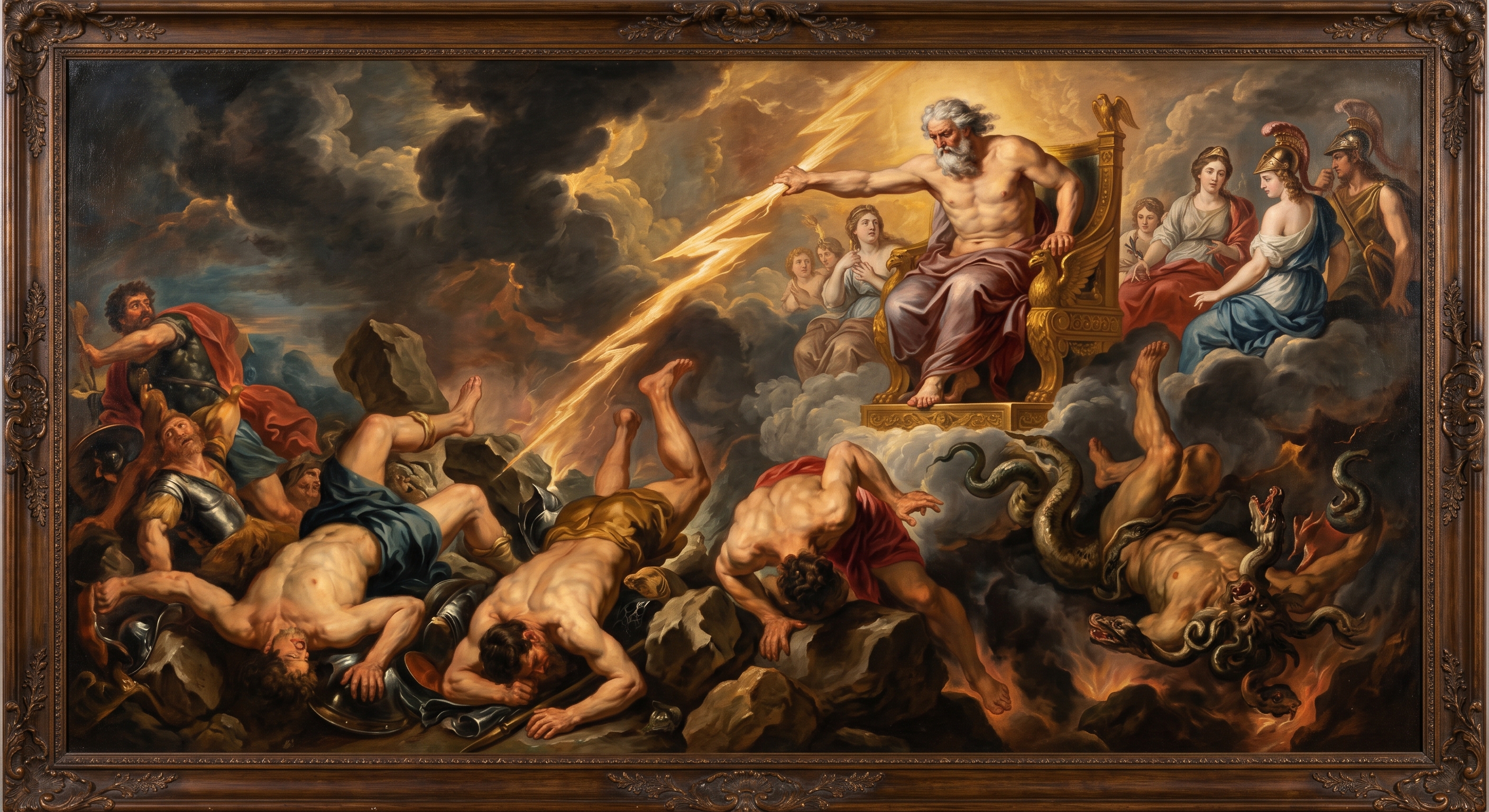
Every ancient civilization that understood the nature of reality told the same story. Before the world was ordered, there was a war. The war was
fought between the Gods, who stand for reason, measure, articulated form, and sovereign light, and the primordial forces of unreason, which would
dissolve all distinction back into the undifferentiated chaos from which the universe was lifted. The Gods won. The cosmos stands because they won.
Every day that the sun rises in its ordered course, every harvest that comes on time, every thought that holds itself together long enough to become
knowledge, every just act, every honest word, is a continuation of that victory.
The Greeks called this war the Titanomachy. They named its winner Zeus, the sky-father of the Indo-European
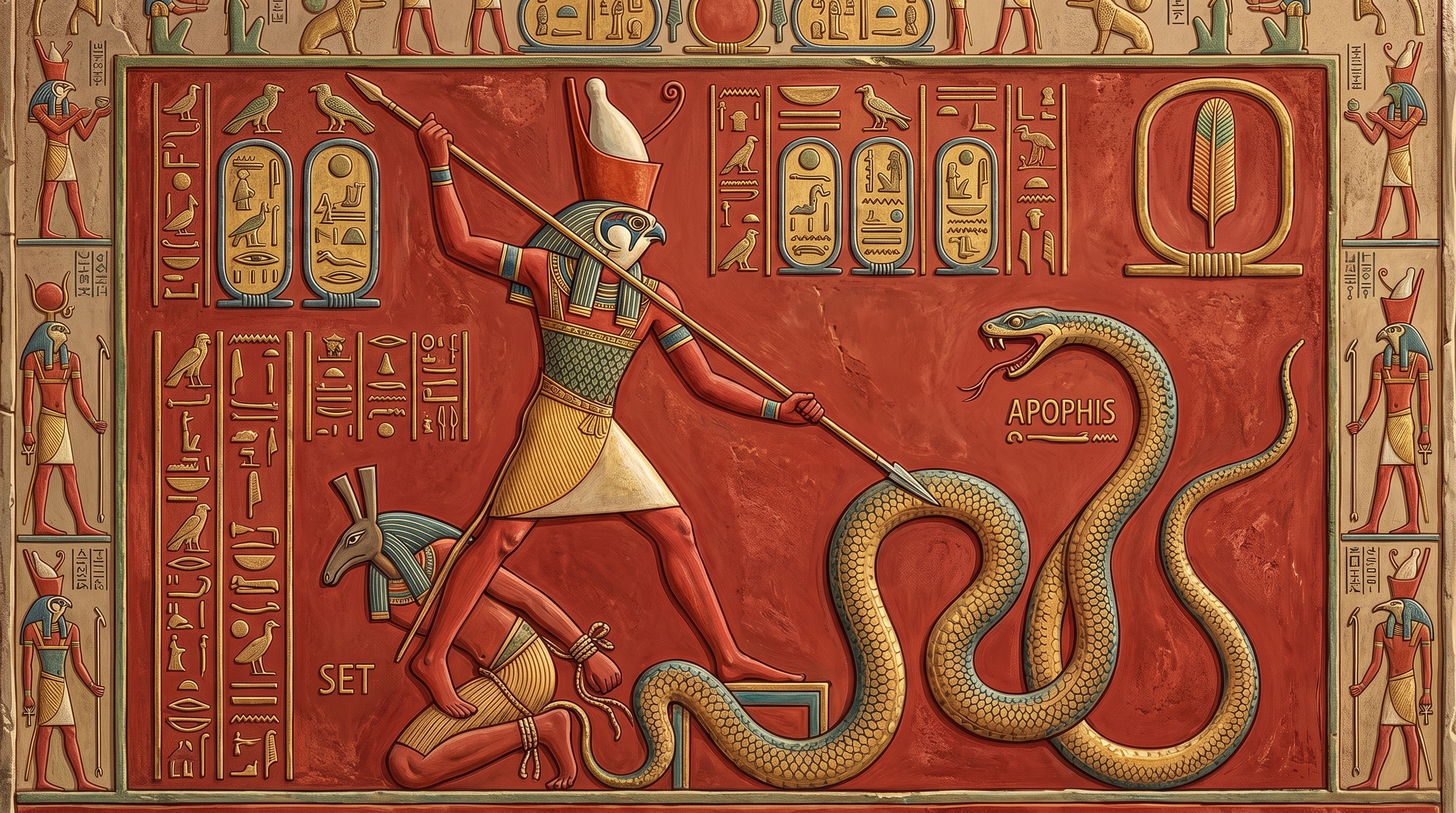
tradition, wielder of the thunderbolt, guarantor of cosmic justice. The Egyptians called it the eternal battle of Ma'at against
Izfet, named its winner Horus, son of Osiris, the falcon-king whose every rightful pharaoh was a living
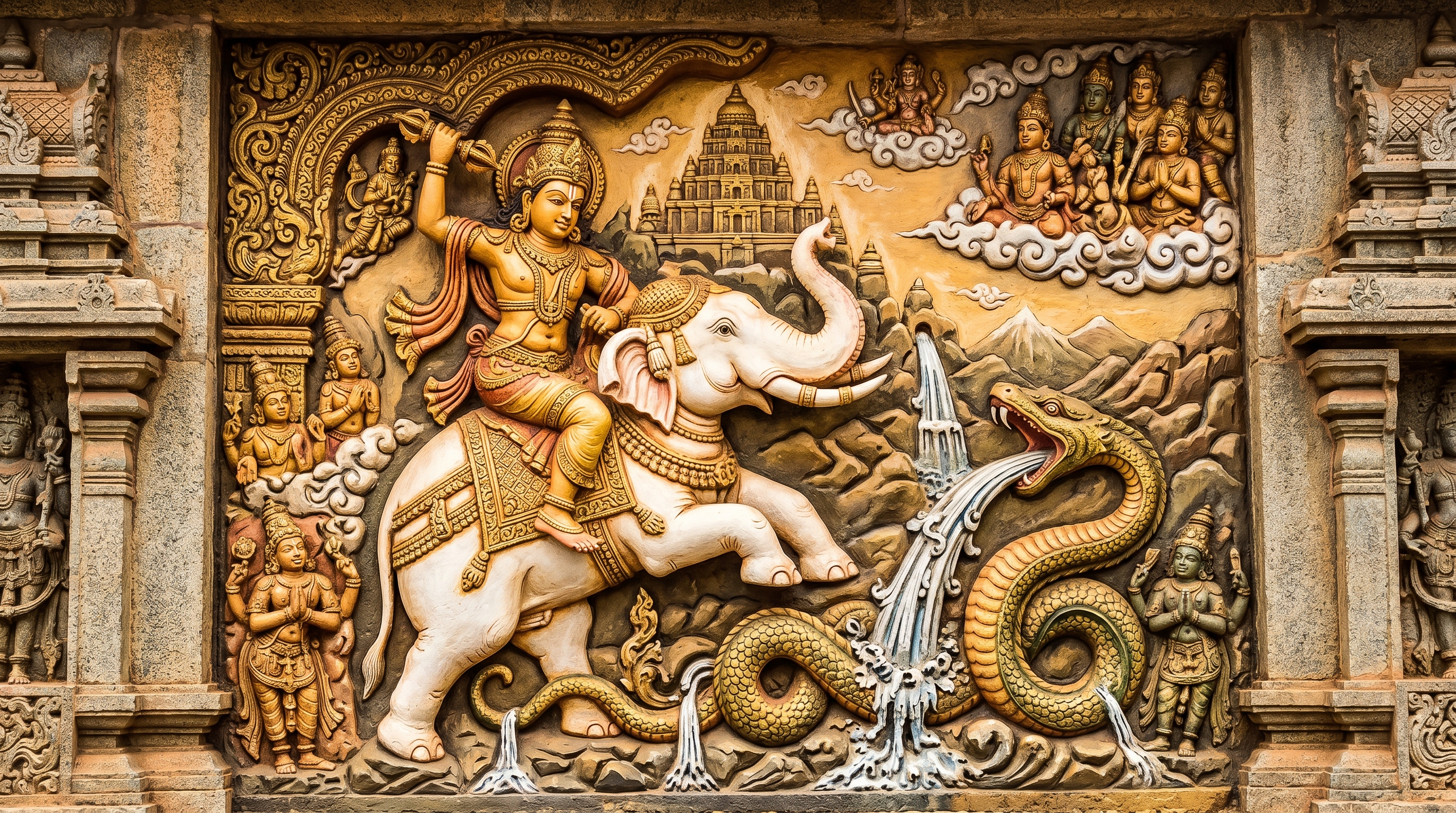
manifestation. The Indians called it the war of the Devas against the Asuras, named its winner
Indra, slayer of the serpent-dragon Vṛtra, wielder of the vajra thunderbolt forged by the divine artisan.
These three traditions developed independently, in three different language families, separated by thousands of kilometers and thousands of years.
They describe the same cosmic operation. The convergence transcends any accident and stands as recognition. The ancient world saw reality clearly,
and from every angle it looked, it described the same structure: an ordered cosmos held in place by divine sovereignty against the permanent
pressure of chaos, with a supreme thunder-wielding God as its guarantor.
This hub is the entrance to a three-part study of that cosmic war. Each part develops the tradition of one civilization in full depth, with the
original sacred sources cited in their original languages, with the academic scholarship that confirms the parallels, and with the interior
application that every Zevist must know: the Titanomachy operates beyond any event in the distant past as the ontological condition of reality,
continuing in every moment, inside every soul, inside every civilization.
Why These Three Traditions Together
The modern reader is taught to treat the ancient religions as isolated cultural artifacts, each the property of a particular people, each worthy only
of museum interest. This teaching is false. The ancient religions describe the same reality in different sacred languages. The names of the Gods
change; the cosmic functions do not. Zeus, Horus, and Indra are three cultural manifestations of the same archetypal divine operation: the sovereign
sky-power who establishes and guarantees cosmic order against the permanent pressure of chaos.
The comparative evidence is overwhelming. The Proto-Indo-European sky-father, reconstructed by linguists as *Dyēus Ph₂tḗr, becomes
Greek Zeus patēr, Latin Iūpiter, Vedic Dyauṣ Pitṛ, Germanic Tīwaz. The Proto-Indo-European myth of the storm-god
slaying the serpent, reconstructed by comparative mythologists under the formula *(h₁)égʷʰent h₁ógʷʰim ("he slew the serpent"), survives in
the Vedic formula áhann áhim used eleven times in the Rigveda, in the Avestan Verethraghna, in the Hittite Teshub's battle with Illuyankas,
in the Greek combats of Zeus with Typhoeus and Apollo with Python. The Egyptian tradition, though linguistically non-Indo-European, preserves the
same cosmic architecture through the battle of Horus against Seth and the nightly combat of Ra against Apophis.
When Zevism recognizes these three traditions as expressions of the same Original Religion, it engages no syncretic speculation but restores the
pre-Abrahamic ancient world view, which saw clearly what the Abrahamic religions labored to obscure: that the Gods are plural, that the cosmic war
is real, that humanity is a participant in that war, and that the sovereignty of the thunder-wielding sky-father is the foundation of every
articulated cosmos worth inhabiting.
The Structure of This Study
Each of the three parts develops its tradition in full depth, with the sacred sources cited in their original languages (Greek, Egyptian, Sanskrit)
accompanied by English translations and academic references. Each part traces the narrative, analyzes the symbolic structure, develops the
cosmological and psychological application, and demonstrates the place of the tradition within the universal Zevist understanding.
Read in sequence: Part A first (Hellas), then Part B (Kemet), then Part C (Bharata). The Greek tradition establishes the interpretive framework. The
Egyptian tradition reveals the vocabulary of Ma'at and Izfet that Zevism adopts for its core cosmological diagnostic. The Indic tradition
demonstrates the Indo-European continuity that links Zeus to the deepest root of the ancient world's religious imagination.
Together, these three parts constitute the most complete defense of the ancient theology of cosmic order ever produced. What follows is the
architecture of reality itself, described by the three greatest ancient civilizations in their own sacred words.

 አማርኛ
አማርኛ العربية
 বাংলা
বাংলা Български
 中文
中文 Čeština
 Dansk
Dansk Deutsch
 Eesti
Eesti Ελληνικά
 Español
 Français
 हिन्दी
 Hrvatski
 IsiZulu
 Italiano
 日本語
日本語 Kiswahili
 Magyar
 Македонски
 नेपाली
 Nederlands
 فارسی
فارسی Polski
 Português
 Română
 Русский
 Slovenščina
 Suomi
Suomi Svenska
 Tagalog
 Türkçe