 አማርኛ
አማርኛ العربية
 বাংলা
বাংলা Български
 中文
中文 Čeština
 Dansk
Dansk Deutsch
 Eesti
Eesti Ελληνικά
 Español
 Français
 हिन्दी
 Hrvatski
 IsiZulu
 Italiano
 日本語
日本語 Kiswahili
 Magyar
 Македонски
 नेपाली
 Nederlands
 فارسی
فارسی Polski
 Português
 Română
 Русский
 Slovenščina
 Suomi
Suomi Svenska
 Tagalog
 Türkçe
Upstream of Kabbalah: Hellas, Egypt, and the Source of the Inner Path
author: High Priest Zevios Metathronos
To the family of Zevists. This teaching examines the inner tradition of Judaism, the Kabbalah, and places it on the chronological horizon where it belongs. The Kabbalah is the most fully developed system of interior ascent still practised without interruption in the West. It is also a late arrival. It stands downstream of Hellas, and Hellas stands downstream of Egypt. The Zevist reads this teaching to learn where the Kabbalah drew its water, what it took with it, and why Zevism does not follow it.
The Kabbalah has merit, and the merit is stated where it occurs. The argument is about position: who stood at the source, who came after, and what the latecomers carried off.
A note on method. Dates follow the accepted academic chronology. Priority is a matter of dating. Borrowing is a matter of evidence. Both are given and kept apart: where a Greek doctrine precedes a Kabbalistic one, the dating settles who was first; where the channel of transmission is documented, and it usually is, the evidence settles who took from whom.
A note on scope. Zevism is not Hellenism. Zevism is the chain of all spirituality from its inception to the present day, and this teaching walks one stretch of that chain. Ancient Hellenism holds the primary place in this stretch because of its depth, its knowledge, and its capacity to represent, alongside every other root, the True Religion.

I. What the Kabbalist Holds
The Kabbalah is a complete interior system. It has a doctrine of the absolute, the Ein Sof, the Without-End. It has a map of divine manifestation, the 10 sefirot, arranged as a tree that is read at once as the structure of the cosmos, the anatomy of the divine, and the anatomy of the human soul. It has a ladder of worlds, 4 of them: Atzilut, Beriah, Yetzirah, Asiyah, emanation, creation, formation, action. It has a practice of intention, kavvanah, that turns every prayer and every ordinary act into a directed ascent. It has a goal, devekut, cleaving to the divine. And it has a cosmic task, tikkun, the repair of a broken world by the gathering of scattered sparks.
That is a coherent architecture. The Zevist who has studied Proclus recognises the shape at once, and the recognition is the point of this teaching.
Some of it is original. The Lurianic doctrine of Tzimtzum, the withdrawal of the infinite into itself to make room for a world, has no exact Greek counterpart. Neither does Shevirat ha-Kelim, the breaking of the vessels. Both are inventions of the 16th century school of Safed, and both are noted here as the Kabbalah's own.
Sefer Yetzirah 1:4:
«עשר ספירות בלימה, עשר ולא תשע, עשר ולא אחת עשרה»
"Ten sefirot of nothingness: ten and not nine, ten and not eleven."
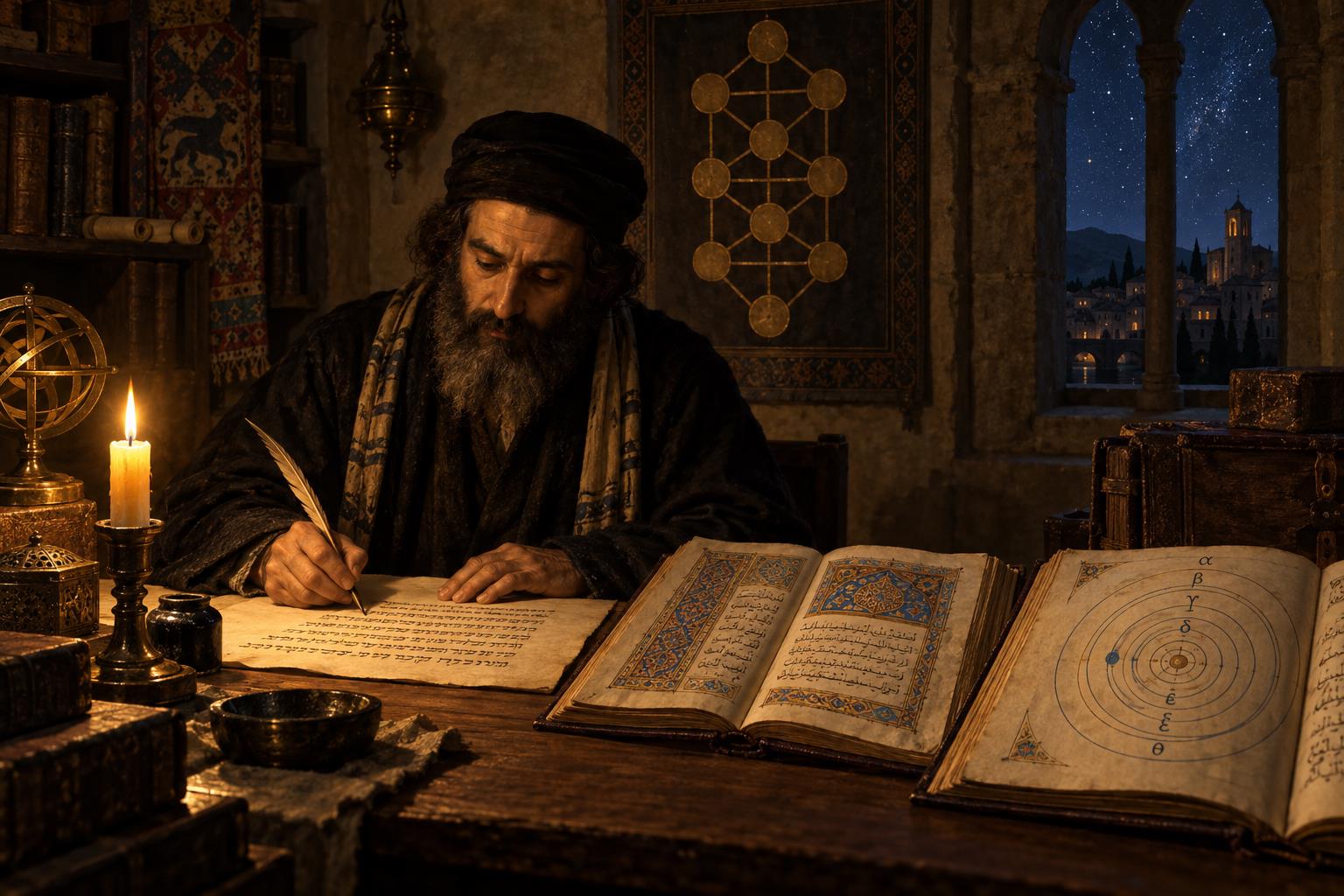
The Kabbalist also holds an unbroken chain of living teachers, which the Hellene lost. From the circles of Provence in the 12th century, through Gerona, Castile, Safed, and the Hasidic courts, the practice passed from mouth to ear without a single generation's gap. That continuity is the reason the Kabbalah appears today as the most developed inner religion in the West. It kept practising while the Hellenic schools were being shut and the temples burned.
II. Why the Kabbalah Survived and Hellas Went Underground
The observer who ranks the Kabbalah first among living inner systems is describing what remained standing after a fire. He should ask who lit it.
In 391 and 392 CE the emperor Theodosius outlawed the cult of the Gods across the Roman world. The Serapeum of Alexandria fell in 391. In 529 CE Justinian closed the philosophical school of Athens, and 7 philosophers, Damascius and Simplicius among them, carried their books to the court of Khosrow in Persia. The temples were converted or demolished, the rites criminalised, the priesthoods dissolved. The Hellenic inner tradition died by execution, at the hands of the state, and never of weakness.
Judaism had already suffered its own catastrophe, and it was the worst in the history of that religion. In 70 CE the Romans destroyed the Temple in Jerusalem. The sanctuary, the priesthood, and the Temple rite ended in a single generation, and after the Bar Kokhba revolt of 132 to 135 CE Hadrian barred the Jews from Jerusalem itself. The people scattered across the Mediterranean and Mesopotamia and stayed scattered for 18 centuries. What survived the scattering was the text and the school. The inner teaching passed in closed circles, teacher to student, under a rule of secrecy that treated exposure as a sin. Christian and Muslim rulers persecuted Jews, often savagely, but they wanted converts, and they permitted Jewish study in a way they never permitted the worship of Zeus. The Kabbalist could keep his lamp lit in a cellar in Gerona. The theurgist of Athens had no cellar left.
So the Hellenic inner path reached the modern age in fragments: Iamblichus' On the Mysteries, Proclus' commentaries, the Chaldean Oracles in scattered quotations, the Greek magical papyri from a single tomb cache in Thebes. The Kabbalah reached the modern age with the chain intact. That difference in survival is the whole difference in apparent development. It says nothing about the source.
III. The Stream Runs Down From Hellas
The Kabbalah's merit as a path of spiritual progression is real, and most of it was taken from Greek hands. The channels are documented. The Zevist should know them by name.
Alexandria, where the two traditions met
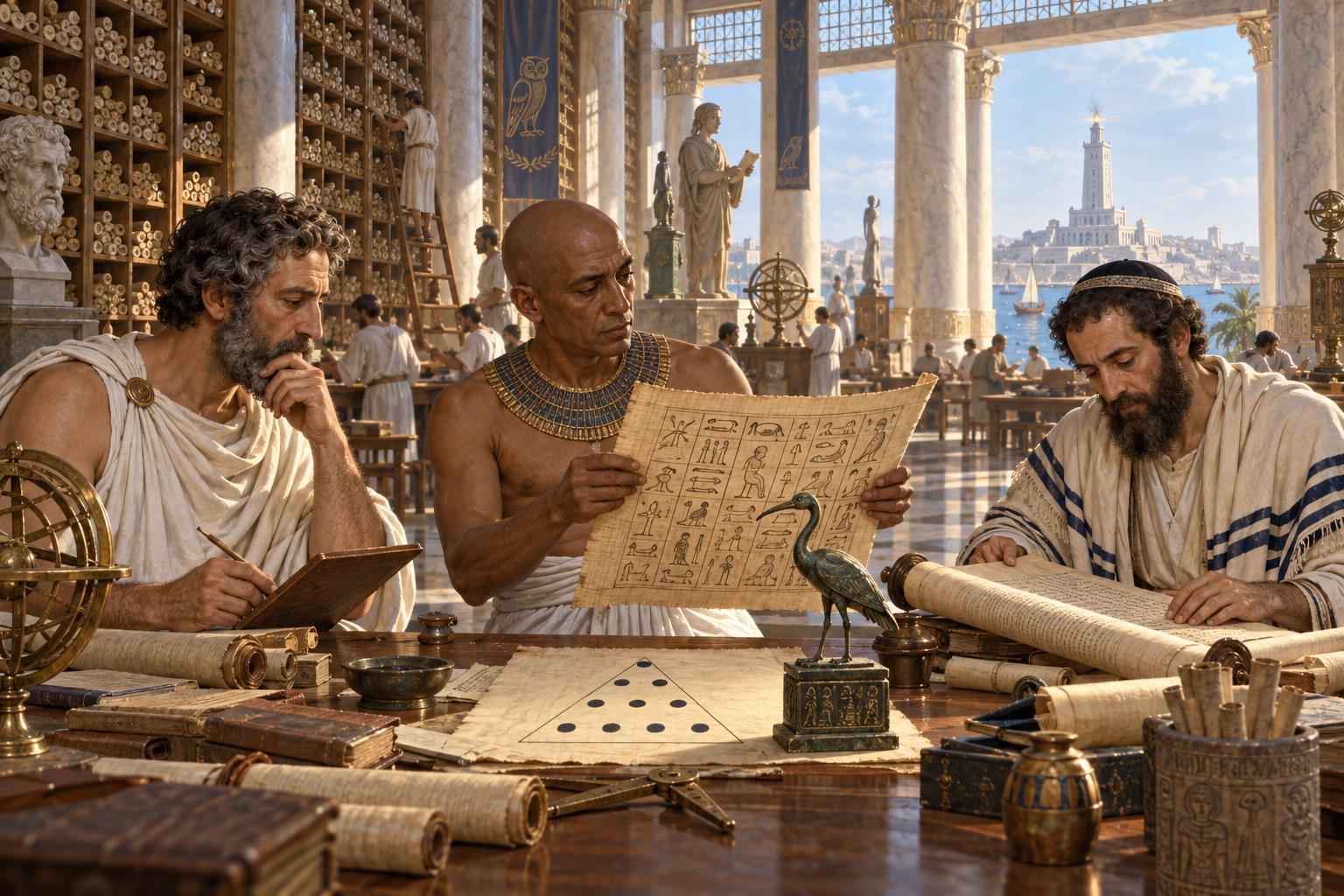
In the 3rd century BCE the Torah was translated into Greek at Alexandria. From that moment Jewish thought had a Greek vocabulary, and within 3 centuries it had a Greek philosophy. Philo of Alexandria (c. 20 BCE to 50 CE) read Moses with the eyes of Plato. He taught the Logos as the mediating divine reason, the intelligible cosmos (κόσμος νοητός) as the pattern of the visible one, and the divine "powers" (δυνάμεις) as the modes through which the unknowable God acts. Every one of those ideas reappears in the Kabbalah: the sefirot are powers, the upper worlds are the intelligible pattern, and the unknowable God behind them is Philo's God with a Hebrew name.
The Greeks noticed the kinship at once. Numenius of Apamea, a Platonist of the 2nd century CE, asked a question that has been quoted for 1,800 years.
Numenius of Apamea, fr. 8 (des Places):
«Τί γάρ ἐστι Πλάτων ἢ Μωσῆς ἀττικίζων;»
"For what is Plato but Moses speaking Attic Greek?"
Hellenistic Jewish writers pressed the claim the other way. Aristobulus and Artapanus made Moses the teacher of Orpheus and the inventor of philosophy. The dispute over priority is therefore 2,000 years old, and both sides agreed on one thing: whoever stood at the source held the higher ground. Philo himself settled the geography. In his Life of Moses he reports that Moses was schooled by Egyptian teachers in arithmetic, geometry, harmony, and the symbolic philosophy written in hieroglyphs. The founder of the Kabbalist's own religion trained at the source the Greeks named.
Number, letter, and the decad
The oldest Kabbalistic text, the Sefer Yetzirah, was composed somewhere between the 2nd and 6th centuries CE. Its sefirot are numbers. The word itself comes from the root for counting. It insists on 10, "ten and not nine, ten and not eleven," and it pairs the 10 with the 22 Hebrew letters to make 32 paths of wisdom. The 10 sefirot are the tetractys. Number as the hidden structure of reality, the decad as the perfect number, the letter as a cosmic element: these were Pythagorean teachings in Croton and Metapontum in the 6th and 5th centuries BCE. The tetractys, 1 + 2 + 3 + 4 = 10, was the Pythagorean oath. The Sefer Yetzirah took the concept, gave it a Hebrew name, and fastened it to a Hebrew alphabet. Scholars from Scholem onward have noted the Neopythagorean shape of the text. The Zevist can say it more plainly: the 10 sefirot are the Pythagorean decad, taken.
The letter-mysticism the Kabbalah made famous was taken as well. Gematria is a Greek loanword. The technique it names, adding up the numerical values of letters, is isopsephy, scratched on the walls of Pompeii before 79 CE and practised as a literary art by Leonides of Alexandria under Nero. Notarikon, the reading of a word as an acrostic, is Greek too. The Kabbalist did skilful things with these instruments. He did not forge them. He took them, and he took their names with them.
The Arabic bridge
Between the Sefer Yetzirah and the first Kabbalists proper lies a gap of 6 centuries, and Greek philosophy crossed it in Arabic. In 9th century Baghdad, Plotinus' Enneads were paraphrased as the Theology of Aristotle and Proclus' Elements as the Book of Causes. Jewish thinkers drank directly from that stream. Isaac Israeli (d. c. 955) wrote Jewish Neoplatonism. Solomon ibn Gabirol (11th century) wrote the Fons Vitae, a Neoplatonic treatise so free of any specifically Jewish reference that the Latin schoolmen who read it as "Avicebron" assumed its author was a Muslim or a Christian. Maimonides (1190) built his Guide on Aristotle. By the time the Kabbalah emerged, Jewish thought had been speaking Greek in Arabic dress for 300 years.
Provence and Gerona
The Sefer ha-Bahir surfaced in Provence in the 1170s. It is the first text in which the sefirot appear as divine powers rather than numbers, and, as Scholem established, the first Jewish text to teach gilgul, the transmigration of souls. Pythagoras had taught metempsychosis 18 centuries earlier. Herodotus had already attributed the doctrine to Egypt 17 centuries earlier. The Kabbalah received the soul's return to the body as a late arrival, and it arrived as Greek and Egyptian property.
In Gerona, Azriel (early 13th century) wrote the Explanation of the Ten Sefirot. His Ein Sof is argued by the apophatic route: the infinite is beyond limit, beyond affirmation and negation, beyond any predicate; nothing can be outside it, so everything must proceed from it. That is the method of Plotinus and Proclus, taken over through Ibn Gabirol and the Arabic Plotinus. The Kabbalistic term for the highest world, atzilut, means emanation, and emanation is πρόοδος, procession, the Neoplatonic law of how the many come from the One. The 4 worlds sit in the same order as the Neoplatonic hypostases: the One, Intellect, Soul, and the body of nature.
Safed and the return
The school of Isaac Luria (1534 to 1572) produced the most original Kabbalistic system. Yet even here the frame is Greek. Luria's cosmos still emanates. Its final movement, tikkun, is the gathering back of what went out, the return of the sparks to their root. Proclus stated the whole rhythm in one proposition 1,100 years earlier.
Proclus, Elements of Theology, proposition 35:
«Πᾶν τὸ αἰτιατὸν καὶ μένει ἐν τῇ αὑτοῦ αἰτίᾳ καὶ πρόεισιν ἀπ᾽ αὐτῆς καὶ ἐπιστρέφει πρὸς αὐτήν.»
"Every effect remains in its cause, proceeds from it, and returns toward it."
Remaining, procession, return: μονή, πρόοδος, ἐπιστροφή. Tzimtzum and the breaking of the vessels are Luria's own. He built them inside a house whose beams were cut in Athens.
Florence, where the kinship was seen
The Renaissance recognised the family resemblance so clearly that it tried to merge the two. Marsilio Ficino translated the Hermetica in 1463 and then Plato. Pico della Mirandola, in his 900 theses of 1486, fused Kabbalah with Platonism and declared them one wisdom. Johann Reuchlin, in On the Art of Kabbalah (1517), went further and argued that Pythagoras had learned his number-mysticism from the Hebrews. The dates answer him. Pythagoras taught in the 6th century BCE. The Sefer Yetzirah cannot be earlier than the 2nd century CE. The only Jewish Pythagoreanism older than that is Philo, who was already writing in Greek, in a Greek city, under the instruction of Plato. Reuchlin saw the resemblance correctly and read the current backwards.
One distinction holds. Chronology proves priority. It does not by itself prove copying in every case, and there are scholars, Moshe Idel chief among them, who argue that much of the Kabbalah grew from older internal Jewish sources. The claim of this teaching is about position. Wherever the channel is documented, the vocabulary, the argument, and the route run from Greek to Hebrew. Wherever it is undocumented, the dates alone show who stood earlier at the water.
What Hellas Holds That the Kabbalah Does Not Develop
12 instruments of the Greek metaphysical field with no direct Kabbalistic counterpart. Each is an independent model, argued and contested within its own school, and each predates the earliest Kabbalistic text.
01 · Plato · 4th c. BCE
Τὸ Ἀγαθόν
The Good: a supreme principle beyond being, grounding truth, intelligibility, and value
02 · Plato; Plotinus · 4th c. BCE; 3rd c. CE
Τὸ Ἕν
The One: absolute unity beyond multiplicity, beyond being and intellect
03 · Aristotle · 4th c. BCE
Ἀκίνητον Κινοῦν
The Unmoved Mover: ultimate causality as pure actuality and final attraction, not emanation
04 · Aristotle · 4th c. BCE
Νόησις Νοήσεως
Thought Thinking Itself: divinity as perfect self-intelligibility
05 · Aristotle · 4th c. BCE
Δύναμις / Ἐνέργεια
Potentiality and actuality: a general ontology of what a thing can be and what it has become
06 · Aristotle · 4th c. BCE
Τέσσερα Αἴτια
The Four Causes: material, formal, efficient, and final explanation in one framework
07 · Plato · 4th c. BCE
Ἰδέαι / Μέθεξις
Forms and participation: how universals exist and how lower things share in higher ones
08 · Plato · 4th c. BCE
Ἀνάμνησις
Recollection: knowledge as recovery of intelligible truth already possessed
09 · Plato · 4th c. BCE
Ἔρως
Desire itself made the ladder from sensible to intelligible Beauty
10 · Pythagoras · 6th c. BCE
Ἁρμονία / Τετρακτύς
Number and ratio as the fabric of cosmic order; the decad the sefirot were built from
11 · Heraclitus; Stoics · 6th c. BCE onward
Λόγος
Rational order immanent throughout the cosmos
12 · Iamblichus; Proclus · 3rd to 5th c. CE
Θεουργία
Theurgy: ritual participation in divine causality, beyond discursive thought
Kabbalistic Doctrine and Greek Antecedent
Read each row from left to right: the Kabbalistic doctrine with its earliest Jewish attestation, the arrow pointing back to the Greek antecedent, and the antecedent with its earliest Greek attestation.
Τὸ Ἄπειρον, Τὸ Ἕν
The Without-End argued by the apophatic route: the Infinite of Anaximander (6th c. BCE) and the One beyond being of Plotinus (3rd c. CE).
Δεκάς, Τετρακτύς
The tetractys, taken from the Pythagoreans: number as the hidden structure of reality and 10 as the perfect number, 6th and 5th c. BCE.
Πρόοδος
Emanation, the procession of the many from the One: Plotinus, 3rd c. CE.
Μετεμψύχωσις
Transmigration of souls: Pythagoras and the Orphics, 6th c. BCE; attributed to Egypt by Herodotus, 5th c. BCE.
Ὁμοίωσις Θεῷ, Ἕνωσις
Assimilation to God (Plato, 4th c. BCE) and union with the One (Plotinus, 3rd c. CE).
Ἐπιστροφή
Return of the effect upon its cause, the third term of remaining, procession, and return: Proclus, 5th c. CE.
Ἰσοψηφία
Letter-number equivalence, and the word gematria itself: Greek inscriptions and epigrams, 1st c. CE.
Ἄνθρωπος
The primordial Man of the Poimandres: Corpus Hermeticum I, Egypt, 1st to 3rd c. CE.
The Chain of Transmission
The source stands at the top. Each rung below it received from the rung above.
IV. Beneath Hellas, Egypt
The Greeks themselves pointed upstream, and they pointed at Egypt.
Herodotus, writing in the 5th century BCE, reports that the names of nearly all the Gods came to Hellas from Egypt (Histories II.50). He reports that the Egyptian priests were the first to teach the immortality of the soul and its passage through other bodies, and that certain Greeks, whose names he declines to give, presented the doctrine as their own (II.123). And he identifies the rites the Greeks called Orphic and Bacchic as Egyptian and Pythagorean.
Herodotus, Histories II.81:
«ὁμολογέουσι δὲ ταῦτα τοῖσι Ὀρφικοῖσι καλεομένοισι καὶ Βακχικοῖσι, ἐοῦσι δὲ Αἰγυπτίοισι καὶ Πυθαγορείοισι.»
"These practices agree with the rites called Orphic and Bacchic, which are in truth Egyptian and Pythagorean."
Plato agreed. In the Timaeus he sets Solon before the priests of Sais and lets an Egyptian deliver the judgement on Greek memory.
Plato, Timaeus 22b:
«ὦ Σόλων, Σόλων, Ἕλληνες ἀεὶ παῖδές ἐστε, γέρων δὲ Ἕλλην οὐκ ἔστιν.»
"Solon, Solon, you Greeks are always children; there is no old man among you."
In the Phaedrus he gives the invention of letters and number to Theuth, the Egyptian Thoth. Isocrates wrote that Pythagoras went to Egypt, became the pupil of the priests, and was the first to bring philosophy to the Greeks. Iamblichus records 22 years of Pythagoras' training in the Egyptian sanctuaries. Diodorus lists the Greeks who studied there: Orpheus, Homer, Lycurgus, Solon, Pythagoras, Democritus, Plato, Eudoxus. When Iamblichus wrote the founding text of theurgy, On the Mysteries, he wrote it in the voice of an Egyptian priest, Abammon, and grounded the whole art in the temple science of Egypt and Chaldea. The Hermetic books, written in Greek in Roman Egypt, carried that priestly theology into the philosophical schools. Plutarch, priest of Delphi, read Isis and Osiris as Platonic metaphysics and said so in a book.
The deference stands on the record. Egypt's inner map is the oldest known. The Memphite Theology, preserved on the Shabaka Stone, teaches that Ptah made the world by heart and tongue, by thought and by word: a doctrine of the creative Logos inscribed 150 years before Heraclitus was born, from an original its own scribes already called ancient. The weighing of the heart in the Book of the Dead is the first interior tribunal in human literature, where the dead man's own heart is placed on the scale against truth and is begged not to testify against him. The Egyptian psychology of ka, ba, and akh, the vital double, the mobile soul, the transfigured spirit, is a doctrine of the soul's parts, attested in the Pyramid Texts 2,000 years before Plato's tripartition. The Amduat, the sun's passage by night through the 12 hours of the underworld and its rebirth at dawn, is the pattern every Mystery cult later dramatised in the dark of an initiation hall.
And the Kabbalist's own scripture begins its story in Egypt. Moses was raised there. Philo says he was taught there. Judaism's own founder stands on the Egyptian bank of the river, and the religion he founded carried Egyptian water out with it.
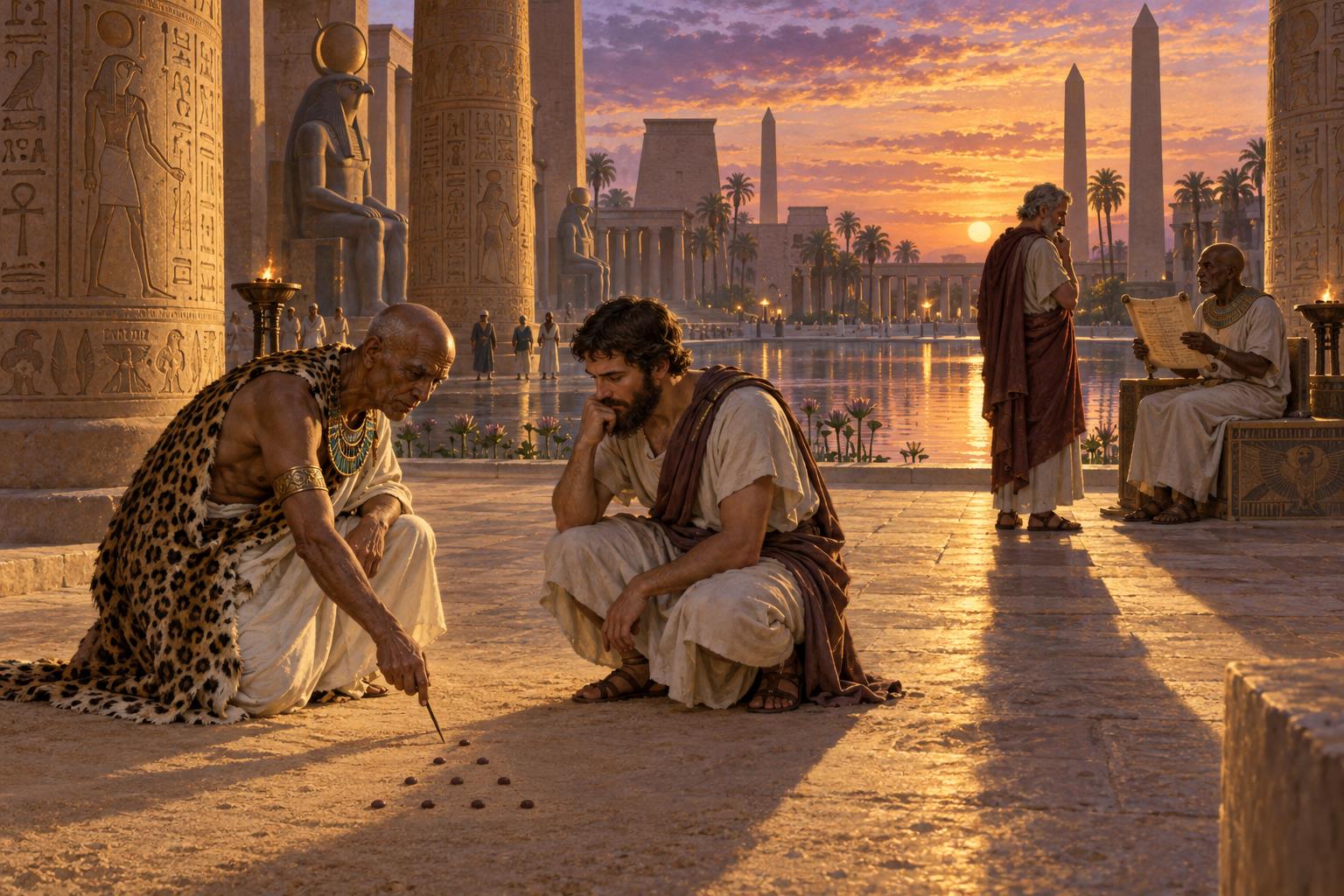
V. The Measure of Sovereign Superiority
Superiority requires a criterion, and the criterion here is breadth: how many independent explanatory models a tradition builds for being, causation, knowledge, divinity, soul, transformation, cosmic order, and ascent.
Measured that way, the Kabbalah is one architecture. Ein Sof, sefirot, names and letters, worlds, Shekhinah, Tzimtzum, Shevirah, Tikkun: a single principal system, developed in depth across 8 centuries and rarely contradicted from within.
Hellas is an ecosystem of systems. It holds 5 rival models of the Absolute that argued with one another for 900 years. Plato's Good, beyond being in dignity and power. Aristotle's Unmoved Mover, pure actuality, Thought Thinking Itself, which moves the cosmos by being loved. The Stoic Logos, divine reason immanent in every stone. Plotinus' One, beyond being and beyond intellect. Proclus' ordered procession from the One through the Henads, the divine unities that are the Gods themselves, down through Intellect and Soul to the world. Beside these it holds whole disciplines the Kabbalah never opened: an ontology of potentiality and actuality, a theory of the 4 causes, a doctrine of Forms and participation, a logic, a mathematical cosmology, a philosophical psychology, an ethics of the passions, and a theory of knowledge as recollection.
Then there is the matter of the Gods. The Kabbalist ascends through the attributes of one God and must, by his own law, treat every other God as an empty name. The Hellene ascends through Gods who are persons, real, plural, present, and beyond them to the One that is their source. His map has more inhabited rooms, and every room has a door that opens.
And there is theurgy. Iamblichus taught that thinking alone never lifts the soul to the Gods, and meditating on symbols alone never does either; ritual acts in which the Gods themselves participate do. The Kabbalah has kavvanah, the directed intention. Hellas has kavvanah and the rite of worship and the God who answers it.
So the ranking stands.
The ranking
Reservoir, river, spring
Where each stands on the one watercourse
The Kabbalah is a reservoir downstream, well kept and late. Hellas is the river in this stretch of the chain, and Egypt is the spring above it. Zevism is the whole watercourse, from the first spring to the present day. It treats Hellas as primary here because Hellas carried the most water at the greatest depth, and because Hellas can stand for every other root beside it.
VI. Why Zevism Faces the Source
A fair objection remains. Knowledge evolves. The Kabbalah proves it: a downstream tradition built Tzimtzum, which the upstream never built. If the stream gathers as it flows, why does Zevism turn its face toward the past?
Because the source is where the water is water.
Downstream, a river carries the silt of every bank it has passed. The Kabbalah carries exile, persecution, the need to hide, the need to prove its orthodoxy to hostile rabbis, and the polemic against the "idolaters" who were in fact its teachers. It carries the rule that Zeus must be called a demon and Thoth a fiction. Sediment of that kind teaches no ascent, and by now it is inseparable from the water. Upstream, the Gods are called Gods, and the priest who taught Pythagoras is honoured by name.
Plato taught that all learning is recollection, ἀνάμνησις: the soul already possesses the truth and must remember it. Zevism practises recollection at the scale of a civilisation. The priest of Sais called the Greeks children because they did not remember. The Zevist refuses to be a child. He remembers Sais, remembers Croton, remembers the Academy and the school of Athens on the day the soldiers came, and he refuses to accept a copy when the original still exists.
Standing at the source has nothing to do with antiquarianism. The spring flows now. The Gods are present now. "The past" is the address of the record, the last place where unbroken access to the Gods was written down in full; the Gods themselves keep a different address, the present. The Zevist reads the record in order to stand where its authors stood, and then he looks up.
This is also why the Zevist can study the Kabbalah without fear. Standing at the source, he recognises his own water in the reservoir. He reads Azriel and hears Plotinus. He reads the Sefer Yetzirah and hears the tetractys. He reads the 4 worlds and sees the hypostases. The Kabbalah becomes a mirror, and in it he sees what Hellas lost in the fire and what a scattered people did with what they took from Hellas across 8 centuries of practice. Then he walks upstream, along the whole chain that Zevism keeps: to Proclus, to Iamblichus, to the Orphic hymns and the Chaldean Oracles, to Plato and Pythagoras, past them to Thebes and Sais, and past Sais to whatever stood before it. Zevism looks to the past because it maintains that one must be at the source, and the source has not moved.
Zeus himself gave the image. In the 8th book of the Iliad he tells the Gods to hang a golden chain from heaven and try to pull him down: they cannot, and he can draw them all up. The Neoplatonists read that chain as the order of being itself, the σειρά that runs from the highest God down through every level of the cosmos. Every tradition that holds a link of that chain holds something real. The Kabbalist holds a link he was handed. The Zevist climbs the whole chain to where it is fastened.
Homer, Iliad VIII.19 to 20:
«σειρὴν χρυσείην ἐξ οὐρανόθεν κρεμάσαντες πάντες τ᾽ ἐξάπτεσθε θεοὶ πᾶσαί τε θέαιναι.»
"Hang a golden chain from heaven, and all of you take hold of it, all Gods and all Goddesses."

The Kabbalist keeps his lamp. Let him keep it; it was lit from a Greek flame, and the flame was carried out of Egypt. The Zevist keeps the fire.
ZEFS AENAOS.