 አማርኛ
አማርኛ العربية
 বাংলা
বাংলা Български
 中文
中文 Čeština
 Dansk
Dansk Deutsch
 Eesti
Eesti Ελληνικά
 Español
 Français
 हिन्दी
 Hrvatski
 IsiZulu
 Italiano
 日本語
日本語 Kiswahili
 Magyar
 Македонски
 नेपाली
 Nederlands
 فارسی
فارسی Polski
 Português
 Română
 Русский
 Slovenščina
 Suomi
Suomi Svenska
 Tagalog
 Türkçe
Upstream of Kabbalah, Part 2: The Chronological Horizon
author: High Priest Zevios Metathronos
To the family of Zevists. Part 1 placed the doctrines of the Kabbalah on the map of their Greek and Egyptian sources. Part 2 widens the frame. The reason for the examination is plain, and it is stated without heat: the culture of the Jewish people has adopted a great many things from the peoples it lived among, and above all from the Greeks. Its schools, its methods of reading, its festival table, its vocabulary, its angels, its heavens, its magic, its images of the divine tree, and the picture of itself that it presents to the modern world all carry material that was made elsewhere and earlier. A Zevist who studies Judaism meets these things wearing Hebrew names. He should know where they were made.
This is spiritual research, and it is conducted as research. Every point below rests on a dated text, an inscription, a floor, or a printed page. The tone is level because the material does not need raising. Where a doctrine or a form is older in Greek or Egyptian than in Hebrew, the dates say so. Where the channel of transmission is documented, the documents say so. Nothing here argues against a people; it is an account of what was taken, by whom, from whom, and when, and the points are left to speak in their own voice.
A note on Moses. Whether Moses existed is debatable. No record outside the Bible mentions him, no Egyptian text records an Exodus, the name itself is Egyptian (ms, "born of", as in Thutmose and Ramesses), the birth story follows the older birth legend of Sargon of Akkad, and the Torah in its present form was composed between the 7th and 5th centuries BCE. Jewish people believe he existed, that he received the Torah at Sinai, and that he led the Exodus, which their own tradition dates to 1313 BCE and the biblical numbers place in the 15th or 13th century BCE. This teaching uses both the belief and the evidence, and marks which is which.
A note on scope, repeated from Part 1. Zevism is not Hellenism. Zevism is the chain of all spirituality from its inception to the present day. Ancient Hellenism holds the primary place in this stretch of the chain because of its depth, its knowledge, and its capacity to represent, alongside every other root, the True Religion.
The Horizon
Before any doctrine is compared, the horizon has to be set. It is set by writing, and the writing is dated.
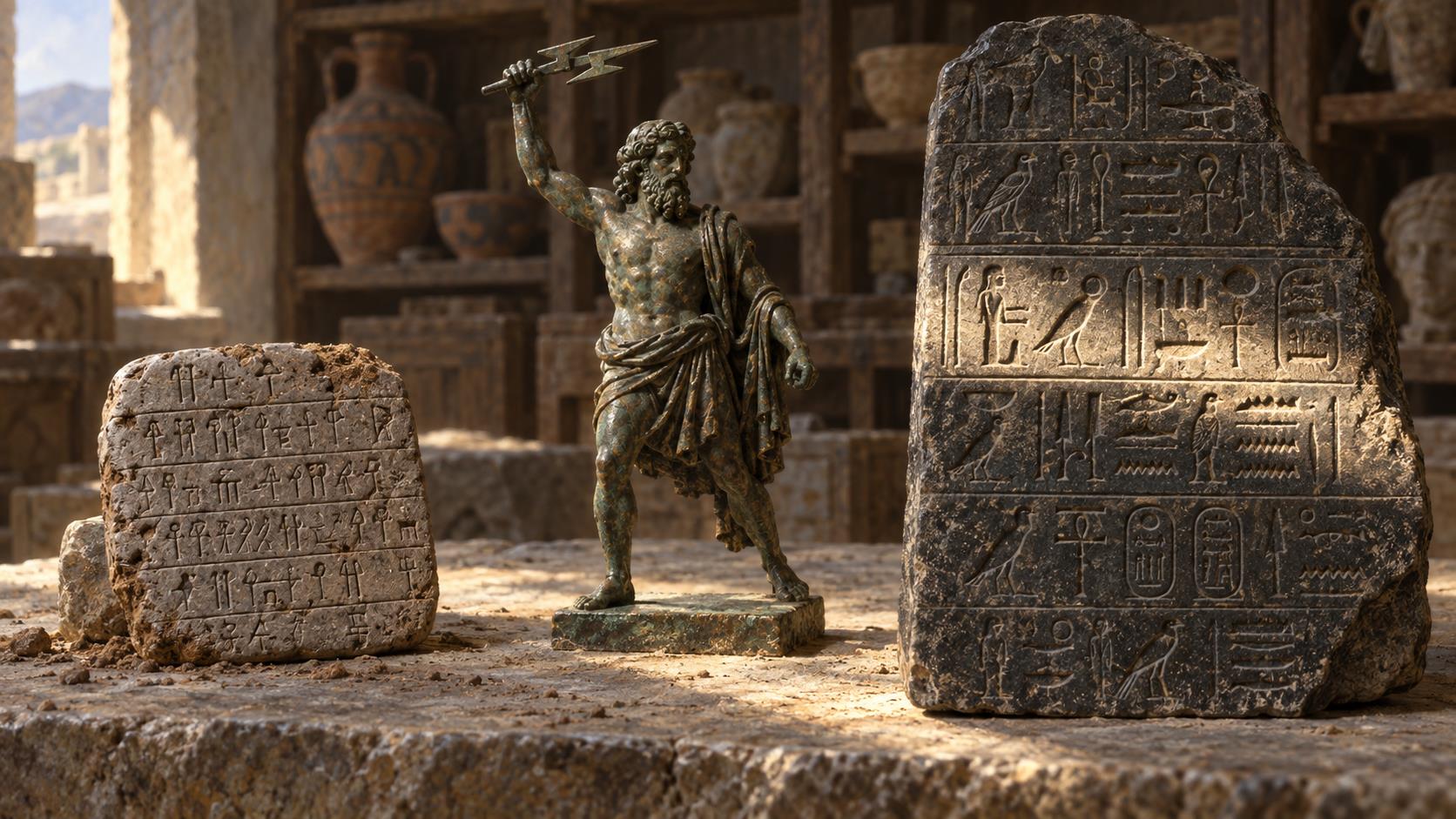
The Greeks and the worship of Zeus precede Israel itself. Greek is written in Linear B from c. 1450 BCE. The tablets of Knossos, Pylos, and Khania (14th to 13th century BCE) record offerings to di-we (Zeus, in the dative), e-ra (Hera), po-se-da-o (Poseidon), a-ta-na-po-ti-ni-ja (Athena), and di-wo-nu-so (Dionysus). That is contemporary with the latest possible Moses and 2 centuries before the pharaoh Merneptah carved the word Israel on his victory stele (c. 1208 BCE), the first mention of that people anywhere. The name of Zeus was written on clay before the name of Israel was written on stone.
Behind that, by linguistic reconstruction, *Dyēus ph₂tēr, "Sky Father", is the oldest recoverable divine name of the Indo-European family: Vedic Dyaus Pitar, Latin Jupiter, Greek Ζεῦ πάτερ. It reaches back to the 4th millennium BCE. Behind everything, Egypt: the Pyramid Texts (c. 2400 BCE) are older than any of it, older than the earliest Greek by 1,000 years and older than the earliest Hebrew by 1,400.
The question of Moses
What is believed and what is attested
The belief: Moses lived, received the Torah at Sinai, and led Israel out of Egypt in 1313 BCE by the rabbinic count, or in the 15th or 13th century BCE by the biblical numbers. The record: no Egyptian document names him or the Exodus; the first external mention of Israel is Merneptah's stele of c. 1208 BCE, describing a people already in Canaan; the Torah was written down between the 7th and 5th centuries BCE; the name Moses is Egyptian; the story of the child in the basket was told of Sargon of Akkad first. Pythagoras (c. 570 to 495 BCE) is attested by men who knew of him in his lifetime: Xenophanes, Heraclitus, Herodotus. On the record, the Greek philosopher is a person and the Hebrew lawgiver is a belief. On the belief, Moses precedes Pythagoras by 7 to 9 centuries and stands downstream of Egypt by his own biography. Either way the horizon holds.
The written texts sit in the same order. Homer (c. 750 BCE) and Hesiod's Theogony (c. 700 BCE) are older than the written Torah. Deuteronomy appears under Josiah in 622 BCE, the Priestly material in the Persian period. The oldest Hebrew inscriptions, the Gezer calendar and the Khirbet Qeiyafa ostracon, sit near 1000 BCE, and the Song of Deborah (Judges 5) may reach the 12th century. Nothing Hebrew is older than Linear B, and nothing in the Hebrew Bible is older than the Pyramid Texts by less than 1,000 years.
The Horizon in Dates
Each row gives the date and the attestation. Rows marked belief rest on tradition; rows marked attested rest on an inscription, a tablet, or a dated text.
Pyramid Texts of Unas
The oldest religious writing on earth
Greek written in Linear B at Knossos
Zeus, Hera, Poseidon, Athena, Dionysus named on tablets at Knossos, Pylos, Khania
The Exodus by the rabbinic count; 15th or 13th c. by the biblical numbers
Merneptah Stele
First mention of Israel, as a people already in Canaan
Earliest Hebrew inscriptions
Gezer calendar, Khirbet Qeiyafa
Homer, Hesiod
Deuteronomy under Josiah
Pythagoras
The Priestly Torah; the Pentateuch in its present form
The Septuagint
The Torah in Greek
Sefer Yetzirah
Sefer ha-Bahir
The Zohar
Isaac Luria
That is the horizon. Every point that follows is read against it.
The Forms of the Tradition Itself
The first 7 testimonies concern the shape of Judaism's tradition: its sects, its chain of succession, its idea of an oral secret, its rules of reading, its central rite, and its words. Each was formed on a Greek model, and the sources that say so are Jewish.
-
The Jewish sects were described as Greek schools by a Jew. Josephus, the priest and historian of the 1st century CE, introduces his readers to the Essenes as a group that "follows a way of life taught to the Greeks by Pythagoras" (Antiquities XV.371). He describes the Pharisees, the ancestors of rabbinic Judaism, as "a sect resembling what the Greeks call the Stoic school" (Life 12). He was writing for Greeks and Romans, and he chose the comparison because it was accurate: the common purse, the white garments, the silence at meals, the oath of secrecy, and the graded initiation of the Essenes are the Pythagorean community of Croton as Iamblichus describes it. The Pharisees' doctrine of fate and free will is the Stoic compromise. The earliest testimony for the Greek form of Jewish inner life comes from the most learned Jew of his generation, and he offered it as a compliment.
-
The chain of tradition is a Greek literary form. The Mishnah opens its ethical tractate with a succession: "Moses received the Torah at Sinai and handed it on to Joshua, Joshua to the elders, the elders to the prophets, and the prophets to the men of the Great Assembly" (Avot 1:1), and then runs the chain down through 5 pairs of sages to Hillel and Shammai. Elias Bickerman showed in 1952 that this is the Hellenistic διαδοχή, the succession list by which each Greek philosophical school certified its own descent from its founder: Thales to Anaximander to Anaximenes, Socrates to Plato to Speusippus. The Greek lists were compiled by Sotion in the 2nd century BCE, exactly when the Pharisaic chain was being formed. The very word Kabbalah means "reception", and the form in which the reception was claimed was received from the Greek schools. The 5 pairs themselves are called zugot, and zug is the Greek ζεῦγος: even the sages who guard the chain are named in Greek.
-
The idea of a secret oral teaching beside the written text is Pythagorean and Platonic. The Mishnah rules that the Chariot may not be expounded even to one student unless he is a sage who understands from his own knowledge (Hagigah 2:1). The rule presupposes a teaching too dangerous for the page, transmitted mouth to ear under a discipline of silence. That is the Pythagorean ἀκούσματα, the oral maxims held under the rule αὐτὸς ἔφα, "he himself said it", and it is the ἄγραφα δόγματα, the unwritten doctrines of Plato, which Aristotle mentions as a known body of teaching separate from the dialogues (Physics 209b). The Greek schools ran an esoteric oral tradition beside a public written one 8 centuries before the Mishnah wrote the rule down. The Kabbalah's whole claim to be an oral secret handed from Sinai is a claim in a Greek form.
-
Hillel's rules of interpretation are Alexandrian rhetoric. The 7 middot attributed to Hillel (1st century BCE), expanded to 13 by Rabbi Ishmael, are the toolkit by which the rabbis draw law from the text. David Daube demonstrated in 1949 that they are the methods of the Greek grammarians and rhetors of Alexandria. Kal va-homer, the inference from the lighter case to the heavier, is the a minori ad maius of the rhetorical handbooks. Gezerah shavah, the inference from equal terms, is the σύγκρισις πρὸς ἴσον. Binyan av, the general principle from a particular case, is the rhetor's argument from example. The rabbis learned to read the Torah with an instrument cut in the Greek schools of Egypt, and the Kabbalist opens his text with the same instrument.
-
PaRDeS, the fourfold sense, is Greek allegory with a Hebrew acronym. The doctrine that scripture has 4 levels, peshat, remez, derash, sod (plain, hinted, homiletic, secret), appears in the 1290s with Moses de León and Bahya ben Asher. The reading of a sacred poem for a hidden philosophical sense begins with Theagenes of Rhegium, who allegorised Homer's battles of the Gods as conflicts of the elements around 525 BCE. The Stoics made it a method; Heraclitus the Allegorist wrote a handbook of it in the 1st century CE; Philo applied it to the Torah in Alexandria; Origen took it from Philo and built the Christian senses of scripture on it; John Cassian fixed the Christian fourfold sense (literal, allegorical, moral, anagogical) in the 5th century. The Kabbalists received a 4-level system that had existed in Latin for 800 years and in Greek for 1,800, and gave it a Hebrew name from the Persian word for a garden. The secret sense, sod, is the Neoplatonic reading of Homer applied to Moses.
-
The Passover Seder is a symposium. The reclining on the left side, the successive cups, the dipping of vegetables before the meal, the child's formal questions, the hymns at the end, and the closing morsel called the afikoman reproduce the Greek symposium and its literature, as Siegfried Stein showed in 1957. The afikoman is the Greek ἐπίκωμον, the after-dinner revel, prohibited in the Mishnah (Pesahim 10:8) and then reinterpreted as a piece of matzah. The central domestic rite of the Jewish year, the one every Jewish child learns first, is Greek in form and carries a Greek word at its centre.
-
The rabbinic lexicon is Greek. Samuel Krauss catalogued roughly 3,000 Greek and Latin loanwords in the Talmud, Midrash, and Targum (1898 to 1899). Sanhedrin is συνέδριον. Apikoros, the rabbinic word for a heretic, is Ἐπίκουρος, the philosopher's own name. Hedyot, the layman, is ἰδιώτης. Sanegor and kategor, the advocate and the accuser before the heavenly court, are συνήγορος and κατήγορος. Pinkas, the ledger, is πίναξ. The vocabulary of the law court, the study house, and the heavenly tribunal was taken with the institutions it named, and the Zohar's Aramaic carries the same freight.
The Heavens and the Names
The next 4 testimonies concern the sky and the powers in it: the planets on the synagogue floor, the sun-God in a Hebrew spellbook, the highest angel's Greek name, and the ascent through the palaces.
-
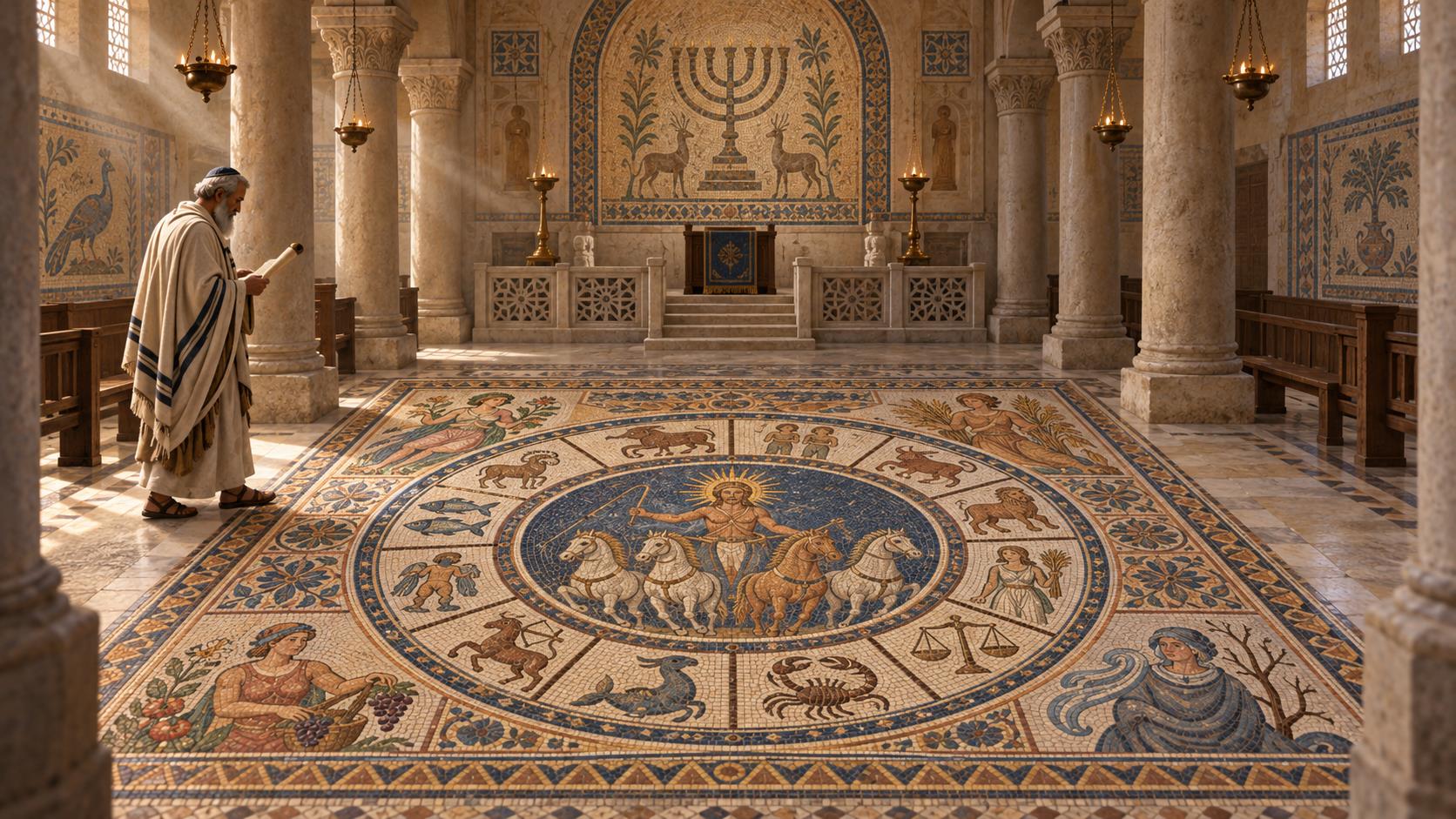
Helios stands on the synagogue floor. The mosaic pavements of Hammat Tiberias (4th century CE), Sepphoris (5th), and Beit Alpha (6th) place the 12 signs of the zodiac around the centre of the prayer hall, and in the centre Helios in his 4-horse chariot, crowned with rays. These are synagogues, built and used by observant communities in the rabbinic period. The Sefer Yetzirah's cosmology of 7 planets and 12 signs assigned to the Hebrew letters is the same Greek astral science, which the Greeks had themselves systematised from Babylon. The Talmud's dictum "Israel has no mazal" (Shabbat 156a) argues against a presence that was already laid in the floor.
-
A Hebrew spellbook contains a prayer to Helios in Greek. Sefer ha-Razim, the Book of Mysteries, is a Hebrew magical text of the 4th century CE recovered by Mordecai Margalioth from the Cairo Genizah. In its fourth firmament it instructs the practitioner to address the sun, and the prayer it gives is a Greek hymn to Helios written in Hebrew letters: "Holy Helios who rises in the east, good mariner, trustworthy leader of the sun's rays..." The "practical Kabbalah" of divine names shares its whole working vocabulary with the Greek Magical Papyri of Egypt, where Iao, Sabaoth, and Abrasax stand in the same spells as Zeus, Helios, and Osiris. The names went both ways in Egypt; the technique went one way, and the Hebrew book calls on the Greek God in Greek.
-
The highest angel carries a Greek name. In 3 Enoch, the Hekhalot text of the 5th or 6th century CE, Metatron sits on a throne beside the throne of God and is called "the lesser YHWH". The leading etymology of his name is Greek: μετὰ θρόνον, "the one beside the throne" (Odeberg), against Lieberman's proposal of the Greek-Latin metator, "the one who goes before". Either way the name is Greek. The concept behind the figure is Philo's Logos, the "second God" and firstborn son through whom the unknowable God acts (Quaestiones in Genesim II.62), which Philo built from Plato and the Stoa. The Kabbalah's throne-angel was named in Greek and conceived in Greek philosophy.
-
The Hekhalot ascent is the Greek ἀναγωγή with Hebrew seals. The Hekhalot texts describe the "descenders to the Chariot" who pass through 7 palaces, each guarded, each opened by a seal and a name. The Orphic gold tablets of Hipponion and Petelia (5th to 4th century BCE) give the soul passwords for the guardians of the underworld spring: "I am a child of Earth and starry Heaven." Plato's Phaedrus (246a to 248c) gives the chariot of the soul rising in the train of the Gods to the rim of heaven. The Mithras Liturgy (PGM IV.475 to 834) gives the ascent through the spheres with the words to be spoken at each gate. Ezekiel saw a chariot; the Jews who wrote the ascent through the palaces had read Plato's.
The Doctrines Not Yet Named
Part 1 treated the sefirot, emanation, transmigration, union, return, and the primordial man. 9 further doctrines follow, each with its Greek or Egyptian date.
-
Gnosis is the missing middle. Scholem himself traced the Sefer ha-Bahir, the first Kabbalistic text, to a Jewish Gnosticism whose sources he could not fully recover. The Gnostic systems are known, dated, and Greek. Valentinus taught in Alexandria and Rome in the 2nd century CE a pleroma of 30 aeons arranged in paired syzygies, the fall of the last aeon Sophia, the fragments of divine light trapped in matter, and the redemption by gathering them home. Sefirot in male and female pairs, the exiled Shekhinah, the breaking of the vessels, and the sparks to be gathered follow 1,000 years later. Moshe Idel argued for older internal Jewish sources. The dates answer him: the Gnostic texts exist, in Greek, in the 2nd century; the Jewish ones that resemble them exist in the 12th.
-
The sparks were sown in Greek fire. Luria's nitzotzot, the sparks of divine light held captive in the shells of matter, have a genealogy. Heraclitus made fire the substance of the cosmos (fr. 30). The Stoics taught the λόγοι σπερματικοί, the seminal reasons of the divine fire sown throughout matter. Plato's Timaeus (41d to 42a) has the Demiurge sow the souls into the stars like seed. The Gnostics made the pneumatic spark the divine element in man that must be freed. The doctrine that divine fire lies scattered in matter and must be gathered back was 2,000 years old when Safed took it and gave it a Hebrew name.
-
The upper triad is Neoplatonic. The Chaldean Oracles (2nd century CE) set at the summit a triad of Father, Power, and Intellect. Proclus set Being, Life, and Intellect (Elements of Theology 101 to 103). The Kabbalah sets Keter, Hokhmah, and Binah, Crown, Wisdom, and Understanding, and the Zohar's Idra Zuta speaks of the "3 heads" carved in the highest Crown. The upper face of the Tree is built on the triadic architecture of the Oracles and the Athenian school, 1,000 years earlier in Greek.
-
Ayin and the negative attributes were argued in Greek first. The early Kabbalists call Keter "Ayin", Nothing, because it is beyond every predicate. Plotinus said of the One that it is "none of the things that are" and cannot be named (Enneads VI.9.3), and the Athenian school built the whole first hypothesis of the Parmenides on the same negation. Maimonides' doctrine of negative attributes (Guide I.51 to 60), which the Kabbalists took over even while attacking him, comes from Alcinous' 3 ways to the first God, negation, analogy, and eminence (Didaskalikos 10), through al-Farabi and Avicenna. The Kabbalists inherited Greek apophatics from the philosopher they claimed to reject, and he had it from Plato's school.
-
The 10 ranks of angels come from Aristotle's spheres. Maimonides lists 10 orders of angels in the Mishneh Torah (Yesodei ha-Torah 2:7): hayyot, ofanim, erelim, hashmalim, serafim, malakhim, elohim, bene elohim, keruvim, ishim. The number 10 comes from the 10 separate intellects of al-Farabi and Avicenna, and their 10 comes from Aristotle's movers of the celestial spheres (Metaphysics Λ 8). The Christian 9 orders of Pseudo-Dionysius, written around 500 CE, are Proclus' henads renamed as angels. The Kabbalah's 10 angelic camps matched to the 10 sefirot sit on both foundations, and both are Greek.
-
The inverted tree is Plato's plant. Plato writes that the human being is "a plant not of earth but of heaven", rooted above, in the place from which the soul first came (Timaeus 90a). The Bahir describes the divine powers as a tree, and the developed Kabbalah teaches a Tree whose roots are in Ein Sof above and whose branches reach down into the world. The image of the tree rooted in heaven was Plato's, and the Bahir grew in Provence, where Plato was being read in Arabic and Latin.
-
Shekhinah was Sophia, and Sophia was the receptacle. The Shekhinah as a feminine divine person, the bride and the exiled daughter, is a Kabbalistic creation of the 12th and 13th centuries; rabbinic literature knows only the "dwelling" of God. The feminine divine had already been written in Greek by Jews: the Wisdom of Solomon, composed in Alexandria in the 1st century BCE, describes Sophia as "a breath of the power of God" in Stoic vocabulary (7:22 to 8:1), and Philo makes her the mother of the cosmos. Behind both stands the receptacle of the Timaeus, the "nurse of becoming" (49a to 52d), and Plutarch's Isis, whom he identifies with that receptacle and calls the female principle of nature (De Iside 53). The feminine indwelling presence was Hellenistic and Egyptian 13 centuries before the Zohar gave it a Hebrew face.
-
The sacred marriage is older than the Zohar by 2,000 years. The Zohar's theology of zivug, the union of Tiferet and Malkhut, the King and the Bride, read through the Song of Songs and enacted in the Sabbath, is a hieros gamos. Diotima's teaching in the Symposium (210a to 212a) makes erotic union the ladder of ascent to Beauty itself. The Iliad (XIV.292 to 351) sets the union of Zeus and Hera on Mount Ida with the earth flowering beneath them. The Mysteries enacted the marriage of the God and the Goddess, and Egypt enacted Isis and Osiris. The Kabbalist's Sabbath bride entered a chamber that had been furnished in Greek and Egyptian for 2 millennia.
-
Judaism acquired the afterlife late, and from outside. Sheol in the Hebrew Bible is a shadow-house without reward, judgement, or return. The immortal soul and the resurrection enter Jewish writing in the 2nd century BCE with Daniel 12:2 and the Greek Wisdom of Solomon (3:1 to 4). The Sadducees, the priestly party, denied both; the Pharisees held both, and Josephus records the split (War II.162 to 165). Plato's Phaedo had argued the soul's immortality 2 centuries before Daniel, and the Egyptian judgement of the dead, the weighing of the heart in the Book of the Dead (spell 125), was 1,300 years old when Daniel was written. The doctrine on which the whole Kabbalistic ascent depends was the last thing Judaism took, and it took it from the 2 sources this teaching names.
The Accusers and the Images
The last 5 testimonies concern the record itself: who wrote the accusation of theft, who drew the Tree, who built the Temple, and what stood in it.
-
Solomon the magician is a Greek invention. The Solomon of the Bible is a king and a builder. The Solomon of the grimoires, master of demons by ring and seal, first appears in the Testament of Solomon, a Greek text of the 1st to 3rd century CE from the Greco-Egyptian magical milieu, and in Josephus' account of the exorcist Eleazar using Solomon's ring before Vespasian (Antiquities VIII.45 to 49). Sefer Raziel, the Key of Solomon, and the whole "practical Kabbalah" of seals and spirits descend from that Greek Solomon, who was assembled in the same workshops as the Greek Magical Papyri.
-
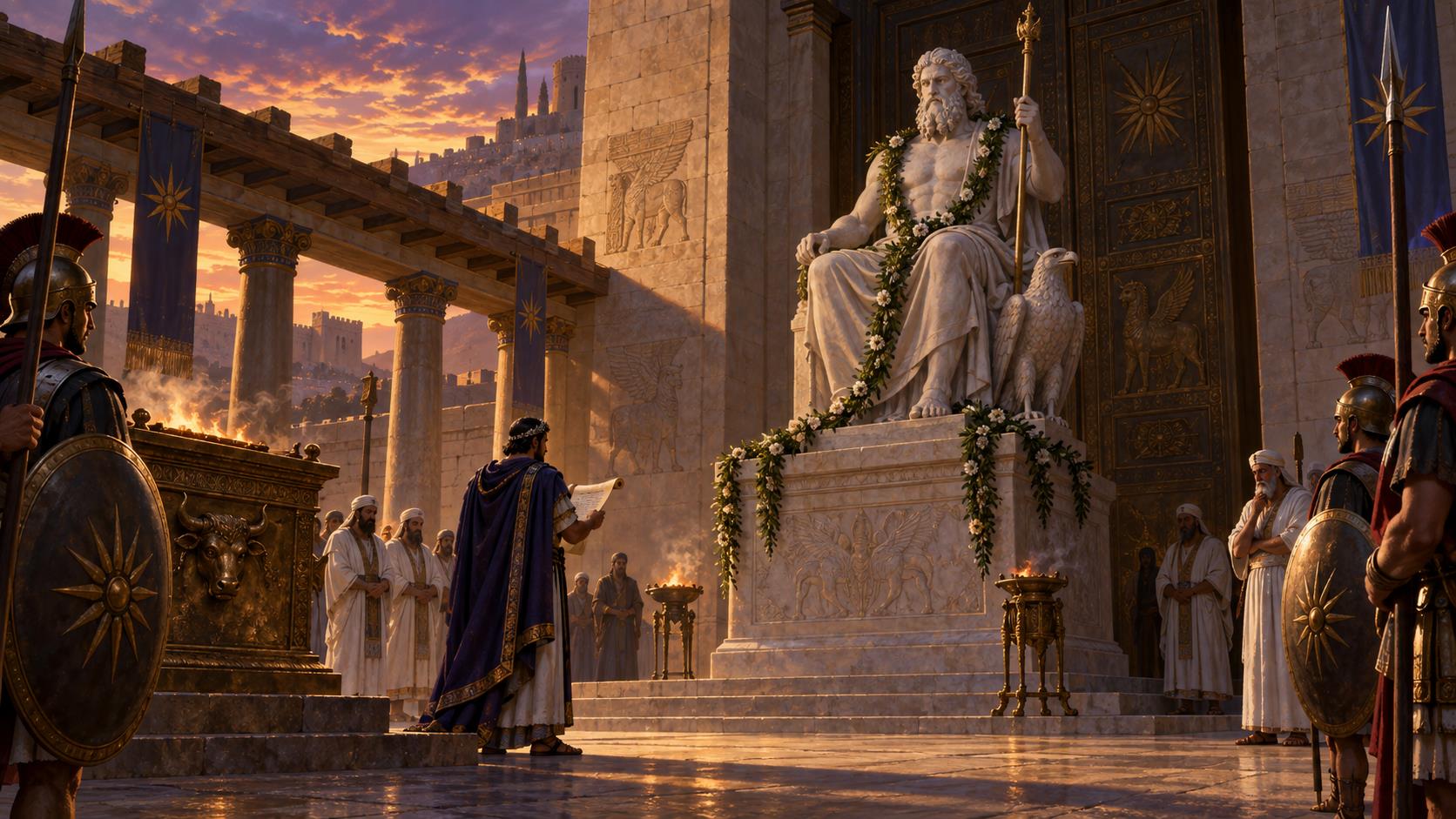
Zeus Olympios stood in the Temple, and the Jews wrote to Sparta as kin. In 167 BCE Antiochus IV rededicated the Jerusalem sanctuary to Zeus Olympios (2 Maccabees 6:2). The Maccabean revolt that followed is the founding event of Judaism's anti- Hellenic identity, and it is recorded in Greek, in 2 Maccabees, a book written in Greek by a Jew. The same generation's literature preserves a letter in which the Spartans and the Jews are declared brothers, both descended from Abraham (1 Maccabees 12:20 to 23; Josephus, Antiquities XII.225 to 227). The identity that defined itself against Zeus was written in Zeus' language and claimed Sparta as family.
-
The accusation of theft was manufactured by the takers. The claim that the Greeks stole their philosophy from Moses was invented in Alexandria in the 2nd century BCE by Aristobulus, who made Plato and Pythagoras readers of the Torah, and by Artapanus, who made Moses the teacher of Orpheus. Clement of Alexandria took it over: "the Greek philosophy was stolen" (Stromata I.17), and he devoted a book to proving "the Greek plagiarism from the Hebrews" (Stromata V.14). Eusebius built the Praeparatio Evangelica on it. Every one of these men wrote in Greek, in Greek literary forms, using Greek philosophical categories, in a Greek city. The charge of theft was drafted by the people carrying the goods, and it was drafted in the language of the people they took them from.
-
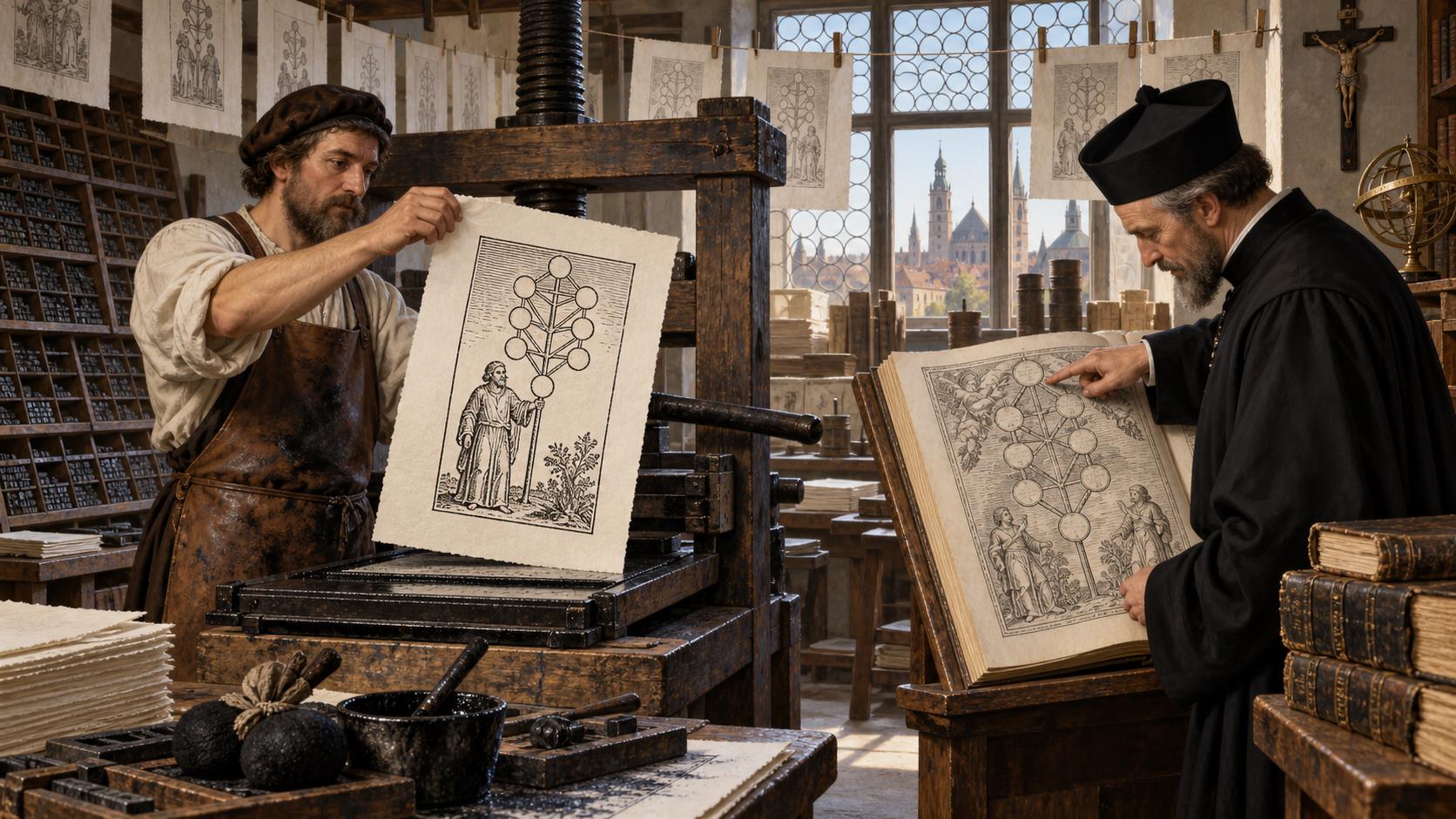
The Tree diagram is Latin print on a Greek template. The picture that the modern world calls "the Kabbalah", 10 circles joined by 22 paths, is not a Jewish manuscript image. The earliest printed sefirotic tree stands on the title page of Portae Lucis (Augsburg, 1516), Paulus Ricius' Latin abridgement of Gikatilla, made by a converted Jew for Christian readers. The tree everyone now recognises, with its exact paths and its columns, was drawn by the Jesuit Athanasius Kircher in Oedipus Aegyptiacus (Rome, 1652) and was adopted from Kircher by the Hermetic Order of the Golden Dawn in 1888, from which it passed to Crowley's 777 and the Tarot. Its diagrammatic ancestor is the Arbor Porphyriana, the tree of genus and species drawn from Porphyry's Isagoge (3rd century CE), which medieval Europe learned to draw before it learned any Hebrew. The image of the Kabbalah was drawn by Christians on a Neoplatonic template, and the "Kabbalah" of the Western esoteric orders is a Hermetic and Neoplatonic hybrid refilled from the Greek spring at every generation.
-
The Temple itself was built by foreign hands. Solomon's sanctuary, whose loss in 70 CE scattered the people and ended the rite, was built with cedar and cypress from Tyre, by Tyrian workmen, under a Tyrian master of bronze, Hiram, "a widow's son of the tribe of Naphtali, and his father a man of Tyre" (1 Kings 5; 7:13 to 14). Its plan, a long room with a porch and a holy of holies, matches the Syro-Phoenician temples excavated at Ain Dara and Tell Tayinat. This closes the horizon. The house was raised by other hands; the text that survived its fall was already being read in Greek; and the inner tradition that grew from that text was built, room by room, from Greek and Egyptian material.
Why the Horizon Matters to the Zevist
The Zevist reads these 25 testimonies to know where he stands, and for no other purpose. Judaism's inner tradition is a real path, practised without interruption, and it will go on being practised. What the Zevist takes from this teaching is the map of its construction: a Greek chain of succession, Greek rules of reading, a Greek festival, a Greek lexicon, Greek heavens, a Greek angel, a Greek ascent, Gnostic aeons, Stoic sparks, Neoplatonic triads and negations, Aristotelian angels, a Platonic tree, an Alexandrian Sophia, a Homeric marriage, a Platonic and Egyptian afterlife, a Greek Solomon, a Christian diagram, and a Tyrian house. Each piece is dated. Each date is earlier in Greek or Egyptian than in Hebrew.
That is what "upstream" means. The Kabbalist stands in a well-kept reservoir. The Zevist walks the river to the spring, and past the spring to the rain. Zeus was named on clay at Knossos before Israel was named on stone at Thebes. The Zevist starts there, and he goes back further.
ZEFS AENAOS.
High Priest Zevios Metathronos