
 አማርኛ
አማርኛ العربية
 বাংলা
বাংলা Български
 中文
中文 Čeština
 Dansk
Dansk Deutsch
 Eesti
Eesti Ελληνικά
 Español
 Français
 हिन्दी
 Hrvatski
 IsiZulu
 Italiano
 日本語
日本語 Kiswahili
 Magyar
 Македонски
 नेपाली
 Nederlands
 فارسی
فارسی Polski
 Português
 Română
 Русский
 Slovenščina
 Suomi
Suomi Svenska
 Tagalog
 Türkçe
A Sermon on Western Civilization: Its Foundations, Its Gifts, and Your Duty
author: High Priest Zevios Metathronos
To the family of Zevists. A working teaching on the civilization that produced the conditions in which we live, think, and practice our faith. This sermon traces the two roots of Western Civilization: Greek philosophy and Roman law. It names the great ideas that distinguish this civilization from all others in history. It acknowledges the failures and crimes committed in its name. And it teaches the Zevist duty: not to condemn the civilization for its errors, but to improve it as a productive citizen, honoring the builders who came before while correcting the mistakes they left behind. The temple you worship in was built by someone. The least you owe that builder is to keep the roof in good repair.
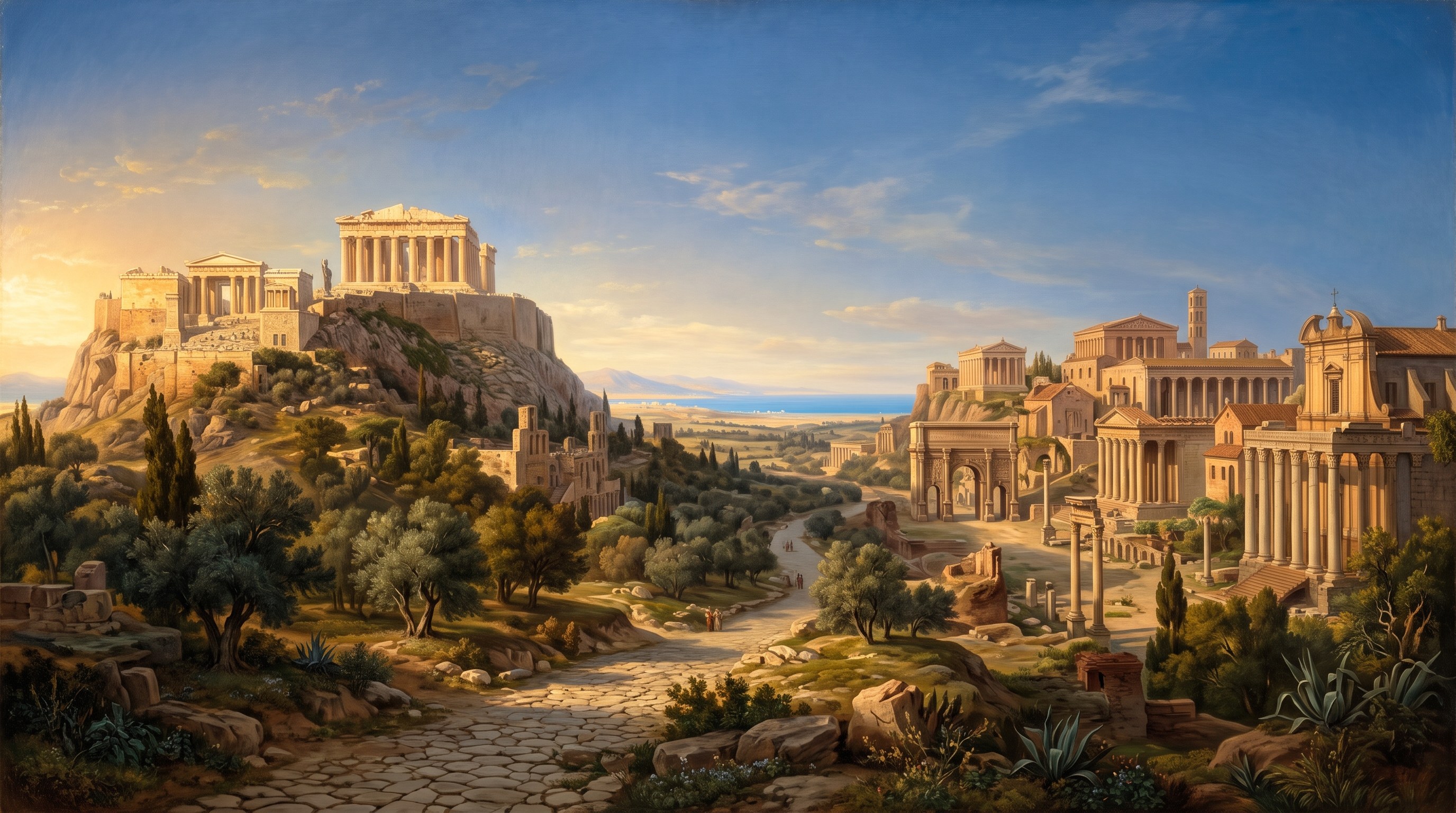
Two structures define Western Civilization. The Parthenon, seat of Athena, embodied the Greek principle that the highest human activity is the pursuit of truth through reason. The Roman Forum embodied the Roman principle that the highest human achievement is the rule of law applied equally to all citizens. Philosophy and law: these are the twin pillars on which everything else rests.
I. Opening: The Civilization You Live In
Every person reading this sentence lives inside a civilization. You didn't choose it, any more than you chose your parents. But you inherited its benefits: the legal system that protects your property, the scientific method that produced your medicine, the philosophical tradition that gave you the concept of individual rights, the engineering that delivers clean water to your home, the political structures that prevent (most of the time) the strong from simply taking what they want from the weak.
These things didn't appear by accident. They were built, over centuries, by specific people working within a specific tradition. That tradition is Western Civilization, and its two foundations are Greek philosophy and Roman law.
This sermon has a simple purpose. It names those foundations. It identifies the great ideas that make this civilization worth preserving. It acknowledges the failures. And it teaches the duty: don't tear down what you inherited. Improve it.
II. The Greek Foundation: Philosophy
Before the Greeks, people asked the Gods for answers. The Greeks did something new: they also asked themselves. They didn't abandon the Gods (the notion that Greek philosophy was "secular" is a modern invention contradicted by every major philosopher from Thales to Proclus). They added a second channel: reason. And they insisted that the two channels, faith and reason, should harmonize.
The revolution was the insistence that the divine and the rational work together. Plato's Timaeus presents the creation of the universe as an act of divine reason. Aristotle's Metaphysics culminates in the Unmoved Mover, pure Nous, pure divine thought. The Stoics identified God with the Logos, the rational principle that pervades all things. For the Greeks, thinking well was itself a form of worship.
From this root grew the following achievements, each of which shaped the civilization we now inhabit:
The invention of systematic philosophy (6th century BCE, Miletus). Thales, Anaximander, Anaximenes asked: what is the fundamental substance of reality? The question itself was the revolution. No culture before them had asked it in this way: without recourse to myth, using observation and reason alone.
The invention of democracy (508 BCE, Athens). Cleisthenes reorganized the Athenian political system to give every citizen (adult free males, admittedly a limited category) equal political rights. The assembly voted on laws, the courts judged cases, and no single person held permanent power. Imperfect by modern standards. Revolutionary by any standard that existed before it.
The invention of formal logic (4th century BCE, Athens). Aristotle's Organon created the science of valid reasoning. For the first time, human beings had a method for distinguishing sound arguments from unsound ones without relying on authority, tradition, or intuition. Every scientific advance since then rests on this foundation.
The invention of mathematical proof (6th-3rd century BCE, from Pythagoras to Euclid). Pythagoras proved the theorem that bears his name. Euclid organized all of geometry into a deductive system in the Elements. This method of starting from axioms and deriving conclusions through logical steps became the model for every exact science.
The invention of historiography (5th century BCE, Athens and Halicarnassus). Herodotus and Thucydides created the discipline of history: the systematic, evidence-based investigation of past events. Before them, the past was myth. After them, the past was a subject of inquiry.
The invention of ethics as a discipline (5th-4th century BCE, Athens). Socrates, Plato, and Aristotle turned the question "how should I live?" into a subject of systematic inquiry. The Nicomachean Ethics remains the most influential work of moral philosophy ever written.
III. The Roman Foundation: Law
The Greeks gave the world philosophy. The Romans gave the world law. Both gifts are indispensable.
Roman law, codified in the Twelve Tables (450 BCE) and culminating in Justinian's Corpus Juris Civilis (534 CE), established principles that govern every modern legal system in the Western world and most legal systems outside it:
The rule of law itself: the principle that even the ruler is subject to the law. Augustus claimed to rule by law, not above it (however imperfectly he followed this principle). The idea that power must operate within legal constraints, rather than arbitrarily, is Rome's greatest gift to humanity.
Due process: the right of the accused to hear the charges, confront the accuser, and present a defense. The Apostle Paul, a Roman citizen, invoked this right when arrested (Acts 25:16). Two thousand years later, it remains the cornerstone of every civilized legal system.
Legal equality: the principle that the law applies equally to all persons within its jurisdiction. Roman practice fell short of this ideal (slaves, women, and non-citizens had fewer rights), but the principle itself was stated and defended. The ius gentium, the law of nations, extended basic legal protections to non-Romans, a step no previous civilization had taken.
Contract law: the Roman system of enforceable contracts created the legal framework for commerce, property transfer, and business relations. Every contract you sign today traces its ancestry to Roman jurisprudence.
The concept of legal personhood: the idea that entities (individuals, corporations, associations) can have legal rights and obligations. This seemingly abstract concept made possible every institution from the university to the limited-liability company.
Cicero, the greatest Roman legal thinker, connected Roman law to Greek philosophy by grounding the authority of law in natural justice:
Cicero, De Legibus I.6.18-19:
"True law is right reason in agreement with nature; it is of universal application, unchanging and everlasting. There will not be different laws at Rome and at Athens, or different laws now and in the future, but one eternal and unchangeable law will be valid for all nations and all times."
This passage is one of the most important in the history of Western thought. Cicero says: law isn't just what the legislature decides. There's a higher law, grounded in nature and reason, and human law is legitimate only insofar as it reflects that higher standard. This is exactly the position Plato took in the Laws, and it's the position the sermon on Law and Justice teaches.
IV. The Great Ideas
From these two foundations, Greek philosophy and Roman law, grew a set of ideas that distinguish Western Civilization from every other civilization in recorded history. These ideas didn't appear all at once. They emerged over centuries, sometimes through struggle, sometimes through catastrophe. But they emerged, and the world is immeasurably better for them.
Religious tolerance. The ancient polytheistic world practiced it naturally. The Romans worshipped their Gods and allowed conquered peoples to worship theirs. Julian the Philosopher (Emperor Julian, reigned 361-363 CE) attempted to restore this principle after the Christian persecutions. After centuries of Christian religious warfare, the Western world rediscovered the principle through painful experience: the Peace of Westphalia (1648), the English Toleration Act (1689), the American First Amendment (1791). The principle is simple: your relationship with the Gods is your own, and no state has the right to dictate it.
Freedom of speech and thought. Socrates practiced it and died for it. The Athenian assembly practiced it daily: any citizen could stand and speak his mind. The principle was suppressed for centuries under theocratic rule and revived during the Enlightenment. John Stuart Mill's On Liberty (1859) gave it its modern formulation: the only legitimate reason for silencing a person is to prevent direct harm to others. No idea, however offensive, should be banned, because the suppression of ideas is always more dangerous than the ideas themselves.
Separation of religious and political authority. The ancient world often merged the two (the Pharaoh was both king and god). The Greek polis kept them partially separate: the priests ran the temples, the assembly ran the city. The Roman Republic maintained the distinction (the pontifex maximus was a religious office, the consul was a political one). After centuries of theocratic fusion under Christianity, the West rediscovered the principle: the state should not control the church, and the church should not control the state. Both are diminished when they merge.
The scientific method. Aristotle's empiricism (observe, classify, reason) combined with the mathematical tradition of Pythagoras and Euclid to produce, eventually, the modern scientific method: hypothesis, experiment, verification, publication, replication. Francis Bacon formalized it. Galileo applied it. Newton perfected it. The result: the most powerful tool for understanding the natural world that humanity has ever possessed.
Individual rights. The Stoic idea that every human being carries a spark of the divine Logos led, through Roman law and Enlightenment philosophy, to the concept of natural rights: rights that belong to every person by virtue of being human, prior to any grant from any government. The American Declaration of Independence (1776), the French Declaration of the Rights of Man (1789), and the Universal Declaration of Human Rights (1948) all rest on this foundation.
Constitutional government. The mixed constitution that Plato described in the Laws, that Aristotle analyzed in the Politics, that Polybius praised in Rome, and that Cicero defended in De Republica: this tradition produced the modern constitutional state, in which power is divided among branches, checked by balances, and limited by a written charter. It's not perfect. It's better than everything else that's been tried.
The university. The Academy (Plato, 387 BCE), the Lyceum (Aristotle, 335 BCE), the Museum of Alexandria (Ptolemy I, c. 295 BCE): these institutions created the model of organized learning that eventually produced the medieval university (Bologna 1088, Oxford 1096, Paris c. 1150) and the modern research institution. The idea that knowledge should be pursued systematically, preserved in libraries, taught to students, and passed to the next generation: this is a Western idea, and it's one of the most valuable things humanity possesses.
V. The Failures
Honesty requires this section.
Western Civilization has committed grave crimes. Slavery, practiced by Greeks and Romans and revived in the Atlantic trade. Colonialism, which subjected millions to exploitation. Religious persecution, from the destruction of pagan temples to the Inquisition to the witch trials. The world wars of the twentieth century, which killed tens of millions. Environmental destruction on a planetary scale.
These are real. They happened. They caused immeasurable suffering. No honest person denies them.
But the response to these failures matters. Two responses are available, and only one is productive.
The first response: condemn the entire civilization. Treat the crimes as proof that the civilization is rotten at its core, beyond redemption, deserving only of demolition. This is the fashionable position in certain circles today, and it's wrong for a simple reason: the very standards by which you condemn the civilization are products of the civilization itself. The concept of human rights that allows you to condemn slavery was invented within the Western tradition. The scientific method that reveals environmental destruction was developed within the Western tradition. The democratic structures that allow you to protest were built by the Western tradition. You're standing on the roof of a building while calling for its demolition.
The second response: acknowledge the failures, learn from them, and improve the civilization from within. This is harder. It requires the discipline to hold two truths simultaneously: this civilization has done terrible things, and this civilization has produced the tools to correct those terrible things. Both are true. The productive citizen works with both.
The Zevist follows the second path.
VI. The Duty of the Productive Citizen
Pericles, in his Funeral Oration as recorded by Thucydides, described the Athenian ideal of citizenship:
Thucydides, History of the Peloponnesian War, II.40:
«Μόνοι γὰρ τόν τε μηδὲν τῶνδε μετέχοντα οὐκ ἀπράγμονα, ἀλλ᾽ ἀχρεῖον νομίζομεν.»
"We alone regard the man who takes no part in public affairs a useless man."
The productive citizen participates. He votes. He serves on juries. He pays taxes honestly. He obeys the law. He runs for office if he has the ability. He supports civic institutions: schools, libraries, courts, hospitals. He treats his neighbor with courtesy. He raises his children to be citizens, not consumers.
When he sees a failure, he doesn't retreat into cynicism ("the system is broken, there's nothing I can do"). He doesn't retreat into rage ("burn it all down"). He asks: what can I build? What can I repair? What problem can I solve that the complainers left untouched? The productive citizen builds. The cynic comments. History remembers builders.
Marcus Aurelius, the philosopher-emperor, wrote the Meditations while governing an empire under plague, invasion, and rebellion. He didn't retreat. He didn't complain. He governed. Every morning he told himself: today I will meet ungrateful, arrogant, dishonest people. Then he went to work. That's the model.
The Zevist contribution is specific: we carry the knowledge of the true spiritual tradition that was suppressed. The Hellenic philosophical tradition, the Egyptian mystical tradition, the old religion of the Gods: these are the missing pieces that the modern West lost when it converted to monotheism. Our duty is to restore them by enriching the existing structures. We're builders who carry older and deeper blueprints.
VII. Closing: The Temple and the City
The Parthenon stood for nearly a thousand years before it was converted into a church. It stood for another thousand years as a church before it was converted into a mosque. It survived as a mosque until 1687, when a Venetian cannonball hit the Ottoman powder magazine stored inside it and blew out the center of the building. The shell still stands.
That shell is Western Civilization. Damaged, altered, partially destroyed by the very people who inherited it. But the foundations are there. The columns are there. The proportions are there. The mathematical precision that Ictinus and Callicrates built into every curve and every column: that's still there, waiting for the builders who will restore it.
Be one of those builders. Don't curse the ruin. Study the blueprint. Pick up the stones. Start building.
The Gods built this civilization through human hands. They gave the Greeks philosophy and the Romans law. They gave the Enlightenment reason and the modern world technology. Every advance was purchased with labor, with sacrifice, with the steady accumulation of wisdom over centuries. When you condemn the civilization that gave you the freedom to think, you dishonor every hand that laid every stone.
Honor them instead. Improve what they built. Correct what they got wrong. And pass it on, better than you found it.
ZEFS AENAOS.
High Priest Zevios Metathronos