Bastet
author: High Priest Zevios Metathronos
co-author: Karnonnos
The knowledge presented contains information for those who want to understand the supremely powerful Goddess of Egypt known as Bastet.
In the Goetia, she was labeled as the demon named Haagenti. Here are some of his names:
Divine Names
- Bast
- Ubaste
- Ubastis
- Ubastetu
- Bubastis [Hellenic]
The Ritual above allows the initiate of Zeus to experience the awe-inspiring currents of Bastet, a deity of power who presides as a
divine Guardian over the Temple.
BASTET
Bastet is an incredibly beloved Egyptian Goddess who rules over power in all forms. In Egypt, Bastet was an incredibly important
deity, not just in day-to-day domestic life and as a patron deity of safety in the home but in all matters related to cosmic
order, societal order, warfare, statehood and occult knowledge. Her functions were so varied that even now Bastet is one of the
most recognizable symbols of Egyptian civilization to resonate down the ages, and she still is synonymous with all feline life.
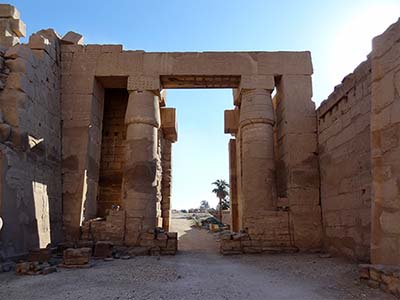
Bubastis Temple remains, present day
Her cult center was located in Per Bastet (Bubastis) in Lower Egypt, thirty miles from modern Cairo. The temple complexes of
Bubastis were associated with fertility rites and celebrations of life. Per Bastet had particular prominence since during
the ancient 22nd Dynasty, it even functioned as the capital of Egypt itself, and the hieratic complexes were considerably
expanded in scope.1 To any visitor, the temple complexes had a holy and very arcane kind of shimmer.
Bastet's annual festival in Bubastis was
among the most popular in Egypt with nearly a million people attending it at any given point it was held, according to the
high priest Herodotus.2The excavations of the sites revealed to modern historians a particularly lavish and
well-provided for resort which seemed to reach an apex of popularity after 1000BCE3, prompting the Late Dynasty
Pharaohs to issue more and more renovations to the complex, justifying the account of the great historian of Antiquity. The
cult at Bubastis did not just celebrate the great cat Goddess, but other feline deities such as Sekhmet,
Pakhet, Maahes and others.
By the same account, it was known as one of the most beautiful temples in Egypt:
Book 2, Histories, Herodotus: 2
Temples there are more spacious and costlier than that of Bubastis, but none so pleasant to behold. It is after the following
fashion. Except at the entrance, it is surrounded by water: for two canals branch off from the river, and run as far as the
entrance to the temple: yet neither canal mingles with the other, but one runs on this side, and the other on that. Each
canal is a hundred feet wide, and its banks are lined with trees. The propylaea are sixty feet in height, and are adorned
with sculptures (probably intaglios in relief) nine feet high, and of excellent workmanship. The Temple being in the middle
of the city is looked down upon from all sides as you walk around; and this comes from the city having been raised, whereas
the temple itself has not been moved, but remains in its original place. Quite round the temple there goes a wall, adorned
with sculptures. Within the inclosure is a grove of fair tall trees, planted around a large building in which is the effigy
(of Bast). The form of that temple is square, each side being a stadium in length. In a line with the entrance is a road
built of stone about three stadia long, leading eastwards through the public market. The road is about 400 feet (120 m)
broad, and is flanked by exceeding tall trees. It leads to the temple of Hermes.
Her temples often demonstrate her relationship to Gods such as Re, for which she was seen as an emissary. Archeologists have
found inscriptions to her in Bubastis that indicate how she was perceived, since unlike Sekhmet, many of Bastet's roles seemed
to relate to spiritual matters and not regal ones involving the machinery of power:
Inscription from Naos of Bastet: 4
King of Upper and Lower Egypt, lord of the Two Lands... (I) have come to you Bastet, lady of the [shrine], | one who gives
his arms supporting the ones who shine/the shining ones(?) (= stars), one to whom transfiguration (Ax.w) is given in heaven
through (xr) Re.
In a domestic guise, she ruled over the protection of the home and the cultivation of new life, as well as vigilance against the
night and darkness. As a powerful Goddess, women frequently called on Her powers during pregnancy and in difficult situations
for her protection and guidance. Bastet, like Isis and Hathor, was equated very strongly with motherhood5 and
nourishment of the young, which is why she is commonly represented in statuary with kittens. During the New Year's celebrations,
Bastet's name was often invoked on celebratory flasks6 and was associated with a gift of cats or kittens to another
household.
Symbolism
In occult terms, Bastet rules over many aspects of distinction. While they are independent animals, cats possess a rigid social
order, which they fiercely enforce at all times. Cats also cannot be commanded to love any being and generally 'claim' whomever
they choose. This symbolism aligns with the anointing ointment Bastet has at her disposal, because her powers of discernment are
absolute: she is an aristocratic Goddess in the true sense of the word.
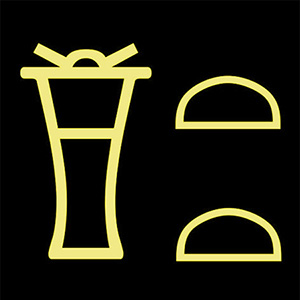
The name Bastet means 'she who is anointed and (in return) She anoints', hence the Hieroglyph of her name is always represented
with an ointment jar7. There is also a code inside Her name with the double t (tet), represented by the two
semicircle Hieroglyphs, meaning 'she who anoints via the Power of Thoth'.
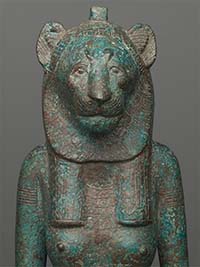
Bastet in lioness form
Bastet's warlike form as a lioness refers to her fierceness as an adversary and her superlative levels of power. In addition
to protecting the home, she also maintained the nation, the greater racial home. In this form of the Goddess, the symbolism
emphasizes the proactive work of the collective of lionesses to uphold the pride that is the basis for any true choice and
liberty. In this guise, she was also equated with Sekhmet in defense of the realm and in the proper use of power.
While dogs guard against external threats, with this symbolism being tied to both Cerberus and Anubis, cats eliminate all
sourcesof disease and decay within the home and farmstead. They also warn against fire.5 The Egyptian lady's job
was to ensure the household is orderly and to be vigilant in overseeing her children for signs of distress, danger or
disease. This was one of the reasons Bastet was invoked by women so strongly throughout the centuries. Vermin especially
posed a danger to children, and these animals were used to guard against the dissipation of new life. Yet just as a cat
exterminates vermin and a mother cares for her children, Bastet's role in a divine sense is to ensure that the spiritual
initiates who have passed through the gate are monitored and kept free of disease, internal chaos, and ignorance. As grain
grows to feed the multitude when freed from pests, so does the soul of the Zevist serve the many when it is cultivated with
proper care. The enforcement of her decrees in relation to cosmic order is absolute.
Her destruction of the snake of chaos and entropy, Apep, symbolized the Egyptian state's acuity to overcome chaos and disorder,
hence she was invoked by Pharoahs for protection. Re was also represented as destroying Apep in the form
of a male cat,
while Bastet likewise maintained order by allowing the dawn to come each day. In turn, Bastet rules over the maintenance of time
and is the dispositor of time as an emissary of Isis.
Related to both Re and Thoth, Bastet's functions often concerned health and medicine. The cleanliness routines of cats and
fastidious care they take to remove their own pollutants parallels the upkeep of spiritual cleansing required of advancement and
the necessity of removing debris from the soul for the serpent to ascend and emerge.
The climbing ability of cats also relates to her as cats will not hesitate to climb upwards. They also exercise balance and
judgement in jumping and can slip through gaps by manipulating their bodies like water. There exists an adversarial and anxious
nature to these animals suggestive of taking care not to be too sure in one's convictions and to be able to move on if
necessary. As the daughter of Re, Bastet was also associated with the purifying, perpetually rising and lowering powers of the
independent Sun for these reasons, among others.
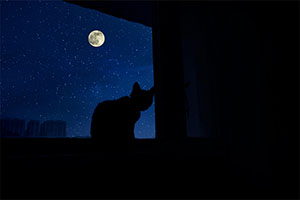
Beyond the more obvious reason that this relates to the ability to confront unforeseen threats, the exceptional ability of cats
to see well in the dark serves as an allegory for being able to see inside one's soul in order to wring out unknown
possibilities. The acolyte must unlock and unify with the unconscious (female) side of the soul; they must wield the ability to
traverse different dimensions as a cat slips in and out of the night. Bastet represents many facets of this process of change
and aspects of spiritual secrecy that she revealed only to Her chosen acolytes; therefore due to this and the association of
Bastet with time, she was equated with certain aspects of Artemis by the Greeks.
Cats were considered exceptionally holy in Ancient Egypt, tied to the health of the farming civilization adjacent to the
Nile's waters. They are known as exceptional familiars and can aid magicians in various forms. Deliberate violence
against a cat was punishable by death. Expensive embalming procedures for cats were often pursued which is another
indication of the popularity of Bastet. In Beni Hasan, a single cemetary with hundreds of thousands of cat remains was
found.
Bastet represented the form of invincible feminine consciousness, the subtle caregiving required to keep the Great Work under
control. Cats always functioned as guardians of granaries, temples, and laboratories alike. Their generally silent nature
demonstrates the need for thoughtful repose in the Zevist initiate and to keep quiet about what quickly brings envy and
chatter. Since feline creatures represent guardians of places in Egyptian thought, the purpose of Bastet as the divine cat is to
guard the household chamber, the zone of proper being that Nephthys properly represents, from all forms
of decay. She deviates from Sekhmet in representing a softer and more playful form of divine expression.
In Norse religion, although cats were uncommon in this part of Europe at the time, the chariot of Freyja (Aphrodite) is pulled by
two domestic cats, showing the breadth of Bastet's power. As Viking civilization expanded, newlyweds and pregnant women were
often gifted with a cat as a gift of Freyja.
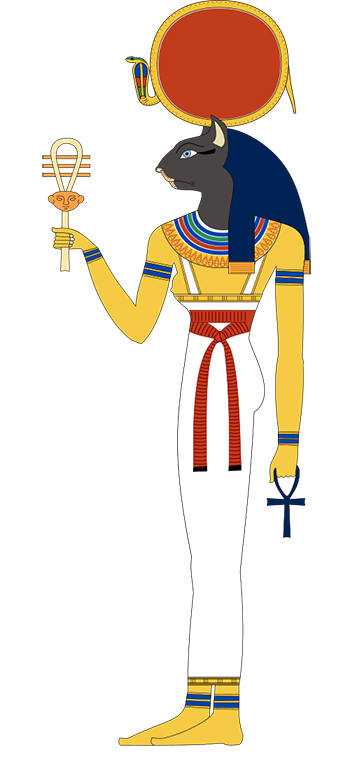
Bastet is the wielder of the sistrum8, which is also associated strongly with Isis and Hathor.
The three
strings of the sistrum represent the three channels of the soul and the necessary prerequisite for power to be wielded carefully
in pursuing immortality. The sound it makes also represents a sound similar to the rush that coincides with rumbling, surging,
and exceptionally bright power that hits one's consciousness when advancement occurs. This sound also parallels the purring and
hissing sound of cats.
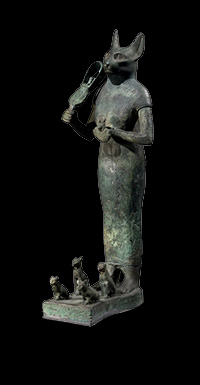
The sistrum, similar to how modern bells have distinct patterns, would be played in a manner of processions by women
familiar to Egyptians. Some of these sound patterns, lost to the sands of time, would be evoked in the imagery itself of
Bastet holding the instrument.
In statues, Bastet is often represented holding a leonine aegis to Her Middle Chakra, while Her other arm holds a sistrum
upwards. This shows the balance between aggression and approval inherent to any true protection. It also serves as a
reminder to consort with the right things and to not let corrupted people enter into one's heart, lest you surrender
your power and endanger the vulnerable in the process. Like Khnum, she is represented with an Ankh, which represents her
fierce guardianship of life.
Alabaster, a type of mineral and rock, is associated with Bastet. The original name was synonymous with the vessels of Bastet
herself, which passed into Ancient Greek as ἀλάβαστρος wares. Jars made from alabaster were typically used to represent her
symbolism, along with other objects such as amulets, brooches, plaques and vases.9 Some alabaster objects in
travertine form found at her sites are rendered in the shape of a cat with highly distinct eyes.10
Bastet is heavily associated with Seshat. Bastet would bless an erected temple, while Seshat indicated the divine geometry for it
to exist. If Bastet constituted the active safety of an established home, Seshat created the measurements for its foundation and
overall existence. Likewise, Seshat would delineate the boundaries for any being to exist and Bastet would control the inner
processes of power for it to exist. The two Goddesses were often held in tandem with each other. An example of this relationship
in day-to-day reality is how a cat is often used to hunt mice in libraries who would otherwise ruin books by gnawing on
them.
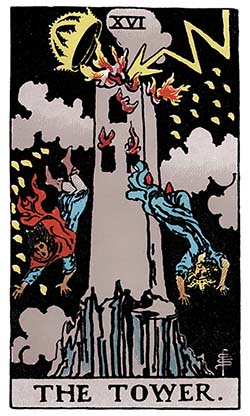
The Major Arcana card of Bastet is the upright Tower, which may seem highly unusual given the softer persona of the cat Goddess;
the Tower is arguably one of the most brutal cards in the Tarot, and its ominous presence signifies the upcoming horizon of a
disaster that will shake the querent’s foundations to the core.
In the Rider Waite deck, it is represented as a medieval tower on a peak struck alight by a bolt of lightning at night, while two
men in their finery fall from it headfirst amidst both flames and sparks. The Crown on top of the Tower is also displaced.
Throughout the imagery of older decks, it was sometimes named the House of God and shared visual cues with cards of pillars
struck by divine fire, while a variant also appeared in France named La Foudre (the Lightning Bolt) with a man observing a tree
hit violently by lightning. These scenes tended to have Christian iconography associated with the stories of the Tower of Babel,
Nimrod and others. The sixteenth card of the Tower, does, however, share a certain synchronicity with the older depictions of
the Strength card of Sekhmet with its pillar, and that card happens to be the eighth card in the sequence.
Any household on shaky foundations will be subject to disaster with the course of time. Cats are known for their powerful sense
of precognition when it comes to danger, while humans tend to be woefully ignorant. This card is also a warning that all
glittering things on earth can be lost in an instant.
As the Tower or Fortress represents the fixed body, there is a deeper alchemical symbolism in this related to Bastet’s
association with the nigredo part of the Opus, being as it is that the breakdown of the Tower shows the rupturing open of the
fixed structure and its reception of divine fire to be rebuilt anew, followed by the Star.
The alchemical descent of Sol and Luna in the guise of the two falling individuals also relates to Bastet’s position between
these two principles. Some experts in Tarot symbolism have remarked that the corrupted cards with the influence of Yehuboric symbolism always show the falling man in the figure of the letter aleph (stolen from Phoenician), which logically links to
Bastet’s name in the next letter.
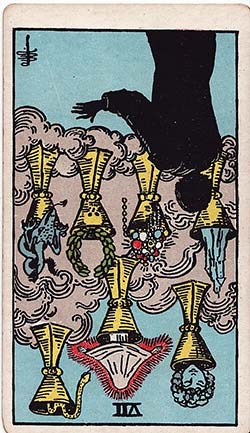
The reversed Seven of Cups is her Minor Arcana card. Interestingly, the intact Tower itself is shown inside of the cups, one of
the few meta-references of the RWS deck. The body of the magician also resembles that of a black cat from the side. Often, in modern
interpretation, this card is more or less a slap back into reality, telling the querent to be practical and comprehensive after
dwelling in delusions. Waite himself associated the reversed meaning with manifesting desire and pushing through to actually nurture
the fantastical images conjured by the Cups. Etteilla simply calls it "Plans", linking in with the
precision of the cat.
Christian and Goetic context
The references to Bastet in the Bible are vague, similar to that of many female deities that the Hebrew people did not deign to
mention. One snide and backhanded reference to Bastet's powers actually occurs in Matthew 26:6-13 when the Nazarene is about to be
sent to
die:
Matthew 26:6-13:
While Jesus was in Bethany in the home of Simon the Leper, a woman came to him with an alabaster jar of very expensive
perfume, which she poured on his head as he was reclining at the table.
When the disciples saw this, they were indignant. “Why this waste?” they asked. “This perfume could have been sold at a high
price and the money given to the poor.”
Aware of this, Jesus said to them, “Why are you bothering this woman? She has done a beautiful thing to me. The poor you will
always have with you, but you will not always have me. When she poured this perfume on my body, she did it to prepare me for
burial. Truly I tell you, wherever this gospel is preached throughout the world, what she has done will also be told, in
memory of her.
This transmutation of Bastet’s power into a nameless female Hebrew 'blessing' the Nazarene with an alabaster jar was designed to
show the Nazarene is 'anointed' and selected to be the head of existence (i.e. power) prior to execution and that he had
achieved the prerequisites for immortality. The anointment process as a whole in Ancient Egypt was associated with Re himself
(Apollo).
Pseudomonarchia daemonum, Johann Weyer: 11
Haagenti is a great president, appearing like a great bull, having the wings of a griphen, but when he taketh humane shape, he
maketh a man wise in everie thing, he changeth all mettals into gold, and changeth wine and water the one into the other, and
commandeth as manie legions as Zagan.
Bastet in medieval times was known as Haagenti (which is actually one of her names) and listed as a male Goetic demon in the form of
a bull with the wings of a griffin, holding an alchemical shield. In this symbolism, Haagenti was said to reveal all of the secrets
of alchemy and to enable change in the initiate through mysteries of water (the subconscious mind) and the mysterious processes of
soul evolution.
Cats themselves were reviled as unclean creatures following the advent of Christianity. They were seen as symbols of independence
that stood in opposition to the dependency cult of the Nazarene. Black cats in particular, linked to Bastet, were seen as
'familiars' of witches. Pope Gregory's decree named Vox in Rama (1233) formally declared cats to be symbols of Satan, with
black cats considered the worst due to a story of a ‘statue’ of a black cat coming to life. Heightened powers were given to
Inquisitors. Antipathy towards cats increased sharply, and extreme violence against defenseless animals was encouraged across
Europe. Only a number of years later, by the late 1340s, did the Black Plague sweep Europe. Unsurprisingly, the disease spread more
readily and freely
due to these criminal measures. In some areas, seventy percent of
the population perished. Knowing the power of cats while reviling
Bastet as a Goddess, the Hebrews in Europe often kept them around,
thereby averting the onslaught of plague in Europe and the Middle
East. The Hebrews of medieval Europe also knew to guard against
famines by deploying cats to protect their grain stores.
Although Islam's heritage in the Middle East and the incomplete
nature of Islam meant cats were held in far
higher regard, cruelty has never been absent.
Bibliography:
1The Temple of Bastet, Ministry of Tourism
and Antiquities, Government of Egypt
2Book 2, Histories, Herodotus
3The Goddess Bastet and the Cult of Feline Deities in the Nile Delta, Eva Lange-Athinodorou
4The Naos of ‘Bastet, Lady of the Shrine’ from Bubastis, Daniela Rosenow
5Dancing for Hathor: Women in Ancient Egypt, Carolyn Graves-Brown
6Egyptian Goddess: The Divine Legacy of Isis, Nut, Hathor, Bast, Sekhmet and Other Goddess in Egyptian Mythology,
Chronicle Press
7Ancient Egyptian Religion, Steven Quirke
8The Complete Gods and Goddesses of Ancient Egypt, Richard H. Wilkinson
9Oval Plaque with a Blessing Dedicated to Bastet,
The Met
10Cosmetic Vessel in the Shape of a Cat, The Met
11Pseudomonarchia daemonum, Johann Weyer

 አማርኛ
አማርኛ العربية
 বাংলা
বাংলা Български
 中文
中文 Čeština
 Dansk
Dansk Deutsch
 Eesti
Eesti Ελληνικά
 Español
 Français
 हिन्दी
 Hrvatski
 IsiZulu
 Italiano
 日本語
日本語 Kiswahili
 Magyar
 Македонски
 नेपाली
 Nederlands
 فارسی
فارسی Polski
 Português
 Română
 Русский
 Slovenščina
 Suomi
Suomi Svenska
 Tagalog
 Türkçe