Khepri
author: High Priest Hooded Cobra 666
co-authors: Karnonnos, Arcadia
The knowledge presented contains information for those who want to understand the solar God known as Khepri. In the Goetia, he
was labeled as the demon Tuvries, Cimejes or Kimaris. Here are some of his names:
Names
- 2500BCE
Kheperu
- Christian era
Tuvries · Cimejes · Kimaris
- Contemporary
Khepu
Divine Names
- Khepri
- Kheper
- Kheperu
- Kheperu-Nesu
- Khepu
The Khepri Ritual above allows the practitioner to bask in the rays of the self-created sun God of Egypt, who resurrected the
Egyptian in life and in death.
KHEPRI
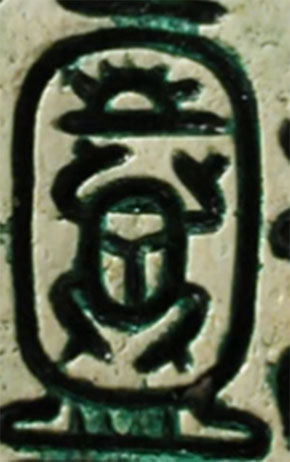
Cartouche of Khepri
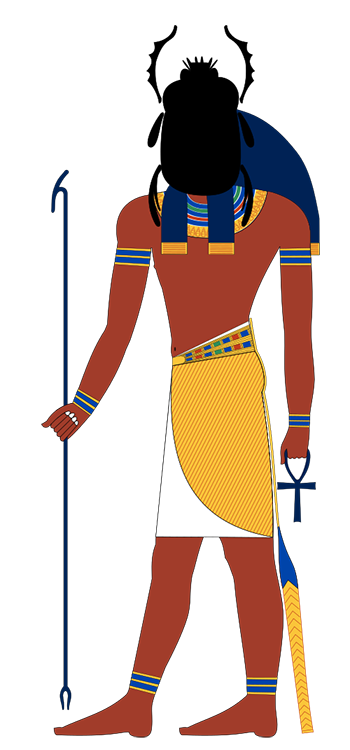
As the scarab-headed God of the Sun, Khepri is one of the most abstract Gods of Ancient Egypt. A testimony to his popularity
are the millions of scarab amulets found throughout Egypt1, yet many of his functions remain almost silent and
enigmatic to modern researchers because of their higher nature. Consequently, he cultivated a reputation as one of the most
inscrutable Gods of the ancient realm.
The God lacked a specific and broad cult of worship, being seen as a subtle force of a hieratic nature who was worshiped in
rituals associated with the sacred complexes of Re and Atum in Heliopolis and Thebes, which is also
where his mythology is assumed to have developed in ever-sopisticated forms.2 Regardless, his symbolism appeared
everywhere—in homes, business establishments, on town walls, and in many other contexts pertaining to life. He is also a
particularly old God of Egypt, as there are allusions to the 'Becoming One' and '[the one] who created himself' in the
Pyramid Texts.34 The scarab was seen as a force of constant, recurring creation and rejuvenation,
celebrated by the Egyptians as particularly important for expressing individuality. To this day, this stylized insect is a
visual shorthand for Egypt.
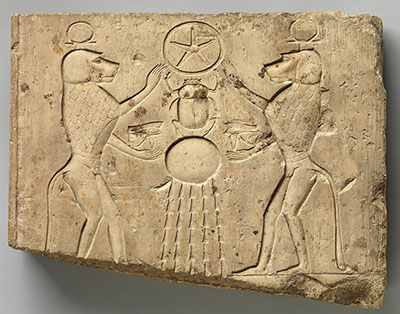
The ancient Egyptians believed that Khepri renewed the sun every day before rolling it above the horizon, then carried it through the
underworld after sunset, only to renew it again the next day. Often in artistic contexts, he was depicted with baboons hailing him
into the sky—animals believed by the Egyptians to greet the morning sun with their calls.
Relief panel showing two baboons offering the wedjat eye to the sun god Khepri,
who holds the Underworld sign,
Late Period–Ptolemaic Period, The Met Gallery
Although this is scarcely noted in the historical record, as Khepri is only shown spearing Apep and engaging in combat to maintain
the Solar barque in the Amduat, Khepri was known as one of Egypt's major war Gods. Aspects of his divine decrees concern the limits
of war and the mental side of command. Conduct of soldiers in representing Egyptian civilization was a domain of his that was taken
very seriously, as was physical combat to crush Isfet (Chaos). To this end, he was also associated with the principle of righteous
destruction and endings. Khepri is often associated with Re, Nun, Khnum, and Shu. The shenu of Khnum, for instance, also shows the
scarab of Khepri. In complex terms, Khepri is the masculine counterpart and yet the energetic opposite of Hecate.
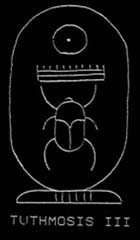
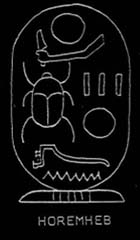
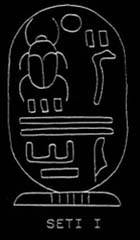
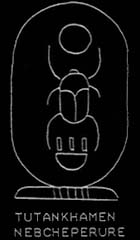
Khepri's prominence in Egyptian religion began with the formalization of the Amduat rituals under Thutmose I when they became a major
religious text in Egypt.5He was invoked by the Pharaohs and often appeared in their names as a hopeful symbol of an
auspicious reign:
Scarab Amulets
In a somewhat distinct context, Khepri was associated with death and rebirth. Funerary amulets and tomb walls, such as those in the
Dendera and Edfu complexes, frequently display scarabs. This served as a metaphor for the desire of the deceased to incarnate again
and was associated with the Opening of the Mouth in mortuary contexts.2 Funerary texts such as the Book of Gates
(particularly the Twelfth Gate6) and the Book of Caverns depict his role as the leader of the barque out of the
underworld. At the sixth hour, the primordial and chaotic waters of Nun are reached, where Khepri lies dormant, guarded by a
five-headed snake. When Re gives his Ba to Khepri, he is revived, and on the twelfth hour, Khepri pushes the sun to its vertex in
the midday sky.
Some of these amulets had funerary meanings relating to protection:
The Presence and Significance of Khepri in Egyptian Religion and Art, Maria M. van Ryneveld2
From the late Old Kingdom (2705–2250 B.C.), scarab amulets became more popular than heart amulets. The Egyptian amulet
was also inscribed with magical formulae, and "Hekau" (words of power) were uttered when placing these amulets on the
deceased (Budge, 1988:25ff.). The heart amulet ("ib") was placed either on the throat or the heart of the mummy, where,
according to the priests, the amulet would offer the greatest magical protection (Hobson, 1987:155).
Khepri was often associated with a blue or green color, represented in the mass-produced amulets and seals of Egypt. Most of
these items were either made in such a way as to appear that color, glazed with blue-green markings, or—more
luxuriously—crafted from rarer turquoise or lapis stones which were highly valued. This color was associated with the
luminance of the Nile during the daytime. These sacred amulets became increasingly popular throughout the Mediterranean
during the Classical period, often manufactured in Egypt and imported industrially into Southern Europe by the advent of the
Roman Empire. These tokens of the decreased and living alike represented the self and the maintenance of the true self in
the face of malefic and powerful influences. Blue was also associated with matters of commerce, protection, and inner peace.
The scarab amulets also were inscribed with messages relating to the Weighing of the Heart:
Scarab Amulet of Hatshepsut, Metropolitan Museum of Art
Spell 30B, taken from Book of the Dead7
... not to stand up as a witness against me, do not be opposed to me in the tribunal, do not be hostile to me in the presence of
the Keeper of the Balance.
One of the major symbols of the beetle God is in the large-scale scarab statues situated in temples, holy complexes and urban
settings throughout Egypt, most famously the large scarab statue made out of granite present at Karnak, dedicated to the God by
Amenhotep III.8 Opposed to the funerary settings in which amulets are placed, these edifications with scarab symbols are
largely interpreted as being symbols of good luck. The largest level of production of Khepri's symbols appeared to occur during the
reign of Amenhotep, similar to his state sponsorship of Sekhmet's statuary.9
Khepri Scarab at Karnak
Symbolism
The sacred animal of Khepri is the scarab beetle, hence frequently he is represented as a man with a scarab hovering above his
head. In more exceptional circumstances like the above image5, he is represented as a scarab-headed man with six of the
legs always visible. Many species, albeit not the black sacred species in Egypt, have a dulled golden hue, but all species appear
metallic. The scarab determinedly rolls the refuse of other animals into a spherical ball, then lays its own eggs inside, with the
newly born young devouring the ball and almost appearing miraculously out of nothing. The ancient Egyptians regarded this process as
particularly fascinating and auspicious, signifying the mystical position of the God as self-manifesting and repeating, even without
visible birth.
Khepri's name means "the self-manifested"2 and is related to the Egyptian verb to create. There are many codes to this
terminology that extend into all aspects of his symbolism, but many of his most sacred functions relate to high level rituals, such
as the Gates of Re. Hieroglyphs of his name show the opened-eye hieroglyph peering at the sacred scarab, with all illusions
dispelled.
A major aspect of his is the solar triad he forms with Atum (Zeus Helios) and Re (Apollo Helios) concerning the progression of the
Sun—sometimes represented as Khepri, Ra-Horakhty (Re-Horus), and Amon Ra.5 This cult had a
major hieratic presence in Karnak. Khepri always deals with the rise of the morning Sun, with Re symbolizing the powerful Sun at
noon and Atum at dusk. As the Sun ascends in the sky, it generates more and more power and perceptible light, allowing people to
accomplish what they must do each day.
Khepri deals with the process of beginning and ending points for all beings. His extensive and powerful command reaches not only over
natural lifespans and the living essence of beings but also in delineating the points of evolution for each and every individual, a
very significant aspect of reality, which was even linguistically coded in the Egyptian language, as life stages such as childhood
or old age were themselves called kheperu. In this, much of his symbolism falls under the aegis of Re, who represented
similar matters of progression by category in mystery schools.
It should be remembered that the ball is not always rolled successfully by the scarab; sometimes it can escape their careful
control, and a decamping ball that is large and fast enough rolling back onto the insect can cause serious harm and
setbacks. The struggle to do this for such a small animal is fraught with danger and obstacles. Sisyphean themes of
struggling against fate are a large part of the allegories he pertains to. Dung beetles are known to improve the environment
and create viable soil structure. They accommodate plant growth and, by removing dung in large amounts, also protect the
lives of vital livestock—something particularly important for the agrarian economy of the Nile. Modern scientific studies
have shown that their efforts greatly improve the chances for plant life to grow and be sustained. This was yet another code
for the beetle and why it was so highly esteemed by the Egyptians. Much like Hecate's functions, this element of something
'filthy' also concerned spiritual hygiene.
Khepri was depicted rolling the ball with his front legs, rather than the back legs used by the actual scarab. Moving through
life 'backwards' is tied to the symbolism of the evolution of the soul. The Sun is represented as the ball that Khepri, or
the scarab, pushes itself. These kinds of symbolisms deal with the formation of the self, one's Sun, nto a coherent
personality able to withstand the onslaught of others' wills or even resist decay due to the forces of time. The Egyptians
knew that one's own Sun, once built, is inexhaustible and without limitations.
The scarab was also associated with the sign of Cancer and the very ancient Age of Cancer by the Ancient Egyptians10,
rather than with the crab. This symbolism relates to protectiveness over the self and the determined nature of the insect.
Occult matters of Khepri relate to the shape of the sphere, in a parallel to Khnum's association with the
circle. For example, anything manipulated naturally between two hands can resemble a spherical object with enough motion and
pressure. The globe is a sphere—albeit not a perfectly symmetrical one—representing the universality of his attributes and the hope
of the Gods that all corners of the earth become a divinely sanctioned realm. The sphere can be viewed as a collection of orbits or
circles oriented around a fixed axis that create a three-dimensional shape. Khepri serves as the governor of this process when it
relates to the cycles of lifespans and the quests involved in each lifetime, all orienting around an inner core. Thus, it is shown
that Khepri slightly differs from Khnum: while Khnum governs the source of life and resurrection, Khepri governs repeated and
distinct creation.
Atoms also relate to this type of shape:
Shapes of the hemisphere are also representative of Khepri, as seen in the mounds created by beetles and termites. Occasionally, the
pyramidal Benben Stone of Atum was equated with such a mound, with Khepri springing from it; both Gods were held to be self-creating
and self-renewing, and both were tied to the mysterious Bennu bird. A similar symbol is the fatty hump of the camel, which the
mobile animal can use for self-sustenance over long distances in punishing conditions.
His Tarot card is the Seven of Swords. The number seven relates to the fractional part of the volume of a sphere, with the property
of a cubed radius having an extra third to add: 4/3 𝜋𝜋 r³. Nemesis and karma are also part of this numerological symbolism;
interestingly, it is known that Ma'at was sometimes regarded as a daughter of Khepri. One half of the head projections of the sacred
scarab (their rays) also number seven. The design of the card—again indirectly influenced by the appearance of the Gods in the
artistic creation of the popular (and partially corrupt) Rider-Waite Deck—shows a blond-haired man in golden clothing of high finery
attempting to steal swords from a military camp, with a bright golden sky in the background.
Part of the card's meaning relates to necessary cunning and strategy. All of these processes are part of accomplishing anything
major, being integral to risk. Personality formation also involves standing apart from the camp or crowd, as pleasing everyone is
impossible. The latter degrees of the sign of Aquarius being the sign of Khepri is no mistake: the conflict between the Sun of the
self and Aquarian ambitions concerning others is a perennial struggle.
The militaristic theme is also a necessary allusion, as Khepri is a patron of soldiers. Whether the camp is the soldier's own
(signifying betrayal) or an enemy camp he skillfully snuck into (signifying strategy) is part of the interpretation relating to the
querent. The heavy swords he struggles to carry, as well as the two left behind, can be seen as an allegory for the struggle of
pushing the sphere, as the beetle does. As anyone familiar with the card knows, the broader interpretation also deals with getting
things done regardless of consequences or karmic retribution for lying and other deceitful behaviors. What is truly evil is brought
into the golden light and cut down. The flag of the camp is raised, suggesting the man may not get away with his scheme. Ultimately,
the Seven of Swords also deals with cleansing. It can also deal with being wary of others' lies, using one's mind and force of self
to deny them the opportunity to deceive. In some ways, this may also involve a counter-strategy when the veil of ignorance is
lifted. All of these themes, in one way or another, convey fidelity to the self.
Two Major Arcana cards representing Khepri are the Sun and the Hierophant reversed.
The Sun is represented as a child with a red standard on a horse beneath a Sun with an oblique and inscrutable expression. In some
decks such as the standard Marseilles decks, it is represented as two children beneath a similar Sun in front of a brick wall, and
in the oldest Visconti deck, as a Cupidon on a black cloud carrying a red sun in his hands. The images of the two children in the
Marseilles deck bear a stylistic resemblance to the two baboons and hands that behold Khepri in Egyptian art. This card can convey
the completion of one's labors, and the joy that results from creation as a whole, but effortless clearing of obstacles and an
increasing cooperation with animals, plant life or children too. It can also indicate pregnancy. As a progression, it signifies
triumph over the hazardous scenarios of Death, the Tower and the Moon due to persistent hard work. It has a connection also to the
citrinitas or xanthotic stage of the Magnum Opus.
The Hierophant in reverse tends to convey making one's own path, just as the beetle determinedly rolls its ball. His presence in
relation to the querent's query can signify the need to be unorthodox and break with dogmas to create breakthroughs. In some older
decks, the represents philosophy, and the need for inquiry regardless of dogmas. On the other hand, the Hierophant can signify
hypocrisy, and the ball chosen being so heavy that it crushes the querent. Do not project an image that is at odds with reality,
because the sun shines on the holy too.
It has been noted that Khepri's candle color is dark blue, and his metal is copper. It can be stated that copper sulfate is notable,
as it transmits a remarkable blue light. The association of Khepri with Venus is suggestive of Venus tailing and almost pushing the
Sun, particularly at dawn.
Enemy Symbolism and Goetic context
Pseudomonarchia daemonum, Johann Weyer11
Cimeries is a great marquesse and a strong, ruling in the parts of Aphrica; he teacheth perfectlie grammar, logicke, and
rhetorike, he discovereth treasures and things hidden, he bringeth to passe, that a man shall seeme with expedition to be turned
into a soldier, he rideth upon a great blacke horsse, and ruleth twentie legions.
Khepri is listed in Christian magical texts as the demon named Kimaris, Cimejes or Tuvries, as he was listed in the rather early
Munich Manual of Demonic Magic.12 It was said that he rules over parts of Africa and appears to be related to the
headless, legendary Cimmerian peoples there who were viewed by medieval Europeans to be living perennially in caves, hinting
facetiously at the Egyptian origin of this God and the burrowing of insects. Much like Hecate, he was said to teach the conjuror the
trivium and corresponds thereby to their similar symbolism of making one’s way, since the trivium means the three roads in Latin.
Bibliography:
1SCARAB/الجعران, Kathlyn M. Cooney, UCLA Encyclopedia of Egyptology
2The Presence and Significance of Khepri in Egyptian Religion and Art, Maria M. van Ryneveld, University of Pretoria
3Utterance 257, Pyramid Texts
4Utterance 587, Pyramid Texts
5Conceptions of God in Ancient Egypt: The One and the Many, Erik Hornung
6Amduat papyrus of Shepeset-heryt, Turin
papyrus Cat. 1783, Museo Egizio 1824-2024, Papyrus Collection
7Volume 118, Thomas A. Holland & Thomas G. Urban (eds.),The University of Chicago Oriental Institute Publications
8EBSCO
9The scarabs of king Amenhotep III, Alaa Okasha, No. 1, Volume 1., June, 2016, Minia Journal of Tourism and
Hospitality Research
10Astronomische Konzepte und Jenseitsvorstellungen in den Pyramidentexten, Rolf Krauss
11Pseudomonarchia daemonum, Johann Weyer
12Munich Manual of Demonic Magic (Liber incantationum, exorcismorum et fascinationum variarum). Beware that this is an
enemy source and corrupted.