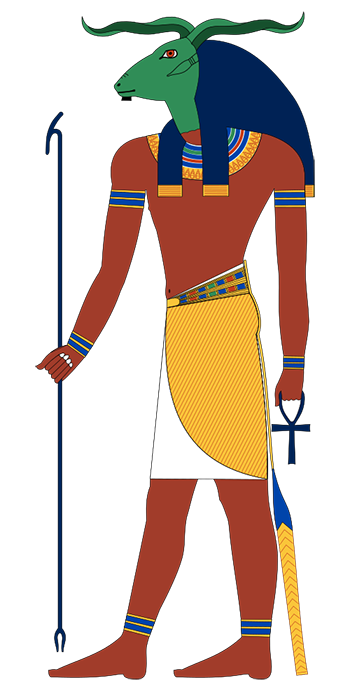
KHNUM
author: High Priest Zevios Metathronos
co-author: Novice Priest Karnonnos
I. Khnum
Khnum's Egyptian name is usually transliterated ẖnmw, later vocalized in Greek and Coptic-looking forms such as Chnoum, Chnoumis, or
Chnoubis. The safest early literary attestation of Khnum as a deity occurs in the Old Kingdom Pyramid Texts, where he already appears as
a divine maker and helper in the royal ascent; the Pyramid Texts therefore show that the name and cultic idea were already established by
the late Fifth and Sixth Dynasties. A still earlier royal-theophoric witness is the Fourth Dynasty name Khnum-Khufu, usually understood
as “Khnum protects me,” attached to the builder of the Great Pyramid; this does not by itself preserve a myth of Khnum, but it proves the
divine name was meaningful in elite naming before the Pyramid Texts were carved.1,2
The name is written with the consonantal skeleton ẖ-n-m-w, and it is usually connected with Egyptian verbs and nouns around joining,
uniting, building, shaping, and forming. This etymology fits the deity's later dominant image as the potter who joins clay, body, ka, and
breath into living beings. The sign group also tends to be written with divine determinatives when the god is meant, while related words
can move in the direction of “join,” “unite,” or “fashion.” For that reason Khnum's name is not merely a label but an active theological
pun: he is the one who joins the living form together, who builds the embodied creature, and who shapes biological life into a vessel
capable of receiving the divine soul.3,4
The Hellenistic and Roman magical form Χνοῦβις, Χνουβίς, commonly called Chnoubis, should be treated as a later development in
Graeco-Egyptian magical religion. Chnoubis is most commonly the radiate lion-headed serpent on
magical gems, often used for healing, digestion, protection of the body, and astral power. The name is plausibly related to Egyptian
Khnum/Chnoum by Greek transmission and magical reinterpretation, though the iconography has become serpent, solar, decanic, and
Agathodaimon-like
rather than the ram-headed creator of Elephantine and Esna.5
Sources: Allen, The Ancient Egyptian Pyramid Texts (2015); Ranke, Die ägyptischen Personennamen (1935); Erman and Grapow, Wörterbuch der ägyptischen Sprache (1926–1931); Hannig, Grosses Handwörterbuch Ägyptisch–Deutsch (1995); Bonner, Studies in Magical Amulets (1950).1,2,3,4,5
II. Khnum: the Origin of Life
Khnum was worshipped in Egypt for thousands of years as the God of Life, who was one of the oldest gods of the Egyptian pantheon.
The word Khnum means to 'yoke together' or 'build', paralleling the word yoga in Sanskrit. Khnum represents life in its purest
and most basal state, the life-force prior to any kind of separation of species or matter by form. For that reason, he was
regarded as pivotal to the maintenance of existence and the ever-flowing font of biological life. The ram God was associated with
the entire animal world, and all species within it, being the symbol of the life-force.6
The Egyptians held Khnum to be the patron deity of the Nile and a focal point of divinity for their survival as a civilization.
His very word could decide the conditions for agriculture where flooding could produce rich deposits of silt and clay for
year-long farming, or lead to depletion and subsequent civic chaos. As we now know via evolutionary theory, water is where all
life begins, and in that regard the symbolism of the great builder is not mistaken. The mythology of the sacred Cosmic Egg was
tied to him, as he fashioned it. He was also said to be the most direct creator of the material basis of humanity, being a potter
who fashioned human beings on his spinning wheel, and in this endeavor, Khnum occupied a place in the sequential creation of
humanity alongside Amon Ra and Ptah. Khnum was held to dwell within sacred places, directing the dictates of biological life
wherever it was found, and so he was also in a sense the primary patron of the entire animal kingdom, as well as everything held
to be living. Khnum was often assimilated with other Gods such as Re, Osiris
and others. He was also associated with Meshkenet, the birth deity of fate.7,8
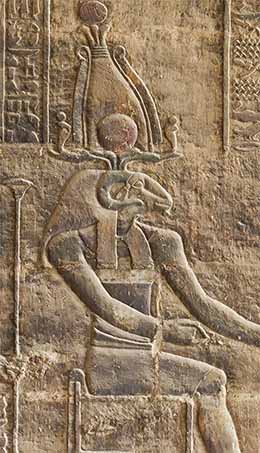
Khnum's power was commonly invoked by rulers for protection of their lives. The name of the Pharaoh who constructed the Great Pyramid of
Giza, Khufu, means 'Khnum is my protector.' In Egyptian art, Pharaohs are often depicted alongside him when asking for divine
intercession in protective matters and functions. When the Romans conquered Egypt, the Roman emperors, beginning with Tiberius, used the
imagery of this deity for good luck and to symbolize their power, and although Khnum is an extremely ancient deity who is mentioned in
the very arcane Pyramid Texts where he creates the boat for Unis to cross and the ladder for Unis to climb, his presence increased in
being varied, prolific, and widespread around the Roman rule of Egypt. In this, an inscription at Esna on a pillar commemorating the
emperor Trajan is a notable source:9,7,10,11
“Live the good God,
scintillating of appearances
in the marshes(?) of Chemmis.
He who was born to be Lord,
so he might multiply festivals for his God,
the Lord of Life (Khnum).
Lord of the Two Lands,
(Autokrator Caesar)|
beloved of Khnum-Re Lord of the Field.
Live the good god,
product of Menhyt and Khnum,
fashioned by Lord of the Potter's Wheel,
having distinguished him in the womb
among those the Founder of this Earth created
for eternity.
King of Upper and Lower Egypt,
Lord of the Two Lands,
(Trajan Augustus)|
beloved of Khnum-Re Lord of Esna.”
Column 11, Esna 298, The Temple of Esna. An Evolving Translation: Esna III
The Famine Stela on Sehel Island is a strong base for understanding Khnum’s mythological role, since it is a theological narrative about
his control of inundation of the Nile and reflective of how he was worshiped. The Stela contains an interesting story about Khnum. Egypt
undergoes a famine for seven years, leading to moral and physical ruin. The ancient Pharaoh Djoser asks the great vizier Imhotep on how
to resolve the problem. The latter investigates the archives at the temple ḥwt-Ibety ("House of the nets") in Hermopolis, a sanctuary
dedicated to Thoth. There he discovers that the Nile's flooding is governed by Khnum, who controls the flow on the island of Elephantine
from a sacred spring where he peacefully dwells. Imhotep reports this finding to the Pharaoh before departing immediately for the
location: upon reaching Elephantine, Imhotep enters Khnum's temple, known as "Joy of Life."12
He performs ritual purifications and offers prayers to Khnum while presenting "all good things" to the God. Exhausted, he falls asleep
within the temple. In his dream, the benevolent Khnum appears before him, introducing himself and revealing his divine nature and powers.
The God concludes by promising to restore the Nile's flow, and when Imhotep awakens, he carefully records every detail of his divine
encounter, then going back to Djoser to relay all that has transpired. According to historians like Lichtheim, the Stela “claims to be a
decree of King Djoser” but is “a work of Ptolemaic times,” composed by the priesthood of Khnum’s temple at Elephantine to establish
legitimacy over Elephantine and Lower Nubia.13
III. The Epithets of Khnum
Khnum has many epithets related to the Elephantine and Esna traditions. They tend to emphasize his power over the Nile cataract, his
residence at Elephantine or Esna, his creator-role as potter, his solar fusion as Khnum-Re, and his life-giving power as the one who
fashions bodies, kings, animals, and divine images. The later Esna material is particularly rich, because Khnum was elevated there into a
cosmic creator whose titles overlap with Re, Ptah, Heka, and the divine craftsman.14,15
Sources: Leitz, Lexikon der ägyptischen Götter und Götterbezeichnungen (2002–2003); Sauneron, Esna V (1962); Drioton, “La stèle de la famine à Séhel” (1933); Varille, “La grande porte du temple d’Esna” (1953).14,15,16,17
IV. Elephantine, the Temples of Khnum
Khnum's most prominent temples were located on islands dedicated to his worship, such as Yebu (Elephantine), near Syene, and Iunyt
(Esna), near Thebes. At Elephantine, Khnum shared complexes of worship with Satet, a female antelope deity tied to his symbolism. The
Elephantine Triad of Khnum, Satis and Anukis was highly important to the region of the Cataract ritualistically and symbolically.
The temple was very old and saw major cycles of investment over the centuries; it was dated to the Third Dynasty of advanced antiquity,
however, at a particular point of centuries of internecine instability in Egypt, it had been left in a delapidated state and was
renovated with laborious care during the Thirtieth Dynasty under Pharaoh Nectanebo I, prior to the Persian recapture of Egypt by Xerxes.
The Elephantine temple subsequently underwent numerous renovations during the Ptolemaic period after the descendants of
Alexander's commanders became Pharaohs.18,19,20
In Esna, Khnum shared a temple complex with Neith (the war Goddess of the rivers) and Heka (the God of Magic). It was constructed
during the Ptolemaic era by Ptolemy V and seems to have had a protective function, and despite how relatively
recent the
temple is in the scheme of Egyptian history, it had a strong association with Khnum. Despite his general antiquity, it
is clear that Khnum took a role as one of the most prominent royal Egyptian Gods in the millennia prior to Egypt falling to
Christianity. He was particularly favored by Roman rulers, inscribed with names such as “Khnum, the Good Protector" and “Khnum,
who is in his Great Place." Part of this appears to have been some pattern of aggrandisement of solar gds during this period,
possibly to rebuild Egypt after much devastation. Some thread of connection of the Esna temple to the abundance of life
existed:21,11
“In Ptolemaic and Roman sources, Esna is designated as Λάτων πόλις or Λάτωνπόλις (Latopolis), “town of the Lates fish.” The Lates
fish (Lates niloticus, or Nile perch; Egyptian aHA, “fighter”) enjoyed a special adoration in and around Esna in Ptolemaic and
Roman times, because it was associated with the goddess Neith. Indeed the cosmogony of Esna reports that during the creation of
the world Neith changed her figure into that of a Lates fish.”
Jochen Hallof, “Esna,” UCLA Encyclopedia of Egyptology
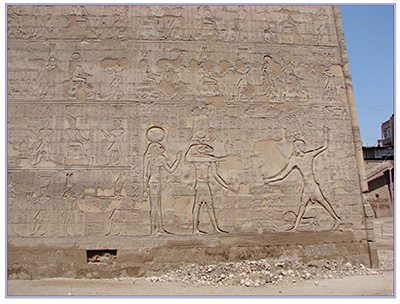
Domitian with Khnum - "The Son of Re"
The worshippers of Khnum often congregated together to chant, leading to official titles listed in texts like 'the Chantress of Khnum'.
For women wishing to conceive, there were rites held at the Temple of Elephantine as Khnum was petitioned to allow them to create new
life. Depictions of him are prolific in temples with mammisi or birthing houses, and these places are where Khnum is depicted forming
juveniles on his potter's wheel like in Philae, often stated to be the child Pharaoh. The Kellis mammisi from Roman Egypt depicts Ptah
and Khnum fashioning people on the wheel.22,23,24
Elephantine became a major hub of the empire, but with the coming of Christianity, function ended and the temple became an archaeological
ruin-field. The Esna temple came to be used for various purposes after the fall of Egyptian religion, after which it became a fixation
for archeologists to uncover:20,25
“In the late third or early fourth century a.d., by which time the temple had presumably been closed, the residents of Esna began to
dismantle its main sanctuary and repurpose the building blocks to build canals. They used the pronaos as a shelter for the next 1,500
years, and, in the nineteenth century, it became a warehouse for storing cotton and ammunition. Over that stretch of time, fires lit
inside for illumination and warmth gradually coated the bright paintings on the ceilings, columns, and interior walls in thick layers of
dirt and soot. Parts of the pronaos were buried beneath sand until the twentieth century.”
Benjamin Leonard, “An Egyptian Temple Reborn,” Archaeology
V. Priesthood of the Ram
The priesthood of Khnum was regimented in various ways. The evidence like the Sehel graffito from the reign of Hatshepsut, published by
Labib Habachi, described the official Amenhotep as “chief priest of Khnum, Satis, and Anukis”. His highest priesthood was therefore
shared with the Trinity of Elephantine, but lower priests were to serve Khnum individually. The Elephantine textual corpus preserved
multiple documents like the Pap. Berlin P. 23572 and Pap. Berlin P. 13577 explicitly addressing or mentioning “the priests of Khnum”,
among many. The database lists letters to the priests in correspondence and letters concerning delivery of bread to them, legal issues of
land purchase, the provisioning of assistance to the people, as well as documents tied to the physical sacred domain of the God. The
roles of these priests were multi-faceted in scope. Porten’s corpus of translated papyri from Elephantine has the lesonis (mr-sn,
economic manager of a temple) appointed by the Persian satrap of Egypt to oversee the economy of temples in a way that links the office
to offerings and deliveries.26,27,28,29
The aforementioned Chantresses of Khnum seem to have occupied a sacred position as well. They occupied specifically musical roles and
according to de Velde had their own phylai or class within the sacred documents relating to his worship. Daily worship is strongly
indicated as part of his cult, relating to men who had taken vows of purity; Khnum was seen as valuable and his qualities were sought
after.30,25
VI. Animal Symbolism
As stated, the word Khnum means 'to build', relating to his mythological role as divine potter, but it also relates to the verbs to
gladden, to enjoy and to please. The Ka as a state of the soul is mystically tied to him in Egyptian texts, meaning the initial consonant
of his name aligns itself with his divine purpose. The word relates to sheep and flocks as a Semitic root. His name also etymologically
means well or spring, hinting that his powers relate to the emergence of all life forms from their basic origin. The spring in ancient
times was also associated with relief from thirst and the terror of famine - like Pegasus, the association with the spring shows he is a
trustworthy entity; the Valeforon, Pegasus and Athena myth has parallels with the Famine
Stela.31,32
Khnum is portrayed with the head of a ram, a very important symbol connecting into life and nature in its purest guise, connected
strongly to the Banebdjed of Osiris. His alternate name Raum relates to the sun
God. The Sanskrit words raum, hraum and rom relating to solar mantras, various states of bliss (connected to the Egyptian
meaning above) and the fur of an animal also are part of his syntactical web of meaning, something later debauched in the Goetia.
The Germanic word 'ram' (of supposedly unknown origin) and the word of power Raum are connected in meaning. To put this in
simpler terms, the struggle and competition of rams is symbolic of the necessity of fighting to survive and dominate. The ram
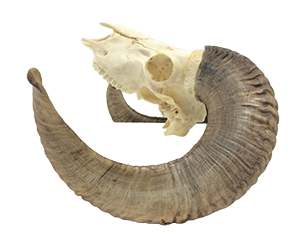
always serves as a symbol of spring, in which life emerges from the deep freeze of winter. Visually, the curvature of a ram's
horns symbolize the beginning of life, starting from nothing and becoming more complex and varied with evolution and development.
Horns of the ram allude to many other processes of creation; ovaries, for example, have this type of shape. The Fibonacci
sequence of the series of numbers where each number is the sum of the two preceding numbers is also represented in the horns.
VII. The Circle and Potter's Wheel
More often, Khnum was represented with a circle on top of horizontal horns (sometimes with dual serpents attached), showing his
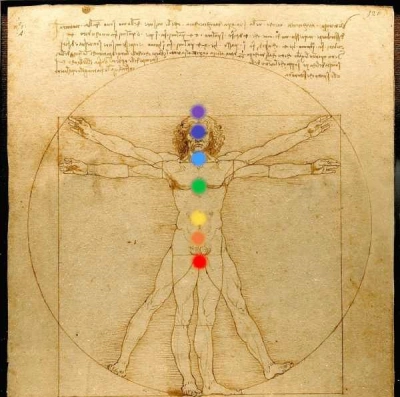
connection to continuity and regeneration but hinting at the symbolism of eternal life through raising the serpent in the Sushumna
channel. Khnum also deals with the Solar Chakra, as the ram is symbolic of the driving power of a life-form, being one of the reasons he
is connected to the mantra Raum. As the bearer of the Ankh, Khnum is heavily associated with this symbol and its life-sustaining powers
and the 'Ba' of the soul also, being known as the Ba of Re.11
A very important aspect of this imagery is his fashioning humans from clay on the potter's wheel and breathing life into them, as this
emphasizes the significance of the raw life-force in sustaining the process of reincarnation and the furtherance of higher nature.
Pottery itself is highly symbolic of basic civilization and what differentiates humanity from the animal kingdom, since it requires
sensitive motor skills and is evidence of the creative mind that is necessary to bring the most rudimentary of peoples into coherent
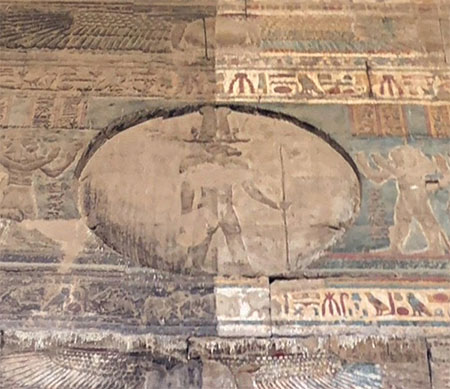
organized structures. Khnum is depicted in ancient Egyptian reliefs within a circle, surrounded by all species, beings, and Gods.
The circle, like the wheel, represents the return of life to its basic forms and advancement out of it. Evidence of this is seen in this
relief at the Temple of Esna:
The word 'room' is also connected to the vastness of what Raum rules over, originally meaning 'space' or 'vastness' in Old English.
Symbolic of this vastness is the account that Thor's chariot is pulled by two rams, while Mangal (the planet Mars) rides a ram in
Hinduism.
VIII. Chrysomallos
He is related in his ram symbolism to the ancient Greek mythological ram named Chrysomallos. A winged ram, sired by Poseidon, flew across
the sea, rescuing the boy Phrixus and providing him with the Golden Fleece that Phrixus hung in the grove of Ares. Thereafter, the ram
returned to the gods, being sacrificed to become the constellation of Aries. The connection of Aries as being 'the spark of life' and
Khnum is deeply rooted; he was also associated with Aries by the Egyptians themselves in the Dendera temple complex. The ram's horns are
also represented in the glyph of Mercury, and the connection of the ram-bearing Hermes-Kriophoros to the ram
God is part of the syllabary of meanings, since Hermes wields the symbol of raw life to ward off disease and decay. This imagery was
often deployed in communities of antiquity before plagues could occur.33,34
IX. Chnoumis
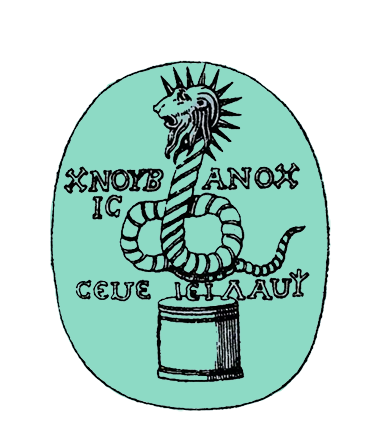
In the occult sense, Khnum is associated in an abstract way with the Chnoumis or Chnoubis amulets of Hellenistic and Roman Egypt.
The figure of Chnomouis is a radiating, lion-headed snake, sometimes featuring a fish tail. It is often accompanied by the
"Chnoubis sign," a triple-S with a horizontal stroke, and the deity was associated with healing, lifegiving and the Agathodaemon.
Chnoumis, or Chnoubis, was understood in late antique astrological and magical traditions as a entity of an astrological decan,
with Hephaestion of Thebes identifying Chnoumis as the third decan of Cancer; in zodiacal astrology the thirty-six decans divided
the 360-degree zodiac into ten-degree sectors; Chnoumis is also associated with Kenmet, the serpentine representative of this
decan in Egyptian astrology.35,36,37
“Clear evidence of such a perception (and use) of green jasper is preserved in the collections of the British Museum with
green-yellow jasper gems of Chnoubis with the inscription: [Χνοῦ]βις πέσσε πέ[σσε...] meaning ‘Chnoubis, digest, digest!’ which
was apparently meant to assist the work of the stomach. Besides, the belief in such properties of green jasper (with an image of
Chnoubis) survived much longer. Even at the turn of the 4th and 5th century, a physician named Marcellus Empiricus (Marcellus
Burdigalensis) recommended using an amulet bearing Chnoubis or with the SSS sign for stomach pain (Bonner 1950, 59). Amulets with
the image of this god were made, inter alia, of green jasper. A Roman physician named Galen (Bonner 1950, 54)3 also wrote about
the special properties of green jasper. He recalls that during the Ptolemaic era, an Egyptian magician called Nechepsos in the
14th book written around 150 BC stated that a sick stomach and oesophagus can be cured by wearing a stone engraved with a radiant
snake, whereby Galen was of the opinion that the medical value depended on the type of stone, and not what was carved on it.”
The Wisdom of Thoth: Magical Texts in Ancient Mediterranean Civilisations (Archaeopress)
The image of Chnoubis, the serpent with a lion's head which emanated sun rays, was mass produced on amulets and gems of emerald-green
hue. Chnoubis was one of the major entities evoked by the tradition of the gems, alongside Abraxas and
Thoth. The rays encircling his head show his solar nature and are tied to the Gnostic entity of the pole, who
had the form of a snake or a lion. Later, this entity was worshiped by certain Gnostic cults in a parallel manner to Abraxas, often
attempting to avoid detection in Christianity. The last attested use of Chnoumis name is very late; from the 9th century from a copper
plaque used in a magic ritual by Copts, with an Arabic inscription from that era.37,38
Sources and Bibliography
- Allen, James P., trans. The Ancient Egyptian Pyramid Texts. 2nd ed. Writings from the Ancient World 38. Atlanta: SBL Press, 2015.
- Ranke, Hermann. Die ägyptischen Personennamen. Vol. 1. Glückstadt: J. J. Augustin, 1935. See entries for names formed with ẖnmw, including Khnum-Khufu.
- Erman, Adolf, and Hermann Grapow, eds. Wörterbuch der ägyptischen Sprache. 5 vols. Leipzig: J. C. Hinrichs, 1926–1931. See s.vv. ẖnm and ẖnmw.
- Hannig, Rainer. Grosses Handwörterbuch Ägyptisch–Deutsch: Die Sprache der Pharaonen, 2800–950 v. Chr. Kulturgeschichte der Antiken Welt 64. Mainz: Philipp von Zabern, 1995. See s.v. ẖnmw.
- Bonner, Campbell. Studies in Magical Amulets, Chiefly Graeco-Egyptian. University of Michigan Studies, Humanistic Series 49. Ann Arbor: University of Michigan Press, 1950. See discussion of Chnoubis/Chnoumis gems.
- Hornblower, G. D. “Theology and Physical Paternity.” Man 32 (1932): 321–24.
- Wilkinson, Richard H. The Complete Gods and Goddesses of Ancient Egypt. London: Thames & Hudson, 2003. See s.v. “Khnum.”
- Temple of Zeus. “Amon Ra.”
- Shaw, Ian, ed. The Oxford History of Ancient Egypt. Oxford: Oxford University Press, 2000. See discussion of Khufu/Khnum-Khufu.
- Faulkner, R. O., trans. The Ancient Egyptian Pyramid Texts. Oxford: Clarendon Press, 1969. See Utterance 300.
- Richter, Barbara, and Saemi Akhmim. “Column 11, Esna 298–314.” In The Temple of Esna: An Evolving Translation, Esna III. Accessed May 1, 2026.
- The Famine Stela. Sehel Island inscription, Ptolemaic period. For English translation, see Miriam Lichtheim, Ancient Egyptian Literature, vol. 3, 94–103.
- Lichtheim, Miriam, trans. Ancient Egyptian Literature. Vol. 3, The Late Period. Berkeley: University of California Press, 1980. See “The Famine Stela,” 94–103.
- Leitz, Christian, ed. Lexikon der ägyptischen Götter und Götterbezeichnungen. 8 vols. Orientalia Lovaniensia Analecta 110–16, 129. Leuven: Peeters, 2002–2003. See entries for ẖnmw/Khnum.
- Sauneron, Serge. Esna V: Les fêtes religieuses d’Esna aux derniers siècles du paganisme. Cairo: Institut français d’archéologie orientale, 1962. See titles and liturgical material for Khnum-Re of Esna.
- Drioton, Étienne. “La stèle de la famine à Séhel.” Bulletin de l’Institut français d’archéologie orientale 33 (1933): 1–75.
- Varille, Alexandre. “La grande porte du temple d’Esna.” Bulletin de l’Institut français d’archéologie orientale 53 (1953): 1–47.
- Müller, Matthias. “Among the Priests of Elephantine Island: Elephantine Island Seen from Egyptian Sources.” Die Welt des Orients 46, no. 2 (2016): 196–223.
- Hart, George. The Routledge Dictionary of Egyptian Gods and Goddesses. 2nd ed. London: Routledge, 2005. See s.v. “Khnum.”
- Sapienza Università di Roma. “Elephantine.” Sacri Lapides Aegypti.
- Hallof, Jochen. “Esna.” In UCLA Encyclopedia of Egyptology, edited by Willeke Wendrich. Los Angeles: UCLA, 2011.
- Habachi, Labib. “A Family from Armant in Aswân and in Thebes.” Journal of Egyptian Archaeology 51 (1965): 123–36.
- Budde, Dagmar. “Child Deities.” In UCLA Encyclopedia of Egyptology, edited by Willeke Wendrich. Los Angeles: UCLA, 2011.
- Kaper, Olaf E. The Kellis Mammisi: A Painted Chapel from the Final Centuries of the Ancient Egyptian Religion. Dakhleh Oasis Project Monograph 1. Oxford: Oxbow Books, 1997.
- Leonard, Benjamin. “An Egyptian Temple Reborn.” Archaeology 75, no. 1 (January/February 2022): 34–39.
- Habachi, Labib. “Two Graffiti at Sehēl from the Reign of Queen Hatshepsut.” Journal of Near Eastern Studies 16, no. 2 (1957): 88–104.
- Staatliche Museen zu Berlin. “Pap. Berlin P. 23572.” Texts and Scripts from Elephantine Island in Egypt
- Staatliche Museen zu Berlin. “Pap. Berlin P. 13577.” Texts and Scripts from Elephantine Island in Egypt.
- Porten, Bezalel. The Elephantine Papyri in English: Three Millennia of Cross-Cultural Continuity and Change. 2nd rev. ed. Atlanta: Society of Biblical Literature, 2011.
- Te Velde, Herman. “Theology, Priests, and Worship in Ancient Egypt.” In Civilizations of the Ancient Near East, edited by Jack M. Sasson, 1731–49. New York: Charles Scribner’s Sons, 1995.
- Treasure, Matthew. “‘Four Faces on One Neck’: The Tetracephalic Ram as an Iconographic Form in the Late New Kingdom.” Master’s thesis, American University in Cairo, 2021.
- Pindar. Olympian Odes; Pythian Odes. Edited and translated by William H. Race. Loeb Classical Library 56. Cambridge, MA: Harvard University Press, 1997. See Olympian 13.
- Apollodorus. The Library. 2 vols. Edited and translated by James George Frazer. Loeb Classical Library 121–22. Cambridge, MA: Harvard University Press, 1921. See 1.9.
- Musée du Louvre. “Zodiaque de Dendéra.” Collection record, Département des Antiquités égyptiennes, D 38. Accessed May 1, 2026.
- Mastrocinque, Attilio. From Jewish Magic to Gnosticism. Studien und Texte zu Antike und Christentum 24. Tübingen: Mohr Siebeck, 2005. See discussion of Chnoubis gems.
- Edmonds, Radcliffe G., III. Drawing Down the Moon: Magic in the Ancient Greco-Roman World. Princeton: Princeton University Press, 2019, 116–48, esp. discussion of Hephaestion, Apotelesmatica 11.15, 12.20–23 Pingree; Dasen, Véronique, and Árpád M. Nagy. “Le serpent léontocéphale Chnoubis et la magie de l’époque romaine impériale.” Anthropozoologica 47, no. 1 (2012): 291–314
- Bąkowska-Czerner, Grażyna, Alessandro Roccati, and Agata Świerzowska, eds. The Wisdom of Thoth: Magical Texts in Ancient Mediterranean Civilisations. Oxford: Archaeopress, 2016.
- M. Étienne, HEKA : Magie et envoûtement dans l’Égypte ancienne, Paris, 2000, p. 114, no. 256: “talisman copte avec dessins magiques et inscriptions en lettres grecques et arabes.”