 አማርኛ
አማርኛ العربية
 বাংলা
বাংলা Български
 中文
中文 Čeština
 Dansk
Dansk Deutsch
 Eesti
Eesti Ελληνικά
 Español
 Français
 हिन्दी
 Hrvatski
 IsiZulu
 Italiano
 日本語
日本語 Kiswahili
 Magyar
 Македонски
 नेपाली
 Nederlands
 فارسی
فارسی Polski
 Português
 Română
 Русский
 Slovenščina
 Suomi
Suomi Svenska
 Tagalog
 Türkçe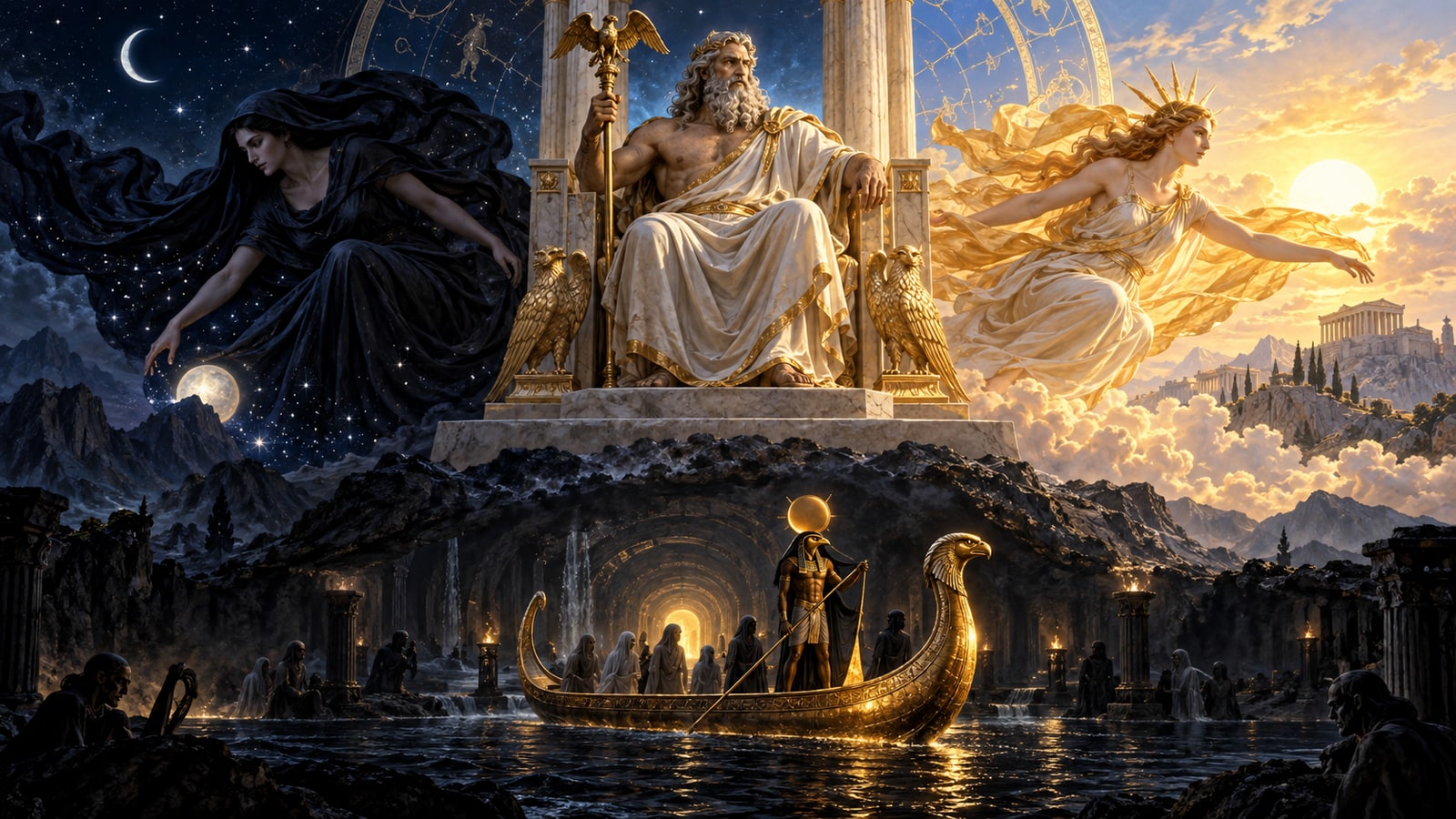
Summary
The Doctrine in Brief
Light and Darkness in Zevism, in 5 points
- 2 forces, no fixed sign. Light and Darkness are cosmological forces. Neither is good or evil by nature; the order that binds them decides their value.
- Under Ma'at, harmony. Held by Zeus as Sovereign of the Cosmos, they turn together like Yin and Yang and produce life, knowledge and renewal.
- Under Izfet, dissolution. Light burns without measure, and darkness becomes the death of all order.
- Darkness is the field of wisdom. Unexplored darkness is entered with light, and once explored it becomes Light: knowledge and wisdom.
- Distance is the fall. Distance from Zeus is the entropic fall, and the final aim of Izfet is the destruction of all life, progression and order.
Ma'at Is the Measure
I. Opening: 2 Forces, 1 Order
Every tradition has a word for light and a word for darkness. Most of them get the relationship wrong.
The common error runs like this: light is good, darkness is evil, and the 2 wage an eternal war until 1 of them wins. The Zoroastrian and Manichaean systems built whole cosmologies on that war, and the later monotheisms preached it for 2 millennia: the "children of light" against the powers of darkness, the unknown as the territory of the devil.
The frame collapses the moment it meets the cosmos. Every seed germinates in dark soil. Every child forms in the dark of the womb. Every body rebuilds itself in sleep. The same sun that ripens the harvest burns the desert and blinds the careless eye.
Zevism reads the cosmos as it stands. Light and Darkness are 2 cosmological forces, and neither is good or evil by nature. The order that binds them decides their value.
Bound by Ma'at, the structured Order of Cosmic Existence, they're positive: they alternate, feed each other, and produce life, knowledge and renewal. Bound by Izfet, the principle of dissolution, they turn negative. Light becomes a fire without measure. Darkness becomes the death of all order.
II. The Sovereign of the Cosmos: Zeus and the Order of Ma'at
Ma'at is the Egyptian name for the structured Order of Cosmic Existence: truth, justice, balance, measure, the correct place of each thing within the whole. The texts call her the daughter of Ra and say that the Gods live on Ma'at. Order is their food.
Ma'at needs a holder, and the holder is the sovereign. Jan Assmann's reading of the Egyptian royal texts gives the duty of the throne in 4 verbs: Ra placed the king on earth to judge mankind, satisfy the Gods, establish Ma'at and annihilate Isfet. Sovereignty and Ma'at are 1 function seen from 2 sides.
Above every earthly throne stands the cosmic one, and the Greeks recognized its occupant at once. Herodotus says it in 6 words: Ἀμοῦν γὰρ Αἰγύπτιοι καλέουσι τὸν Δία, "for the Egyptians call Zeus Amun" (Histories II.42.5). Amun-Ra, King of the Gods, bears the title Lord of Ma'at.
Hesiod gives the Greek side of the doctrine. Zeus wins the kingship, and his first act is distribution: each immortal receives a portion and an honour (Theogony 73-74, 885). Then he takes Themis, Divine Law, as consort, and she bears him the Horai, whose names read like a Greek translation of Ma'at: Εὐνομίη, Good Order; Δίκη, Justice; Εἰρήνη, Peace (Theogony 901-903). The Horai are also the Seasons: the measured return of light and dark through the year is the work of the daughters of Zeus and Divine Law.
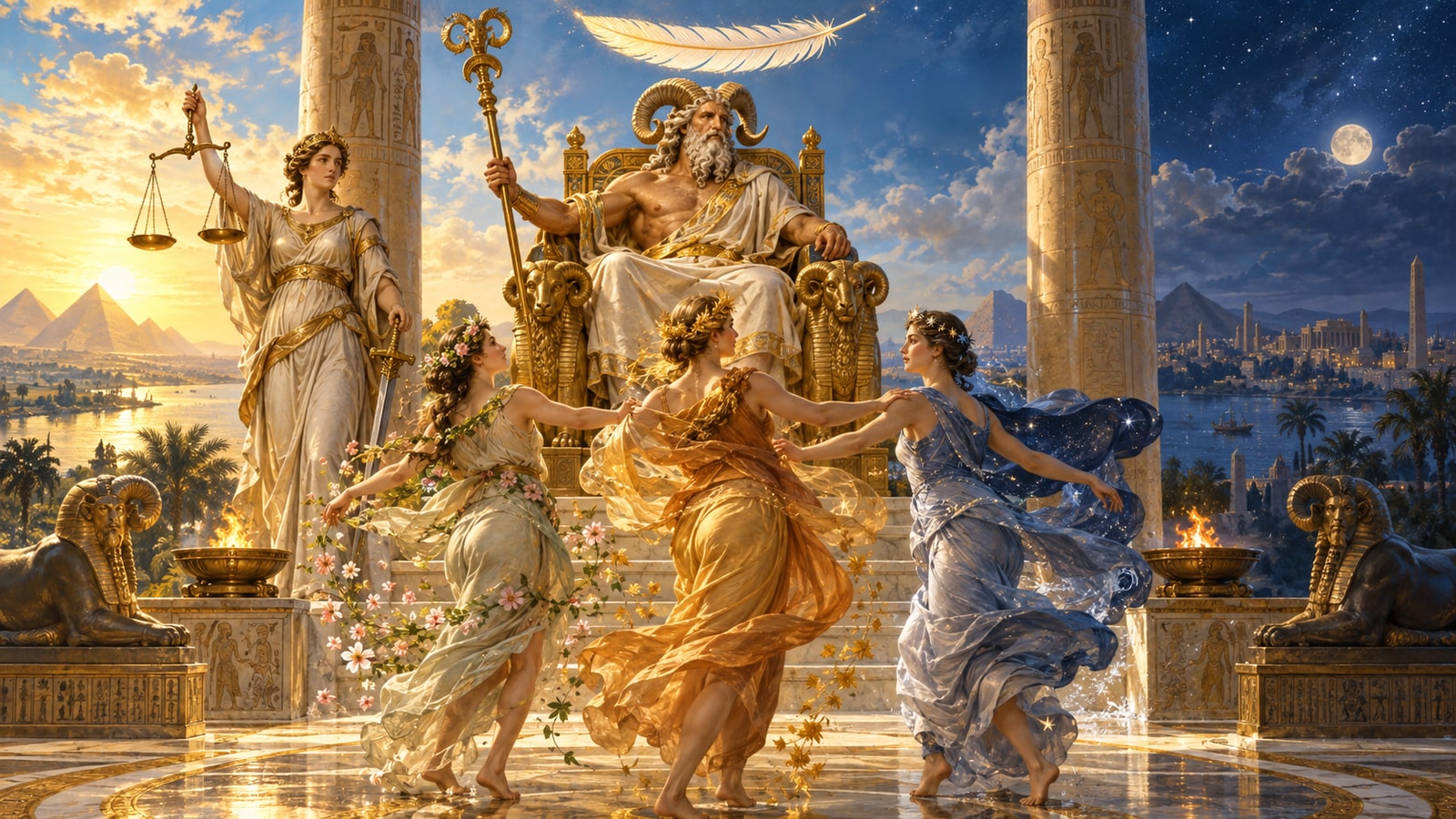
The name itself seals the point. Zeus descends from the Indo-European *Dyēus, from the root *dyeu-, "to shine": the bright sky, the day. The Sovereign's very name is Light. Yet Hesiod tells the farmer to pray Διὶ χθονίῳ, to Zeus of the earth (Works and Days 465), and Homer names Ζεύς τε καταχθόνιος, Zeus beneath the earth (Iliad IX.457). The Sovereign of Light holds the dark as well, and so both realms obey 1 measure.
The Stoic Cleanthes addresses Zeus as φύσεως ἀρχηγέ, νόμου μέτα πάντα κυβερνῶν, "first principle of nature, steering all things with law," and then names what the Sovereign does with opposites:
Cleanthes, Hymn to Zeus 18-21:
«ἀλλὰ σὺ καὶ τὰ περισσὰ ἐπίστασαι ἄρτια θεῖναι
καὶ κοσμεῖν τἄκοσμα, καὶ οὐ φίλα σοὶ φίλα ἐστίν·
ὧδε γὰρ εἰς ἓν πάντα συνήρμοκας, ἐσθλὰ κακοῖσιν,
ὥσθ᾽ ἕνα γίγνεσθαι πάντων λόγον αἰὲν ἐόντα.»"But you know how to make the uneven even and to bring the disordered into order, and what is unloved is dear to you. For in this way you have fitted all things into 1, the good together with the bad, so that there comes to be 1 everlasting Logos of all things."
Zeus makes the uneven even. He orders the disordered: κοσμεῖν τἄκοσμα, literally "to bring into cosmos what has none." He fits opposites into 1. That fitting is Ma'at. Sovereignty over the cosmos is the power to bind forces that would tear each other apart into a single living order.
III. Darkness Before Light: The Mother of Day
Zevism starts at the source, and at the source darkness comes first. Hesiod's cosmogony opens with Chaos, the yawning gap. Out of the gap comes the first darkness, and out of darkness comes light:
Hesiod, Theogony 123-125:
«ἐκ Χάεος δ᾽ Ἔρεβός τε μέλαινά τε Νὺξ ἐγένοντο·
Νυκτὸς δ᾽ αὖτ᾽ Αἰθήρ τε καὶ Ἡμέρη ἐξεγένοντο,
οὓς τέκε κυσαμένη Ἐρέβει φιλότητι μιγεῖσα.»"From Chaos came Erebus and black Night, and from Night in turn came Aether and Day, whom she conceived and bore after she lay in love with Erebus."
Light is the child of darkness. Aether, the bright air where the Gods dwell, and Day, the light that mortals live by, both come out of the womb of Night. No ancient Greek read those lines and concluded that Night was evil.
Egypt teaches the same in its own language. At Hermopolis the priests taught that the Ogdoad, 8 primordial Gods, stood before creation, and 1 of its 4 pairs was Kek and Kauket, Darkness itself in male and female form. Darkness was a creative God, 1 of the 8 powers of the primeval waters out of which the first sunrise rose.
In Homer, Hypnos escapes the fury of Zeus by fleeing to Night, and Zeus stops: ἅζετο γὰρ μὴ Νυκτὶ θοῇ ἀποθύμια ἕρδοι, "for he shrank in awe from doing what would displease swift Night" (Iliad XIV.261). The Sovereign reveres Darkness as a power inside his own order.
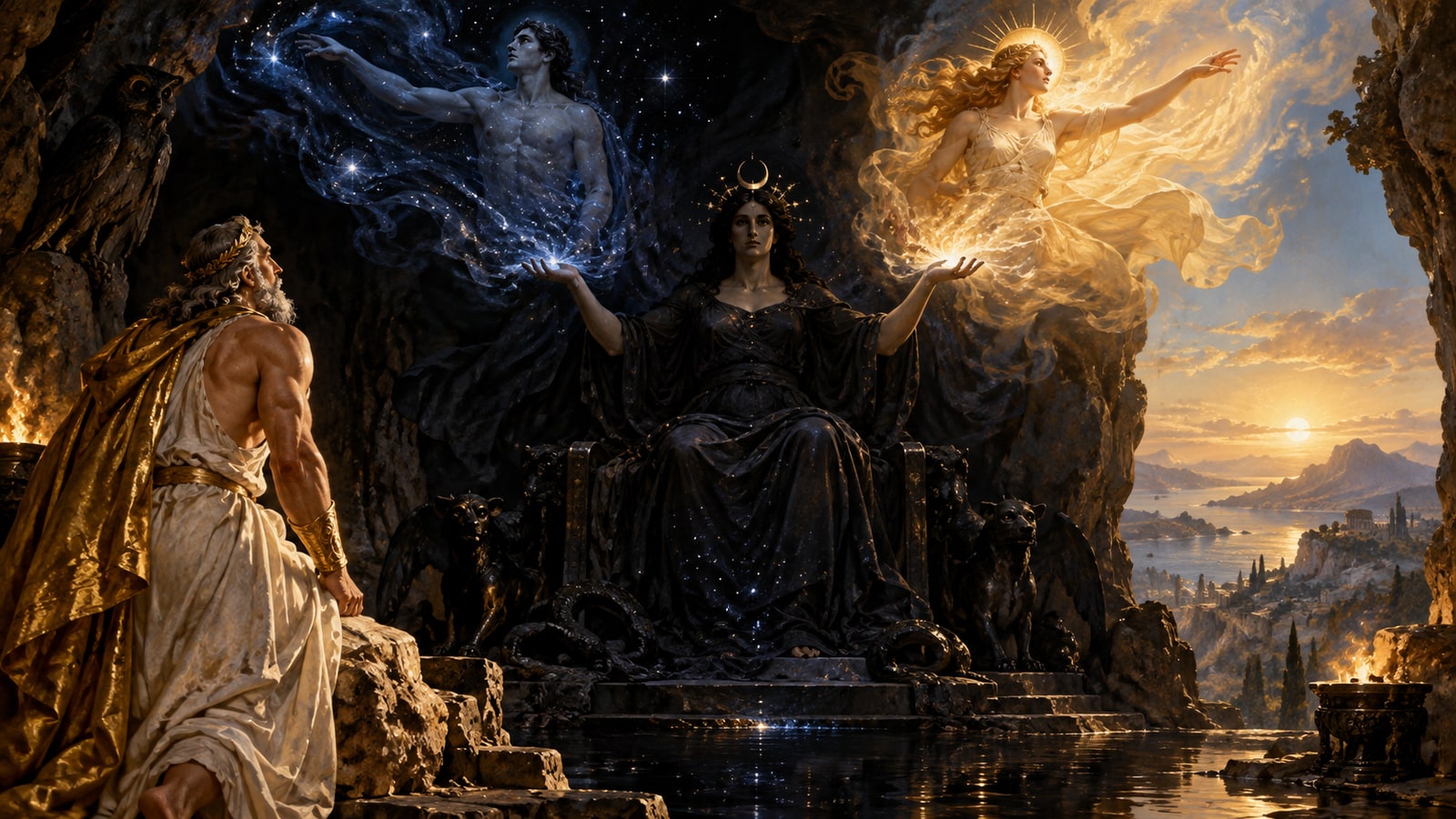
The Orphic theogony goes further. Before Zeus orders the cosmos, he goes to the cave of Night and consults her as an oracle:
Orphic Fragments 164-165 Kern (OF 237 Bernabé), in Proclus, In Timaeum I 206.26 and I 313.31 Diehl:
«Μαῖα, θεῶν ὑπάτη, Νὺξ ἄμβροτε, πῶς, τάδε φράζε,
πῶς χρή μ᾽ ἀθανάτων ἀρχὴν κρατερόφρονα θέσθαι;
…
πῶς δέ μοι ἕν τε τὰ πάντ᾽ ἔσται καὶ χωρὶς ἕκαστον;»"Mother, highest of the Gods, immortal Night, how, tell me this, how must I establish my strong-minded rule among the immortals? … And how shall all things be 1 for me, and each thing apart?"
Night answers: wrap all things in the ineffable aether, and set heaven, earth and sea within it. The Sovereign of Light walks into the cave of Darkness with a question and comes out with the wisdom to build. His question names Ma'at exactly: all things 1, and each thing in its place.
IV. Unexplored Darkness and the Lamp of the Seeker
Here the practical teaching begins.
Unexplored darkness is the region of what hasn't yet been known: the unread text, the uncharted sea, the untried discipline, the depths of your own psyche. Evil has no part in it. It's the field of all future wisdom, and whoever fears it stays ignorant for life. Heraclitus stated the condition of all inquiry in 3 words: φύσις κρύπτεσθαι φιλεῖ, "Nature loves to hide" (DK 22 B123). Nobody receives the truth of things without going in after it.
The method is to walk into darkness carrying light. The light is reason, discipline, the Logos, the teachings of the ancients, the practice of meditation. When the seeker enters the unknown with the lamp lit, the darkness yields. What was dark becomes visible, and what was visible becomes understood. Explored darkness becomes Light, and that Light is knowledge and wisdom. Every map was once a blank.
The Greeks built their holiest rite around this act. At Eleusis the Mysteries were celebrated at night, re-enacting Demeter's search for her stolen daughter: στρωφᾶτ᾽ αἰθομένας δαΐδας μετὰ χερσὶν ἔχουσα, "she roamed, holding blazing torches in her hands" (Hymn to Demeter 48). The initiates walked the same road with the same fire, led by the δᾳδοῦχος, the Torchbearer, and the rite reached its summit in a great light.
Plato describes the passage in the Republic and adds a warning every seeker needs:
Plato, Republic VII 518a:
«ἀλλ᾽ εἰ νοῦν γε ἔχοι τις, ἦν δ᾽ ἐγώ, μεμνῇτ᾽ ἂν ὅτι διτταὶ καὶ ἀπὸ διττῶν γίγνονται ἐπιταράξεις ὄμμασιν, ἔκ τε φωτὸς εἰς σκότος μεθισταμένων καὶ ἐκ σκότους εἰς φῶς.»
"But anyone with sense, I said, would remember that the eyes are disturbed in 2 ways and from 2 causes: when they pass from light into darkness, and when they pass from darkness into light."
The prisoner climbs from the cave into the sun and is dazzled, then goes back down carrying what he saw. Plato demands both movements.
2 failures flank the correct path: the closed mind that refuses to enter darkness at all, and the reckless seeker who plunges in without discipline and gets swallowed. The Zevist goes in, and he carries the lamp.
V. The Night Journey of the Sun: Darkness as Regeneration
Egypt drew the most complete map of darkness under Ma'at. The Amduat, "the Book of What Is in the Underworld," painted in the royal tombs of the Valley of the Kings, follows the sun through the 12 hours of night.
At sunset the solar barque sails into the Duat. Light enters darkness. In the 6th hour, at the deepest point of the night, the sun's ba unites with its own body, identified with Osiris, Lord of the Dead. The source of life descends into death and joins it: the midnight of the cosmos is its moment of conception.
In the 7th hour Apophis, the great serpent, lies across the path to halt the barque. Isis and the Eldest Magician stop him with words of power, and Serqet with her companion puts him in fetters. The barque sails on. In the 12th hour the sun passes through a giant serpent named Ankh-netjeru, "Life of the Gods," entering at the tail and leaving at the mouth, and emerges reborn as Khepri, the scarab of the morning.
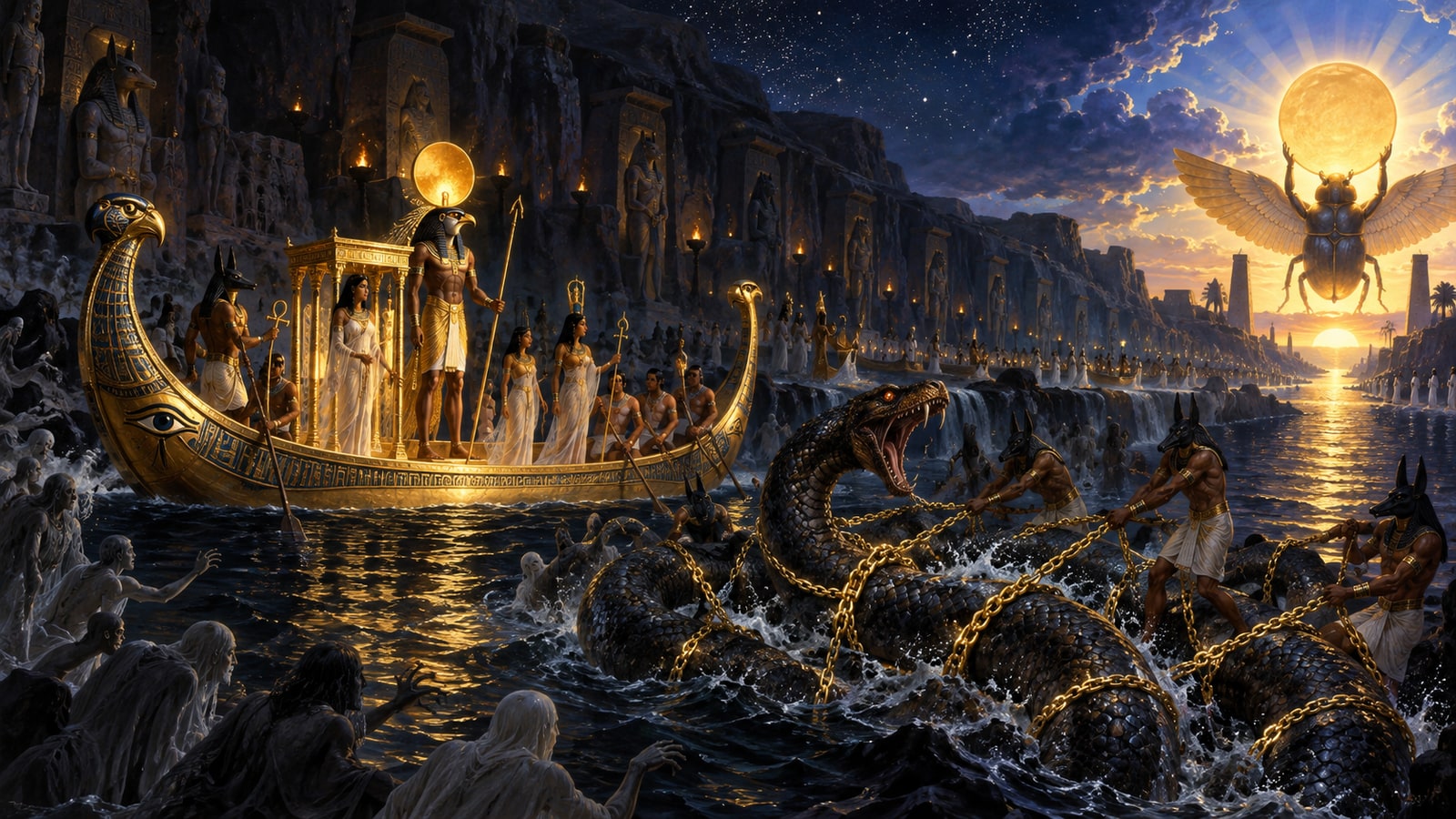
Darkness is where the sun dies, and it's where the sun is reborn. Without the night journey there'd be no morning. The Duat under Ma'at works as a womb.
Apophis lives in the same dark and belongs to a different power. The Duat is darkness bound by Ma'at: regeneration. Apophis is Izfet inside the darkness: the force that would stop the barque forever, placed by Egyptian thought outside creation, on the side of the nonexistent. The 2, set side by side, give this entire sermon in 1 image.
Heraclitus saw the same law from the Greek side:
Heraclitus, DK 22 B67 (Hippolytus, Refutatio IX.10):
«ὁ θεὸς ἡμέρη εὐφρόνη, χειμὼν θέρος, πόλεμος εἰρήνη, κόρος λιμός …»
"The God is day and night, winter and summer, war and peace, satiety and hunger …"
Day and night belong to the God as 1 continuous life. Heraclitus even rebukes Hesiod for treating them as 2: ἔστι γὰρ ἕν, "for they are 1" (B57). He calls the cosmos an ever-living fire, ἁπτόμενον μέτρα καὶ ἀποσβεννύμενον μέτρα, "kindling in measures and going out in measures" (B30). The key word is μέτρα. Light and darkness alternate by measure, and measure is Ma'at.
The Chinese tradition drew the same law as Yin and Yang: a dark half and a light half turning around each other, each carrying the seed of the other. Zevism adds 1 clarification: the circle turns because a Sovereign holds its centre. Under Zeus, Ma'at and the Divine Order, Light and Darkness operate as Yin and Yang do, each generating the other, neither destroying the other.
VI. Death, Life and Rebirth: The Cell as Witness
The doctrine can be tested in your own body.
You replace about 330 billion cells every day, according to the most careful count yet made (Sender and Milo, Nature Medicine, 2021): roughly 3.8 million every second. Old cells die, new cells are born, and stem cells stand in reserve to regenerate the tissue.
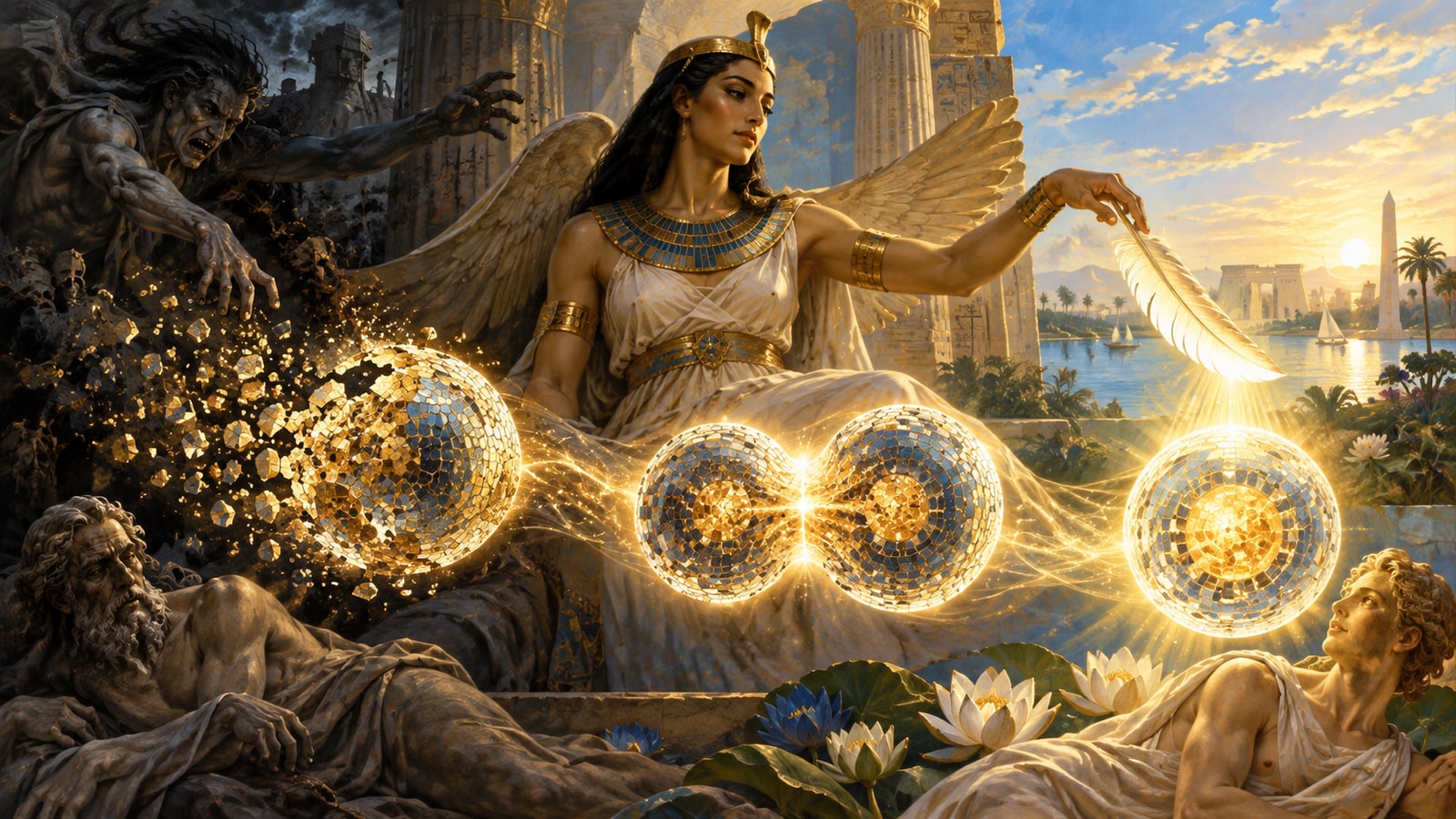
Under Ma'at the cycle produces health. Cells die on schedule through apoptosis, programmed cell death, an orderly dismantling that hands their materials back to the body without harm. New cells divide to replace them in the exact number required, and the tissue keeps its form.
Death serves life at every stage. In the womb your hands began as paddles; the cells between the fingers died on command, and the fingers appeared. In the thymus about 98% of developing immune cells die during selection, because they'd fail to recognize the body or would attack it. Darkness under Ma'at sculpts the living form.
Now remove Ma'at from the same 3 processes.
Life without measure is cancer. Hanahan and Weinberg's classic paper on the hallmarks of cancer (Cell, 2000) names 2 of its defining traits: evading apoptosis and limitless replicative potential. The cancer cell refuses to die and refuses to stop dividing. It's light without darkness, and it kills the body that feeds it.
Death without rebirth is degeneration. Cells die and nothing replaces them: tissue wastes, organs fail, the nervous system unravels. Necrosis bursts cells open and floods the tissue with inflammation. That's darkness without light, the night with no morning.
Rebirth without order is the corrupted copy: the mutation that replicates error, the immune cell that turns on the body it was born to guard.
Death, Life and Rebirth of cells under Ma'at equals Health. The same Death, Life and Rebirth under Izfet equals Destruction and Illness. The binding decides everything.
The same law holds at the scale of the whole body. A surgeon takes a scalpel and opens the body: the skin is cut, blood flows, and the patient carries a wound for weeks. The damage is real, it's temporary, and it serves Ma'at. The cut exists to remove the disease, repair the organ and restore the order of the body. It breaks in order to heal, and it destroys a little in order to create.
Now put a blade in the hand of someone who strikes another person without warrant. The same skin is cut and the same blood flows, and this time the act springs from the will to do harm. It serves Izfet: it opens the body in order to ruin it.
In both cases the body is harmed. One harm heals, and the other ruins. The wound can look identical on the day it's made. What separates them is the order each one serves.
VII. Light and Darkness Under Izfet
Izfet is the Egyptian name for the opposite of Ma'at: disorder, falsehood, injustice, violence. Where Ma'at builds, Izfet dissolves, and under it neither force is safe.
Light under Izfet is light without measure. Heraclitus drew the boundary:
Heraclitus, DK 22 B94 (Plutarch, De Exilio 11, 604A):
«ἥλιος γὰρ οὐχ ὑπερβήσεται μέτρα· εἰ δὲ μή, Ἐρινύες μιν Δίκης ἐπίκουροι ἐξευρήσουσιν.»
"For the Sun will not overstep his measures; otherwise the Erinyes, the enforcers of Justice, will hunt him down."
Even the Sun stands under Justice. Light that breaks its measure commits a crime against the cosmos. The Greeks told that crime as the story of Phaethon, who seized the chariot of Helios and drove the Sun off its course until the earth burned, and Zeus struck him down with the thunderbolt. The Sovereign restored the measure. The Egyptians told it as the rampage of the Eye of Ra: in the Book of the Heavenly Cow, Sekhmet slaughters mankind without limit until Ra floods the fields with beer dyed red with ochre and she drinks herself into stillness.
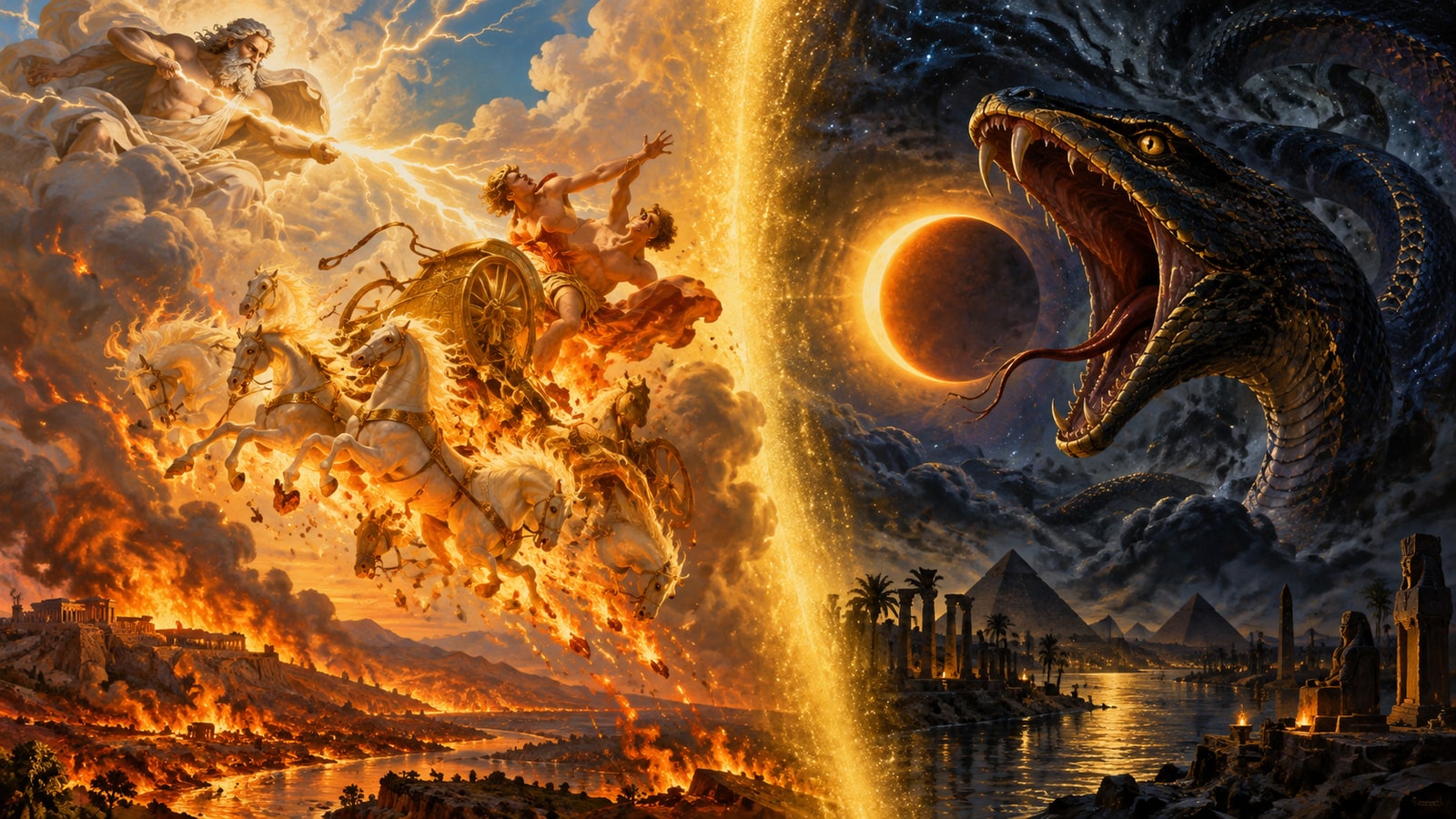
In human form, light under Izfet is the blinding certainty of the fanatic, knowledge weaponized against life, the arrogance that claims to see everything and stops looking. Ὕβρις is light that has broken its measure.
Darkness under Izfet is worse. It's dissolution: the death of all order, and therefore the end of life and existence. The dark of the womb and of the Duat carries the seeds of the next morning. The dark of Izfet carries nothing: the sun swallowed, the barque stopped forever. In the human sphere it's ignorance chosen and defended, the lamp deliberately put out.
Everything Izfet touches comes apart. Izfet is the collapse of existence.
VIII. The 2 Bindings Side by Side
Each row names a force or a process. The middle column shows it bound by Ma'at under Zeus, where it's positive. The right column shows the same force bound by Izfet, where it turns negative.
| Force | Under Ma'at: Positive | Under Izfet: Negative |
|---|---|---|
| Darkness | The womb of the cosmos: Night, mother of Day; rest, incubation and regeneration | Dissolution: the death of all order, the end of life and of existence |
| Light | Illumination in measure: knowledge, warmth, growth and vision | Fire without measure: scorching, blinding, hubris (Phaethon, the Eye of Ra unbound) |
| Unexplored Darkness | The field of future wisdom, entered with the lamp lit | The unknown feared and forbidden, or entered without light and swallowing the seeker |
| Explored Darkness | Becomes Light: knowledge and wisdom | Becomes cunning: knowledge seized and turned against life |
| Night | The Duat: the sun's regeneration and its rebirth at dawn as Khepri | Apophis: the serpent that would halt the sun and end every morning |
| Day | Work, vision and ordered action | Exposure, exhaustion and drought |
| Death | Completion and release that clear the way for renewal (apoptosis) | Annihilation with no renewal (necrosis, degeneration) |
| Life | Growth in the number and place required (ordered cell division) | Growth that refuses its measure (cancer) |
| Rebirth | Regeneration: the tissue renews itself and keeps its form | Corrupted replication: mutation, error copied forward |
| The Cycle as a Whole | Health | Destruction and Illness |
| The Wound | The surgeon's scalpel: temporary damage to the body, made to heal and to create | The unwarranted blow: the same damage, done from the will to harm and to ruin |
| The Opposites | Harmony: 2 forces turning around 1 centre, like Yin and Yang | War: each force tearing at the other until neither remains |
| Relation to Zeus | Nearness to the Sovereign and to the Divine Order | Distance from the Sovereign: the entropic fall |
| Final Direction | Continuity of life, progression and order | The destruction of all life, progression and order: the collapse of existence |
Across every row the force stays the same, and the binding decides its value.
IX. The Entropic Fall: Distance From the Sovereign
Zevist doctrine explains Izfet in terms of distance. The Sovereign holds Ma'at. Wherever the order stands near Zeus, it holds. Wherever it drifts away from him, it loosens. Distance from Zeus and from the Principle of Ma'at is the entropic fall: order decays, structure unravels, and the cosmos slides back toward unstructured chaos.
Physics describes the same slope. By the second law of thermodynamics, the entropy of an isolated system never decreases: left alone, every structure runs down. Life survives only by drawing order from beyond itself. Schrödinger put it in 1 sentence in What Is Life? (1944): "What an organism feeds upon is negative entropy." Cut the body off from its source and it starts to fall apart.
Ma'at has to be sustained continuously, by the Sovereign above and by those who serve the order below. The Egyptians repelled Apophis every night. The temples recited the Book of Overthrowing Apophis, preserved in the Papyrus Bremner-Rhind (305 BCE, British Museum), and the priests burned and trampled his image night after night, because Izfet presses on the order at every moment.
The fall moves in stages. It starts as drift, a small departure from the right. Drift becomes decay, and decay becomes dissolution, the return to unstructured chaos. Izfet doesn't stop there. Its ultimate goal is the destruction of all life, all progression and all order. Hesiod's Chaos still gave birth to Night, and Night to Day. Izfet wants nothing born at all.
Egypt located the point where Izfet enters the human world. In Coffin Texts spell 1130 the Creator speaks: "I made every man like his fellow. I did not command that they do wrong. It is their hearts that disobey what I have said." Izfet enters through the heart that departs from the Word, and every human act of Izfet repeats the fall on a small scale.
Egypt also preserved the promise of restoration. The Prophecy of Neferti describes a land fallen into Izfet, then announces the king who'll restore the order:
The Prophecy of Neferti 68-69 (ed. Helck):
«iw mȝʿt r iit r st.s, isft dr.ti r rwty.»
"Ma'at will come back to her seat, and Isfet is driven outside."
The means of restoration never change: return to the Sovereign, restore the measure, and set each thing back in its place.
X. Closing: Into the Night With the Lamp
Light and Darkness will surround you for the whole of your life, down to the billions of cells that die and are reborn in you every day. The Zevist's task is to keep that wheel in order.
Hold the doctrine in its compact form. Under Zeus, Ma'at and the Divine Order, Light and Darkness turn together like Yin and Yang and produce life, knowledge and renewal. Under Izfet both break loose: light burns without measure, darkness dissolves everything it touches, and existence begins to collapse.
The duties follow directly:
- Enter the unexplored darkness. Don't fear the unknown or brand it as evil. Every piece of wisdom you'll ever possess waits there until you go in after it.
- Carry the light when you go in. Take reason, discipline, the teachings of the ancients and the practice of meditation with you. Darkness entered with light becomes knowledge; darkness entered without it swallows the seeker.
- Keep your own light in measure. Knowledge that breaks its measure turns into hubris, and Zeus struck Phaethon from the chariot for exactly that crime.
- Refuse Izfet in every form. The lie, the injustice, the chosen ignorance and the slow drift from the right are 1 fall at different speeds. Stop it where it starts.
- Stay near the Sovereign. The order holds wherever it stands close to Zeus, and every act of worship, study and justice closes the distance.
The sun enters the Duat every evening and rises reborn every morning, because the order holds. Walk the same road. Go down into the dark with the lamp lit, bind what waits there, and come back up at dawn carrying more light than you took down.
ZEFS AENAOS.
High Priest Zevios Metathronos
Temple of Zeus Foundation