 አማርኛ
አማርኛ العربية
 বাংলা
বাংলা Български
 中文
中文 Čeština
 Dansk
Dansk Deutsch
 Eesti
Eesti Ελληνικά
 Español
 Français
 हिन्दी
 Hrvatski
 IsiZulu
 Italiano
 日本語
日本語 Kiswahili
 Magyar
 Македонски
 नेपाली
 Nederlands
 فارسی
فارسی Polski
 Português
 Română
 Русский
 Slovenščina
 Suomi
Suomi Svenska
 Tagalog
 Türkçe
Existence, Cosmology and Ethics · The Ten Antithetical Powers · Power II
Limit and Unlimited
Πέρας καὶ Ἄπειρον
author: High Priest Zevios Metathronos
To the family of Zevists. A working teaching, grounded in Philolaus and the Pythagorean table of opposites, in Plato's Philebus and Laws, in Anaximander, Hesiod and the maxims of Delphi, and in the Egyptian witness of Nun and the measured flood of the Nile. This is the second of the Ten Antithetical Powers, and it follows Light and Darkness. It sets out 3 things: that everything that exists is fitted together from Limit and the Unlimited, and that neither of them is evil; that under Ma'at, held by Zeus, Limit acts as a shore and the Unlimited as living supply, while under Izfet Limit hardens into a mold and the Unlimited runs into formless dissolution; and that the Zevist who masters this Power learns the measure by which a human being is shaped toward the Gods.
I. Opening: The Second Power
Light and Darkness opened this series, and it laid down the law that governs all 10 Powers. Unexplored darkness is the ground you walk into carrying light, and explored darkness becomes Light: knowledge and wisdom. Bound by Ma'at, the structured Order of Cosmic Existence that Zeus holds as Sovereign of the Cosmos, the 2 forces work together like the death and renewal of cells in a healthy body. Bound by Izfet, the same 2 forces turn into destruction and disease. Izfet is dissolution: the collapse of existence and the entropic fall back into unstructured chaos.
Every Power in this series obeys that law. Each Power is a pair, and neither member of the pair is evil. Ma'at holds them in measure, and they build life. Izfet breaks the measure in 2 ways: one member seizes sole rule, or the pair is torn apart. Both roads end in the same place.
Limit and the Unlimited stand at the root of all the others. When the Pythagoreans drew up their table of 10 opposites, πέρας and ἄπειρον came first, and φῶς and σκότος came 8th (Aristotle, Metaphysics A.5, 986a22-26). Before anything can be light or dark, one or many, hot or cold, it has to be something: a content held inside a boundary. That's this Power.
II. The Ancient Witnesses
Philolaus of Croton, named by ancient tradition as the first Pythagorean to publish a book On Nature, opened it with the claim this whole teaching rests on:
Philolaus, DK 44 B1 (Diogenes Laertius VIII.85)
«ἁ φύσις δ’ ἐν τῷ κόσμῳ ἁρμόχθη ἐξ ἀπείρων τε καὶ περαινόντων, καὶ ὅλος ὁ κόσμος καὶ τὰ ἐν αὐτῷ πάντα.»
"Nature in the cosmos was fitted together out of unlimited things and limiting things, both the cosmos as a whole and everything in it."
Look at the verb. ἁρμόχθη means "was fitted together," and it comes from the same root as ἁρμονία. The 2 are joined, and the joining is a harmony. Philolaus says so outright: since the first principles were unlike and not of one kind, they could never have been set in order had a harmony not come upon them (DK 44 B6).
Plato took this up and made it the key to the Philebus. Socrates calls it a gift from the Gods, thrown down to men by a Prometheus together with a blazing fire:
Plato, Philebus 16c
«ὡς ἐξ ἑνὸς μὲν καὶ πολλῶν ὄντων τῶν ἀεὶ λεγομένων εἶναι, πέρας δὲ καὶ ἀπειρίαν ἐν αὑτοῖς σύμφυτον ἐχόντων.»
"...that the things said at any time to be are made of one and many, and hold limit and unlimitedness grown together inside them."
The key word is σύμφυτον: inborn, grown together. Limit and the Unlimited grow up side by side inside the nature of the thing. Then Plato names what their right joining produces:
Plato, Philebus 25e-26b
«ἆρα οὐκ ἐν μὲν νόσοις ἡ τούτων ὀρθὴ κοινωνία τὴν ὑγιείας φύσιν ἐγέννησεν; ... οὐκοῦν ἐκ τούτων ὧραί τε καὶ ὅσα καλὰ πάντα ἡμῖν γέγονε, τῶν τε ἀπείρων καὶ τῶν πέρας ἐχόντων συμμειχθέντων;»
"In sickness, doesn't the right partnership of these beget the nature of health? ... And from these the seasons and all things beautiful have come to be for us, the unlimited and the things that have limit mixed together?"
Between those 2 sentences Plato adds music: high and low, fast and slow, are unlimited in themselves, and a limit entering them produces "all music" (Philebus 26a). Health, music, the seasons and beauty: everything a human being loves is Limit and the Unlimited in right partnership. Plato also says who sets the limit when it's missing:
Plato, Philebus 26b
«ὕβριν γάρ που καὶ σύμπασαν πάντων πονηρίαν αὕτη κατιδοῦσα ἡ θεός, ὦ καλὲ Φίληβε, πέρας οὔτε ἡδονῶν οὐδὲν οὔτε πλησμονῶν ἐνὸν ἐν αὐτοῖς, νόμον καὶ τάξιν πέρας ἔχοντ’ ἔθετο.»
"For this goddess, fair Philebus, seeing wanton excess and all the wickedness of all things, since there was no limit in them of pleasures or of surfeits, established law and order, which have limit."
Wickedness is defined here as limitlessness, and the cure comes from the divine: law and order that have limit. The Greeks never needed a tablet of prohibitions to learn this. They carved 2 sayings on Apollo's temple at Delphi, γνῶθι σαυτόν and μηδὲν ἄγαν, "Know yourself" and "Nothing in excess" (Plato, Protagoras 343b). Hesiod had already given the farmer the rule of his whole life:
Hesiod, Works and Days 694
«μέτρα φυλάσσεσθαι· καιρὸς δ’ ἐπὶ πᾶσιν ἄριστος.»
"Keep to measures; right proportion is best in all things."
Anaximander, the first to name the ἄπειρον as the source of all things, adds the warning. Things that overstep their bounds "pay penalty and retribution to one another for their injustice according to the ordering of time" (DK 12 B1). To break a limit is ἀδικία, injustice, and the cosmos collects the debt.
III. The Egyptian Witness: Nun, the Mound and the Flood
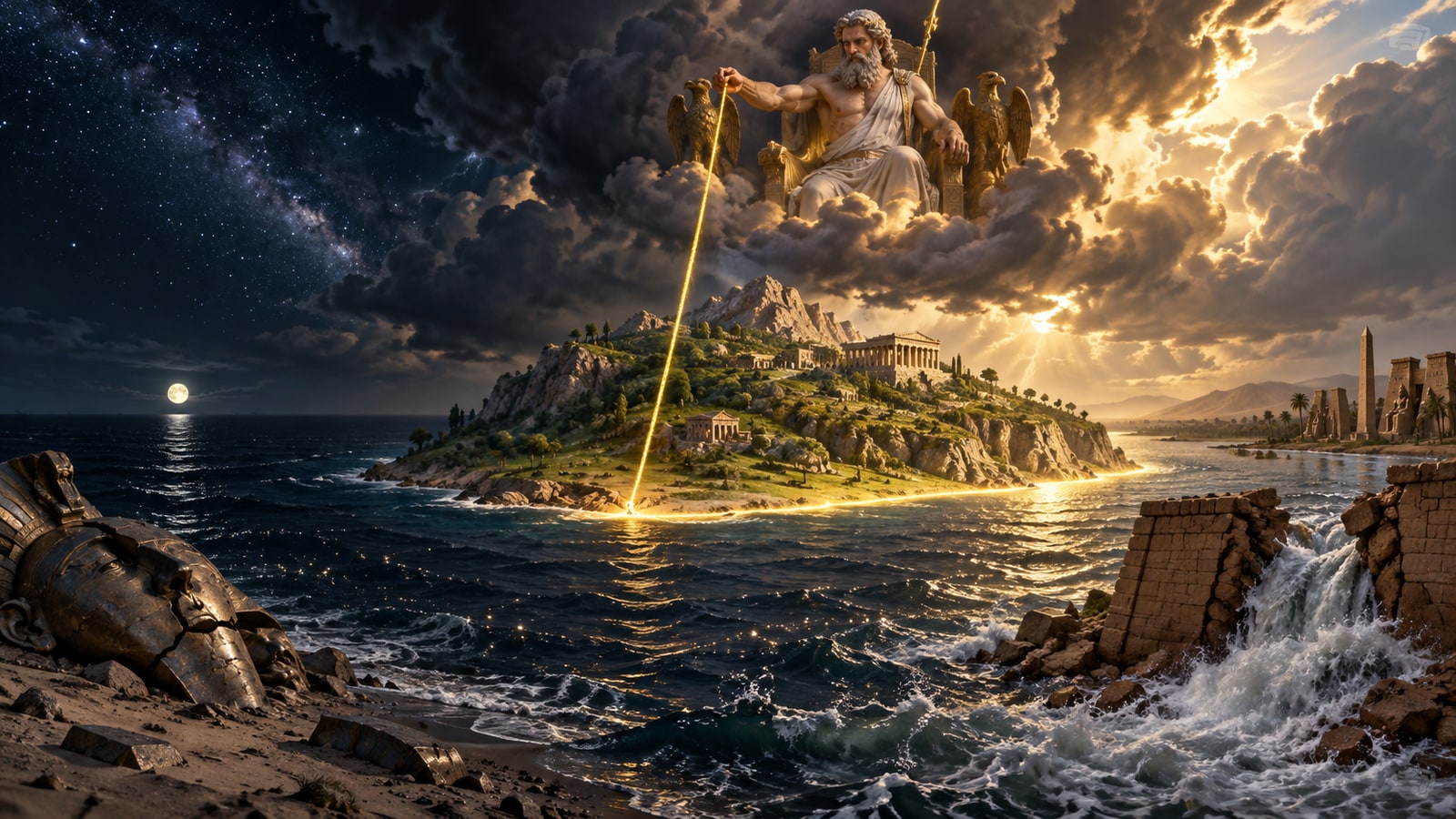
Egypt taught the same truth in her own images. Before creation there was Nun, the boundless dark water, and the Pyramid Texts place the king's birth "in Nun, before the sky existed, before the earth existed" (Utterance 486, §1040). Creation began when the first mound rose out of Nun: ground with an edge. Nun remained around the mound, and it still surrounds the ordered world. Egypt held that the flood of the Nile wells up from it.
That flood is the clearest lesson in this Power ever written down. Egypt measured it with nilometers, and Pliny preserves the scale:
Pliny, Natural History V.57-58
«Iustum incrementum est cubitorum XVI. minores aquae non omnia rigant, ampliores detinent tardius recedendo. ... in XII cubitis famem sentit, in XIII etiamnum esurit, XIIII cubita hilaritatem adferunt, XV securitatem, XVI delicias.»
"The right rise is 16 cubits. Smaller floods don't water everything; larger ones hold the land back by receding too slowly. ... At 12 cubits the province feels famine, at 13 it still goes hungry, 14 cubits bring cheer, 15 security, 16 delight."
Read it as doctrine. Water is the Unlimited, the living supply. The cubit mark is the Limit. At 16 cubits supply and measure meet, and Egypt feasts. With too little water, the Limit encloses a dry and starving land. With too much, water drowns the fields and the season of sowing is lost. The same river gives life or death, and the only difference is measure. The Romans carved the Nile as a reclining god with 16 children climbing over him, one for each cubit of the perfect flood.
That measure has a name: Ma'at. On the scales of judgment the heart is weighed against her feather, and it must balance.
IV. Limit and Unlimited Under Ma'at
Under Ma'at, Limit is a shore and the Unlimited is the sea that meets it.
The Temple teaches the difference between a shore and a mold. A shore is a genuine limit. It follows the nature of the water, lets the tide come and go, and gives the sea a coast where life gathers. A mold is an imposed constraint. It's forced onto a nature from outside, it can't breathe, and whatever is poured into it takes the mold's shape and hardens there. Ma'at's limits are shores. Plato says the God "proceeds straight on his course according to nature," κατὰ φύσιν (Laws IV, 716a). A limit that comes from Zeus fits the thing it bounds.
- The living cell. Every cell in your body is a sea inside a shore. The membrane lets nourishment in and waste out; it holds the cell without sealing it. Inside, metabolism runs day and night. Shore and flow together make a life.
- Music. The Pythagoreans found the octave in the ratio 2:1. Sound is unlimited; the ratio is its shore, and the shore makes a scale.
- The trained body. Strength is the supply. Load, rest and sleep are the shore. Held inside that shore, strength grows every season.
- Coinage and trade. Money needs a limit on issue so it keeps its value, and a flow of exchange so it lives. Both together make a market.
- The Temple itself. Ranks, vows and rites are shores around the unlimited force of devotion. They give devotion a coast to build on.
The pattern of the first Power repeats here. The Unlimited is like unexplored darkness: raw, potent, not yet known. Limit is the light you carry into it. Every time you give the Unlimited a true shape, you turn potential into existence, the way explored darkness turns into Light.
V. Limit and Unlimited Under Izfet
Izfet attacks this Power from both sides.
The first face: Limit alone. The shore hardens into a mold. Form survives, and life drains out of it. The body shows this as fibrosis: scar tissue invades an organ, stiffens it and replaces working tissue with a rigid wall. The city shows it as law multiplied past reason, where every act needs a permit and nothing grows. Religion shows it as a code of hundreds of prohibitions telling a man what he may not touch, eat or wear from waking to sleep. The 613 commandments of the Yehuborist code are a mold. The 2 sayings at Delphi are a shore.
The second face: the Unlimited alone. The sea breaks the shore. Form dissolves. The body shows this as cancer: a cell escapes the signals that tell it to stop dividing and grows without limit until it kills the body that feeds it. The soul shows it as ὕβρις, appetite without end, the "wanton excess and all the wickedness" of Philebus 26b. The economy shows it as money printed without limit until it buys nothing.
Both faces kill the thing they seize. The mold kills by suffocation and the flood by drowning. That's Izfet: the fall back into unstructured chaos, reached from 2 directions.
The Power at a Glance
| Domain | Under Ma'at | Izfet: Limit Alone (the Mold) | Izfet: the Unlimited Alone (the Flood) |
|---|---|---|---|
| Cosmos | The risen mound, Nun around it | Frozen form, nothing moves | Return to the formless waters |
| River | The flood at 16 cubits: plenty | 12 cubits: famine | Water that won't recede: the sowing season lost |
| Body | Membrane and metabolism | Fibrosis, the scarred organ | Cancer, growth without limit |
| Sound | The tuned string: music | A string clamped dead: silence | Noise |
| Soul | Desire given measure | Rigidity, fear, the frozen will | ὕβρις, appetite without end |
| City | Law with limit, κατὰ φύσιν | The mold of multiplied prohibitions | Anarchy and the tyrant's appetite |
VI. The Argument
| Step | Statement | Witness |
|---|---|---|
| Observation | Everything that exists has a content and a boundary: a cell, a note, a river, a city, a man. | Philolaus B1 |
| First test | Take the Limit away and the content spills into formlessness: the flood, the cancer, the tyrant. | Pliny V.57-58; Philebus 26b |
| Second test | Take the Unlimited away and the Limit encloses nothing: the dry field, the scar, the dead code. | Pliny V.57-58 |
| Third test | Give the 2 their right measure, and health, music, seasons and beauty appear. | Philebus 25e-26b |
| Conclusion | Neither Limit nor the Unlimited is evil. Evil is the breaking of their measure, which is Izfet. The measure is Ma'at, and Zeus holds it. | Laws IV, 716c |
The argument holds from every side. Call the Unlimited evil and you condemn the Nile, the blood in your veins and the raw capacity of your own mind. Call Limit evil and you condemn your own skin, the banks of every river and the ratio that makes an octave. One position survives: the pair is good, and the break is the enemy.
Objections Answered
- "The Pythagoreans put the Unlimited in the column of evil." They set it beside darkness and plurality, under κακόν. Yet Philolaus, their own spokesman, said nature is fitted together from both, and a column can't be evil when nothing exists without it. The Pythagoreans saw a real danger, the Unlimited unbound, and filed it under the wrong heading. That danger is Izfet. Light and Darkness made the same correction for σκότος, and this Power makes it for ἄπειρον.
- "Limits are oppression. Freedom means having none." A river without banks turns into a swamp and then a desert. A man without limits becomes the slave of whatever appetite runs strongest in him, the ὕβρις of Philebus 26b. Freedom lives inside a shore. Power VII, Necessity and Freedom, carries this through.
- "Then more rules are always better." That road leads straight to the mold. A limit forced against a nature kills it, and a code that multiplies prohibitions breeds obedient corpses. The test of any limit is whether it's κατὰ φύσιν: whether it lets the thing it bounds live and grow. The shore passes that test, and the mold fails it.
VII. The Premise and Purpose in Zevism
Zevism exists for one aim: ὁμοίωσις θεῷ κατὰ τὸ δυνατόν, becoming as the Gods, as far as possible (Theaetetus 176b), which the Temple reads as the literal transmutation of human essence into divine essence. Look closely at Plato's formula and you'll find this Power inside it. ὁμοίωσις θεῷ is the unlimited aim: nothing less than the divine. κατὰ τὸ δυνατόν is the limit: the measure of your present capacity. An aim with no measure is fantasy and ends in collapse. A measure with no aim is a mold and ends in stagnation. Held together, they make a path you can walk, and the limit moves up every time your capacity grows.
The source matters here. Zevism looks to the past because one must stand at the source, and at the source the Greeks gave the soul a shore: measure, fitness and harmony.
| Dimension of the Zevist Path | What Limit and Unlimited Train |
|---|---|
| Meditation (δυνατόν, capacity of power) | The mind's content is unlimited; attention is its shore. Meditation draws that shore around the flood of thought, so capacity grows without spilling. |
| Ethics (Φρόνησις and Justice) | Φρόνησις finds the measure in each act. Justice gives each thing its due limit, no more and no less. |
| Existential (a life in service of ὁμοίωσις θεῷ) | A life with a shape: vows, rank and work arranged to serve growth instead of freezing it. |
| Theurgy (Σοφία, Θεουργία) | "God would be for us the measure of all things" (Laws IV, 716c). The theurgist takes the divine measure as his own and grows toward the measure itself. |
The Ethic of Limit and Unlimited
- Draw your shores. Set limits that fit your nature and your aim: hours of work, hours of rest, what you eat, what you let into your mind. A shore gives your force a coast to build on. Without one, your energy floods out and waters nothing.
- Break your molds. Find the limits you carry that were forced on you against your nature: inherited fears, borrowed guilt, prohibitions that serve someone else's control. Test each one by asking whether it lets you grow. A limit that blocks your growth is a mold, and it has to go.
- Keep the supply alive. Don't let discipline dry you out. Keep drinking from the Unlimited: learning, beauty, devotion and the force of your own ambition. A shore with no sea behind it is a desert.
- Measure your appetites. Every appetite is unlimited by nature. Give each one its 16 cubits: enough to feast, never so much that the season of sowing is lost.
- Take the measure from above. Human measures drift; the divine measure holds. When you're unsure where a limit belongs, ask what a God would do, and set your shore there.
VIII. Correlation and Closing
Limit and Unlimited stands in the second row of the tetractys beside The One and the Many. Together they're the 2 principles of Existence, and the cosmic and human Powers unfold from them. This Power returns in every later one. Fire is "kindled in measures and quenched in measures" (Heraclitus B30), which is Power V. Pleasure receives its limit from the goddess of Philebus 26b, which is Power IX. Necessity is the limit inside which freedom works, which is Power VII.
| Power | Pair | Row of the Tetractys |
|---|---|---|
| I | Light and Darkness | Apex |
| II | Limit and Unlimited | Existence |
| III | The One and the Many | Existence |
| IV | Love and Strife | Cosmology |
| V | Fire and Water | Cosmology |
| VI | Time and Eternity | Cosmology |
| VII | Necessity and Freedom | Ethics |
| VIII | Memory and Forgetting | Ethics |
| IX | Pleasure and Pain | Ethics |
| X | Ascent and Descent | Ethics |
Plato, Laws IV, 716c
«ὁ δὴ θεὸς ἡμῖν πάντων χρημάτων μέτρον ἂν εἴη μάλιστα, καὶ πολὺ μᾶλλον ἤ πού τις, ὥς φασιν, ἄνθρωπος.»
"God would be for us the measure of all things, in the highest degree, and far more than any man, as they say."
The God is the measure, far above any man. Draw your shores by His measure, keep the sea alive behind them, and break every mold that stands between you and what you're meant to become.
ZEFS AENAOS.
High Priest Zevios Metathronos
Temple of Zeus Foundation