 አማርኛ
አማርኛ العربية
 বাংলা
বাংলা Български
 中文
中文 Čeština
 Dansk
Dansk Deutsch
 Eesti
Eesti Ελληνικά
 Español
 Français
 हिन्दी
 Hrvatski
 IsiZulu
 Italiano
 日本語
日本語 Kiswahili
 Magyar
 Македонски
 नेपाली
 Nederlands
 فارسی
فارسی Polski
 Português
 Română
 Русский
 Slovenščina
 Suomi
Suomi Svenska
 Tagalog
 Türkçe
Three colors of the inner work
The Temple of Zeus assigns black to Ida, red to Pingala, and white to Sushumna. These three nadis belong to the soul's ordered spiritual structure. Their powers enter harmony through the inward work, and their colors give the mind a clear means of distinguishing the currents while contemplating their unity. [1]
The colors also reveal transformation as a process. Black gathers attention inward; white signifies clarification and balanced presence; red conveys an awakened fullness of life. Their spiritual force becomes clear through the relationship between the stages. Each operation prepares a capacity that the complete soul will require.
The threefold circulation of the soul
The black, red, and white channels describe an inward relationship. Ida expresses the receptive pole: the capacity to gather, contain, and receive the subtle impressions of spiritual life. Pingala expresses the active pole: the capacity to direct, kindle, and carry intention into expression. Sushumna signifies the central path within which these powers acquire a common ascent. The Temple assigns their colors explicitly: black, red, and white respectively. [1][4]
The center is the principle of their accord. When receptivity is cultivated, will has something meaningful to direct. When will is cultivated, the receptive depths acquire protection and continuity. The white channel signifies the soul's capacity to hold both operations within one work. Its whiteness belongs to integration and clarity: differentiated powers can contribute to a luminous whole without losing their character.
The serpent gives the threefold image its transformative movement. In Zevist teaching, Kundalini is the latent spiritual force whose ascent opens greater awareness and the soul's hidden abilities. The channels belong to the preparation of that ascent. Their harmony expresses a soul becoming capable of bearing illumination throughout its structure, under the guidance of the Gods. [5]
The inner alchemy of depth, purity, and fire
Black teaches the practitioner how to enter depth. It gathers attention away from scattered surfaces and gives space for what must be understood before change becomes possible. The Temple associates black with containment, patience, self-control, and the beginnings of alchemical transformation. In this work, darkness is the chamber in which an immature form can be examined and remade. [6]
White teaches clarification. The practitioner brings a purpose into view, distinguishes it from competing impulses, and learns to preserve an undivided relation to it. Red teaches the strength by which this clarified purpose becomes living expression. It supplies determination and warmth to a work that would otherwise remain an inward possibility. Contemplating the three colors in relation helps the soul recognize which operation a particular moment requires.
Do not turn the sequence into a demand for sudden intensity. The Temple's account of Kundalini emphasizes gradual preparation and consistency. The alchemical rhythm is patient: gather what has been dispersed, clarify what has been gathered, and embody what has become clear. Through this rhythm the colors describe a disciplined spiritual life, in which the receptive and active powers become companions in the ascent toward the Godhead. [5]
Distinguishing a current from a stage of the work
The three nadis and the alchemical sequence answer different questions within contemplation. The channel colors identify receptive, active, and central powers. The sequence describes operations undertaken in transformation. One concerns the relationship of the soul's currents; the other concerns what the practitioner is presently doing with the material of experience. Keeping these functions clear makes the three colors more useful. [1]
Consider a difficult matter brought into meditation. It may require the receptive patience associated with black before its significance can be understood. It may then require clarification, expressed through white, and finally the determined action associated with red. The whole soul participates throughout. The practitioner need not imagine that one channel has become the entire person during one phase. The colors help identify the task, and the nadis help recall the powers that cooperate in carrying it out. This distinction gives the inner alchemy both a stable structure and a flexible application to the actual conditions of life.
Egyptian and alchemical evidence
In ancient Egypt, black was associated with the fertile land of the Nile. The Australian Museum explains the connection between black pigment, the name Kemet or black land, and the dark soil nourished by the river. This is a documented historical example of black carrying a positive association with the renewal of life. [2]
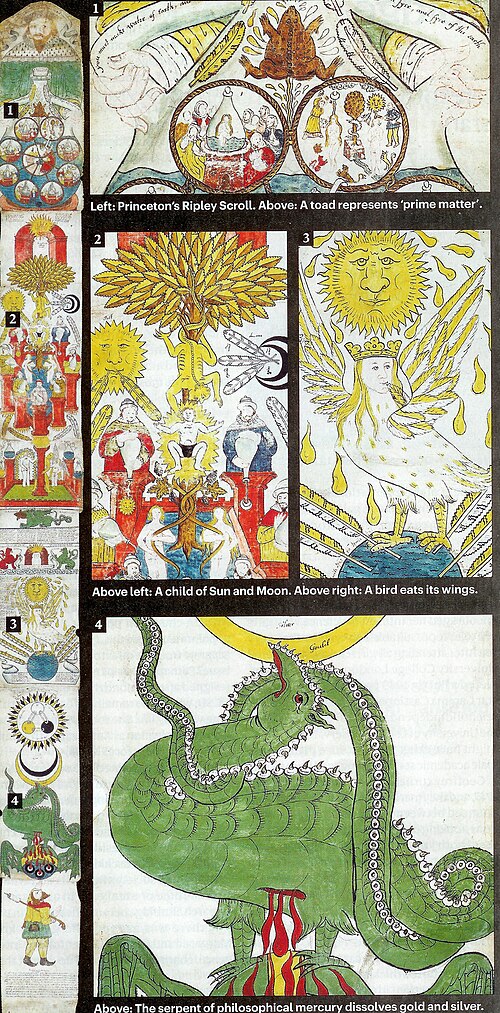
Black, white, and red also have a documented place in European alchemical imagery. The Fitzwilliam Museum's account of its early sixteenth-century Ripley Scroll identifies the original white paper, black ink, and red vermilion with a sequence of transformation, from base metal through silver to gold. The illustrated tradition is medieval and early modern. Its surviving documents should be dated accordingly, even when a contemporary religion interprets their imagery through a wider account of spiritual alchemy. [3]