
 አማርኛ
አማርኛ العربية
 বাংলা
বাংলা Български
 中文
中文 Čeština
 Dansk
Dansk Deutsch
 Eesti
Eesti Ελληνικά
 Español
 Français
 हिन्दी
 Hrvatski
 IsiZulu
 Italiano
 日本語
日本語 Kiswahili
 Magyar
 Македонски
 नेपाली
 Nederlands
 فارسی
فارسی Polski
 Português
 Română
 Русский
 Slovenščina
 Suomi
Suomi Svenska
 Tagalog
 Türkçe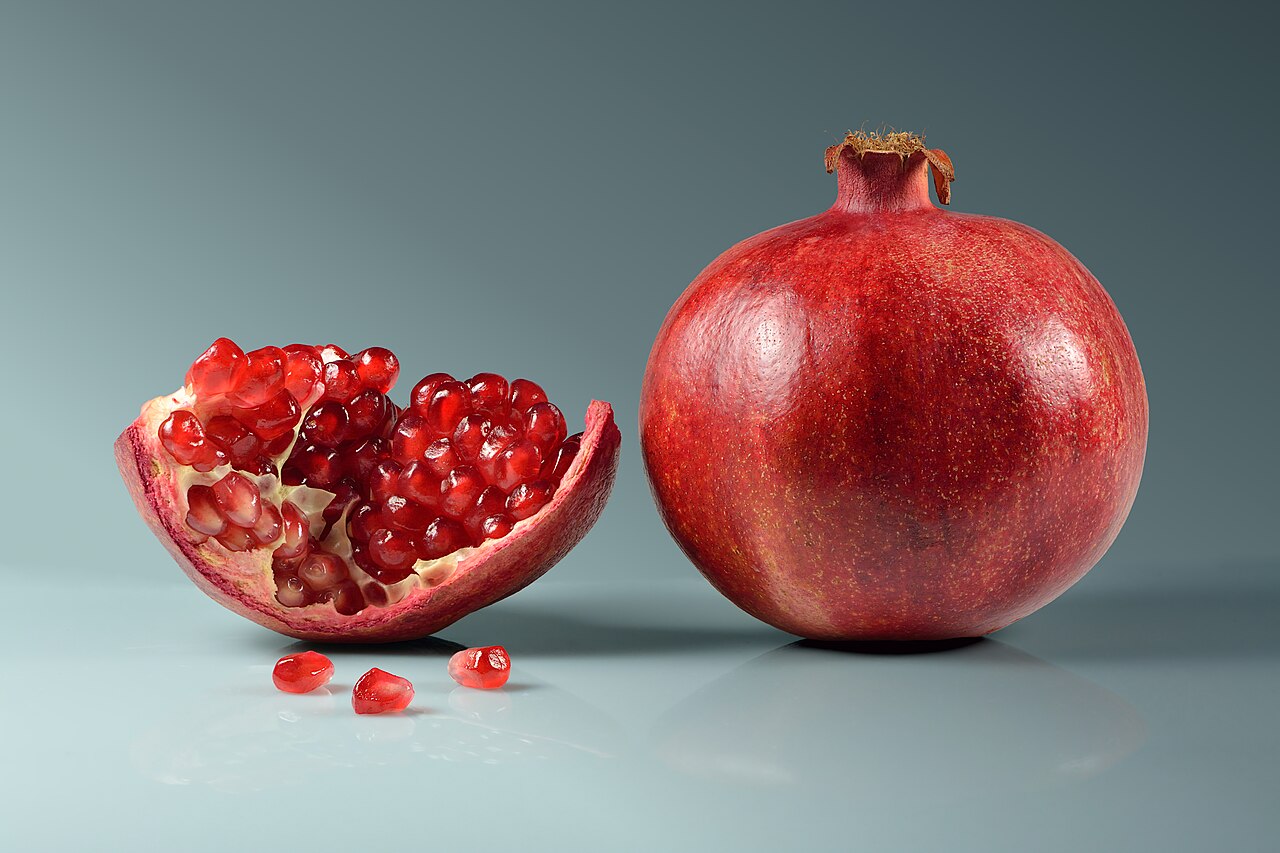


The queen's sealed treasury
The pomegranate is a fitting vessel for the power of Persephone. Its firm outer form encloses a multitude of shining seeds, each held within the same living whole. To the Zevist worshipper, it reveals the soul as a treasury: outwardly one being, inwardly rich with faculties awaiting their season of awakening. The fruit's depth of colour and concealed abundance express the mystery of a life whose true wealth exceeds its visible surface.
Persephone's sovereignty reaches into what is hidden. Her symbol invites the seeker to approach inward depth with reverence and resolve. The underworld of the myth becomes, within this spiritual exposition, a sacred image for the concealed regions of the soul, where powers may remain unrecognized until they are brought into conscious relationship with the Gods. Her pomegranate speaks of an abundance that is preserved in darkness and revealed through opening.
Seeds of power within the soul
The Temple teaches that the soul possesses distinct centres of energy, each with its own functions and powers. The gathered seeds can be contemplated as an image of these differentiated capacities within a single spiritual life. The correspondence concerns the fruit's unity and multiplicity; its many seeds need no fixed numerical assignment. Each glistening chamber suggests a power capable of receiving light and contributing to the radiance of the whole. [1]
The rind expresses the containing boundary of the aura. Spiritual growth requires both an increasing interior richness and a coherent form through which that richness can be held. The opened fruit reveals what the closed fruit protects. In the same way, a soul developing through meditation learns when to gather its power, when to reveal its understanding and how to act from an inward abundance that has become its own.
The ancient seed and the division of the year
In the Homeric Hymn to Demeter, the pomegranate seed binds Persephone to a recurring stay with Hades. The settlement gives Her one third of the year below and two thirds with Her mother and the other immortals. This particular account supplies neither a rule of six seeds nor an equal division into six months. Its own proportions deserve to be preserved. [2]
The return of Persephone also appears in ancient art. On the Metropolitan Museum's bell-krater of about 440 BCE, She rises from the earth while Hermes and torch-bearing Hecate accompany Her and Demeter awaits Her. The image makes the movement between realms visible. The fruit and the return scene belong to the same sacred story, each revealing a different aspect of Persephone's enduring bond with the depths. [3]
Descent, transformation and return
In a Zevist mystical reading, descent signifies the gathering of consciousness into the roots of one's own being. The seeker encounters the sources of desire, the powers held beneath habitual awareness and the sacred life waiting to be cultivated there. Persephone's descent gives this inward movement a royal form. The hidden realm is approached as a domain to be understood and ordered through Divine relationship.
Her return expresses the ascent of what has been transformed. The Temple's teaching on Kundalini describes spiritual development as the awakening and elevation of power through the soul's centres. Within this symbolic correspondence, Persephone's movement links depth to radiance: the energy gathered below becomes capable of participating in a higher life. The pomegranate is the seal of continuity between the two conditions. What has been learned in depth accompanies the soul into the light. [4]
The fruit as an image of sacred ripening
The seeds also express patience in theurgy. Every spiritual faculty has a period of formation, and a rich inner life cannot be reduced to the demand for immediate signs. The pomegranate ripens by gathering what sustains it into a coherent fullness. So the worshipper cultivates devotion, study and regular meditation until insight becomes a stable possession. Ripeness is the power to give forth what has truly developed.
In contemplation, behold the closed fruit as the soul's protected treasury, then its opened interior as a revelation of living light. Offer Persephone the wish that the powers concealed within may ripen in harmony with the Divine order. Her pomegranate teaches a sovereignty founded upon inward wealth: the soul learns to enter its depths, preserve what is precious and return with a greater capacity for life.