
 አማርኛ
አማርኛ العربية
 বাংলা
বাংলা Български
 中文
中文 Čeština
 Dansk
Dansk Deutsch
 Eesti
Eesti Ελληνικά
 Español
 Français
 हिन्दी
 Hrvatski
 IsiZulu
 Italiano
 日本語
日本語 Kiswahili
 Magyar
 Македонски
 नेपाली
 Nederlands
 فارسی
فارسی Polski
 Português
 Română
 Русский
 Slovenščina
 Suomi
Suomi Svenska
 Tagalog
 Türkçe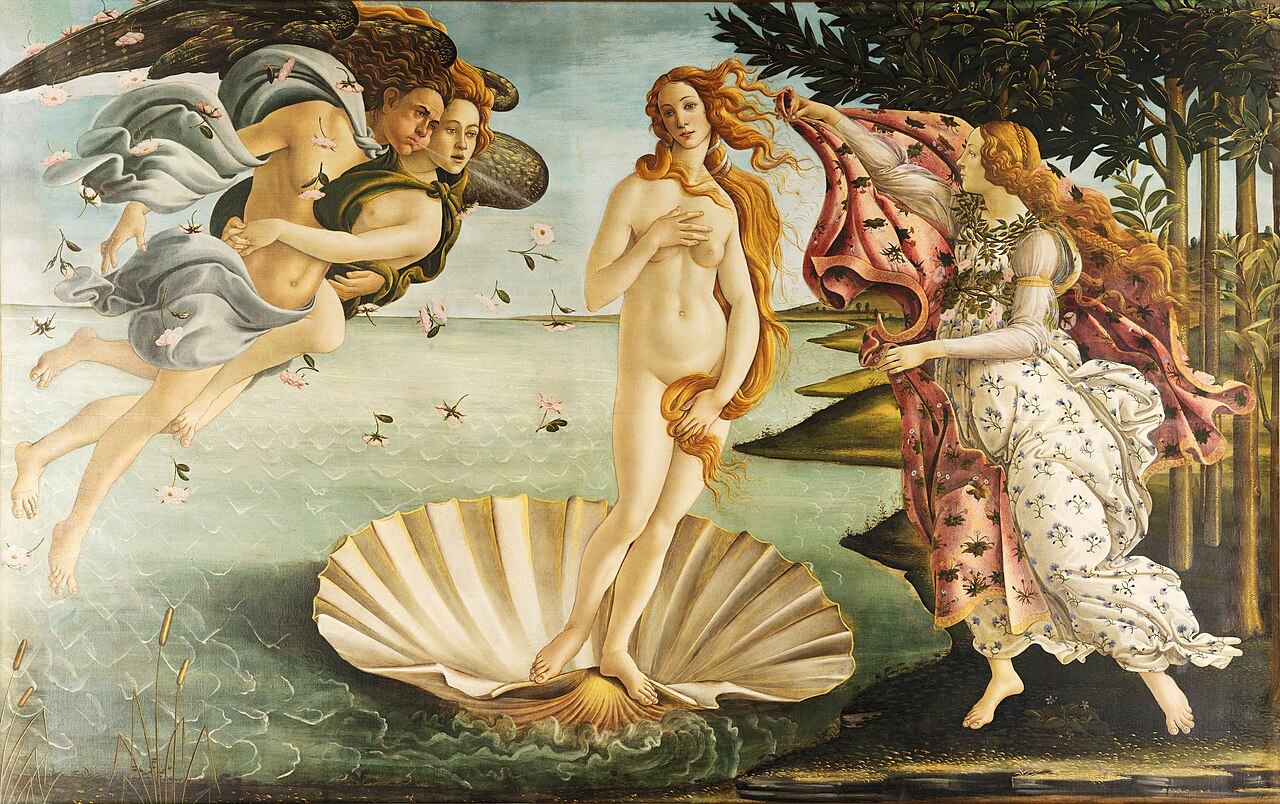


The Goddess and the sea
The shell of Aphrodite is a sacred vessel of manifestation. It presents the generative depths of life opening to reveal the Goddess in beauty, and it calls the Zevist devotee to awaken the powers through which divine influence takes form within the soul. Its luminous interior signifies receptivity; its widening mouth signifies the release of living power. Aphrodite’s emergence becomes an image of spiritual birth, in which concealed vitality rises into consciousness and the heart receives the presence of the Goddess. [3][4]
Hesiod describes Aphrodite’s generation in sea foam and Her approach first to Cythera and then Cyprus. Grass grows beneath Her feet, and Eros and Himeros accompany Her. The passage grounds the Goddess’s relation to the sea and to desire; it does not describe a shell carrying Her. That celebrated visual form belongs to the artistic history through which Her maritime character received further expression. [1]
The shell as a vessel of the soul
The Temple describes the chakras as energetic centres shaped like spinning cups, each receiving and holding spiritual power. The open shell gives this teaching an immediately visible form. Its hollow is a place of gathering; its breadth permits an unfolding; its rim gives the gathered power a definite shape. Through this correspondence, the shell can be contemplated as an image of the soul prepared to receive divine energy and express it according to a beautiful order. [4]
Aphrodite’s relation to the heart gives the vessel a particular centre. The heart chakra joins the powers of life through attraction and harmony, while the generative energy of the soul supplies the force of renewal. The shell brings reception and birth into one image: what the soul receives through devotion becomes material for inner alchemy. Feeling grows luminous, desire gains a sacred direction, and the presence of the Goddess becomes an influence within the devotee’s spiritual life. [3]
The pale radiance of the shell also calls to mind the Temple’s white and silver correspondences with the Third Eye and psychic receptivity. The Goddess’s arrival from the deep can thus be contemplated as the disclosure of a power that ordinary awareness had not yet perceived. In theurgy, the visible image gathers the devotee’s attention toward this divine presence. The shell opens, the inner faculties awaken, and beauty announces that spiritual life has begun to reveal itself in form. [5]
Botticelli’s great image
Botticelli’s Birth of Venus, painted about 1485, gives the shell its most familiar majestic presentation. The Uffizi explains that the scene shows the Goddess arriving on Cyprus, carried toward shore upon a great scallop shell. Winds blow from the left, and a female figure waits to receive Her with a flowered garment. The open shell supports the composition’s central presence and carries the eye toward Her. [2]
This Renaissance work offers a complete and beautiful image for the page. Its historical place strengthens the reader’s understanding: an ancient account of divine emergence inspired later artists to create new forms of visibility. Zevist contemplation can receive the painting’s beauty while recognising the distinct contribution of its fifteenth-century maker. Sacred images have histories, and those histories reveal the sustained power of the Gods to engage human imagination.
Receptivity and expression
The shell’s inner space suggests receptivity with form. It receives while maintaining a definite boundary and shape. For the devotee, this becomes an image of a soul prepared to welcome beauty through cultivated attention. Receptivity grows through study, the refinement of feeling, and the removal of habits that make perception coarse. What is received can then become a source of generosity, affection, and creative work.
The spreading ribs draw many lines outward from one region. Contemplated symbolically, they suggest a unified power unfolding into varied expressions: bodily grace, eloquence, music, friendship, and the delight of living things. Their harmony encourages the person to bring different faculties into relationship. Aphrodite’s beauty becomes a principle of integration, giving coherence to what would otherwise remain scattered.
Crossing the threshold
Sea and shore meet at a threshold. The shell poised between them can signify the passage from inward possibility into an embodied life. An insight becomes speech; affection becomes an act of care; an imagined work becomes something made. In Zevist practice, the symbol invites the devotee to honour this passage by giving worthy form to what has been received. The Goddess’s arrival thus becomes a subject for contemplation whenever beauty asks to enter the world through human action.